Thinking Strategically & Critically:
Seeing Possibilities
Jane Dysart jane@dysartjones.com
Rebecca Jones rebecca@dysartjones.com


www.dysartjones.com
Focus for today


             Viewing situations &
             solutions strategically
Seeing Possibilities


Seeing Differently         Adjusting Views
Let’s explore:

 • What strategic & critical thinking is
 • Why it’s important for our decision-making, problem-
  solving & designing solutions
 • Identifying & avoiding traps, trips & landmines that foil
  our decision-making…..maybe even disarming them?
 • Experiences
 • Characteristics required
Our agenda

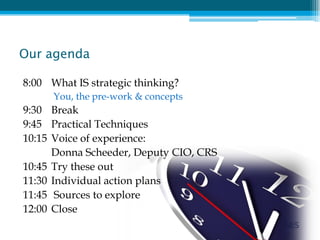
8:00 What IS strategic thinking?
      You, the pre-work & concepts
9:30 Break
9:45 Practical Techniques
10:15 Voice of experience:
      Donna Scheeder, Deputy CIO, CRS
10:45 Try these out
11:30 Individual action plans
11:45 Sources to explore
12:00 Close
“in making decisions, you may be at the mercy of your mind’s
                     strange workings….”
        Hammond, Keeney & Raiffa, The Hidden Traps in Decision Making, Harvard Business Review,
                                                                                   January 2006
The whole purpose of thinking strategically is
to take steps, real tasks, that are strategic – that
aren’t just to put out a fire today but that will
ensure sustainability & success over the next 2-
3 years – hopefully over the next 5 years.
Risk? I’ll show you risk…..

  “it's too risky to NOT be different in this economy”
                           Stephen Abram, March 22, 2011


• It’s too risky to NOT think differently…..to NOT
    question our assumptions……to NOT design
                      our futures
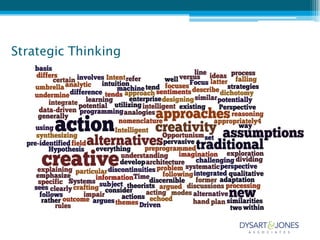
Strategic Thinking
Critical Thinking: formal definition

  “ the intellectually disciplined process of actively and
   skillfully conceptualizing, applying, analyzing, synthesizing,
   and/or evaluating information gathered from, or generated
   by, observation, experience, reflection, reasoning, or
   communication, as a guide to belief and action.”


Critical Thinking as Defined by the National Council for Excellence in Critical Thinking, 1987
A statement by Michael Scriven & Richard Paul at the 8th Annual International Conference on Critical Thinking and Education Reform,
Summer 1987}. http://www.criticalthinking.org/page.cfm?PageID=766&CategoryID=51 Last accessed May 31, 2009
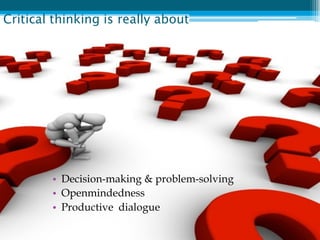
Critical thinking is really about


        • Decision-making & problem-solving
        • Openmindedness
        • Productive dialogue
Good Strategic & Critical Thinking
 • Raises the right questions – clearly & precisely
 • Focuses on the real problem or decision to be taken
 • Gathers & assesses relevant information
   ▫ Uses abstract ideas to interpret info effectively
 • Develops well-reasoned conclusions & solutions, testing
   them against relevant criteria and standards
 • Relies on recognizing & assessing assumptions,
   implications, & consequences
 • Communicates effectively with others in figuring out
   solutions to complex problems
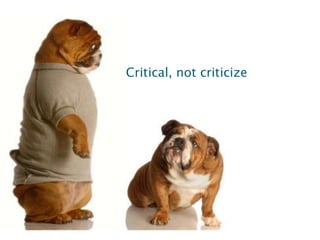
Critical, not criticize
Critical optimism is a responsibility
      “Library Boards & staff when planning cannot be, by
      definition, pessimists. It just doesn’t go with the job.
      We’re supposed to be defining the future, aren’t we? [...]
      If we can’t see the world as a better place to live in, than
      what chance does anyone else have?”

      “History tells us that before great library can happen, it
      first has to be a mission. And a mission starts with a
      dream. As library employees & advocates, we potentially
      hold enormous power. And with it comes responsibility.
      Wield it imaginatively and wisely. And optimistically.”
             Richard Seymour, Optimistic Futurism in Interactions May-June 2008
Strategic thinking is about:

•   Openness, flexibility, adaptability
•   Articulating the goal
•   Clarifying assumptions
•   Questioning status quo
•   Facts
•   Focusing on the future
Why?
• For our customers
  • Designing meaningful services

• For our organizations
  • Planning, negotiating, managing & relationship building

• For ourselves, and our professional credibility
  • Aware & factor in our :
    • tendencies & assumptions
    • perceptions & selections based on conditioning, beliefs and
       desires, focus, emotions
    • reconstructive memory affected by time, what we want to
       remember, and after-acquired information and suggestion

  • Confident in our:
    • knowledge
    • ability to reason
Wake up call


“Set in our ways” won’t move us forward

“Naming” the process at first makes it legitimate to:
   Challenge usual practices
   Rethink what has been thought
   Expand the emphasis from short-term fixes to long-term fusion
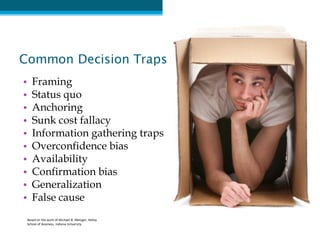
Common Decision Traps
•   Framing
•   Status quo
•   Anchoring
•   Sunk cost fallacy
•   Information gathering traps
•   Overconfidence bias
•   Availability
•   Confirmation bias
•   Generalization
•   False cause
 Based on the work of Michael B. Metzger, Kelley
 School of Business, Indiana University
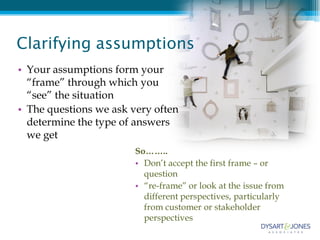
Clarifying assumptions
• Your assumptions form your
  “frame” through which you
  “see” the situation
• The questions we ask very often
  determine the type of answers
  we get
                        So……..
                        • Don’t accept the first frame – or
                          question
                        • “re-frame” or look at the issue from
                          different perspectives, particularly
                          from customer or stakeholder
                          perspectives
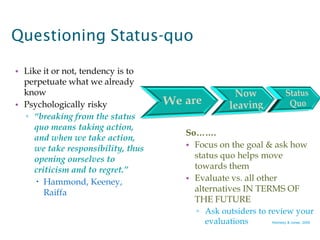
Questioning Status-quo

• Like it or not, tendency is to
  perpetuate what we already
  know
• Psychologically risky
  ▫ “breaking from the status
    quo means taking action,
                                   So…….
    and when we take action,
    we take responsibility, thus   • Focus on the goal & ask how
    opening ourselves to             status quo helps move
    criticism and to regret.”        towards them
      Hammond, Keeney,            • Evaluate vs. all other
       Raiffa                        alternatives IN TERMS OF
                                     THE FUTURE
                                      ▫ Ask outsiders to review your
                                        evaluations      Kennedy & Jones, 2009
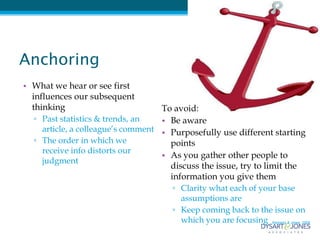
Anchoring
• What we hear or see first
  influences our subsequent
  thinking                            To avoid:
   ▫ Past statistics & trends, an     • Be aware
     article, a colleague’s comment   • Purposefully use different starting
   ▫ The order in which we              points
     receive info distorts our
                                      • As you gather other people to
     judgment
                                        discuss the issue, try to limit the
                                        information you give them
                                         ▫ Clarity what each of your base
                                           assumptions are
                                         ▫ Keep coming back to the issue on
                                           which you are focusing Kennedy & Jones, 2009
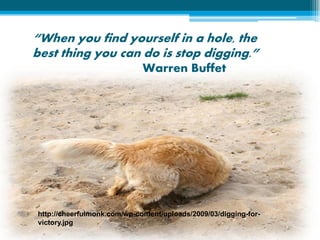
“When you find yourself in a hole, the
best thing you can do is stop digging.”
                             Warren Buffet


http://cheerfulmonk.com/wp-content/uploads/2009/03/digging-for-
victory.jpg
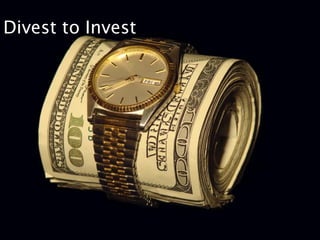
Divest to Invest
Facts


        “…if you lack realism today, you may lack
                  credibility tomorrow…”

                      John Maxwell, Leadership Gold, 2010
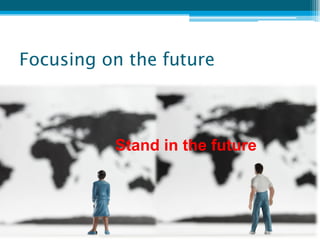
Focusing on the future


          Stand in the future
“Beyond Strategic Thinking” Jeanne Liedtka, Darden School of Business,
University of Virginia, Rotman Magazine Winter 2011 p. 29+ (author of
Designing for Growth, 2011)
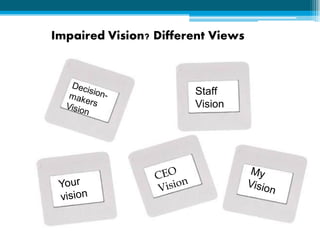
Impaired Vision? Different Views


                       Staff
                       Vision
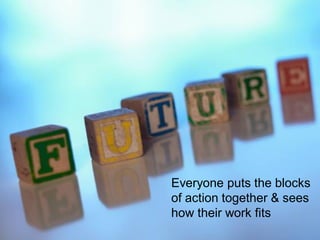
Everyone puts the blocks
of action together & sees
how their work fits
For a group to get to clarity they
have to wade through confusion
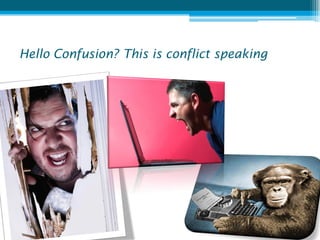
Hello Confusion? This is conflict speaking
33


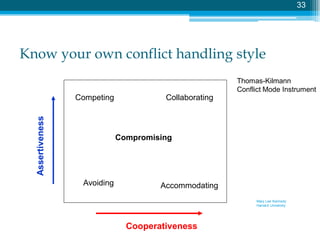
Know your own conflict handling style
                                                        Thomas-Kilmann
                                                        Conflict Mode Instrument
                  Competing             Collaborating
  Assertiveness


                              Compromising


                   Avoiding            Accommodating
                                                             Mary Lee Kennedy
                                                             Harvard University


                                Cooperativeness
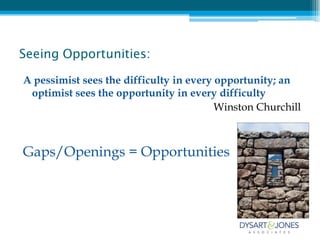
Seeing Opportunities:

A pessimist sees the difficulty in every opportunity; an
 optimist sees the opportunity in every difficulty
                                         Winston Churchill


Gaps/Openings = Opportunities
Strategic thinking
                           •Take a wide scope

                           •Ask the right questions

                           •Scan actively in different places

                           •Pay attention to signals

                           •Explore for more info

                           •Decide

                           •Act

                     http://k53.pbase.com/g6/26/738326/2/73218400.iyljcuiK.jpg
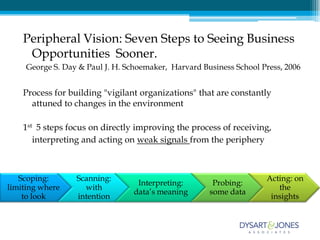
Peripheral Vision: Seven Steps to Seeing Business
     Opportunities Sooner.
     George S. Day & Paul J. H. Schoemaker, Harvard Business School Press, 2006


    Process for building "vigilant organizations" that are constantly
      attuned to changes in the environment

    1st 5 steps focus on directly improving the process of receiving,
       interpreting and acting on weak signals from the periphery


   Scoping:       Scanning:                                          Acting: on
                                   Interpreting:       Probing:
limiting where      with                                                the
                                  data’s meaning      some data
    to look       intention                                           insights
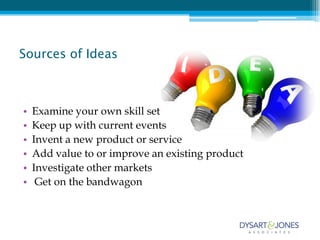
Sources of Ideas


•   Examine your own skill set
•   Keep up with current events
•   Invent a new product or service
•   Add value to or improve an existing product
•   Investigate other markets
•    Get on the bandwagon
Let’s try it out:
 • First 10 minutes on your own
   – Prepare your decision approach for either Case 1 or
     Case 2

 • Next 10 minutes with your colleague or
   someone beside you
   – Talk through your plan or approach with each other
   – Advise each other on critical thinking delivery (good
     practice/decision traps)


 • Next 10 minutes discussing our experiences
   – Challenges, affirmations, ah ha’s!
Group Exercises
Case one:                            Case two:

• Your budget will be 10% less       • You have an idea for a new
  for the next financial year.         service you believe clients will
• 80% of your current budget is        value. There isn’t any more
  staff, 15% is content, the other     funding available and staff are
  5% is for various                    working at capacity.
  administrative costs (travel,
  training, phones, supplies).

• Put together an approach for       • Put together a plan for making
  making the decision of how to        the case to proceed with the
  work within this budget.             service.
Case one:
Your budget will be 10% less for the next financial year. 80% of your current budget is staff, 15% is content, the other
   5% is for various administrative costs (travel, training, phones, supplies). Put together an approach for making
   the decision of how to work within this budget.
Case two:
You have an idea for a new service you believe clients will value. There isn’t any more funding available and staff
   are working at capacity. Put together a plan for making the case to proceed with the service.
In your partner discussions,

• What surprised you when you had to think about
  critical thinking practices and avoiding decision-making
  traps?
• What challenges do you recognize you’ll have using this
  approach?
• What will you do differently in making decisions?
• What more do you want to know so that you can do this
  better?
• How will you apply this starting now?
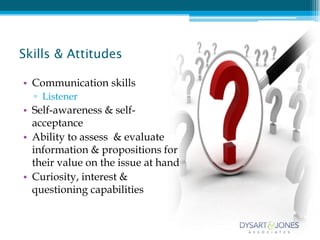
Skills & Attitudes

• Communication skills
  ▫ Listener
• Self-awareness & self-
  acceptance
• Ability to assess & evaluate
  information & propositions for
  their value on the issue at hand
• Curiosity, interest &
  questioning capabilities
Curiosity rarely, if ever kills the cat
What’s critical?

• Awareness

• Disciplining your decision-making to uncover thinking
  errors & prevent judgment errors

• Curiousity

• Trying it
Implicit that we can’t make
  decisions alone or in a
  vacuum or in the same
  way we always have

The decisions & problems we
 face are increasingly
 complex

 It’s hard, and it’s worth it
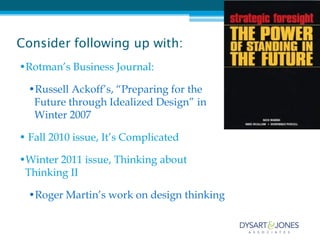
Consider following up with:
•Rotman’s Business Journal:

  •Russell Ackoff’s, “Preparing for the
   Future through Idealized Design” in
   Winter 2007

• Fall 2010 issue, It’s Complicated

•Winter 2011 issue, Thinking about
 Thinking II

  •Roger Martin’s work on design thinking
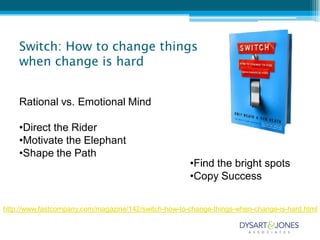
Switch: How to change things
    when change is hard


    Rational vs. Emotional Mind

    •Direct the Rider
    •Motivate the Elephant
    •Shape the Path
                                                      •Find the bright spots
                                                      •Copy Success

http://www.fastcompany.com/magazine/142/switch-how-to-change-things-when-change-is-hard.html
•   www.trendwatching.com
•   www.trendhunter.com
•   www.infotoday.com
•   www.davidleeking.com/
•   www.walkingpaper.org/ Aaron Schmidt
•   www.tametheweb.com/ Michael Stephens
•   http://stephenslighthouse.com/ Stephen Abram
•   www.wfs.org World Future Society
•   www.librarytechnology.org Marshall Breeding
•   Library of Congress Webcast series: Digital future
    http://www.loc.gov/today/cyberlc/results.php?mode
    =s&cat=45
And for critical thinking:
The Critical Thinking Community
  http://www.criticalthinking.org/articles/Open-minded-inquiry.cfm
• Kramer, R. M., A. E. Tenbrunsel, and M. H. Bazerman, eds. Social Decision
  Making: Social Dilemmas, Social Values, and Ethical Judgments. Routledge, in
  press.
• Bazerman, Max, and D. Moore. Judgment in Managerial Decision Making. 7th
  ed. John Wiley and Sons, Inc., 2008.
• Milkman, Katherine L., Max H. Bazerman, and Dolly Chugh. "How Can
  Decision Making Be Improved?" Perspectives on Psychological Science (in
  press). Abstract
• Raiffa, Howard, John S. Hammond, and Ralph L. Keeney. "The Hidden
  Traps in Decision Making." HBR Classic. Harvard Business Review 84, no. 1
  (January 2006).
• Hammond, John S., III, Ralph L. Keeney, and Howard Raiffa. Smart Choices:
  A Practical Guide to Making Better Decisions. Boston: Harvard Business
  School Press, 1998. (Paperback: Broadway Books, 2002
Recouping my investment in the Strategic & Critical Thinking Workshop, June 2011


  2 things I am going to do with this information, or as a result of our discussions today are:


  1.


  2.


       I’ll do this by (date):_________________________
Thank you


              jane@dysartjones.com
            rebecca@dysartjones.com
              www.dysartjones.com

Thinking strategically & critically seeing possibilities

  • 1.
    Thinking Strategically &Critically: Seeing Possibilities Jane Dysart jane@dysartjones.com Rebecca Jones rebecca@dysartjones.com www.dysartjones.com
  • 2.
    Focus for today Viewing situations & solutions strategically
  • 3.
  • 4.
    Let’s explore: •What strategic & critical thinking is • Why it’s important for our decision-making, problem- solving & designing solutions • Identifying & avoiding traps, trips & landmines that foil our decision-making…..maybe even disarming them? • Experiences • Characteristics required
  • 5.
    Our agenda 8:00 WhatIS strategic thinking? You, the pre-work & concepts 9:30 Break 9:45 Practical Techniques 10:15 Voice of experience: Donna Scheeder, Deputy CIO, CRS 10:45 Try these out 11:30 Individual action plans 11:45 Sources to explore 12:00 Close
  • 6.
    “in making decisions,you may be at the mercy of your mind’s strange workings….” Hammond, Keeney & Raiffa, The Hidden Traps in Decision Making, Harvard Business Review, January 2006
  • 7.
    The whole purposeof thinking strategically is to take steps, real tasks, that are strategic – that aren’t just to put out a fire today but that will ensure sustainability & success over the next 2- 3 years – hopefully over the next 5 years.
  • 8.
    Risk? I’ll showyou risk….. “it's too risky to NOT be different in this economy” Stephen Abram, March 22, 2011 • It’s too risky to NOT think differently…..to NOT question our assumptions……to NOT design our futures
  • 9.
  • 10.
    Critical Thinking: formaldefinition “ the intellectually disciplined process of actively and skillfully conceptualizing, applying, analyzing, synthesizing, and/or evaluating information gathered from, or generated by, observation, experience, reflection, reasoning, or communication, as a guide to belief and action.” Critical Thinking as Defined by the National Council for Excellence in Critical Thinking, 1987 A statement by Michael Scriven & Richard Paul at the 8th Annual International Conference on Critical Thinking and Education Reform, Summer 1987}. http://www.criticalthinking.org/page.cfm?PageID=766&CategoryID=51 Last accessed May 31, 2009
  • 11.
    Critical thinking isreally about • Decision-making & problem-solving • Openmindedness • Productive dialogue
  • 12.
    Good Strategic &Critical Thinking • Raises the right questions – clearly & precisely • Focuses on the real problem or decision to be taken • Gathers & assesses relevant information ▫ Uses abstract ideas to interpret info effectively • Develops well-reasoned conclusions & solutions, testing them against relevant criteria and standards • Relies on recognizing & assessing assumptions, implications, & consequences • Communicates effectively with others in figuring out solutions to complex problems
  • 13.
  • 14.
    Critical optimism isa responsibility “Library Boards & staff when planning cannot be, by definition, pessimists. It just doesn’t go with the job. We’re supposed to be defining the future, aren’t we? [...] If we can’t see the world as a better place to live in, than what chance does anyone else have?” “History tells us that before great library can happen, it first has to be a mission. And a mission starts with a dream. As library employees & advocates, we potentially hold enormous power. And with it comes responsibility. Wield it imaginatively and wisely. And optimistically.” Richard Seymour, Optimistic Futurism in Interactions May-June 2008
  • 15.
    Strategic thinking isabout: • Openness, flexibility, adaptability • Articulating the goal • Clarifying assumptions • Questioning status quo • Facts • Focusing on the future
  • 16.
    Why? • For ourcustomers • Designing meaningful services • For our organizations • Planning, negotiating, managing & relationship building • For ourselves, and our professional credibility • Aware & factor in our : • tendencies & assumptions • perceptions & selections based on conditioning, beliefs and desires, focus, emotions • reconstructive memory affected by time, what we want to remember, and after-acquired information and suggestion • Confident in our: • knowledge • ability to reason
  • 17.
    Wake up call “Setin our ways” won’t move us forward “Naming” the process at first makes it legitimate to:  Challenge usual practices  Rethink what has been thought  Expand the emphasis from short-term fixes to long-term fusion
  • 18.
    Common Decision Traps • Framing • Status quo • Anchoring • Sunk cost fallacy • Information gathering traps • Overconfidence bias • Availability • Confirmation bias • Generalization • False cause Based on the work of Michael B. Metzger, Kelley School of Business, Indiana University
  • 19.
    Clarifying assumptions • Yourassumptions form your “frame” through which you “see” the situation • The questions we ask very often determine the type of answers we get So…….. • Don’t accept the first frame – or question • “re-frame” or look at the issue from different perspectives, particularly from customer or stakeholder perspectives
  • 20.
    Questioning Status-quo • Likeit or not, tendency is to perpetuate what we already know • Psychologically risky ▫ “breaking from the status quo means taking action, So……. and when we take action, we take responsibility, thus • Focus on the goal & ask how opening ourselves to status quo helps move criticism and to regret.” towards them  Hammond, Keeney, • Evaluate vs. all other Raiffa alternatives IN TERMS OF THE FUTURE ▫ Ask outsiders to review your evaluations Kennedy & Jones, 2009
  • 21.
    Anchoring • What wehear or see first influences our subsequent thinking To avoid: ▫ Past statistics & trends, an • Be aware article, a colleague’s comment • Purposefully use different starting ▫ The order in which we points receive info distorts our • As you gather other people to judgment discuss the issue, try to limit the information you give them ▫ Clarity what each of your base assumptions are ▫ Keep coming back to the issue on which you are focusing Kennedy & Jones, 2009
  • 22.
    “When you findyourself in a hole, the best thing you can do is stop digging.” Warren Buffet http://cheerfulmonk.com/wp-content/uploads/2009/03/digging-for- victory.jpg
  • 23.
  • 24.
    Facts “…if you lack realism today, you may lack credibility tomorrow…” John Maxwell, Leadership Gold, 2010
  • 25.
    Focusing on thefuture Stand in the future
  • 26.
    “Beyond Strategic Thinking”Jeanne Liedtka, Darden School of Business, University of Virginia, Rotman Magazine Winter 2011 p. 29+ (author of Designing for Growth, 2011)
  • 27.
    Impaired Vision? DifferentViews Staff Vision
  • 28.
    Everyone puts theblocks of action together & sees how their work fits
  • 29.
    For a groupto get to clarity they have to wade through confusion
  • 30.
    Hello Confusion? Thisis conflict speaking
  • 31.
    33 Know your ownconflict handling style Thomas-Kilmann Conflict Mode Instrument Competing Collaborating Assertiveness Compromising Avoiding Accommodating Mary Lee Kennedy Harvard University Cooperativeness
  • 32.
    Seeing Opportunities: A pessimistsees the difficulty in every opportunity; an optimist sees the opportunity in every difficulty Winston Churchill Gaps/Openings = Opportunities
  • 33.
    Strategic thinking •Take a wide scope •Ask the right questions •Scan actively in different places •Pay attention to signals •Explore for more info •Decide •Act http://k53.pbase.com/g6/26/738326/2/73218400.iyljcuiK.jpg
  • 34.
    Peripheral Vision: SevenSteps to Seeing Business Opportunities Sooner. George S. Day & Paul J. H. Schoemaker, Harvard Business School Press, 2006 Process for building "vigilant organizations" that are constantly attuned to changes in the environment 1st 5 steps focus on directly improving the process of receiving, interpreting and acting on weak signals from the periphery Scoping: Scanning: Acting: on Interpreting: Probing: limiting where with the data’s meaning some data to look intention insights
  • 35.
    Sources of Ideas • Examine your own skill set • Keep up with current events • Invent a new product or service • Add value to or improve an existing product • Investigate other markets • Get on the bandwagon
  • 36.
    Let’s try itout: • First 10 minutes on your own – Prepare your decision approach for either Case 1 or Case 2 • Next 10 minutes with your colleague or someone beside you – Talk through your plan or approach with each other – Advise each other on critical thinking delivery (good practice/decision traps) • Next 10 minutes discussing our experiences – Challenges, affirmations, ah ha’s!
  • 37.
    Group Exercises Case one: Case two: • Your budget will be 10% less • You have an idea for a new for the next financial year. service you believe clients will • 80% of your current budget is value. There isn’t any more staff, 15% is content, the other funding available and staff are 5% is for various working at capacity. administrative costs (travel, training, phones, supplies). • Put together an approach for • Put together a plan for making making the decision of how to the case to proceed with the work within this budget. service.
  • 38.
    Case one: Your budgetwill be 10% less for the next financial year. 80% of your current budget is staff, 15% is content, the other 5% is for various administrative costs (travel, training, phones, supplies). Put together an approach for making the decision of how to work within this budget.
  • 39.
    Case two: You havean idea for a new service you believe clients will value. There isn’t any more funding available and staff are working at capacity. Put together a plan for making the case to proceed with the service.
  • 40.
    In your partnerdiscussions, • What surprised you when you had to think about critical thinking practices and avoiding decision-making traps? • What challenges do you recognize you’ll have using this approach? • What will you do differently in making decisions? • What more do you want to know so that you can do this better? • How will you apply this starting now?
  • 41.
    Skills & Attitudes •Communication skills ▫ Listener • Self-awareness & self- acceptance • Ability to assess & evaluate information & propositions for their value on the issue at hand • Curiosity, interest & questioning capabilities
  • 42.
    Curiosity rarely, ifever kills the cat
  • 43.
    What’s critical? • Awareness •Disciplining your decision-making to uncover thinking errors & prevent judgment errors • Curiousity • Trying it
  • 44.
    Implicit that wecan’t make decisions alone or in a vacuum or in the same way we always have The decisions & problems we face are increasingly complex It’s hard, and it’s worth it
  • 45.
    Consider following upwith: •Rotman’s Business Journal: •Russell Ackoff’s, “Preparing for the Future through Idealized Design” in Winter 2007 • Fall 2010 issue, It’s Complicated •Winter 2011 issue, Thinking about Thinking II •Roger Martin’s work on design thinking
  • 46.
    Switch: How tochange things when change is hard Rational vs. Emotional Mind •Direct the Rider •Motivate the Elephant •Shape the Path •Find the bright spots •Copy Success http://www.fastcompany.com/magazine/142/switch-how-to-change-things-when-change-is-hard.html
  • 47.
    www.trendwatching.com • www.trendhunter.com • www.infotoday.com • www.davidleeking.com/ • www.walkingpaper.org/ Aaron Schmidt • www.tametheweb.com/ Michael Stephens • http://stephenslighthouse.com/ Stephen Abram • www.wfs.org World Future Society • www.librarytechnology.org Marshall Breeding • Library of Congress Webcast series: Digital future http://www.loc.gov/today/cyberlc/results.php?mode =s&cat=45
  • 48.
    And for criticalthinking: The Critical Thinking Community http://www.criticalthinking.org/articles/Open-minded-inquiry.cfm • Kramer, R. M., A. E. Tenbrunsel, and M. H. Bazerman, eds. Social Decision Making: Social Dilemmas, Social Values, and Ethical Judgments. Routledge, in press. • Bazerman, Max, and D. Moore. Judgment in Managerial Decision Making. 7th ed. John Wiley and Sons, Inc., 2008. • Milkman, Katherine L., Max H. Bazerman, and Dolly Chugh. "How Can Decision Making Be Improved?" Perspectives on Psychological Science (in press). Abstract • Raiffa, Howard, John S. Hammond, and Ralph L. Keeney. "The Hidden Traps in Decision Making." HBR Classic. Harvard Business Review 84, no. 1 (January 2006). • Hammond, John S., III, Ralph L. Keeney, and Howard Raiffa. Smart Choices: A Practical Guide to Making Better Decisions. Boston: Harvard Business School Press, 1998. (Paperback: Broadway Books, 2002
  • 49.
    Recouping my investmentin the Strategic & Critical Thinking Workshop, June 2011 2 things I am going to do with this information, or as a result of our discussions today are: 1. 2. I’ll do this by (date):_________________________
  • 50.
    Thank you jane@dysartjones.com rebecca@dysartjones.com www.dysartjones.com