Building Leadership Skills:Building Leadership Skills:
Problem-SolvingProblem-Solving
and Decision-Makingand Decision-Making
Not All Decisions RequireNot All Decisions Require
Equal AttentionEqual Attention
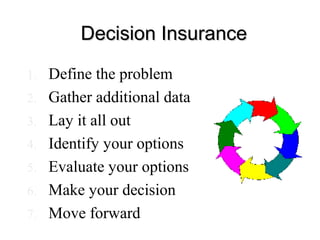
Decision InsuranceDecision Insurance
1. Define the problem
2. Gather additional data
3. Lay it all out
4. Identify your options
5. Evaluate your options
6. Make your decision
7. Move forward
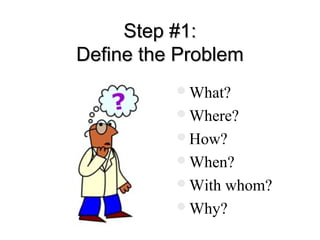
Step #1:Step #1:
Define the ProblemDefine the Problem
What?
Where?
How?
When?
With whom?
Why?
For a Complex ProblemFor a Complex Problem
Break it down
Verify with others
Prioritize
Describe the Desired Outcome(s)Describe the Desired Outcome(s)
Define the
solved state:
Here’s what
should be
happening…
Identify Specific,Identify Specific,
Measurable GoalsMeasurable Goals
What are we trying to
Achieve?
Preserve?
Avoid?
Eliminate?
Link Back to the Big PictureLink Back to the Big Picture
Make sure your
desired outcomes
align clearly with
the library’s
mission and
strategic plan
Reality Check:Reality Check:
Decision PoliticsDecision Politics
Who are the stakeholders in this
situation?
What will they need to get out of any
decision?
How and when should they participate
in finding a solution?
Step #2:Step #2:
Gather Additional DataGather Additional Data
Broad
Objective
Verifiable
Relevant
BewareBeware
Hearsay/rumor
Opinion
Wishful thinking
Labeling the problem
Blaming/scapegoating
Vivid but minor evidence
Look Outside the LibraryLook Outside the Library
as Well as Inas Well as In
Don’t OverlookDon’t Overlook
Your own beliefs and biases
Your own (possible) role in the
situation
How Much Information IsHow Much Information Is
Enough?Enough?
Just Be Sure YouJust Be Sure You
Cover the BasesCover the Bases
Bouncing around
is natural
More information
may accrue over
time
Step #3:Step #3:
Lay It All OutLay It All Out
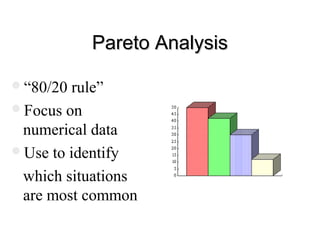
Pareto AnalysisPareto Analysis
“80/20 rule”
Focus on
numerical data
Use to identify
which situations
are most common
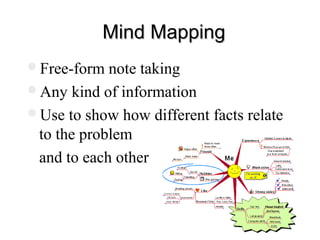
Mind MappingMind Mapping
Free-form note taking
Any kind of information
Use to show how different facts relate
to the problem
and to each other
Look into CausesLook into Causes
but Don’t Bog Downbut Don’t Bog Down
Not all problems are “caused”
Not all causes can be corrected
Ask for input – one person at a time.
The Un-Problem:The Un-Problem:
Appreciative InquiryAppreciative Inquiry
Systematic discovery of the best in
people and organizations
Unconditional positive questions
Directed conversation and storytelling
What is working well?
How can we do more of that?
Step #4:Step #4:
Identify Your OptionsIdentify Your Options
What options do we
have?
What has been done
in other libraries?
In other disciplines?
How about
something new?
Situation:Situation:
Something’s Gone WrongSomething’s Gone Wrong
Find and correct the changes that
account for the fall-off in results.
Situation:Situation:
Increased – or Changing –Increased – or Changing –
ExpectationsExpectations
Find new ways of operating.
Situation:Situation:
The Double WhammyThe Double Whammy
Find ways to reengineer the system –
correct and invent.
Situation:Situation:
It Never Did Work RightIt Never Did Work Right
Find ways to overhaul – or completely
rebuild.
Things That CanThings That Can
Limit Your ThinkingLimit Your Thinking
Searching for THE ONE RIGHT ANSWER
Not involving front line people
Looking inside the library only
Waiting for 100% agreement
Fear of embarrassment or failure
Be Sure to IncludeBe Sure to Include
Current approach
Something new
Something fun
Step #5:Step #5:
Evaluate Your OptionsEvaluate Your Options
Check SheetCheck Sheet
Option
1
Option
2
Option
3
Option
4
Desired
Outcome
 
Desired
Outcome

Desired
Outcome

Desired
Outcome
  
SWOT:SWOT:
Strengths – Weaknesses –Strengths – Weaknesses –
Opportunities – ThreatsOpportunities – Threats
PMI:PMI:
Plus – Minus - InterestingPlus – Minus - Interesting
Six Thinking HatsSix Thinking Hats
Think ThroughThink Through
Risks and ConsequencesRisks and Consequences
Reversible?
Pilot-able?
Timely?
Politically sensitive?
Special Challenges in ManySpecial Challenges in Many
Library EnvironmentsLibrary Environments
Perfectionism
Catastrophizing
Mixed feelings
about success
Step #6:Step #6:
Make Your DecisionMake Your Decision
Reality Check:Reality Check:
Strategic ThinkingStrategic Thinking
How might this decision change the
library’s position or reputation?
Will it set the stage or define a pattern for
future decisions?
Do library stakeholders need a heads-up?
Who will get credit if things turn out well?
Take Time to Write a BriefTake Time to Write a Brief
Summary of Your ProcessSummary of Your Process
Step #7:Step #7:
Move ForwardMove Forward
Communicate the decision/solution
Plan the implementation
Monitor results
Learn as you go
When Things Go WrongWhen Things Go Wrong
Work each problem
Re-prioritize if
necessary
Maintain focus on
desired outcomes
After a fair trial, change
options

Problem solving skills