DECISION MAKING
       &
PROBLEM SOLVING


BY: SOFT SKILLS WORLD
“We cannot solve our problems
with the same thinking we used
    when we created them”

       -Albert Einstein
Let’s Take a Decision
PROBLEM SOLVING


• Problem - a discrepancy
   – current state-desired state
• Decisions- Choices
   – Two or more alternatives
• Decision Making
   – process of choice making
General model of problem solving


•   Identify problem
•   Define Objective
•   Make a predecision
•   Generate alternatives
•   Evaluate alternatives
•   Make a choice
•   Implement choice
•   Follow up
Types of Decisions


• Programmed
   – Simple, routine; preestablished routines and procedures;
     lower level workers (usually alone)
• Non programmed
   – Complex, creative; no prescriptions available, upper level
     supervisors (usually in groups)
• Strategic
   – high level, non programmed, directions for organization
Types of Decisions


• Certain vs. uncertain
   – knowledge of decision outcomes
   – probability of decision outcomes
   – information available
• Uncertainty Reduction
Types of Decisions


•   top down vs. empowered
•   decentralisation
•   premises
•   computers
Individual differences in decision making


• Directive
   – prefer simple, clear solutions
   – make decisions rapidly
   – don’t consider many alternatives
   – rely on existing rules
Individual differences in decision making


• Analytical
   – prefer complex problems
   – carefully analyse alternatives
   – enjoy solving problems
   – willing to use innovative methods
Individual differences in decision making


• Conceptual
   – socially oriented
   – humanistic and artistic approach
   – solve problems creatively
   – enjoy new ideas
Individual differences in decision making


• Behavioural
   – concern for their organizations
   – interest in helping others
   – open to suggestions
   – rely on meetings
Moving away from the rational


•   bounded rationality
•   intuition
•   selective perception
•   halo effect
•   contrast effect
•   projection
•   stereotyping
•   self fulfilling profecy
Moving away from the rational


•   obvious candidate
•   garbage can model
•   self interests
•   enactment
•   training
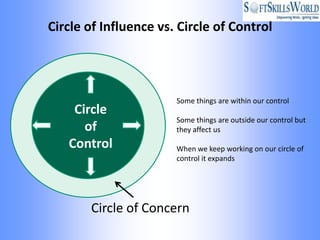
Circle of Influence vs. Circle of Control


                       Some things are within our control
    Circle
                       Some things are outside our control but
      of               they affect us
   Control             When we keep working on our circle of
                       control it expands


       Circle of Concern
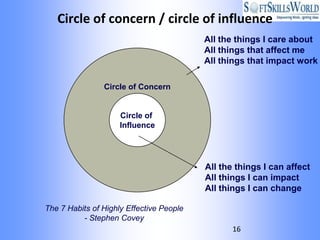
Circle of concern / circle of influence
                                          All the things I care about
                                          All things that affect me
                                          All things that impact work

                Circle of Concern


                     Circle of
                     Influence


                                          All the things I can affect
                                          All things I can impact
                                          All things I can change

The 7 Habits of Highly Effective People
          - Stephen Covey
                                                 16
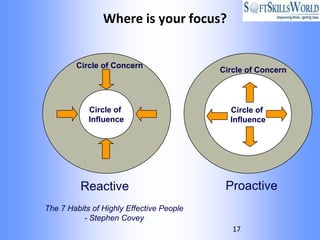
Where is your focus?


        Circle of Concern
                                          Circle of Concern


            Circle of                       Circle of
            Influence                       Influence


          Reactive                         Proactive
The 7 Habits of Highly Effective People
          - Stephen Covey
                                             17
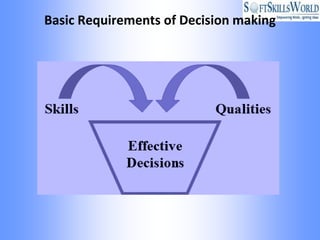
Basic Requirements of Decision making
Skills & Qualities

 Knowledge / expertise in a given field

 Past Experience

 Communication Skills

 Self Confidence/Conviction

 Analytical Skills

 Time Management Skills

 Creativity

   At last but not the least……….
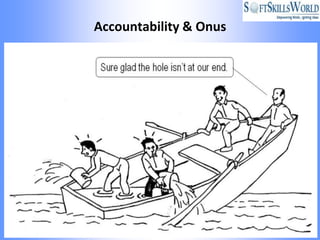
Accountability & Onus
How do we make Decisions?
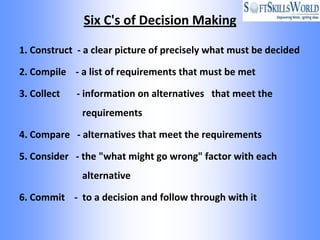
Six C's of Decision Making

1. Construct - a clear picture of precisely what must be decided

2. Compile - a list of requirements that must be met

3. Collect   - information on alternatives that meet the
              requirements

4. Compare - alternatives that meet the requirements

5. Consider - the "what might go wrong" factor with each
              alternative

6. Commit - to a decision and follow through with it
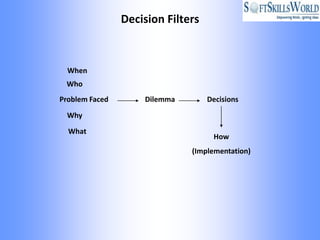
Decision Filters


  When
 Who
Problem Faced       Dilemma        Decisions
  Why
  What
                                    How
                              (Implementation)
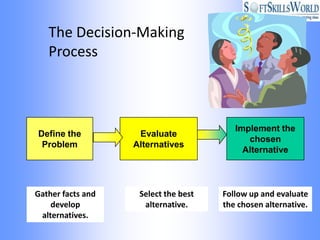
The Decision-Making
   Process


                                         Implement the
Define the          Evaluate
                                            chosen
 Problem           Alternatives
                                           Alternative


Gather facts and    Select the best   Follow up and evaluate
    develop          alternative.     the chosen alternative.
 alternatives.
Let’s Take Another Decision
Problem Solution


• Analyzing the Problem

• Defining the Problem

• Identify the Causes

• Generating Solutions

• Decision
Analyze the Problem


• Key Issues


• Ideal Outcomes


• Avoid Judgments
Defining the Problem


• Why it is Problem?


• What type of problem is it ?


• How urgent is the problem?


• What are the consequences ?
Causes

• Mindset


• Environment


• Inability


• Lack of Experience
Generating Solutions


• Optimal Solution


• Maximum Gain / Minimum Loss


• Predictions (Trial and Error)
Decisions


• What is the probability of success?

• Be Confident

• Avoid Dilemmas

• Forecast

• Choose alternative which best meets the criteria.
Problem Solving Test
How Good are You At Problem Solving
Interpretation
Score                                     Comment
        You probably tend to view problems as negatives, instead of seeing them as
        opportunities to make exciting and necessary change. Your approach to
        problem solving is more intuitive than systematic, and this may have led to
36-55
        some poor experiences in the past. With more practice, and by following a
        more structured approach, you'll be able to develop this important skill and
        start solving problems more effectively right away.
56-75   Your approach to problem solving is a little "hit-and-miss." Sometimes your
        solutions work really well, and other times they don't. You understand what
        you should do, and you recognize that having a structured problem-solving
        process is important. However, you don't always follow that process. By
        working on your consistency and committing to the process, you'll see
        significant improvements
75 &    You are a confident problem solver. You take time to understand the problem,
above   understand the criteria for a good decision, and generate some good options.
        Because you approach problems systematically, you cover the essentials each
        time – and your decisions are well though out, well planned, and well
        executed. You can continue to perfect your problem-solving skills and use
        them for continuous improvement initiatives within your organization.
Let’s Call It A Day
Let’s Call It A Day
Share Your Experience


• 1 incident when problem was solved by you

• 1 incident when you were not able to solve the problem
The 7 Habits of Highly Successful People

Stephen R. Covey, Simon & Schuster, Inc., 1989

• Be Proactive - take the initiative

• Visualize the end from the start - know where you’re going

• List priorities (Put first thing first)

• Think WIN/WIN

• Understand -- listen, listen, listen / learn, learn, learn (SEEK
   FIRST TO UNDERSTAND, THEN BE UNDERSTOOD)

• Synergize -- make the whole more than the sum of the parts

• Personal Renewal (SHARPENING THE SAW)
Problem solving ?


Two wilderness hikers chanced upon a fierce grizzly bear.
One of them pulled his running shoes from his pack and
rapidly laced them up. His companion yelled in astonishment,
“Are you crazy? You can’t outrun a bear.”
His reply as he took off down the trail,
“I don’t have to outrun the bear.
All I have to do is outrun you.”
Defining the real problem. A difficult task!
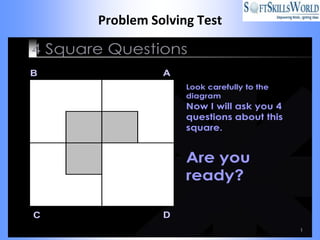
Problem Solving Test

4 Square Questions
B                A
                     Look carefully to the
                     diagram
                     Now I will ask you 4
                     questions about this
                     square.


                     Are you
                     ready?

C                D
                                             1
The Kepner-Tregoe (K.T.) method
•   The Kepner-Tregoe (K.T.) method
•   Problems are rated according to:
•   • Timing (urgency)
•   • Trend (potential for growth or disaster)
•   • Impact (how serious; how will it affect others?)

•   High (H); Medium (M); Low (L)
•   Also, what type of K.T. to carry out?

•   Problem analysis (PA);
•   Decision analysis (DA);
•   Potential Problem analysis (PPA)

•   Core K.T. ideas:
•   Things were OK; they’re not now. What’s changed?
•   Something distinguishes
•   what is a problem and
•   what is not.
•   Who was involved?
•   Who was not?
•   Why was it important?
•   Why is it unimportant?
•   How was the conclusion reached?
Kepner-Tregoe approach to decision analysis
                   - Steps
• Prepare a decision statement having both an action and a result
  component.
• Establish strategic requirements (Musts), operational objectives (Wants),
  and restraints (Limits)
• Rank objectives and assign relative weights.
• Generate alternatives.
• Assign a relative score for each alternative on an objective-by-objective
  basis.
• Calculate a weighted score for each alternative and identify the top two
  or three.
• List adverse consequences for each top alternative and evaluate
  probability (high, medium, low) and severity (high, medium, low).
• Make a final, single choice between top alternatives.
Fish Bone Approach
“Thinking-- The Ultimate Human Resource”

• We can always improve our thinking skills.
• Confused thinking arises from trying to do too much at once.
• We should emphasize what can be, not what is.
Six Hats

• There are six different imaginary hats that you can put on or
  take off.
• Think of the “hats” as thinking icons.
• Each hat is a different color and represents a different type
  or mode of thinking.
• We all wear the same hat (do the same type of thinking) at
  the same time.
• When we change hats -we change our thinking.
• Edward De Bono M.D., Ph.D., (philosophy, medicine &
  psychology), Rhodes scholar
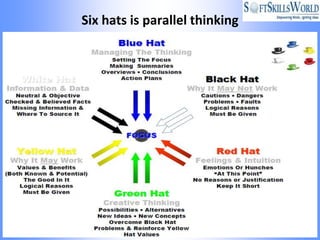
Six hats is parallel thinking
The blue hat


•   Thinking about thinking
•   Instructions for thinking
•   The organization of thinking
•   Control of the other hats
•   Discipline and focus
The blue hat role


•   Control of thinking & the process
•   Begin & end session with blue hat
•   Facilitator, session leader’s role
•   Choreography
     – open, sequence, close
     – Focus: what should we be thinking about
     – Asking the right questions
     – Defining & clarifying the problem
     – Setting the thinking tasks
Open with the blue hat…


•   Why we are here
•   what we are thinking about
•   definition of the situation or problem
•   alternative definitions
•   what we want to achieve
•   where we want to end up
•   the background to the thinking
•   a plan for the sequence of hats
…and close with the blue hat


•   What we have achieved
•   Outcome
•   Conclusion
•   Design
•   Solution
•   Next steps
White Hat Thinking


•   Neutral, objective information
•   Facts & figures
•   Questions: what do we know, what don’t we know,
    what do we need to know
•   Excludes opinions, hunches, judgements
•   Removes feelings & impressions
•   Two tiers of facts
     – Believed Facts
     – Checked Facts
Red Hat Thinking


•   Emotions & feelings
•   Hunches, intuitions, impressions
•   Doesn’t have to be logical or consistent
•   No justifications, reasons or basis
•   All decisions are emotional in the end
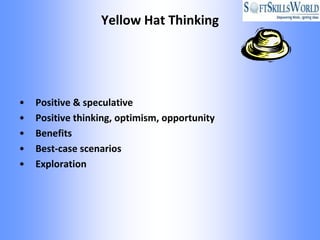
Yellow Hat Thinking


•   Positive & speculative
•   Positive thinking, optimism, opportunity
•   Benefits
•   Best-case scenarios
•   Exploration
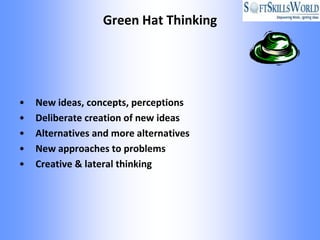
Green Hat Thinking


•   New ideas, concepts, perceptions
•   Deliberate creation of new ideas
•   Alternatives and more alternatives
•   New approaches to problems
•   Creative & lateral thinking
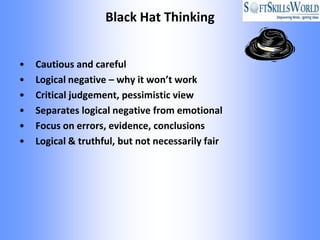
Black Hat Thinking


•   Cautious and careful
•   Logical negative – why it won’t work
•   Critical judgement, pessimistic view
•   Separates logical negative from emotional
•   Focus on errors, evidence, conclusions
•   Logical & truthful, but not necessarily fair
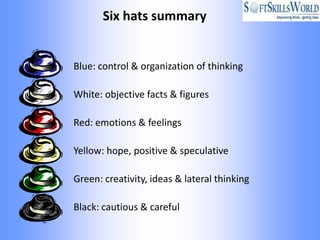
Six hats summary


Blue: control & organization of thinking

White: objective facts & figures

Red: emotions & feelings

Yellow: hope, positive & speculative

Green: creativity, ideas & lateral thinking

Black: cautious & careful
Force Field Analysis
Activity Time


• BCCI Selection Committee
Problem solving & decision making

Problem solving & decision making

  • 1.
    DECISION MAKING & PROBLEM SOLVING BY: SOFT SKILLS WORLD
  • 2.
    “We cannot solveour problems with the same thinking we used when we created them” -Albert Einstein
  • 3.
  • 4.
    PROBLEM SOLVING • Problem- a discrepancy – current state-desired state • Decisions- Choices – Two or more alternatives • Decision Making – process of choice making
  • 5.
    General model ofproblem solving • Identify problem • Define Objective • Make a predecision • Generate alternatives • Evaluate alternatives • Make a choice • Implement choice • Follow up
  • 6.
    Types of Decisions •Programmed – Simple, routine; preestablished routines and procedures; lower level workers (usually alone) • Non programmed – Complex, creative; no prescriptions available, upper level supervisors (usually in groups) • Strategic – high level, non programmed, directions for organization
  • 7.
    Types of Decisions •Certain vs. uncertain – knowledge of decision outcomes – probability of decision outcomes – information available • Uncertainty Reduction
  • 8.
    Types of Decisions • top down vs. empowered • decentralisation • premises • computers
  • 9.
    Individual differences indecision making • Directive – prefer simple, clear solutions – make decisions rapidly – don’t consider many alternatives – rely on existing rules
  • 10.
    Individual differences indecision making • Analytical – prefer complex problems – carefully analyse alternatives – enjoy solving problems – willing to use innovative methods
  • 11.
    Individual differences indecision making • Conceptual – socially oriented – humanistic and artistic approach – solve problems creatively – enjoy new ideas
  • 12.
    Individual differences indecision making • Behavioural – concern for their organizations – interest in helping others – open to suggestions – rely on meetings
  • 13.
    Moving away fromthe rational • bounded rationality • intuition • selective perception • halo effect • contrast effect • projection • stereotyping • self fulfilling profecy
  • 14.
    Moving away fromthe rational • obvious candidate • garbage can model • self interests • enactment • training
  • 15.
    Circle of Influencevs. Circle of Control Some things are within our control Circle Some things are outside our control but of they affect us Control When we keep working on our circle of control it expands Circle of Concern
  • 16.
    Circle of concern/ circle of influence All the things I care about All things that affect me All things that impact work Circle of Concern Circle of Influence All the things I can affect All things I can impact All things I can change The 7 Habits of Highly Effective People - Stephen Covey 16
  • 17.
    Where is yourfocus? Circle of Concern Circle of Concern Circle of Circle of Influence Influence Reactive Proactive The 7 Habits of Highly Effective People - Stephen Covey 17
  • 18.
    Basic Requirements ofDecision making
  • 19.
    Skills & Qualities Knowledge / expertise in a given field  Past Experience  Communication Skills  Self Confidence/Conviction  Analytical Skills  Time Management Skills  Creativity  At last but not the least……….
  • 20.
  • 22.
    How do wemake Decisions?
  • 23.
    Six C's ofDecision Making 1. Construct - a clear picture of precisely what must be decided 2. Compile - a list of requirements that must be met 3. Collect - information on alternatives that meet the requirements 4. Compare - alternatives that meet the requirements 5. Consider - the "what might go wrong" factor with each alternative 6. Commit - to a decision and follow through with it
  • 24.
    Decision Filters When Who Problem Faced Dilemma Decisions Why What How (Implementation)
  • 25.
    The Decision-Making Process Implement the Define the Evaluate chosen Problem Alternatives Alternative Gather facts and Select the best Follow up and evaluate develop alternative. the chosen alternative. alternatives.
  • 26.
  • 27.
    Problem Solution • Analyzingthe Problem • Defining the Problem • Identify the Causes • Generating Solutions • Decision
  • 28.
    Analyze the Problem •Key Issues • Ideal Outcomes • Avoid Judgments
  • 29.
    Defining the Problem •Why it is Problem? • What type of problem is it ? • How urgent is the problem? • What are the consequences ?
  • 30.
    Causes • Mindset • Environment •Inability • Lack of Experience
  • 31.
    Generating Solutions • OptimalSolution • Maximum Gain / Minimum Loss • Predictions (Trial and Error)
  • 32.
    Decisions • What isthe probability of success? • Be Confident • Avoid Dilemmas • Forecast • Choose alternative which best meets the criteria.
  • 33.
    Problem Solving Test HowGood are You At Problem Solving
  • 34.
    Interpretation Score Comment You probably tend to view problems as negatives, instead of seeing them as opportunities to make exciting and necessary change. Your approach to problem solving is more intuitive than systematic, and this may have led to 36-55 some poor experiences in the past. With more practice, and by following a more structured approach, you'll be able to develop this important skill and start solving problems more effectively right away. 56-75 Your approach to problem solving is a little "hit-and-miss." Sometimes your solutions work really well, and other times they don't. You understand what you should do, and you recognize that having a structured problem-solving process is important. However, you don't always follow that process. By working on your consistency and committing to the process, you'll see significant improvements 75 & You are a confident problem solver. You take time to understand the problem, above understand the criteria for a good decision, and generate some good options. Because you approach problems systematically, you cover the essentials each time – and your decisions are well though out, well planned, and well executed. You can continue to perfect your problem-solving skills and use them for continuous improvement initiatives within your organization.


  • 35.
  • 36.
  • 37.
    Share Your Experience •1 incident when problem was solved by you • 1 incident when you were not able to solve the problem
  • 38.
    The 7 Habitsof Highly Successful People Stephen R. Covey, Simon & Schuster, Inc., 1989 • Be Proactive - take the initiative • Visualize the end from the start - know where you’re going • List priorities (Put first thing first) • Think WIN/WIN • Understand -- listen, listen, listen / learn, learn, learn (SEEK FIRST TO UNDERSTAND, THEN BE UNDERSTOOD) • Synergize -- make the whole more than the sum of the parts • Personal Renewal (SHARPENING THE SAW)
  • 39.
    Problem solving ? Twowilderness hikers chanced upon a fierce grizzly bear. One of them pulled his running shoes from his pack and rapidly laced them up. His companion yelled in astonishment, “Are you crazy? You can’t outrun a bear.” His reply as he took off down the trail, “I don’t have to outrun the bear. All I have to do is outrun you.” Defining the real problem. A difficult task!
  • 40.
    Problem Solving Test 4Square Questions B A Look carefully to the diagram Now I will ask you 4 questions about this square. Are you ready? C D 1
  • 41.
    The Kepner-Tregoe (K.T.)method • The Kepner-Tregoe (K.T.) method • Problems are rated according to: • • Timing (urgency) • • Trend (potential for growth or disaster) • • Impact (how serious; how will it affect others?) • High (H); Medium (M); Low (L) • Also, what type of K.T. to carry out? • Problem analysis (PA); • Decision analysis (DA); • Potential Problem analysis (PPA) • Core K.T. ideas: • Things were OK; they’re not now. What’s changed? • Something distinguishes • what is a problem and • what is not. • Who was involved? • Who was not? • Why was it important? • Why is it unimportant? • How was the conclusion reached?
  • 42.
    Kepner-Tregoe approach todecision analysis - Steps • Prepare a decision statement having both an action and a result component. • Establish strategic requirements (Musts), operational objectives (Wants), and restraints (Limits) • Rank objectives and assign relative weights. • Generate alternatives. • Assign a relative score for each alternative on an objective-by-objective basis. • Calculate a weighted score for each alternative and identify the top two or three. • List adverse consequences for each top alternative and evaluate probability (high, medium, low) and severity (high, medium, low). • Make a final, single choice between top alternatives.
  • 43.
  • 44.
    “Thinking-- The UltimateHuman Resource” • We can always improve our thinking skills. • Confused thinking arises from trying to do too much at once. • We should emphasize what can be, not what is.
  • 45.
    Six Hats • Thereare six different imaginary hats that you can put on or take off. • Think of the “hats” as thinking icons. • Each hat is a different color and represents a different type or mode of thinking. • We all wear the same hat (do the same type of thinking) at the same time. • When we change hats -we change our thinking. • Edward De Bono M.D., Ph.D., (philosophy, medicine & psychology), Rhodes scholar
  • 46.
    Six hats isparallel thinking
  • 47.
    The blue hat • Thinking about thinking • Instructions for thinking • The organization of thinking • Control of the other hats • Discipline and focus
  • 48.
    The blue hatrole • Control of thinking & the process • Begin & end session with blue hat • Facilitator, session leader’s role • Choreography – open, sequence, close – Focus: what should we be thinking about – Asking the right questions – Defining & clarifying the problem – Setting the thinking tasks
  • 49.
    Open with theblue hat… • Why we are here • what we are thinking about • definition of the situation or problem • alternative definitions • what we want to achieve • where we want to end up • the background to the thinking • a plan for the sequence of hats
  • 50.
    …and close withthe blue hat • What we have achieved • Outcome • Conclusion • Design • Solution • Next steps
  • 51.
    White Hat Thinking • Neutral, objective information • Facts & figures • Questions: what do we know, what don’t we know, what do we need to know • Excludes opinions, hunches, judgements • Removes feelings & impressions • Two tiers of facts – Believed Facts – Checked Facts
  • 52.
    Red Hat Thinking • Emotions & feelings • Hunches, intuitions, impressions • Doesn’t have to be logical or consistent • No justifications, reasons or basis • All decisions are emotional in the end
  • 53.
    Yellow Hat Thinking • Positive & speculative • Positive thinking, optimism, opportunity • Benefits • Best-case scenarios • Exploration
  • 54.
    Green Hat Thinking • New ideas, concepts, perceptions • Deliberate creation of new ideas • Alternatives and more alternatives • New approaches to problems • Creative & lateral thinking
  • 55.
    Black Hat Thinking • Cautious and careful • Logical negative – why it won’t work • Critical judgement, pessimistic view • Separates logical negative from emotional • Focus on errors, evidence, conclusions • Logical & truthful, but not necessarily fair
  • 56.
    Six hats summary Blue:control & organization of thinking White: objective facts & figures Red: emotions & feelings Yellow: hope, positive & speculative Green: creativity, ideas & lateral thinking Black: cautious & careful
  • 57.
  • 58.
    Activity Time • BCCISelection Committee

Editor's Notes

  • #2 Paired activity:Purpose: To make participants aware of the things which are within their control. Point: Proactive people always focus on what they can do vs. other/environment.Time: 05 MinutesMake a list of at least 10 aspects which are within your circle of control and 5 which are in the circle of concern.Each pair presents their findings.
  • #19 What skills & qualities do you think, would a person require to make decisions? List down
  • #20 1. Knowledge/expertise in a given field: knowing your subject matter as well as your competition’s products and services will give you an edge in business as well as the ability to answer pointed knowledge provides a base to any decision and also helps to minimize the risk because then it becomes easier to evaluate all the parameters2. Past Experiences: Successful business leaders tend to be very observant and are exceptionally good at decision-making. Part of what makes them good at making the right decision quickly is their knowledge and past experiences. A busine.ss-savvy executive acts fast, but not without clear intentions and strategic thought.Your past experiences, direct and indirect, is the raw material you use to make smart, strategic decisions. For this reason, it is very important to be fully vested in all that you do, hear and see. Those who pay attention and ‘live in the present” tend to be better decision makers.When it comes to decision making its not only your experience but other’s experience also helps a lot3. Communication skills: if you have to take some important decision and you missed some information in a previous conversation or meeting, don’t try to work around it. Go to the source and ask questions. The ensuing conversation will not only fill in the missing data, but it may lead to other insights that would otherwise be missed. Invite an opinionated friend over to strategize. Plenty of great ideas come from thought-provoking conversations.4. Self confidence: In decision making it is necessary to convince yourself first then only you will be able to convince others. When you are taking decision make sure that you have no regrets5. Analytical skills: Before taking any decision, it is necessary to have data in hand. Your analytical skills helps you to analyze, evaluate and then use the same data as a information6. Time management skills: If decisions are not taken timely, it may not solve the purpose7. Creativity: Creativity in decision making always helps to see problem and its alternatives from all angles. While taking decision it is always appreciable to think out of box
  • #42 Kepner-Tregoe approach to decision analysis. StepsPrepare a decision statement having both an action and a result component.Establish strategic requirements (Musts), operational objectives (Wants), and restraints (Limits)Rank objectives and assign relative weights.Generate alternatives.Assign a relative score for each alternative on an objective-by-objective basis.Calculate a weighted score for each alternative and identify the top two or three.List adverse consequences for each top alternative and evaluate probability (high, medium, low) and severity (high, medium, low).Make a final, single choice between top alternatives