Creativity Problem Solving

                 By
       Dr. Vijay Kr Khurana
Problem Solving
• Problem solving is a mental process which is the
  concluding part of the larger problem process that
  includes problem finding and problem shaping where
  problem is defined as a state of desire for the reaching of
  a definite goal from a present condition that either is not
  directly moving toward the goal, is far from it or needs
  more complex logic for finding a missing description of
  conditions or steps toward the goal.
• Problem solving has been defined as a higher-order
  cognitive process that requires the modulation and
  control of more routine or fundamental skills
Problem Solving
Problem-solving techniques
These techniques are usually called problem solving
  strategies. Some of these are:
• Abstraction: solving the problem in a model of the
  system before applying it to the real system
• Analogy: using a solution that solved an analogous
  problem
• Brainstorming: (especially by using groups of people)
  suggesting a large number of solutions or ideas and
  combining and developing them until an optimum
  solution is found
Problem Solving
Problem-solving techniques .. Contd
• Lateral thinking: approaching solutions indirectly and
  creatively
• Fractionalization / Divide and conquer: breaking down a
  large, complex problem into smaller, solvable problems
• Hypothesis testing: assuming a possible explanation to
  the problem and trying to prove (or, in some contexts,
  disprove) the assumption
• Means-ends analysis: choosing an action at each step to
  move closer to the goal
Problem Solving
Problem-solving techniques .. Contd
• Morphological analysis: assessing the output and
  interactions of an entire system
• Reduction: transforming the problem into another
  problem for which solutions exist
• Research: employing existing ideas or adapting existing
  solutions to similar problems
Problem Solving
Problem-solving techniques .. Contd

• Root cause analysis: eliminating the cause of the problem
• Trial-and-error: testing possible solutions until the right
  one is found
• Proof: try to prove that the problem cannot be solved.
  The point where the proof fails will be the starting point
  for solving it
What is Creative Problem Solving
           Approach
What is Creative Problem Solving
            Approach
• Problem solving usually involves application of logic
  and / or skills for finding solution on the plane of known /
  existing knowledge as under:
   – Done by further investigations
   – Done by improved skill capability
   – Pursued path may be complex but it is still on the
     same plane (perhaps expanding the plane somewhat /
     slightly)
What is Creative Problem Solving
            Approach
• Sometimes logic and / or skills may be applied to the
  expanded plane of knowldege by expanding it as under:
   – Acquisition of information along a path that fits with
     current reasoning
   – As normal scientific work
What is Creative Problem Solving
                  Approach
• However what to do when the plane of knowledge has been
  totally searched and logically expanded and the problem is
  still not solved? This calls for creative problem solving
  approach.
• Creative Problem Solving is a method for approaching a
  problem or a challenge in an imaginative and innovative way.
• It is a special form of problem solving in which the solution is
  independently created rather than learned with assistance.
• Creative problem solving always involves creativity.
• Creative problem solving is a part of overall problem solving
What is Creative Problem Solving
            Approach
Categories of Creative Problem Solving Techniques
1. Creativity techniques designed to shift a person's mental
   state into one that fosters creativity….. Viz. One such
   popular technique is to take a break and relax or sleep
   after intensively trying to think of a solution.
2. Creativity techniques designed to reframe the problem.
   …. Viz, reconsidering one's goals by asking "What am I
   really trying to accomplish?" can lead to useful insights.
What is Creative Problem Solving
            Approach
Categories of Creative Problem Solving Techniques
3. Creativity techniques designed to increase the quantity of
   fresh ideas. …..This approach is based on the belief that
   a larger number of ideas increase the chances that one of
   them has value.
4. Creative-problem-solving techniques designed to
   efficiently lead to a fresh perspective that causes a
   solution to become obvious….. This category is useful for
   solving especially challenging problems.
What is Creative Problem Solving
            Approach
Some examples of the creative problem solving techniques /
     approaches are as under:
i. TRIZ, which is also known as Theory of Inventive Problem
     Solving (TIPS), was developed by Genrich Altshuller and his
     colleagues -This method is designed to foster the creation and
     development of patentable inventions, but is also useful for
     creating non-product solutions.
ii. Mind mapping is a creativity technique that both reframes the
     situation and fosters creativity.
iii. Brainstorming is a group activity designed to increase the
     quantity of fresh ideas..
iv. Edward De Bono’s concept of lateral thinking
What is Creative Problem Solving
            Approach
Contd……Techniques/ approaches:
• v) Dismantling or fractionalisation of problem into parts
  – A big problem may be difficult to diagnose and deal.
  However its complexility can be reduced by dimantling /
  fractionalizing it into smaller parts. Focus on smaller parts
  may help in thinking up ideas for problem solving thus
  facilitating creativity.
• vi) Reversal of Problem (By turning it around viz. inside-
  out, upside-down or back to front) - This approach helps in
  thinking up ideas from opposite / different prespective and
  thus helps in finding new or different ideas for problem
  solving.
What is Creative Problem Solving
                  Process
• The Creative Problem Solving Process (CPS), also known as
  the Osborn-Parnes CPS process, was developed by Alex
  Osborn and Dr. Sidney J. Parnes in the 1950s.
• Osborn-Parnes CPS process is different from other "creative
  problem solving" methods that it uses both divergent and
  convergent thinking during each process step, and not just
  when generating ideas to solve the problem. Each step begins
  with divergent thinking, a broad search for many alternatives.
  This is followed by convergent thinking, the process of
  evaluating and selecting.
• Thus CPS is a structured method for generating novel and
  useful solutions to problems. It is flexible process as well.
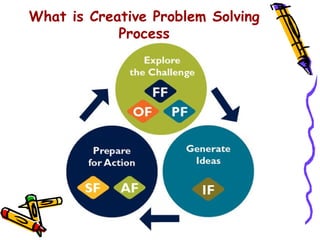
• CPS follows three process stages, which match a person's
  natural creative process, and six explicit steps.
What is Creative Problem Solving
            Process
What is Creative Problem Solving
                 Process
1. Explore the Challenge –
a).     OF - Objective Finding - Identify Goal, Wish or
    Challenge. It might be the initial dissatisfaction or a desire
    that opens the door to using the CPS process.
b).     FF -Fact Finding - Gather Data
• Assess and review all the data that pertains to the
    situation at hand. Who’s involved, what’s involved, when,
    where, and why it’s important. Make a list of the facts
    and information, as well as the more visceral hunches,
    feelings, perceptions, assumptions and gossips around the
    situation. In this step, all the relevant data is collected &
    taken into consideration to review the objective and begin
    to innovate.
What is Creative Problem Solving
            Process
• c). PF - Problem Finding - Clarify the Problem
• In this step, we explore the facts and data to find all the
  problems and challenges inherent in the situation, and all
  the opportunities they represent. This is about making
  sure that we are focusing on the right problem. It is
  possible to come up with the right answer to the wrong
  problem. Re-define what we want or what’s stopping us.
What is Creative Problem Solving
            Process
2. Generate Ideas
• d. )         IF -    Idea Finding -
• Generating ideas is much more than brainstorming.
   During this step, be vigilant about deferring judgment
   and coming up with wild, outrageous, out-of-the-box
   ideas. This is where you explore ideas that are possible
   solutions. It’s also where you need to stretch to make
   connections, take risks, and try new combinations to
   find potentially innovative solutions.
What is Creative Problem Solving
            Process
3. Prepare for Action
• e). SF - Solution Finding – Select and Strengthen
   Solutions
• First, try to strengthen and improve the best ideas
   generated. Next, generate the criteria that needs to be
   considered to evaluate the ideas for success. Apply that
   criteria to the good ideas and decide which are most
   likely to solve the redefined problem. The best idea needs
   to meet criteria that makes it actionable before it
   becomes the solution. A creative idea is not really useful
   if it could not be implemented.
•
What is Creative Problem Solving
            Process
• f). AF - Acceptance Finding
• In this step, look at who’s responsible, what has to be
  done by when, and what resources are available in order
  to realize this idea as a full-fledged, activated solution.
Creativity Problem Solving

                 By
       Dr. Vijay Kr Khurana

Creative problem solving

  • 1.
    Creativity Problem Solving By Dr. Vijay Kr Khurana
  • 2.
    Problem Solving • Problemsolving is a mental process which is the concluding part of the larger problem process that includes problem finding and problem shaping where problem is defined as a state of desire for the reaching of a definite goal from a present condition that either is not directly moving toward the goal, is far from it or needs more complex logic for finding a missing description of conditions or steps toward the goal. • Problem solving has been defined as a higher-order cognitive process that requires the modulation and control of more routine or fundamental skills
  • 3.
    Problem Solving Problem-solving techniques Thesetechniques are usually called problem solving strategies. Some of these are: • Abstraction: solving the problem in a model of the system before applying it to the real system • Analogy: using a solution that solved an analogous problem • Brainstorming: (especially by using groups of people) suggesting a large number of solutions or ideas and combining and developing them until an optimum solution is found
  • 4.
    Problem Solving Problem-solving techniques.. Contd • Lateral thinking: approaching solutions indirectly and creatively • Fractionalization / Divide and conquer: breaking down a large, complex problem into smaller, solvable problems • Hypothesis testing: assuming a possible explanation to the problem and trying to prove (or, in some contexts, disprove) the assumption • Means-ends analysis: choosing an action at each step to move closer to the goal
  • 5.
    Problem Solving Problem-solving techniques.. Contd • Morphological analysis: assessing the output and interactions of an entire system • Reduction: transforming the problem into another problem for which solutions exist • Research: employing existing ideas or adapting existing solutions to similar problems
  • 6.
    Problem Solving Problem-solving techniques.. Contd • Root cause analysis: eliminating the cause of the problem • Trial-and-error: testing possible solutions until the right one is found • Proof: try to prove that the problem cannot be solved. The point where the proof fails will be the starting point for solving it
  • 7.
    What is CreativeProblem Solving Approach
  • 8.
    What is CreativeProblem Solving Approach • Problem solving usually involves application of logic and / or skills for finding solution on the plane of known / existing knowledge as under: – Done by further investigations – Done by improved skill capability – Pursued path may be complex but it is still on the same plane (perhaps expanding the plane somewhat / slightly)
  • 9.
    What is CreativeProblem Solving Approach • Sometimes logic and / or skills may be applied to the expanded plane of knowldege by expanding it as under: – Acquisition of information along a path that fits with current reasoning – As normal scientific work
  • 10.
    What is CreativeProblem Solving Approach • However what to do when the plane of knowledge has been totally searched and logically expanded and the problem is still not solved? This calls for creative problem solving approach. • Creative Problem Solving is a method for approaching a problem or a challenge in an imaginative and innovative way. • It is a special form of problem solving in which the solution is independently created rather than learned with assistance. • Creative problem solving always involves creativity. • Creative problem solving is a part of overall problem solving
  • 11.
    What is CreativeProblem Solving Approach Categories of Creative Problem Solving Techniques 1. Creativity techniques designed to shift a person's mental state into one that fosters creativity….. Viz. One such popular technique is to take a break and relax or sleep after intensively trying to think of a solution. 2. Creativity techniques designed to reframe the problem. …. Viz, reconsidering one's goals by asking "What am I really trying to accomplish?" can lead to useful insights.
  • 12.
    What is CreativeProblem Solving Approach Categories of Creative Problem Solving Techniques 3. Creativity techniques designed to increase the quantity of fresh ideas. …..This approach is based on the belief that a larger number of ideas increase the chances that one of them has value. 4. Creative-problem-solving techniques designed to efficiently lead to a fresh perspective that causes a solution to become obvious….. This category is useful for solving especially challenging problems.
  • 13.
    What is CreativeProblem Solving Approach Some examples of the creative problem solving techniques / approaches are as under: i. TRIZ, which is also known as Theory of Inventive Problem Solving (TIPS), was developed by Genrich Altshuller and his colleagues -This method is designed to foster the creation and development of patentable inventions, but is also useful for creating non-product solutions. ii. Mind mapping is a creativity technique that both reframes the situation and fosters creativity. iii. Brainstorming is a group activity designed to increase the quantity of fresh ideas.. iv. Edward De Bono’s concept of lateral thinking
  • 14.
    What is CreativeProblem Solving Approach Contd……Techniques/ approaches: • v) Dismantling or fractionalisation of problem into parts – A big problem may be difficult to diagnose and deal. However its complexility can be reduced by dimantling / fractionalizing it into smaller parts. Focus on smaller parts may help in thinking up ideas for problem solving thus facilitating creativity. • vi) Reversal of Problem (By turning it around viz. inside- out, upside-down or back to front) - This approach helps in thinking up ideas from opposite / different prespective and thus helps in finding new or different ideas for problem solving.
  • 15.
    What is CreativeProblem Solving Process • The Creative Problem Solving Process (CPS), also known as the Osborn-Parnes CPS process, was developed by Alex Osborn and Dr. Sidney J. Parnes in the 1950s. • Osborn-Parnes CPS process is different from other "creative problem solving" methods that it uses both divergent and convergent thinking during each process step, and not just when generating ideas to solve the problem. Each step begins with divergent thinking, a broad search for many alternatives. This is followed by convergent thinking, the process of evaluating and selecting. • Thus CPS is a structured method for generating novel and useful solutions to problems. It is flexible process as well. • CPS follows three process stages, which match a person's natural creative process, and six explicit steps.
  • 16.
    What is CreativeProblem Solving Process
  • 17.
    What is CreativeProblem Solving Process 1. Explore the Challenge – a). OF - Objective Finding - Identify Goal, Wish or Challenge. It might be the initial dissatisfaction or a desire that opens the door to using the CPS process. b). FF -Fact Finding - Gather Data • Assess and review all the data that pertains to the situation at hand. Who’s involved, what’s involved, when, where, and why it’s important. Make a list of the facts and information, as well as the more visceral hunches, feelings, perceptions, assumptions and gossips around the situation. In this step, all the relevant data is collected & taken into consideration to review the objective and begin to innovate.
  • 18.
    What is CreativeProblem Solving Process • c). PF - Problem Finding - Clarify the Problem • In this step, we explore the facts and data to find all the problems and challenges inherent in the situation, and all the opportunities they represent. This is about making sure that we are focusing on the right problem. It is possible to come up with the right answer to the wrong problem. Re-define what we want or what’s stopping us.
  • 19.
    What is CreativeProblem Solving Process 2. Generate Ideas • d. ) IF - Idea Finding - • Generating ideas is much more than brainstorming. During this step, be vigilant about deferring judgment and coming up with wild, outrageous, out-of-the-box ideas. This is where you explore ideas that are possible solutions. It’s also where you need to stretch to make connections, take risks, and try new combinations to find potentially innovative solutions.
  • 20.
    What is CreativeProblem Solving Process 3. Prepare for Action • e). SF - Solution Finding – Select and Strengthen Solutions • First, try to strengthen and improve the best ideas generated. Next, generate the criteria that needs to be considered to evaluate the ideas for success. Apply that criteria to the good ideas and decide which are most likely to solve the redefined problem. The best idea needs to meet criteria that makes it actionable before it becomes the solution. A creative idea is not really useful if it could not be implemented. •
  • 21.
    What is CreativeProblem Solving Process • f). AF - Acceptance Finding • In this step, look at who’s responsible, what has to be done by when, and what resources are available in order to realize this idea as a full-fledged, activated solution.
  • 22.
    Creativity Problem Solving By Dr. Vijay Kr Khurana