Susan Hewett MAED 5040
The process of overcoming difficulties that possibly interfere with the attainment of a goal.
Originally, I had planned to focus on the difficulties with problem solving However, I narrowed the information down to open ended problems and problem based learning
A problem with multiple ways to solve A problem with multiple solutions
A scenario is given to students who use reasoning, questioning, and critical thinking to determine a solution  (Cerezo, 2004) Small groups receive a scenario with multiple solutions; together they must determine the solution and defend their answer (Belland, 2010) An approach where students apply textbook knowledge to case study situations (Chamberlin & Moon, 2008)
273 7 th  grade students Students presented with problem: “ There are 3 jugs, A, B, and C.  Find the best way of measuring out a given quantity of water using these jugs. Many looked for  and used a pattern within answers
A second problem about a circle with an inscribed hexagon was presented. Students were asked to “write as many ideas as …[possible] about the figure” Statements scored based on 3 criteria Students who did not use the same pattern for the first problem did better on the second problem.
Students who avoid a pattern are able to develop original ideas in an open ended problem in mathematics
90 4 th  graders Compares multiple choice and open ended problems Data analyzed through use of written and verbal responses from students
Some students received multiple choice first, some open ended first Problems were based on those that are given on state assessment every year
Multiple choice leads to focus on choices, not answer to question in problem Open ended questions do not usually rely on learned algorithms and shortcuts that can apply and usually work Students more likely to solve problem when open ended
14 at risk females in grades 6-8 Attended various schools within the same system Currently using problem based learning in classes Selected because they are at risk, but like using problem based learning
Presented math or science situation to solve. Collaboration in small group, followed by group presentation Students willing to participate in group work and in presentation Students interviewed about problem based learning
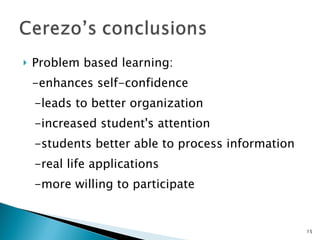
Problem based learning: -enhances self-confidence -leads to better organization -increased student's attention -students better able to process information -real life applications -more willing to participate
Small sample size already using problem based learning Selected students liked problem based learning
12  7 th  grade students, taught in French Looked at thinking of students As students worked, they were asked to talk through their reasoning and explanations
Only a few students solved problem correctly Students preferred informal strategies to formal algebraic ones Main strategy chosen was Trial and Error
Most students solved the problem using non-algebraic techniques Strategies used: Estimation and guess and check Trial and error Forward operations Work backwards Write a numerical sentence Write an algebraic equation
Small sample size Analyzing thinking is very subjective Presence of researcher as students work problems
Not a true research study Presents information comparing problem based learning and model eliciting approach Apply textbook knowledge to real life situations Discusses pros and cons of problem based learning
Realistic Leads to creativity Higher order thinking Teacher as facilitator Learn via discovery Self-directed learning Interconnectedness Collaboration Self-assessment
Time Don’t focus on single discipline Mathematical models may or may not be used Must be used regularly
164 5 th  graders Problems were presented via Internet, but work was done in classroom supervised by homeroom teacher
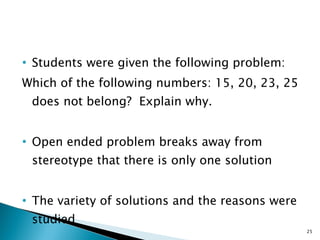
Students were given the following problem: Which of the following numbers: 15, 20, 23, 25 does not belong?  Explain why. Open ended problem breaks away from stereotype that there is only one solution The variety of solutions and the reasons were studied
24 6 th  grade students Low achieving students Involved after school program Used manipulatives
Students worked in groups on given problems Each small group developed their own arguments and justifications Students were eager to share findings Students corrected one another
Small sample size Setting  Participants
79 7 th  grade students Use of computer technology and scaffolding Study not related to math classes Specifically focused on the development of arguments
More beneficial to low and average achievers Scaffolding kept groups organized Students stayed focused
Involved graduate students and 9 th  and 10 th  grade students Focused on  how  to teach problem solving  Used individual teacher’s lessons and observations
The teachers did not always hear the reasoning of students when an alternative solution was given Teachers were unable to select problems that conveyed what they wanted There must be a connection between different topics At the end of the study, the problems were no longer a means of memorizing and applying a formula, but became a tool for investigation by students.
Saturday Graduate students
48  10 th  grade females Control and experimental groups were determined on basis of pre-test scores 2 teachers
Primary grades usually use expository teaching methods for math Problem solving techniques leads to students integrating the content Problem solving methods have become the “norm” in math classes
Experimental group showed larger gains  Interesting side note : experimental group was actually a combination of expository and problem-solving Reasons : -students lacked basic math skills    -caused students to have difficulty
Small sample size Location of school in Pakistan Lack of basic skills prior to study Students hesitant to change how they learn
110 3 rd  graders, placed in 2 groups Pre-test  7 weeks Computer software
Motivated students All students solve problems
Use regularly with non-routine problems Justify explanations Work collaboratively Multiple solutions or methods Time to implement Greater achievement Real life applications
Belland, B. (2010). Portraits of middle school students constructing evidence-based arguments during problem-based learning: the impact of computer-based scaffolds.  Educational Technology Research & Development ,  58 (3), 285-309. doi:10.1007/s11423-009-9139-4. Cerezo, N. (2004). Problem-based learning in the middle school: A research case study of the perceptions of at-risk females.  Research in Middle Level Education Online ,  27 (1), 20-42. Retrieved from Education Research Complete database. Chamberlin, S. A. , & Moon, S. M. (2008). How does the problem based learning approach compare to the model-eliciting activity approach in mathematics?.  International Journal for Mathematics Teaching and Learning ,  Nov 28 . Retrieved from  http://www.cimt.plymouth.ac.uk/journal/chamberlin.pdf Imai, T. (2000). The influence of overcoming fixation in mathematics towards divergent thinking… International Journal of mathematical Education in Science and Technology , 31(2), 187 – 193. Retrieved from Education Research Complete database. Karp, A. (2010). Analyzing and attempting to overcome prospective teachers’ difficulties during problem-solving instruction.  Journal of Mathematics Teacher Education ,  13 (2), 121-139. doi:10.1007/s10857-009-9127-y. Kazemi, E. (2002). Exploring test performance in mathematics: the questions children’s answers raise.  Journal of Mathematical Behavior ,  21 (2), 203. Retrieved from Education Research Complete database. Klavir, R., & Hershkovitch, S. (2008). Teaching and evaluating ‘open-ended’ problems.  International Journal for Mathematics Teaching and Learning ,  May 20 . Retrieved from  http://www.cimt.plymouth.ac.uk/journal/klavir.pdf
Mueller, M., & Masher, C. (2009). Learning to Reason in an Informal Math After-School Program.  Mathematics Education Research Journal ,  21 (3), 7-35. Retrieved from Education Research Complete database Osta, I., & Labban, S. (2007). Seventh graders' prealgebraic problem solving strategies: geometric, arithmetic, and algebraic interplay.  International Journal for Mathematics Teaching and Learning ,  Nov 28 . Retrieved from  http://www.cimt.plymouth.ac.uk/journal/osta.pdf Perveen, K. (2010). Effect Of The Problem-Solving Approach On Academic Achievement Of Students In Mathematics At The Secondary Level.  Contemporary Issues in Education Research ,  3 (3), 9-13. Retrieved from Education Research Complete database. Schoppek, W., & Tulis, M. (2010). Enhancing Arithmetic and Word-Problem Solving Skills Efficiently by Individualized Computer-Assisted Practice.  Journal of Educational Research ,  103 (4), 239-252. Retrieved from Education Research Complete database

Problem solving powerpoint

  • 1.
  • 2.
    The process ofovercoming difficulties that possibly interfere with the attainment of a goal.
  • 3.
    Originally, I hadplanned to focus on the difficulties with problem solving However, I narrowed the information down to open ended problems and problem based learning
  • 4.
    A problem withmultiple ways to solve A problem with multiple solutions
  • 5.
    A scenario isgiven to students who use reasoning, questioning, and critical thinking to determine a solution (Cerezo, 2004) Small groups receive a scenario with multiple solutions; together they must determine the solution and defend their answer (Belland, 2010) An approach where students apply textbook knowledge to case study situations (Chamberlin & Moon, 2008)
  • 7.
    273 7 th grade students Students presented with problem: “ There are 3 jugs, A, B, and C. Find the best way of measuring out a given quantity of water using these jugs. Many looked for and used a pattern within answers
  • 8.
    A second problemabout a circle with an inscribed hexagon was presented. Students were asked to “write as many ideas as …[possible] about the figure” Statements scored based on 3 criteria Students who did not use the same pattern for the first problem did better on the second problem.
  • 9.
    Students who avoida pattern are able to develop original ideas in an open ended problem in mathematics
  • 10.
    90 4 th graders Compares multiple choice and open ended problems Data analyzed through use of written and verbal responses from students
  • 11.
    Some students receivedmultiple choice first, some open ended first Problems were based on those that are given on state assessment every year
  • 12.
    Multiple choice leadsto focus on choices, not answer to question in problem Open ended questions do not usually rely on learned algorithms and shortcuts that can apply and usually work Students more likely to solve problem when open ended
  • 13.
    14 at riskfemales in grades 6-8 Attended various schools within the same system Currently using problem based learning in classes Selected because they are at risk, but like using problem based learning
  • 14.
    Presented math orscience situation to solve. Collaboration in small group, followed by group presentation Students willing to participate in group work and in presentation Students interviewed about problem based learning
  • 15.
    Problem based learning:-enhances self-confidence -leads to better organization -increased student's attention -students better able to process information -real life applications -more willing to participate
  • 16.
    Small sample sizealready using problem based learning Selected students liked problem based learning
  • 17.
    12 7th grade students, taught in French Looked at thinking of students As students worked, they were asked to talk through their reasoning and explanations
  • 18.
    Only a fewstudents solved problem correctly Students preferred informal strategies to formal algebraic ones Main strategy chosen was Trial and Error
  • 19.
    Most students solvedthe problem using non-algebraic techniques Strategies used: Estimation and guess and check Trial and error Forward operations Work backwards Write a numerical sentence Write an algebraic equation
  • 20.
    Small sample sizeAnalyzing thinking is very subjective Presence of researcher as students work problems
  • 21.
    Not a trueresearch study Presents information comparing problem based learning and model eliciting approach Apply textbook knowledge to real life situations Discusses pros and cons of problem based learning
  • 22.
    Realistic Leads tocreativity Higher order thinking Teacher as facilitator Learn via discovery Self-directed learning Interconnectedness Collaboration Self-assessment
  • 23.
    Time Don’t focuson single discipline Mathematical models may or may not be used Must be used regularly
  • 24.
    164 5 th graders Problems were presented via Internet, but work was done in classroom supervised by homeroom teacher
  • 25.
    Students were giventhe following problem: Which of the following numbers: 15, 20, 23, 25 does not belong? Explain why. Open ended problem breaks away from stereotype that there is only one solution The variety of solutions and the reasons were studied
  • 26.
    24 6 th grade students Low achieving students Involved after school program Used manipulatives
  • 27.
    Students worked ingroups on given problems Each small group developed their own arguments and justifications Students were eager to share findings Students corrected one another
  • 28.
    Small sample sizeSetting Participants
  • 29.
    79 7 th grade students Use of computer technology and scaffolding Study not related to math classes Specifically focused on the development of arguments
  • 30.
    More beneficial tolow and average achievers Scaffolding kept groups organized Students stayed focused
  • 31.
    Involved graduate studentsand 9 th and 10 th grade students Focused on how to teach problem solving Used individual teacher’s lessons and observations
  • 32.
    The teachers didnot always hear the reasoning of students when an alternative solution was given Teachers were unable to select problems that conveyed what they wanted There must be a connection between different topics At the end of the study, the problems were no longer a means of memorizing and applying a formula, but became a tool for investigation by students.
  • 33.
  • 34.
    48 10th grade females Control and experimental groups were determined on basis of pre-test scores 2 teachers
  • 35.
    Primary grades usuallyuse expository teaching methods for math Problem solving techniques leads to students integrating the content Problem solving methods have become the “norm” in math classes
  • 36.
    Experimental group showedlarger gains Interesting side note : experimental group was actually a combination of expository and problem-solving Reasons : -students lacked basic math skills -caused students to have difficulty
  • 37.
    Small sample sizeLocation of school in Pakistan Lack of basic skills prior to study Students hesitant to change how they learn
  • 38.
    110 3 rd graders, placed in 2 groups Pre-test 7 weeks Computer software
  • 39.
    Motivated students Allstudents solve problems
  • 40.
    Use regularly withnon-routine problems Justify explanations Work collaboratively Multiple solutions or methods Time to implement Greater achievement Real life applications
  • 41.
    Belland, B. (2010).Portraits of middle school students constructing evidence-based arguments during problem-based learning: the impact of computer-based scaffolds. Educational Technology Research & Development , 58 (3), 285-309. doi:10.1007/s11423-009-9139-4. Cerezo, N. (2004). Problem-based learning in the middle school: A research case study of the perceptions of at-risk females. Research in Middle Level Education Online , 27 (1), 20-42. Retrieved from Education Research Complete database. Chamberlin, S. A. , & Moon, S. M. (2008). How does the problem based learning approach compare to the model-eliciting activity approach in mathematics?. International Journal for Mathematics Teaching and Learning , Nov 28 . Retrieved from http://www.cimt.plymouth.ac.uk/journal/chamberlin.pdf Imai, T. (2000). The influence of overcoming fixation in mathematics towards divergent thinking… International Journal of mathematical Education in Science and Technology , 31(2), 187 – 193. Retrieved from Education Research Complete database. Karp, A. (2010). Analyzing and attempting to overcome prospective teachers’ difficulties during problem-solving instruction. Journal of Mathematics Teacher Education , 13 (2), 121-139. doi:10.1007/s10857-009-9127-y. Kazemi, E. (2002). Exploring test performance in mathematics: the questions children’s answers raise. Journal of Mathematical Behavior , 21 (2), 203. Retrieved from Education Research Complete database. Klavir, R., & Hershkovitch, S. (2008). Teaching and evaluating ‘open-ended’ problems. International Journal for Mathematics Teaching and Learning , May 20 . Retrieved from http://www.cimt.plymouth.ac.uk/journal/klavir.pdf
  • 42.
    Mueller, M., &Masher, C. (2009). Learning to Reason in an Informal Math After-School Program. Mathematics Education Research Journal , 21 (3), 7-35. Retrieved from Education Research Complete database Osta, I., & Labban, S. (2007). Seventh graders' prealgebraic problem solving strategies: geometric, arithmetic, and algebraic interplay. International Journal for Mathematics Teaching and Learning , Nov 28 . Retrieved from http://www.cimt.plymouth.ac.uk/journal/osta.pdf Perveen, K. (2010). Effect Of The Problem-Solving Approach On Academic Achievement Of Students In Mathematics At The Secondary Level. Contemporary Issues in Education Research , 3 (3), 9-13. Retrieved from Education Research Complete database. Schoppek, W., & Tulis, M. (2010). Enhancing Arithmetic and Word-Problem Solving Skills Efficiently by Individualized Computer-Assisted Practice. Journal of Educational Research , 103 (4), 239-252. Retrieved from Education Research Complete database