NAMING & FORMULA WRITING
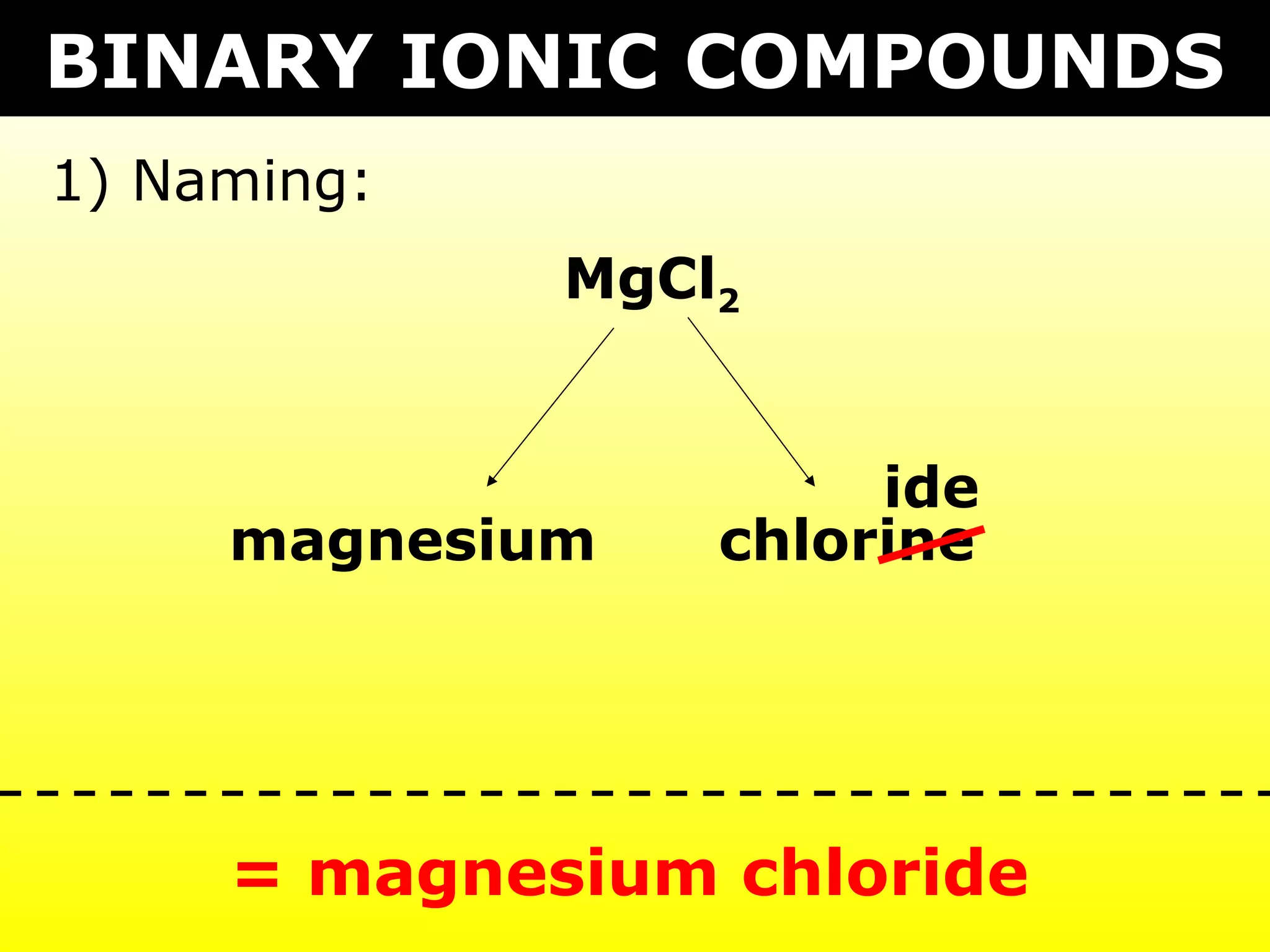
BINARY IONIC COMPOUNDS
1) Naming:
             MgCl2


                      ide
     magnesium   chlorine


     = magnesium chloride
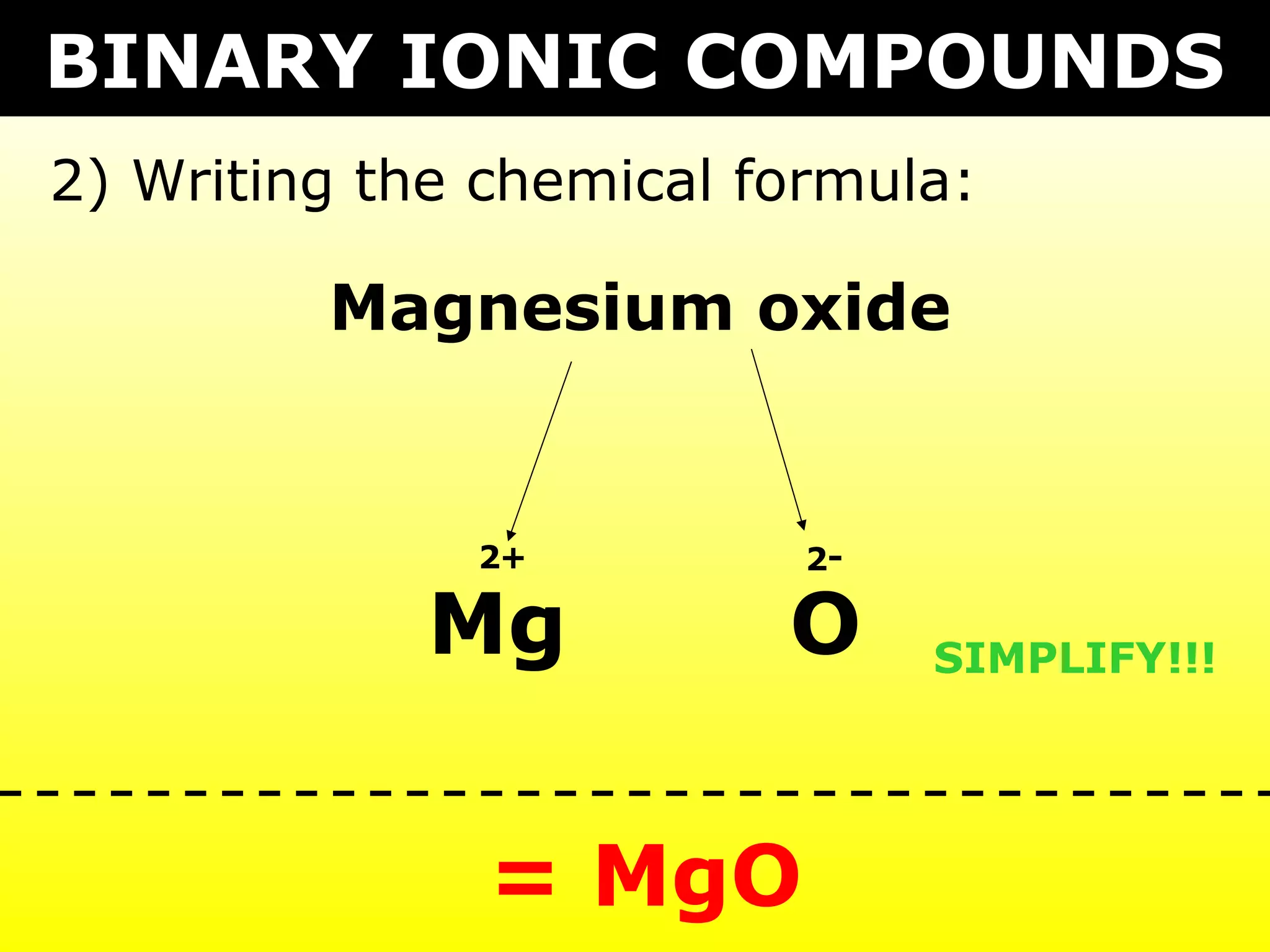
BINARY IONIC COMPOUNDS
2) Writing the chemical formula:

         Magnesium oxide


              2+          2-

             Mg          O     SIMPLIFY!!!


               = MgO
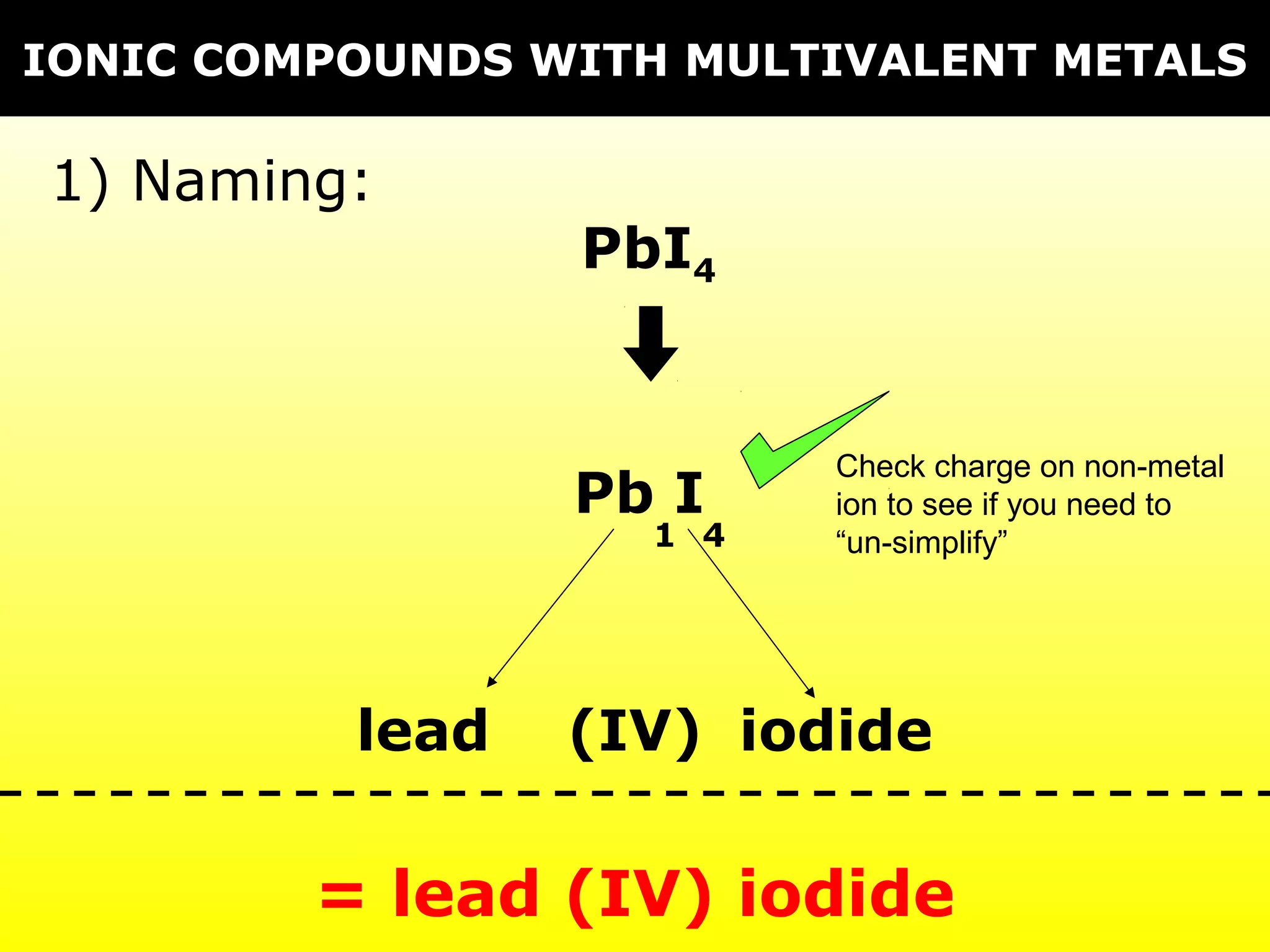
IONIC COMPOUNDS WITH MULTIVALENT METALS

1) Naming:
                 PbI4


                          Check charge on non-metal
                 Pb I     ion to see if you need to
                    1 4   “un-simplify”


          lead   (IV) iodide

         = lead (IV) iodide
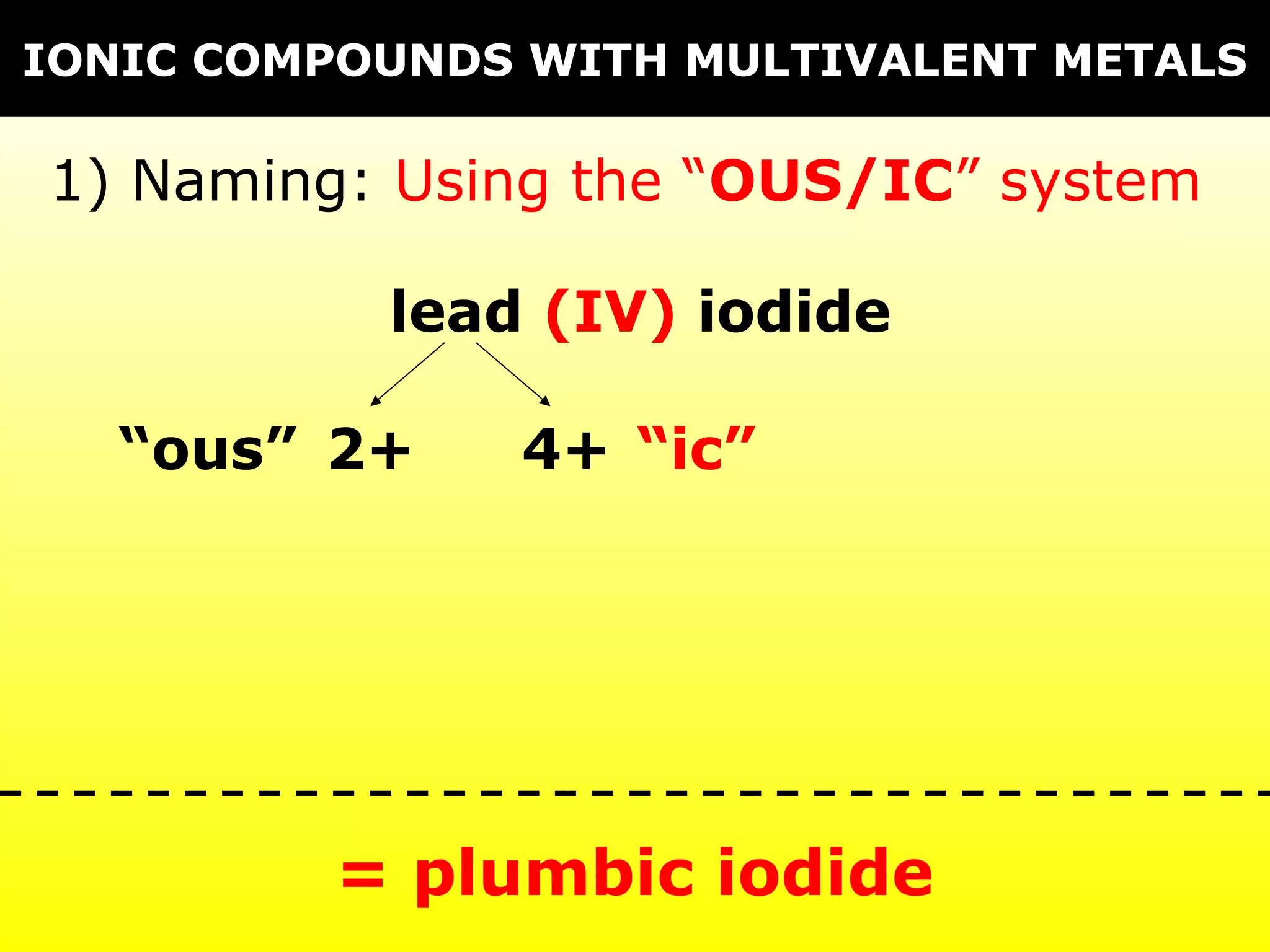
IONIC COMPOUNDS WITH MULTIVALENT METALS

1) Naming: Using the “OUS/IC” system

           lead (IV) iodide

   “ous” 2+    4+ “ic”


         = plumbic iodide
IONIC COMPOUNDS WITH MULTIVALENT METALS

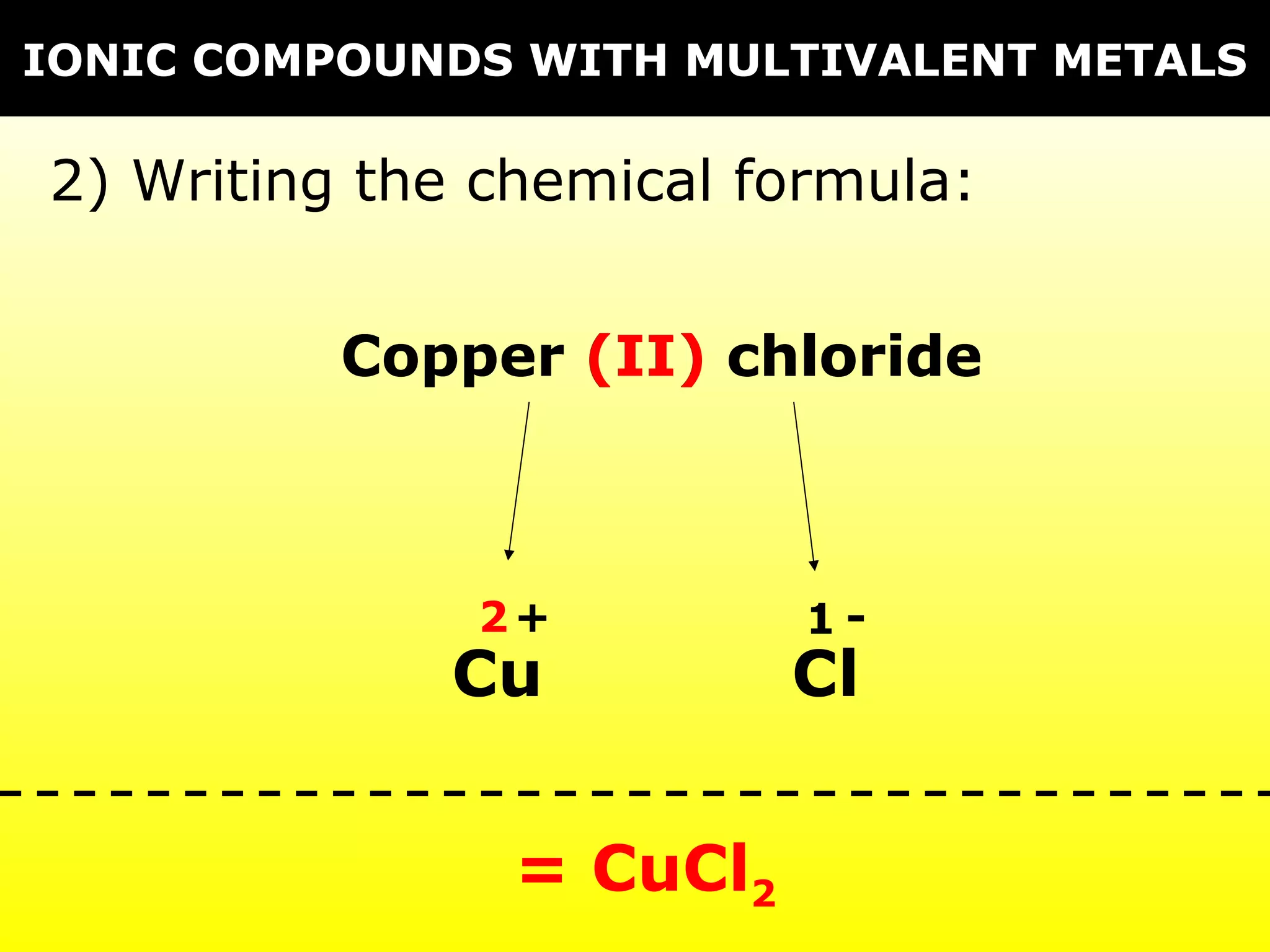
2) Writing the chemical formula:


          Copper (II) chloride


              2+          1-
             Cu           Cl


                = CuCl2
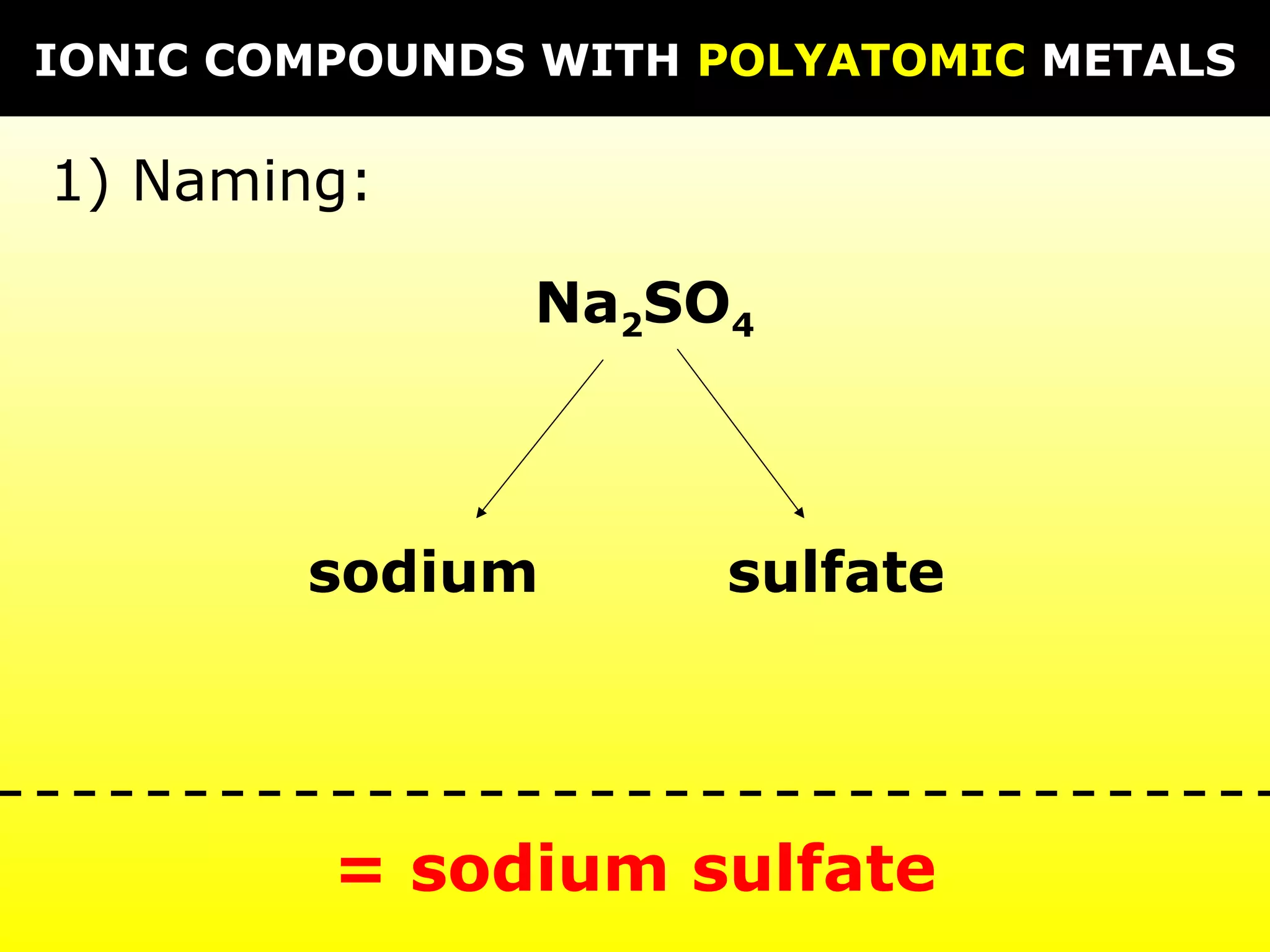
IONIC COMPOUNDS WITH POLYATOMIC METALS

1) Naming:

               Na2SO4


        sodium       sulfate


         = sodium sulfate
IONIC COMPOUNDS WITH POLYATOMIC METALS

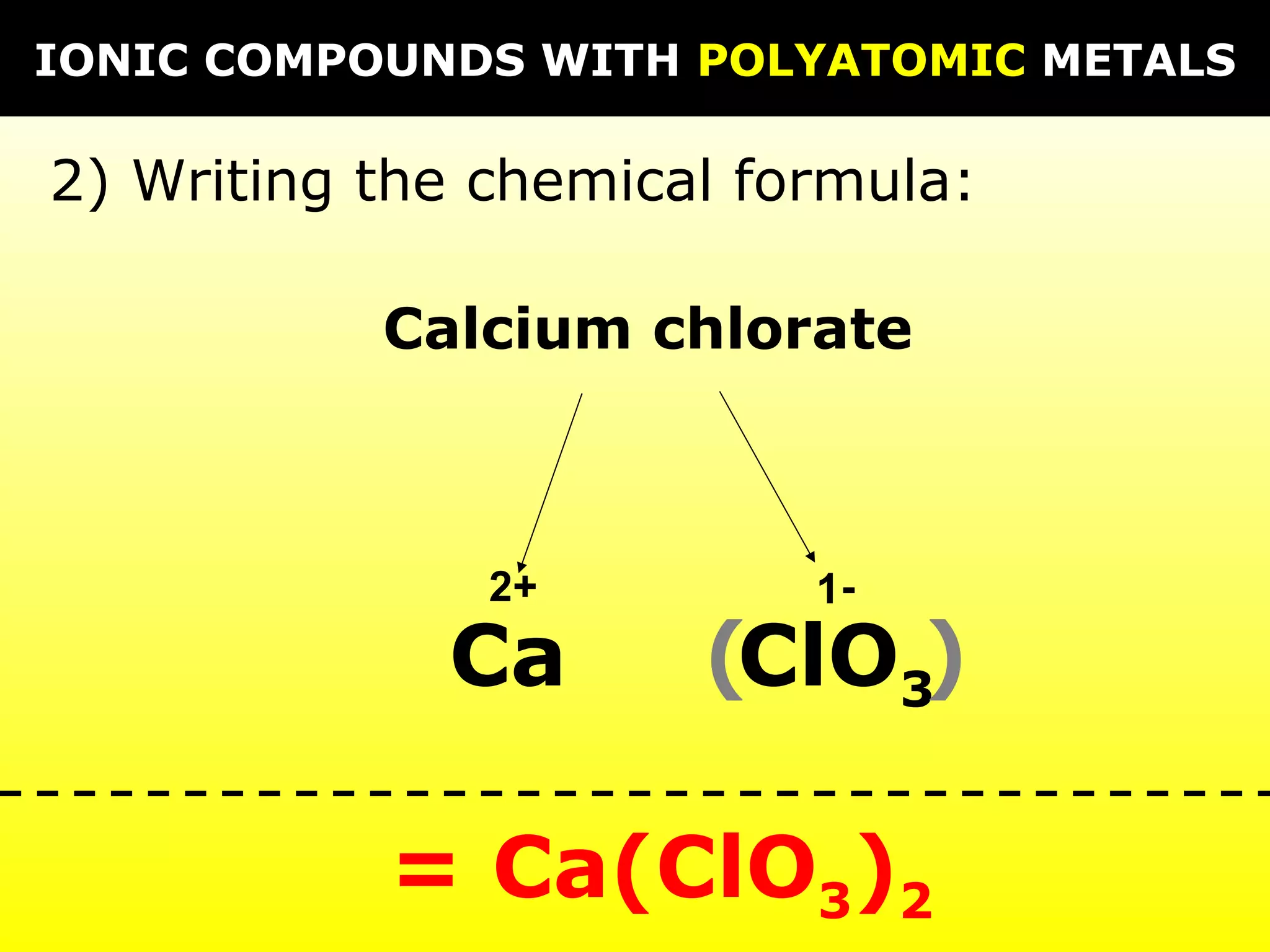
2) Writing the chemical formula:

           Calcium chlorate


               2+         1-
             Ca       (ClO3)

           = Ca(ClO3)2
IONIC COMPOUNDS WITH POLYATOMIC METALS


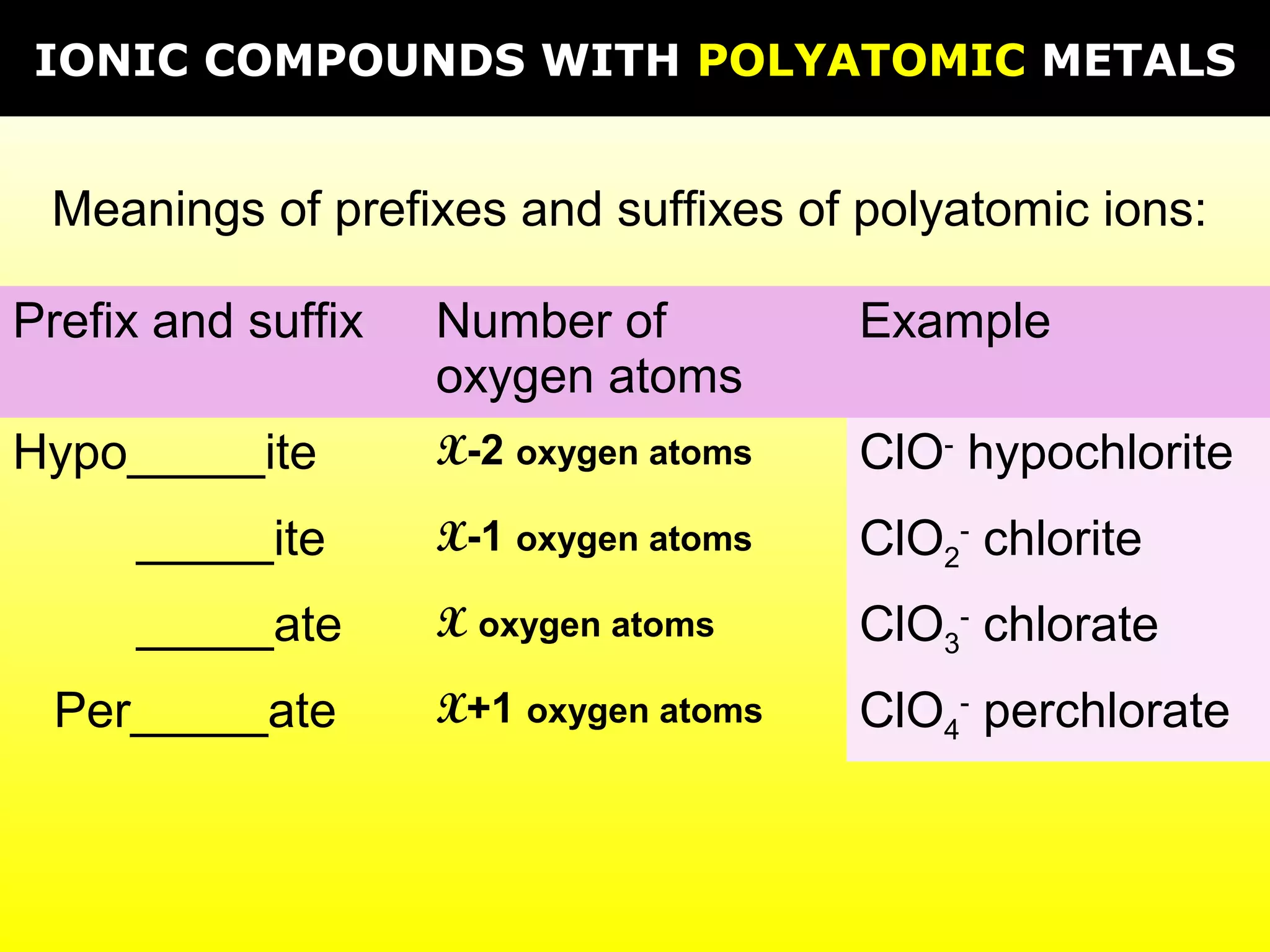
 Meanings of prefixes and suffixes of polyatomic ions:

Prefix and suffix   Number of          Example
                    oxygen atoms
Hypo_____ite        X-2 oxygen atoms   ClO- hypochlorite
     _____ite       X-1 oxygen atoms   ClO2- chlorite
     _____ate       X oxygen atoms     ClO3- chlorate
 Per_____ate        X+1 oxygen atoms   ClO4- perchlorate
IONIC COMPOUNDS WITH POLYATOMIC METALS


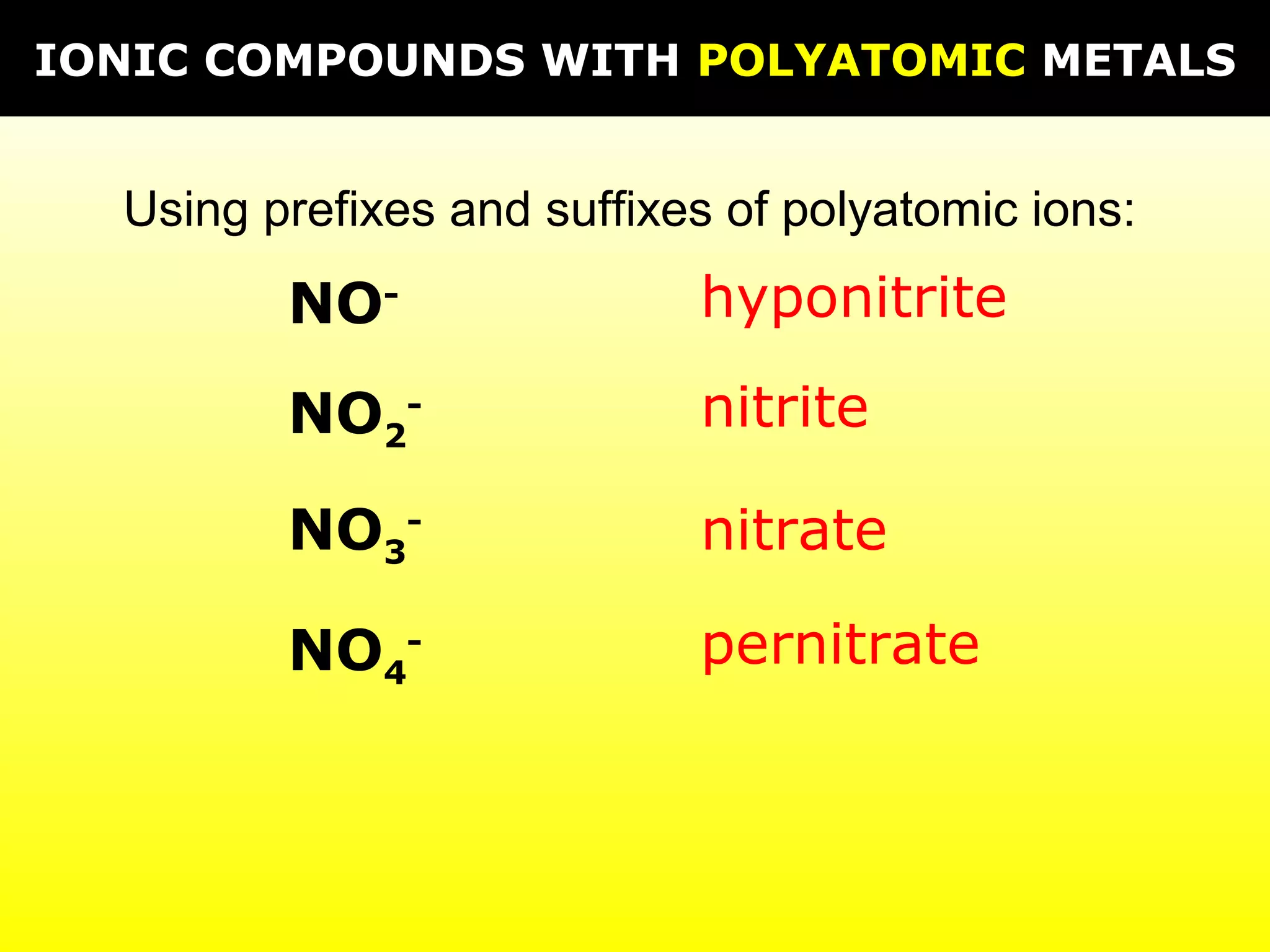
  Using prefixes and suffixes of polyatomic ions:
         NO-                hyponitrite

         NO2-               nitrite

         NO3-               nitrate

         NO4-               pernitrate
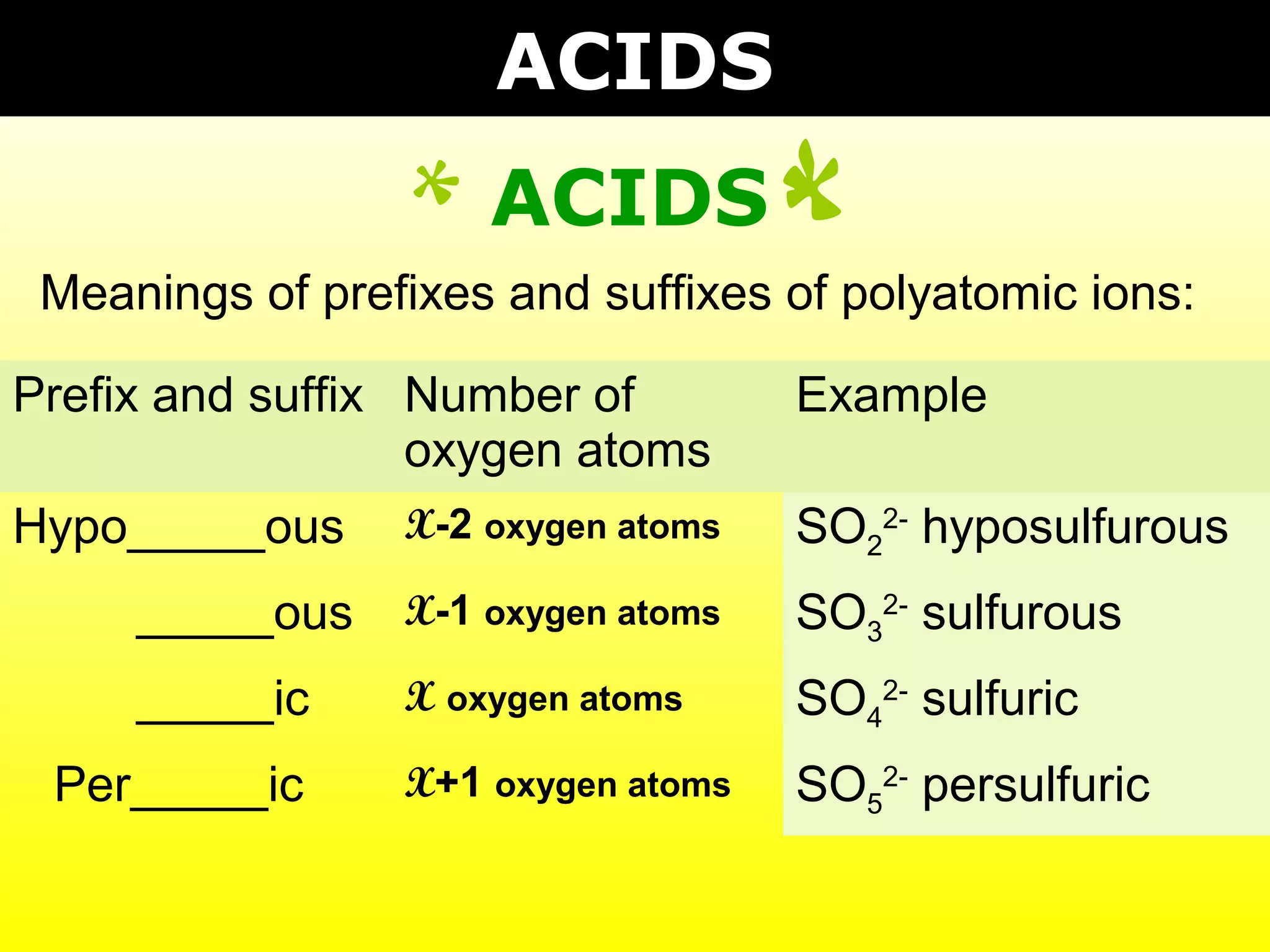
ACIDS
                     ACIDS
 Meanings of prefixes and suffixes of polyatomic ions:

Prefix and suffix Number of         Example
                  oxygen atoms
Hypo_____ous     X-2 oxygen atoms   SO22- hyposulfurous
     _____ous    X-1 oxygen atoms   SO32- sulfurous
     _____ic     X oxygen atoms     SO42- sulfuric
 Per_____ic      X+1 oxygen atoms   SO52- persulfuric
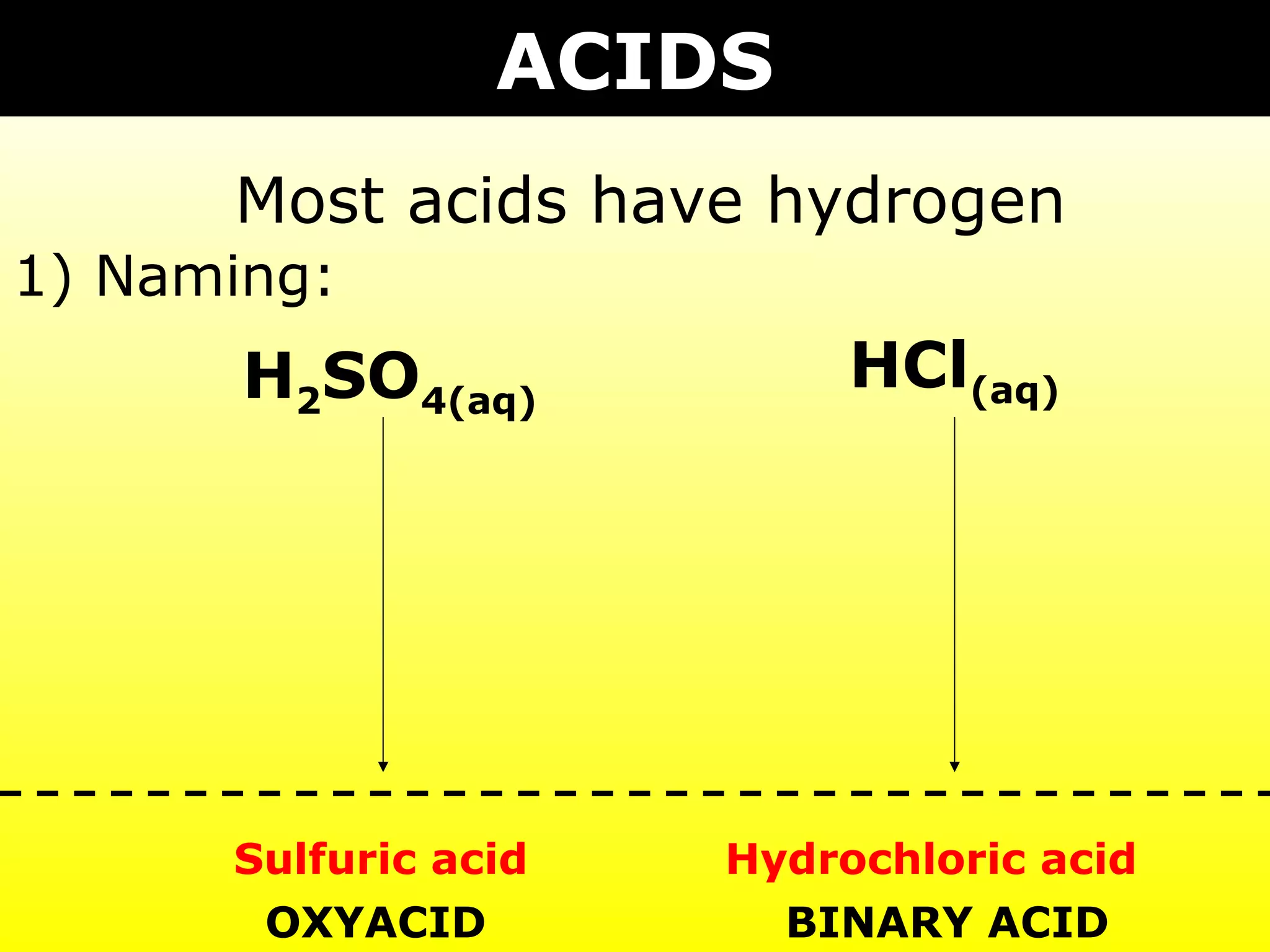
ACIDS
      Most acids have hydrogen
1) Naming:
       H2SO4(aq)           HCl(aq)


      Sulfuric acid   Hydrochloric acid
       OXYACID          BINARY ACID
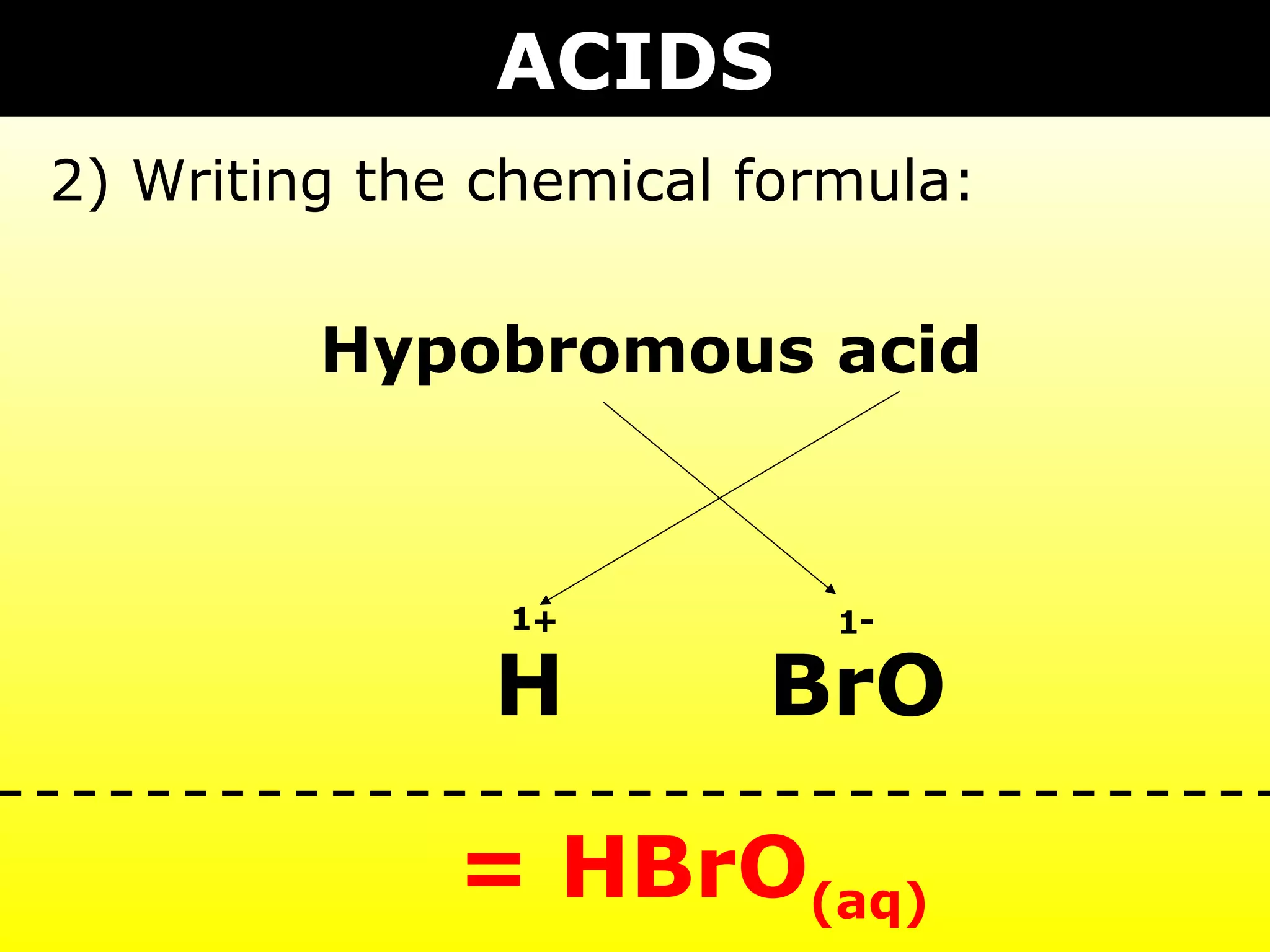
ACIDS
2) Writing the chemical formula:


         Hypobromous acid


               1+          1-

               H        BrO

              = HBrO(aq)
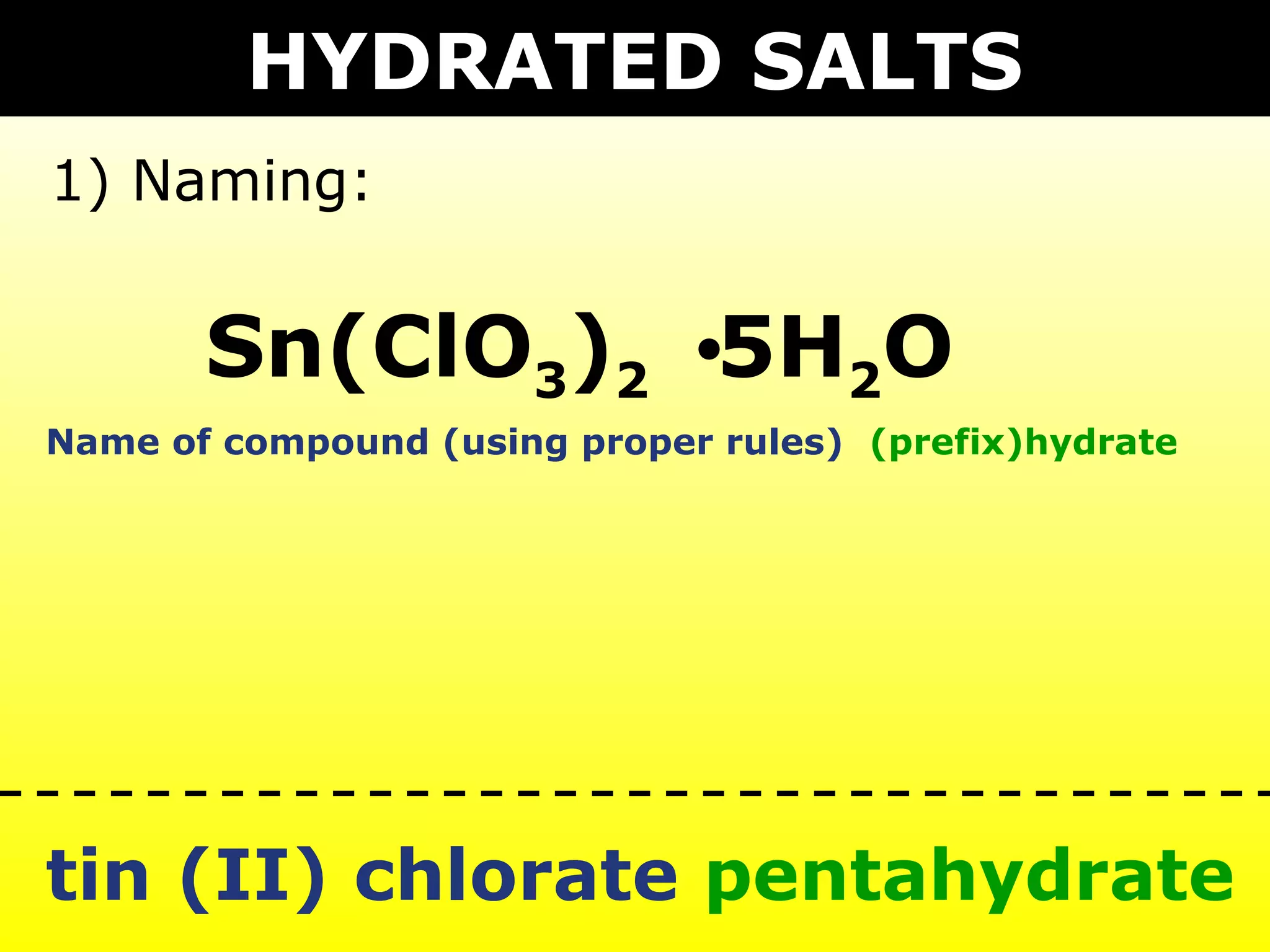
HYDRATED SALTS
1) Naming:


       Sn(ClO3)2 5H2O
Name of compound (using proper rules) (prefix)hydrate


tin (II) chlorate pentahydrate
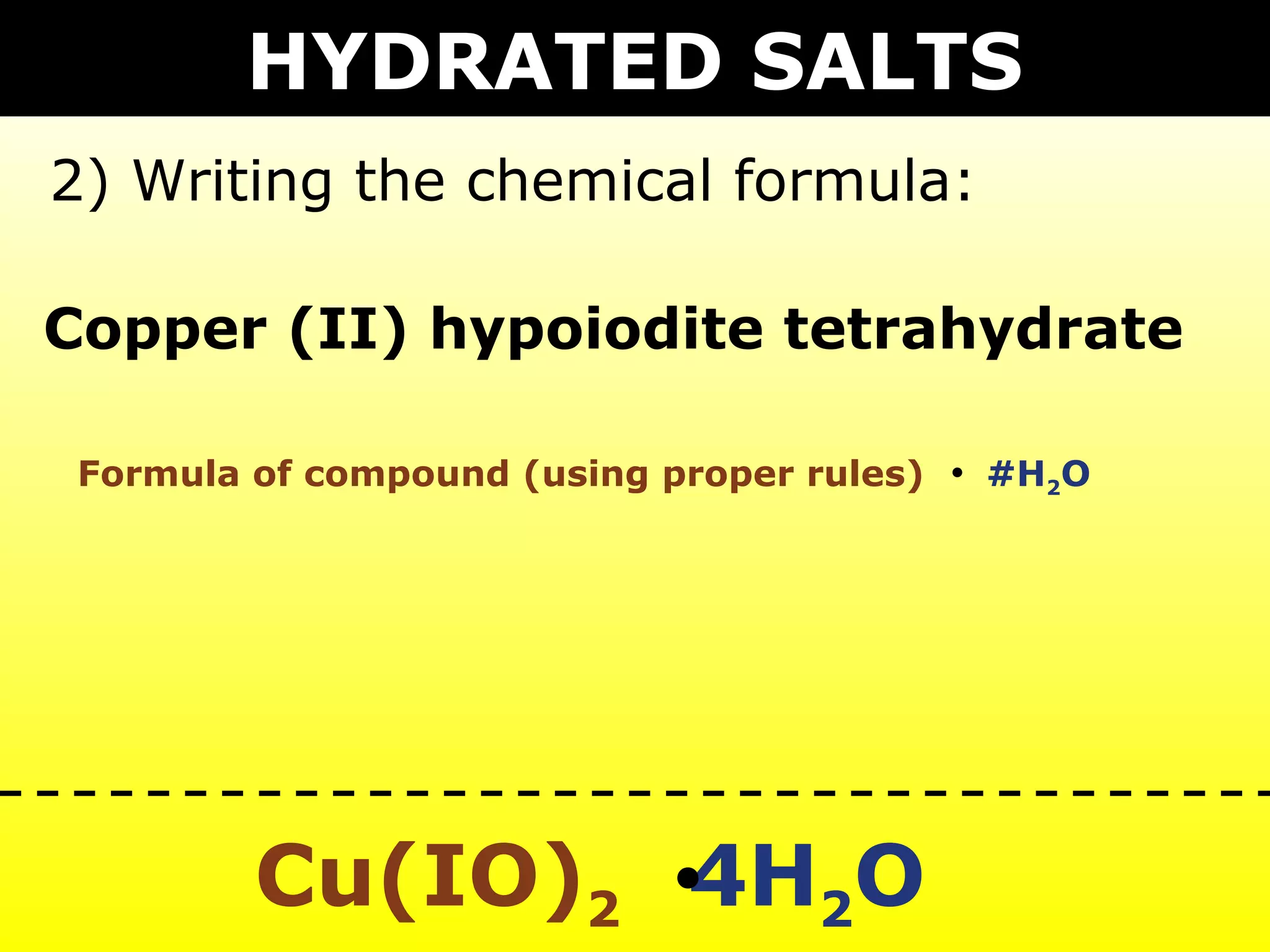
HYDRATED SALTS
2) Writing the chemical formula:

Copper (II) hypoiodite tetrahydrate

 Formula of compound (using proper rules)   #H2O


         Cu(IO)2 4H2O
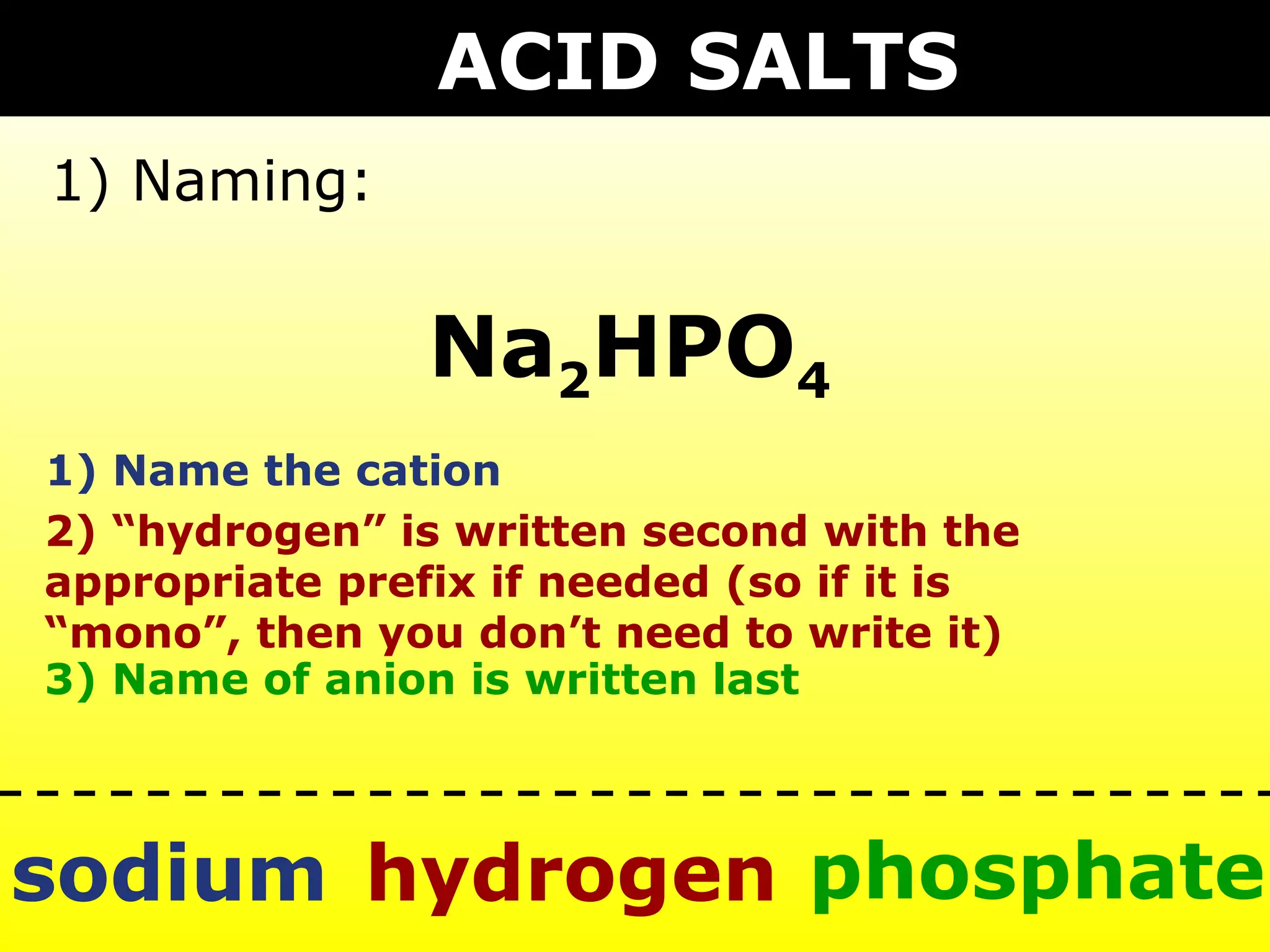
ACID SALTS
1) Naming:


                Na2HPO4
1) Name the cation
2) “hydrogen” is written second with the
appropriate prefix if needed (so if it is
“mono”, then you don’t need to write it)
3) Name of anion is written last


sodium hydrogen phosphate
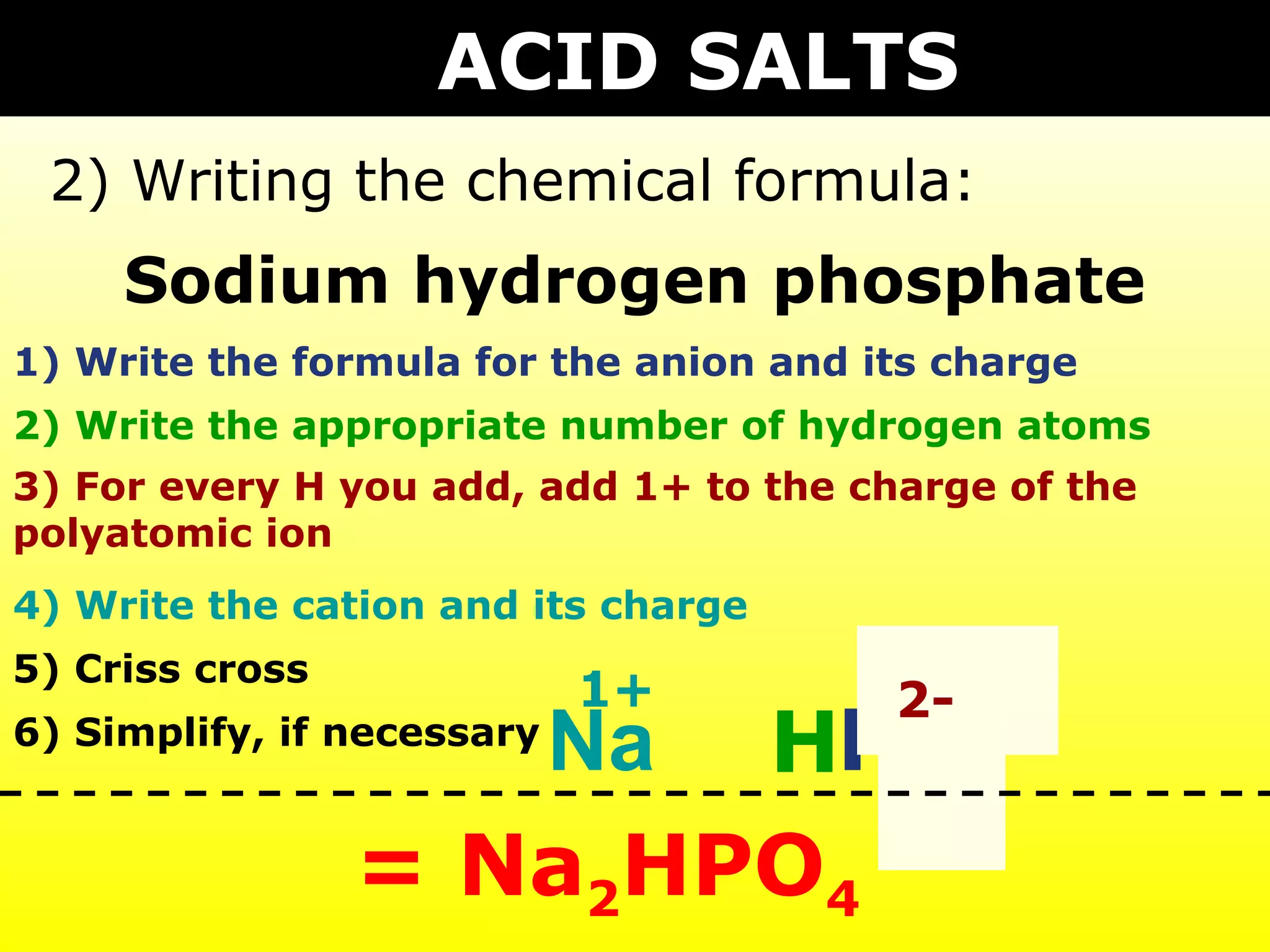
ACID SALTS
 2) Writing the chemical formula:
     Sodium hydrogen phosphate
1) Write the formula for the anion and its charge
2) Write the appropriate number of hydrogen atoms
3) For every H you add, add 1+ to the charge of the
polyatomic ion
4) Write the cation and its charge
5) Criss cross
                            1+          3-
                                        2-
                    Na HPO4
6) Simplify, if necessary


                 = Na2HPO4
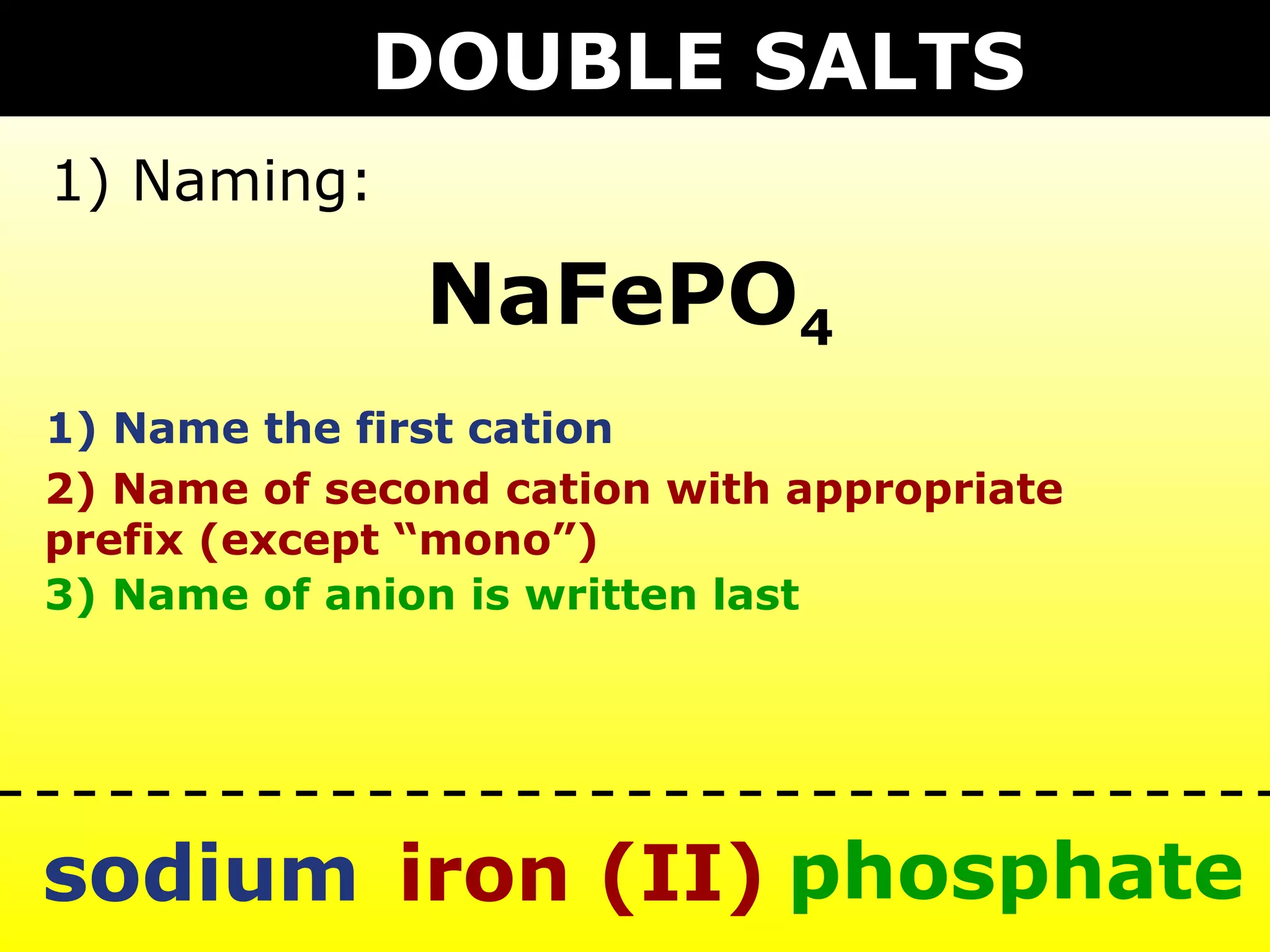
DOUBLE SALTS
1) Naming:

               NaFePO4
1) Name the first cation
2) Name of second cation with appropriate
prefix (except “mono”)
3) Name of anion is written last


sodium iron (II) phosphate
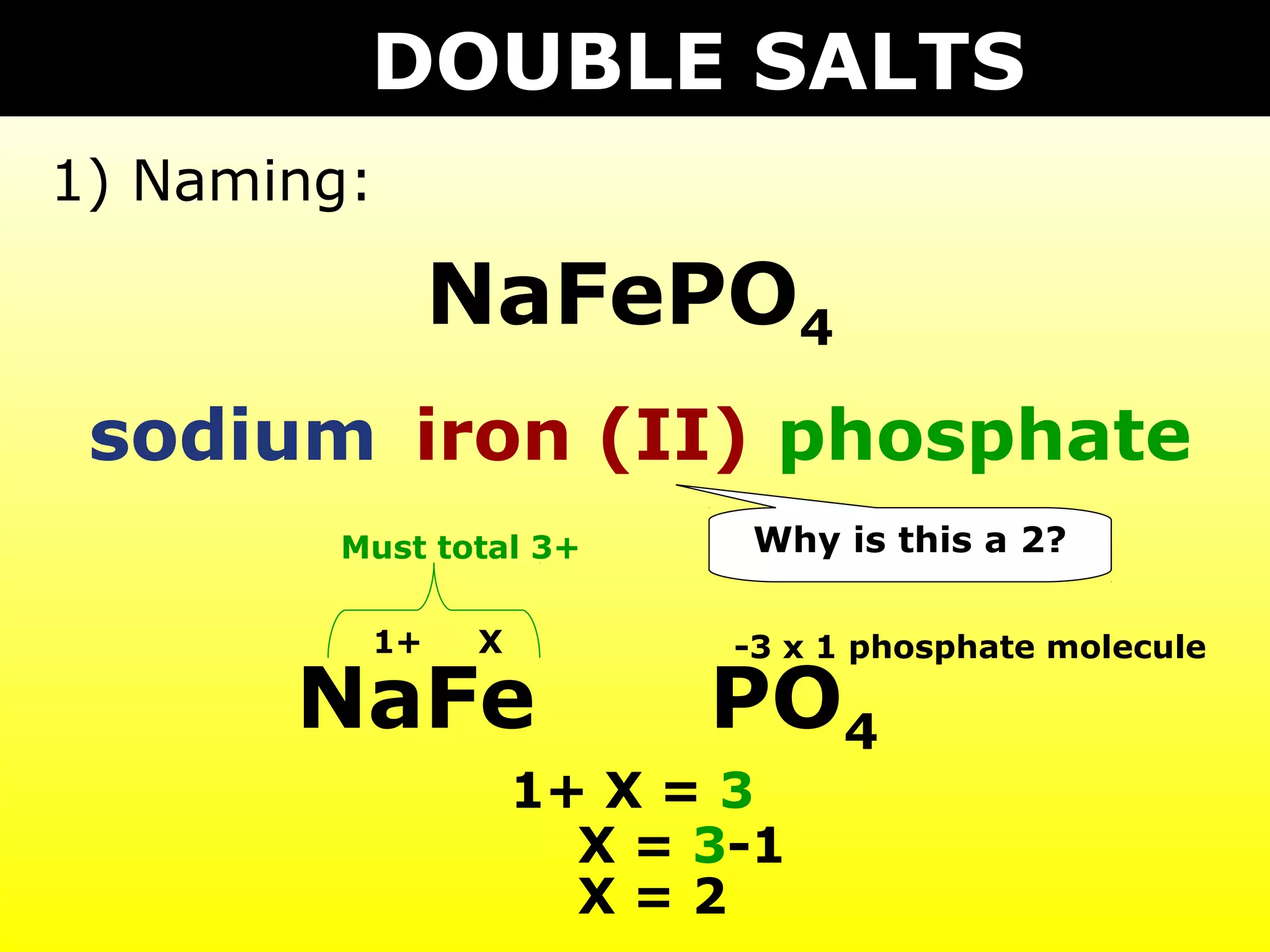
DOUBLE SALTS
1) Naming:

              NaFePO4
 sodium iron (II) phosphate
        Must total 3+     Why is this a 2?

         1+    X          -3 x 1 phosphate molecule

       NaFe              PO4
                   1+ X = 3
                     X = 3-1
                     X=2
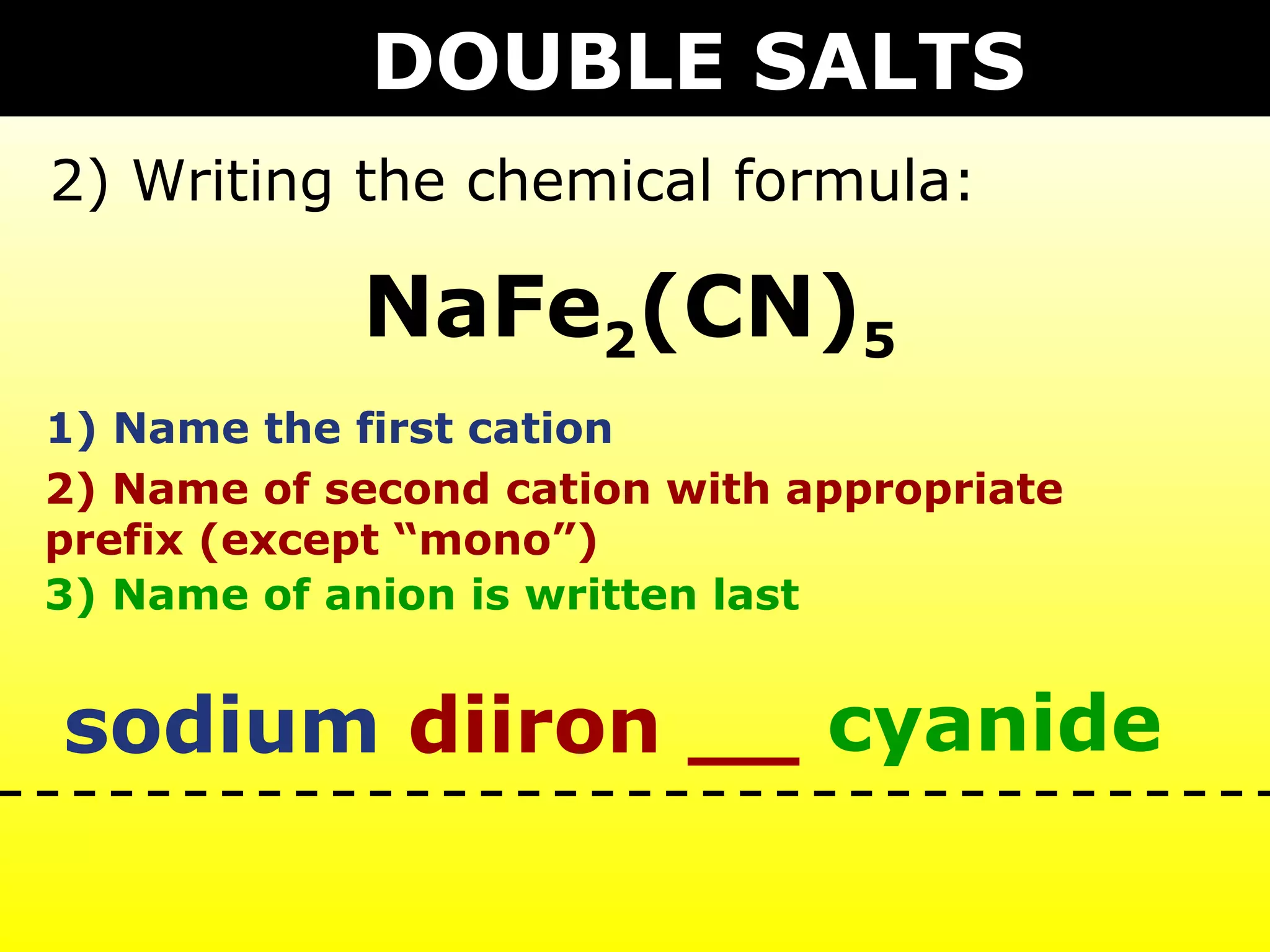
DOUBLE SALTS
2) Writing the chemical formula:

            NaFe2(CN)5
1) Name the first cation
2) Name of second cation with appropriate
prefix (except “mono”)
3) Name of anion is written last


sodium diiron __ cyanide
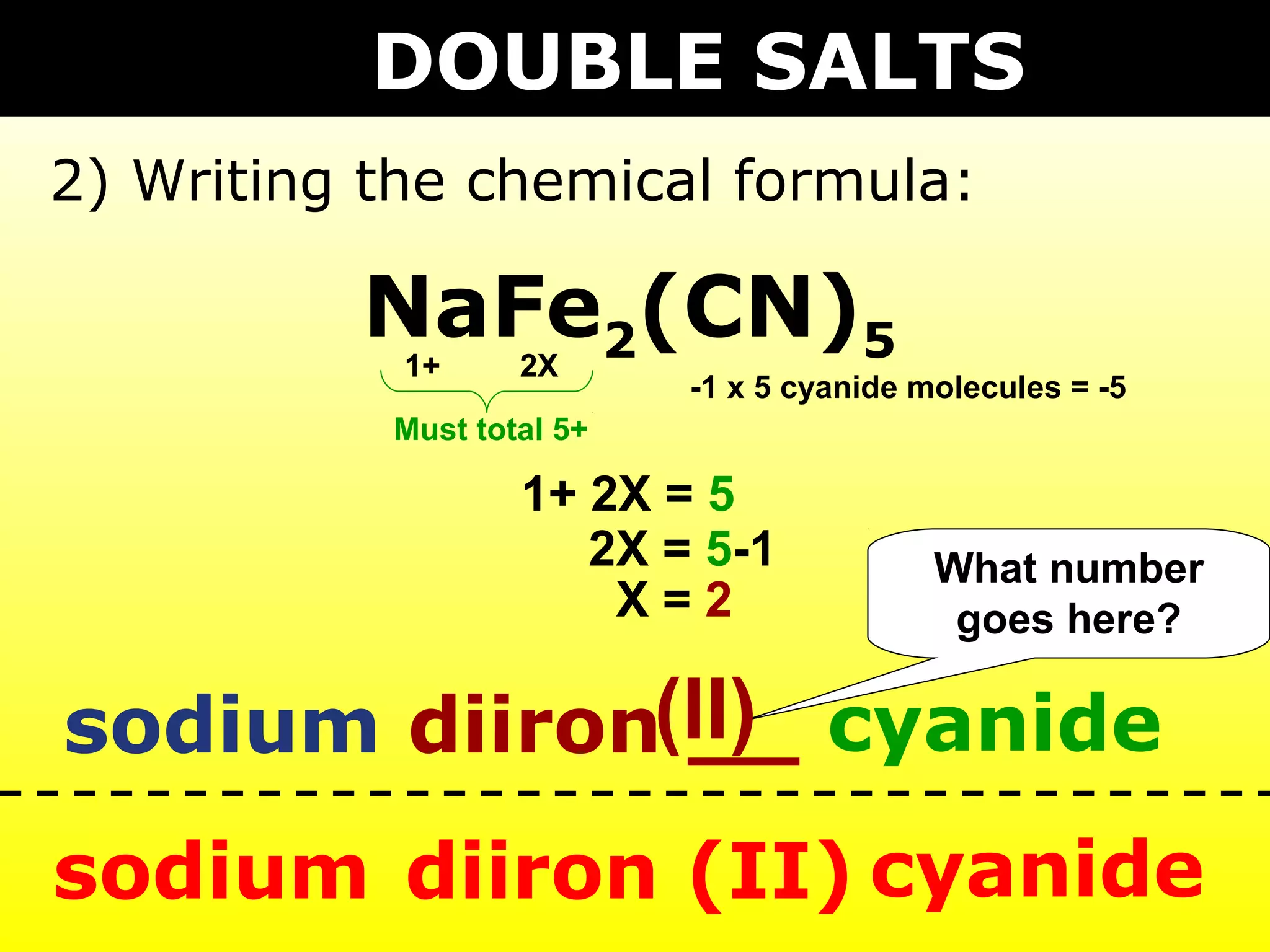
DOUBLE SALTS
2) Writing the chemical formula:

          NaFe2(CN)5
            1+     2X
                           -1 x 5 cyanide molecules = -5
           Must total 5+

                   1+ 2X = 5
                      2X = 5-1             What number
                       X=2                  goes here?

sodium diiron(II) cyanide
              __
sodium diiron (II) cyanide
DOUBLE SALTS
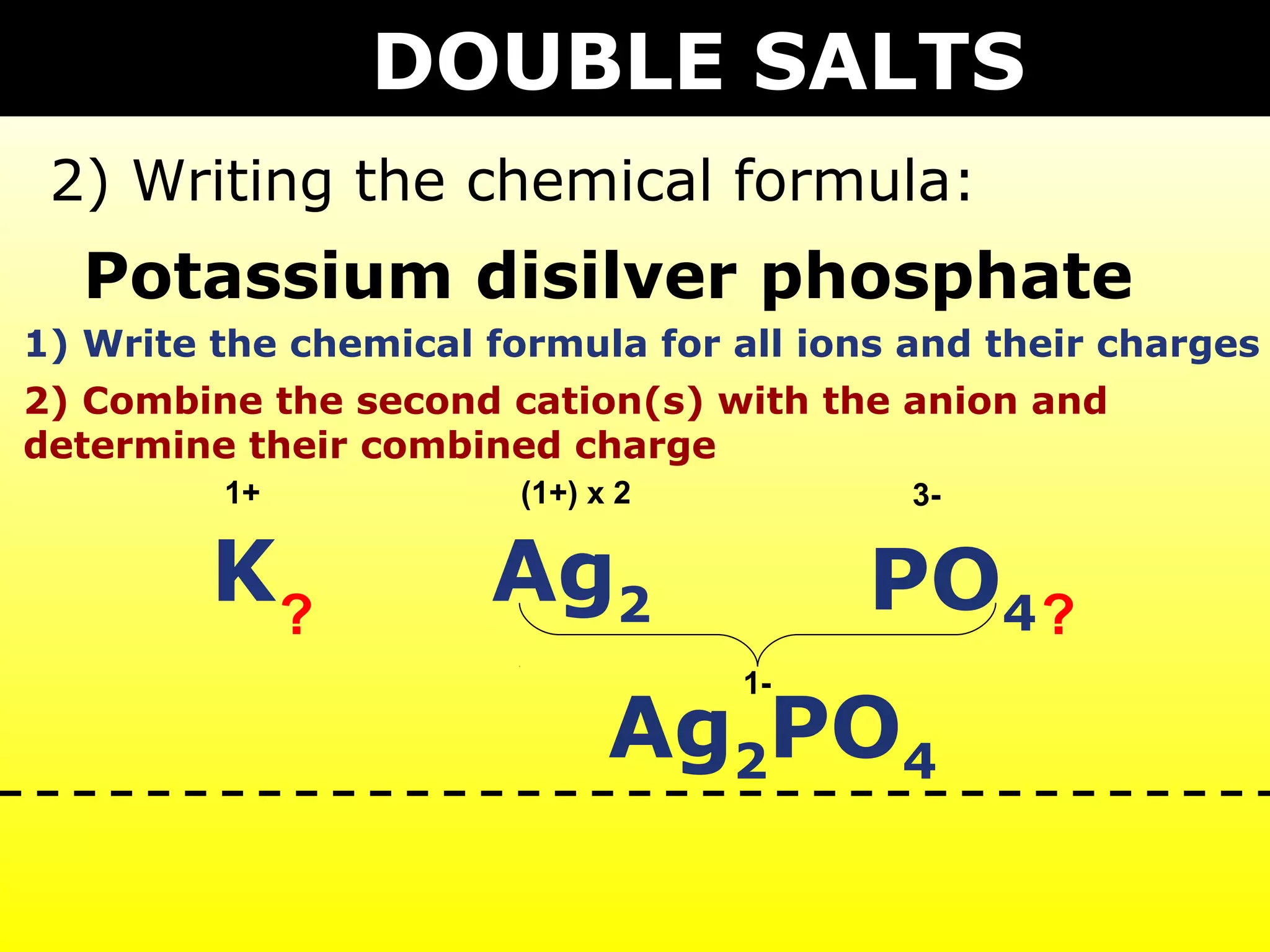
 2) Writing the chemical formula:
  Potassium disilver phosphate
1) Write the chemical formula for all ions and their charges
2) Combine the second cation(s) with the anion and
determine their combined charge
         1+             (1+) x 2           3-


         K?           Ag2               PO4 ?
                                   1-

                              Ag2PO4
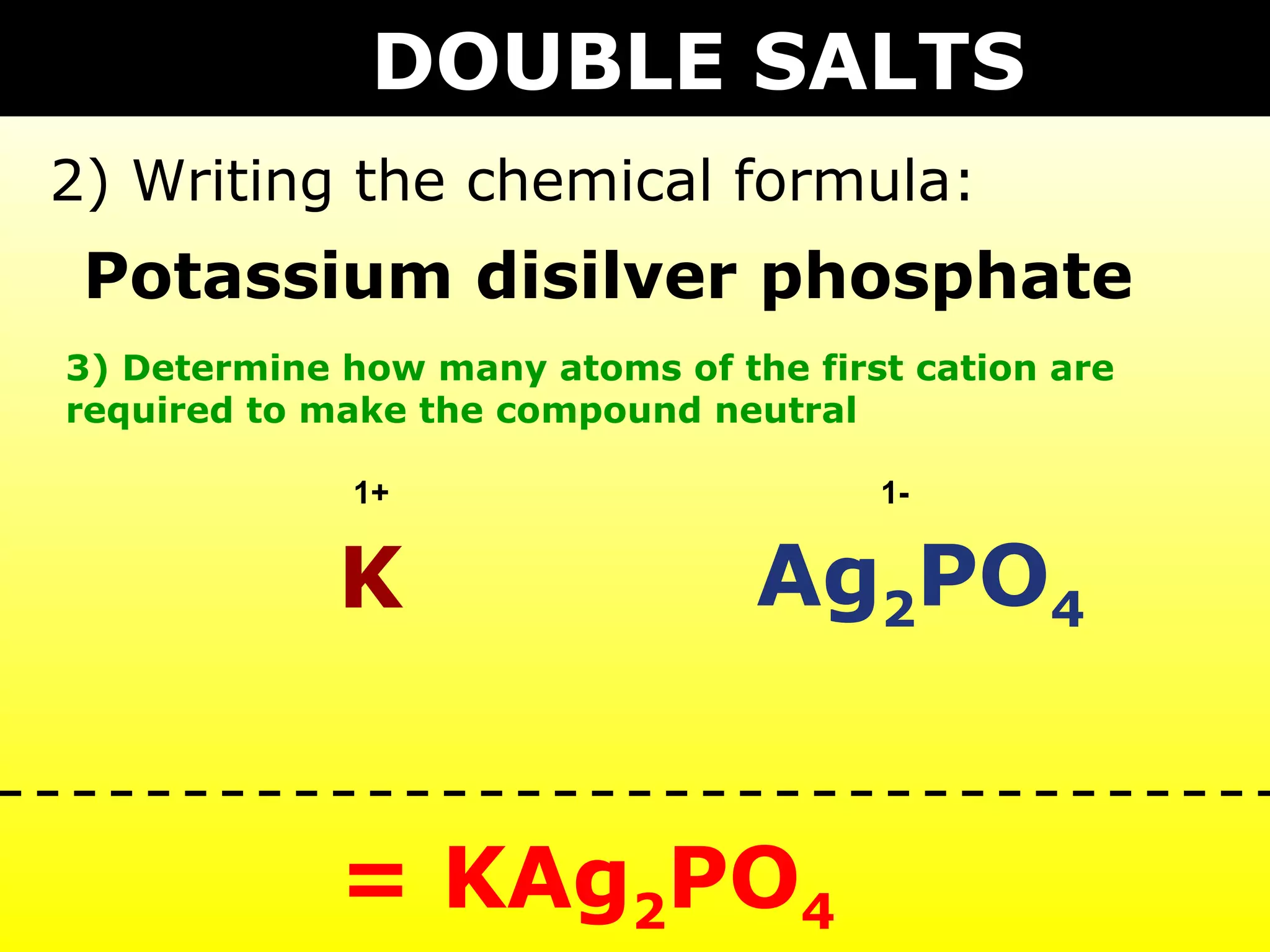
DOUBLE SALTS
2) Writing the chemical formula:
 Potassium disilver phosphate
3) Determine how many atoms of the first cation are
required to make the compound neutral

             1+                        1-


             K                   Ag2PO4


             = KAg2PO4
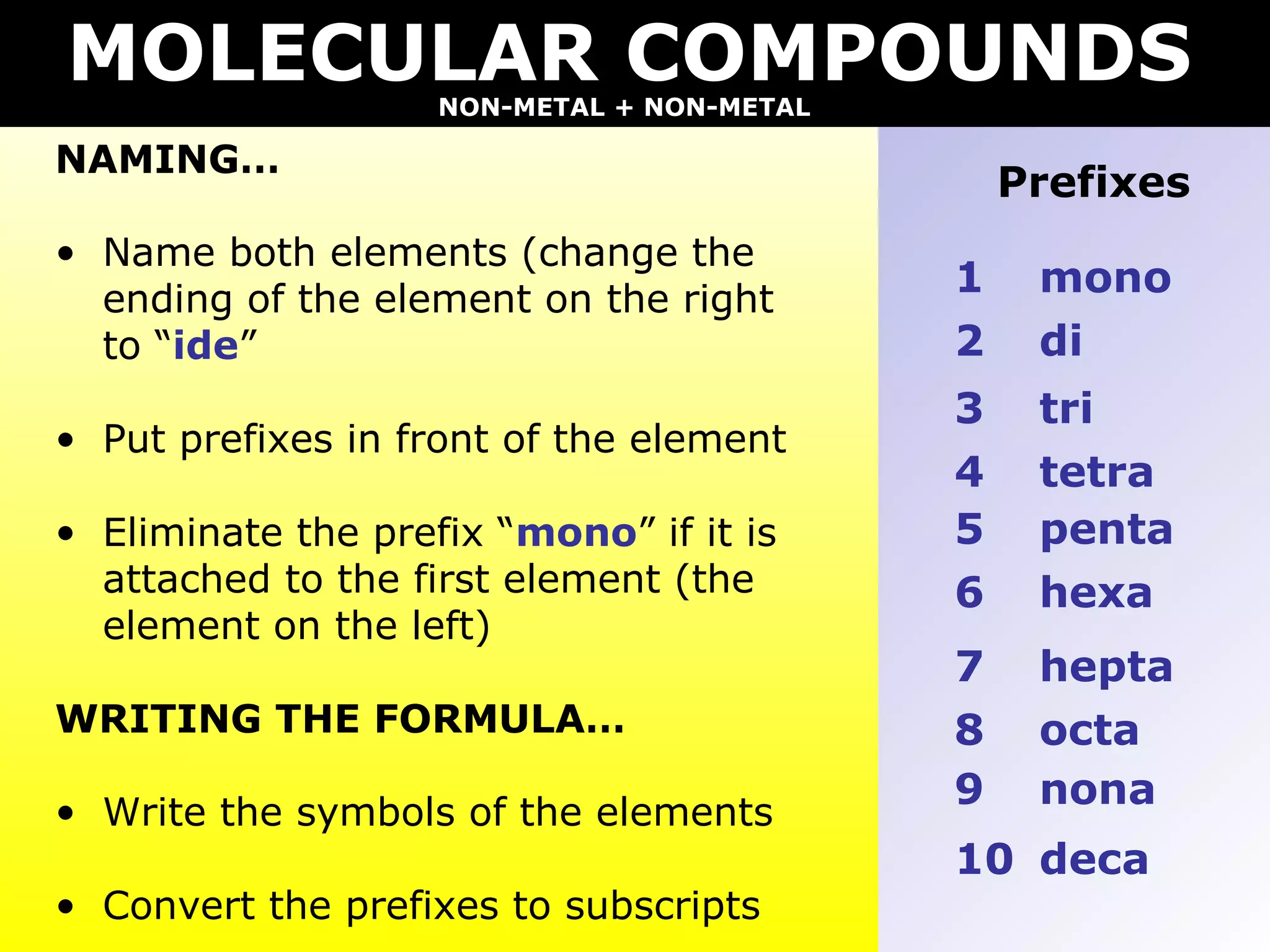
MOLECULAR COMPOUNDS NON-METAL + NON-METAL

NAMING…
                                                Prefixes
• Name both elements (change the
  ending of the element on the right
                                            1    mono
  to “ide”                                  2    di
                                            3    tri
• Put prefixes in front of the element
                                            4    tetra
• Eliminate the prefix “mono” if it is      5    penta
  attached to the first element (the        6    hexa
  element on the left)
                                            7    hepta
WRITING THE FORMULA…                        8    octa
                                            9    nona
• Write the symbols of the elements
                                            10 deca
• Convert the prefixes to subscripts
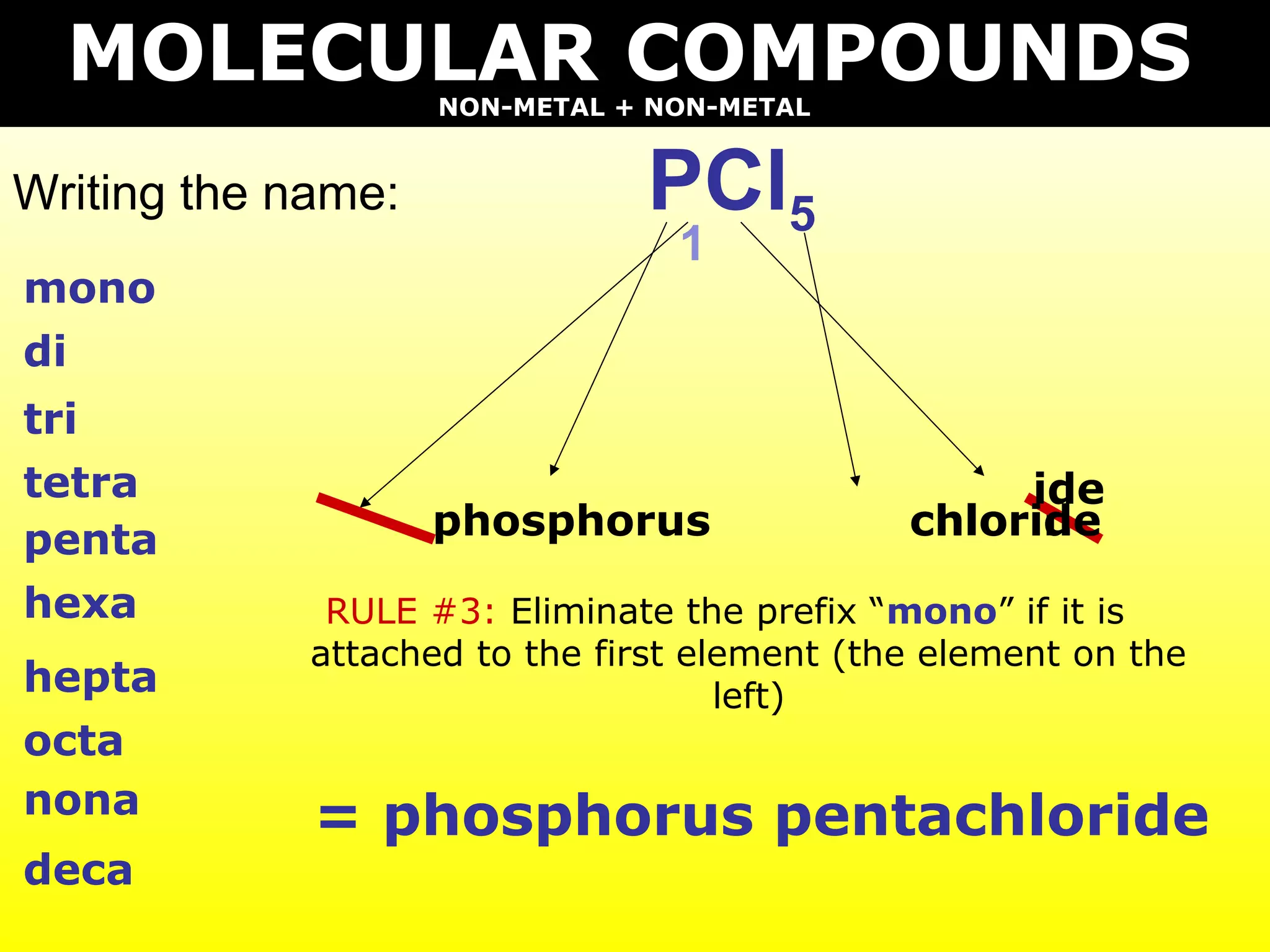
MOLECULAR COMPOUNDS
                    NON-METAL + NON-METAL


Writing the name:              PCl5
                                 1
mono
di
tri
tetra                                              ide
penta               phosphorus                chlorine
                                              chloride
hexa          RULE #3: Eliminate the prefix “mono” if it is
             attached to the first element (the element on the
hepta                                left)
octa
nona         = phosphorus pentachloride
deca
MOLECULAR COMPOUNDS
                   NON-METAL + NON-METAL


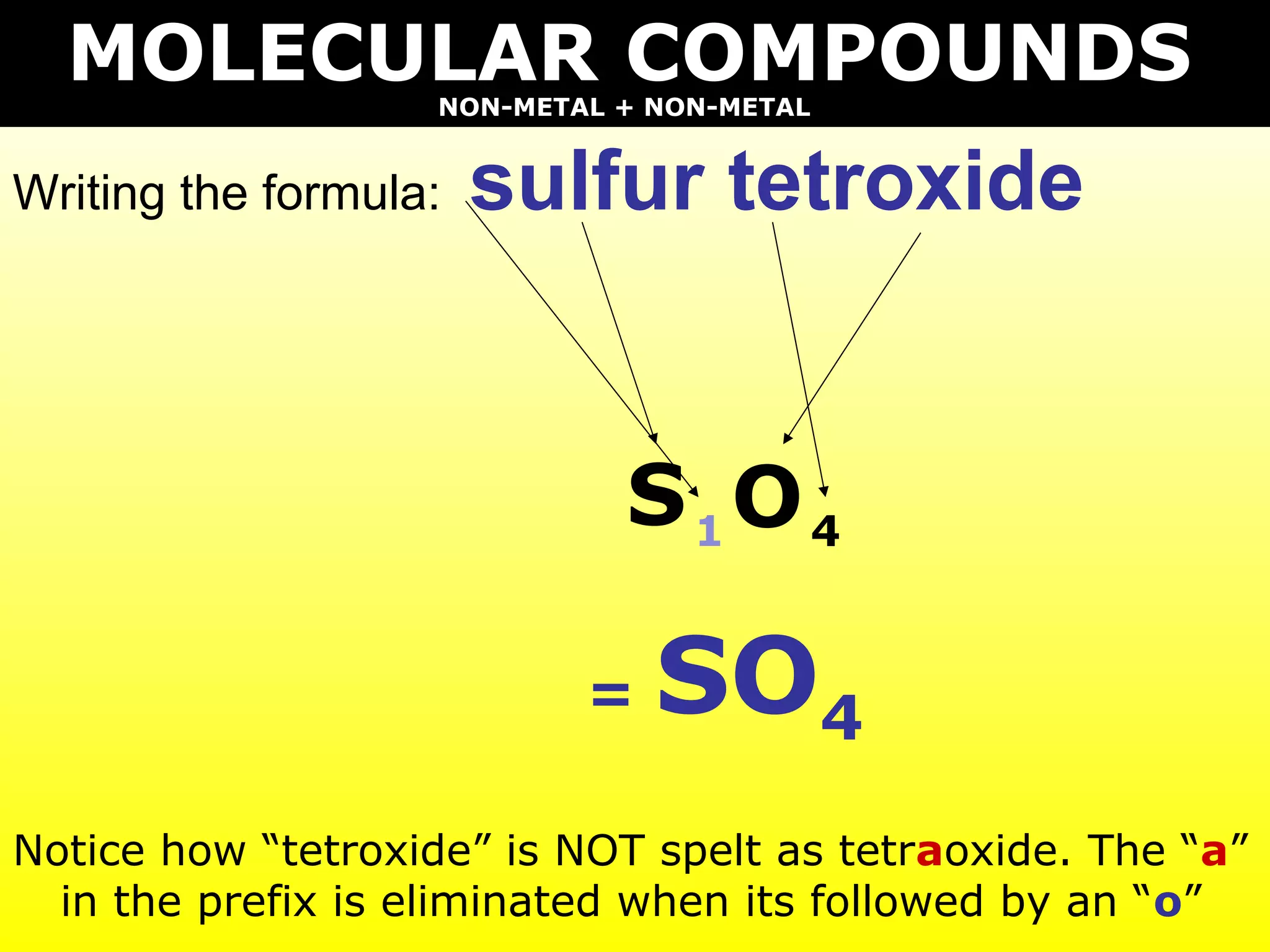
Writing the formula:   sulfur tetroxide


                             S1O4

                           =   SO4
Notice how “tetroxide” is NOT spelt as tetraoxide. The “a”
  in the prefix is eliminated when its followed by an “o”

10 naming and formula writing 2012

  • 1.
  • 2.
    BINARY IONIC COMPOUNDS 1)Naming: MgCl2 ide magnesium chlorine = magnesium chloride
  • 3.
    BINARY IONIC COMPOUNDS 2)Writing the chemical formula: Magnesium oxide 2+ 2- Mg O SIMPLIFY!!! = MgO
  • 4.
    IONIC COMPOUNDS WITHMULTIVALENT METALS 1) Naming: PbI4 Check charge on non-metal Pb I ion to see if you need to 1 4 “un-simplify” lead (IV) iodide = lead (IV) iodide
  • 5.
    IONIC COMPOUNDS WITHMULTIVALENT METALS 1) Naming: Using the “OUS/IC” system lead (IV) iodide “ous” 2+ 4+ “ic” = plumbic iodide
  • 6.
    IONIC COMPOUNDS WITHMULTIVALENT METALS 2) Writing the chemical formula: Copper (II) chloride 2+ 1- Cu Cl = CuCl2
  • 7.
    IONIC COMPOUNDS WITHPOLYATOMIC METALS 1) Naming: Na2SO4 sodium sulfate = sodium sulfate
  • 8.
    IONIC COMPOUNDS WITHPOLYATOMIC METALS 2) Writing the chemical formula: Calcium chlorate 2+ 1- Ca (ClO3) = Ca(ClO3)2
  • 9.
    IONIC COMPOUNDS WITHPOLYATOMIC METALS Meanings of prefixes and suffixes of polyatomic ions: Prefix and suffix Number of Example oxygen atoms Hypo_____ite X-2 oxygen atoms ClO- hypochlorite _____ite X-1 oxygen atoms ClO2- chlorite _____ate X oxygen atoms ClO3- chlorate Per_____ate X+1 oxygen atoms ClO4- perchlorate
  • 10.
    IONIC COMPOUNDS WITHPOLYATOMIC METALS Using prefixes and suffixes of polyatomic ions: NO- hyponitrite NO2- nitrite NO3- nitrate NO4- pernitrate
  • 11.
    ACIDS ACIDS Meanings of prefixes and suffixes of polyatomic ions: Prefix and suffix Number of Example oxygen atoms Hypo_____ous X-2 oxygen atoms SO22- hyposulfurous _____ous X-1 oxygen atoms SO32- sulfurous _____ic X oxygen atoms SO42- sulfuric Per_____ic X+1 oxygen atoms SO52- persulfuric
  • 12.
    ACIDS Most acids have hydrogen 1) Naming: H2SO4(aq) HCl(aq) Sulfuric acid Hydrochloric acid OXYACID BINARY ACID
  • 13.
    ACIDS 2) Writing thechemical formula: Hypobromous acid 1+ 1- H BrO = HBrO(aq)
  • 14.
    HYDRATED SALTS 1) Naming: Sn(ClO3)2 5H2O Name of compound (using proper rules) (prefix)hydrate tin (II) chlorate pentahydrate
  • 15.
    HYDRATED SALTS 2) Writingthe chemical formula: Copper (II) hypoiodite tetrahydrate Formula of compound (using proper rules) #H2O Cu(IO)2 4H2O
  • 16.
    ACID SALTS 1) Naming: Na2HPO4 1) Name the cation 2) “hydrogen” is written second with the appropriate prefix if needed (so if it is “mono”, then you don’t need to write it) 3) Name of anion is written last sodium hydrogen phosphate
  • 17.
    ACID SALTS 2)Writing the chemical formula: Sodium hydrogen phosphate 1) Write the formula for the anion and its charge 2) Write the appropriate number of hydrogen atoms 3) For every H you add, add 1+ to the charge of the polyatomic ion 4) Write the cation and its charge 5) Criss cross 1+ 3- 2- Na HPO4 6) Simplify, if necessary = Na2HPO4
  • 18.
    DOUBLE SALTS 1) Naming: NaFePO4 1) Name the first cation 2) Name of second cation with appropriate prefix (except “mono”) 3) Name of anion is written last sodium iron (II) phosphate
  • 19.
    DOUBLE SALTS 1) Naming: NaFePO4 sodium iron (II) phosphate Must total 3+ Why is this a 2? 1+ X -3 x 1 phosphate molecule NaFe PO4 1+ X = 3 X = 3-1 X=2
  • 20.
    DOUBLE SALTS 2) Writingthe chemical formula: NaFe2(CN)5 1) Name the first cation 2) Name of second cation with appropriate prefix (except “mono”) 3) Name of anion is written last sodium diiron __ cyanide
  • 21.
    DOUBLE SALTS 2) Writingthe chemical formula: NaFe2(CN)5 1+ 2X -1 x 5 cyanide molecules = -5 Must total 5+ 1+ 2X = 5 2X = 5-1 What number X=2 goes here? sodium diiron(II) cyanide __ sodium diiron (II) cyanide
  • 22.
    DOUBLE SALTS 2)Writing the chemical formula: Potassium disilver phosphate 1) Write the chemical formula for all ions and their charges 2) Combine the second cation(s) with the anion and determine their combined charge 1+ (1+) x 2 3- K? Ag2 PO4 ? 1- Ag2PO4
  • 23.
    DOUBLE SALTS 2) Writingthe chemical formula: Potassium disilver phosphate 3) Determine how many atoms of the first cation are required to make the compound neutral 1+ 1- K Ag2PO4 = KAg2PO4
  • 24.
    MOLECULAR COMPOUNDS NON-METAL+ NON-METAL NAMING… Prefixes • Name both elements (change the ending of the element on the right 1 mono to “ide” 2 di 3 tri • Put prefixes in front of the element 4 tetra • Eliminate the prefix “mono” if it is 5 penta attached to the first element (the 6 hexa element on the left) 7 hepta WRITING THE FORMULA… 8 octa 9 nona • Write the symbols of the elements 10 deca • Convert the prefixes to subscripts
  • 25.
    MOLECULAR COMPOUNDS NON-METAL + NON-METAL Writing the name: PCl5 1 mono di tri tetra ide penta phosphorus chlorine chloride hexa RULE #3: Eliminate the prefix “mono” if it is attached to the first element (the element on the hepta left) octa nona = phosphorus pentachloride deca
  • 26.
    MOLECULAR COMPOUNDS NON-METAL + NON-METAL Writing the formula: sulfur tetroxide S1O4 = SO4 Notice how “tetroxide” is NOT spelt as tetraoxide. The “a” in the prefix is eliminated when its followed by an “o”