RULES IN NAMING
INORGANIC
COMPOUND
Prepared by:
STEFFHANIE D. TABLIGA
BINARY MOLECULAR
COMPOUNDS
O When a pair of elements form more than
one type of covalent compound, Greek
prefixes are used to indicate how many of
each element are in a compound.
O The more electronegative element is
written last and its ending is changed to –
ide.
EXAMPLES:
 N2O = Dinitrogen monoxide
 NO = Nitrogen monoxide
 N2O3 = Dinitrogen trioxide
 N205 = Dinitrogen
pentoxide
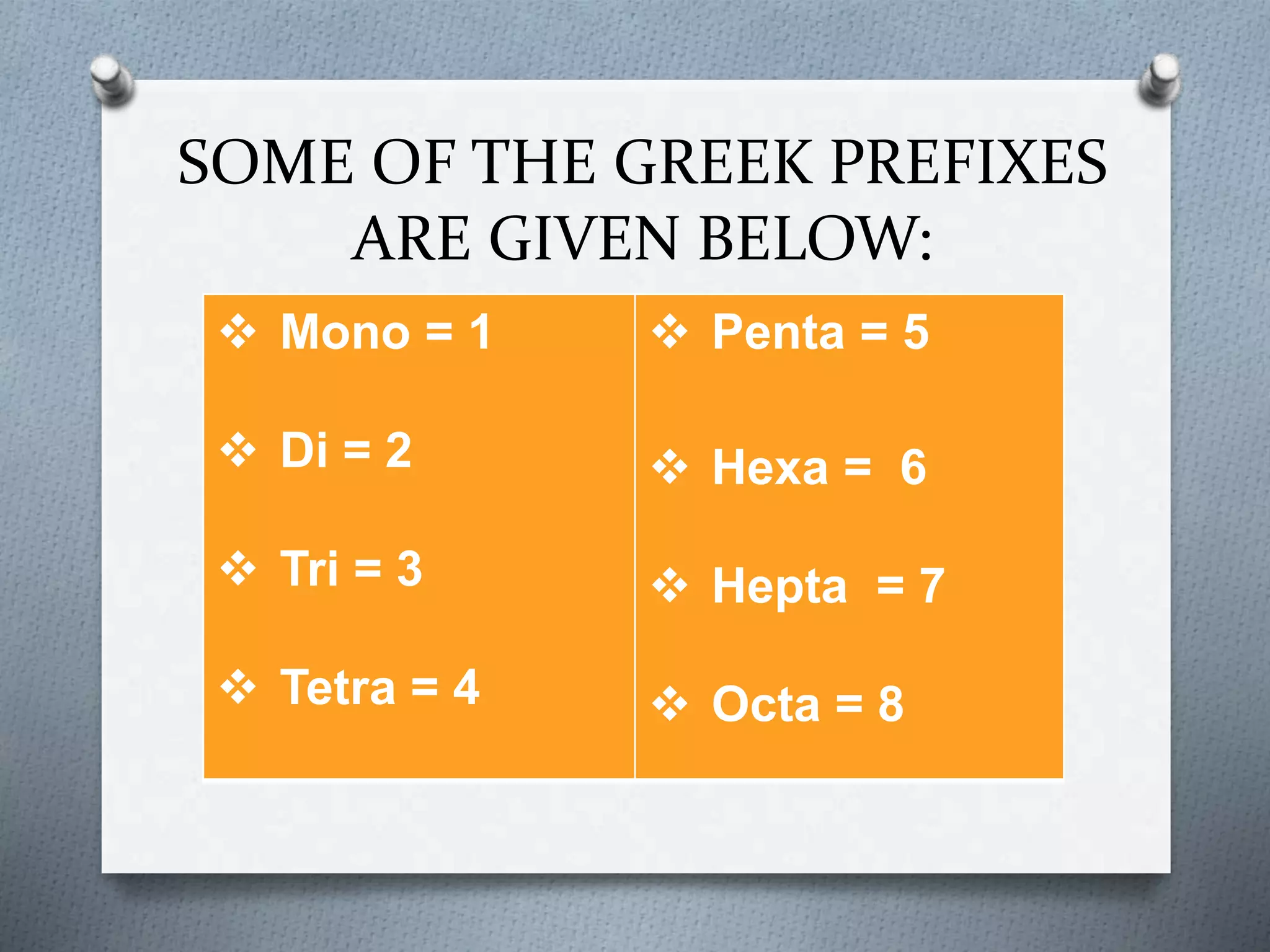
SOME OF THE GREEK PREFIXES
ARE GIVEN BELOW:
 Mono = 1
 Di = 2
 Tri = 3
 Tetra = 4
 Penta = 5
 Hexa = 6
 Hepta = 7
 Octa = 8
IONIC COMPOUNDS
O Metals give up electrons to form positively
charged cations.
O Non-metals gain electrons to form
negatively charged anions.
O Ionic compounds are formed from the
Coulombic interaction between cations
and anions.
WHEN WE NAME AN IONIC
COMPOUND, WE WRITE:
 The name of the cation comes first
followed by the name of the anion,
changing the name of the anion to end in
–ide for monotomic anions are not altered.
EXAMPLES:
• NaCl = Sodium chloride
• Znl2 = Zinc iodide
• NaNO3 = Sodium nitrate
 In those cases where the metal can
form cations of differing charges the
positive charge is given by a roman
numeral in parentheses.
EXAMPLES:
• CuO = Copper (II) Oxide
• Cu2O = Copper (I) Oxide
• Cr2O3 = Chromium (III) Oxide
OXYANIONS
OOxyanions are those polyatomic
anions containing oxygen. There
are a large number of oxyanions,
which makes it difficult to remember
of their names. Fortunately there is
a set of rules that makes this task
much easier.
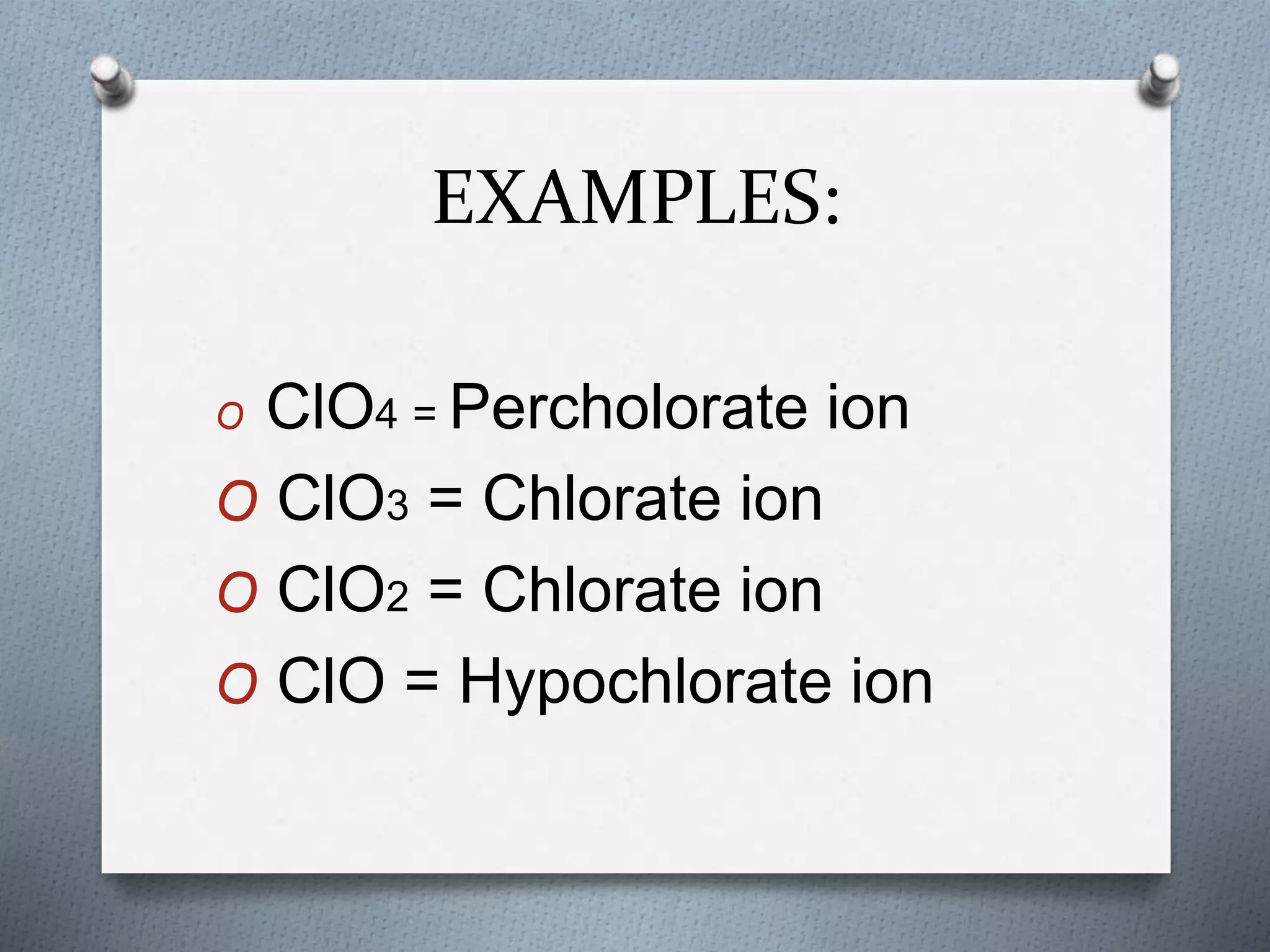
EXAMPLES:
O ClO4 = Percholorate ion
O ClO3 = Chlorate ion
O ClO2 = Chlorate ion
O ClO = Hypochlorate ion
ACIDS
 A simplistic definition of an acid is a
ccompound that dissolves in water
to release H+ ions.
 The ending –ate is used for the
most common oxyanion of a given
element.
 NO3 = Nitrate ion
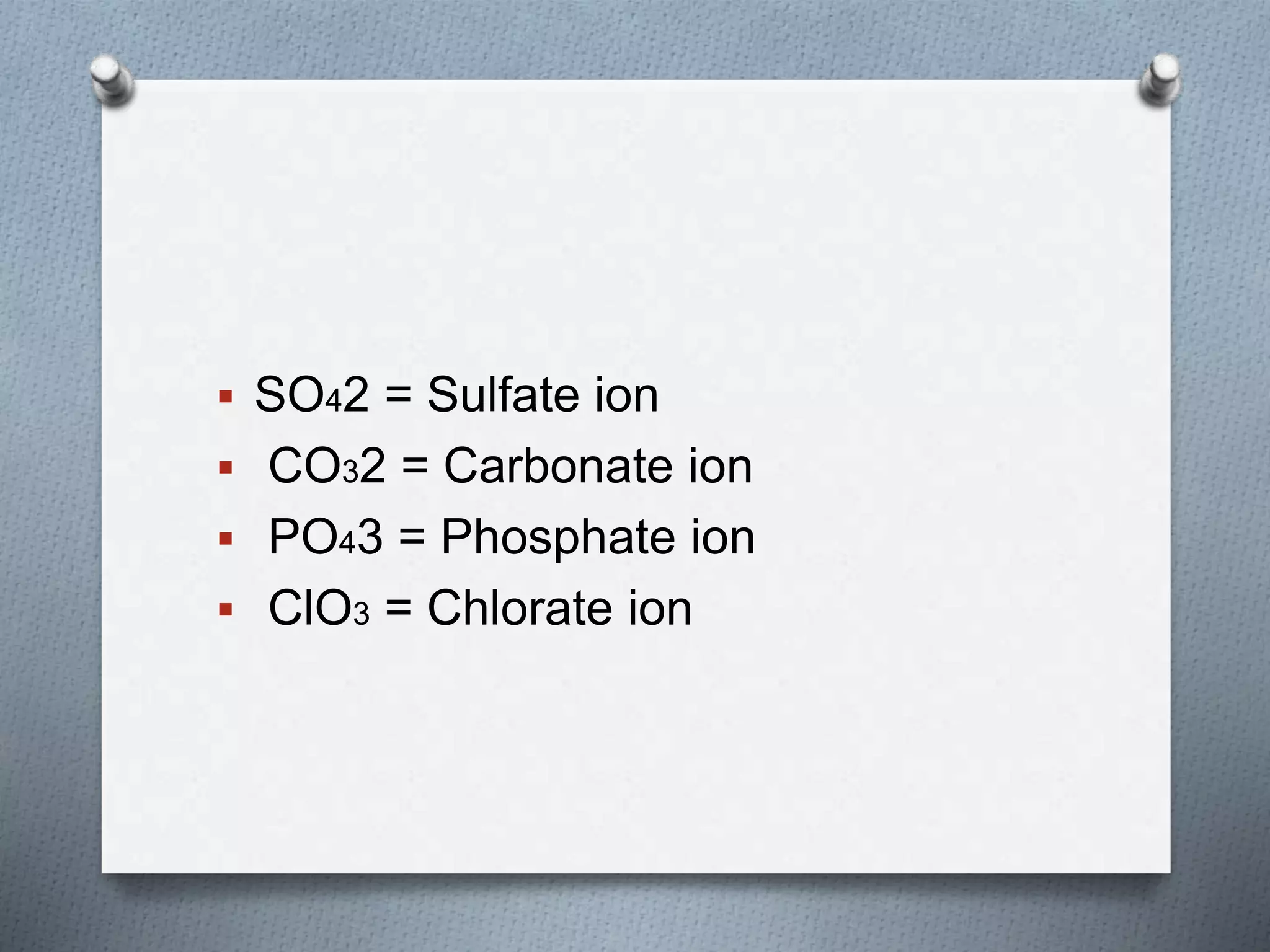
 SO42 = Sulfate ion
 CO32 = Carbonate ion
 PO43 = Phosphate ion
 ClO3 = Chlorate ion
 The ending –ite is used for the oxyanion
with the same charge, but one less
oxygen than the –ate oxyanion.
 NO2 = Nitrite ion
 SO32 = Sulfite ion
 PO33 = Phosphite ion
 ClO2 = Chlorite ion
 The prefix per- is used if there is an
oxyanion with the same charge but one
more oxygen than the –ate oxyanion,
while the prefix hypo- is used.
 A simplistic definition of an acid is a
compound that dissolves in water to
release H+ ions to an oxyanion to balance
its charge. The rules for naming simple
acids are based on the names of the
anions, they are given below.
o When the anion ends in –ide, change the
ending to –ic and add the prefix hydro- to
derive the name of the acid.
o Anion = chloride (Cl-) hydrochloric acid
(HCl)
o Anion = bromide (Br-) hydrobromic acid
(HBr)
o Anion = sulfide (s2) hydrosulfuric acid
(H2S)
o When the anion ends in –are, change the
ending to –ic to derive the name of the
acid.
o Anion = chlorate (CLO3) chloric acid
(HCLO3)
o Anion = sulfate (SO42) sulfuric acid
(H2SO4)
o Anion = nitrate (NO3) nitric acid (HNO3)
o When the anion ends in –ite, change the
ending to –ous to derive the name of the
acid.
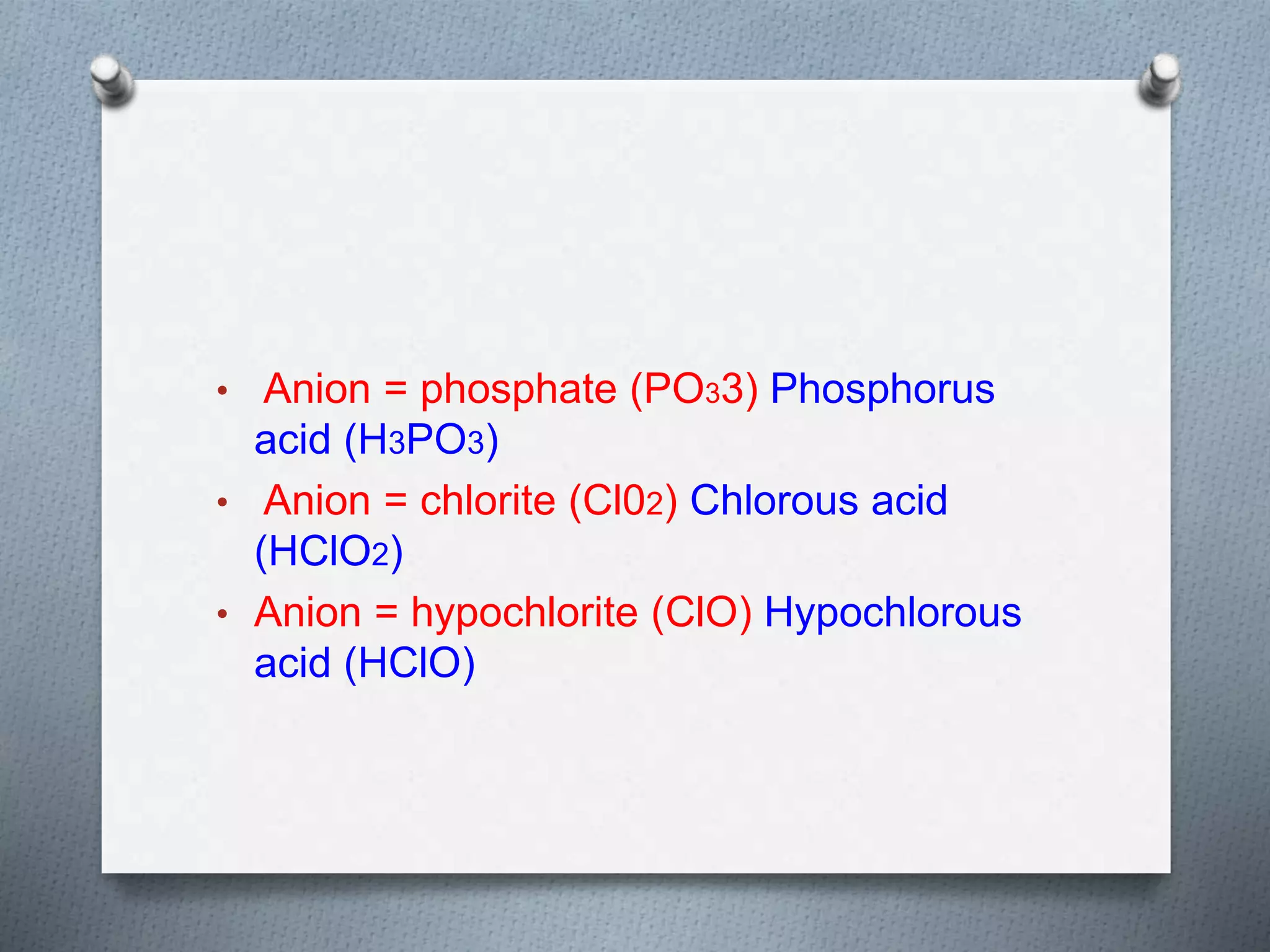
• Anion = phosphate (PO33) Phosphorus
acid (H3PO3)
• Anion = chlorite (Cl02) Chlorous acid
(HClO2)
• Anion = hypochlorite (ClO) Hypochlorous
acid (HClO)
THANK YOU  
AND
GOD BLESS  

rules in naming organic compound

  • 1.
  • 2.
    BINARY MOLECULAR COMPOUNDS O Whena pair of elements form more than one type of covalent compound, Greek prefixes are used to indicate how many of each element are in a compound. O The more electronegative element is written last and its ending is changed to – ide.
  • 3.
    EXAMPLES:  N2O =Dinitrogen monoxide  NO = Nitrogen monoxide  N2O3 = Dinitrogen trioxide  N205 = Dinitrogen pentoxide
  • 4.
    SOME OF THEGREEK PREFIXES ARE GIVEN BELOW:  Mono = 1  Di = 2  Tri = 3  Tetra = 4  Penta = 5  Hexa = 6  Hepta = 7  Octa = 8
  • 5.
    IONIC COMPOUNDS O Metalsgive up electrons to form positively charged cations. O Non-metals gain electrons to form negatively charged anions. O Ionic compounds are formed from the Coulombic interaction between cations and anions.
  • 6.
    WHEN WE NAMEAN IONIC COMPOUND, WE WRITE:  The name of the cation comes first followed by the name of the anion, changing the name of the anion to end in –ide for monotomic anions are not altered. EXAMPLES: • NaCl = Sodium chloride • Znl2 = Zinc iodide • NaNO3 = Sodium nitrate
  • 7.
     In thosecases where the metal can form cations of differing charges the positive charge is given by a roman numeral in parentheses. EXAMPLES: • CuO = Copper (II) Oxide • Cu2O = Copper (I) Oxide • Cr2O3 = Chromium (III) Oxide
  • 8.
    OXYANIONS OOxyanions are thosepolyatomic anions containing oxygen. There are a large number of oxyanions, which makes it difficult to remember of their names. Fortunately there is a set of rules that makes this task much easier.
  • 9.
    EXAMPLES: O ClO4 =Percholorate ion O ClO3 = Chlorate ion O ClO2 = Chlorate ion O ClO = Hypochlorate ion
  • 10.
    ACIDS  A simplisticdefinition of an acid is a ccompound that dissolves in water to release H+ ions.  The ending –ate is used for the most common oxyanion of a given element.  NO3 = Nitrate ion
  • 11.
     SO42 =Sulfate ion  CO32 = Carbonate ion  PO43 = Phosphate ion  ClO3 = Chlorate ion
  • 12.
     The ending–ite is used for the oxyanion with the same charge, but one less oxygen than the –ate oxyanion.  NO2 = Nitrite ion  SO32 = Sulfite ion  PO33 = Phosphite ion  ClO2 = Chlorite ion
  • 13.
     The prefixper- is used if there is an oxyanion with the same charge but one more oxygen than the –ate oxyanion, while the prefix hypo- is used.  A simplistic definition of an acid is a compound that dissolves in water to release H+ ions to an oxyanion to balance its charge. The rules for naming simple acids are based on the names of the anions, they are given below.
  • 14.
    o When theanion ends in –ide, change the ending to –ic and add the prefix hydro- to derive the name of the acid. o Anion = chloride (Cl-) hydrochloric acid (HCl) o Anion = bromide (Br-) hydrobromic acid (HBr) o Anion = sulfide (s2) hydrosulfuric acid (H2S)
  • 15.
    o When theanion ends in –are, change the ending to –ic to derive the name of the acid. o Anion = chlorate (CLO3) chloric acid (HCLO3) o Anion = sulfate (SO42) sulfuric acid (H2SO4) o Anion = nitrate (NO3) nitric acid (HNO3) o When the anion ends in –ite, change the ending to –ous to derive the name of the acid.
  • 16.
    • Anion =phosphate (PO33) Phosphorus acid (H3PO3) • Anion = chlorite (Cl02) Chlorous acid (HClO2) • Anion = hypochlorite (ClO) Hypochlorous acid (HClO)
  • 17.
    THANK YOU  AND GOD BLESS  