Warm-up Are the following compound ionic? MgCl 2  CO 2 CaS H 2 O What are the characteristics of ionic compounds? Metal and nonmetal in formula High melting point. Conductive as liquid, or dissolved in water. Form Crystals Shatter when struck
4-6: Naming Compounds Name  ionic compounds. Write  formulas from ionic compound names.
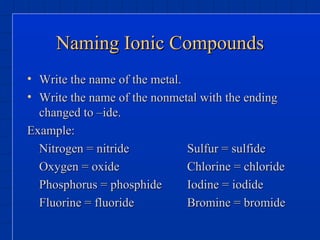
Naming Ionic Compounds Write the name of the metal. Write the name of the nonmetal with the ending changed to –ide. Example: Nitrogen = nitride Sulfur = sulfide Oxygen = oxide Chlorine = chloride Phosphorus = phosphide Iodine = iodide Fluorine = fluoride Bromine = bromide
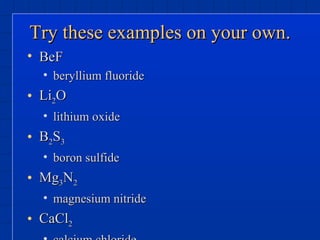
Try these examples on your own. BeF beryllium fluoride Li 2 O lithium oxide B 2 S 3 boron sulfide Mg 3 N 2 magnesium nitride CaCl 2 calcium chloride
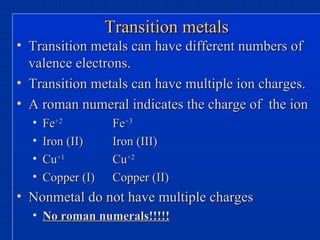
Transition metals Transition metals can have different numbers of valence electrons.  Transition metals can have multiple ion charges. A roman numeral indicates the charge of  the ion Fe +2 Fe +3 Iron (II) Iron (III) Cu +1 Cu +2 Copper (I) Copper (II) Nonmetal do not have multiple charges No roman numerals!!!!!
Naming Ionic Compounds Name metal (positive charge) Use roman numeral only if it is a transition metal with multiple charges. Name nonmetal (negative charge) No roman numerals!!!!!!!!
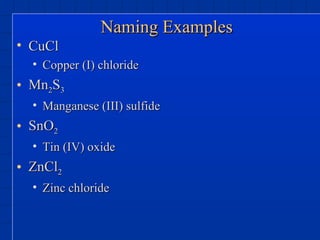
Naming Examples CuCl Copper (I) chloride Mn 2 S 3 Manganese (III) sulfide SnO 2 Tin (IV) oxide ZnCl 2 Zinc chloride
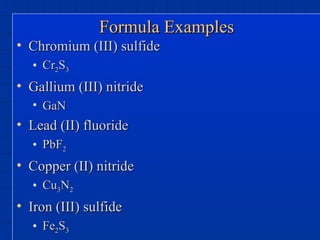
Formula Examples Chromium (III) sulfide Cr 2 S 3 Gallium (III) nitride GaN Lead (II) fluoride PbF 2 Copper (II) nitride Cu 3 N 2 Iron (III) sulfide Fe 2 S 3
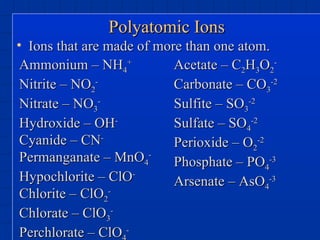
Polyatomic Ions Ions that are made of more than one atom. Ammonium – NH 4 + Nitrite – NO 2 -   Nitrate – NO 3 - Hydroxide – OH - Cyanide – CN - Permanganate – MnO 4 - Hypochlorite – ClO - Chlorite – ClO 2 - Chlorate – ClO 3 - Perchlorate – ClO 4 - Acetate – C 2 H 3 O 2 - Carbonate – CO 3 -2 Sulfite – SO 3 -2 Sulfate – SO 4 -2 Perioxide – O 2 -2 Phosphate – PO 4 -3 Arsenate – AsO 4 -3
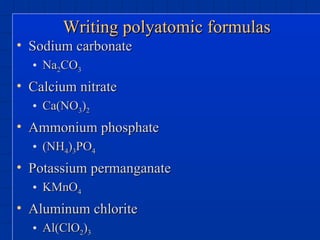
Writing polyatomic formulas Sodium carbonate Na 2 CO 3 Calcium nitrate Ca(NO 3 ) 2 Ammonium phosphate (NH 4 ) 3 PO 4 Potassium permanganate KMnO 4 Aluminum chlorite Al(ClO 2 ) 3
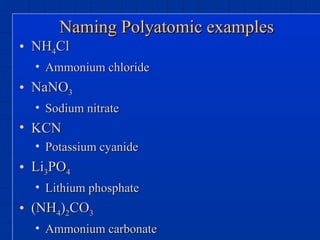
Naming Polyatomic examples NH 4 Cl Ammonium chloride NaNO 3 Sodium nitrate KCN Potassium cyanide Li 3 PO 4 Lithium phosphate (NH 4 ) 2 CO 3 Ammonium carbonate

4-6 Naming Ionic Compounds

  • 1.
    Warm-up Are thefollowing compound ionic? MgCl 2 CO 2 CaS H 2 O What are the characteristics of ionic compounds? Metal and nonmetal in formula High melting point. Conductive as liquid, or dissolved in water. Form Crystals Shatter when struck
  • 2.
    4-6: Naming CompoundsName ionic compounds. Write formulas from ionic compound names.
  • 3.
    Naming Ionic CompoundsWrite the name of the metal. Write the name of the nonmetal with the ending changed to –ide. Example: Nitrogen = nitride Sulfur = sulfide Oxygen = oxide Chlorine = chloride Phosphorus = phosphide Iodine = iodide Fluorine = fluoride Bromine = bromide
  • 4.
    Try these exampleson your own. BeF beryllium fluoride Li 2 O lithium oxide B 2 S 3 boron sulfide Mg 3 N 2 magnesium nitride CaCl 2 calcium chloride
  • 5.
    Transition metals Transitionmetals can have different numbers of valence electrons. Transition metals can have multiple ion charges. A roman numeral indicates the charge of the ion Fe +2 Fe +3 Iron (II) Iron (III) Cu +1 Cu +2 Copper (I) Copper (II) Nonmetal do not have multiple charges No roman numerals!!!!!
  • 6.
    Naming Ionic CompoundsName metal (positive charge) Use roman numeral only if it is a transition metal with multiple charges. Name nonmetal (negative charge) No roman numerals!!!!!!!!
  • 7.
    Naming Examples CuClCopper (I) chloride Mn 2 S 3 Manganese (III) sulfide SnO 2 Tin (IV) oxide ZnCl 2 Zinc chloride
  • 8.
    Formula Examples Chromium(III) sulfide Cr 2 S 3 Gallium (III) nitride GaN Lead (II) fluoride PbF 2 Copper (II) nitride Cu 3 N 2 Iron (III) sulfide Fe 2 S 3
  • 9.
    Polyatomic Ions Ionsthat are made of more than one atom. Ammonium – NH 4 + Nitrite – NO 2 - Nitrate – NO 3 - Hydroxide – OH - Cyanide – CN - Permanganate – MnO 4 - Hypochlorite – ClO - Chlorite – ClO 2 - Chlorate – ClO 3 - Perchlorate – ClO 4 - Acetate – C 2 H 3 O 2 - Carbonate – CO 3 -2 Sulfite – SO 3 -2 Sulfate – SO 4 -2 Perioxide – O 2 -2 Phosphate – PO 4 -3 Arsenate – AsO 4 -3
  • 10.
    Writing polyatomic formulasSodium carbonate Na 2 CO 3 Calcium nitrate Ca(NO 3 ) 2 Ammonium phosphate (NH 4 ) 3 PO 4 Potassium permanganate KMnO 4 Aluminum chlorite Al(ClO 2 ) 3
  • 11.
    Naming Polyatomic examplesNH 4 Cl Ammonium chloride NaNO 3 Sodium nitrate KCN Potassium cyanide Li 3 PO 4 Lithium phosphate (NH 4 ) 2 CO 3 Ammonium carbonate