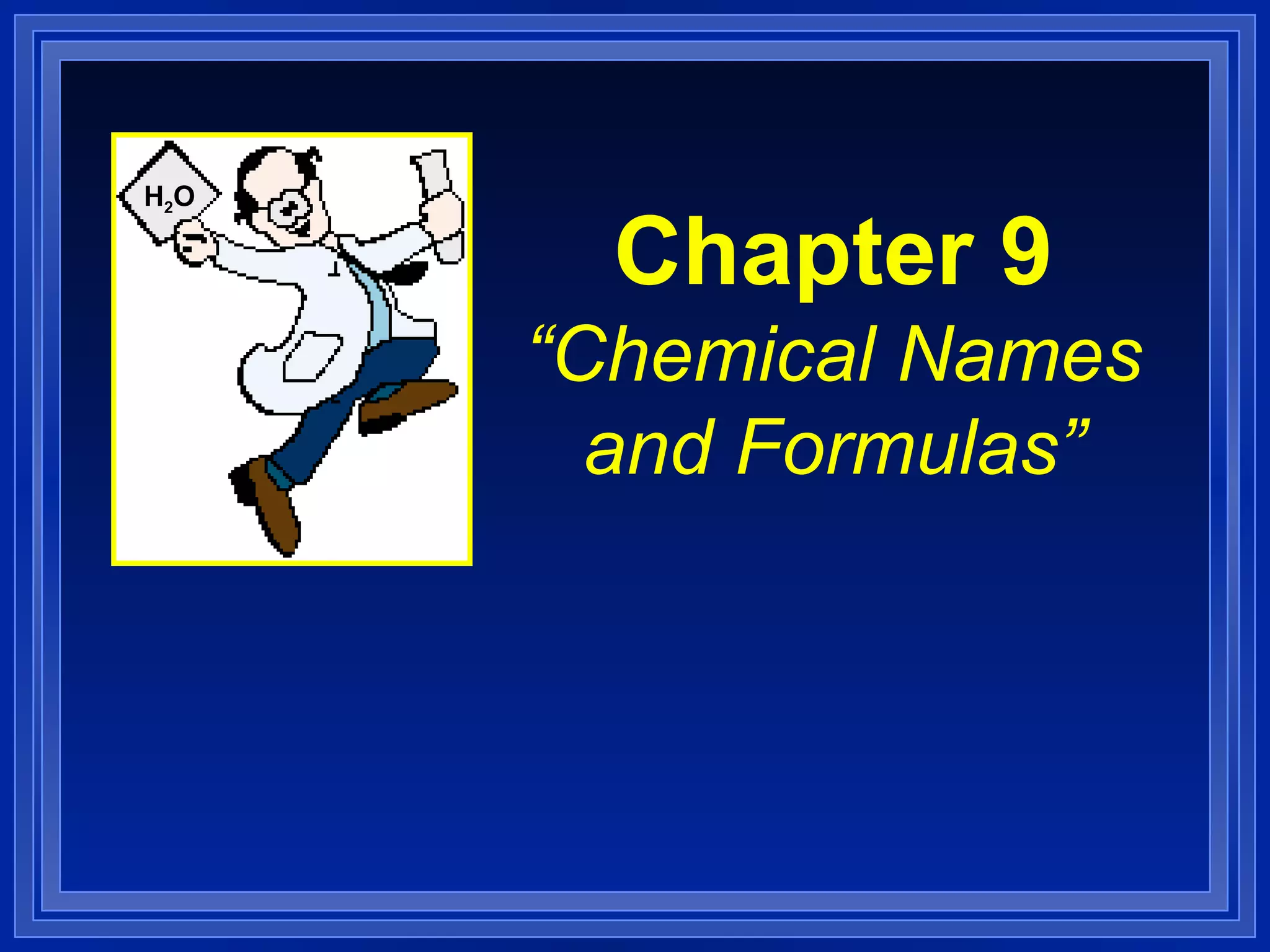
Chapter 9 “Chemical Names and Formulas” H 2 O
Section 9.1 Naming Ions OBJECTIVES: Identify  the charges on monatomic ions by using the periodic table, and  name  the ions.
Section 9.1 Naming Ions OBJECTIVES: Define  a polyatomic ion and  write  the names and formulas of the most common polyatomic ions.
Section 9.1 Naming Ions OBJECTIVES: Identify  the two common  endings  for the names of most polyatomic ions.
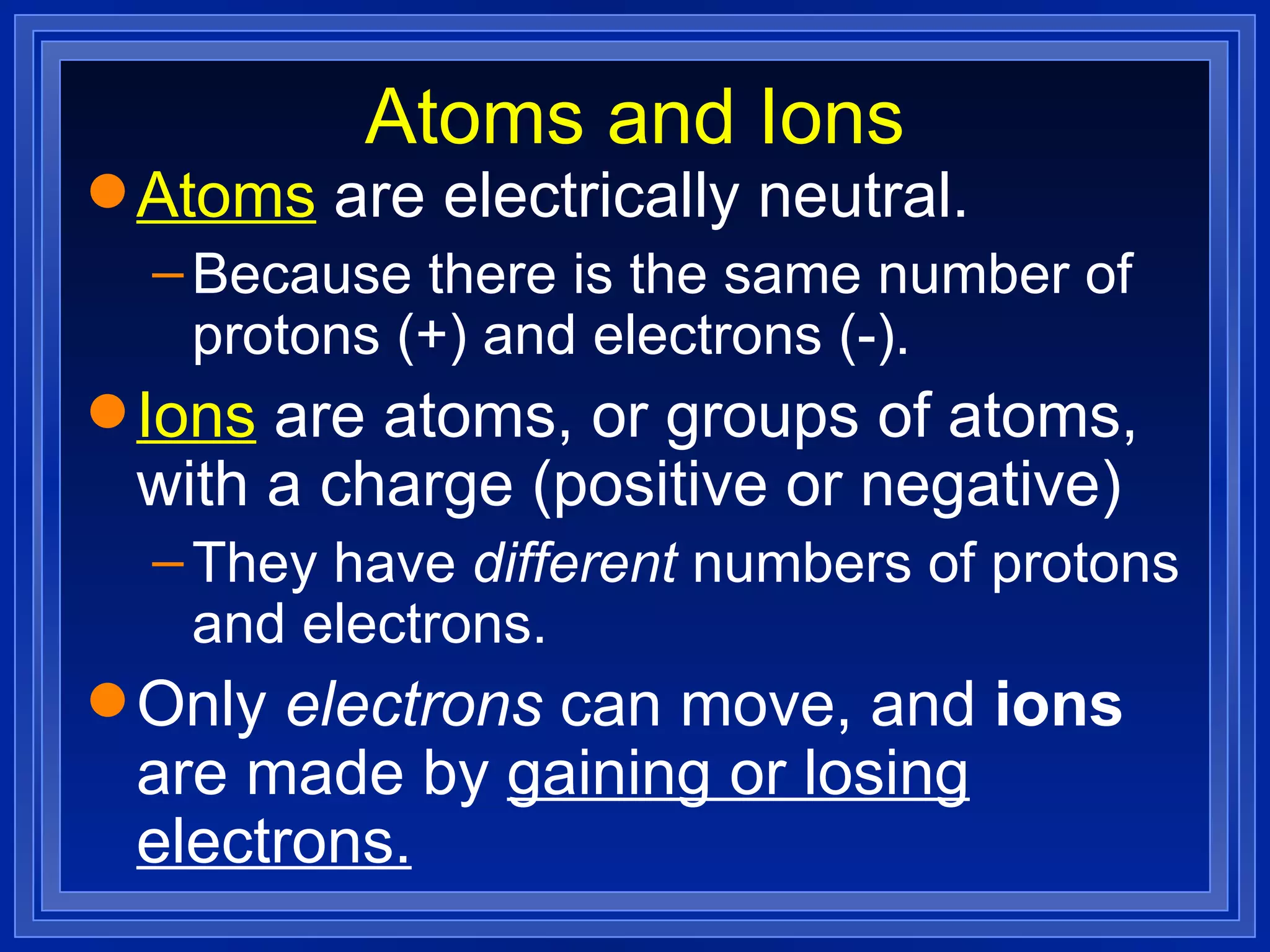
Atoms and Ions Atoms  are electrically neutral. Because there is the same number of protons (+) and electrons (-). Ions  are atoms, or groups of atoms, with a charge (positive or negative) They have  different  numbers of protons and electrons. Only  electrons  can move, and  ions  are made by  gaining or losing electrons.
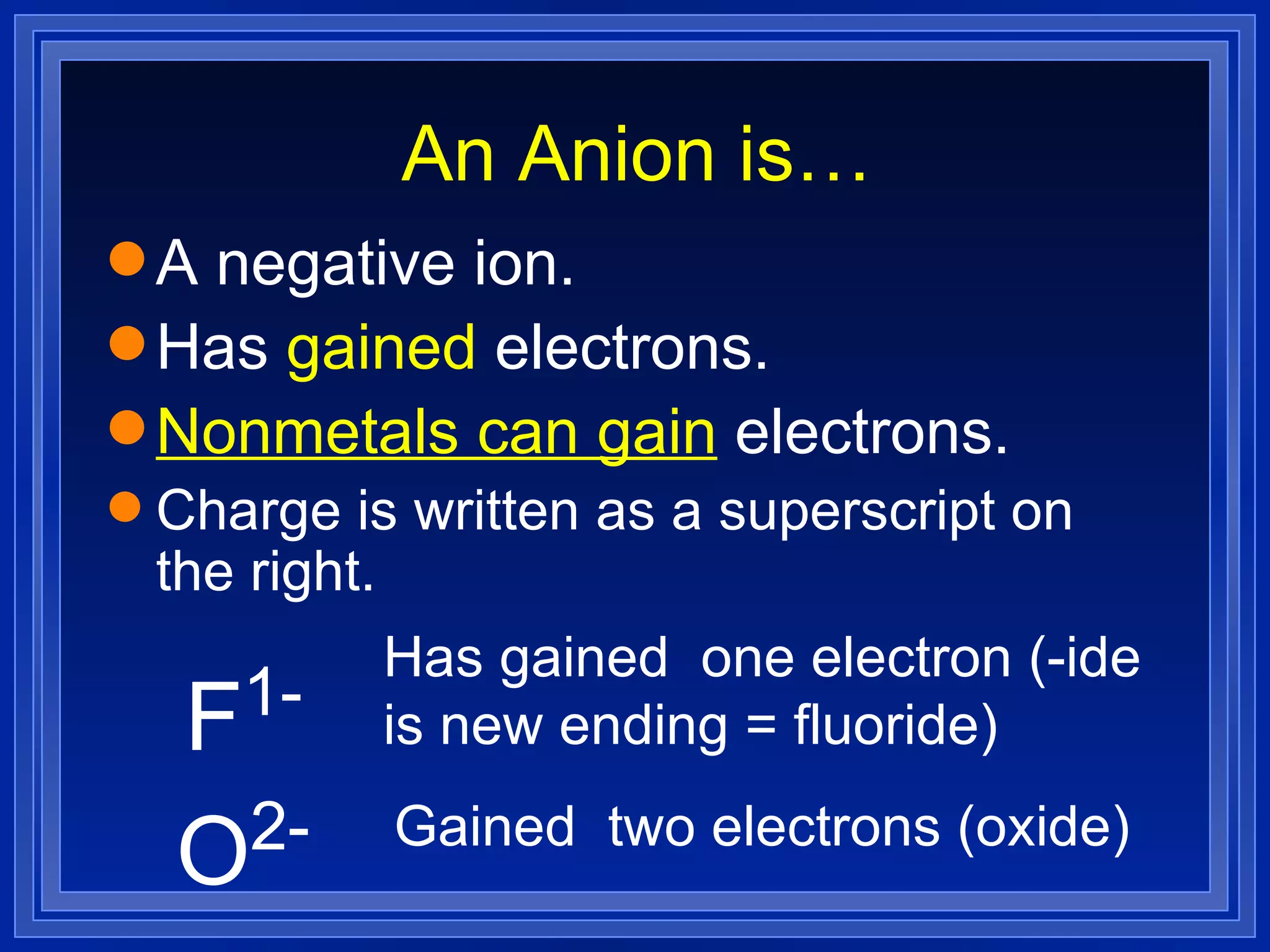
An Anion is… A negative ion. Has  gained  electrons. Nonmetals can gain  electrons. Charge is written as a superscript on the right. F 1- Has gained  one electron (-ide is new ending = fluoride) O 2- Gained  two electrons (oxide)
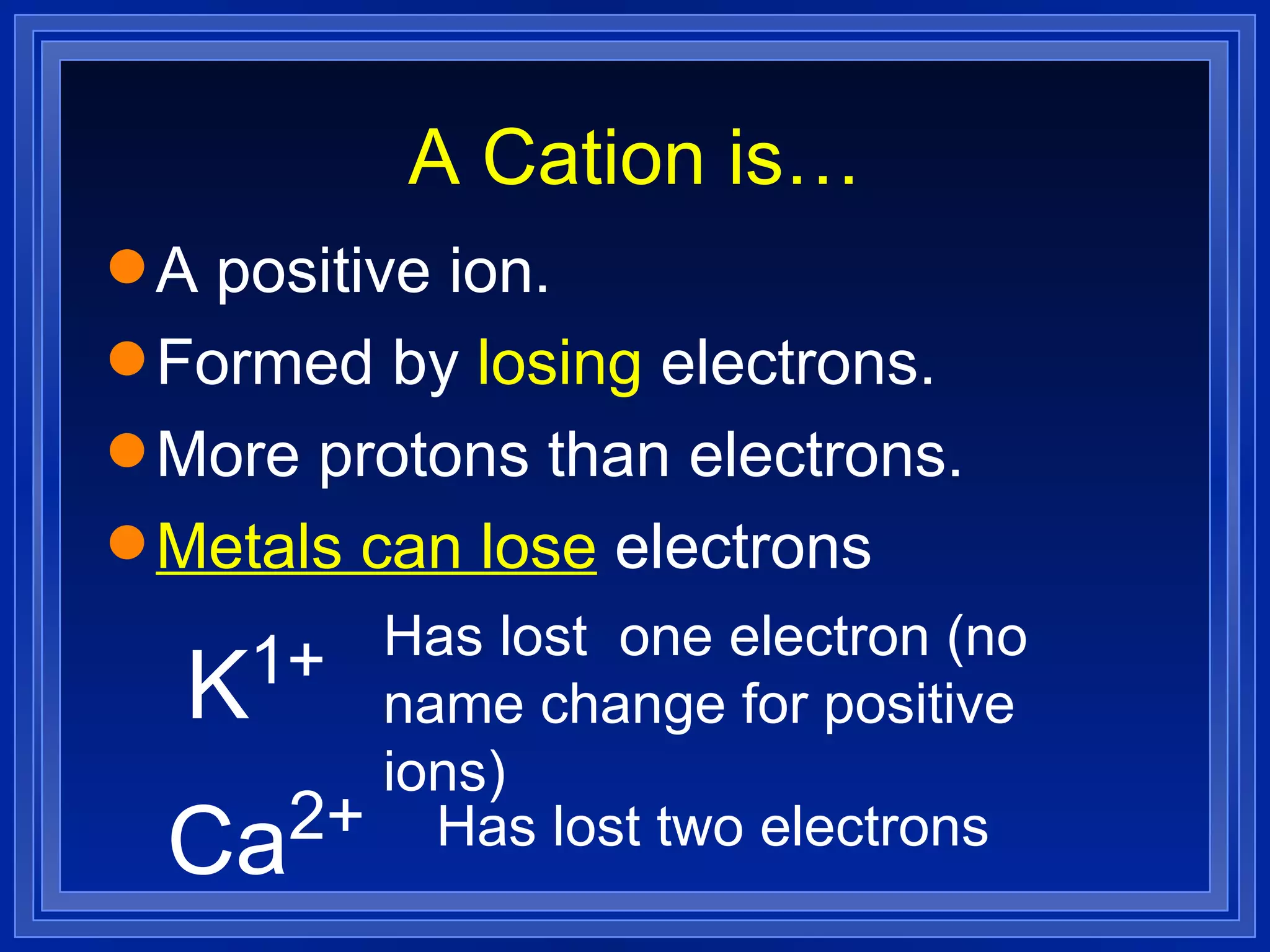
A Cation is… A positive ion. Formed by  losing  electrons. More protons than electrons. Metals can lose  electrons K 1+ Has lost  one electron (no name change for positive ions) Ca 2+ Has lost two electrons
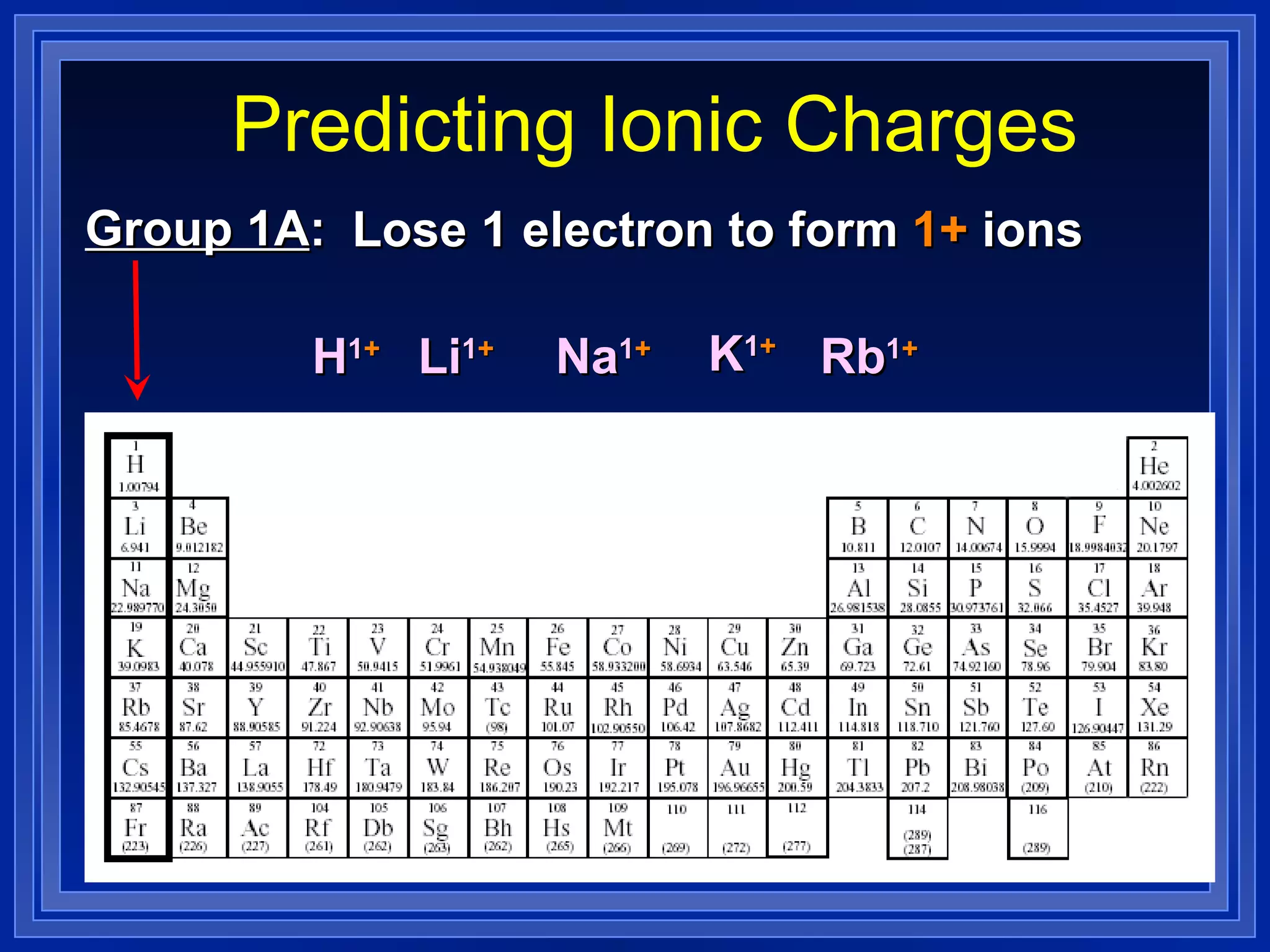
Predicting Ionic Charges Group 1A : Lose 1 electron to form  1+  ions H 1 + Li 1 + Na 1 + K 1 + Rb 1 +
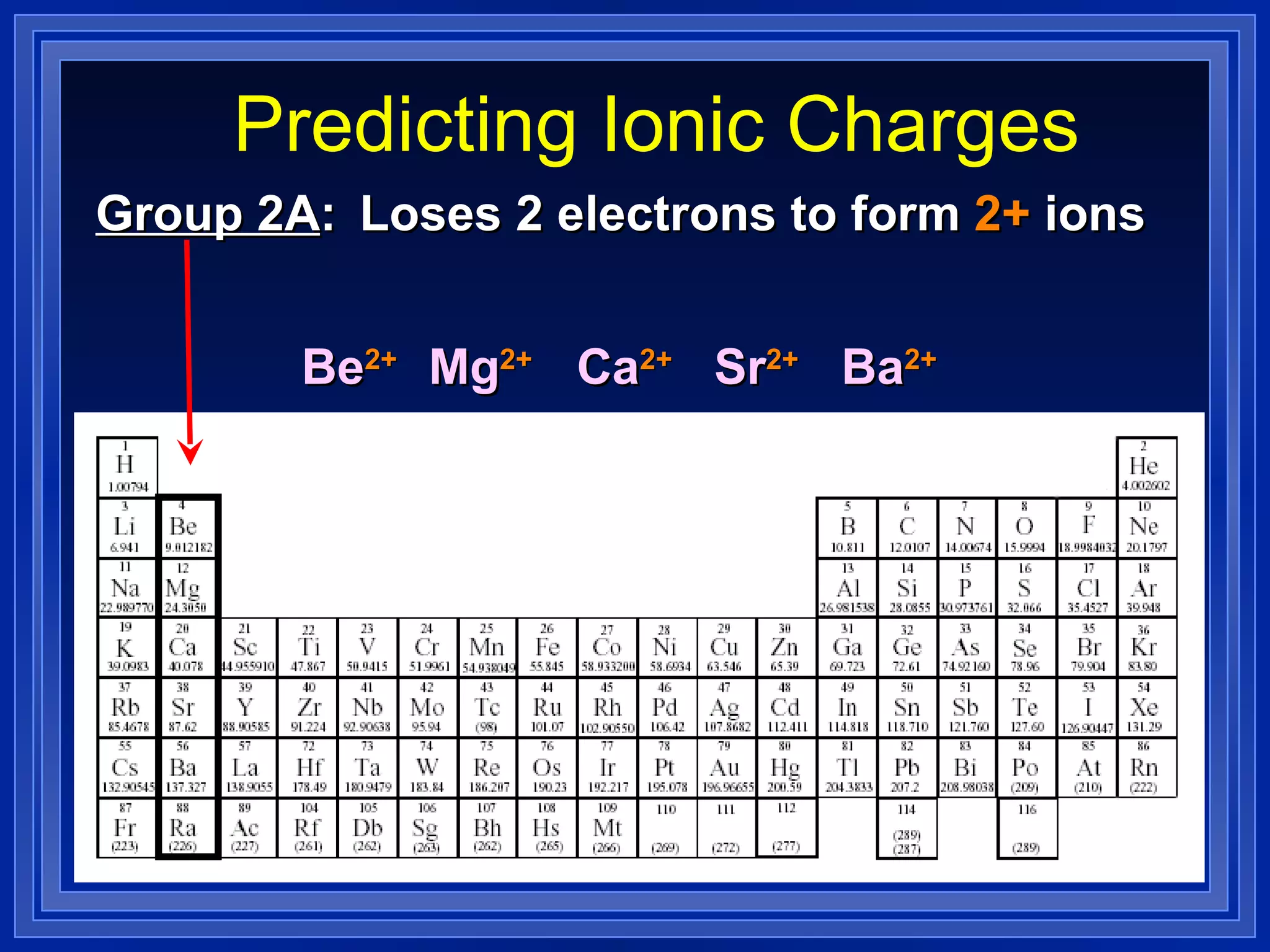
Predicting Ionic Charges Group 2A : Loses 2 electrons to form  2+  ions Be 2+ Mg 2+ Ca 2+ Sr 2+ Ba 2+
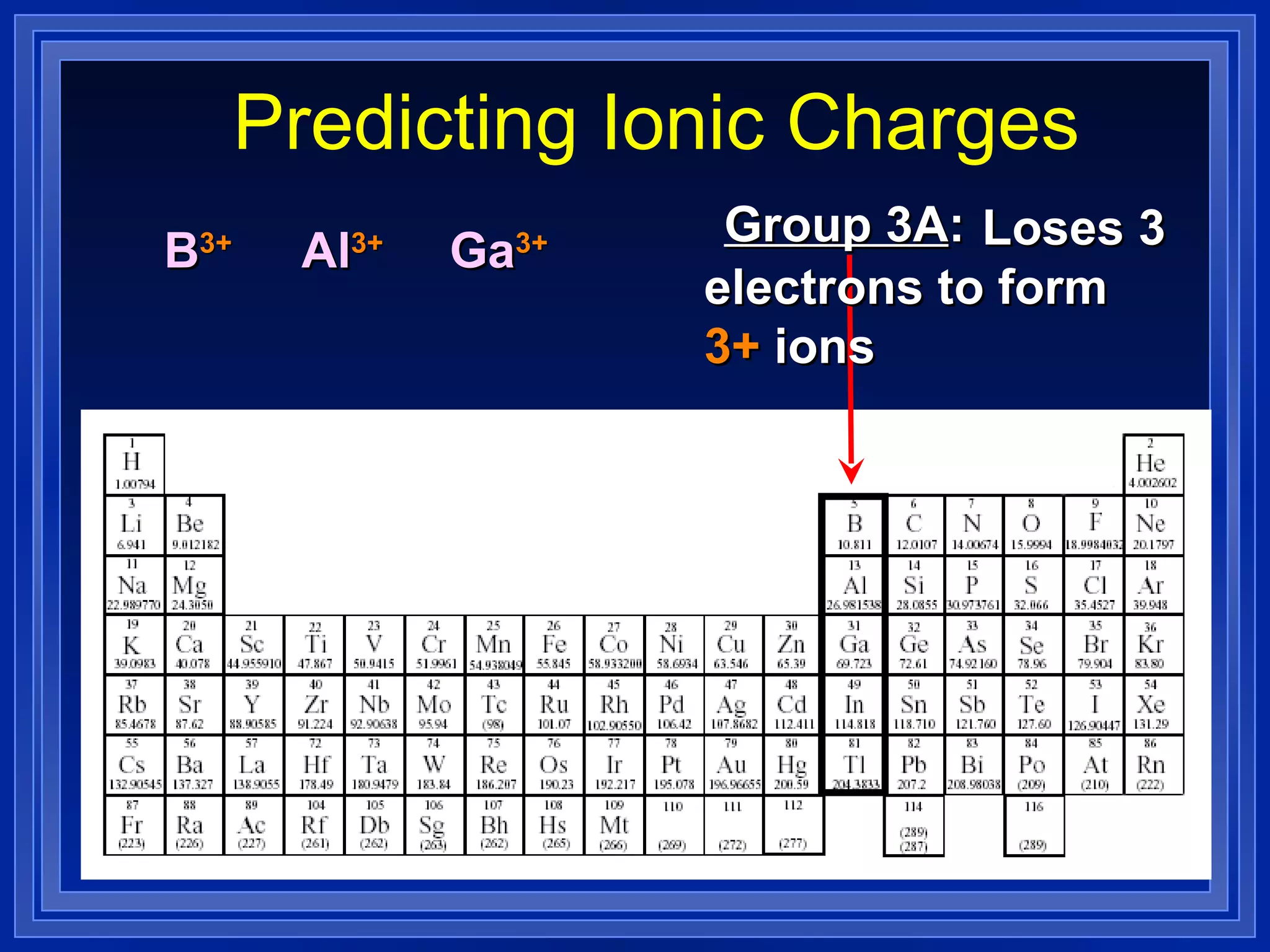
Predicting Ionic Charges Group 3A : Loses 3  electrons to form  3+  ions B 3+ Al 3+ Ga 3+
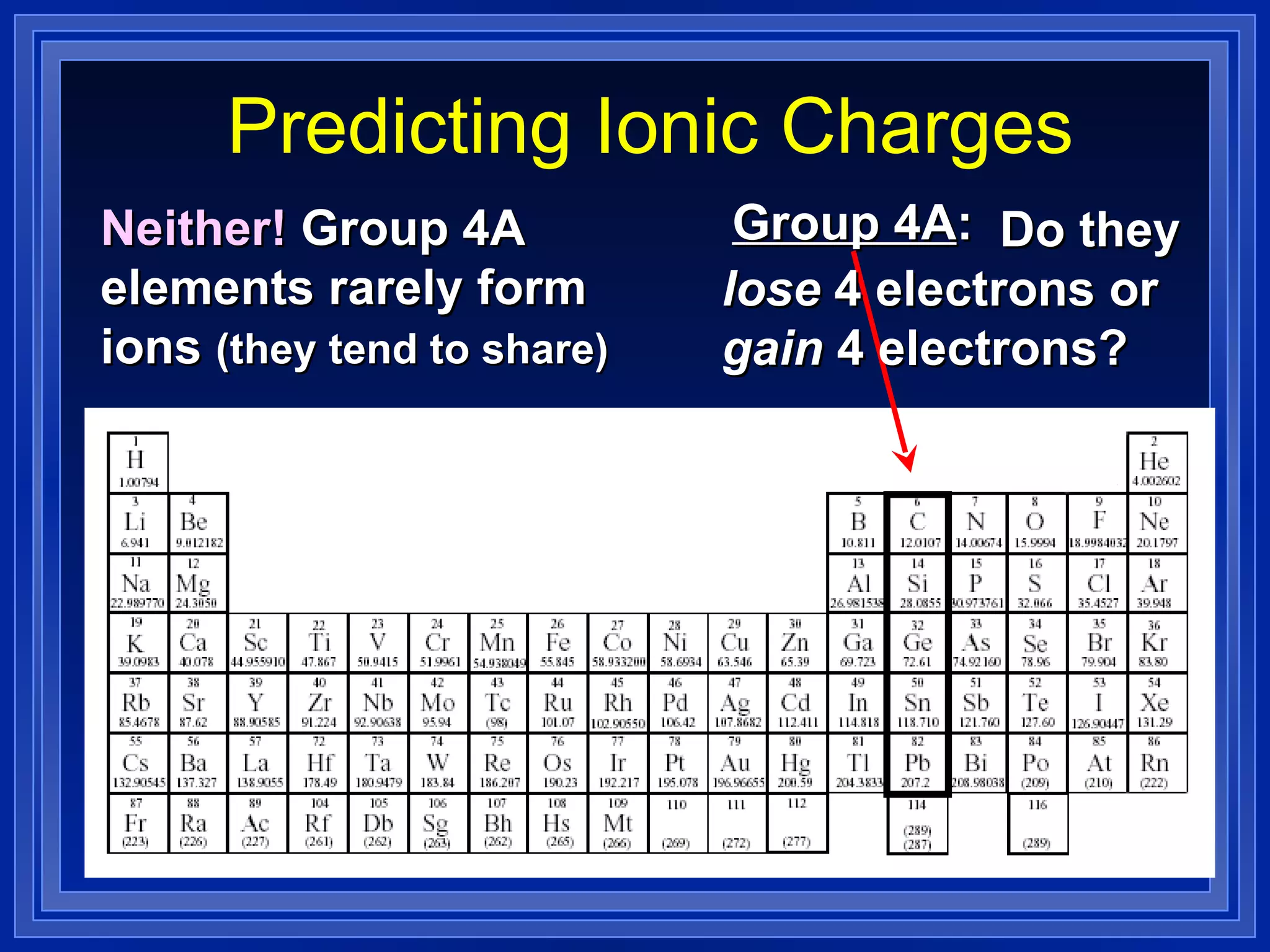
Predicting Ionic Charges Group 4A : Do they  lose  4 electrons or  gain  4 electrons? Neither!  Group 4A elements rarely form ions  (they tend to share)
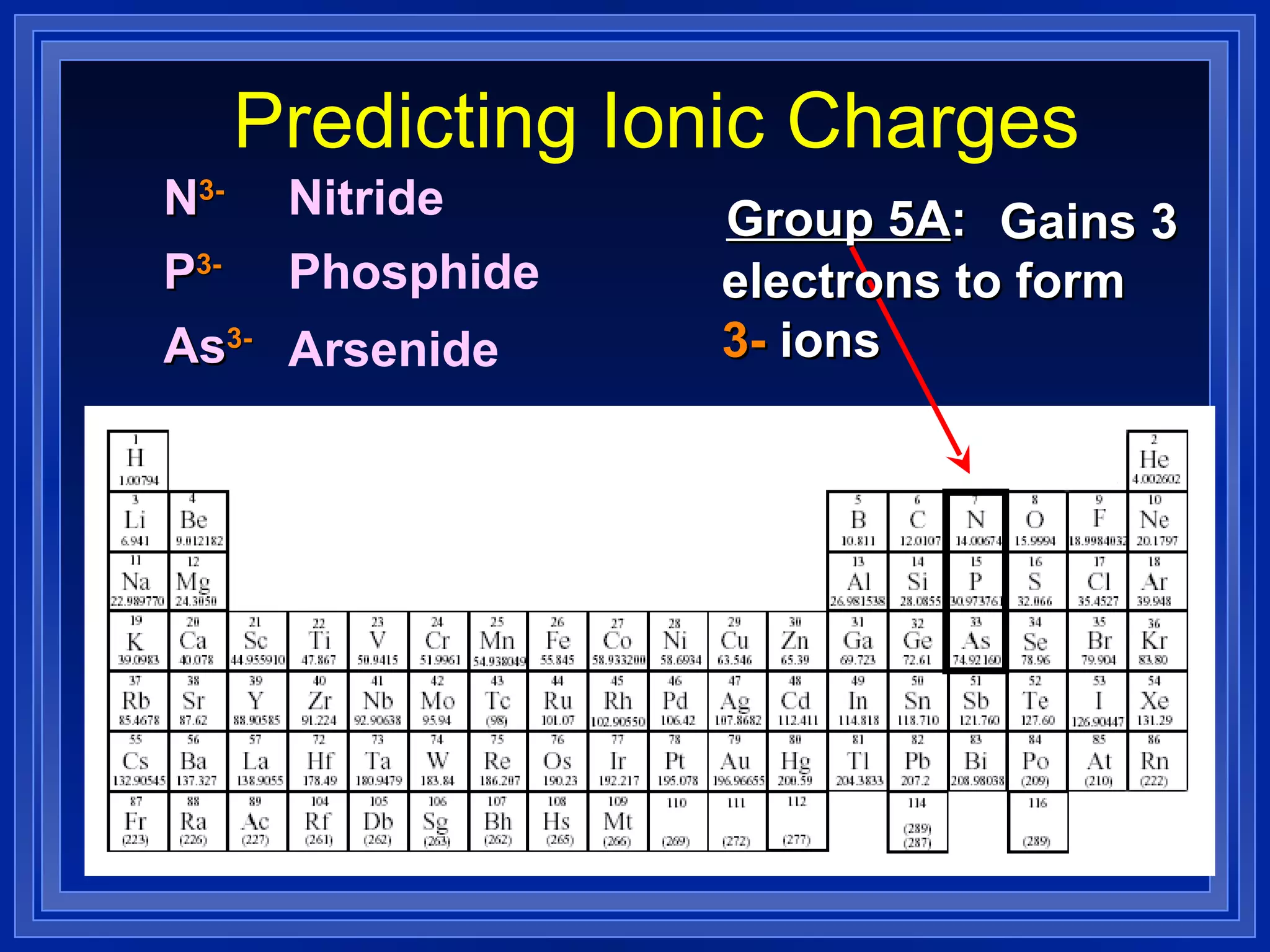
Predicting Ionic Charges Group 5A : Gains 3  electrons to form  3-  ions N 3- P 3- As 3- Nitride Phosphide Arsenide
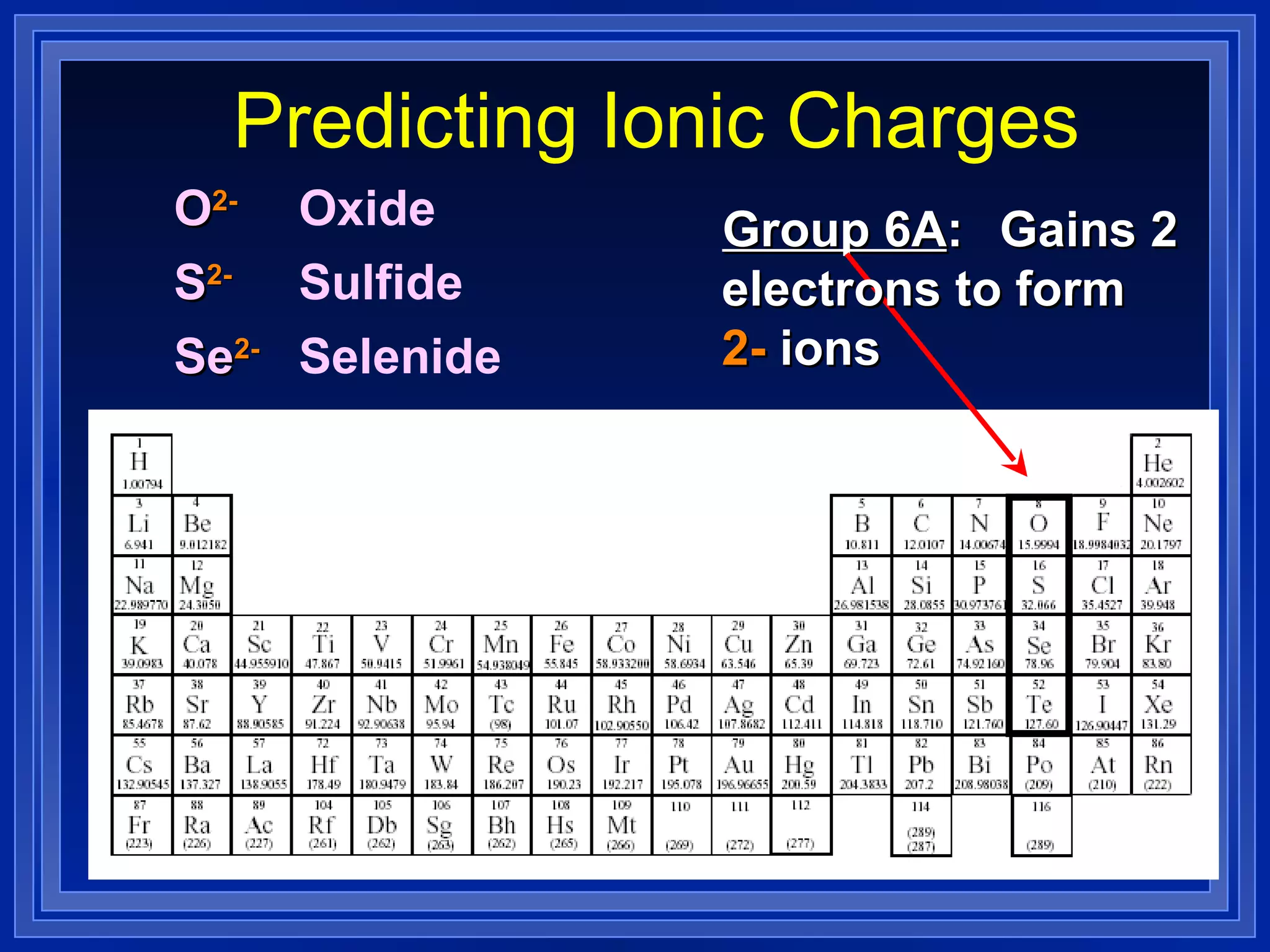
Predicting Ionic Charges Group 6A : Gains 2  electrons to form  2-  ions O 2- S 2- Se 2- Oxide Sulfide Selenide
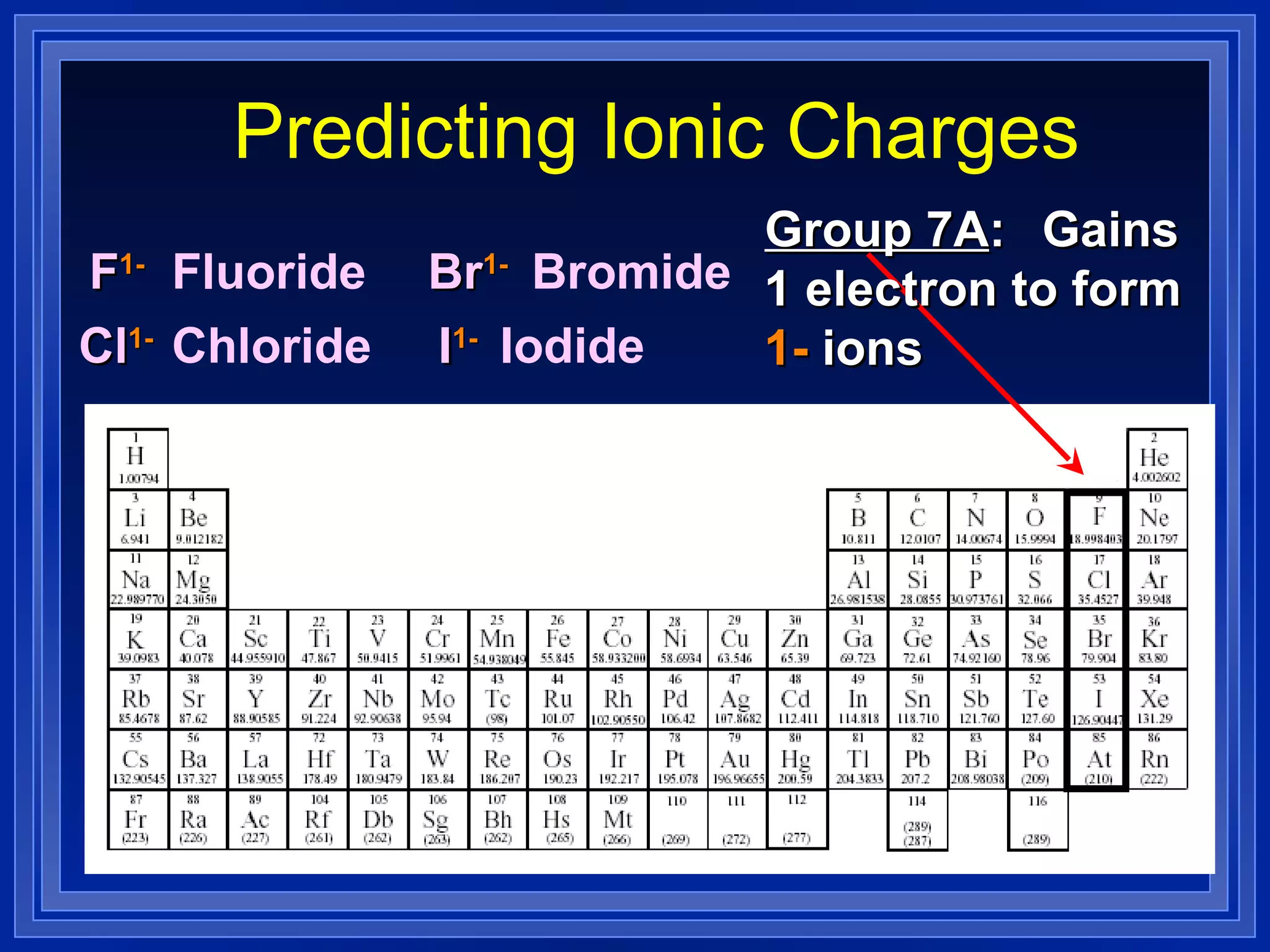
Predicting Ionic Charges Group 7A : Gains 1 electron to form  1-  ions F 1- Cl 1- Br 1- Fluoride Chloride Bromide I 1- Iodide
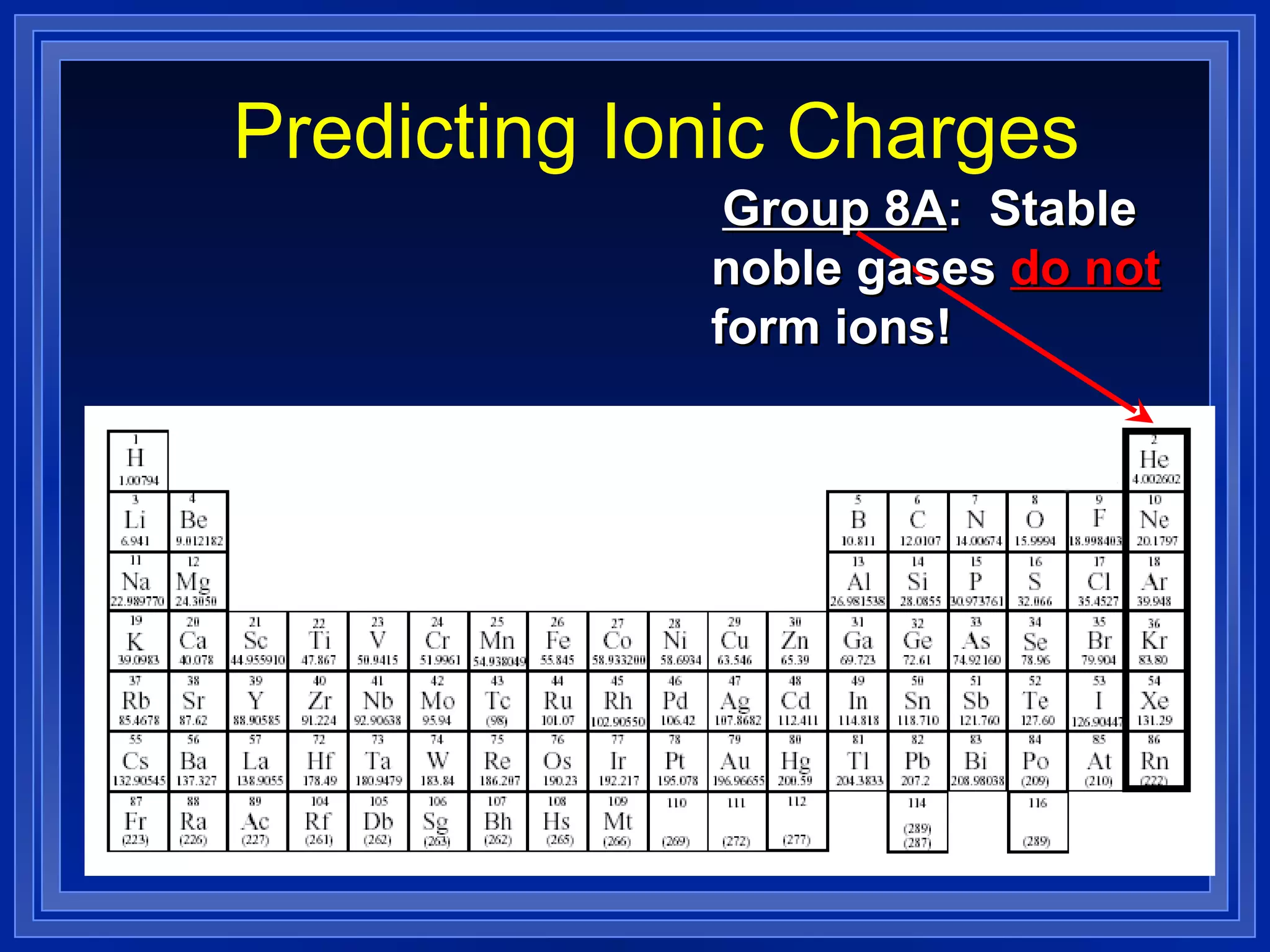
Predicting Ionic Charges Group 8A : Stable noble gases  do not  form ions!
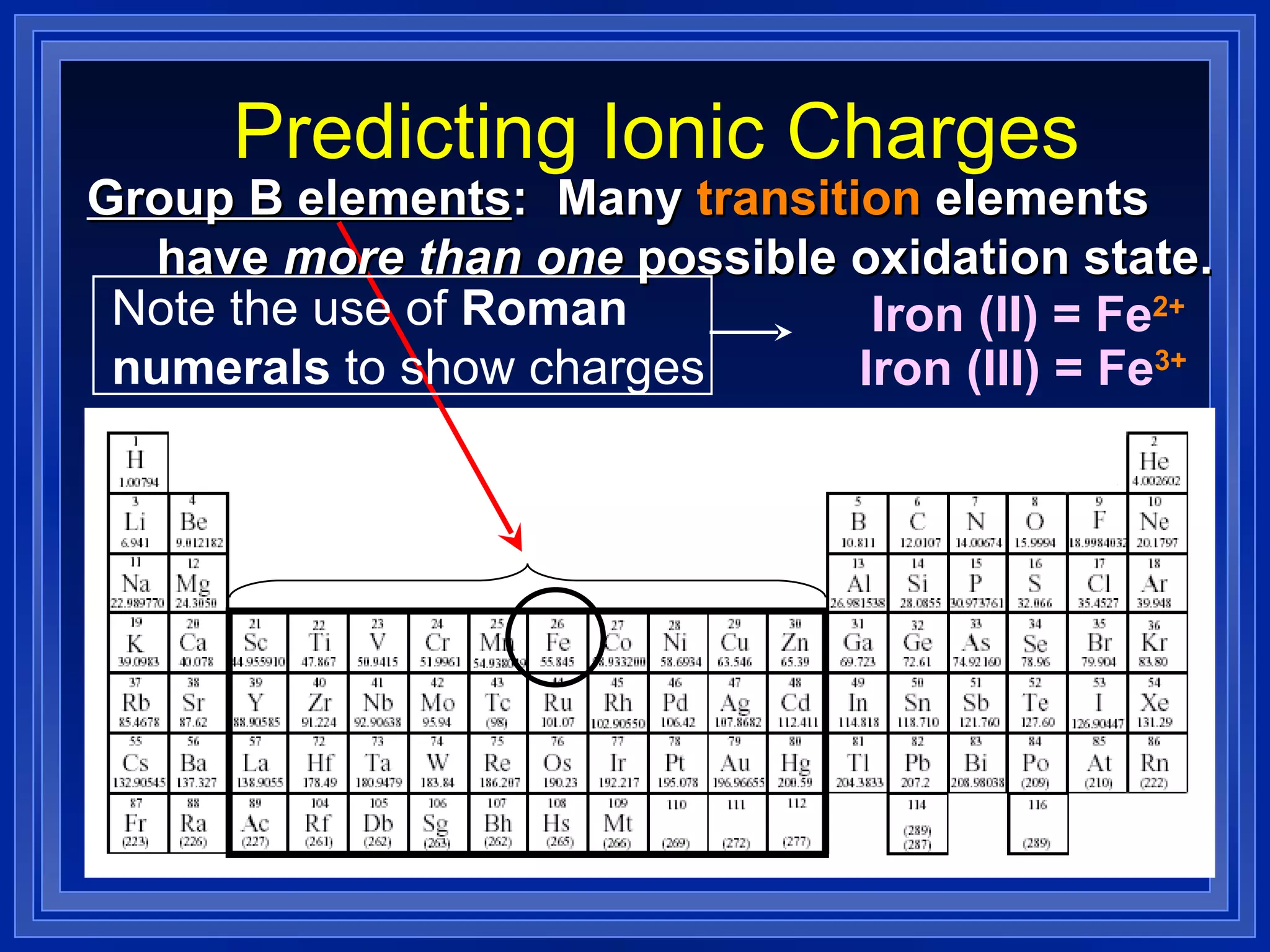
Predicting Ionic Charges Group B elements : Many  transition  elements  have  more than one  possible oxidation state. Iron (II) = Fe 2+ Iron (III) = Fe 3+ Note the use of  Roman numerals  to show charges
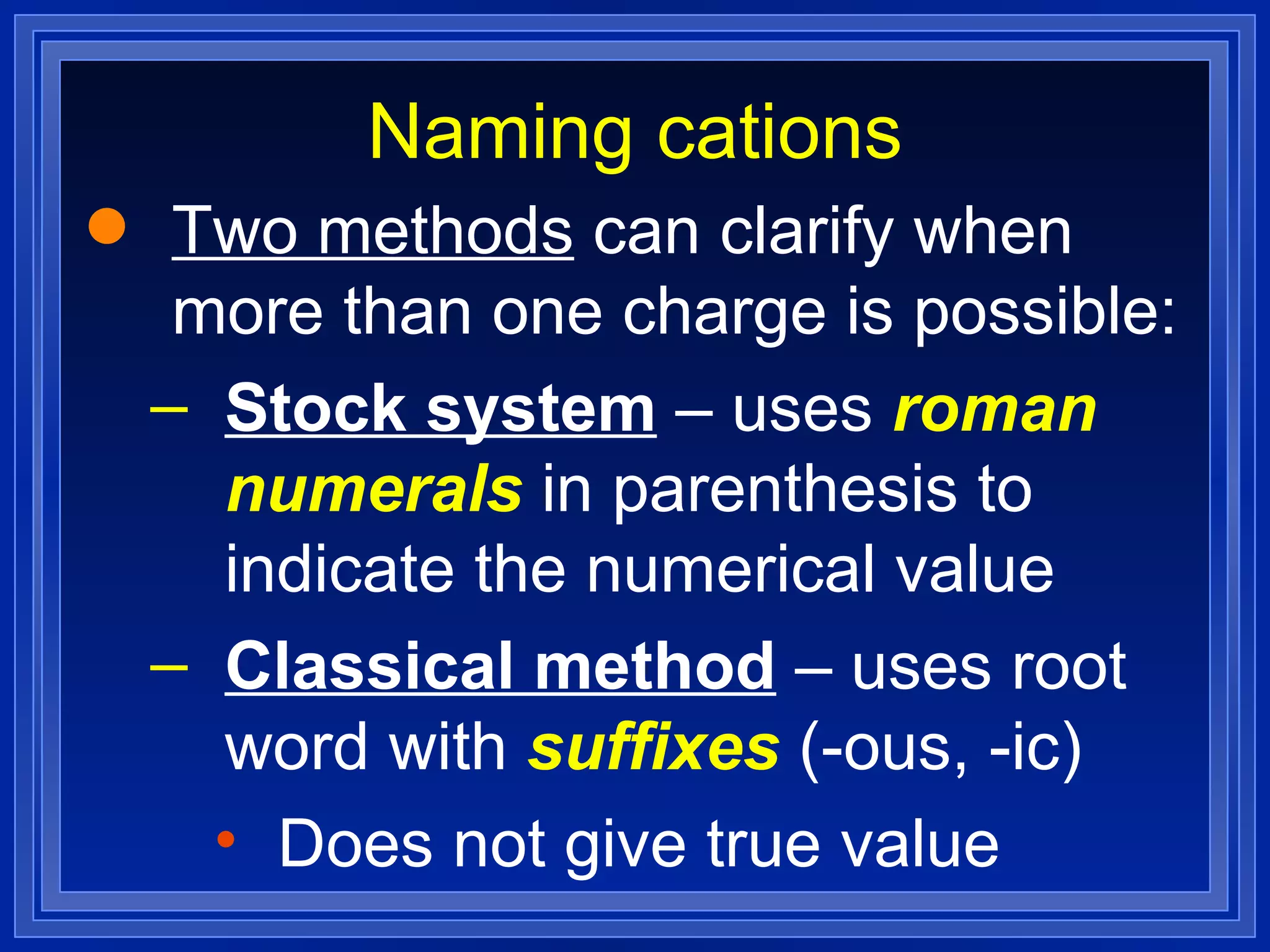
Naming cations Two methods  can clarify when more than one charge is possible: Stock system  – uses  roman numerals  in parenthesis to indicate the numerical value Classical method  – uses root word with  suffixes  (-ous, -ic) Does not give true value
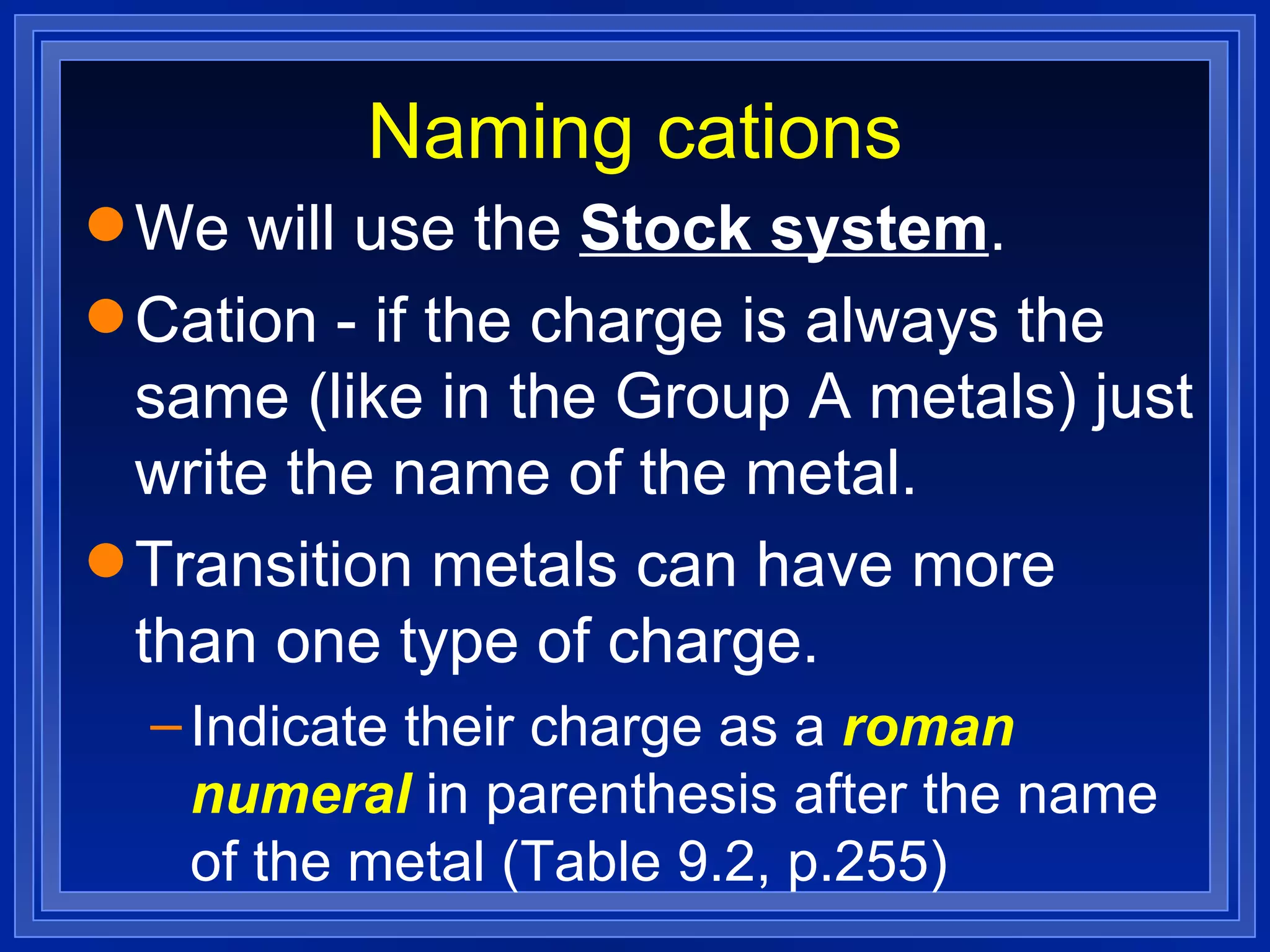
Naming cations We will use the  Stock system . Cation - if the charge is always the same (like in the Group A metals) just write the name of the metal. Transition metals can have more than one type of charge. Indicate their charge as a  roman numeral  in parenthesis after the name of the metal (Table 9.2, p.255)
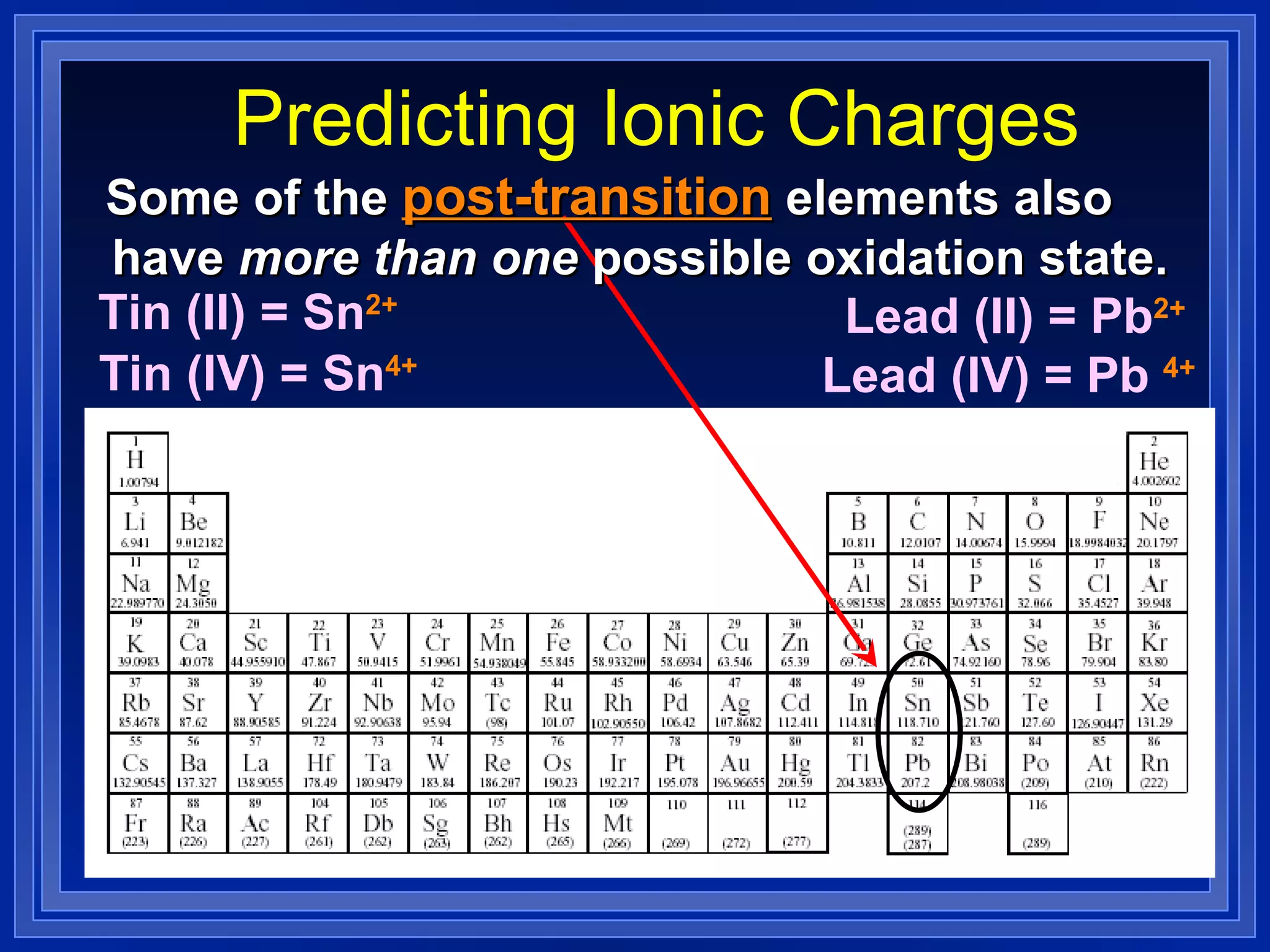
Predicting Ionic Charges Some of the  post-transition  elements also  have  more than one  possible oxidation state. Tin (II) = Sn 2+ Lead (II) = Pb 2+ Tin (IV) = Sn 4+ Lead (IV) = Pb  4+
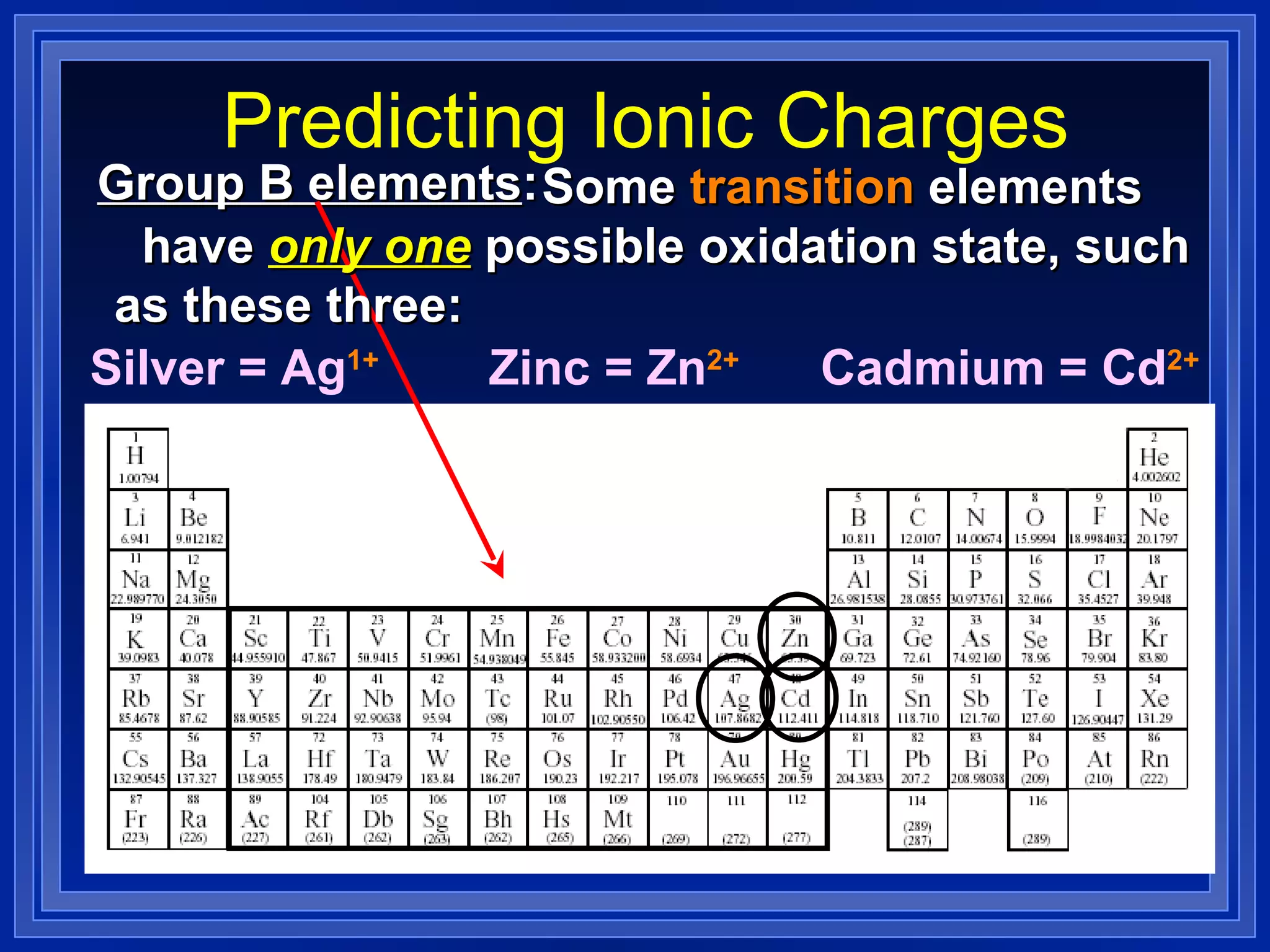
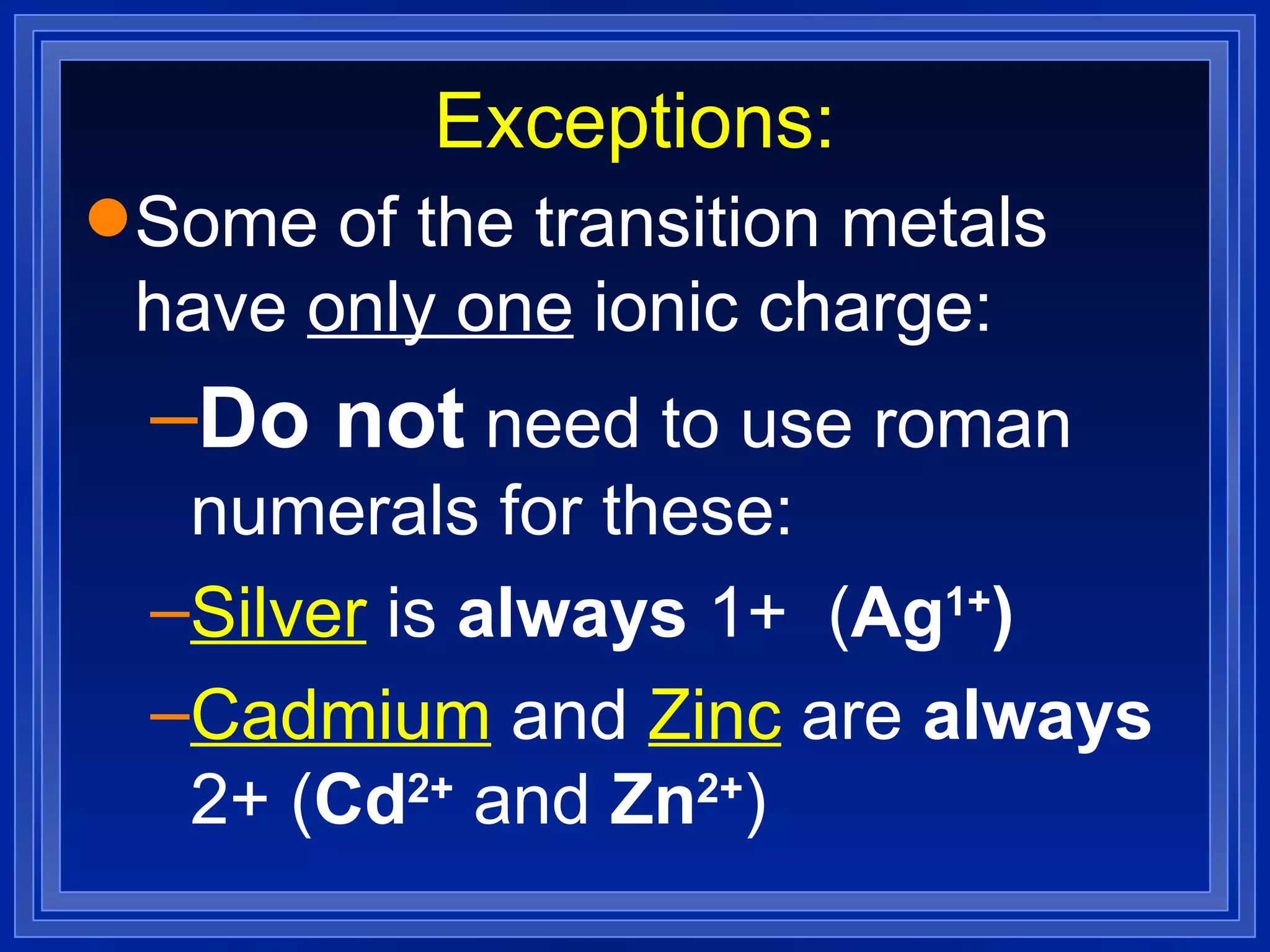
Predicting Ionic Charges Group B elements : Some  transition  elements  have  only one  possible oxidation state, such as these three: Zinc = Zn 2+ Silver = Ag 1+ Cadmium = Cd 2+
Exceptions: Some of the transition metals have  only one  ionic charge: Do not  need to use roman numerals for these: Silver  is  always  1+  ( Ag 1+ ) Cadmium  and  Zinc  are  always  2+ ( Cd 2+  and  Zn 2+ )
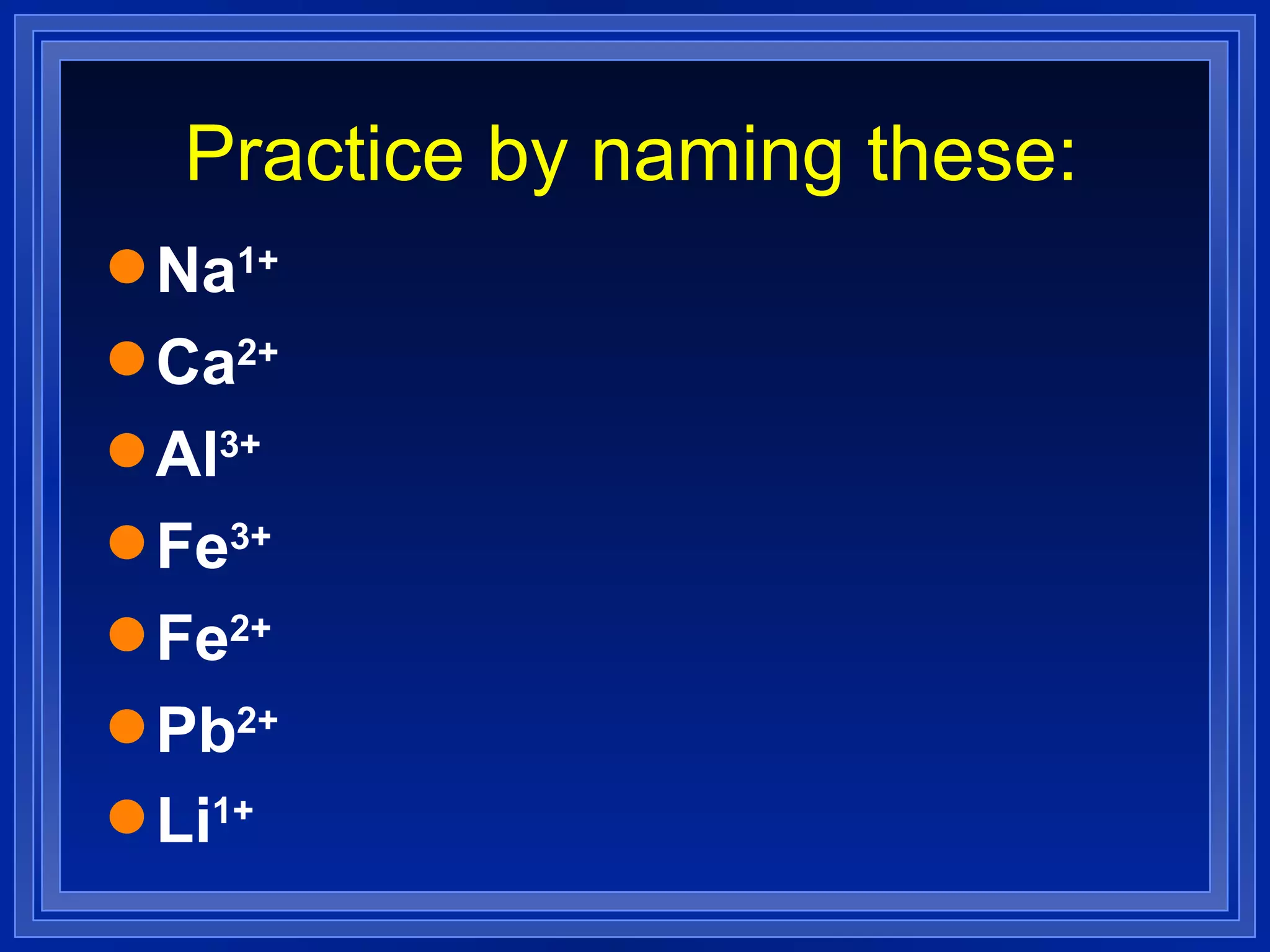
Practice by naming these: Na 1+   Ca 2+   Al 3+   Fe 3+   Fe 2+   Pb 2+   Li 1+
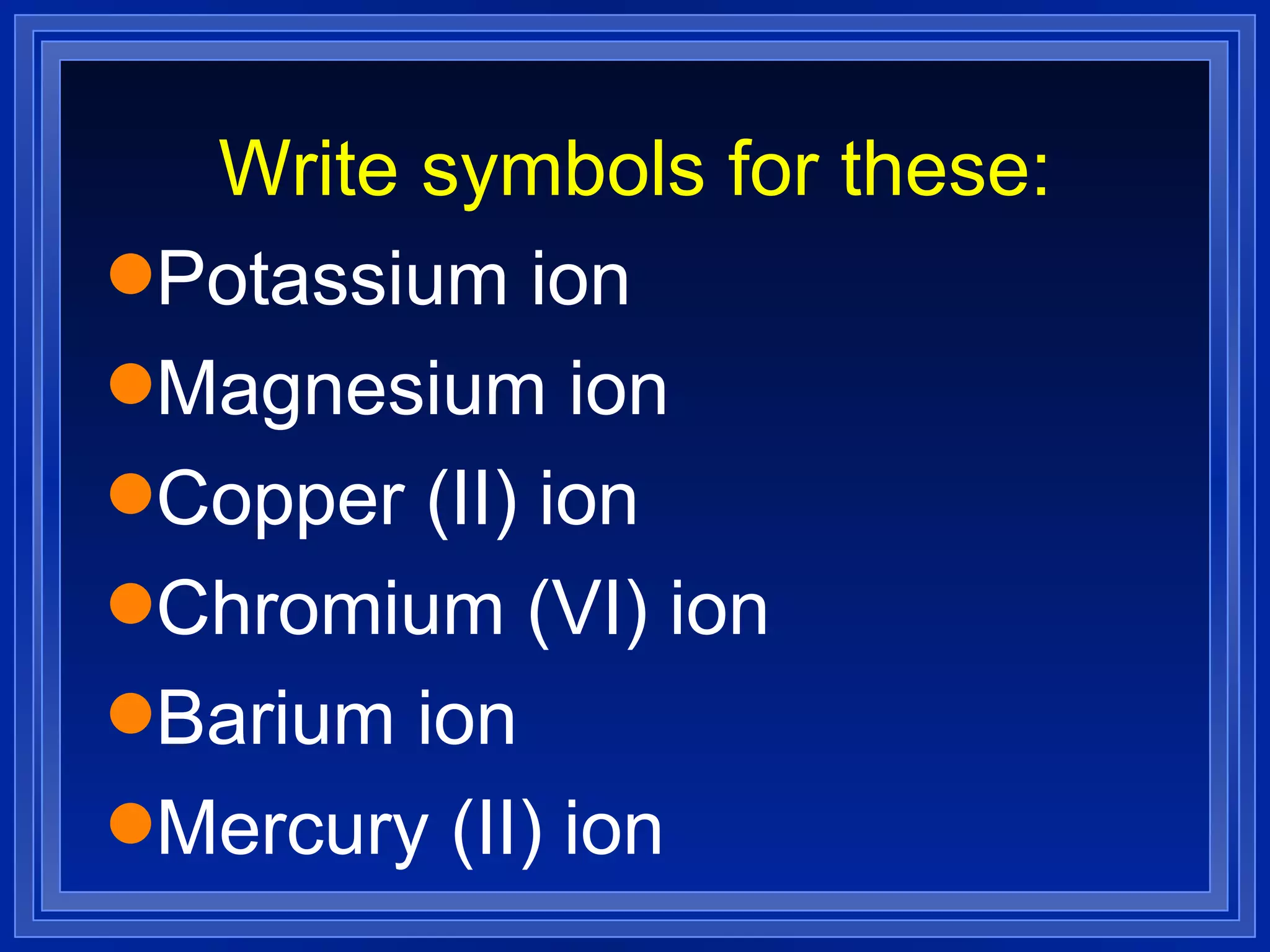
Write symbols for these: Potassium ion Magnesium ion  Copper (II) ion Chromium (VI) ion Barium ion Mercury (II) ion
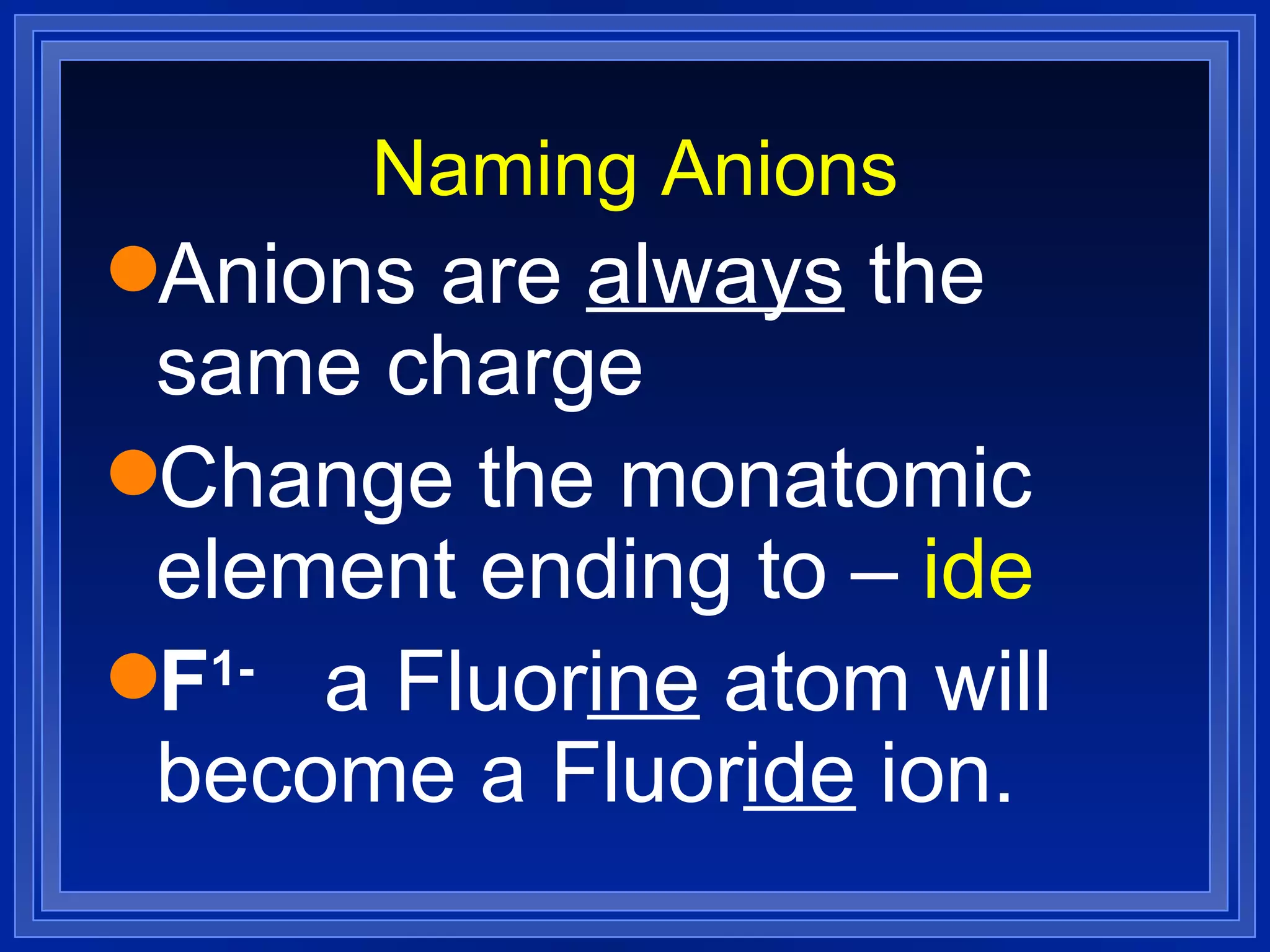
Naming Anions Anions are  always  the same charge Change the monatomic element ending to –  ide F 1-   a Fluor ine  atom will become a Fluor ide  ion.
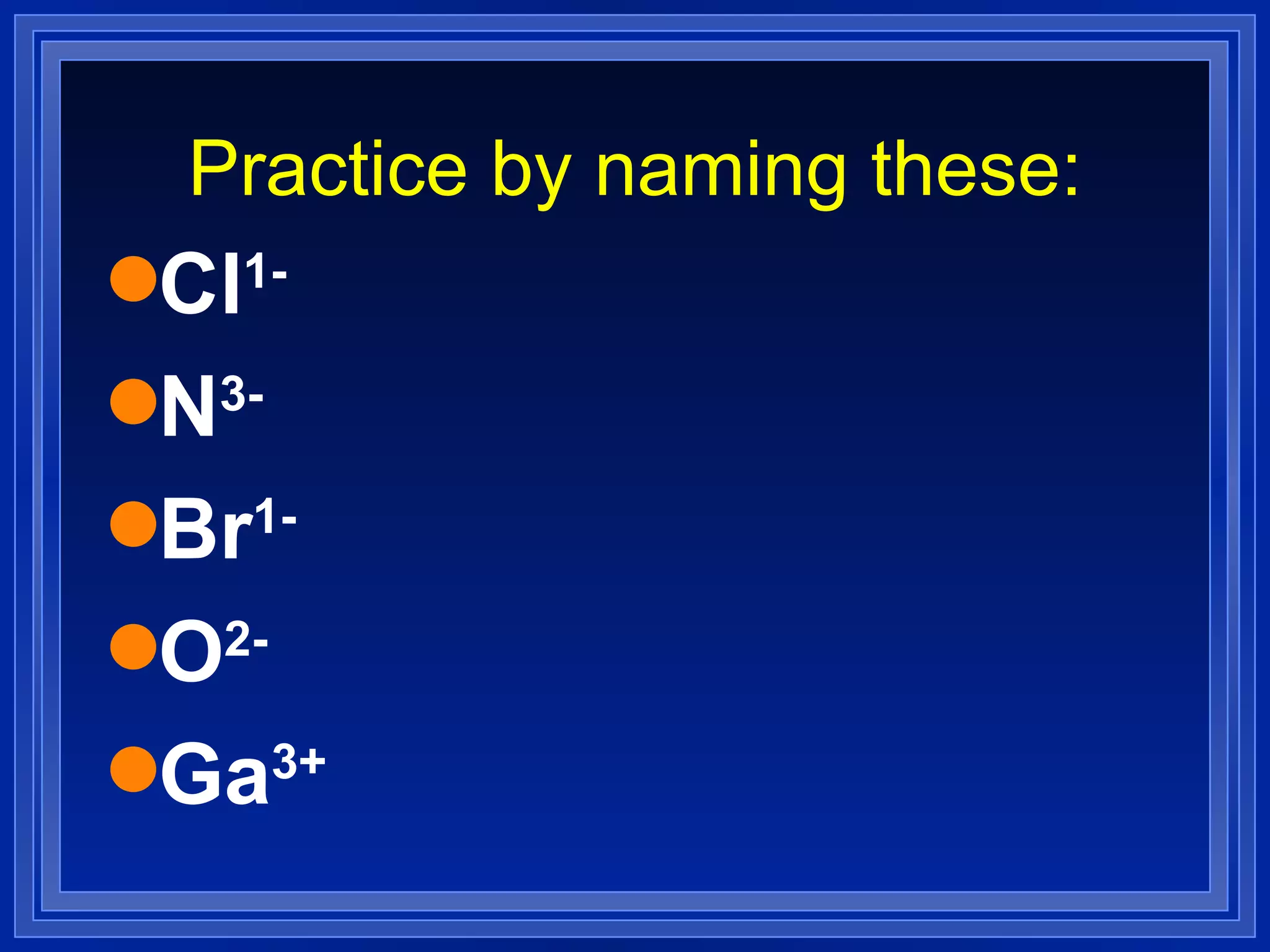
Practice by naming these: Cl 1-   N 3-   Br 1-   O 2- Ga 3+
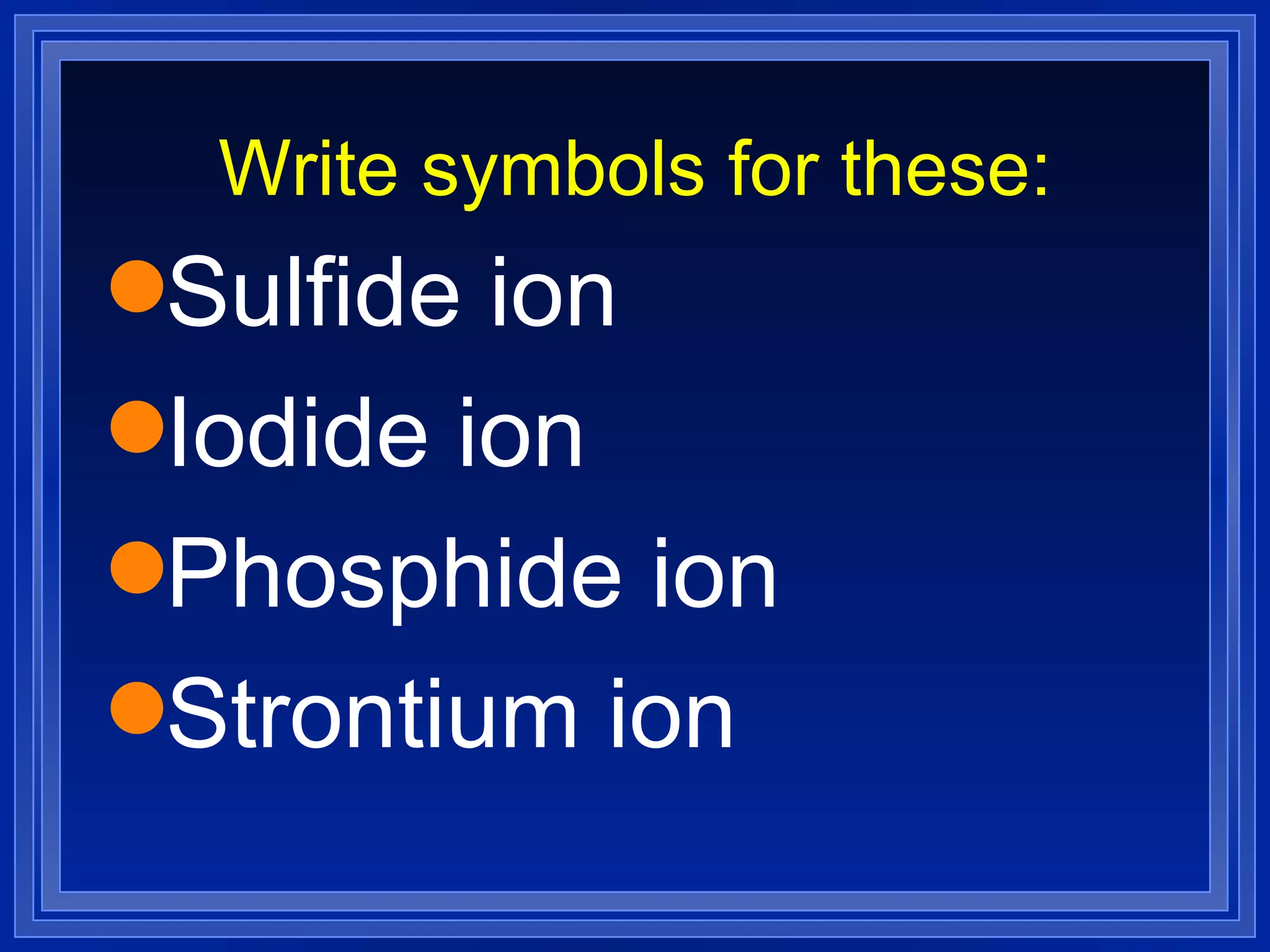
Write symbols for these: Sulfide ion Iodide ion Phosphide ion Strontium ion
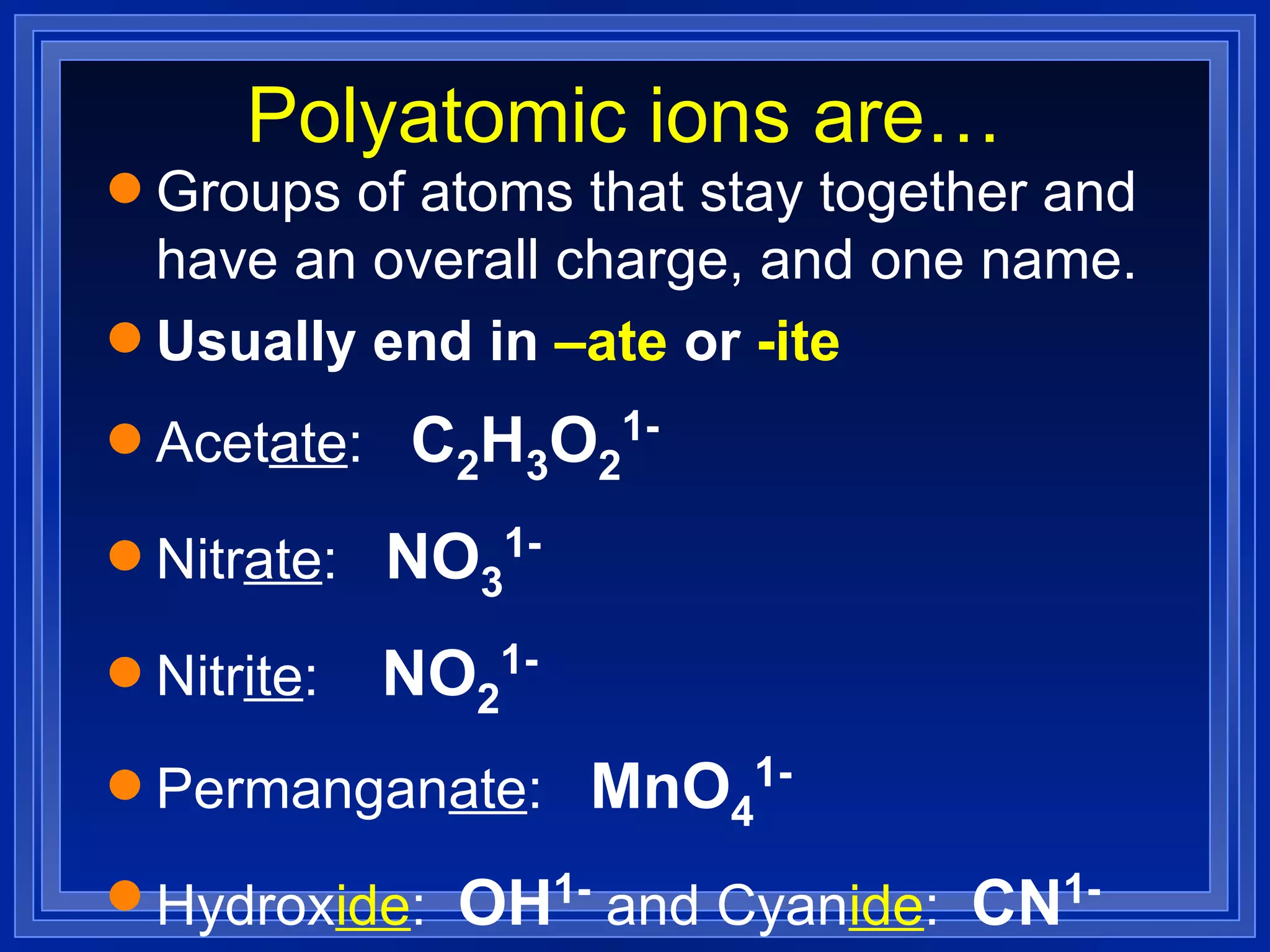
Polyatomic ions are… Groups of atoms that stay together and have an overall charge, and one name. Usually end in  –ate  or  -ite Acet ate :  C 2 H 3 O 2 1- Nitr ate :  NO 3 1- Nitr ite :  NO 2 1- Permangan ate :  MnO 4 1-   Hydrox ide :  OH 1-  and Cyan ide :  CN 1-
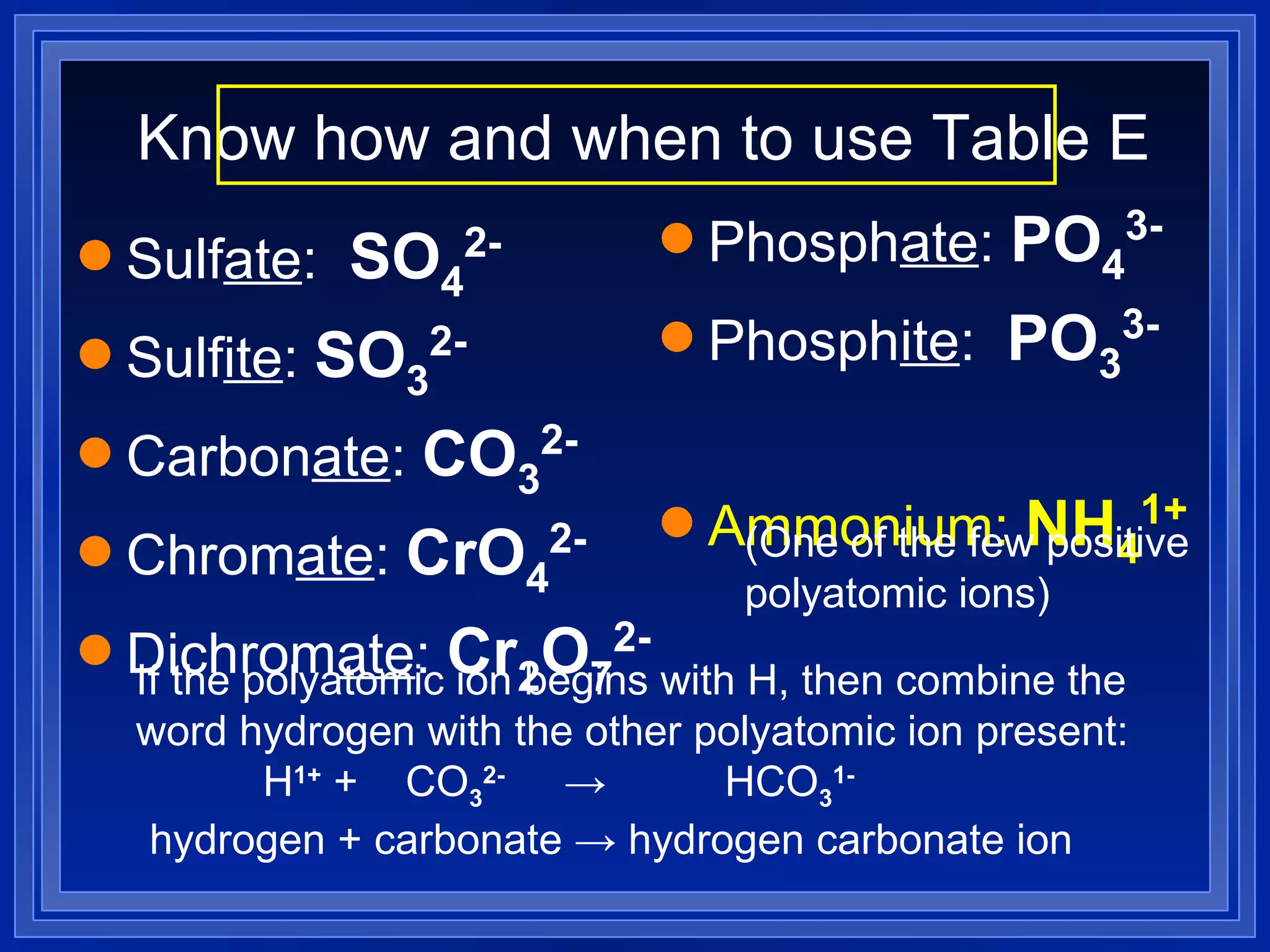
Sulf ate :  SO 4 2- Sulf ite :  SO 3 2- Carbon ate :  CO 3 2- Chrom ate :  CrO 4 2- Dichrom ate :  Cr 2 O 7 2- Phosph ate :  PO 4 3- Phosph ite :  PO 3 3-   Ammonium:  NH 4 1+ Know how and when to use Table E If the polyatomic ion begins with H, then combine the word hydrogen with the other polyatomic ion present:  H 1+  +  CO 3 2-   ->  HCO 3 1-    hydrogen + carbonate -> hydrogen carbonate ion (One of the few positive polyatomic ions)
Section 9.2  Naming and Writing Formulas for Ionic Compounds OBJECTIVES: Apply the rules  for  naming and writing formulas  for  binary ionic compounds.
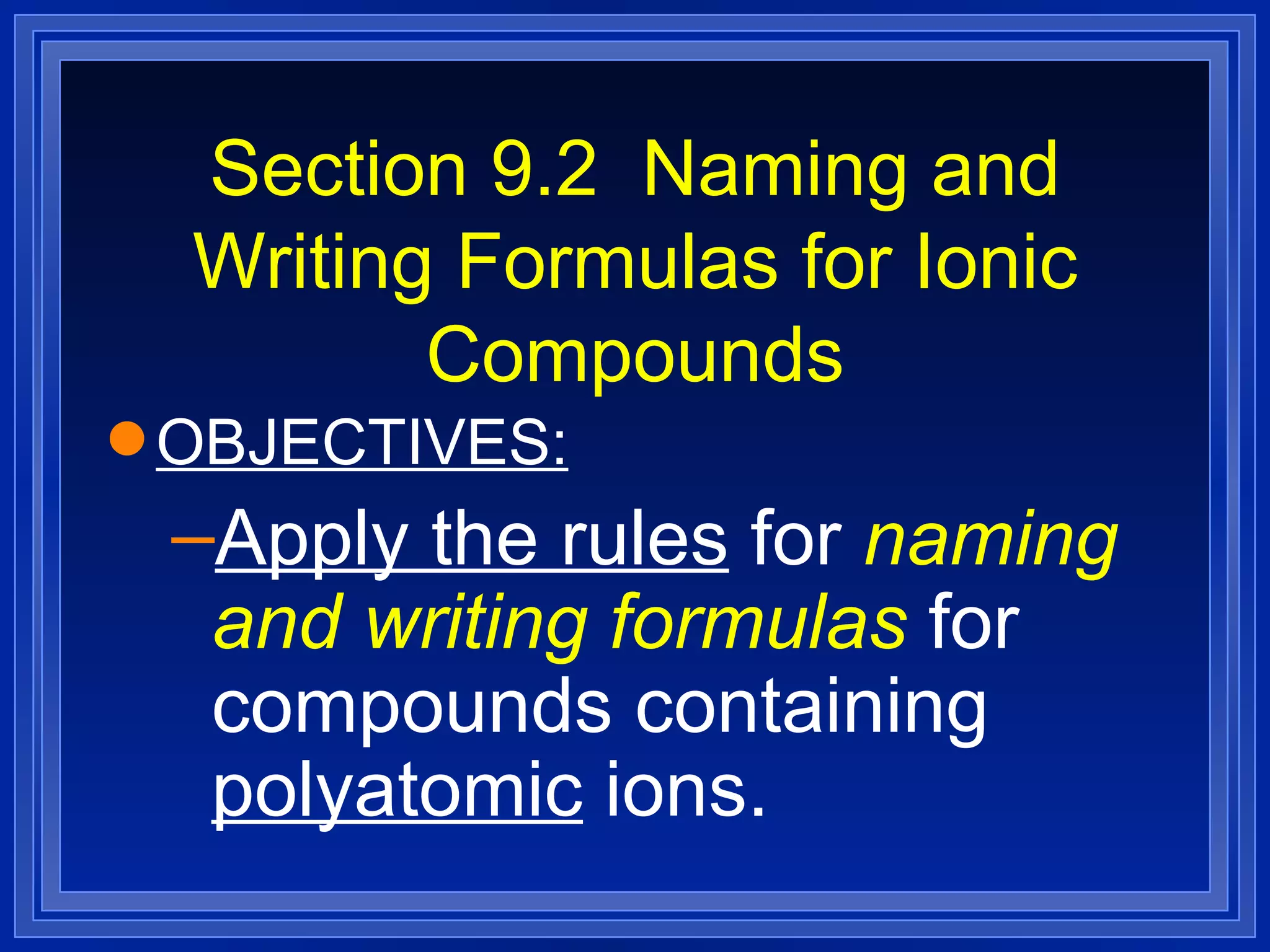
Section 9.2  Naming and Writing Formulas for Ionic Compounds OBJECTIVES: Apply the rules  for  naming and writing formulas  for compounds containing  polyatomic  ions.
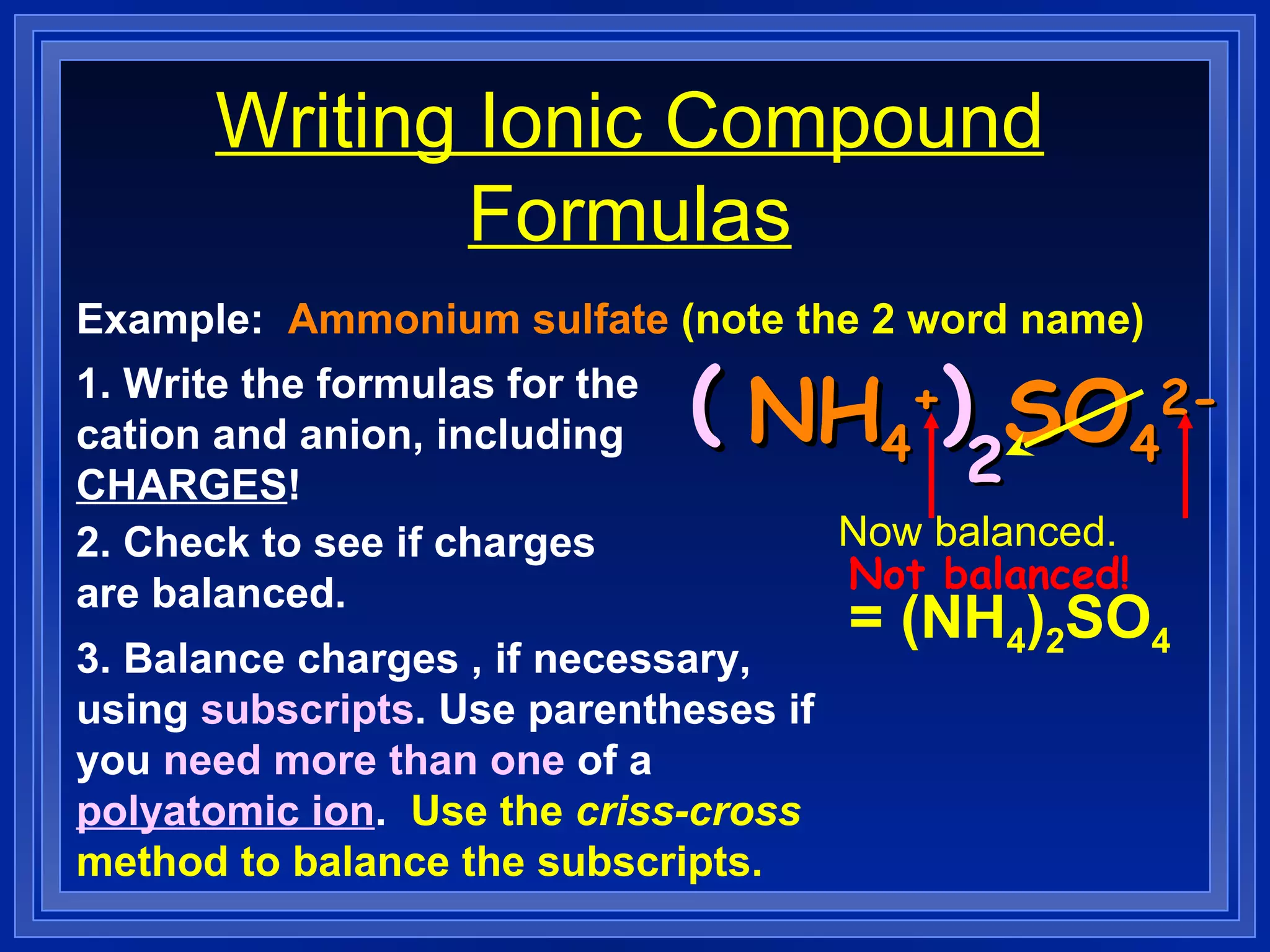
Writing Ionic Compound Formulas Example:  Barium nitrate  (note the 2 word name) 1. Write the formulas for the cation and anion, including  CHARGES ! Ba 2+ NO 3 - 2. Check to see if charges are balanced.   3. Balance charges , if necessary, using  subscripts . Use parentheses if you  need more than one  of a  polyatomic ion .  Use the  criss-cross  method to balance subscripts. Not balanced! (  ) 2 Now balanced. = Ba(NO 3 ) 2
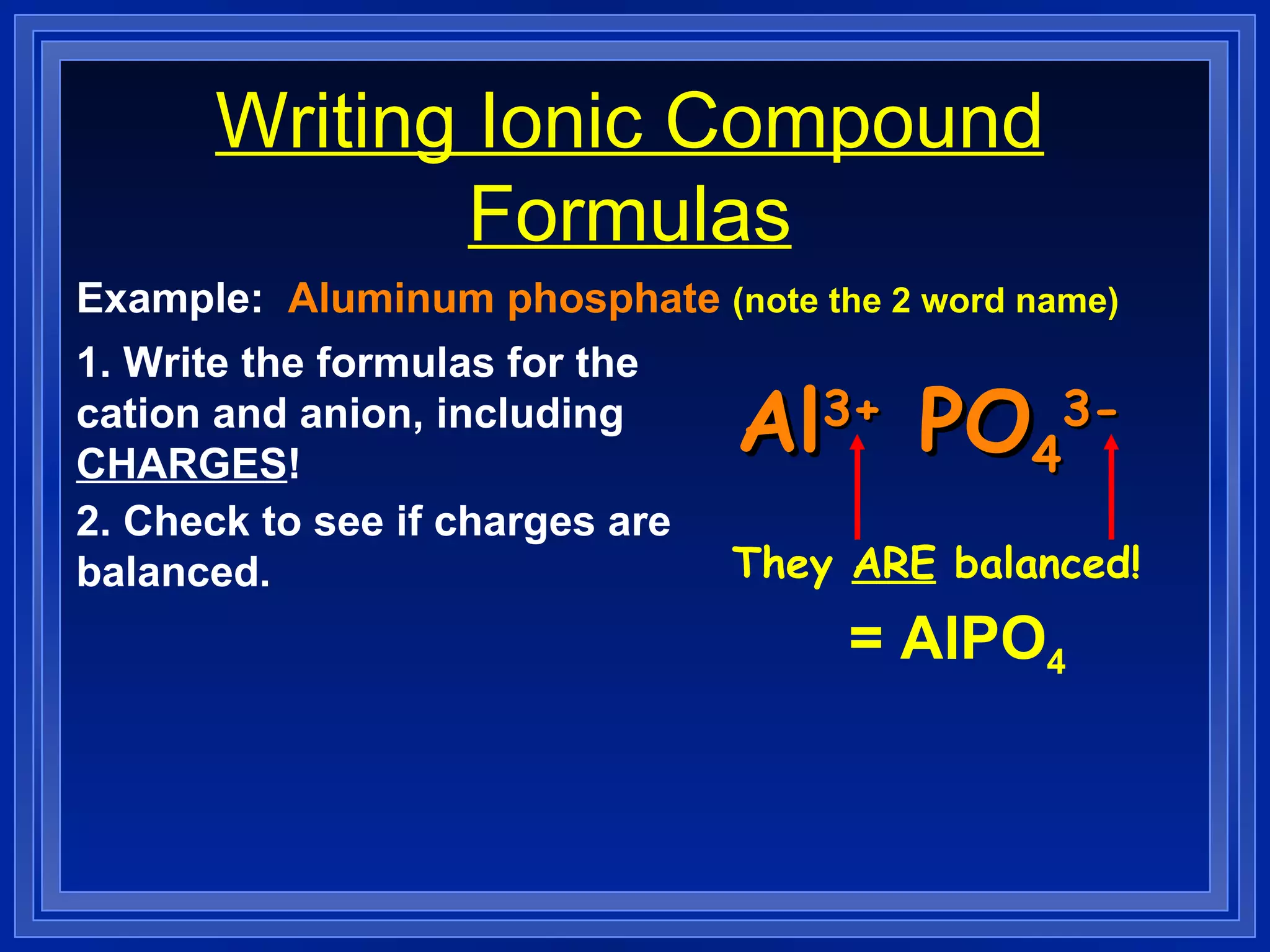
Writing Ionic Compound Formulas Example:  Ammonium sulfate  (note the 2 word name) 1. Write the formulas for the cation and anion, including  CHARGES ! NH 4 + SO 4 2- 2. Check to see if charges are balanced.   3. Balance charges , if necessary, using  subscripts . Use parentheses if you  need more than one  of a  polyatomic ion .  Use the  criss-cross  method to balance the subscripts. Not balanced! (  ) 2 Now balanced. = (NH 4 ) 2 SO 4
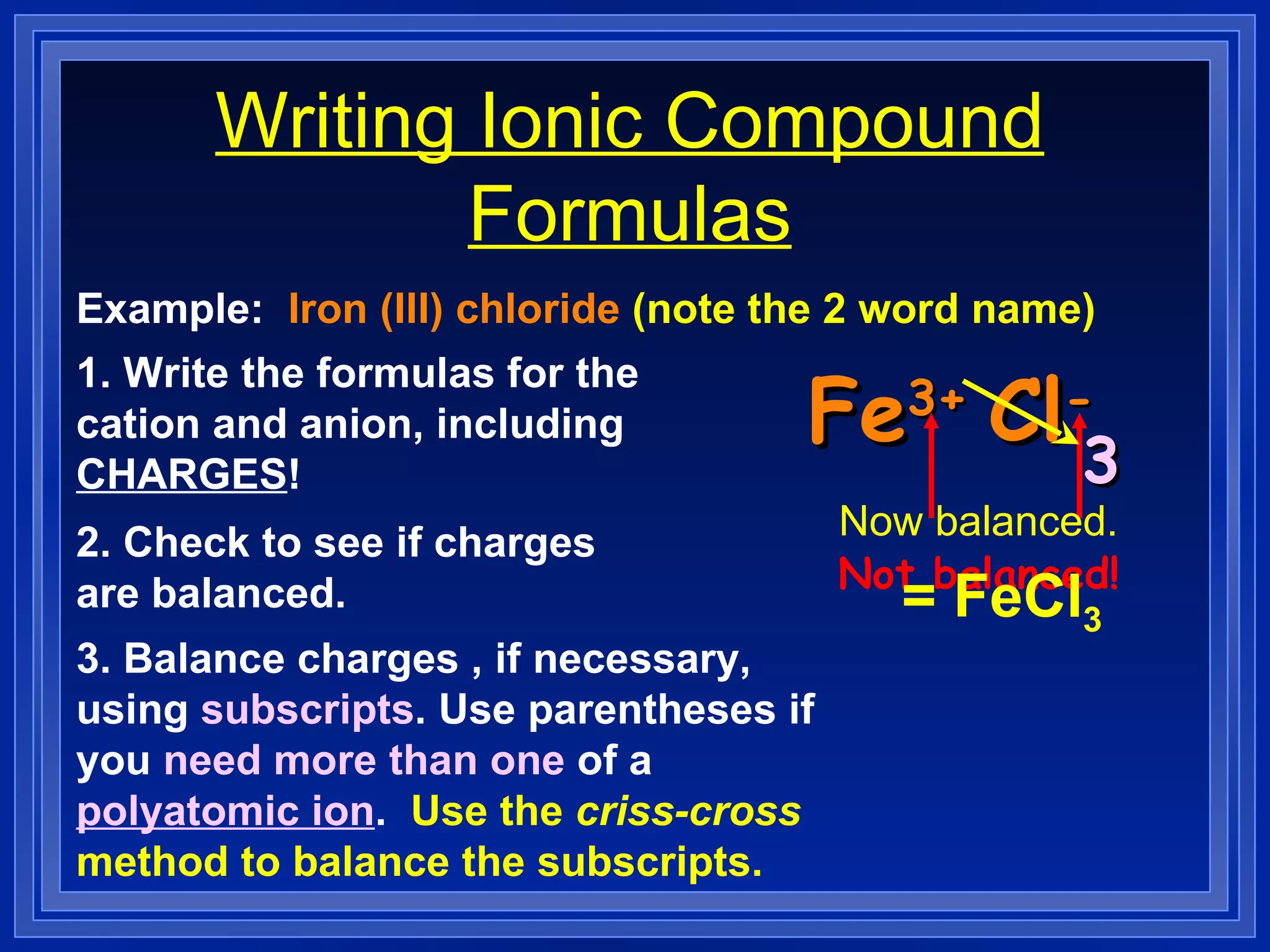
Writing Ionic Compound Formulas Example:  Iron (III) chloride  (note the 2 word name) 1. Write the formulas for the cation and anion, including  CHARGES ! Fe 3+ Cl - 2. Check to see if charges are balanced.   3. Balance charges , if necessary, using  subscripts . Use parentheses if you  need more than one  of a  polyatomic ion .  Use the  criss-cross  method to balance the subscripts. Not balanced! 3 Now balanced. = FeCl 3
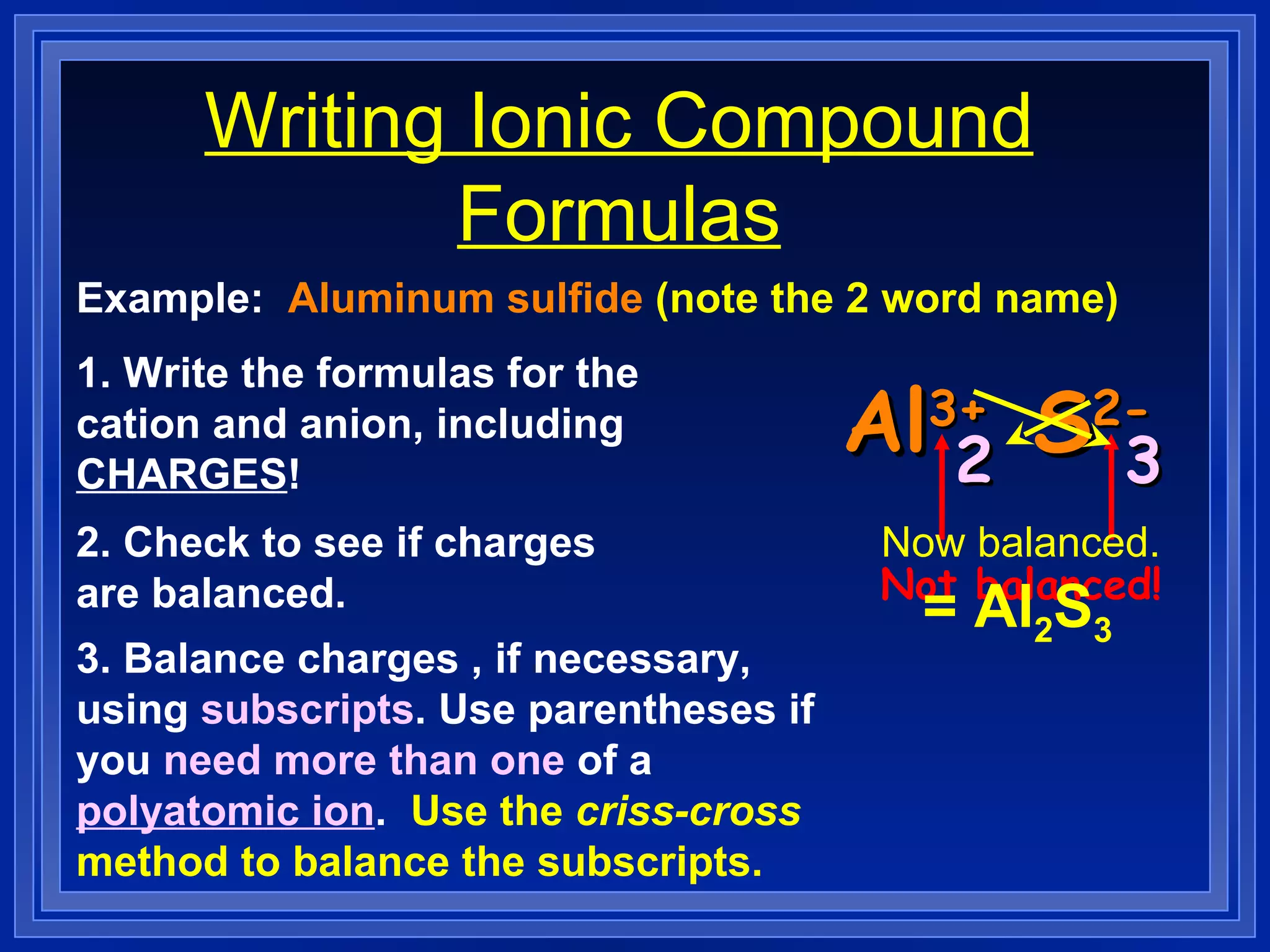
Writing Ionic Compound Formulas Example:  Aluminum sulfide  (note the 2 word name) 1. Write the formulas for the cation and anion, including  CHARGES ! Al 3+ S 2- 2. Check to see if charges are balanced.   3. Balance charges , if necessary, using  subscripts . Use parentheses if you  need more than one  of a  polyatomic ion .  Use the  criss-cross  method to balance the subscripts. Not balanced! 2 3 Now balanced. = Al 2 S 3
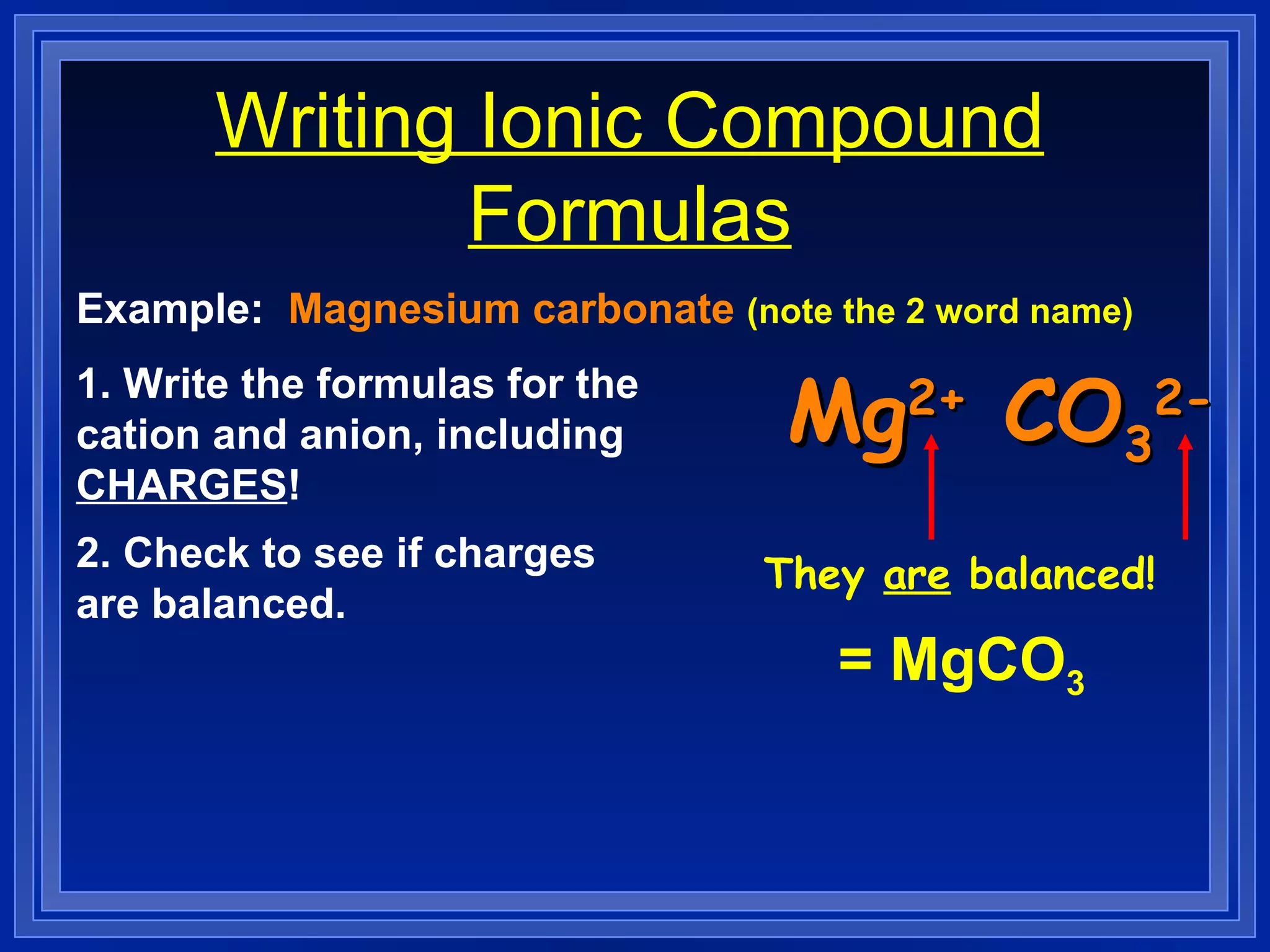
Writing Ionic Compound Formulas Example:  Magnesium carbonate  (note the 2 word name) 1. Write the formulas for the cation and anion, including  CHARGES ! Mg 2+ CO 3 2- 2. Check to see if charges are balanced.   They  are  balanced! = MgCO 3
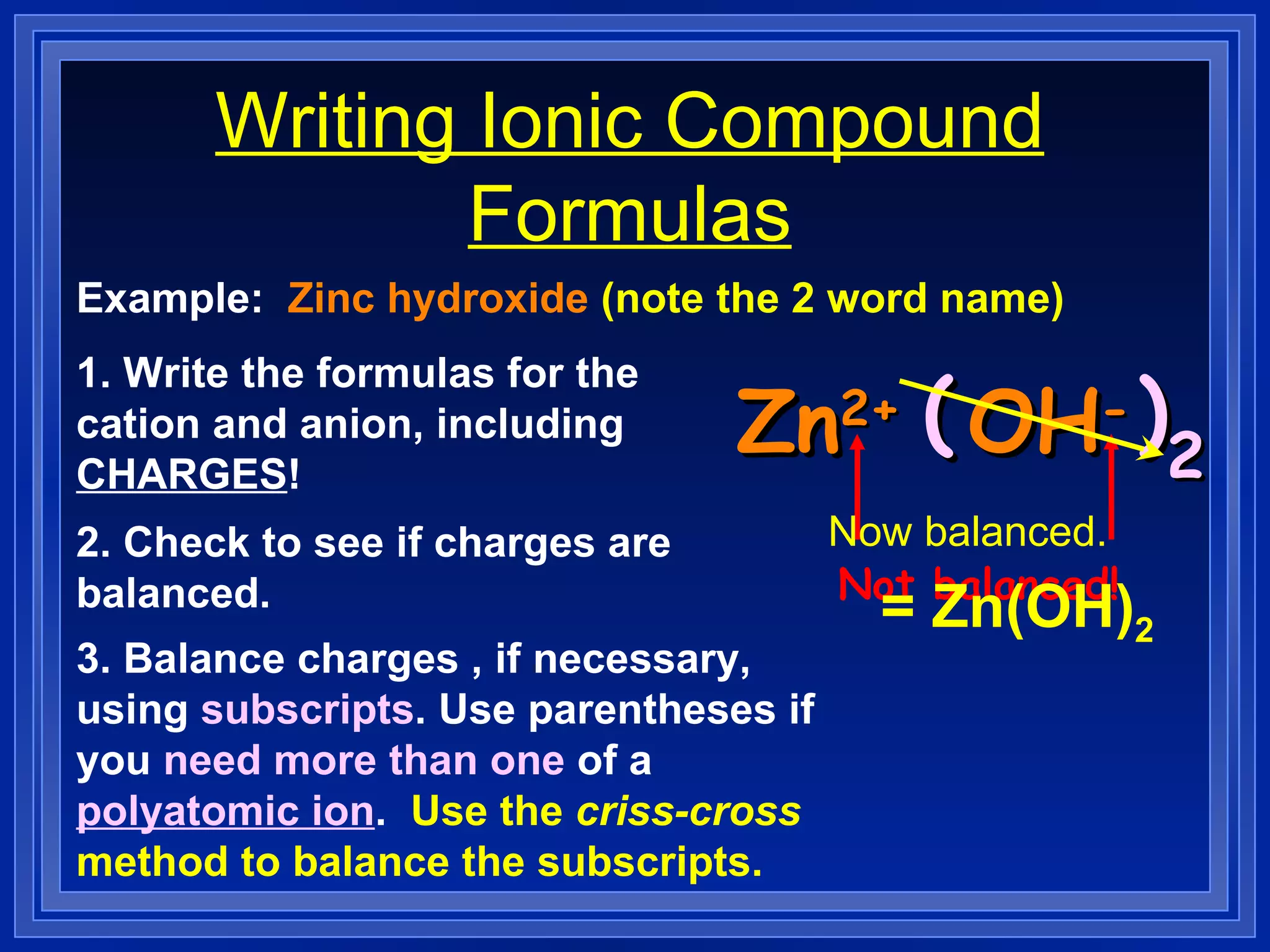
Writing Ionic Compound Formulas Example:  Zinc hydroxide  (note the 2 word name) 1. Write the formulas for the cation and anion, including  CHARGES ! Zn 2+ OH - 2. Check to see if charges are balanced.  3. Balance charges , if necessary, using  subscripts . Use parentheses if you  need more than one  of a  polyatomic ion .  Use the  criss-cross  method to balance the subscripts. Not balanced! (  ) 2 Now balanced. = Zn(OH) 2
Writing Ionic Compound Formulas Example:  Aluminum phosphate  (note the 2 word name) 1. Write the formulas for the cation and anion, including  CHARGES ! Al 3+ PO 4 3- 2. Check to see if charges are balanced.   They  ARE  balanced! = AlPO 4
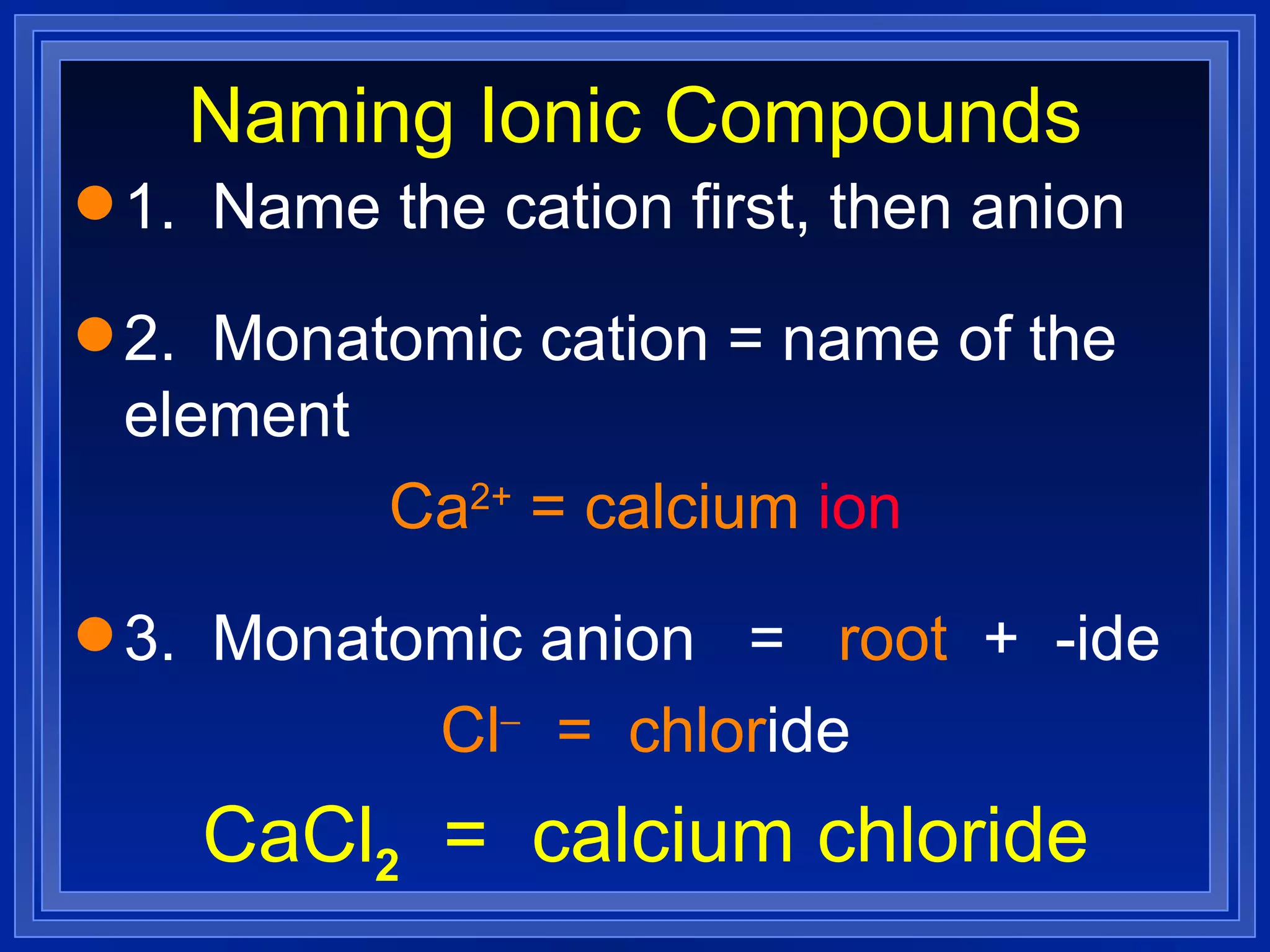
Naming Ionic Compounds 1.  Name the cation first, then anion 2.  Monatomic cation = name of the element Ca 2+  = calcium   ion 3.  Monatomic anion  =  root   +  -ide Cl    =  chlor ide CaCl 2   =  calcium chloride
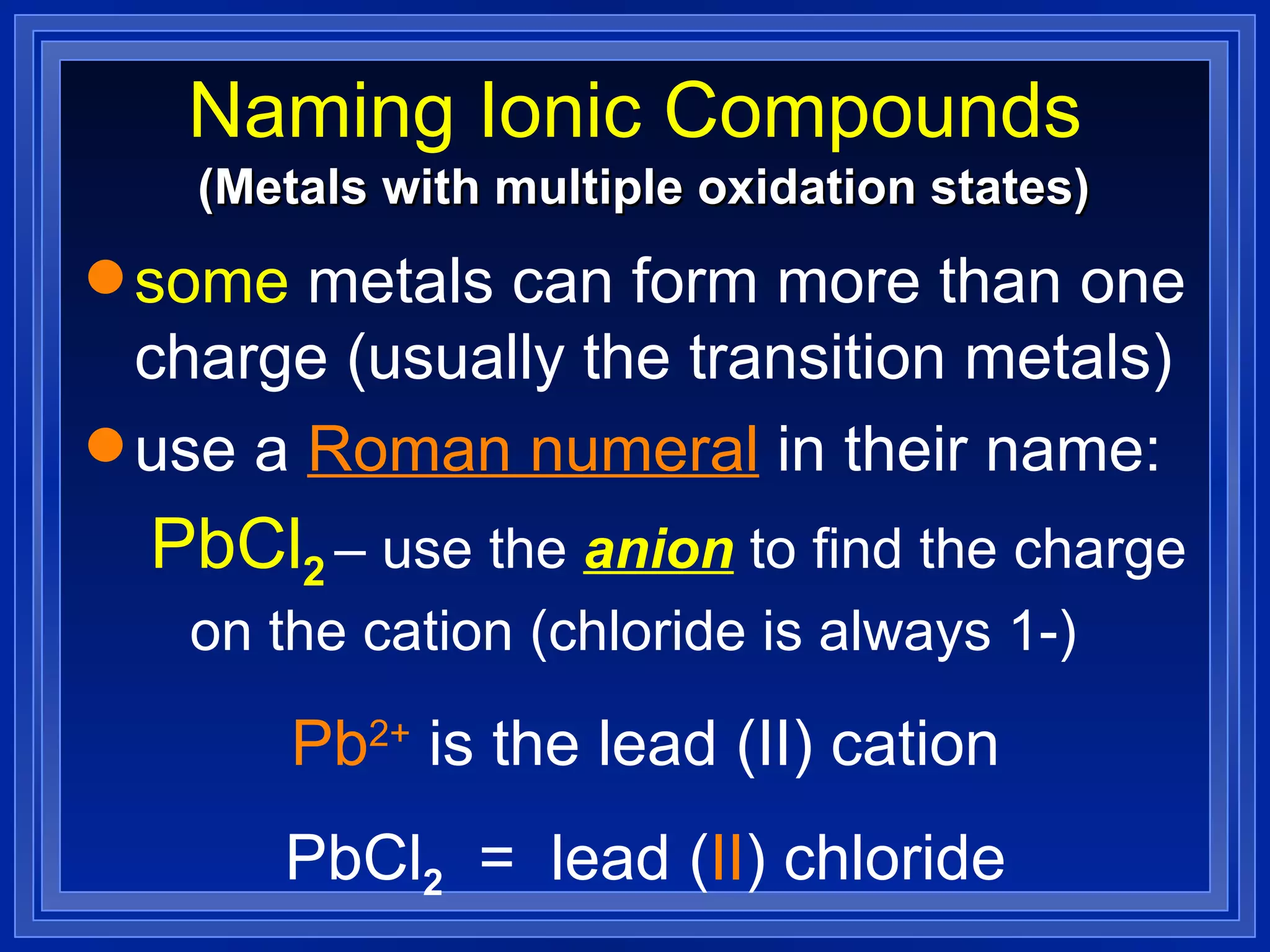
Naming Ionic Compounds some  metals can form more than one charge (usually the transition metals) use a  Roman numeral   in their name: PbCl 2   – use the  anion  to find the charge on the cation (chloride is always 1-) Pb 2+   is the lead (II) cation PbCl 2   =  lead ( II ) chloride (Metals with multiple oxidation states)
Things to look for: If cations have ( ), the number in parenthesis is their charge. If anions end in  -ide  they are probably off the periodic table (Monoatomic) If anion ends in  -ate  or  –ite ,  then it is polyatomic
Practice by writing the formula or name as required… Iron (II) Phosphate Tin (II) Fluoride Potassium Sulfide Ammonium Chromate MgSO 4 FeCl 3
Section 9.3 Naming and Writing Formulas for Molecular Compounds OBJECTIVES: Interpret  the  prefixes  in the names of  molecular compounds  in terms of their chemical formulas.
Section 9.3 Naming and Writing Formulas for Molecular Compounds OBJECTIVES: Apply the rules  for  naming and writing formulas  for binary molecular compounds.
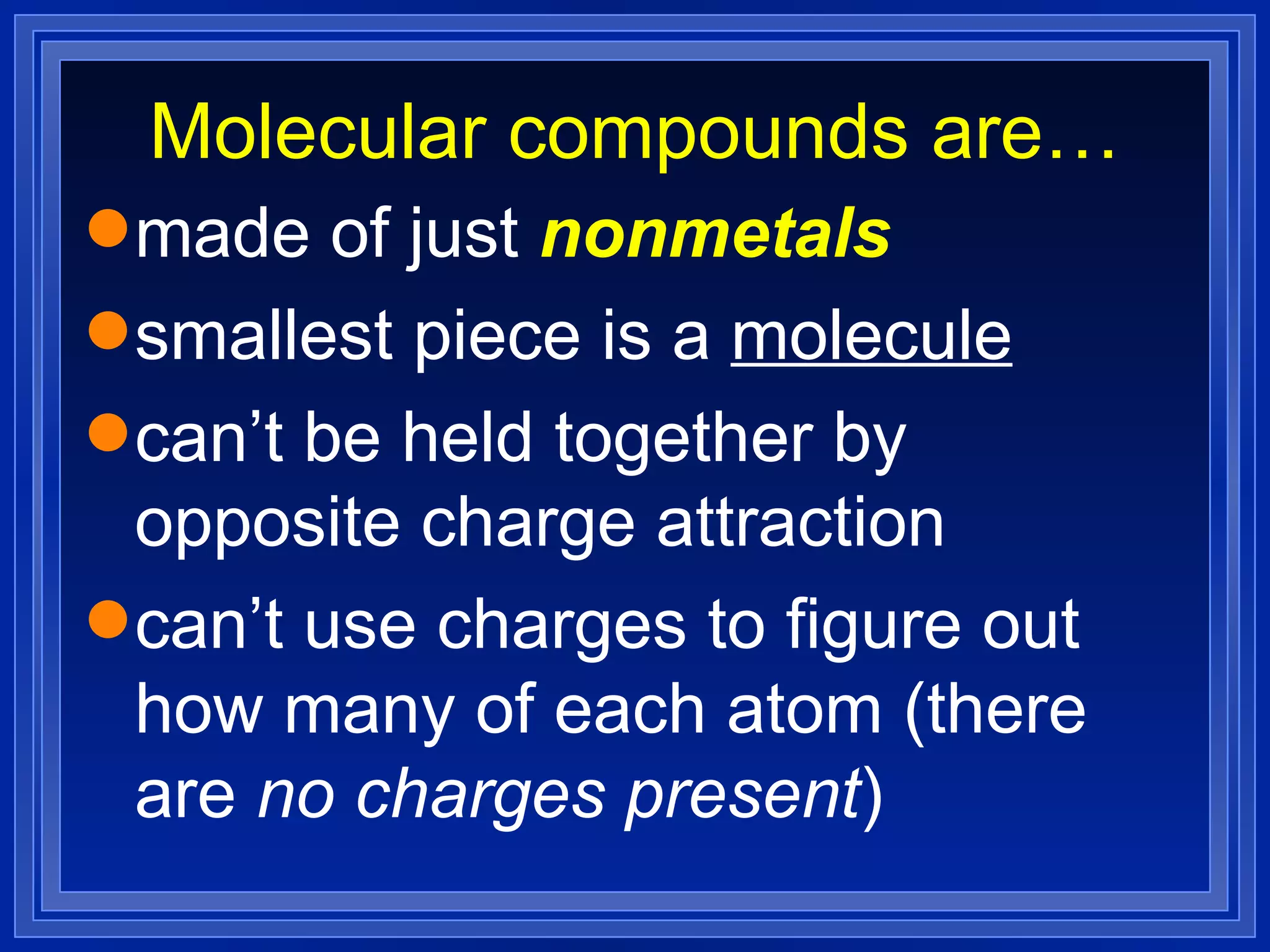
Molecular compounds are… made of just  nonmetals smallest piece is a  molecule can’t be held together by opposite charge attraction can’t use charges to figure out how many of each atom (there are  no charges present )
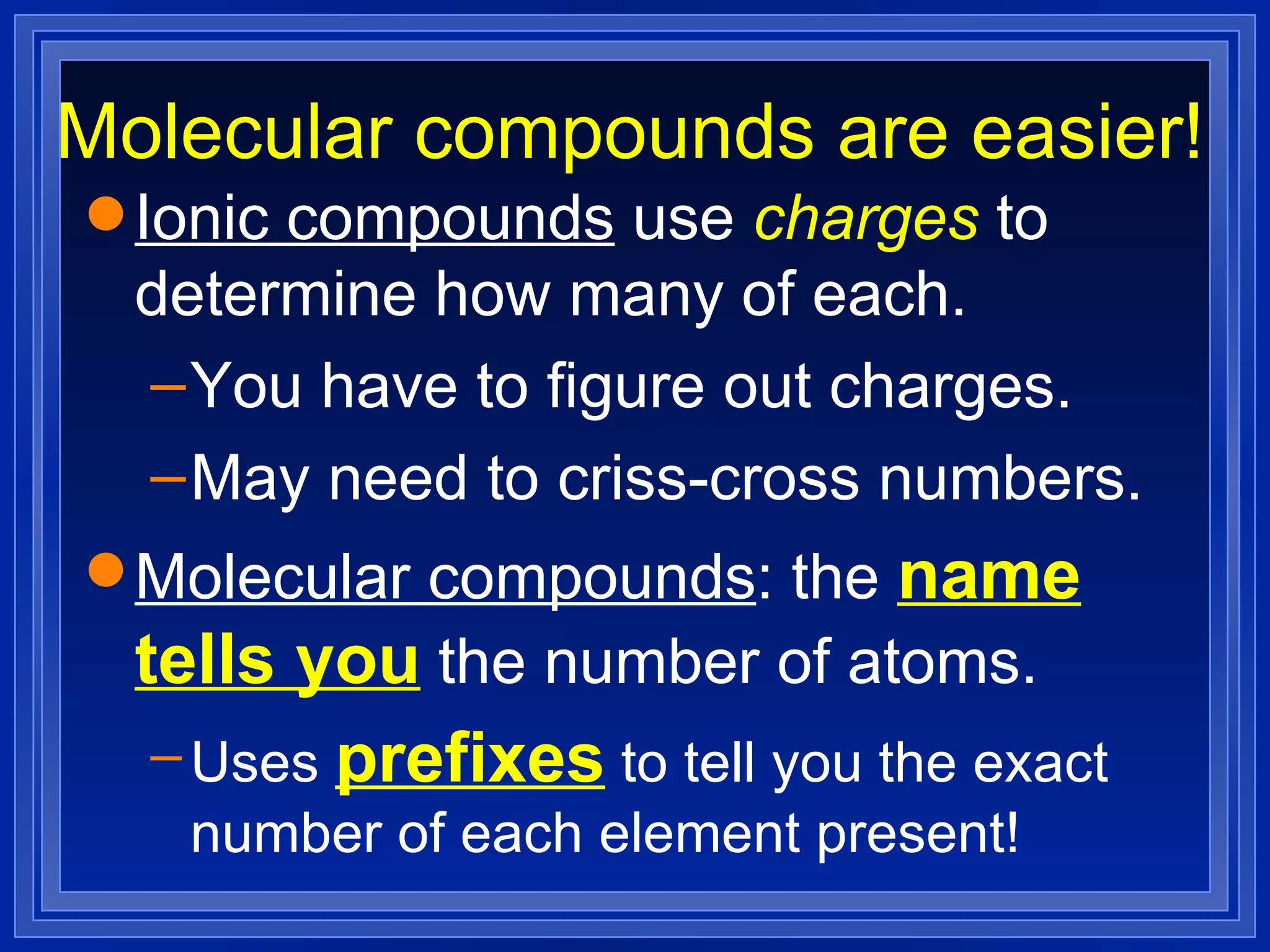
Molecular compounds are easier! Ionic compounds  use  charges  to determine how many of each. You have to figure out charges. May need to criss-cross numbers. Molecular compounds : the  name tells you  the number of atoms. Uses  prefixes  to tell you the exact number of each element present!
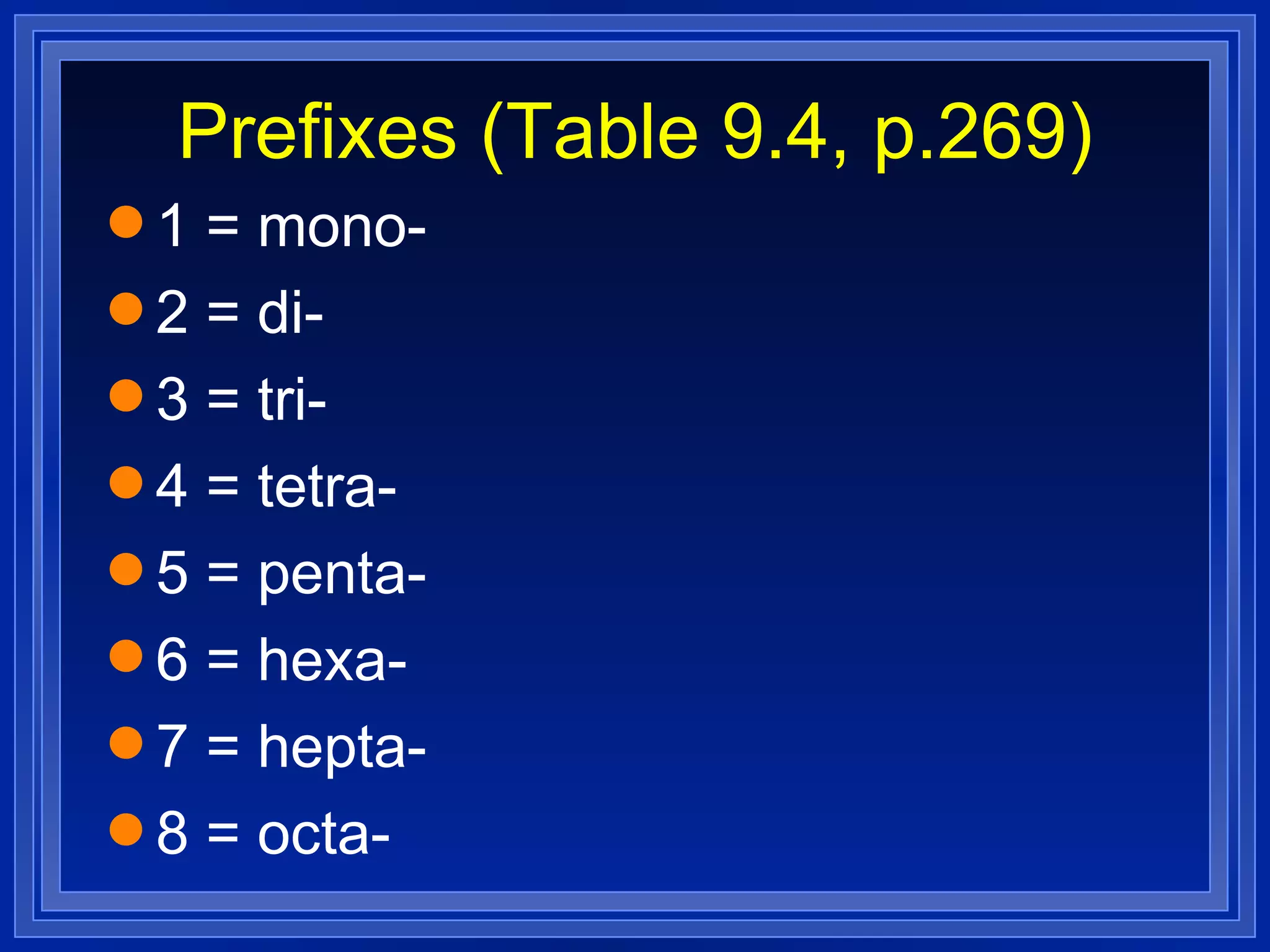
Prefixes (Table 9.4, p.269) 1 = mono- 2 = di- 3 = tri- 4 = tetra- 5 = penta- 6 = hexa- 7 = hepta- 8 = octa-
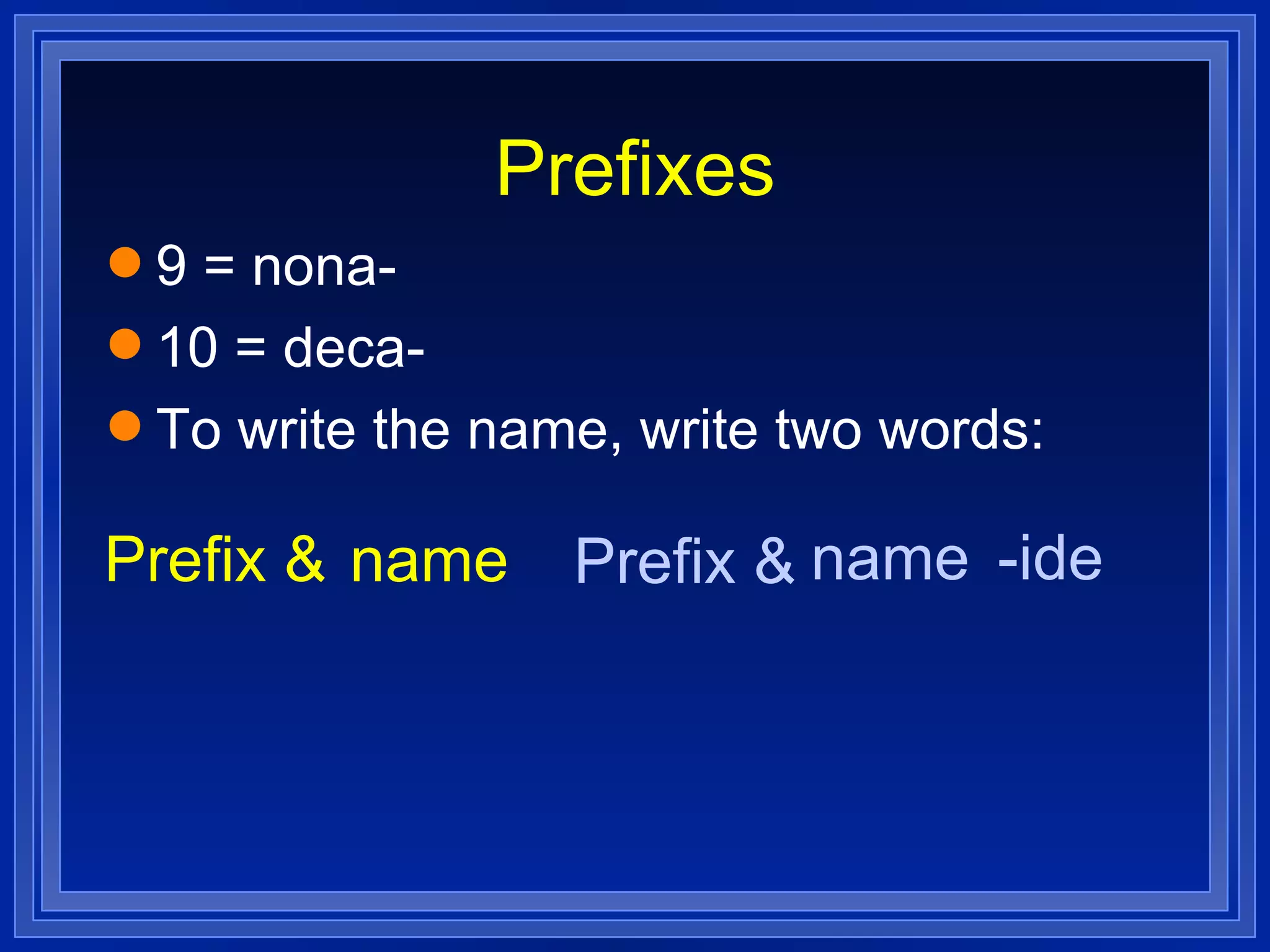
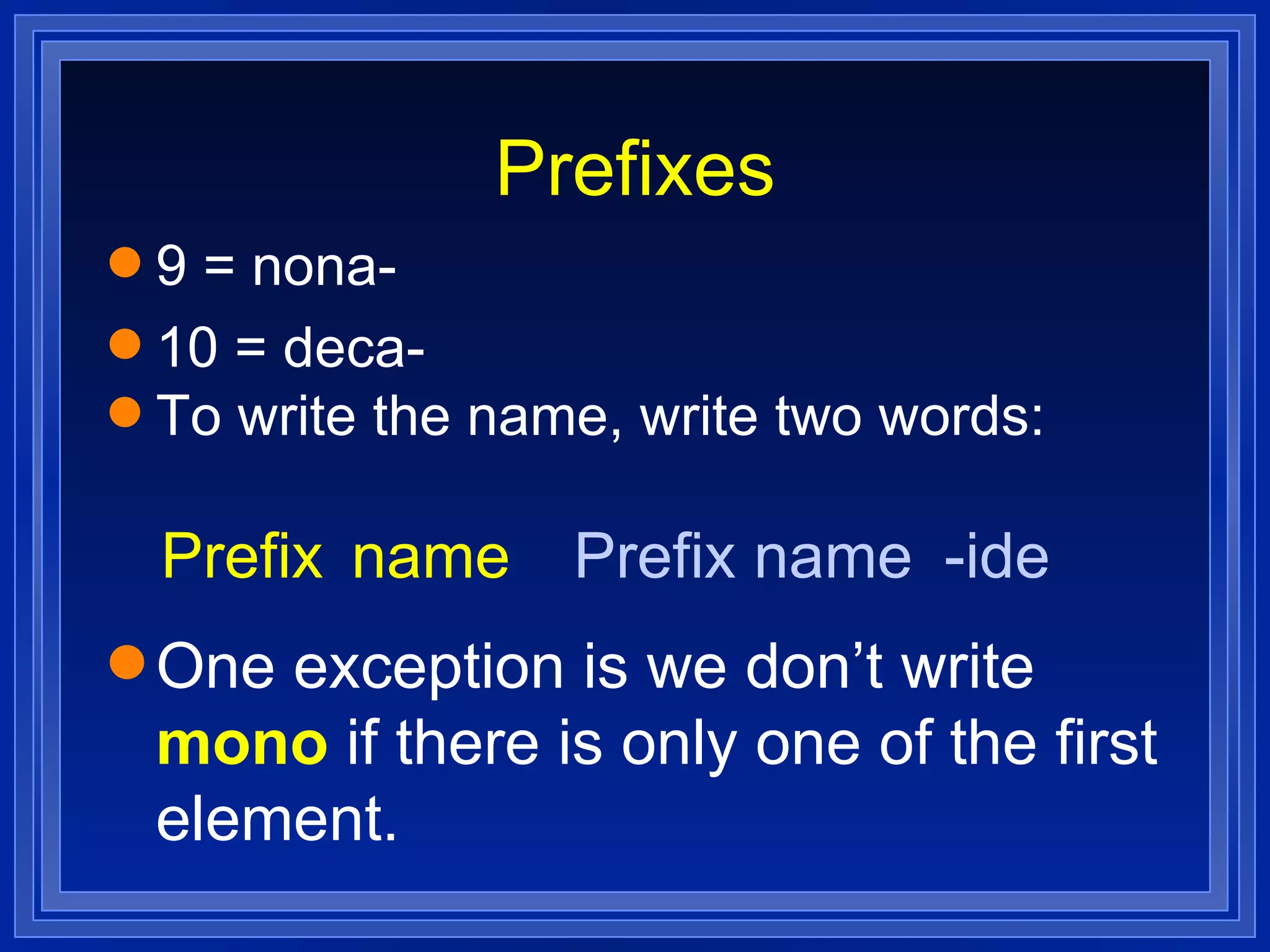
Prefixes 9 = nona- 10 = deca- To write the name, write two words: Prefix & name Prefix & name -ide
Prefixes 9 = nona- 10 = deca- To write the name, write two words: One exception is we don’t write  mono  if there is only one of the first element. Prefix name Prefix name -ide
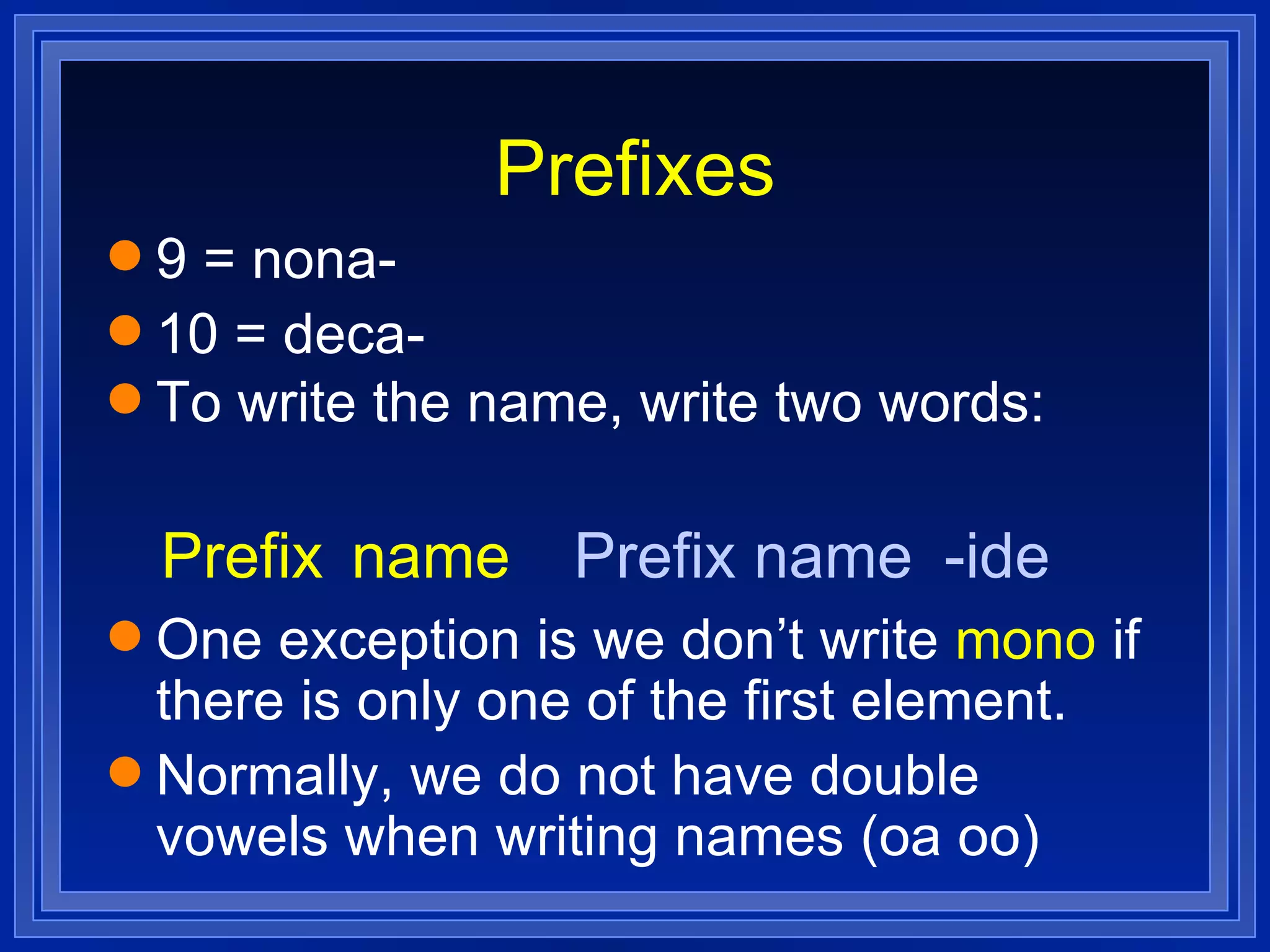
Prefixes 9 = nona- 10 = deca- To write the name, write two words: One exception is we don’t write  mono  if there is only one of the first element. Normally, we do not have double vowels when writing names (oa oo) Prefix name Prefix name -ide
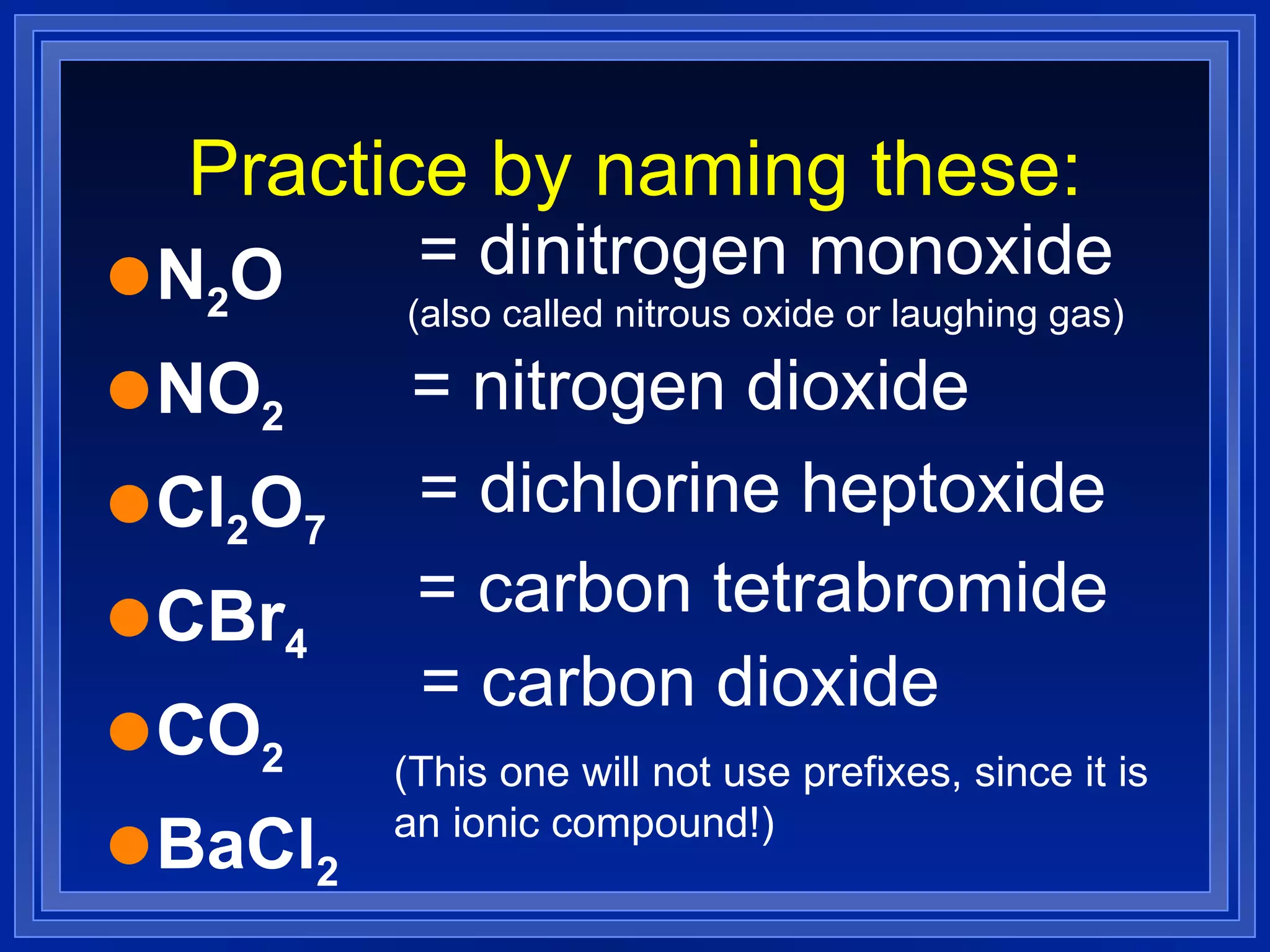
Practice by naming these: N 2 O NO 2   Cl 2 O 7   CBr 4   CO 2   BaCl 2   (This one will not use prefixes, since it is an ionic compound!) = dinitrogen monoxide (also called nitrous oxide or laughing gas) = nitrogen dioxide = dichlorine heptoxide = carbon tetrabromide = carbon dioxide
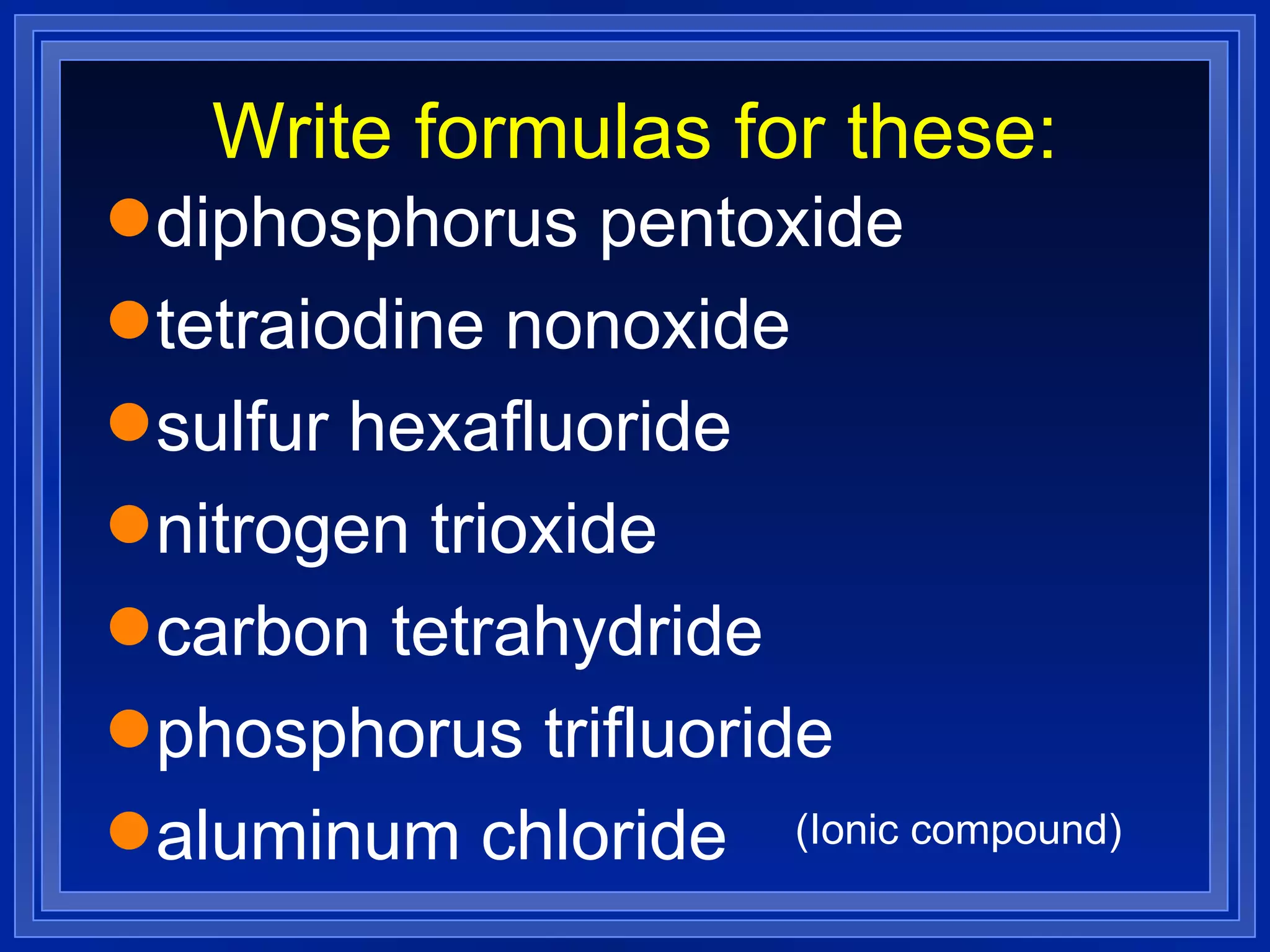
Write formulas for these: diphosphorus pentoxide tetraiodine nonoxide sulfur hexafluoride nitrogen trioxide carbon tetrahydride phosphorus trifluoride aluminum chloride (Ionic compound)
Section 9.4 Naming and Writing Formulas for Acids and Bases OBJECTIVES: Apply three rules  for  naming  acids.
Section 9.4 Naming and Writing Formulas for Acids and Bases OBJECTIVES: Apply the rules  in reverse to write  formulas  of acids.
Section 9.4 Naming and Writing Formulas for Acids and Bases OBJECTIVES: Apply the rules  for  naming  bases.
Acids are… Compounds that give off  hydrogen ions  (H 1+ ) when dissolved in water  (the Arrhenius definition) Will start the formula with H. There will always be some Hydrogen next to an anion. The  anion  determines the name.
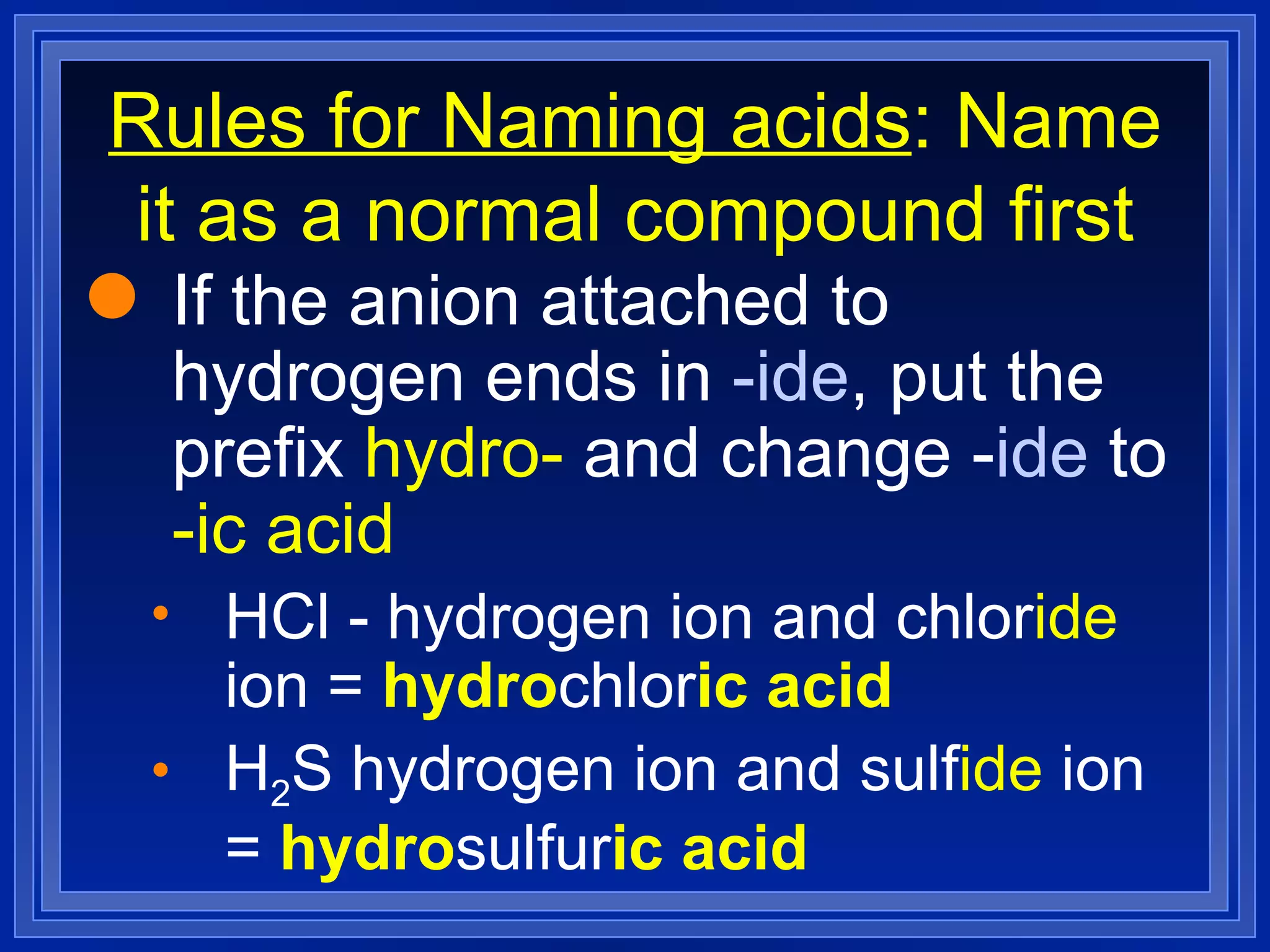
Rules for Naming acids : Name it as a normal compound first If the anion attached to hydrogen ends in  -ide , put the prefix  hydro-  and change - ide  to  -ic acid HCl - hydrogen ion and chlor ide  ion =  hydro chlor ic acid H 2 S hydrogen ion and sulf ide  ion =  hydro sulfur ic acid
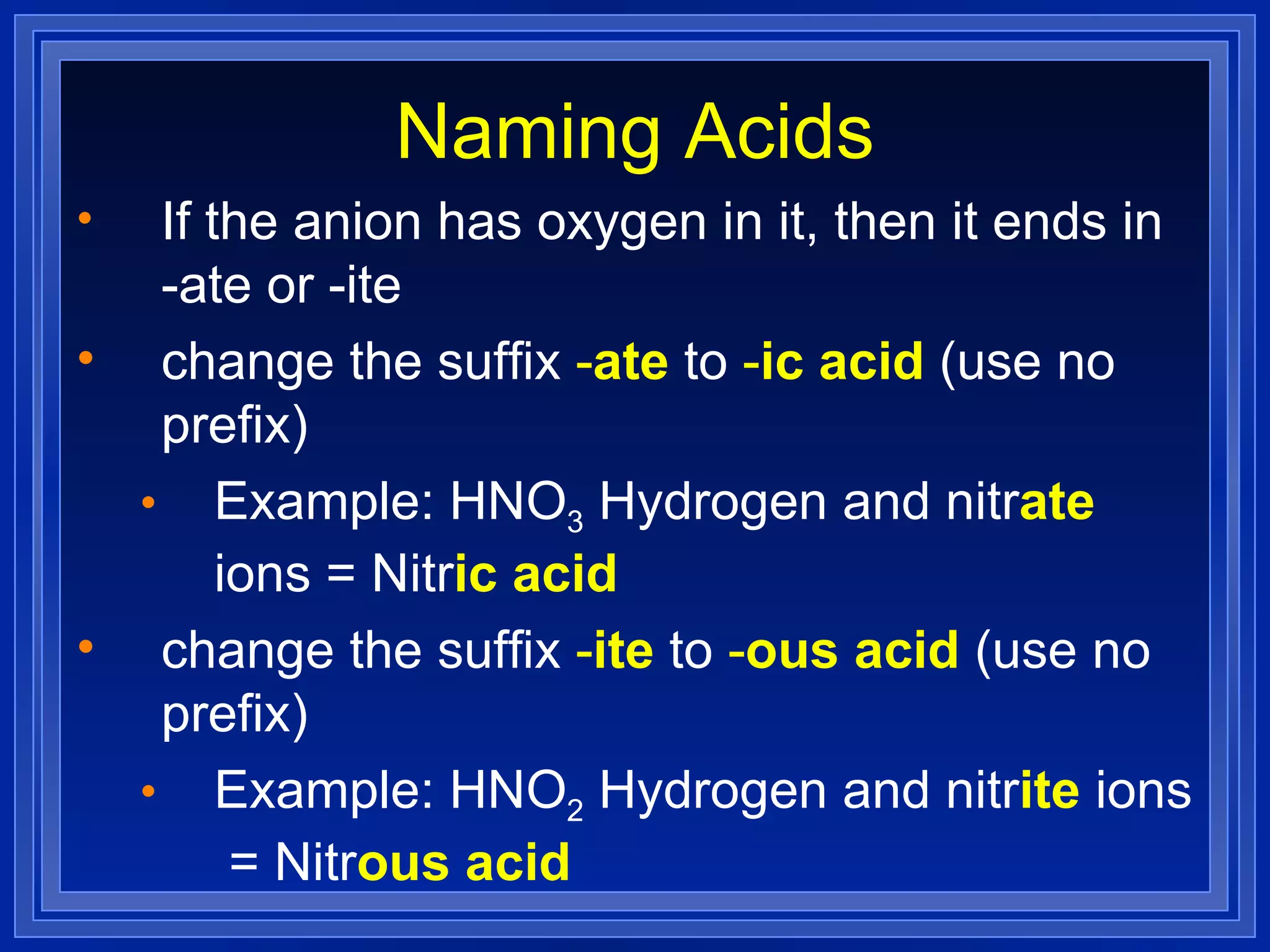
Naming Acids If the anion has oxygen in it, then it ends in -ate or -ite change the suffix  - ate   to  - ic acid   (use no prefix) Example: HNO 3  Hydrogen and nitr ate  ions = Nitr ic acid change the suffix  - ite   to  - ous acid   (use no prefix) Example: HNO 2  Hydrogen and nitr ite  ions  = Nitr ous acid
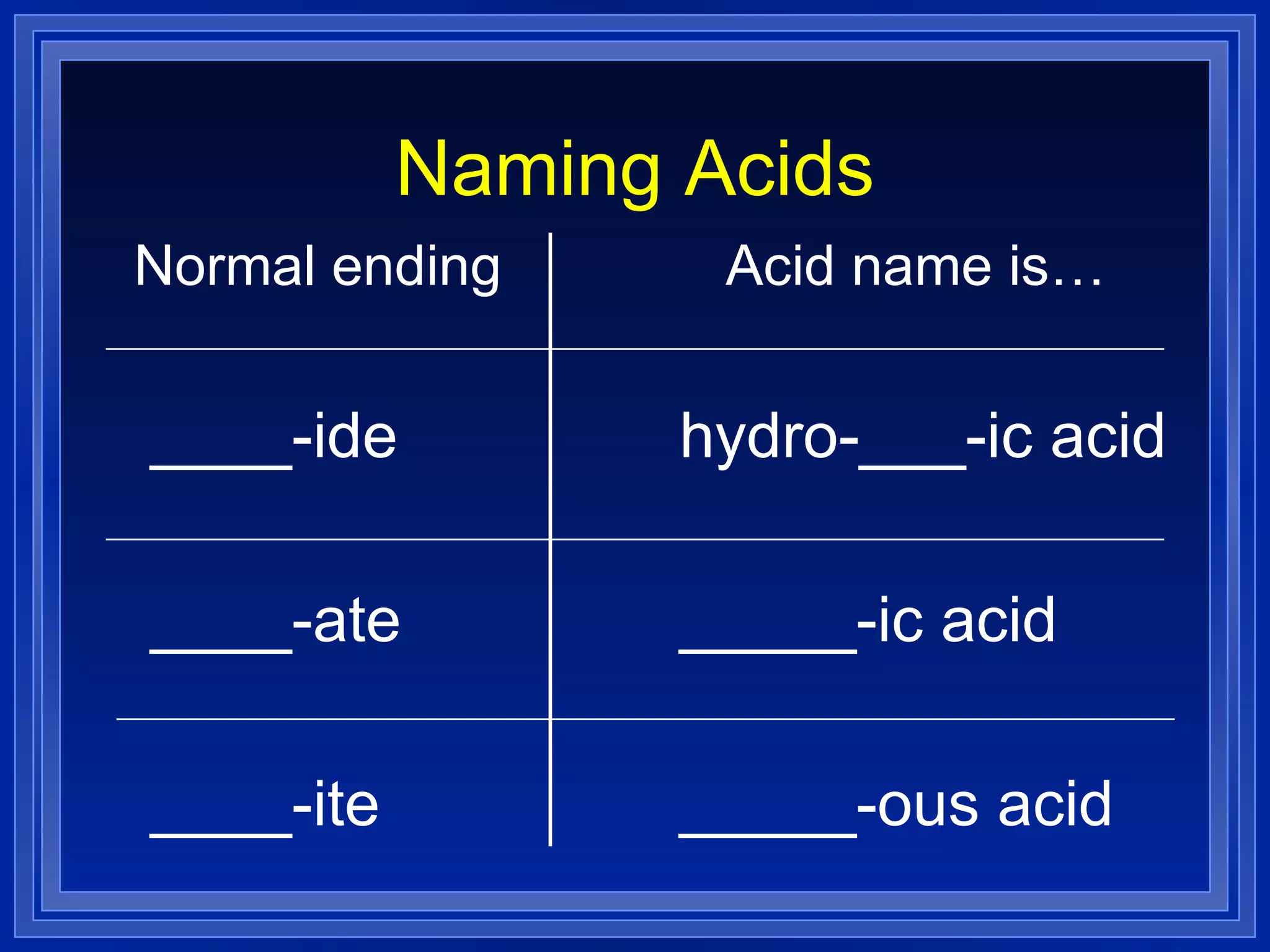
Naming Acids Normal ending ____-ide ____-ate ____-ite Acid name is… hydro-___-ic acid _____-ic acid _____-ous acid
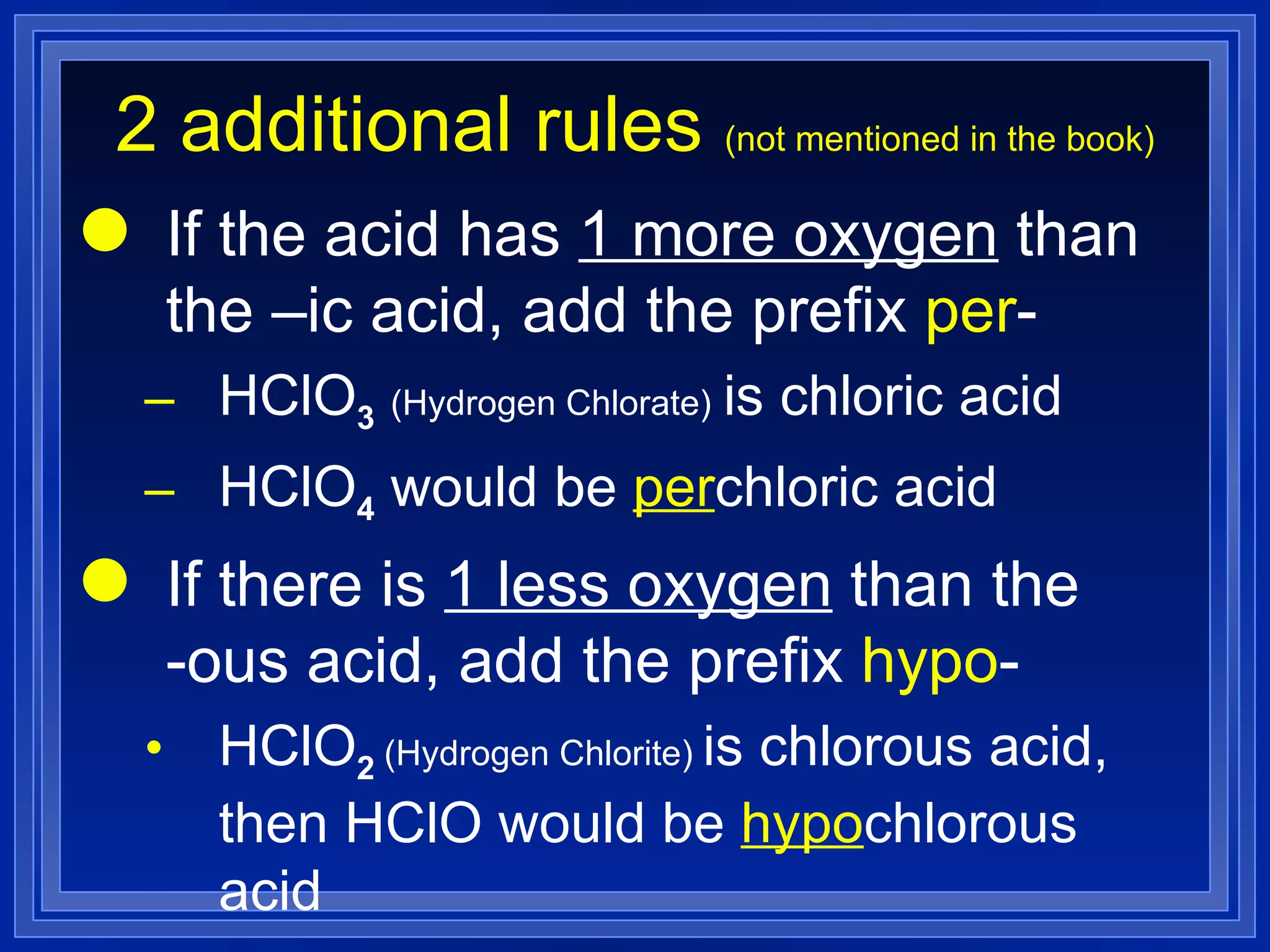
2 additional rules  (not mentioned in the book) If the acid has  1 more oxygen  than the –ic acid, add the prefix  per - HClO 3   (Hydrogen Chlorate)   is chloric acid HClO 4  would be  per chloric acid If there is  1 less oxygen  than the  -ous acid, add the prefix  hypo - HClO 2  (Hydrogen Chlorite)  is chlorous acid, then HClO would be  hypo chlorous acid
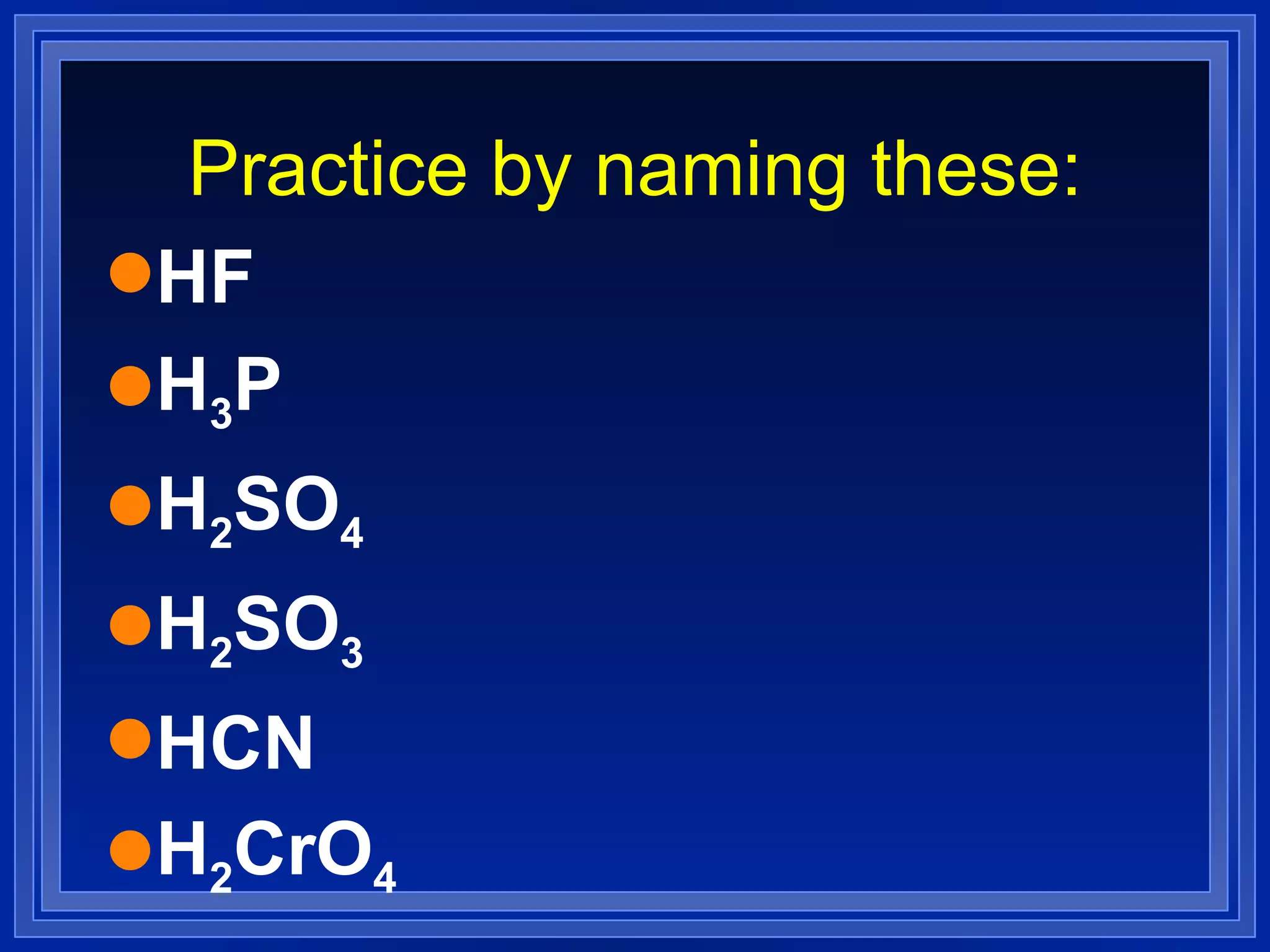
Practice by naming these: HF H 3 P H 2 SO 4   H 2 SO 3   HCN H 2 CrO 4
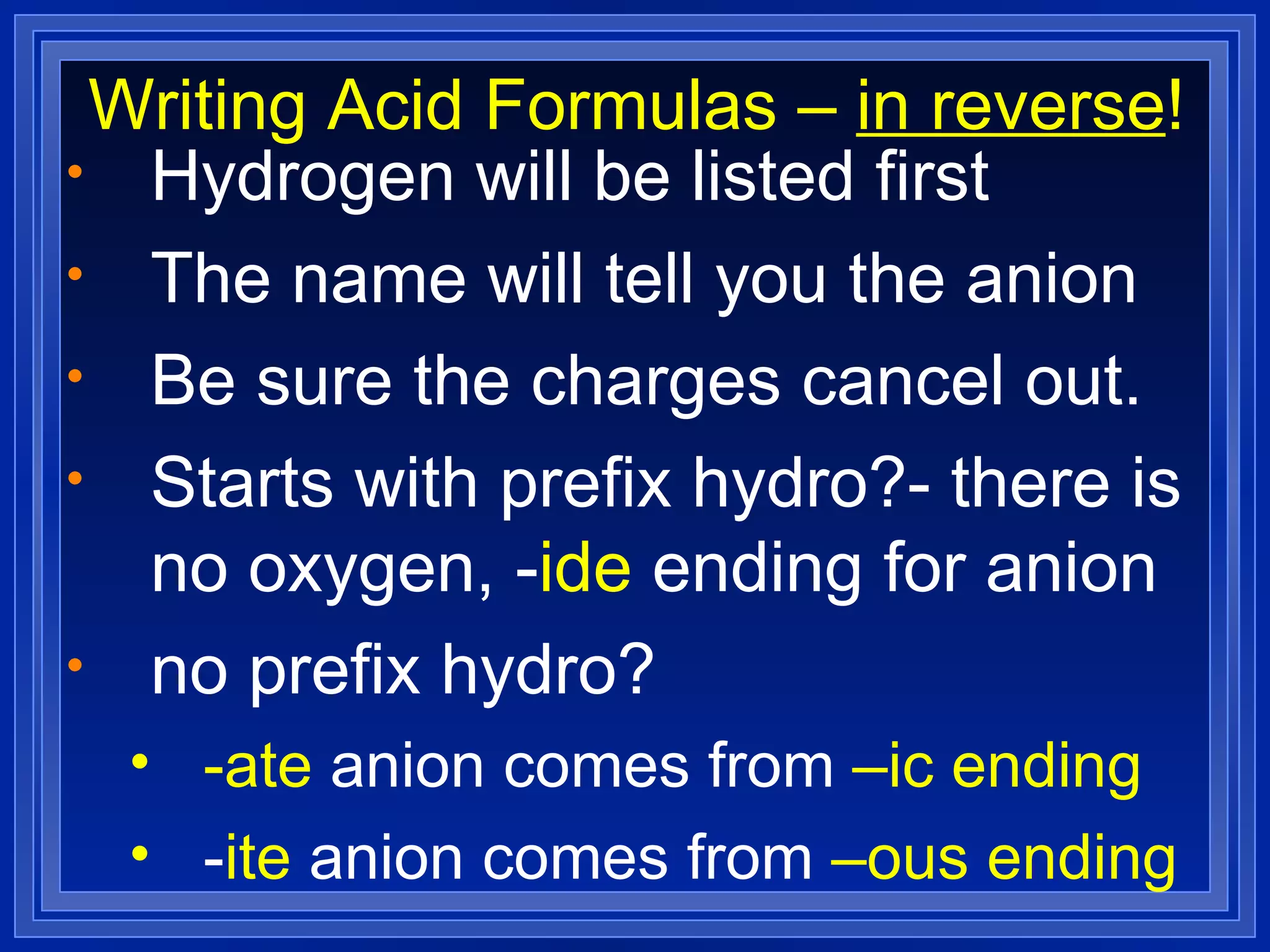
Writing Acid Formulas –  in reverse ! Hydrogen will be listed first The name will tell you the anion Be sure the charges cancel out. Starts with prefix hydro?- there is no oxygen, - ide  ending for anion no prefix hydro? -ate  anion   comes from  –ic ending - ite  anion comes from  –ous ending
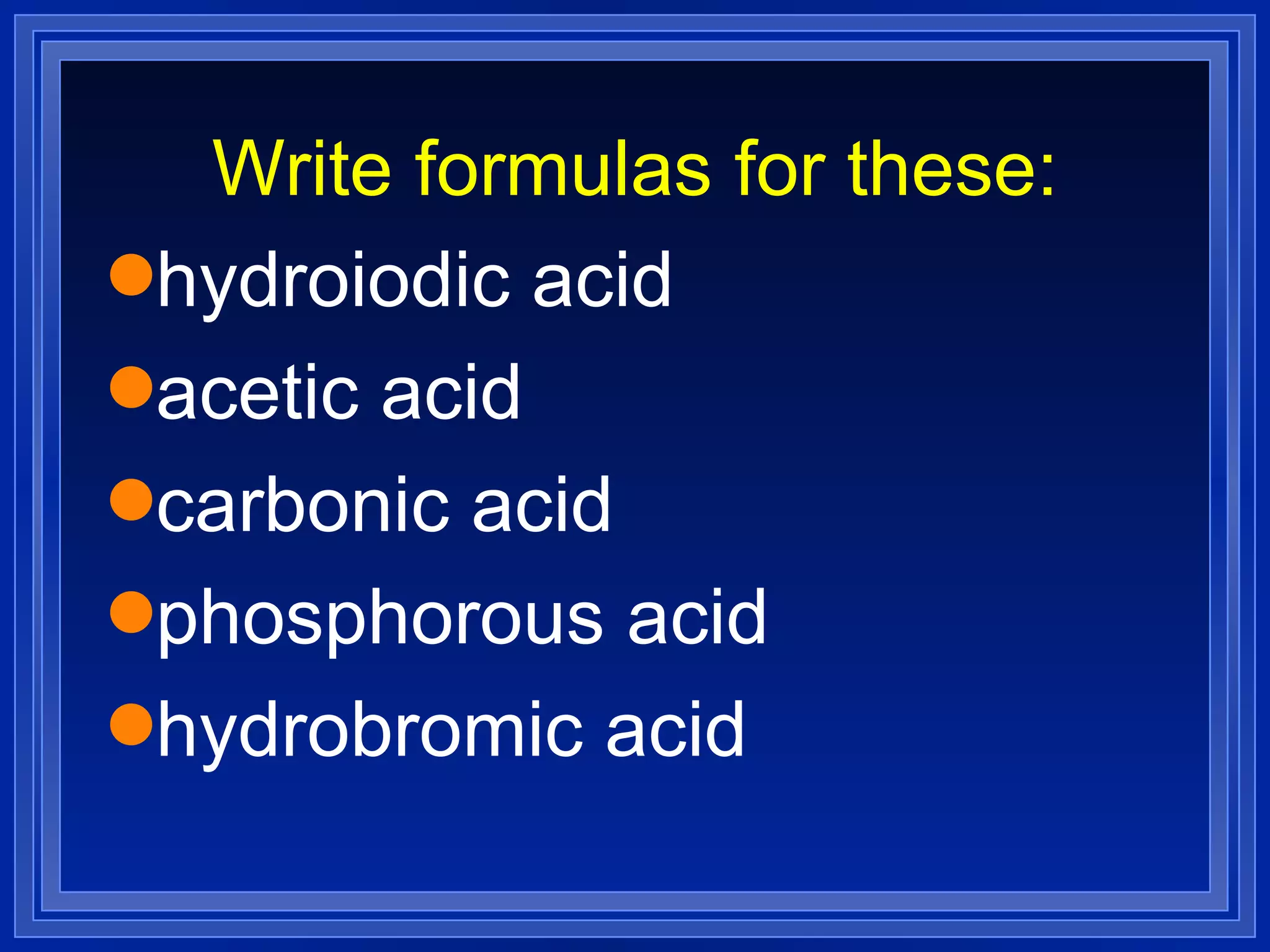
Write formulas for these: hydroiodic acid acetic acid carbonic acid phosphorous acid hydrobromic acid
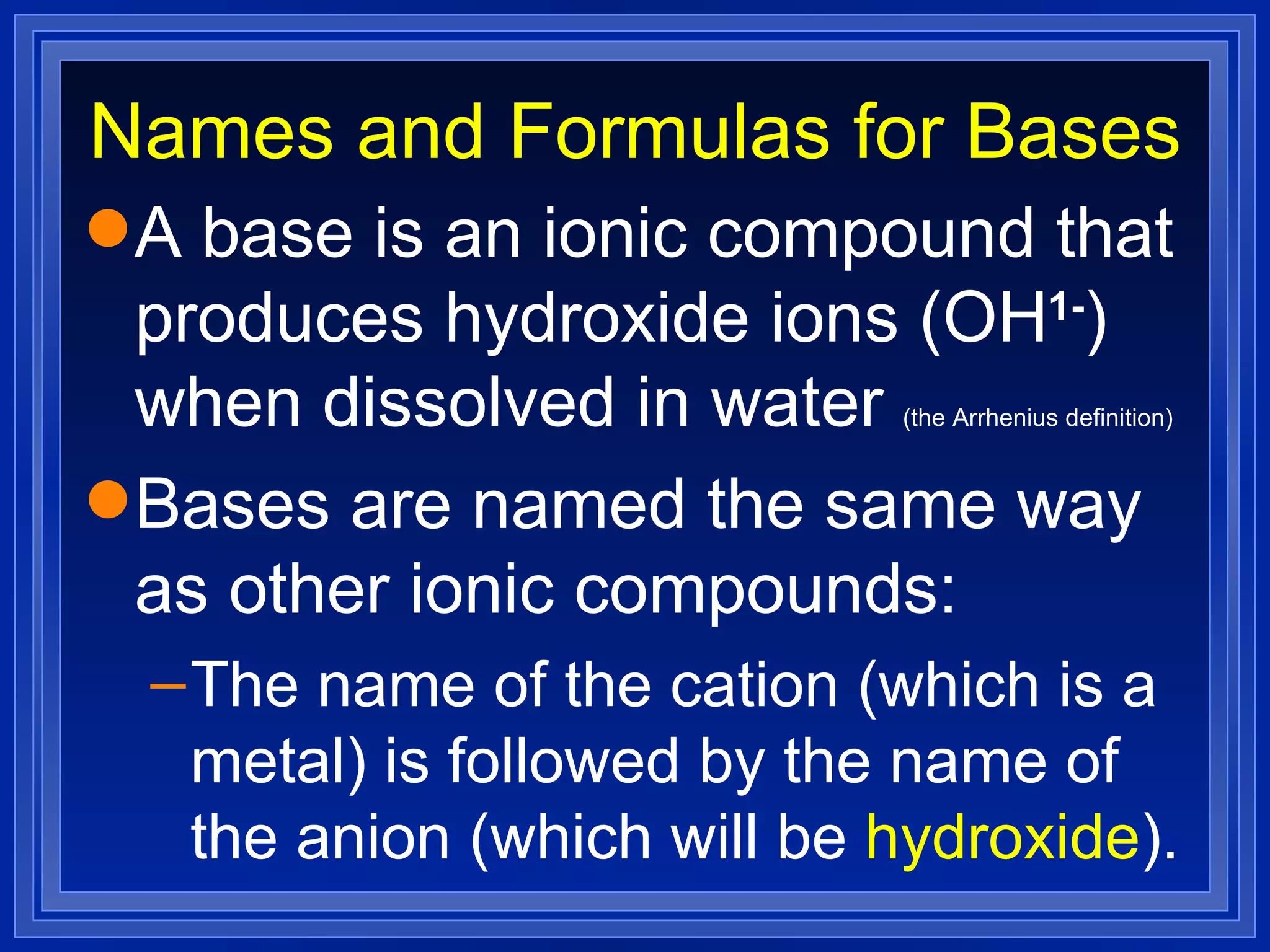
Names and Formulas for Bases A base is an ionic compound that produces hydroxide ions (OH 1- ) when dissolved in water  (the Arrhenius definition) Bases are named the same way as other ionic compounds: The name of the cation (which is a metal) is followed by the name of the anion (which will be  hydroxide ).
Names and Formulas for Bases NaOH is sodium hydroxide Ca(OH) 2  is calcium hydroxide To write the formula: Write the symbol for the metal cation followed by the formula for the hydroxide ion (OH 1- ) then use the criss-cross method to balance the charges.
Practice by writing the formula for the following: Magnesium hydroxide Iron (III) hydroxide Zinc hydroxide
Section 9.5 The Laws Governing Formulas and Names OBJECTIVES: Define  the laws of definite proportions and multiple proportions.
Section 9.5 The Laws Governing Formulas and Names OBJECTIVES: Apply the rules  for naming chemical compounds by using a flowchart.
Section 9.5 The Laws Governing Formulas and Names OBJECTIVES: Apply the rules  for writing the formulas of chemial compounds by using a flowchart.
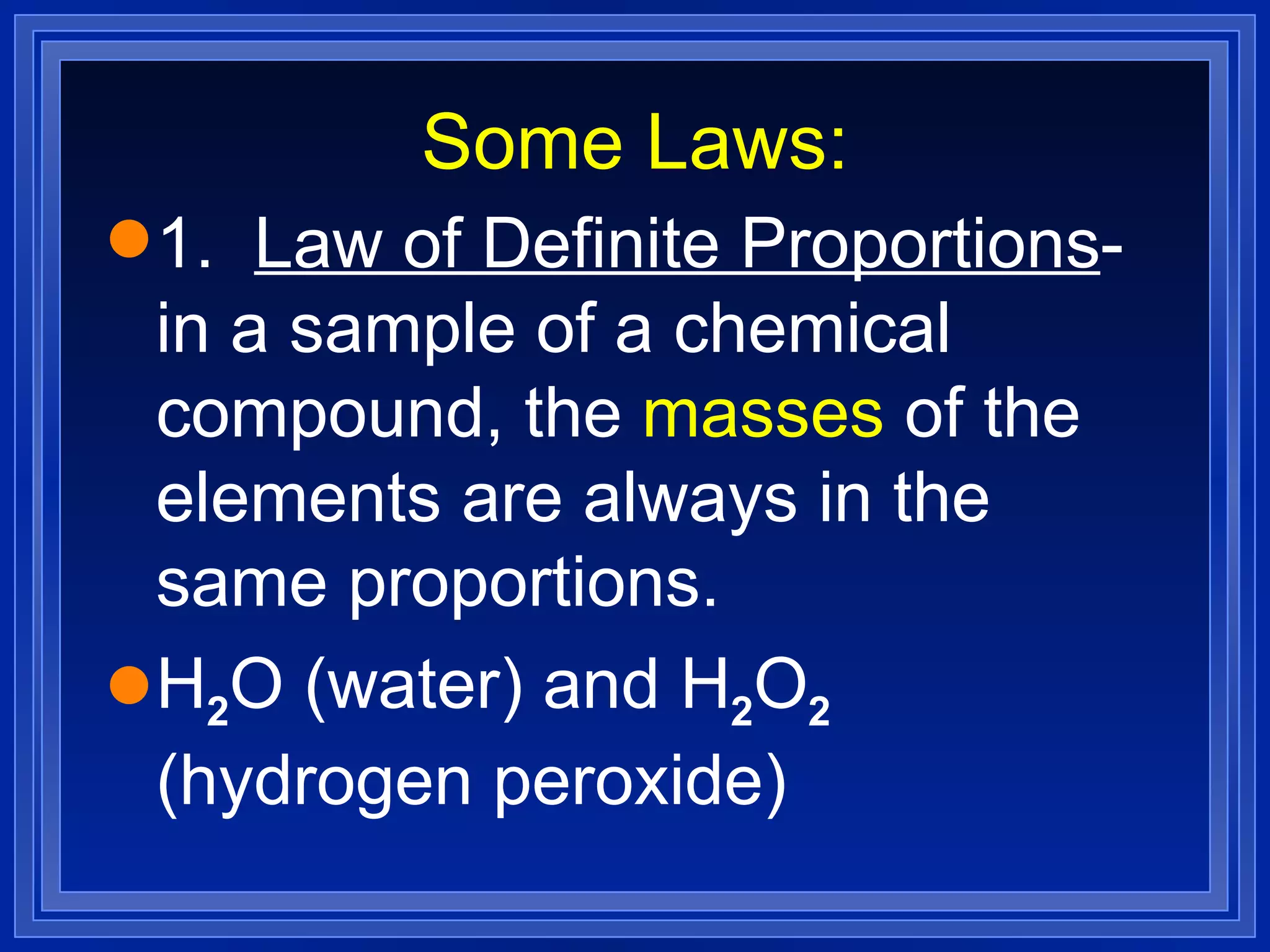
Some Laws: 1.  Law of Definite Proportions - in a sample of a chemical compound, the  masses  of the elements are always in the same proportions. H 2 O (water) and H 2 O 2  (hydrogen peroxide)
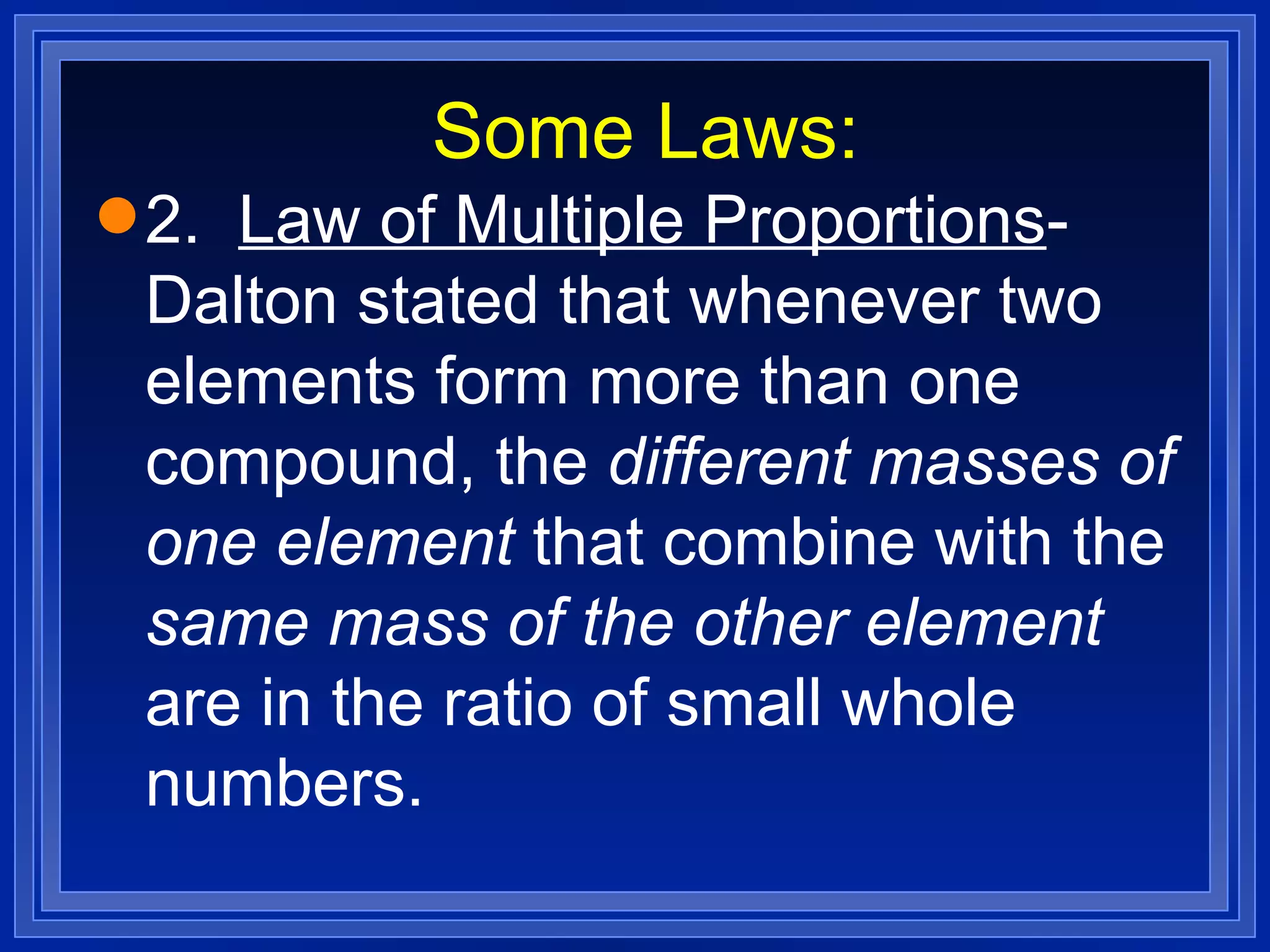
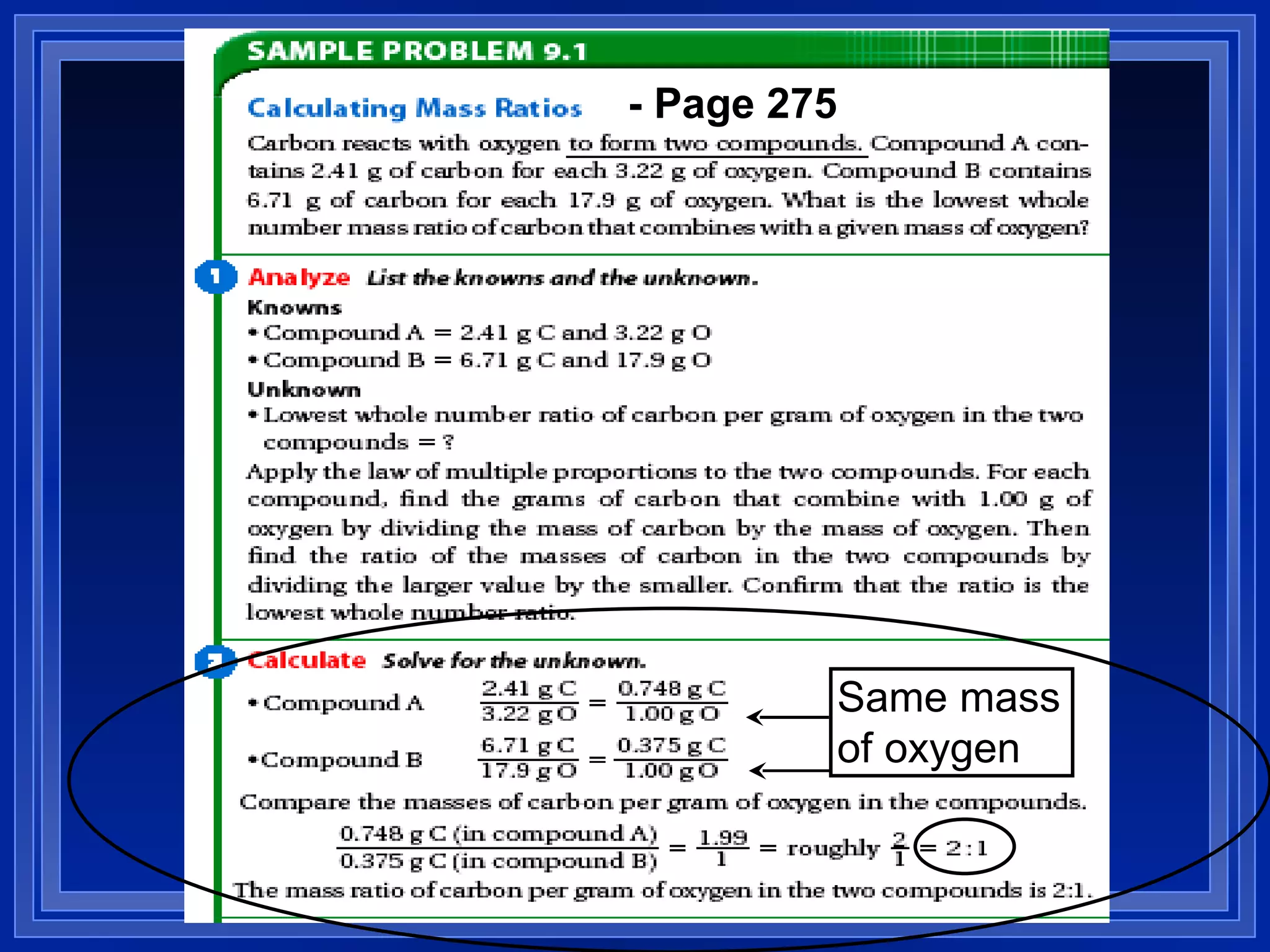
Some Laws: 2.  Law of Multiple Proportions - Dalton stated that whenever two elements form more than one compound, the  different masses of one element  that combine with the  same mass of the other element  are in the ratio of small whole numbers.
Same mass of oxygen - Page 275
Summary of Naming and Formula Writing For naming, follow the flowchart- Figure 9.20, page 277 For writing formulas, follow the flowchart from Figure 9.22, page 278
Helpful to remember... 1. In an ionic compound, the net ionic charge is  zero  (criss-cross method) 2. An  -ide  ending generally indicates a binary compound 3. An  -ite  or  -ate  ending means there is a polyatomic ion that has oxygen 4.  Prefixes  generally mean molecular; they show the number of each atom
Helpful to remember... 5. A  Roman numeral  after the name of a cation is the  ionic charge  of the cation Use the  handout sheets  provided by your teacher! End of Chapter 9

Chemistry - Chp 9 - Chemical Names and Formulas - PowerPoint

  • 1.
    Chapter 9 “ChemicalNames and Formulas” H 2 O
  • 2.
    Section 9.1 NamingIons OBJECTIVES: Identify the charges on monatomic ions by using the periodic table, and name the ions.
  • 3.
    Section 9.1 NamingIons OBJECTIVES: Define a polyatomic ion and write the names and formulas of the most common polyatomic ions.
  • 4.
    Section 9.1 NamingIons OBJECTIVES: Identify the two common endings for the names of most polyatomic ions.
  • 5.
    Atoms and IonsAtoms are electrically neutral. Because there is the same number of protons (+) and electrons (-). Ions are atoms, or groups of atoms, with a charge (positive or negative) They have different numbers of protons and electrons. Only electrons can move, and ions are made by gaining or losing electrons.
  • 6.
    An Anion is…A negative ion. Has gained electrons. Nonmetals can gain electrons. Charge is written as a superscript on the right. F 1- Has gained one electron (-ide is new ending = fluoride) O 2- Gained two electrons (oxide)
  • 7.
    A Cation is…A positive ion. Formed by losing electrons. More protons than electrons. Metals can lose electrons K 1+ Has lost one electron (no name change for positive ions) Ca 2+ Has lost two electrons
  • 8.
    Predicting Ionic ChargesGroup 1A : Lose 1 electron to form 1+ ions H 1 + Li 1 + Na 1 + K 1 + Rb 1 +
  • 9.
    Predicting Ionic ChargesGroup 2A : Loses 2 electrons to form 2+ ions Be 2+ Mg 2+ Ca 2+ Sr 2+ Ba 2+
  • 10.
    Predicting Ionic ChargesGroup 3A : Loses 3 electrons to form 3+ ions B 3+ Al 3+ Ga 3+
  • 11.
    Predicting Ionic ChargesGroup 4A : Do they lose 4 electrons or gain 4 electrons? Neither! Group 4A elements rarely form ions (they tend to share)
  • 12.
    Predicting Ionic ChargesGroup 5A : Gains 3 electrons to form 3- ions N 3- P 3- As 3- Nitride Phosphide Arsenide
  • 13.
    Predicting Ionic ChargesGroup 6A : Gains 2 electrons to form 2- ions O 2- S 2- Se 2- Oxide Sulfide Selenide
  • 14.
    Predicting Ionic ChargesGroup 7A : Gains 1 electron to form 1- ions F 1- Cl 1- Br 1- Fluoride Chloride Bromide I 1- Iodide
  • 15.
    Predicting Ionic ChargesGroup 8A : Stable noble gases do not form ions!
  • 16.
    Predicting Ionic ChargesGroup B elements : Many transition elements have more than one possible oxidation state. Iron (II) = Fe 2+ Iron (III) = Fe 3+ Note the use of Roman numerals to show charges
  • 17.
    Naming cations Twomethods can clarify when more than one charge is possible: Stock system – uses roman numerals in parenthesis to indicate the numerical value Classical method – uses root word with suffixes (-ous, -ic) Does not give true value
  • 18.
    Naming cations Wewill use the Stock system . Cation - if the charge is always the same (like in the Group A metals) just write the name of the metal. Transition metals can have more than one type of charge. Indicate their charge as a roman numeral in parenthesis after the name of the metal (Table 9.2, p.255)
  • 19.
    Predicting Ionic ChargesSome of the post-transition elements also have more than one possible oxidation state. Tin (II) = Sn 2+ Lead (II) = Pb 2+ Tin (IV) = Sn 4+ Lead (IV) = Pb 4+
  • 20.
    Predicting Ionic ChargesGroup B elements : Some transition elements have only one possible oxidation state, such as these three: Zinc = Zn 2+ Silver = Ag 1+ Cadmium = Cd 2+
  • 21.
    Exceptions: Some ofthe transition metals have only one ionic charge: Do not need to use roman numerals for these: Silver is always 1+ ( Ag 1+ ) Cadmium and Zinc are always 2+ ( Cd 2+ and Zn 2+ )
  • 22.
    Practice by namingthese: Na 1+ Ca 2+ Al 3+ Fe 3+ Fe 2+ Pb 2+ Li 1+
  • 23.
    Write symbols forthese: Potassium ion Magnesium ion Copper (II) ion Chromium (VI) ion Barium ion Mercury (II) ion
  • 24.
    Naming Anions Anionsare always the same charge Change the monatomic element ending to – ide F 1- a Fluor ine atom will become a Fluor ide ion.
  • 25.
    Practice by namingthese: Cl 1- N 3- Br 1- O 2- Ga 3+
  • 26.
    Write symbols forthese: Sulfide ion Iodide ion Phosphide ion Strontium ion
  • 27.
    Polyatomic ions are…Groups of atoms that stay together and have an overall charge, and one name. Usually end in –ate or -ite Acet ate : C 2 H 3 O 2 1- Nitr ate : NO 3 1- Nitr ite : NO 2 1- Permangan ate : MnO 4 1- Hydrox ide : OH 1- and Cyan ide : CN 1-
  • 28.
    Sulf ate : SO 4 2- Sulf ite : SO 3 2- Carbon ate : CO 3 2- Chrom ate : CrO 4 2- Dichrom ate : Cr 2 O 7 2- Phosph ate : PO 4 3- Phosph ite : PO 3 3- Ammonium: NH 4 1+ Know how and when to use Table E If the polyatomic ion begins with H, then combine the word hydrogen with the other polyatomic ion present: H 1+ + CO 3 2- -> HCO 3 1- hydrogen + carbonate -> hydrogen carbonate ion (One of the few positive polyatomic ions)
  • 29.
    Section 9.2 Naming and Writing Formulas for Ionic Compounds OBJECTIVES: Apply the rules for naming and writing formulas for binary ionic compounds.
  • 30.
    Section 9.2 Naming and Writing Formulas for Ionic Compounds OBJECTIVES: Apply the rules for naming and writing formulas for compounds containing polyatomic ions.
  • 31.
    Writing Ionic CompoundFormulas Example: Barium nitrate (note the 2 word name) 1. Write the formulas for the cation and anion, including CHARGES ! Ba 2+ NO 3 - 2. Check to see if charges are balanced. 3. Balance charges , if necessary, using subscripts . Use parentheses if you need more than one of a polyatomic ion . Use the criss-cross method to balance subscripts. Not balanced! ( ) 2 Now balanced. = Ba(NO 3 ) 2
  • 32.
    Writing Ionic CompoundFormulas Example: Ammonium sulfate (note the 2 word name) 1. Write the formulas for the cation and anion, including CHARGES ! NH 4 + SO 4 2- 2. Check to see if charges are balanced. 3. Balance charges , if necessary, using subscripts . Use parentheses if you need more than one of a polyatomic ion . Use the criss-cross method to balance the subscripts. Not balanced! ( ) 2 Now balanced. = (NH 4 ) 2 SO 4
  • 33.
    Writing Ionic CompoundFormulas Example: Iron (III) chloride (note the 2 word name) 1. Write the formulas for the cation and anion, including CHARGES ! Fe 3+ Cl - 2. Check to see if charges are balanced. 3. Balance charges , if necessary, using subscripts . Use parentheses if you need more than one of a polyatomic ion . Use the criss-cross method to balance the subscripts. Not balanced! 3 Now balanced. = FeCl 3
  • 34.
    Writing Ionic CompoundFormulas Example: Aluminum sulfide (note the 2 word name) 1. Write the formulas for the cation and anion, including CHARGES ! Al 3+ S 2- 2. Check to see if charges are balanced. 3. Balance charges , if necessary, using subscripts . Use parentheses if you need more than one of a polyatomic ion . Use the criss-cross method to balance the subscripts. Not balanced! 2 3 Now balanced. = Al 2 S 3
  • 35.
    Writing Ionic CompoundFormulas Example: Magnesium carbonate (note the 2 word name) 1. Write the formulas for the cation and anion, including CHARGES ! Mg 2+ CO 3 2- 2. Check to see if charges are balanced. They are balanced! = MgCO 3
  • 36.
    Writing Ionic CompoundFormulas Example: Zinc hydroxide (note the 2 word name) 1. Write the formulas for the cation and anion, including CHARGES ! Zn 2+ OH - 2. Check to see if charges are balanced. 3. Balance charges , if necessary, using subscripts . Use parentheses if you need more than one of a polyatomic ion . Use the criss-cross method to balance the subscripts. Not balanced! ( ) 2 Now balanced. = Zn(OH) 2
  • 37.
    Writing Ionic CompoundFormulas Example: Aluminum phosphate (note the 2 word name) 1. Write the formulas for the cation and anion, including CHARGES ! Al 3+ PO 4 3- 2. Check to see if charges are balanced. They ARE balanced! = AlPO 4
  • 38.
    Naming Ionic Compounds1. Name the cation first, then anion 2. Monatomic cation = name of the element Ca 2+ = calcium ion 3. Monatomic anion = root + -ide Cl  = chlor ide CaCl 2 = calcium chloride
  • 39.
    Naming Ionic Compoundssome metals can form more than one charge (usually the transition metals) use a Roman numeral in their name: PbCl 2 – use the anion to find the charge on the cation (chloride is always 1-) Pb 2+ is the lead (II) cation PbCl 2 = lead ( II ) chloride (Metals with multiple oxidation states)
  • 40.
    Things to lookfor: If cations have ( ), the number in parenthesis is their charge. If anions end in -ide they are probably off the periodic table (Monoatomic) If anion ends in -ate or –ite , then it is polyatomic
  • 41.
    Practice by writingthe formula or name as required… Iron (II) Phosphate Tin (II) Fluoride Potassium Sulfide Ammonium Chromate MgSO 4 FeCl 3
  • 42.
    Section 9.3 Namingand Writing Formulas for Molecular Compounds OBJECTIVES: Interpret the prefixes in the names of molecular compounds in terms of their chemical formulas.
  • 43.
    Section 9.3 Namingand Writing Formulas for Molecular Compounds OBJECTIVES: Apply the rules for naming and writing formulas for binary molecular compounds.
  • 44.
    Molecular compounds are…made of just nonmetals smallest piece is a molecule can’t be held together by opposite charge attraction can’t use charges to figure out how many of each atom (there are no charges present )
  • 45.
    Molecular compounds areeasier! Ionic compounds use charges to determine how many of each. You have to figure out charges. May need to criss-cross numbers. Molecular compounds : the name tells you the number of atoms. Uses prefixes to tell you the exact number of each element present!
  • 46.
    Prefixes (Table 9.4,p.269) 1 = mono- 2 = di- 3 = tri- 4 = tetra- 5 = penta- 6 = hexa- 7 = hepta- 8 = octa-
  • 47.
    Prefixes 9 =nona- 10 = deca- To write the name, write two words: Prefix & name Prefix & name -ide
  • 48.
    Prefixes 9 =nona- 10 = deca- To write the name, write two words: One exception is we don’t write mono if there is only one of the first element. Prefix name Prefix name -ide
  • 49.
    Prefixes 9 =nona- 10 = deca- To write the name, write two words: One exception is we don’t write mono if there is only one of the first element. Normally, we do not have double vowels when writing names (oa oo) Prefix name Prefix name -ide
  • 50.
    Practice by namingthese: N 2 O NO 2 Cl 2 O 7 CBr 4 CO 2 BaCl 2 (This one will not use prefixes, since it is an ionic compound!) = dinitrogen monoxide (also called nitrous oxide or laughing gas) = nitrogen dioxide = dichlorine heptoxide = carbon tetrabromide = carbon dioxide
  • 51.
    Write formulas forthese: diphosphorus pentoxide tetraiodine nonoxide sulfur hexafluoride nitrogen trioxide carbon tetrahydride phosphorus trifluoride aluminum chloride (Ionic compound)
  • 52.
    Section 9.4 Namingand Writing Formulas for Acids and Bases OBJECTIVES: Apply three rules for naming acids.
  • 53.
    Section 9.4 Namingand Writing Formulas for Acids and Bases OBJECTIVES: Apply the rules in reverse to write formulas of acids.
  • 54.
    Section 9.4 Namingand Writing Formulas for Acids and Bases OBJECTIVES: Apply the rules for naming bases.
  • 55.
    Acids are… Compoundsthat give off hydrogen ions (H 1+ ) when dissolved in water (the Arrhenius definition) Will start the formula with H. There will always be some Hydrogen next to an anion. The anion determines the name.
  • 56.
    Rules for Namingacids : Name it as a normal compound first If the anion attached to hydrogen ends in -ide , put the prefix hydro- and change - ide to -ic acid HCl - hydrogen ion and chlor ide ion = hydro chlor ic acid H 2 S hydrogen ion and sulf ide ion = hydro sulfur ic acid
  • 57.
    Naming Acids Ifthe anion has oxygen in it, then it ends in -ate or -ite change the suffix - ate to - ic acid (use no prefix) Example: HNO 3 Hydrogen and nitr ate ions = Nitr ic acid change the suffix - ite to - ous acid (use no prefix) Example: HNO 2 Hydrogen and nitr ite ions = Nitr ous acid
  • 58.
    Naming Acids Normalending ____-ide ____-ate ____-ite Acid name is… hydro-___-ic acid _____-ic acid _____-ous acid
  • 59.
    2 additional rules (not mentioned in the book) If the acid has 1 more oxygen than the –ic acid, add the prefix per - HClO 3 (Hydrogen Chlorate) is chloric acid HClO 4 would be per chloric acid If there is 1 less oxygen than the -ous acid, add the prefix hypo - HClO 2 (Hydrogen Chlorite) is chlorous acid, then HClO would be hypo chlorous acid
  • 60.
    Practice by namingthese: HF H 3 P H 2 SO 4 H 2 SO 3 HCN H 2 CrO 4
  • 61.
    Writing Acid Formulas– in reverse ! Hydrogen will be listed first The name will tell you the anion Be sure the charges cancel out. Starts with prefix hydro?- there is no oxygen, - ide ending for anion no prefix hydro? -ate anion comes from –ic ending - ite anion comes from –ous ending
  • 62.
    Write formulas forthese: hydroiodic acid acetic acid carbonic acid phosphorous acid hydrobromic acid
  • 63.
    Names and Formulasfor Bases A base is an ionic compound that produces hydroxide ions (OH 1- ) when dissolved in water (the Arrhenius definition) Bases are named the same way as other ionic compounds: The name of the cation (which is a metal) is followed by the name of the anion (which will be hydroxide ).
  • 64.
    Names and Formulasfor Bases NaOH is sodium hydroxide Ca(OH) 2 is calcium hydroxide To write the formula: Write the symbol for the metal cation followed by the formula for the hydroxide ion (OH 1- ) then use the criss-cross method to balance the charges.
  • 65.
    Practice by writingthe formula for the following: Magnesium hydroxide Iron (III) hydroxide Zinc hydroxide
  • 66.
    Section 9.5 TheLaws Governing Formulas and Names OBJECTIVES: Define the laws of definite proportions and multiple proportions.
  • 67.
    Section 9.5 TheLaws Governing Formulas and Names OBJECTIVES: Apply the rules for naming chemical compounds by using a flowchart.
  • 68.
    Section 9.5 TheLaws Governing Formulas and Names OBJECTIVES: Apply the rules for writing the formulas of chemial compounds by using a flowchart.
  • 69.
    Some Laws: 1. Law of Definite Proportions - in a sample of a chemical compound, the masses of the elements are always in the same proportions. H 2 O (water) and H 2 O 2 (hydrogen peroxide)
  • 70.
    Some Laws: 2. Law of Multiple Proportions - Dalton stated that whenever two elements form more than one compound, the different masses of one element that combine with the same mass of the other element are in the ratio of small whole numbers.
  • 71.
    Same mass ofoxygen - Page 275
  • 72.
    Summary of Namingand Formula Writing For naming, follow the flowchart- Figure 9.20, page 277 For writing formulas, follow the flowchart from Figure 9.22, page 278
  • 73.
    Helpful to remember...1. In an ionic compound, the net ionic charge is zero (criss-cross method) 2. An -ide ending generally indicates a binary compound 3. An -ite or -ate ending means there is a polyatomic ion that has oxygen 4. Prefixes generally mean molecular; they show the number of each atom
  • 74.
    Helpful to remember...5. A Roman numeral after the name of a cation is the ionic charge of the cation Use the handout sheets provided by your teacher! End of Chapter 9