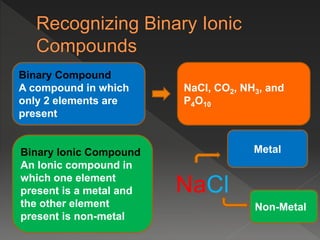
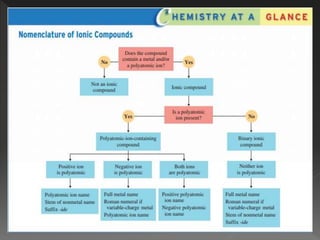
Binary Compound
A compound in which
only 2 elements are
present
NaCl, CO2, NH3, and
P4O10
Binary Ionic Compound
An Ionic compound in
which one element
present is a metal and
the other element
present is non-metal
NaCl
Metal
Non-Metal
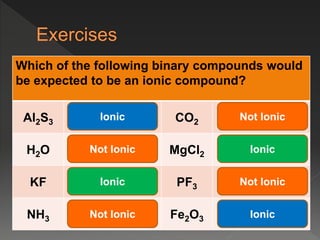
Which of the following binary compounds would
be expected to be an ionic compound?
Al2S3 CO2
H2O MgCl2
KF PF3
NH3 Fe2O3
Ionic
Not Ionic
Ionic
Not Ionic
Not Ionic
Ionic
Ionic
Not Ionic
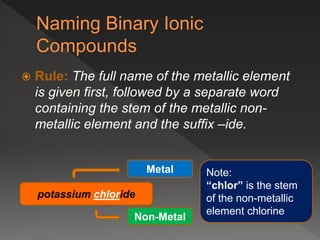
 Rule: The full name of the metallic element
is given first, followed by a separate word
containing the stem of the metallic non-
metallic element and the suffix –ide.
Metal
Non-Metal
potassium chloride
Note:
“chlor” is the stem
of the non-metallic
element chlorine
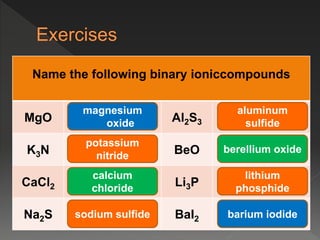
Name the following binary ioniccompounds
MgO Al2S3
K3N BeO
CaCl2 Li3P
Na2S BaI2
magnesium
oxide
potassium
nitride
calcium
chloride
sodium sulfide
aluminum
sulfide
berellium oxide
barium iodide
lithium
phosphide
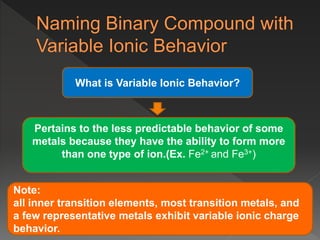
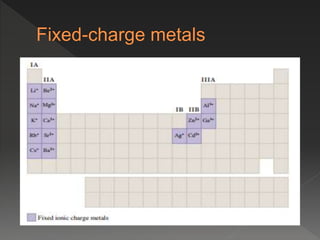
What is Variable Ionic Behavior?
Pertains to the less predictable behavior of some
metals because they have the ability to form more
than one type of ion.(Ex. Fe2+ and Fe3+)
Note:
all inner transition elements, most transition metals, and
a few representative metals exhibit variable ionic charge
behavior.
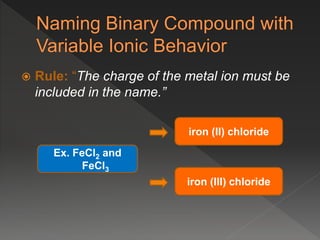
 Rule: “The charge of the metal ion must be
included in the name.”
Ex. FeCl2 and
FeCl3
iron (II) chloride
iron (III) chloride
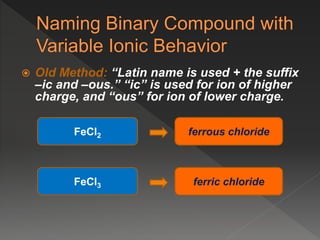
 Old Method: “Latin name is used + the suffix
–ic and –ous.” “ic” is used for ion of higher
charge, and “ous” for ion of lower charge.
FeCl2
ferric chloride
ferrous chloride
FeCl3
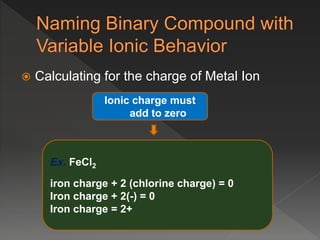
 Calculating for the charge of Metal Ion
Ionic charge must
add to zero
Ex. FeCl2
iron charge + 2 (chlorine charge) = 0
Iron charge + 2(-) = 0
Iron charge = 2+
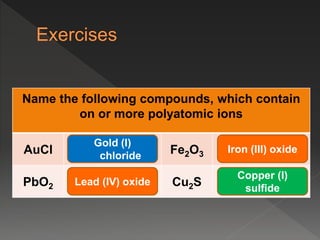
Name the following compounds, which contain
on or more polyatomic ions
AuCl Fe2O3
PbO2 Cu2S
Gold (I)
chloride
Lead (IV) oxide
Iron (III) oxide
Copper (I)
sulfide
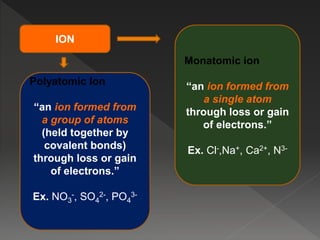
ION
Monatomic ion
“an ion formed from
a single atom
through loss or gain
of electrons.”
Ex. Cl-,Na+, Ca2+, N3-
Polyatomic Ion
“an ion formed from
a group of atoms
(held together by
covalent bonds)
through loss or gain
of electrons.”
Ex. NO3
-, SO4
2-, PO4
3-
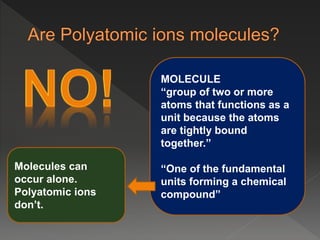
MOLECULE
“group of two or more
atoms that functions as a
unit because the atoms
are tightly bound
together.”
“One of the fundamental
units forming a chemical
compound”
Molecules can
occur alone.
Polyatomic ions
don’t.
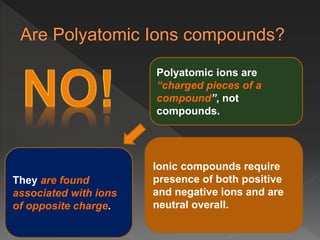
Polyatomic ions are
“charged pieces of a
compound”, not
compounds.
They are found
associated with ions
of opposite charge.
Ionic compounds require
presence of both positive
and negative ions and are
neutral overall.
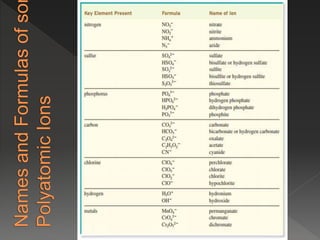
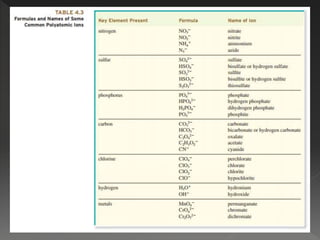
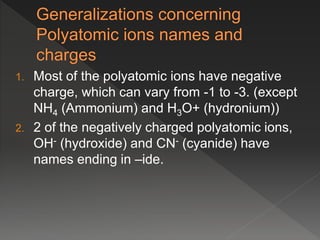
1. Most of the polyatomic ions have negative
charge, which can vary from -1 to -3. (except
NH4 (Ammonium) and H3O+ (hydronium))
2. 2 of the negatively charged polyatomic ions,
OH- (hydroxide) and CN- (cyanide) have
names ending in –ide.
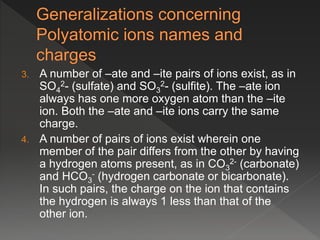
3. A number of –ate and –ite pairs of ions exist, as in
SO4
2- (sulfate) and SO3
2- (sulfite). The –ate ion
always has one more oxygen atom than the –ite
ion. Both the –ate and –ite ions carry the same
charge.
4. A number of pairs of ions exist wherein one
member of the pair differs from the other by having
a hydrogen atoms present, as in CO3
2- (carbonate)
and HCO3
- (hydrogen carbonate or bicarbonate).
In such pairs, the charge on the ion that contains
the hydrogen is always 1 less than that of the
other ion.
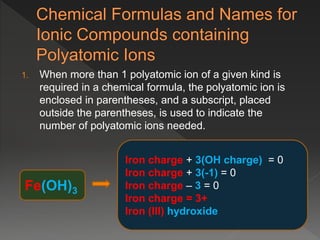
1. When more than 1 polyatomic ion of a given kind is
required in a chemical formula, the polyatomic ion is
enclosed in parentheses, and a subscript, placed
outside the parentheses, is used to indicate the
number of polyatomic ions needed.
Fe(OH)3
Iron charge + 3(OH charge) = 0
Iron charge + 3(-1) = 0
Iron charge – 3 = 0
Iron charge = 3+
Iron (III) hydroxide
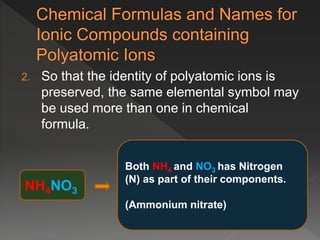
2. So that the identity of polyatomic ions is
preserved, the same elemental symbol may
be used more than one in chemical
formula.
NH4NO3
Both NH4 and NO3 has Nitrogen
(N) as part of their components.
(Ammonium nitrate)
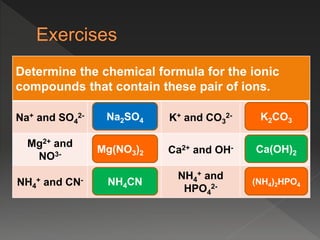
Determine the chemical formula for the ionic
compounds that contain these pair of ions.
Na+ and SO4
2- K+ and CO3
2-
Mg2+ and
NO3- Ca2+ and OH-
NH4
+ and CN- NH4
+ and
HPO4
2-
Na2SO4
Mg(NO3)2
NH4CN
K2CO3
Ca(OH)2
(NH4)2HPO4
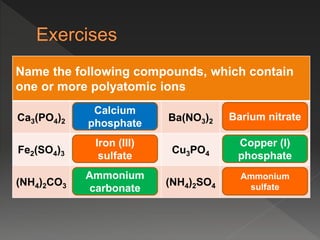
Name the following compounds, which contain
one or more polyatomic ions
Ca3(PO4)2 Ba(NO3)2
Fe2(SO4)3 Cu3PO4
(NH4)2CO3 (NH4)2SO4
Calcium
phosphate
Iron (III)
sulfate
Ammonium
carbonate
Barium nitrate
Copper (I)
phosphate
Ammonium
sulfate
 General, Organic, and Biological Chemistry
by H. Stephen Stoker

BINARY IONIC COMPOUND.pptx

  • 3.
    Binary Compound A compoundin which only 2 elements are present NaCl, CO2, NH3, and P4O10 Binary Ionic Compound An Ionic compound in which one element present is a metal and the other element present is non-metal NaCl Metal Non-Metal
  • 4.
    Which of thefollowing binary compounds would be expected to be an ionic compound? Al2S3 CO2 H2O MgCl2 KF PF3 NH3 Fe2O3 Ionic Not Ionic Ionic Not Ionic Not Ionic Ionic Ionic Not Ionic
  • 5.
     Rule: Thefull name of the metallic element is given first, followed by a separate word containing the stem of the metallic non- metallic element and the suffix –ide. Metal Non-Metal potassium chloride Note: “chlor” is the stem of the non-metallic element chlorine
  • 7.
    Name the followingbinary ioniccompounds MgO Al2S3 K3N BeO CaCl2 Li3P Na2S BaI2 magnesium oxide potassium nitride calcium chloride sodium sulfide aluminum sulfide berellium oxide barium iodide lithium phosphide
  • 8.
    What is VariableIonic Behavior? Pertains to the less predictable behavior of some metals because they have the ability to form more than one type of ion.(Ex. Fe2+ and Fe3+) Note: all inner transition elements, most transition metals, and a few representative metals exhibit variable ionic charge behavior.
  • 9.
     Rule: “Thecharge of the metal ion must be included in the name.” Ex. FeCl2 and FeCl3 iron (II) chloride iron (III) chloride
  • 10.
     Old Method:“Latin name is used + the suffix –ic and –ous.” “ic” is used for ion of higher charge, and “ous” for ion of lower charge. FeCl2 ferric chloride ferrous chloride FeCl3
  • 11.
     Calculating forthe charge of Metal Ion Ionic charge must add to zero Ex. FeCl2 iron charge + 2 (chlorine charge) = 0 Iron charge + 2(-) = 0 Iron charge = 2+
  • 13.
    Name the followingcompounds, which contain on or more polyatomic ions AuCl Fe2O3 PbO2 Cu2S Gold (I) chloride Lead (IV) oxide Iron (III) oxide Copper (I) sulfide
  • 15.
    ION Monatomic ion “an ionformed from a single atom through loss or gain of electrons.” Ex. Cl-,Na+, Ca2+, N3- Polyatomic Ion “an ion formed from a group of atoms (held together by covalent bonds) through loss or gain of electrons.” Ex. NO3 -, SO4 2-, PO4 3-
  • 17.
    MOLECULE “group of twoor more atoms that functions as a unit because the atoms are tightly bound together.” “One of the fundamental units forming a chemical compound” Molecules can occur alone. Polyatomic ions don’t.
  • 18.
    Polyatomic ions are “chargedpieces of a compound”, not compounds. They are found associated with ions of opposite charge. Ionic compounds require presence of both positive and negative ions and are neutral overall.
  • 20.
    1. Most ofthe polyatomic ions have negative charge, which can vary from -1 to -3. (except NH4 (Ammonium) and H3O+ (hydronium)) 2. 2 of the negatively charged polyatomic ions, OH- (hydroxide) and CN- (cyanide) have names ending in –ide.
  • 21.
    3. A numberof –ate and –ite pairs of ions exist, as in SO4 2- (sulfate) and SO3 2- (sulfite). The –ate ion always has one more oxygen atom than the –ite ion. Both the –ate and –ite ions carry the same charge. 4. A number of pairs of ions exist wherein one member of the pair differs from the other by having a hydrogen atoms present, as in CO3 2- (carbonate) and HCO3 - (hydrogen carbonate or bicarbonate). In such pairs, the charge on the ion that contains the hydrogen is always 1 less than that of the other ion.
  • 22.
    1. When morethan 1 polyatomic ion of a given kind is required in a chemical formula, the polyatomic ion is enclosed in parentheses, and a subscript, placed outside the parentheses, is used to indicate the number of polyatomic ions needed. Fe(OH)3 Iron charge + 3(OH charge) = 0 Iron charge + 3(-1) = 0 Iron charge – 3 = 0 Iron charge = 3+ Iron (III) hydroxide
  • 23.
    2. So thatthe identity of polyatomic ions is preserved, the same elemental symbol may be used more than one in chemical formula. NH4NO3 Both NH4 and NO3 has Nitrogen (N) as part of their components. (Ammonium nitrate)
  • 24.
    Determine the chemicalformula for the ionic compounds that contain these pair of ions. Na+ and SO4 2- K+ and CO3 2- Mg2+ and NO3- Ca2+ and OH- NH4 + and CN- NH4 + and HPO4 2- Na2SO4 Mg(NO3)2 NH4CN K2CO3 Ca(OH)2 (NH4)2HPO4
  • 25.
    Name the followingcompounds, which contain one or more polyatomic ions Ca3(PO4)2 Ba(NO3)2 Fe2(SO4)3 Cu3PO4 (NH4)2CO3 (NH4)2SO4 Calcium phosphate Iron (III) sulfate Ammonium carbonate Barium nitrate Copper (I) phosphate Ammonium sulfate
  • 30.
     General, Organic,and Biological Chemistry by H. Stephen Stoker