CHEMISTRY I Chapter 16 Rules for Assigning Oxidation Numbers
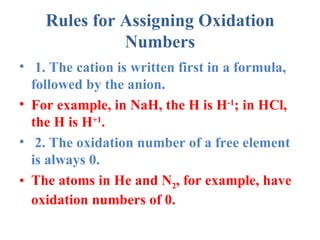
Rules for Assigning Oxidation Numbers 1. The cation is written first in a formula, followed by the anion.  For example, in NaH, the H is H -1 ; in HCl, the H is H +1 .  2. The oxidation number of a free element is always 0.  The atoms in He and N 2 , for example, have oxidation numbers of 0.
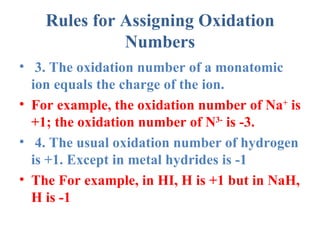
Rules for Assigning Oxidation Numbers 3. The oxidation number of a monatomic ion equals the charge of the ion.  For example, the oxidation number of Na +  is +1; the oxidation number of N 3-  is -3.  4. The usual oxidation number of hydrogen is +1. Except in metal hydrides is -1 The For example, in HI, H is +1 but in NaH, H is -1
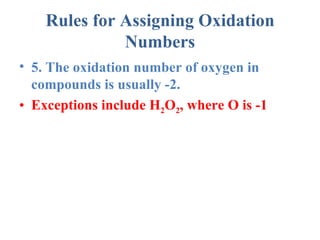
Rules for Assigning Oxidation Numbers 5. The oxidation number of oxygen in compounds is usually -2.  Exceptions include H 2 O 2 , where O is -1
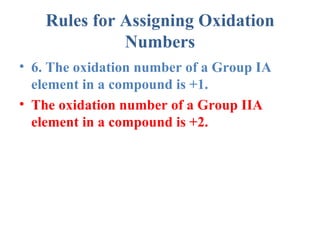
Rules for Assigning Oxidation Numbers 6. The oxidation number of a Group IA element in a compound is +1.  The oxidation number of a Group IIA element in a compound is +2.
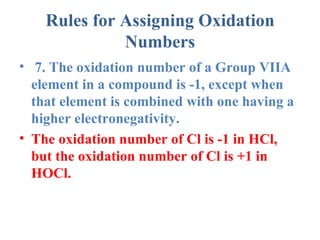
Rules for Assigning Oxidation Numbers 7. The oxidation number of a Group VIIA element in a compound is -1, except when that element is combined with one having a higher electronegativity.  The oxidation number of Cl is -1 in HCl, but the oxidation number of Cl is +1 in HOCl.
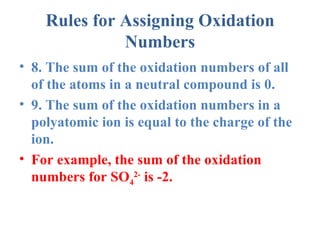
Rules for Assigning Oxidation Numbers 8. The sum of the oxidation numbers of all of the atoms in a neutral compound is 0.  9. The sum of the oxidation numbers in a polyatomic ion is equal to the charge of the ion.  For example, the sum of the oxidation numbers for SO 4 2-  is -2.
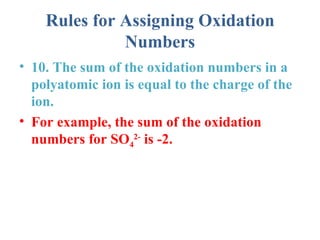
Rules for Assigning Oxidation Numbers 10. The sum of the oxidation numbers in a polyatomic ion is equal to the charge of the ion.  For example, the sum of the oxidation numbers for SO 4 2-  is -2.

Rules assign oxidation numbers

  • 1.
    CHEMISTRY I Chapter16 Rules for Assigning Oxidation Numbers
  • 2.
    Rules for AssigningOxidation Numbers 1. The cation is written first in a formula, followed by the anion. For example, in NaH, the H is H -1 ; in HCl, the H is H +1 . 2. The oxidation number of a free element is always 0. The atoms in He and N 2 , for example, have oxidation numbers of 0.
  • 3.
    Rules for AssigningOxidation Numbers 3. The oxidation number of a monatomic ion equals the charge of the ion. For example, the oxidation number of Na + is +1; the oxidation number of N 3- is -3. 4. The usual oxidation number of hydrogen is +1. Except in metal hydrides is -1 The For example, in HI, H is +1 but in NaH, H is -1
  • 4.
    Rules for AssigningOxidation Numbers 5. The oxidation number of oxygen in compounds is usually -2. Exceptions include H 2 O 2 , where O is -1
  • 5.
    Rules for AssigningOxidation Numbers 6. The oxidation number of a Group IA element in a compound is +1. The oxidation number of a Group IIA element in a compound is +2.
  • 6.
    Rules for AssigningOxidation Numbers 7. The oxidation number of a Group VIIA element in a compound is -1, except when that element is combined with one having a higher electronegativity. The oxidation number of Cl is -1 in HCl, but the oxidation number of Cl is +1 in HOCl.
  • 7.
    Rules for AssigningOxidation Numbers 8. The sum of the oxidation numbers of all of the atoms in a neutral compound is 0. 9. The sum of the oxidation numbers in a polyatomic ion is equal to the charge of the ion. For example, the sum of the oxidation numbers for SO 4 2- is -2.
  • 8.
    Rules for AssigningOxidation Numbers 10. The sum of the oxidation numbers in a polyatomic ion is equal to the charge of the ion. For example, the sum of the oxidation numbers for SO 4 2- is -2.