N A M I N G
C O M P O U N D S
A N D W R I T I N G
F O R M U L A S
Binary Molecular Compounds
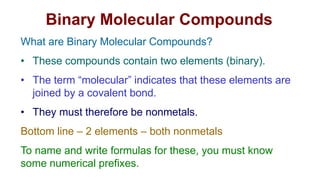
What are Binary Molecular Compounds?
• These compounds contain two elements (binary).
• The term “molecular” indicates that these elements are
joined by a covalent bond.
• They must therefore be nonmetals.
Bottom line – 2 elements – both nonmetals
To name and write formulas for these, you must know
some numerical prefixes.
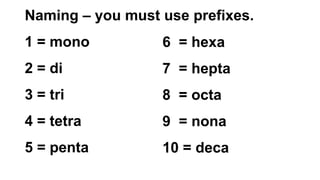
Naming – you must use prefixes.
1 = mono
2 = di
3 = tri
4 = tetra
5 = penta
6 = hexa
7 = hepta
8 = octa
9 = nona
10 = deca
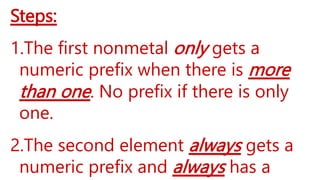
Steps:
1.The first nonmetal only gets a
numeric prefix when there is more
than one. No prefix if there is only
one.
2.The second element always gets a
numeric prefix and always has a
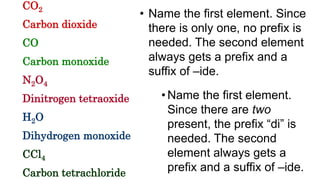
CO2
Carbon dioxide
CO
Carbon monoxide
N2O4
Dinitrogen tetraoxide
H2O
Dihydrogen monoxide
CCl4
Carbon tetrachloride
• Name the first element. Since
there is only one, no prefix is
needed. The second element
always gets a prefix and a
suffix of –ide.
• Name the first element.
Since there are two
present, the prefix “di” is
needed. The second
element always gets a
prefix and a suffix of –ide.
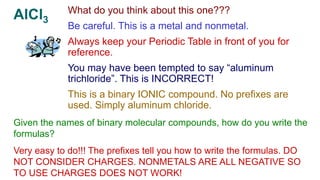
AlCl3
What do you think about this one???
Be careful. This is a metal and nonmetal.
Always keep your Periodic Table in front of you for
reference.
You may have been tempted to say “aluminum
trichloride”. This is INCORRECT!
This is a binary IONIC compound. No prefixes are
used. Simply aluminum chloride.
Given the names of binary molecular compounds, how do you write the
formulas?
Very easy to do!!! The prefixes tell you how to write the formulas. DO
NOT CONSIDER CHARGES. NONMETALS ARE ALL NEGATIVE SO
TO USE CHARGES DOES NOT WORK!
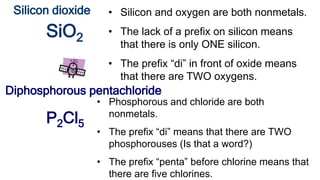
Silicon dioxide
Diphosphorous pentachloride
• Silicon and oxygen are both nonmetals.
• The lack of a prefix on silicon means
that there is only ONE silicon.
• The prefix “di” in front of oxide means
that there are TWO oxygens.
SiO2
• Phosphorous and chloride are both
nonmetals.
• The prefix “di” means that there are TWO
phosphorouses (Is that a word?)
• The prefix “penta” before chlorine means that
there are five chlorines.
P2Cl5
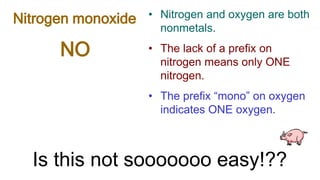
NO
Nitrogen monoxide • Nitrogen and oxygen are both
nonmetals.
• The lack of a prefix on
nitrogen means only ONE
nitrogen.
• The prefix “mono” on oxygen
indicates ONE oxygen.
Is this not sooooooo easy!??
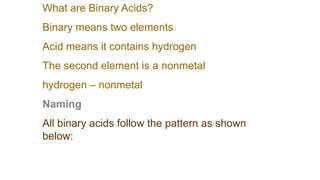
What are Binary Acids?
Binary means two elements
Acid means it contains hydrogen
The second element is a nonmetal
hydrogen – nonmetal
Naming
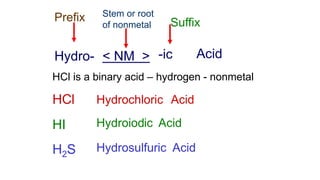
All binary acids follow the pattern as shown
below:
Prefix
Hydro-
Stem or root
of nonmetal
< NM >
Suffix
-ic Acid
HCl Hydro
HI Hydro
HCl is a binary acid – hydrogen - nonmetal
chloric Acid
iodic Acid
H2S Hydrosulfuric Acid
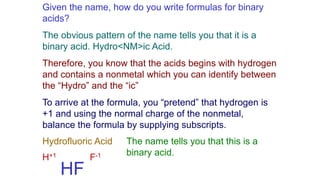
Given the name, how do you write formulas for binary
acids?
The obvious pattern of the name tells you that it is a
binary acid. Hydro<NM>ic Acid.
Therefore, you know that the acids begins with hydrogen
and contains a nonmetal which you can identify between
the “Hydro” and the “ic”
To arrive at the formula, you “pretend” that hydrogen is
+1 and using the normal charge of the nonmetal,
balance the formula by supplying subscripts.
Hydrofluoric Acid The name tells you that this is a
binary acid.
H+1 F-1
HF
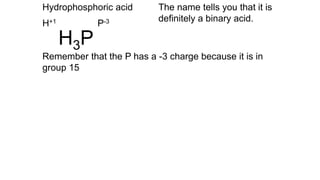
Hydrophosphoric acid The name tells you that it is
definitely a binary acid.
H+1 P-3
Remember that the P has a -3 charge because it is in
group 15
H3P
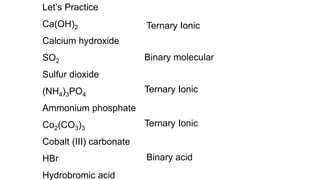
Let’s Practice
Ca(OH)2
Calcium hydroxide
SO2
Sulfur dioxide
(NH4)3PO4
Ammonium phosphate
Co2(CO3)3
Cobalt (III) carbonate
HBr
Hydrobromic acid
Ternary Ionic
Binary molecular
Ternary Ionic
Ternary Ionic
Binary acid
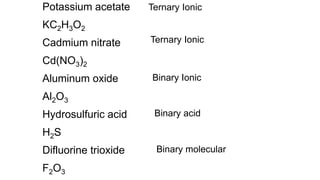
Potassium acetate
KC2H3O2
Cadmium nitrate
Cd(NO3)2
Aluminum oxide
Al2O3
Hydrosulfuric acid
H2S
Difluorine trioxide
F2O3
Ternary Ionic
Ternary Ionic
Binary Ionic
Binary acid
Binary molecular
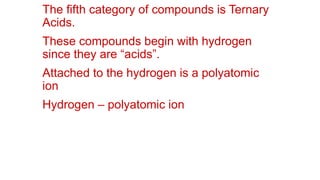
The fifth category of compounds is Ternary
Acids.
These compounds begin with hydrogen
since they are “acids”.
Attached to the hydrogen is a polyatomic
ion
Hydrogen – polyatomic ion
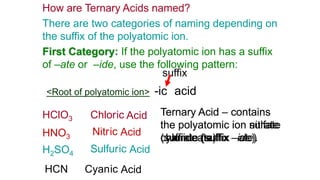
<Root of polyatomic ion>
suffix
-ic acid
HClO3 Chlor
HNO3
Nitr
H2SO4 Sulfur
HCN Cyan
How are Ternary Acids named?
There are two categories of naming depending on
the suffix of the polyatomic ion.
First Category: If the polyatomic ion has a suffix
of –ate or –ide, use the following pattern:
Ternary Acid – contains
the polyatomic ion
chlorate (suffix –ate)
Ternary Acid – contains
the polyatomic ion nitrate
(suffix –ate).
Ternary Acid – contains
the polyatomic ion sulfate
(suffix –ate).
Ternary Acid – contains
the polyatomic ion
cyanide (suffix –ide).
ic Acid
ic Acid
ic Acid
ic Acid
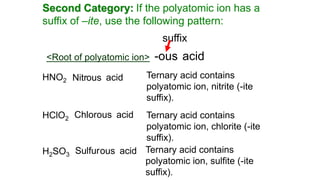
Second Category: If the polyatomic ion has a
suffix of –ite, use the following pattern:
<Root of polyatomic ion>
suffix
-ous acid
HNO2
Ternary acid contains
polyatomic ion, nitrite (-ite
suffix).
Nitrous acid
HClO2 Ternary acid contains
polyatomic ion, chlorite (-ite
suffix).
Chlorous acid
H2SO3
Ternary acid contains
polyatomic ion, sulfite (-ite
suffix).
Sulfurous acid
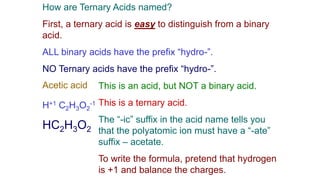
How are Ternary Acids named?
First, a ternary acid is easy to distinguish from a binary
acid.
ALL binary acids have the prefix “hydro-”.
NO Ternary acids have the prefix “hydro-”.
Acetic acid This is an acid, but NOT a binary acid.
This is a ternary acid.
The “-ic” suffix in the acid name tells you
that the polyatomic ion must have a “-ate”
suffix – acetate.
To write the formula, pretend that hydrogen
is +1 and balance the charges.
H+1 C2H3O2
-1
HC2H3O2
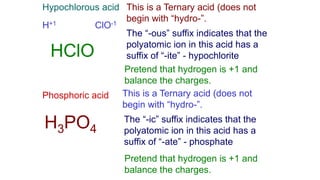
Hypochlorous acid This is a Ternary acid (does not
begin with “hydro-”.
The “-ous” suffix indicates that the
polyatomic ion in this acid has a
suffix of “-ite” - hypochlorite
Pretend that hydrogen is +1 and
balance the charges.
H+1 ClO-1
HClO
Phosphoric acid This is a Ternary acid (does not
begin with “hydro-”.
The “-ic” suffix indicates that the
polyatomic ion in this acid has a
suffix of “-ate” - phosphate
H3PO4
Pretend that hydrogen is +1 and
balance the charges.
Thanks!
Any questions? Don't
hesitate to
ask for our help

GENCHEM1-nomenclature-molecularcmpds.pptx

  • 1.
    N A MI N G C O M P O U N D S A N D W R I T I N G F O R M U L A S
  • 2.
    Binary Molecular Compounds Whatare Binary Molecular Compounds? • These compounds contain two elements (binary). • The term “molecular” indicates that these elements are joined by a covalent bond. • They must therefore be nonmetals. Bottom line – 2 elements – both nonmetals To name and write formulas for these, you must know some numerical prefixes.
  • 3.
    Naming – youmust use prefixes. 1 = mono 2 = di 3 = tri 4 = tetra 5 = penta 6 = hexa 7 = hepta 8 = octa 9 = nona 10 = deca
  • 4.
    Steps: 1.The first nonmetalonly gets a numeric prefix when there is more than one. No prefix if there is only one. 2.The second element always gets a numeric prefix and always has a
  • 5.
    CO2 Carbon dioxide CO Carbon monoxide N2O4 Dinitrogentetraoxide H2O Dihydrogen monoxide CCl4 Carbon tetrachloride • Name the first element. Since there is only one, no prefix is needed. The second element always gets a prefix and a suffix of –ide. • Name the first element. Since there are two present, the prefix “di” is needed. The second element always gets a prefix and a suffix of –ide.
  • 6.
    AlCl3 What do youthink about this one??? Be careful. This is a metal and nonmetal. Always keep your Periodic Table in front of you for reference. You may have been tempted to say “aluminum trichloride”. This is INCORRECT! This is a binary IONIC compound. No prefixes are used. Simply aluminum chloride. Given the names of binary molecular compounds, how do you write the formulas? Very easy to do!!! The prefixes tell you how to write the formulas. DO NOT CONSIDER CHARGES. NONMETALS ARE ALL NEGATIVE SO TO USE CHARGES DOES NOT WORK!
  • 7.
    Silicon dioxide Diphosphorous pentachloride •Silicon and oxygen are both nonmetals. • The lack of a prefix on silicon means that there is only ONE silicon. • The prefix “di” in front of oxide means that there are TWO oxygens. SiO2 • Phosphorous and chloride are both nonmetals. • The prefix “di” means that there are TWO phosphorouses (Is that a word?) • The prefix “penta” before chlorine means that there are five chlorines. P2Cl5
  • 8.
    NO Nitrogen monoxide •Nitrogen and oxygen are both nonmetals. • The lack of a prefix on nitrogen means only ONE nitrogen. • The prefix “mono” on oxygen indicates ONE oxygen. Is this not sooooooo easy!??
  • 9.
    What are BinaryAcids? Binary means two elements Acid means it contains hydrogen The second element is a nonmetal hydrogen – nonmetal Naming All binary acids follow the pattern as shown below:
  • 10.
    Prefix Hydro- Stem or root ofnonmetal < NM > Suffix -ic Acid HCl Hydro HI Hydro HCl is a binary acid – hydrogen - nonmetal chloric Acid iodic Acid H2S Hydrosulfuric Acid
  • 11.
    Given the name,how do you write formulas for binary acids? The obvious pattern of the name tells you that it is a binary acid. Hydro<NM>ic Acid. Therefore, you know that the acids begins with hydrogen and contains a nonmetal which you can identify between the “Hydro” and the “ic” To arrive at the formula, you “pretend” that hydrogen is +1 and using the normal charge of the nonmetal, balance the formula by supplying subscripts. Hydrofluoric Acid The name tells you that this is a binary acid. H+1 F-1 HF
  • 12.
    Hydrophosphoric acid Thename tells you that it is definitely a binary acid. H+1 P-3 Remember that the P has a -3 charge because it is in group 15 H3P
  • 13.
    Let’s Practice Ca(OH)2 Calcium hydroxide SO2 Sulfurdioxide (NH4)3PO4 Ammonium phosphate Co2(CO3)3 Cobalt (III) carbonate HBr Hydrobromic acid Ternary Ionic Binary molecular Ternary Ionic Ternary Ionic Binary acid
  • 14.
    Potassium acetate KC2H3O2 Cadmium nitrate Cd(NO3)2 Aluminumoxide Al2O3 Hydrosulfuric acid H2S Difluorine trioxide F2O3 Ternary Ionic Ternary Ionic Binary Ionic Binary acid Binary molecular
  • 15.
    The fifth categoryof compounds is Ternary Acids. These compounds begin with hydrogen since they are “acids”. Attached to the hydrogen is a polyatomic ion Hydrogen – polyatomic ion
  • 16.
    <Root of polyatomicion> suffix -ic acid HClO3 Chlor HNO3 Nitr H2SO4 Sulfur HCN Cyan How are Ternary Acids named? There are two categories of naming depending on the suffix of the polyatomic ion. First Category: If the polyatomic ion has a suffix of –ate or –ide, use the following pattern: Ternary Acid – contains the polyatomic ion chlorate (suffix –ate) Ternary Acid – contains the polyatomic ion nitrate (suffix –ate). Ternary Acid – contains the polyatomic ion sulfate (suffix –ate). Ternary Acid – contains the polyatomic ion cyanide (suffix –ide). ic Acid ic Acid ic Acid ic Acid
  • 17.
    Second Category: Ifthe polyatomic ion has a suffix of –ite, use the following pattern: <Root of polyatomic ion> suffix -ous acid HNO2 Ternary acid contains polyatomic ion, nitrite (-ite suffix). Nitrous acid HClO2 Ternary acid contains polyatomic ion, chlorite (-ite suffix). Chlorous acid H2SO3 Ternary acid contains polyatomic ion, sulfite (-ite suffix). Sulfurous acid
  • 18.
    How are TernaryAcids named? First, a ternary acid is easy to distinguish from a binary acid. ALL binary acids have the prefix “hydro-”. NO Ternary acids have the prefix “hydro-”. Acetic acid This is an acid, but NOT a binary acid. This is a ternary acid. The “-ic” suffix in the acid name tells you that the polyatomic ion must have a “-ate” suffix – acetate. To write the formula, pretend that hydrogen is +1 and balance the charges. H+1 C2H3O2 -1 HC2H3O2
  • 19.
    Hypochlorous acid Thisis a Ternary acid (does not begin with “hydro-”. The “-ous” suffix indicates that the polyatomic ion in this acid has a suffix of “-ite” - hypochlorite Pretend that hydrogen is +1 and balance the charges. H+1 ClO-1 HClO Phosphoric acid This is a Ternary acid (does not begin with “hydro-”. The “-ic” suffix indicates that the polyatomic ion in this acid has a suffix of “-ate” - phosphate H3PO4 Pretend that hydrogen is +1 and balance the charges.
  • 20.