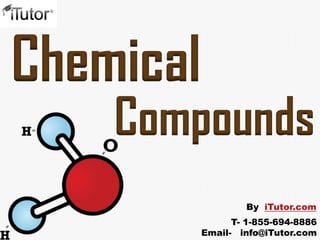
Chemical
Compounds
T- 1-855-694-8886
Email- info@iTutor.com
By iTutor.com
CHEMICAL COMPOUND
A compound, when we are talking about
chemistry,
is simply any substance that is made up of two or
more elements which react with one another.
The
elements must be present in fixed ratios.
-: Example :-
Hydrogen and Oxygen are pure elements and are
gases.© iTutor. 2000-2013. All Rights Reserved
CHEMICAL FORMULA
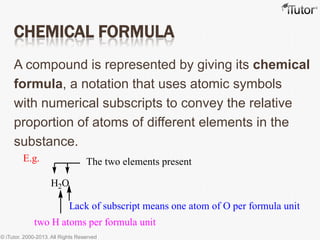
A compound is represented by giving its chemical
formula, a notation that uses atomic symbols
with numerical subscripts to convey the relative
proportion of atoms of different elements in the
substance.
H2O
The two elements present
two H atoms per formula unit
Lack of subscript means one atom of O per formula unit
E.g.
© iTutor. 2000-2013. All Rights Reserved
TYPES OF CHEMICAL FORMULA
Empirical Formula
Molecular Formula
Structural Formula
© iTutor. 2000-2013. All Rights Reserved
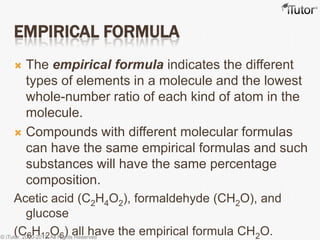
EMPIRICAL FORMULA
 The empirical formula indicates the different
types of elements in a molecule and the lowest
whole-number ratio of each kind of atom in the
molecule.
 Compounds with different molecular formulas
can have the same empirical formulas and such
substances will have the same percentage
composition.
Acetic acid (C2H4O2), formaldehyde (CH2O), and
glucose
(C6H12O6) all have the empirical formula CH2O.© iTutor. 2000-2013. All Rights Reserved
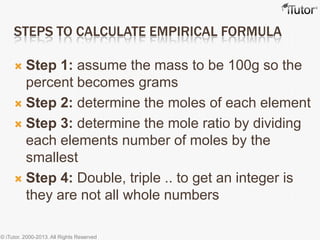
STEPS TO CALCULATE EMPIRICAL FORMULA
 Step 1: assume the mass to be 100g so the
percent becomes grams
 Step 2: determine the moles of each element
 Step 3: determine the mole ratio by dividing
each elements number of moles by the
smallest
 Step 4: Double, triple .. to get an integer is
they are not all whole numbers
© iTutor. 2000-2013. All Rights Reserved
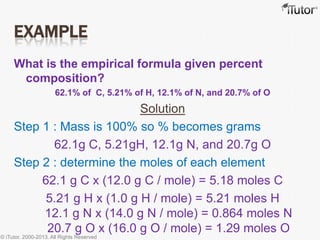
EXAMPLE
What is the empirical formula given percent
composition?
62.1% of C, 5.21% of H, 12.1% of N, and 20.7% of O
Solution
Step 1 : Mass is 100% so % becomes grams
62.1g C, 5.21gH, 12.1g N, and 20.7g O
Step 2 : determine the moles of each element
62.1 g C x (12.0 g C / mole) = 5.18 moles C
5.21 g H x (1.0 g H / mole) = 5.21 moles H
12.1 g N x (14.0 g N / mole) = 0.864 moles N
20.7 g O x (16.0 g O / mole) = 1.29 moles O
© iTutor. 2000-2013. All Rights Reserved
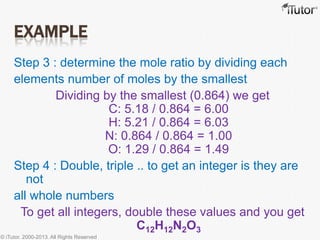
EXAMPLE
Step 3 : determine the mole ratio by dividing each
elements number of moles by the smallest
Dividing by the smallest (0.864) we get
C: 5.18 / 0.864 = 6.00
H: 5.21 / 0.864 = 6.03
N: 0.864 / 0.864 = 1.00
O: 1.29 / 0.864 = 1.49
Step 4 : Double, triple .. to get an integer is they are
not
all whole numbers
To get all integers, double these values and you get
C12H12N2O3
© iTutor. 2000-2013. All Rights Reserved
MOLECULAR FORMULA
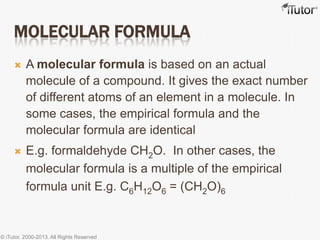
 A molecular formula is based on an actual
molecule of a compound. It gives the exact number
of different atoms of an element in a molecule. In
some cases, the empirical formula and the
molecular formula are identical
 E.g. formaldehyde CH2O. In other cases, the
molecular formula is a multiple of the empirical
formula unit E.g. C6H12O6 = (CH2O)6
© iTutor. 2000-2013. All Rights Reserved
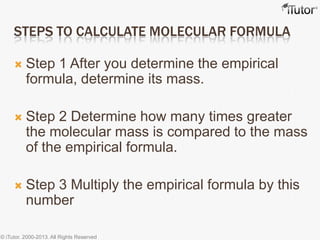
STEPS TO CALCULATE MOLECULAR FORMULA
 Step 1 After you determine the empirical
formula, determine its mass.
 Step 2 Determine how many times greater
the molecular mass is compared to the mass
of the empirical formula.
 Step 3 Multiply the empirical formula by this
number
© iTutor. 2000-2013. All Rights Reserved
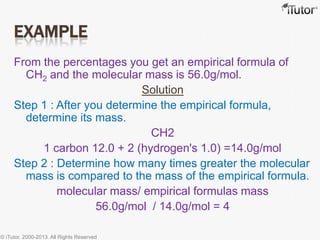
EXAMPLE
From the percentages you get an empirical formula of
CH2 and the molecular mass is 56.0g/mol.
Solution
Step 1 : After you determine the empirical formula,
determine its mass.
CH2
1 carbon 12.0 + 2 (hydrogen's 1.0) =14.0g/mol
Step 2 : Determine how many times greater the molecular
mass is compared to the mass of the empirical formula.
molecular mass/ empirical formulas mass
56.0g/mol / 14.0g/mol = 4
© iTutor. 2000-2013. All Rights Reserved
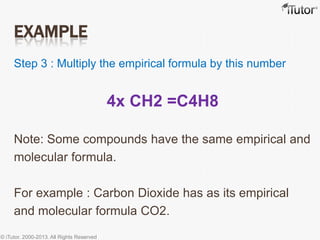
EXAMPLE
Step 3 : Multiply the empirical formula by this number
4x CH2 =C4H8
Note: Some compounds have the same empirical and
molecular formula.
For example : Carbon Dioxide has as its empirical
and molecular formula CO2.
© iTutor. 2000-2013. All Rights Reserved
STRUCTURAL FORMULA
The structural formula shows the elements in
the
compound, the exact number of each atom in
the
compound, and the bonding pattern for the
compound. The electron-dot formula and Lewis
formula are examples of structural formulas.
© iTutor. 2000-2013. All Rights Reserved
STRUCTURAL FORMULA
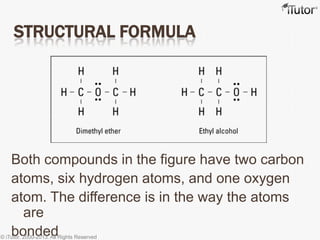
Both compounds in the figure have two carbon
atoms, six hydrogen atoms, and one oxygen
atom. The difference is in the way the atoms
are
bonded© iTutor. 2000-2013. All Rights Reserved
THE END
Call us for more
Information:
www.iTutor.com
1-855-694-8886
Visit

Chemical Compounds

  • 1.
  • 2.
    CHEMICAL COMPOUND A compound,when we are talking about chemistry, is simply any substance that is made up of two or more elements which react with one another. The elements must be present in fixed ratios. -: Example :- Hydrogen and Oxygen are pure elements and are gases.© iTutor. 2000-2013. All Rights Reserved
  • 3.
    CHEMICAL FORMULA A compoundis represented by giving its chemical formula, a notation that uses atomic symbols with numerical subscripts to convey the relative proportion of atoms of different elements in the substance. H2O The two elements present two H atoms per formula unit Lack of subscript means one atom of O per formula unit E.g. © iTutor. 2000-2013. All Rights Reserved
  • 4.
    TYPES OF CHEMICALFORMULA Empirical Formula Molecular Formula Structural Formula © iTutor. 2000-2013. All Rights Reserved
  • 5.
    EMPIRICAL FORMULA  Theempirical formula indicates the different types of elements in a molecule and the lowest whole-number ratio of each kind of atom in the molecule.  Compounds with different molecular formulas can have the same empirical formulas and such substances will have the same percentage composition. Acetic acid (C2H4O2), formaldehyde (CH2O), and glucose (C6H12O6) all have the empirical formula CH2O.© iTutor. 2000-2013. All Rights Reserved
  • 6.
    STEPS TO CALCULATEEMPIRICAL FORMULA  Step 1: assume the mass to be 100g so the percent becomes grams  Step 2: determine the moles of each element  Step 3: determine the mole ratio by dividing each elements number of moles by the smallest  Step 4: Double, triple .. to get an integer is they are not all whole numbers © iTutor. 2000-2013. All Rights Reserved
  • 7.
    EXAMPLE What is theempirical formula given percent composition? 62.1% of C, 5.21% of H, 12.1% of N, and 20.7% of O Solution Step 1 : Mass is 100% so % becomes grams 62.1g C, 5.21gH, 12.1g N, and 20.7g O Step 2 : determine the moles of each element 62.1 g C x (12.0 g C / mole) = 5.18 moles C 5.21 g H x (1.0 g H / mole) = 5.21 moles H 12.1 g N x (14.0 g N / mole) = 0.864 moles N 20.7 g O x (16.0 g O / mole) = 1.29 moles O © iTutor. 2000-2013. All Rights Reserved
  • 8.
    EXAMPLE Step 3 :determine the mole ratio by dividing each elements number of moles by the smallest Dividing by the smallest (0.864) we get C: 5.18 / 0.864 = 6.00 H: 5.21 / 0.864 = 6.03 N: 0.864 / 0.864 = 1.00 O: 1.29 / 0.864 = 1.49 Step 4 : Double, triple .. to get an integer is they are not all whole numbers To get all integers, double these values and you get C12H12N2O3 © iTutor. 2000-2013. All Rights Reserved
  • 9.
    MOLECULAR FORMULA  Amolecular formula is based on an actual molecule of a compound. It gives the exact number of different atoms of an element in a molecule. In some cases, the empirical formula and the molecular formula are identical  E.g. formaldehyde CH2O. In other cases, the molecular formula is a multiple of the empirical formula unit E.g. C6H12O6 = (CH2O)6 © iTutor. 2000-2013. All Rights Reserved
  • 10.
    STEPS TO CALCULATEMOLECULAR FORMULA  Step 1 After you determine the empirical formula, determine its mass.  Step 2 Determine how many times greater the molecular mass is compared to the mass of the empirical formula.  Step 3 Multiply the empirical formula by this number © iTutor. 2000-2013. All Rights Reserved
  • 11.
    EXAMPLE From the percentagesyou get an empirical formula of CH2 and the molecular mass is 56.0g/mol. Solution Step 1 : After you determine the empirical formula, determine its mass. CH2 1 carbon 12.0 + 2 (hydrogen's 1.0) =14.0g/mol Step 2 : Determine how many times greater the molecular mass is compared to the mass of the empirical formula. molecular mass/ empirical formulas mass 56.0g/mol / 14.0g/mol = 4 © iTutor. 2000-2013. All Rights Reserved
  • 12.
    EXAMPLE Step 3 :Multiply the empirical formula by this number 4x CH2 =C4H8 Note: Some compounds have the same empirical and molecular formula. For example : Carbon Dioxide has as its empirical and molecular formula CO2. © iTutor. 2000-2013. All Rights Reserved
  • 13.
    STRUCTURAL FORMULA The structuralformula shows the elements in the compound, the exact number of each atom in the compound, and the bonding pattern for the compound. The electron-dot formula and Lewis formula are examples of structural formulas. © iTutor. 2000-2013. All Rights Reserved
  • 14.
    STRUCTURAL FORMULA Both compoundsin the figure have two carbon atoms, six hydrogen atoms, and one oxygen atom. The difference is in the way the atoms are bonded© iTutor. 2000-2013. All Rights Reserved
  • 15.
    THE END Call usfor more Information: www.iTutor.com 1-855-694-8886 Visit