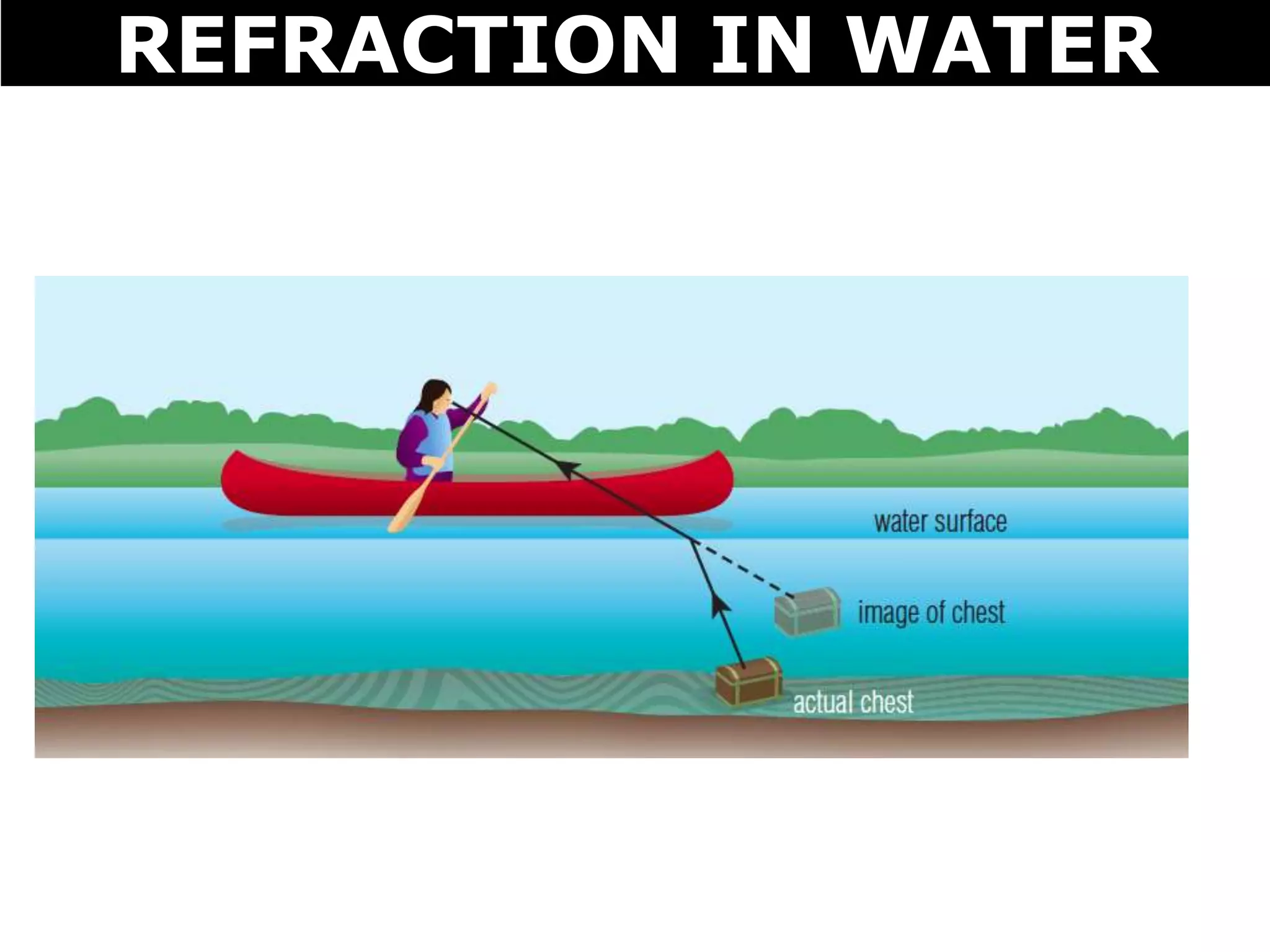
Refraction is the bending of light when passing from one medium to another. It occurs because the speed of light is decreased in denser mediums, causing the light's path to bend toward the normal. Snell's law describes the mathematical relationship between the angle of incidence and angle of refraction, stating that for two mediums, the ratio of sines of the incidence and refraction angles is equal to the ratio of the indexes of refraction. The index of refraction is a number that represents how much a medium slows light down relative to a vacuum.
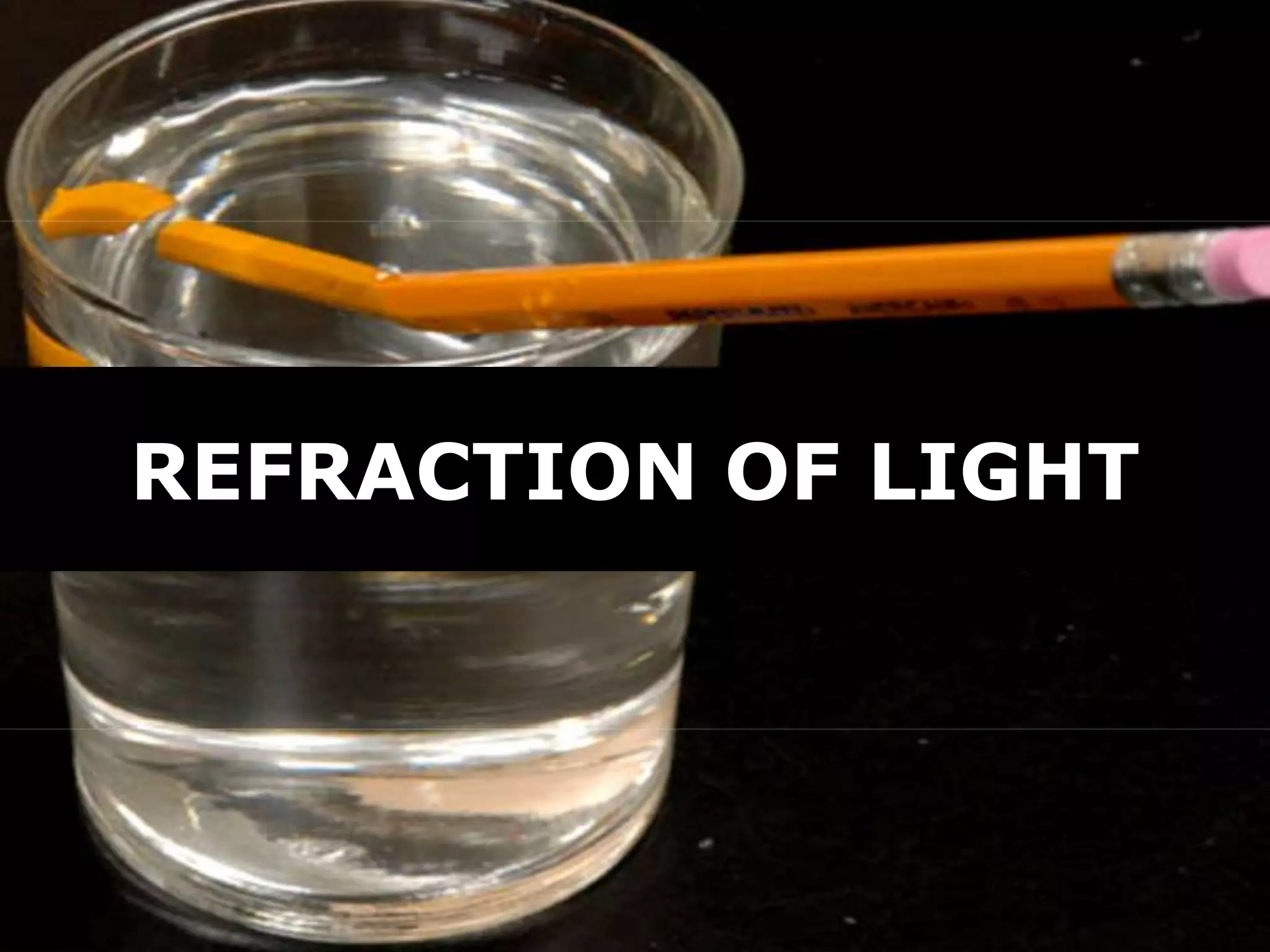
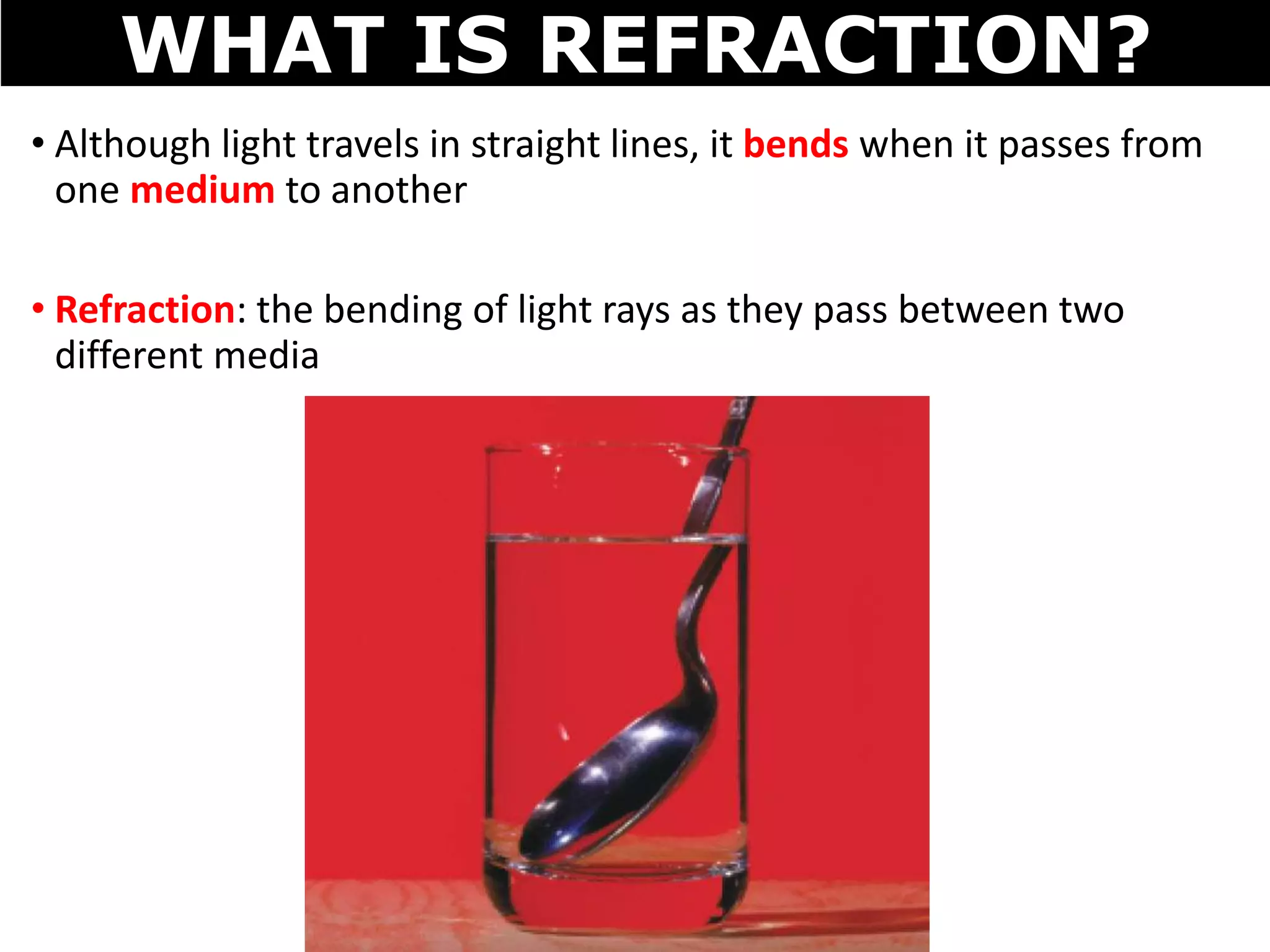
• Although lighttravels in straight lines, it bends when it passes from
one medium to another
• Refraction: the bending of light rays as they pass between two
different media
WHAT IS REFRACTION?
3.
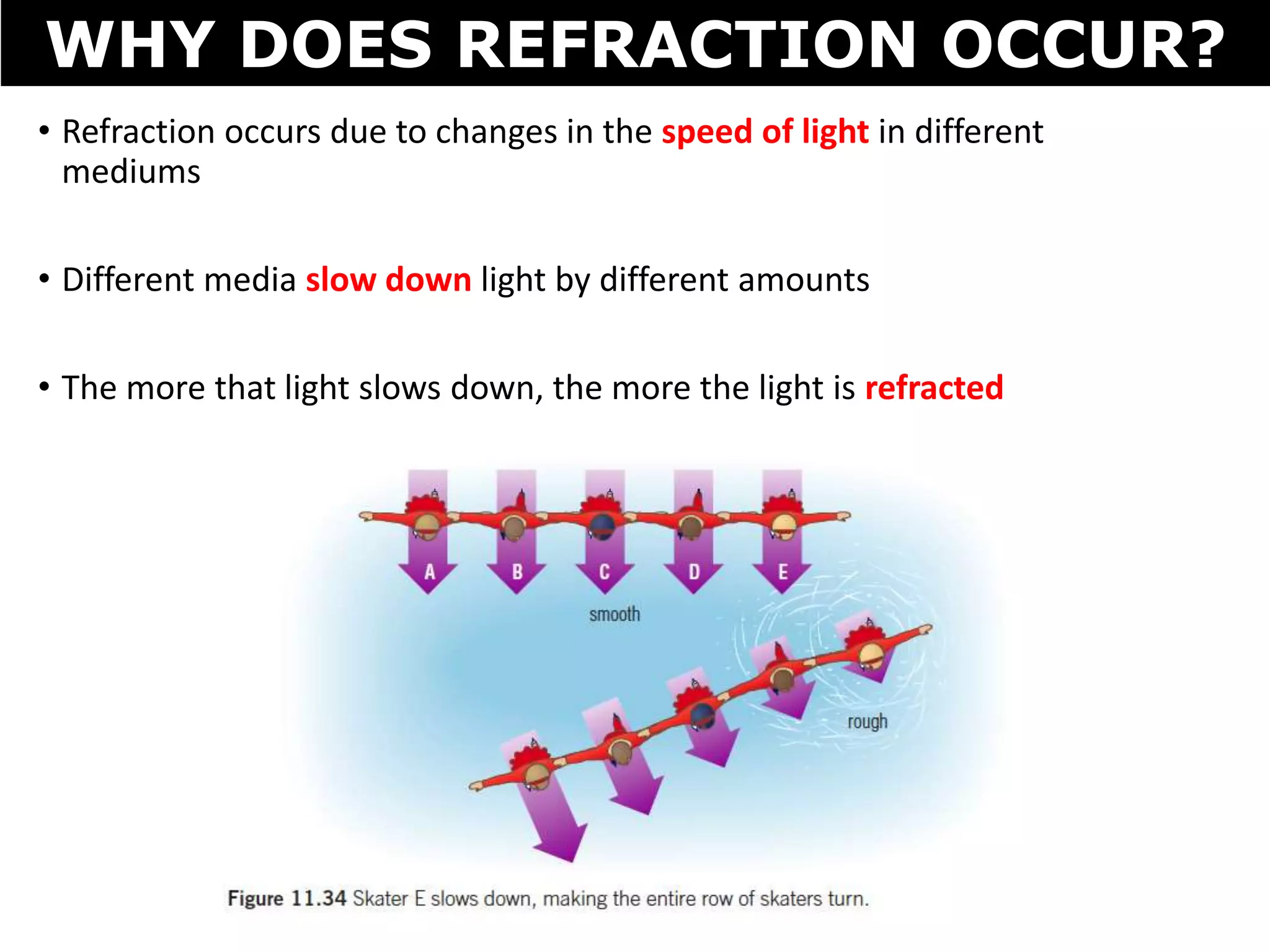
• Refraction occursdue to changes in the speed of light in different
mediums
• Different media slow down light by different amounts
• The more that light slows down, the more the light is refracted
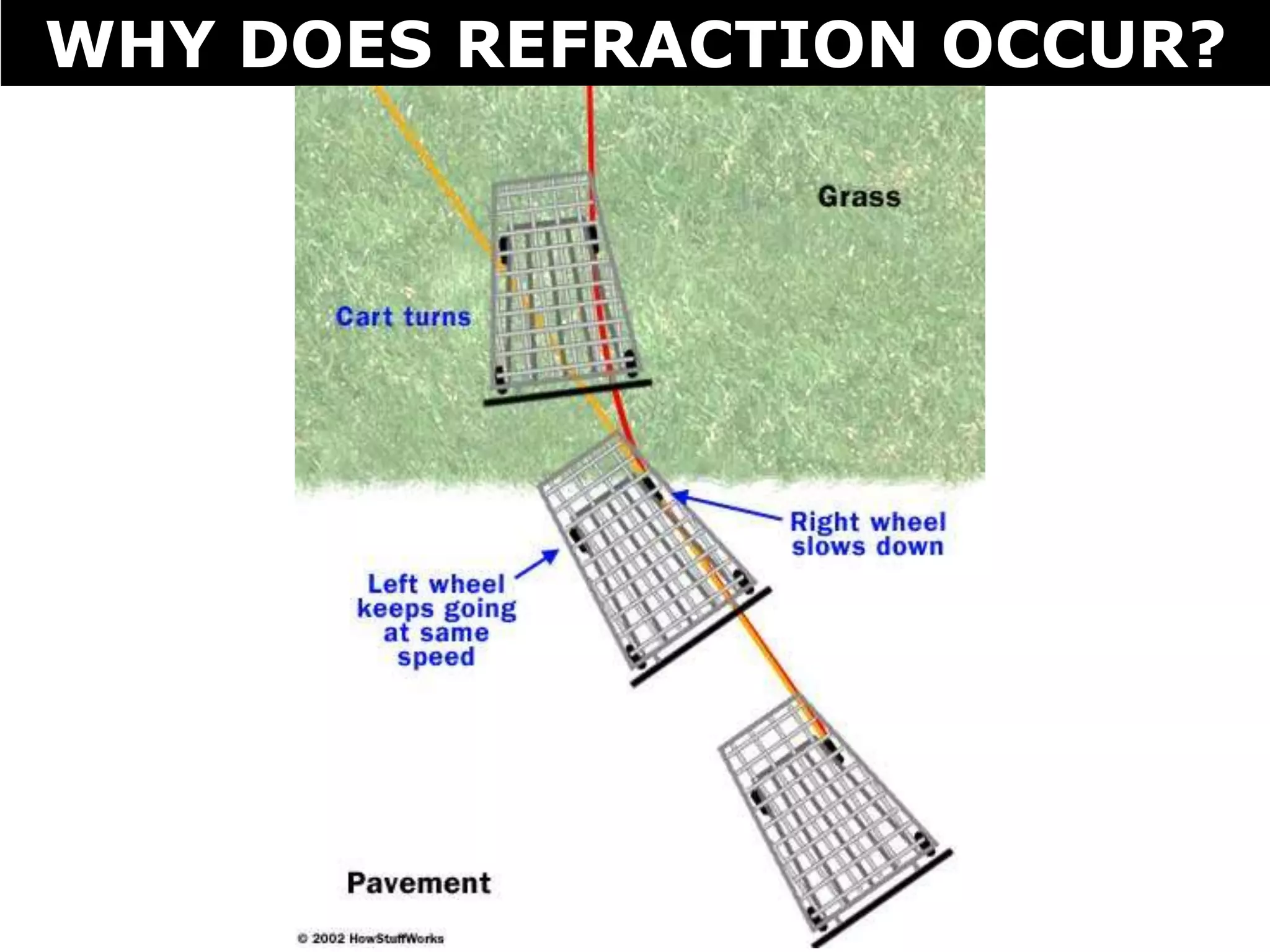
WHY DOES REFRACTION OCCUR?
4.
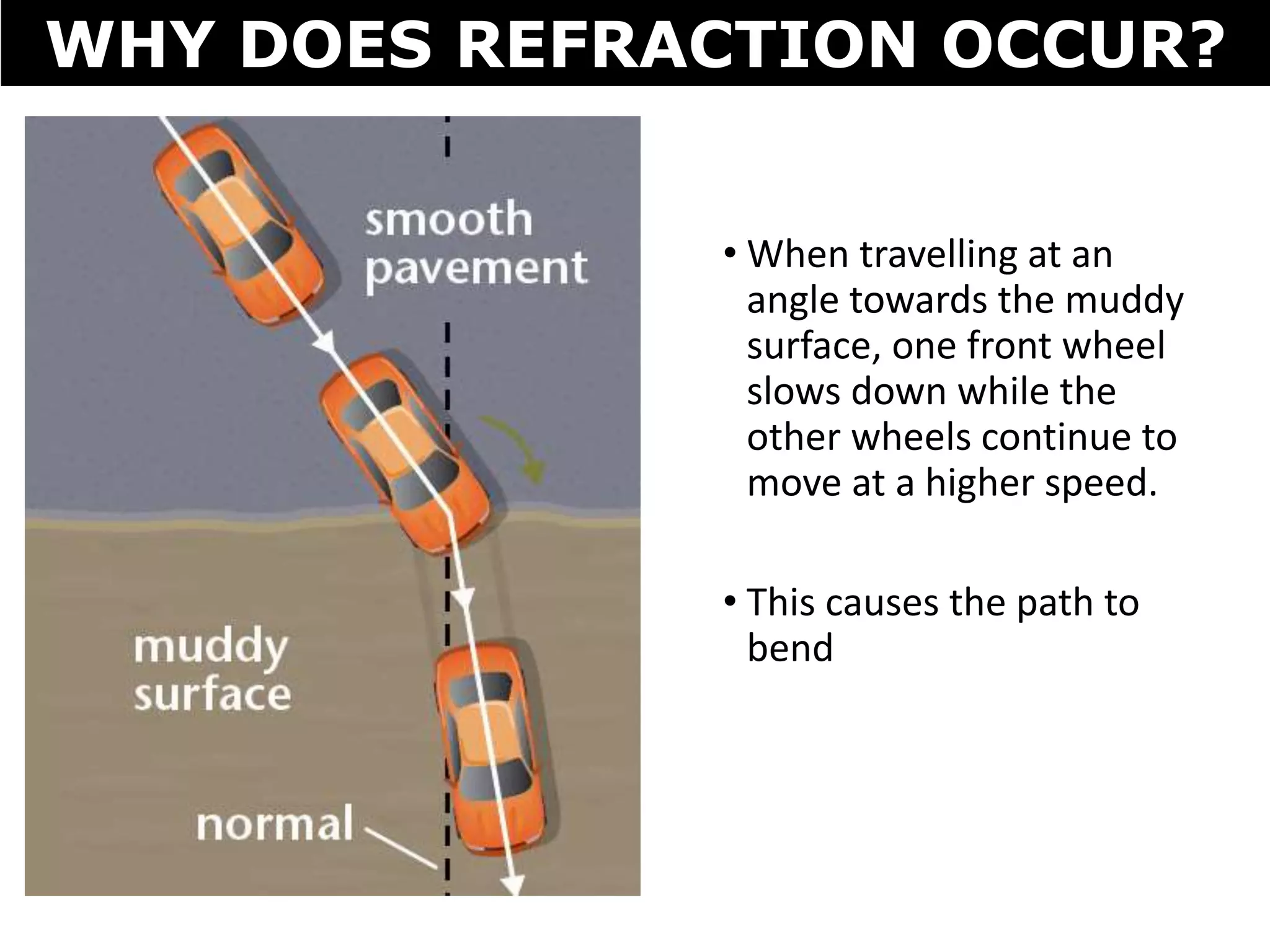
• When travellingat an
angle towards the muddy
surface, one front wheel
slows down while the
other wheels continue to
move at a higher speed.
• This causes the path to
bend
WHY DOES REFRACTION OCCUR?
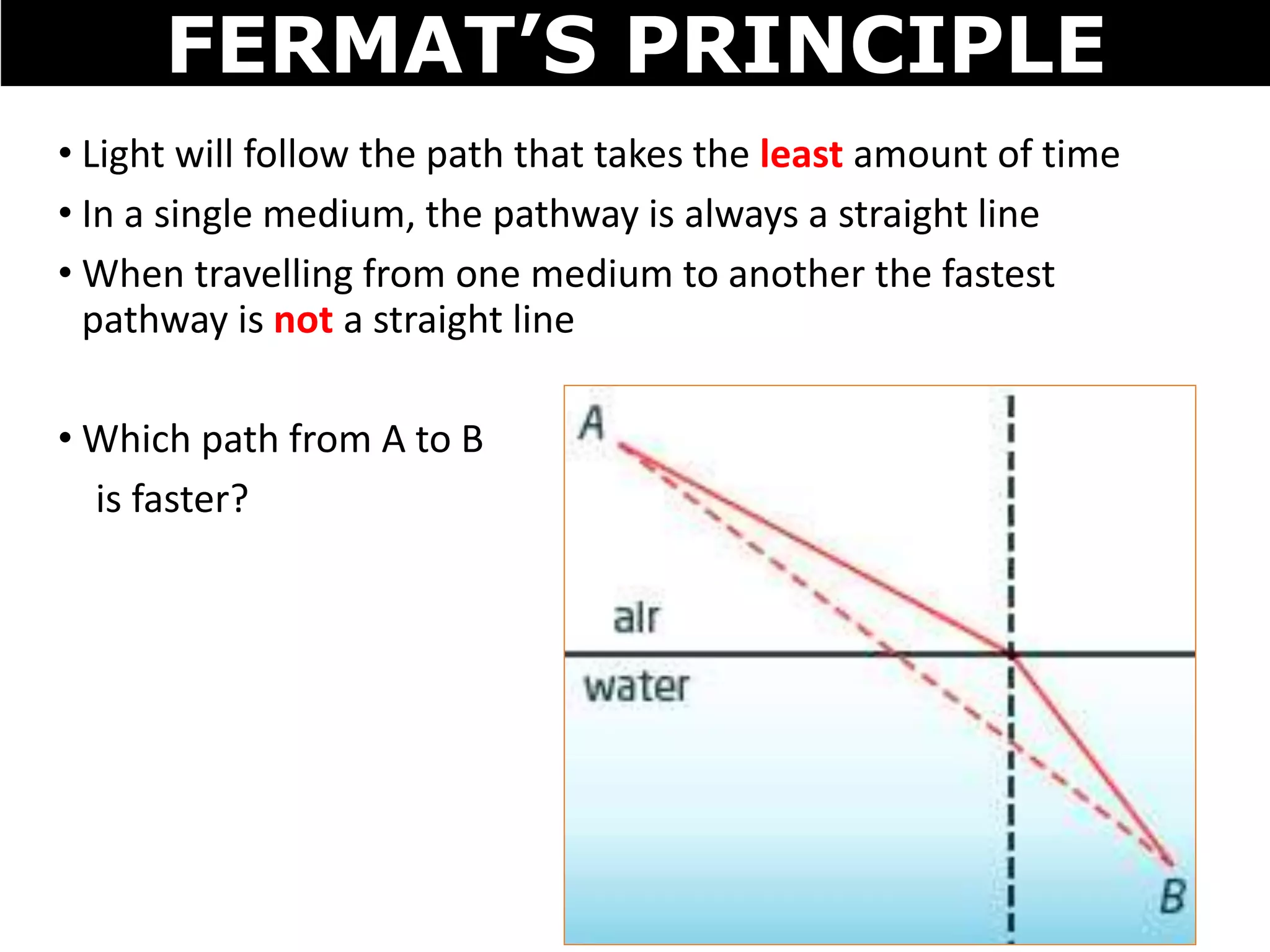
• Light willfollow the path that takes the least amount of time
• In a single medium, the pathway is always a straight line
• When travelling from one medium to another the fastest
pathway is not a straight line
• Which path from A to B
is faster?
FERMAT’S PRINCIPLE
8.
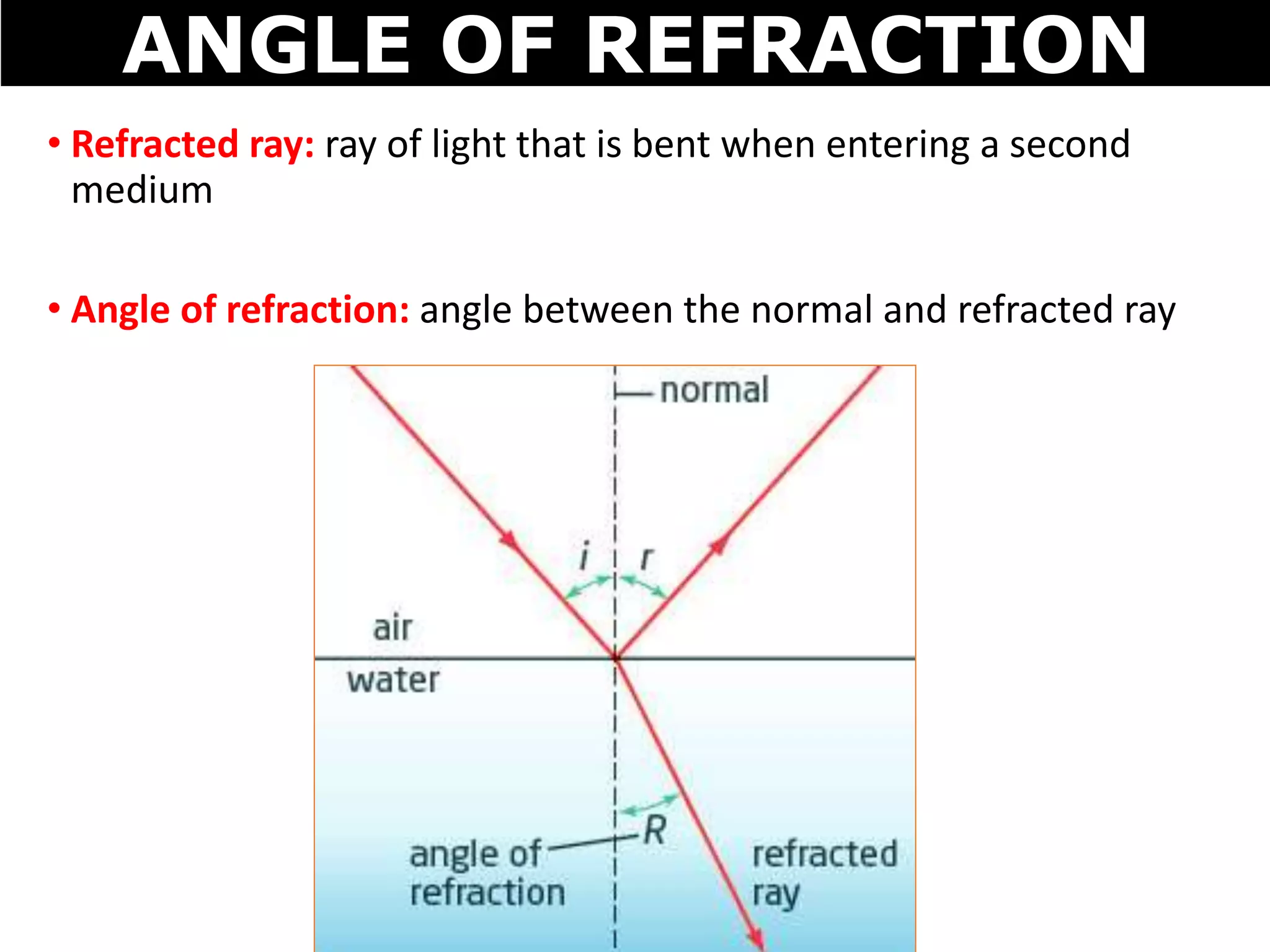
• Refracted ray:ray of light that is bent when entering a second
medium
• Angle of refraction: angle between the normal and refracted ray
ANGLE OF REFRACTION
9.
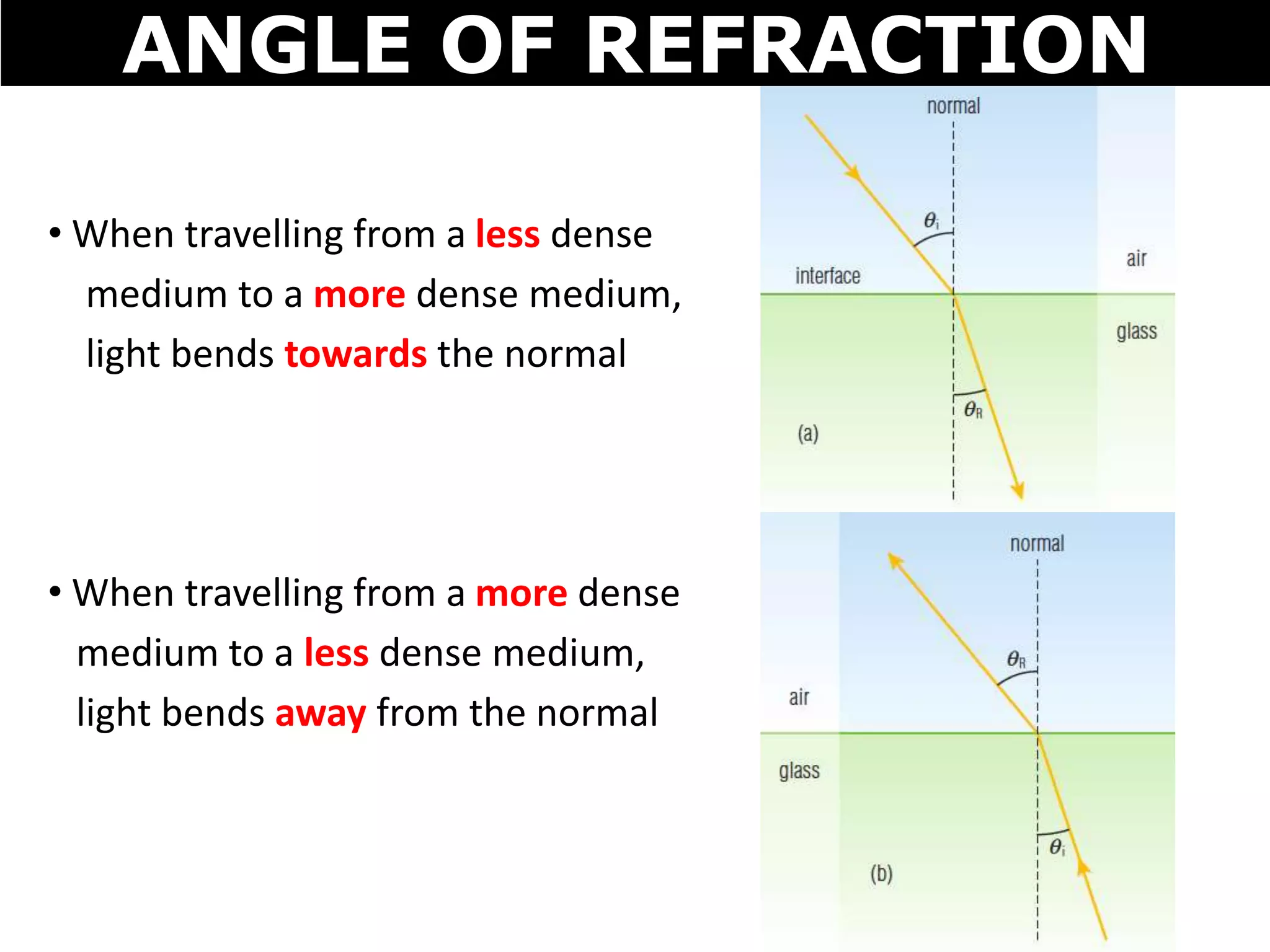
• When travellingfrom a less dense
medium to a more dense medium,
light bends towards the normal
• When travelling from a more dense
medium to a less dense medium,
light bends away from the normal
ANGLE OF REFRACTION
10.
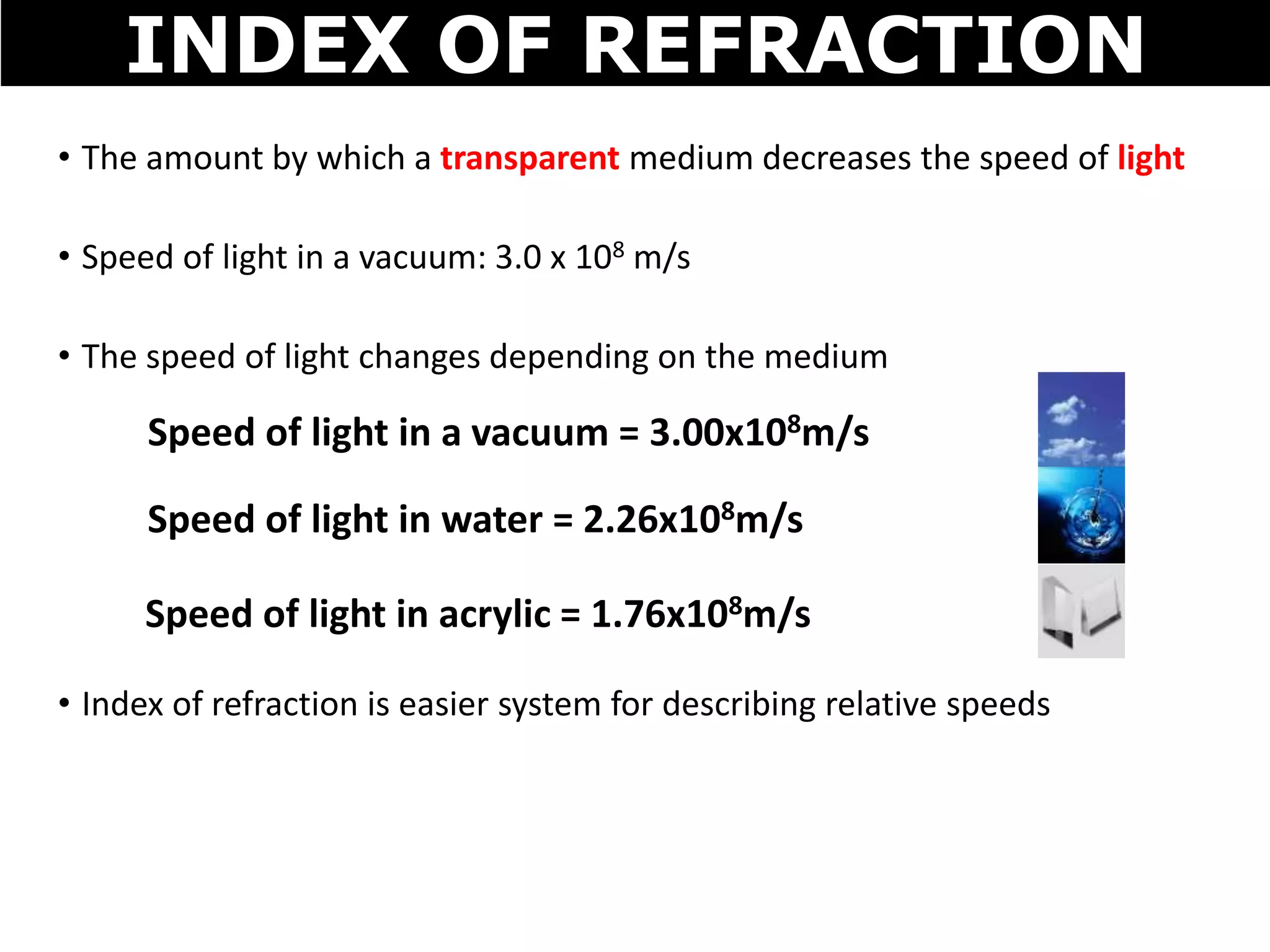
• The amountby which a transparent medium decreases the speed of light
• Speed of light in a vacuum: 3.0 x 10⁸ m/s
• The speed of light changes depending on the medium
• Index of refraction is easier system for describing relative speeds
INDEX OF REFRACTION
Speed of light in a vacuum = 3.00x10⁸m/s
Speed of light in water = 2.26x10⁸m/s
Speed of light in acrylic = 1.76x10⁸m/s
11.
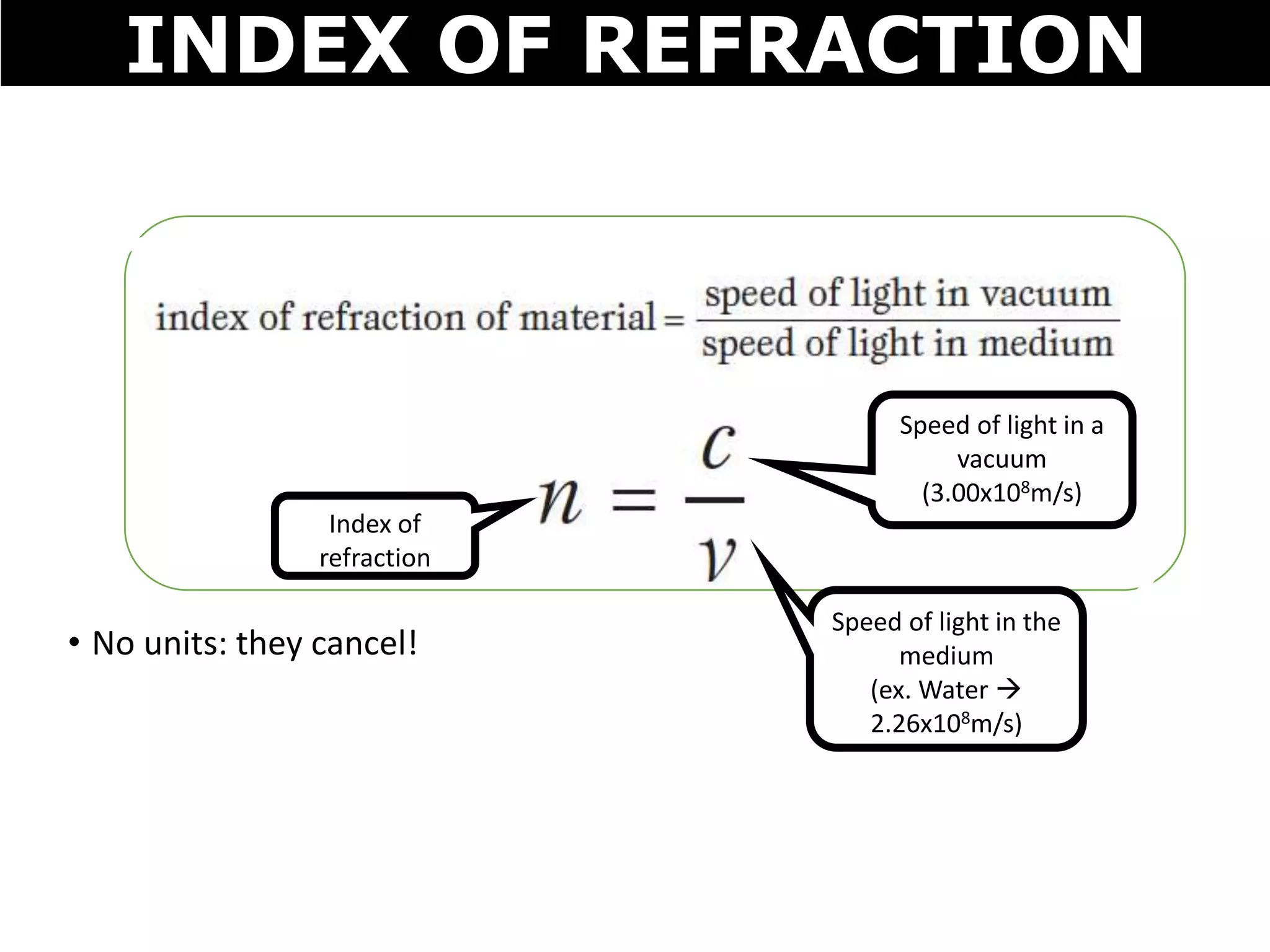
• No units:they cancel!
or
INDEX OF REFRACTION
Index of
refraction
Speed of light in a
vacuum
(3.00x10⁸m/s)
Speed of light in the
medium
(ex. Water
2.26x10⁸m/s)
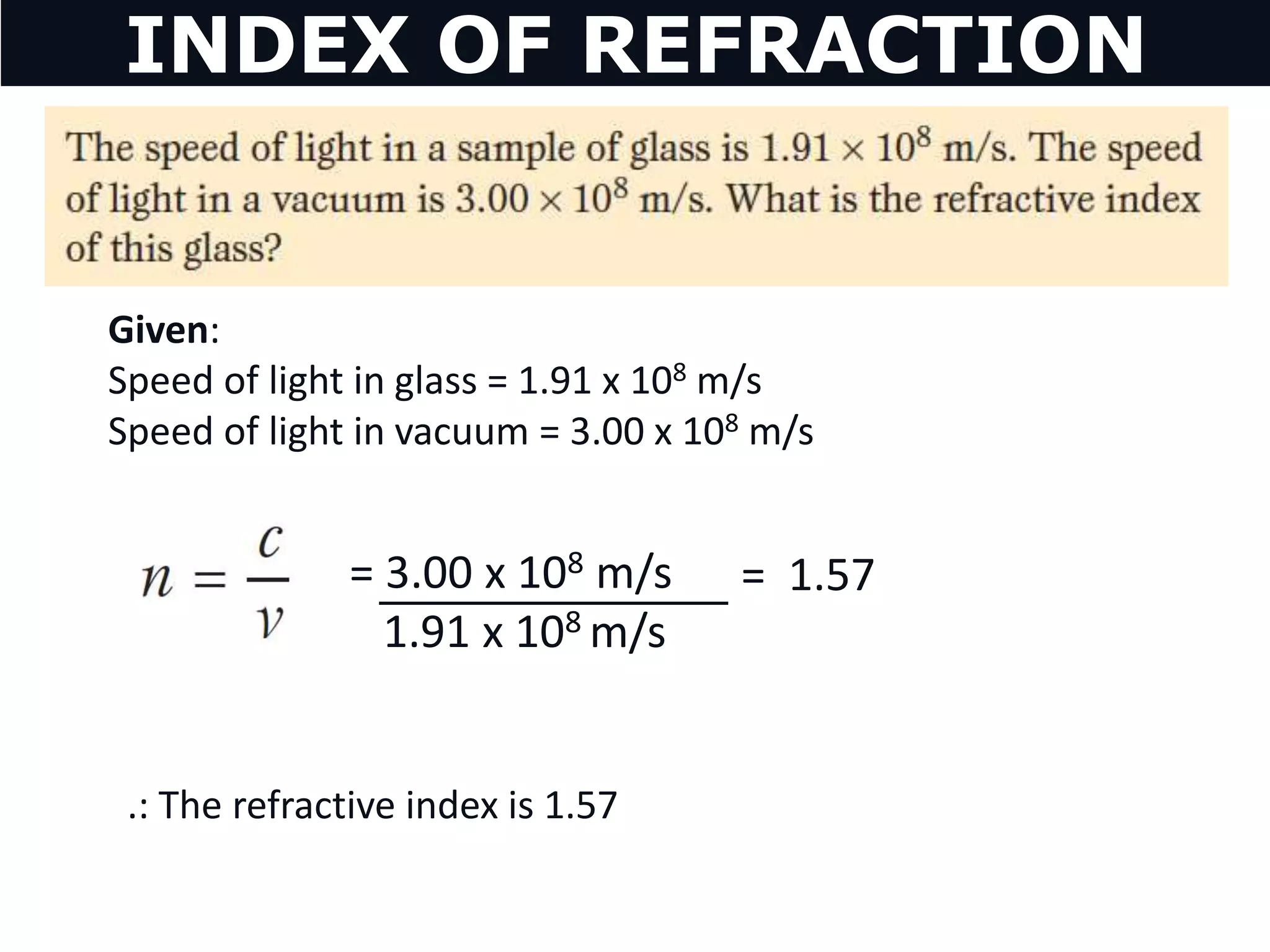
Given:
Speed of lightin glass = 1.91 x 10⁸ m/s
Speed of light in vacuum = 3.00 x 10⁸ m/s
= 1.57= 3.00 x 10⁸ m/s
1.91 x 10⁸ m/s
.: The refractive index is 1.57
INDEX OF REFRACTION
14.
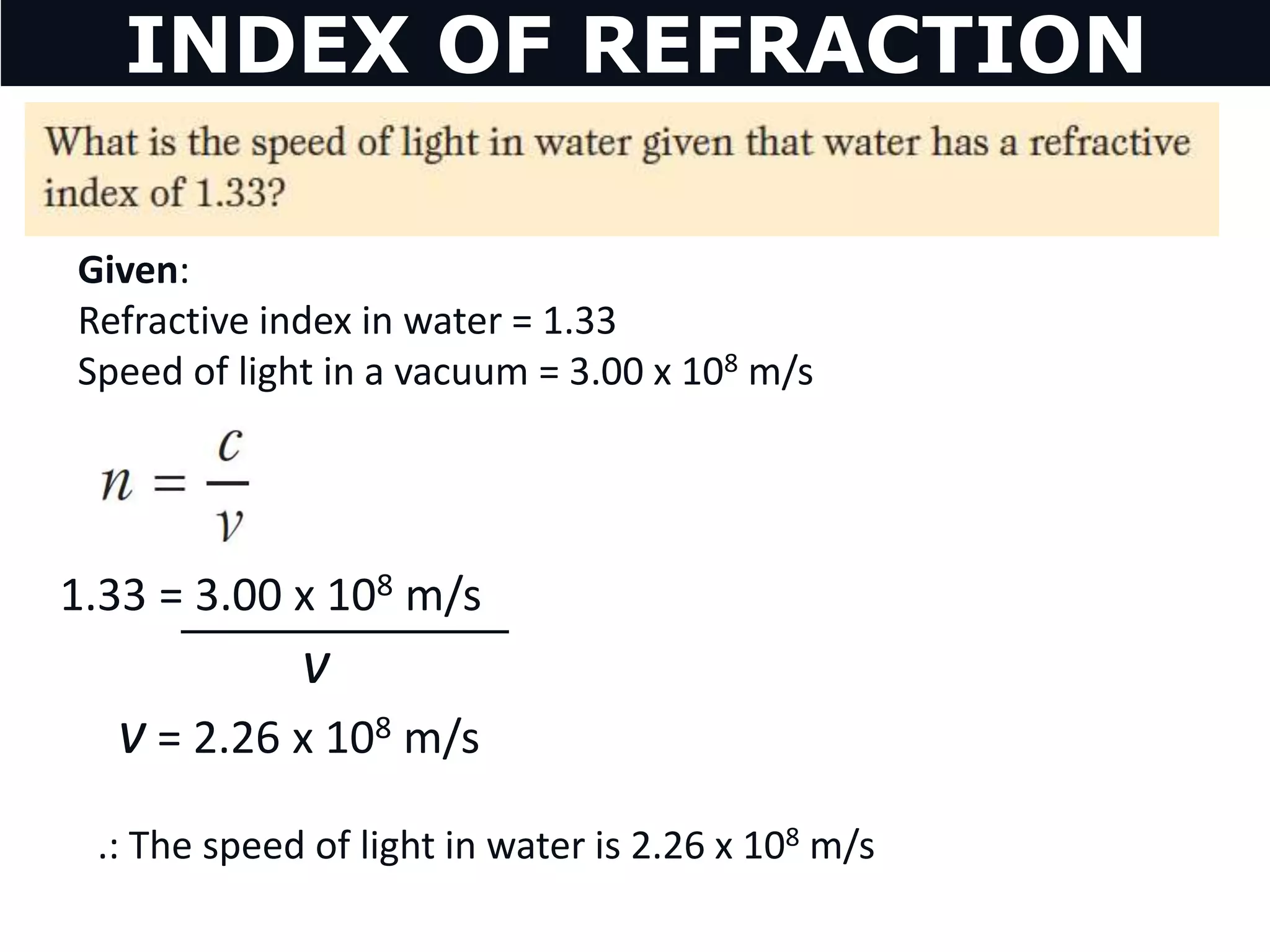
v = 2.26x 10⁸ m/s
1.33 = 3.00 x 10⁸ m/s
v
.: The speed of light in water is 2.26 x 10⁸ m/s
INDEX OF REFRACTION
Given:
Refractive index in water = 1.33
Speed of light in a vacuum = 3.00 x 10⁸ m/s
15.
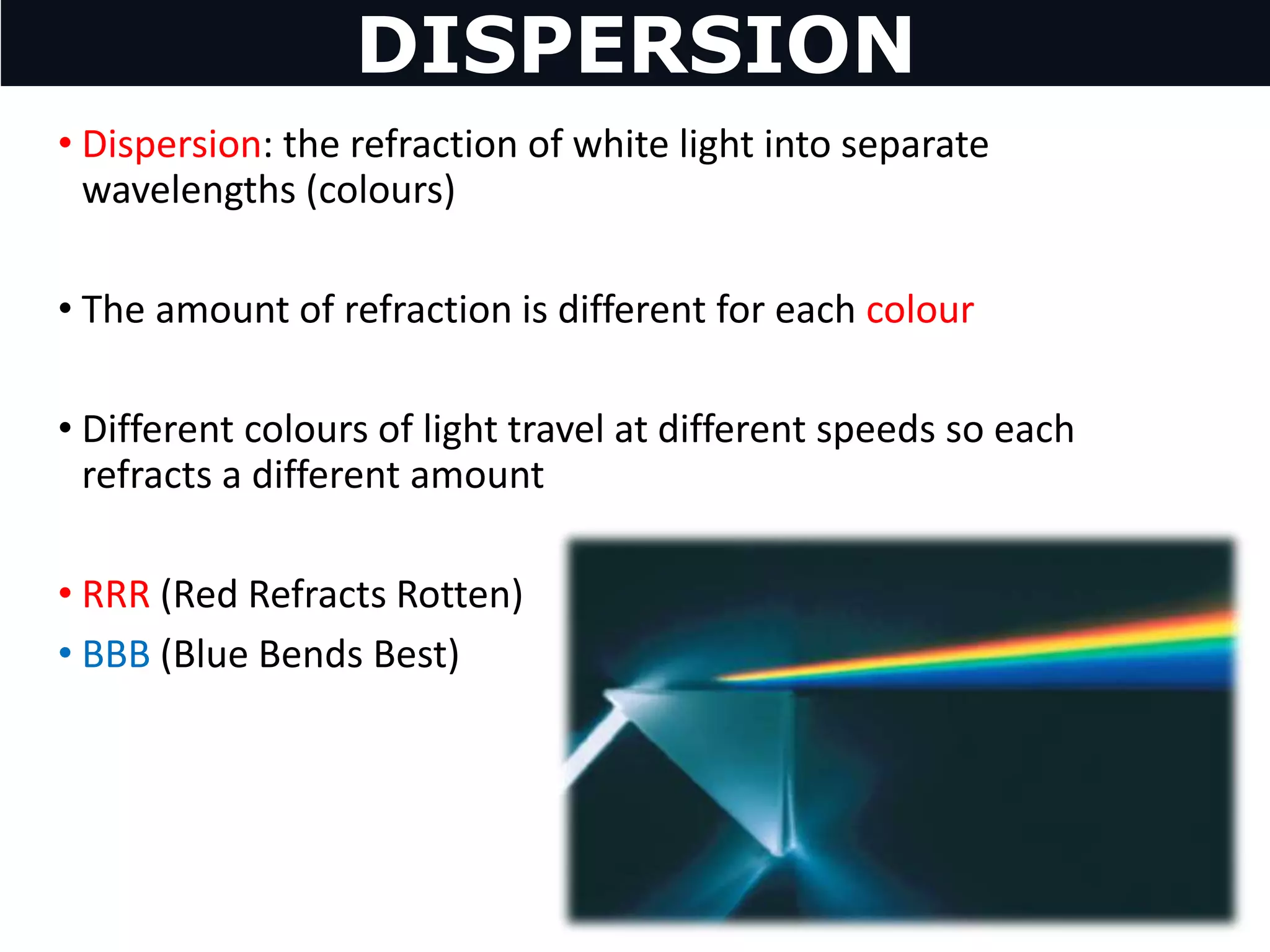
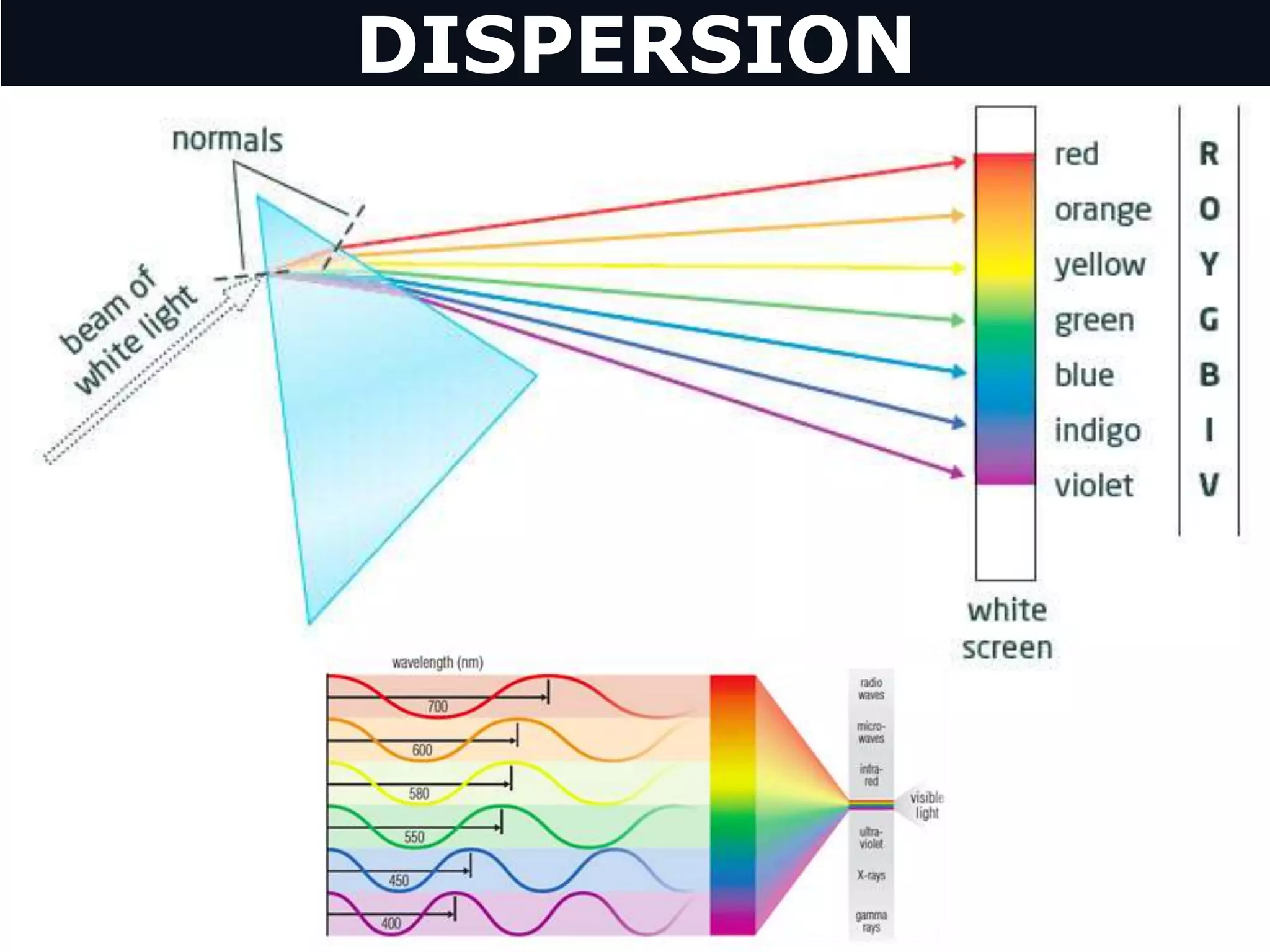
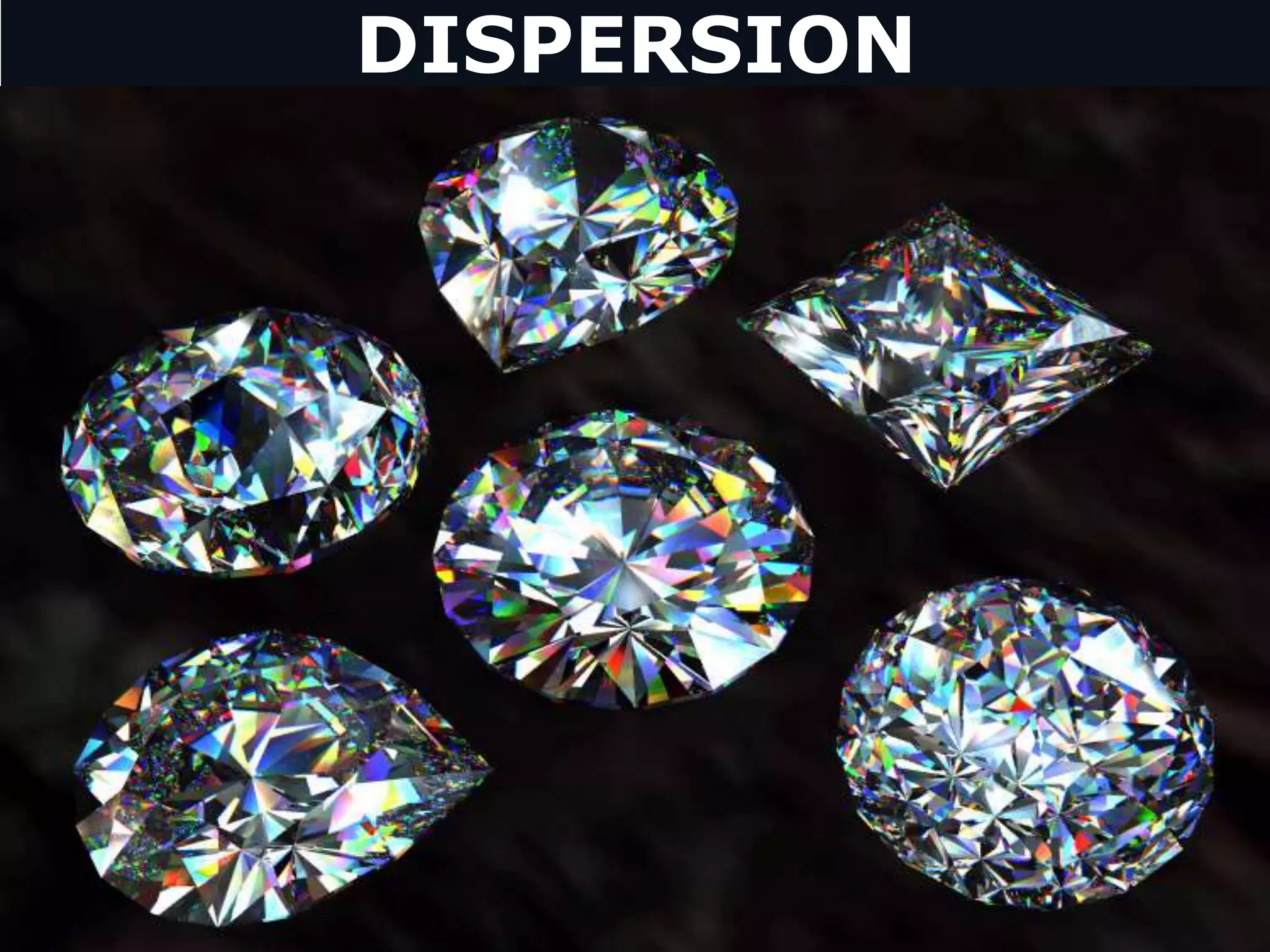
• Dispersion: therefraction of white light into separate
wavelengths (colours)
• The amount of refraction is different for each colour
• Different colours of light travel at different speeds so each
refracts a different amount
• RRR (Red Refracts Rotten)
• BBB (Blue Bends Best)
DISPERSION
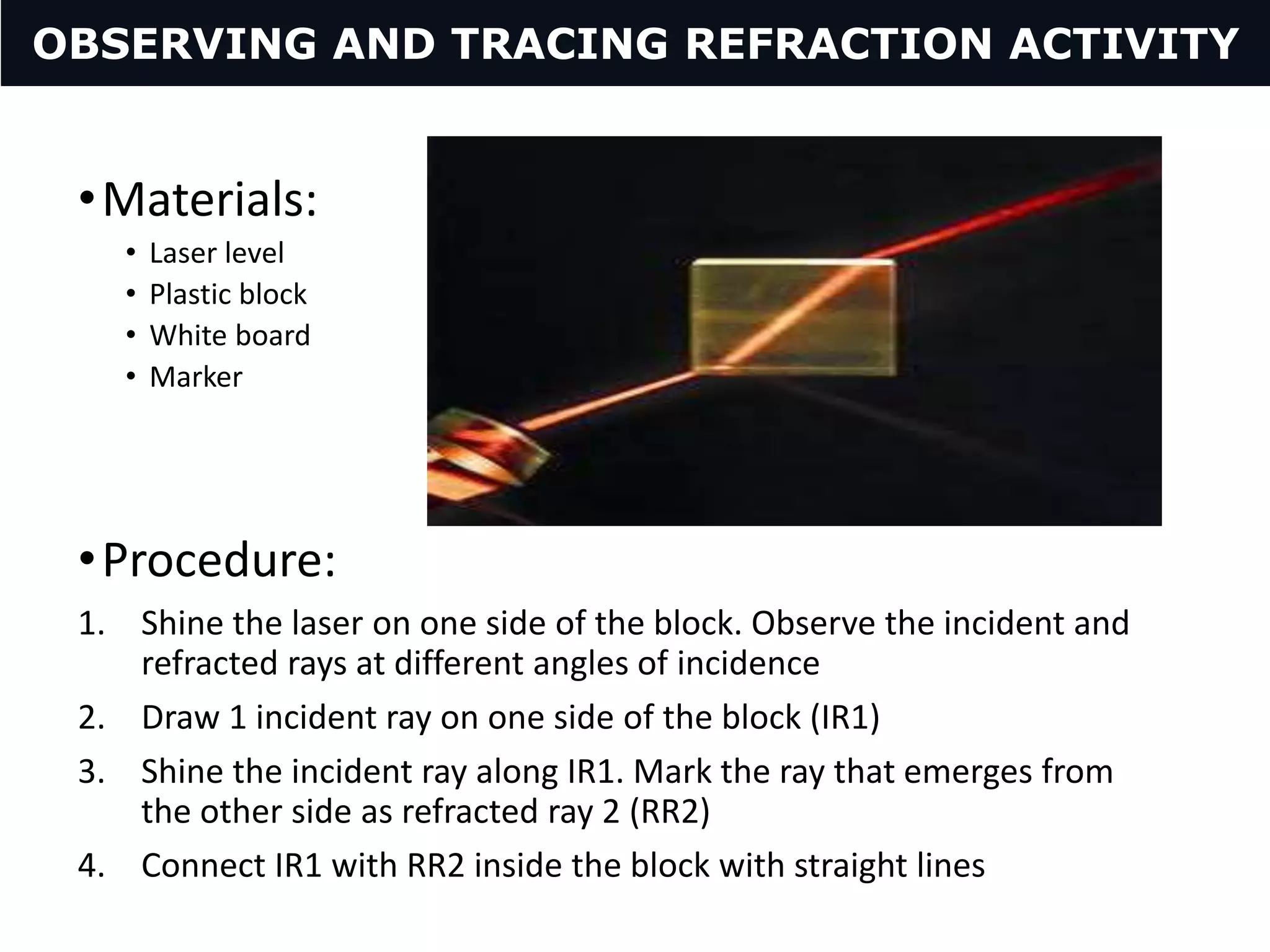
•Materials:
• Laser level
•Plastic block
• White board
• Marker
•Procedure:
1. Shine the laser on one side of the block. Observe the incident and
refracted rays at different angles of incidence
2. Draw 1 incident ray on one side of the block (IR1)
3. Shine the incident ray along IR1. Mark the ray that emerges from
the other side as refracted ray 2 (RR2)
4. Connect IR1 with RR2 inside the block with straight lines
OBSERVING AND TRACING REFRACTION ACTIVITY
19.
•Analysis:
• Label whatyou think is refracted ray 1 (RR1) and incident ray 2 (IR2)
• Draw a normal on both surfaces of the block
• Measure i1, R1, i2, R2
• What do you notice about i1, R2? How about i2, R1?
OBSERVING AND TRACING REFRACTION ACTIVITY
20.
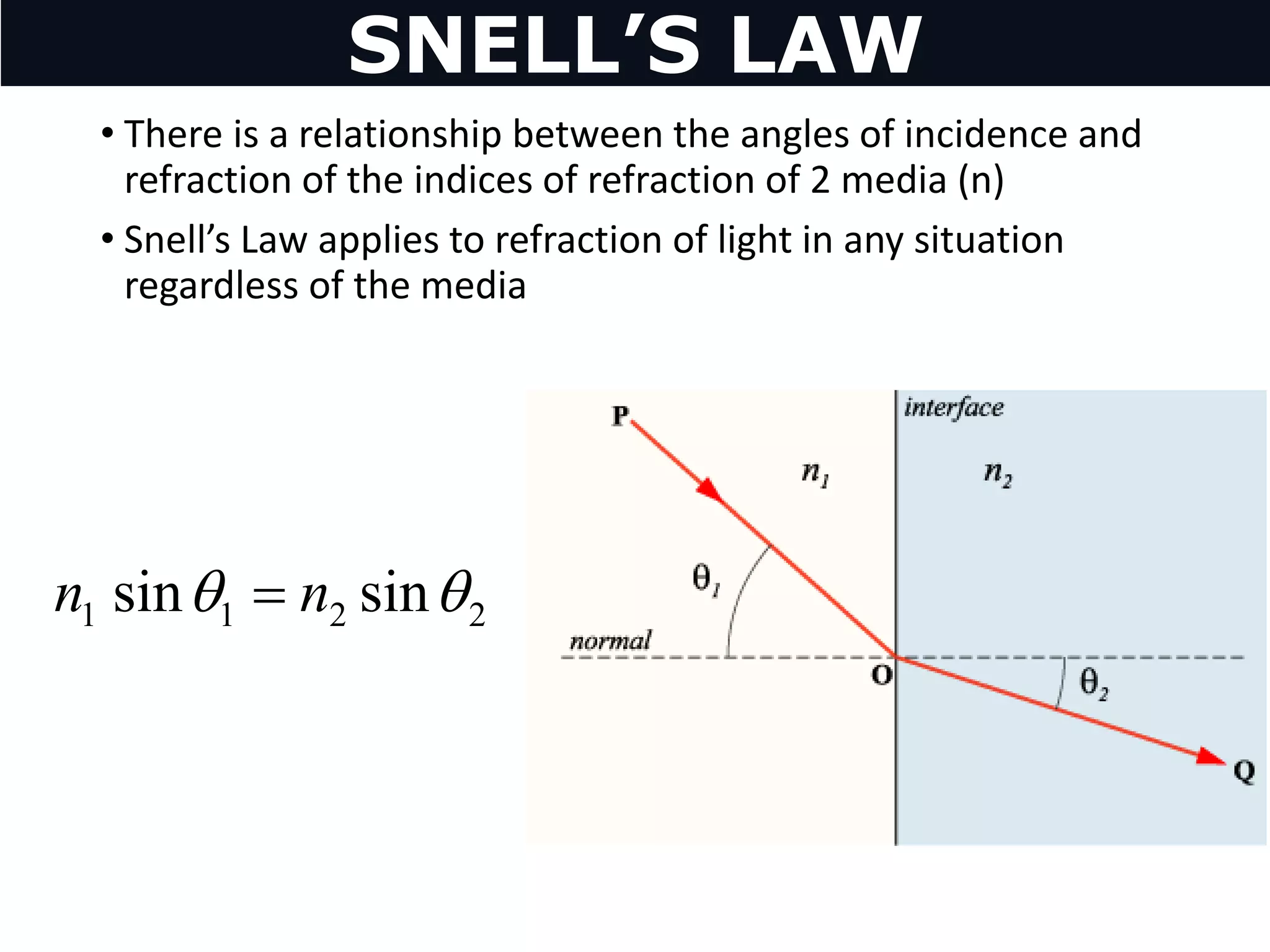
• There isa relationship between the angles of incidence and
refraction of the indices of refraction of 2 media (n)
• Snell’s Law applies to refraction of light in any situation
regardless of the media
2211 sinsin nn
SNELL’S LAW
21.
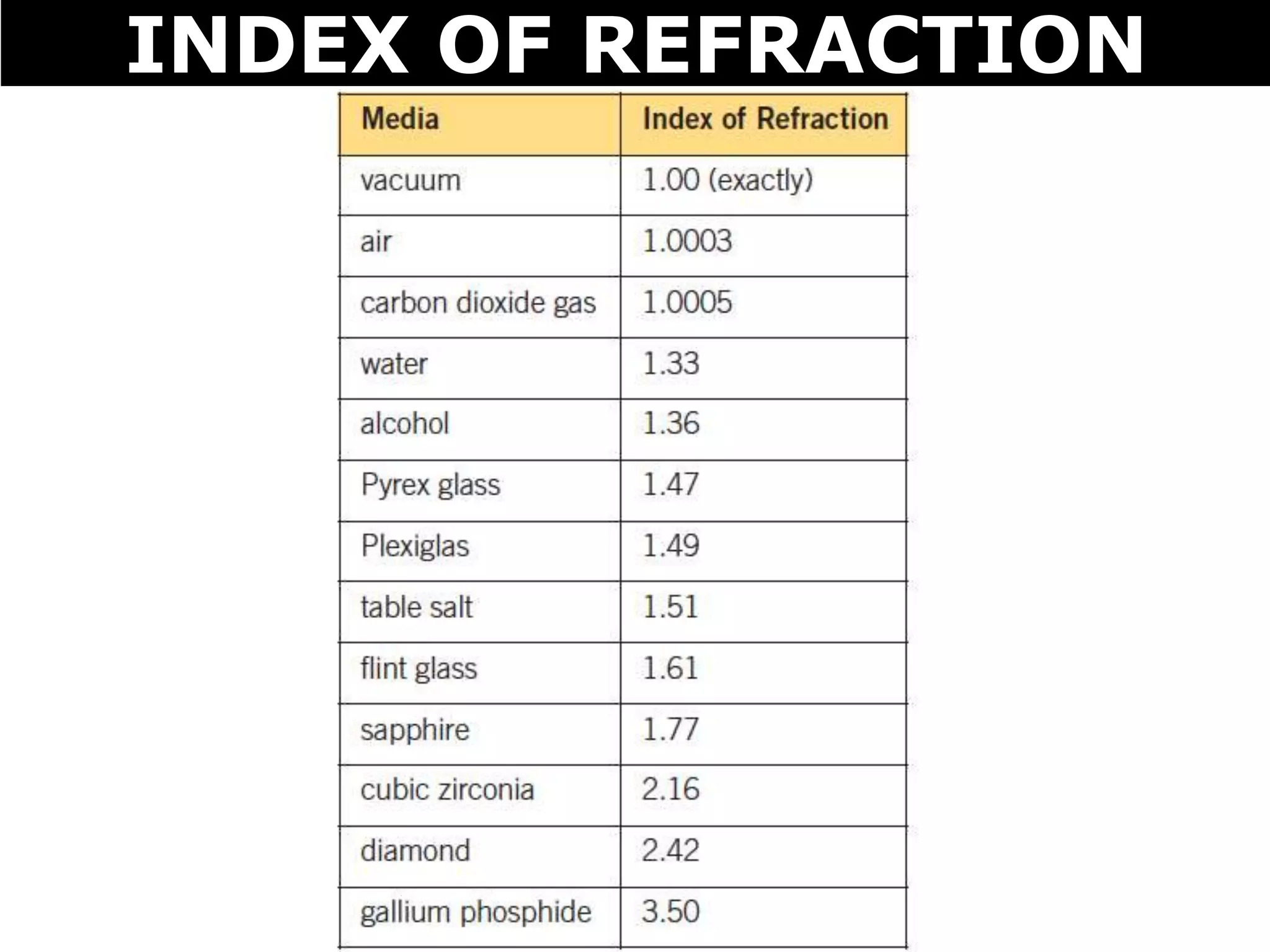
1. Light passesfrom air (n = 1.00) into diamond (n = 2.42)
with an angle of incidence of 60.0 degrees. What is the
angle of refraction?
2. What is the index of refraction of a material if the angle of
incidence in air is 50.0 degrees and the angle of refraction
in the material is 40.0 degrees?
3. A diamond ring is dropped into water. The index of
refraction for diamond is 2.42. If light strikes the diamond
at an angle of incidence of 60.0 degrees, what will be the
angle of refraction in diamond?
SNELL’S LAW QUESTIONS


![[Unit 12.2] refraction of light](https://cdn.slidesharecdn.com/ss_thumbnails/unit12-2refractionoflight-100829070254-phpapp01-thumbnail.jpg?width=640&height=640&fit=bounds)


![[Unit 9.02] refraction of light](https://cdn.slidesharecdn.com/ss_thumbnails/unit9-02refractionoflight-100916190231-phpapp02-thumbnail.jpg?width=640&height=640&fit=bounds)


