5.2 REFRACTION OF LIGHT
PREPAIRED BY:
PHYSICS DEPARTMENT
SBPI TEMERLOH
Situation related to refraction of light
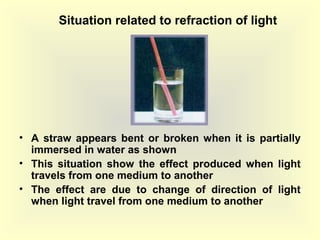
• A straw appears bent or broken when it is partially
immersed in water as shown
• This situation show the effect produced when light
travels from one medium to another
• The effect are due to change of direction of light
when light travel from one medium to another
Refraction of light
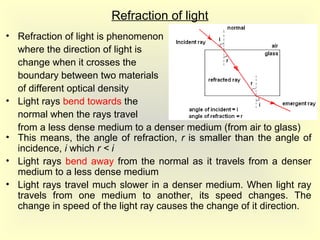
• Refraction of light is phenomenon
where the direction of light is
change when it crosses the
boundary between two materials
of different optical density
• Light rays bend towards the
normal when the rays travel
from a less dense medium to a denser medium (from air to glass)
• This means, the angle of refraction, r is smaller than the angle of
incidence, i which r < i
• Light rays bend away from the normal as it travels from a denser
medium to a less dense medium
• Light rays travel much slower in a denser medium. When light ray
travels from one medium to another, its speed changes. The
change in speed of the light ray causes the change of it direction.
Laws of refraction
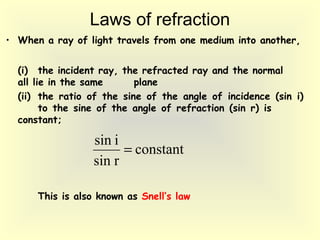
• When a ray of light travels from one medium into another,
(i) the incident ray, the refracted ray and the normal
all lie in the same plane
(ii) the ratio of the sine of the angle of incidence (sin i)
to the sine of the angle of refraction (sin r) is
constant;
This is also known as Snell’s law
constant
rsin
isin
=
Refractive index
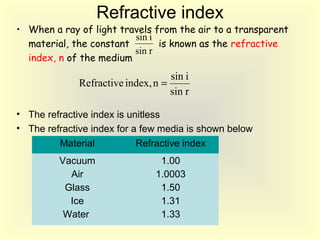
• When a ray of light travels from the air to a transparent
material, the constant is known as the refractive
index, n of the medium
• The refractive index is unitless
• The refractive index for a few media is shown below
rsin
isin
rsin
isin
nindex,Refractive =
Material Refractive index
Vacuum
Air
Glass
Ice
Water
1.00
1.0003
1.50
1.31
1.33
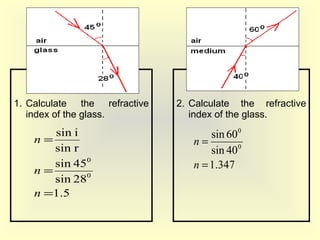
1. Calculate the refractive
index of the glass.
2. Calculate the refractive
index of the glass.
5.1
28sin
45sin
rsin
isin
0
0
=
=
=
n
n
n
347.1
40sin
60sin
0
0
=
=
n
n
Refractive index and the speed of light
• Light travel at a very high speed of 3 x 10⁸
m s-1
in a
vacuum
• When a ray of light passes from air or vacuum into a
medium which is optically denser, its speed is reduce
• The bending effect of light when it travels from air into a
medium depends on:
(i) the type of the medium
(ii) the angle of incidence
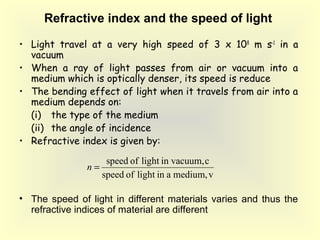
• Refractive index is given by:
• The speed of light in different materials varies and thus the
refractive indices of material are different
vmedium,ainlightofspeed
cin vacuum,lightofspeed
=n
• The value of n>1 for all materials because the speed of
light in a vacuum is larger than the speed of light in
the materials
• Any material with high refractive index is said to be
optically denser then material with a lower refractive
index
Example 1
• Calculate the index of refraction for light traveling from
air to a medium with the speed of 1.8 x 10⁸
m s-1
. [ speed
of light in air = 3.0 x 10⁸
m s-1
]
Solution:
67.1
108.1
103
n
mediumainlightofspeed
airin thelightofspeed
n
8
8
=
×
×
=
=
n
Example 2
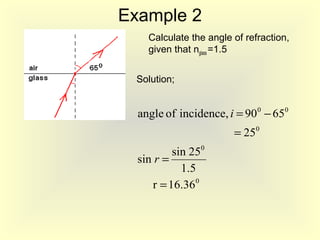
Calculate the angle of refraction,
given that nglass =1.5
Solution;
0
0
0
00
36.16r
1.5
25sin
sin
25
6590incidence,ofangle
=
=
=
−=
r
i
Real depth and apparent depth
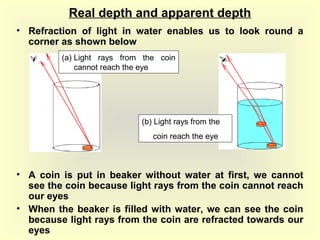
• Refraction of light in water enables us to look round a
corner as shown below
• A coin is put in beaker without water at first, we cannot
see the coin because light rays from the coin cannot reach
our eyes
• When the beaker is filled with water, we can see the coin
because light rays from the coin are refracted towards our
eyes
(a) Light rays from the coin
cannot reach the eye
(b) Light rays from the
coin reach the eye
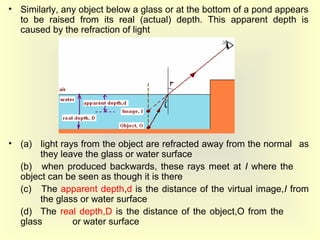
• Similarly, any object below a glass or at the bottom of a pond appears
to be raised from its real (actual) depth. This apparent depth is
caused by the refraction of light
• (a) light rays from the object are refracted away from the normal as
they leave the glass or water surface
(b) when produced backwards, these rays meet at I where the
object can be seen as though it is there
(c) The apparent depth,d is the distance of the virtual image,I from
the glass or water surface
(d) The real depth,D is the distance of the object,O from the
glass or water surface
• In optical astronomy, the ‘twinkling’ of stars is due
to the refraction of light
(a) the earth’s atmosphere is made up of layers of
gases with varying optical density and refractive
indices
(b) as light from a star passes through those layers
of gases, it experiences repeated refraction
(c) this causes scintillation (twinkling) which
smears the apparent point-like image of a star
into a disc.
More to know
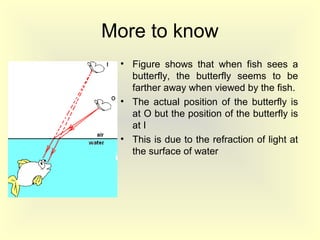
• Figure shows that when fish sees a
butterfly, the butterfly seems to be
farther away when viewed by the fish.
• The actual position of the butterfly is
at O but the position of the butterfly is
at I
• This is due to the refraction of light at
the surface of water
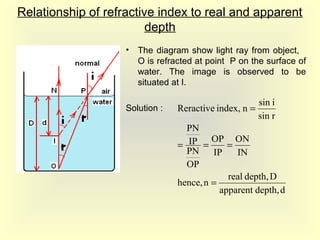
Relationship of refractive index to real and apparent
depth
• The diagram show light ray from object,
O is refracted at point P on the surface of
water. The image is observed to be
situated at I.
Solution :
ddepth,apparent
Ddepth,real
nhence,
IN
ON
IP
OP
OP
PN
IP
PN
rsin
isin
nindex,Reractive
=
===
=
Example 1
Some coins are found lying at the bottom of a pond of water 1.4 m
deep. What is the depth of the coins when viewed from above the
water surface?
[refractive index of water = 4/3]
Solution:
1.05m
3
4
1.4
n
D
dcoin,theofdepthapparentthus,
ddepth,apparent
Ddepth,real
nwater,ofindexrefractive
=
=
=
=
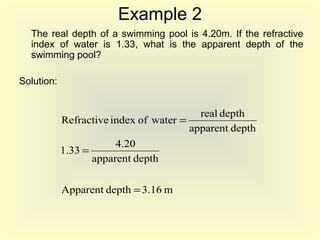
Example 2
The real depth of a swimming pool is 4.20m. If the refractive
index of water is 1.33, what is the apparent depth of the
swimming pool?
Solution:
m3.16depthApparent
depthapparent
4.20
1.33
depthapparent
depthreal
waterofindexRefractive
=
=
=
The End

5.2 refraction of light

  • 1.
    5.2 REFRACTION OFLIGHT PREPAIRED BY: PHYSICS DEPARTMENT SBPI TEMERLOH
  • 2.
    Situation related torefraction of light • A straw appears bent or broken when it is partially immersed in water as shown • This situation show the effect produced when light travels from one medium to another • The effect are due to change of direction of light when light travel from one medium to another
  • 3.
    Refraction of light •Refraction of light is phenomenon where the direction of light is change when it crosses the boundary between two materials of different optical density • Light rays bend towards the normal when the rays travel from a less dense medium to a denser medium (from air to glass) • This means, the angle of refraction, r is smaller than the angle of incidence, i which r < i • Light rays bend away from the normal as it travels from a denser medium to a less dense medium • Light rays travel much slower in a denser medium. When light ray travels from one medium to another, its speed changes. The change in speed of the light ray causes the change of it direction.
  • 4.
    Laws of refraction •When a ray of light travels from one medium into another, (i) the incident ray, the refracted ray and the normal all lie in the same plane (ii) the ratio of the sine of the angle of incidence (sin i) to the sine of the angle of refraction (sin r) is constant; This is also known as Snell’s law constant rsin isin =
  • 5.
    Refractive index • Whena ray of light travels from the air to a transparent material, the constant is known as the refractive index, n of the medium • The refractive index is unitless • The refractive index for a few media is shown below rsin isin rsin isin nindex,Refractive = Material Refractive index Vacuum Air Glass Ice Water 1.00 1.0003 1.50 1.31 1.33
  • 6.
    1. Calculate therefractive index of the glass. 2. Calculate the refractive index of the glass. 5.1 28sin 45sin rsin isin 0 0 = = = n n n 347.1 40sin 60sin 0 0 = = n n
  • 7.
    Refractive index andthe speed of light • Light travel at a very high speed of 3 x 10⁸ m s-1 in a vacuum • When a ray of light passes from air or vacuum into a medium which is optically denser, its speed is reduce • The bending effect of light when it travels from air into a medium depends on: (i) the type of the medium (ii) the angle of incidence • Refractive index is given by: • The speed of light in different materials varies and thus the refractive indices of material are different vmedium,ainlightofspeed cin vacuum,lightofspeed =n
  • 8.
    • The valueof n>1 for all materials because the speed of light in a vacuum is larger than the speed of light in the materials • Any material with high refractive index is said to be optically denser then material with a lower refractive index
  • 9.
    Example 1 • Calculatethe index of refraction for light traveling from air to a medium with the speed of 1.8 x 10⁸ m s-1 . [ speed of light in air = 3.0 x 10⁸ m s-1 ] Solution: 67.1 108.1 103 n mediumainlightofspeed airin thelightofspeed n 8 8 = × × = = n
  • 10.
    Example 2 Calculate theangle of refraction, given that nglass =1.5 Solution; 0 0 0 00 36.16r 1.5 25sin sin 25 6590incidence,ofangle = = = −= r i
  • 11.
    Real depth andapparent depth • Refraction of light in water enables us to look round a corner as shown below • A coin is put in beaker without water at first, we cannot see the coin because light rays from the coin cannot reach our eyes • When the beaker is filled with water, we can see the coin because light rays from the coin are refracted towards our eyes (a) Light rays from the coin cannot reach the eye (b) Light rays from the coin reach the eye
  • 12.
    • Similarly, anyobject below a glass or at the bottom of a pond appears to be raised from its real (actual) depth. This apparent depth is caused by the refraction of light • (a) light rays from the object are refracted away from the normal as they leave the glass or water surface (b) when produced backwards, these rays meet at I where the object can be seen as though it is there (c) The apparent depth,d is the distance of the virtual image,I from the glass or water surface (d) The real depth,D is the distance of the object,O from the glass or water surface
  • 13.
    • In opticalastronomy, the ‘twinkling’ of stars is due to the refraction of light (a) the earth’s atmosphere is made up of layers of gases with varying optical density and refractive indices (b) as light from a star passes through those layers of gases, it experiences repeated refraction (c) this causes scintillation (twinkling) which smears the apparent point-like image of a star into a disc.
  • 14.
    More to know •Figure shows that when fish sees a butterfly, the butterfly seems to be farther away when viewed by the fish. • The actual position of the butterfly is at O but the position of the butterfly is at I • This is due to the refraction of light at the surface of water
  • 15.
    Relationship of refractiveindex to real and apparent depth • The diagram show light ray from object, O is refracted at point P on the surface of water. The image is observed to be situated at I. Solution : ddepth,apparent Ddepth,real nhence, IN ON IP OP OP PN IP PN rsin isin nindex,Reractive = === =
  • 16.
    Example 1 Some coinsare found lying at the bottom of a pond of water 1.4 m deep. What is the depth of the coins when viewed from above the water surface? [refractive index of water = 4/3] Solution: 1.05m 3 4 1.4 n D dcoin,theofdepthapparentthus, ddepth,apparent Ddepth,real nwater,ofindexrefractive = = = =
  • 17.
    Example 2 The realdepth of a swimming pool is 4.20m. If the refractive index of water is 1.33, what is the apparent depth of the swimming pool? Solution: m3.16depthApparent depthapparent 4.20 1.33 depthapparent depthreal waterofindexRefractive = = =
  • 18.