PHYSICS
Propagation & Reflection Of Light
Light
• Light was considered as mysterious thing in
olden days.
• Light deals with luminous energy, energy
which causes the sensation of vision.
• Light is brightness that comes from an
object producing light , called luminous body
(sun).
• Light comes from atoms. Atoms that produce
light have either gained energy by absorbing
light from an other source or by being struck
by other particles. It is this extra energy that
causes an atom to give off light.
• Study of light and interaction of light and
matter is known as optics.
Properties of Light
Rectilinear propagation.
Shadow formation
Reflection.
Refraction.
Diffraction.
Dispersion.
Polarization.
Interference.
Properties of Light
Shadow Formation= The straight rays of light
passing the edges of non transparent( opaque) body,
leave a sharp shadow of that body in the way of light.
Properties of Light
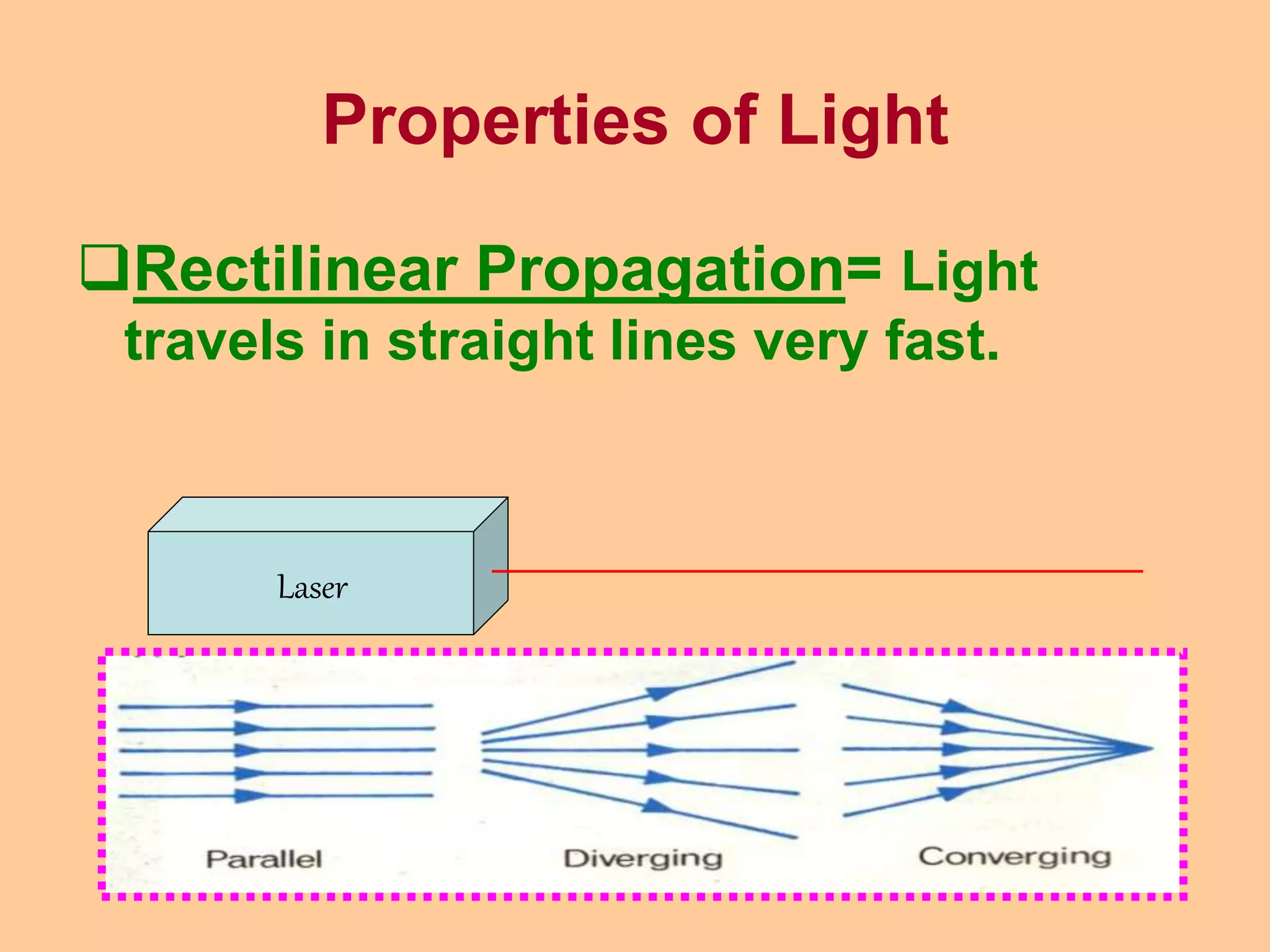
Rectilinear Propagation= Light
travels in straight lines very fast.
Laser
Properties of Light
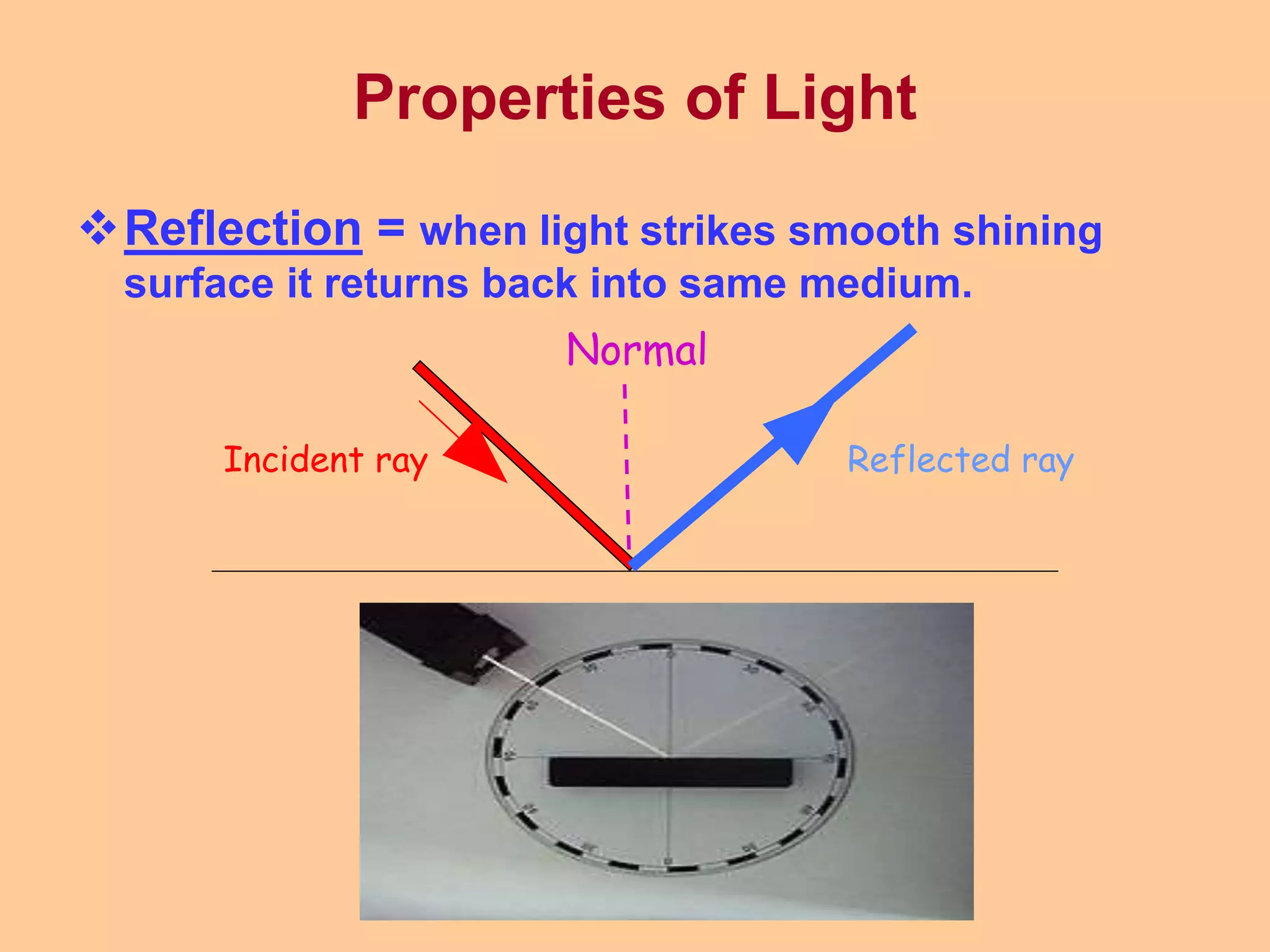
Reflection = when light strikes smooth shining
surface it returns back into same medium.
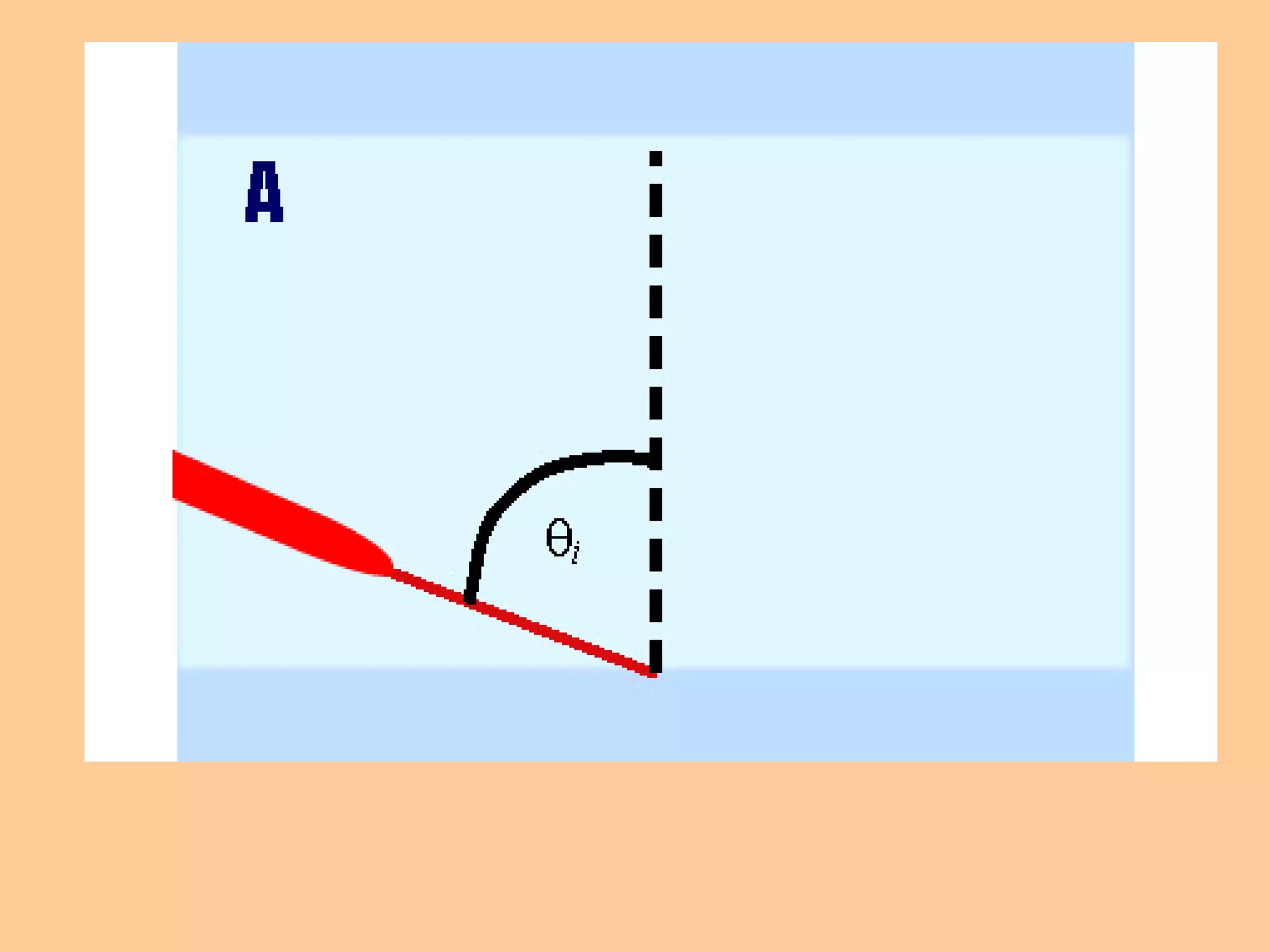
Incident ray Reflected ray
Normal
Properties of Light
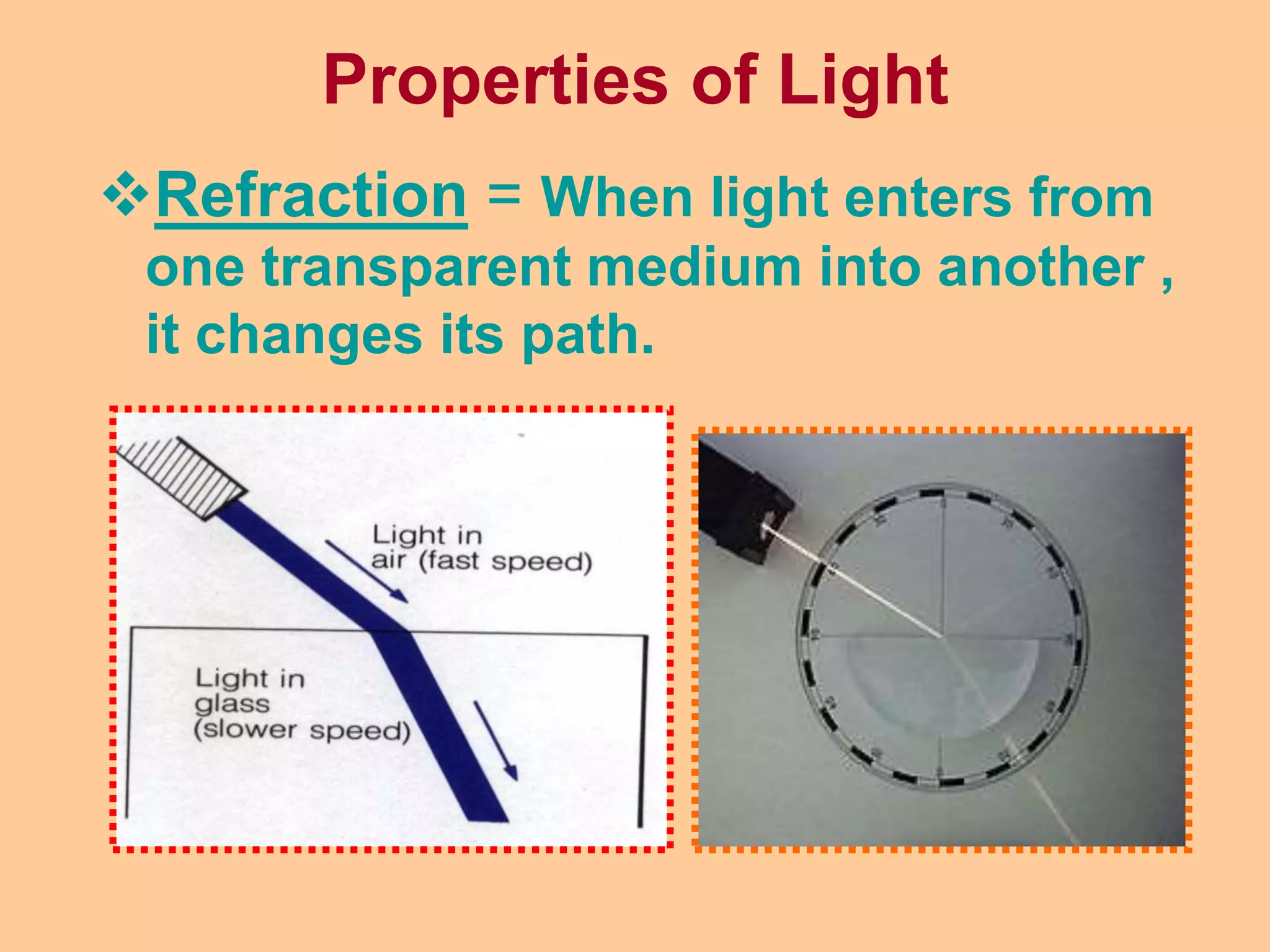
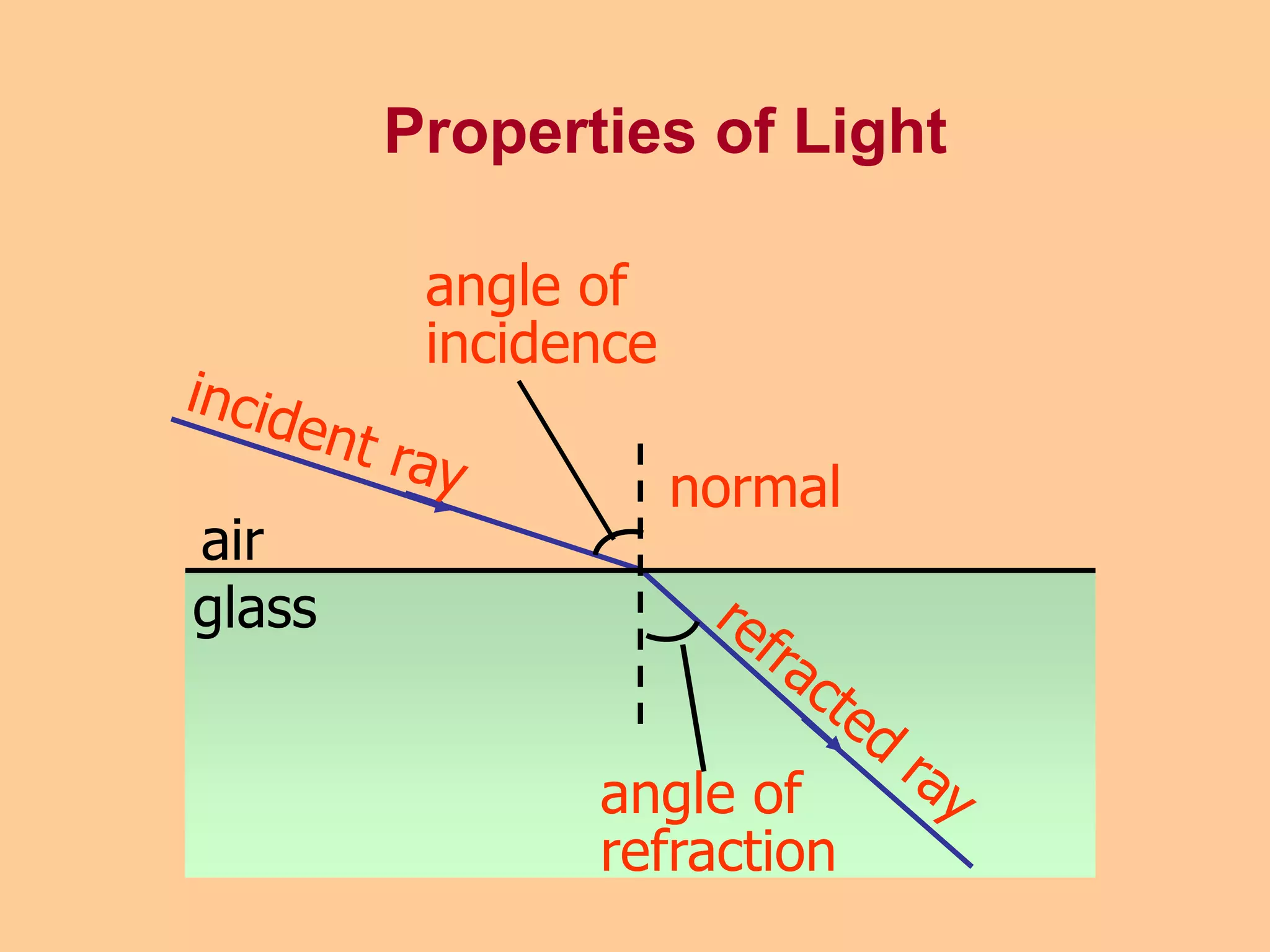
Refraction = When light enters from
one transparent medium into another ,
it changes its path.
air
glass
normal
angle of
refraction
angle of
incidence
Properties of Light
Properties of Light
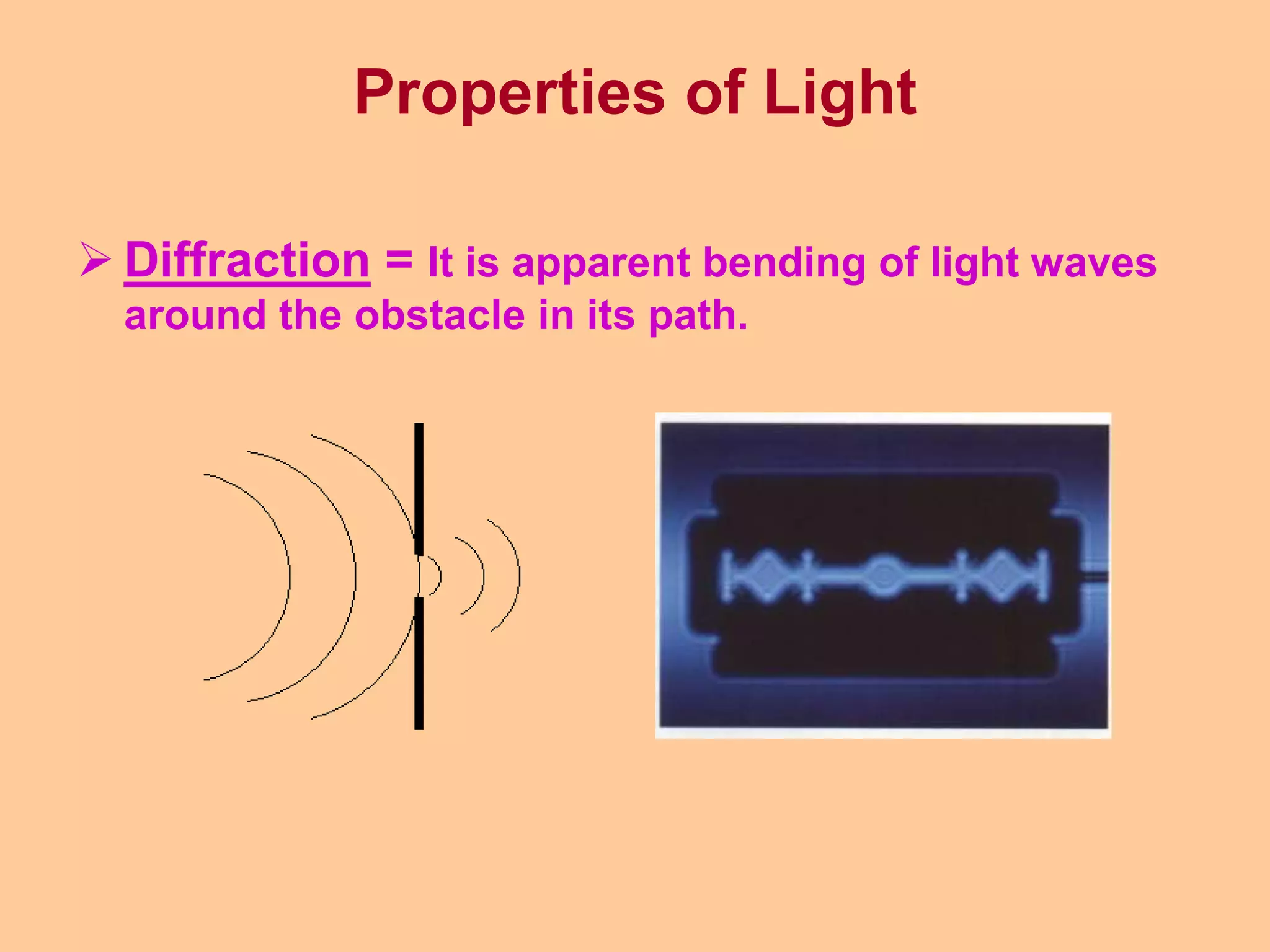
 Diffraction = It is apparent bending of light waves
around the obstacle in its path.
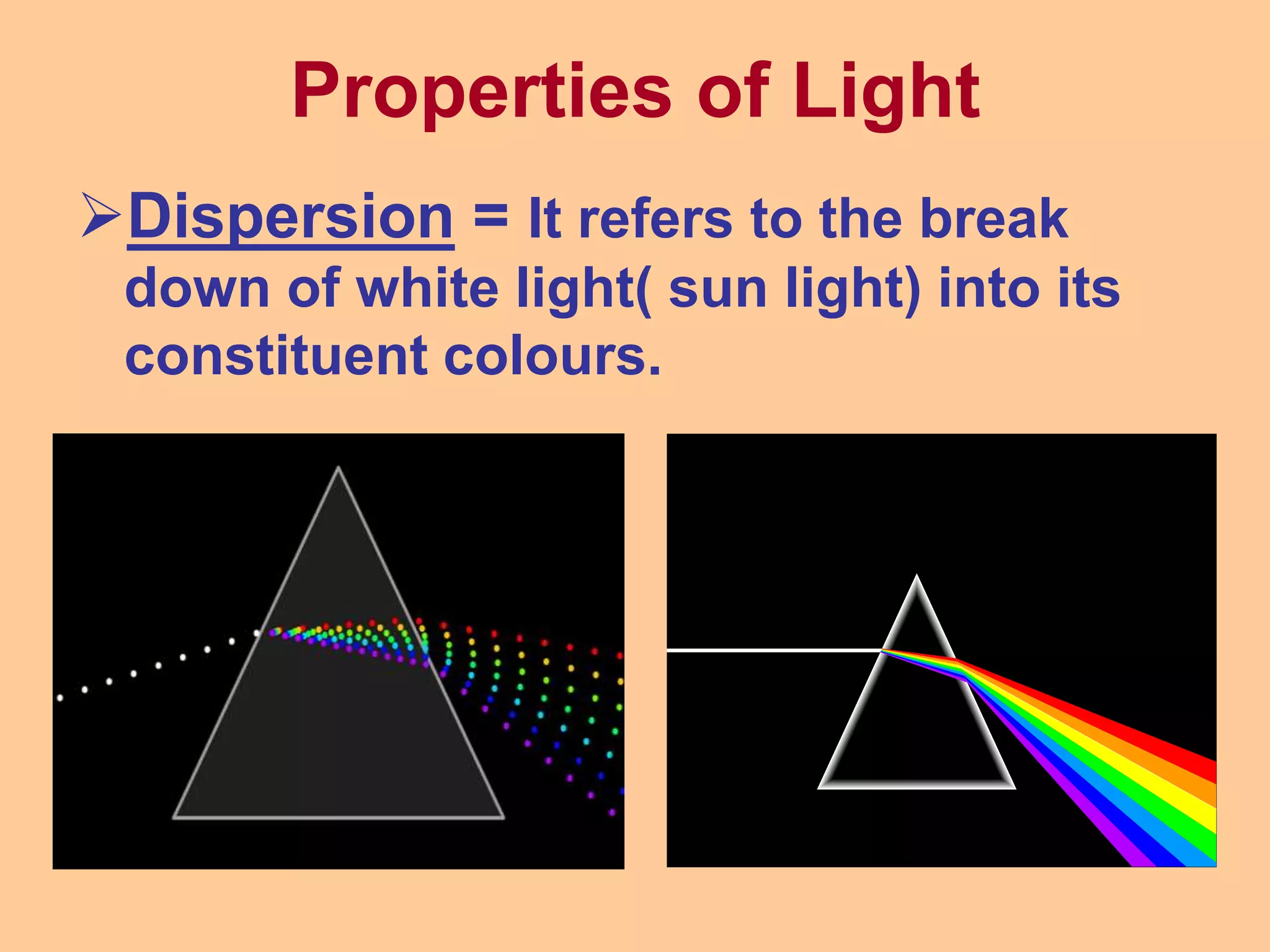
Dispersion = It refers to the break
down of white light( sun light) into its
constituent colours.
Properties of Light
Properties of Light
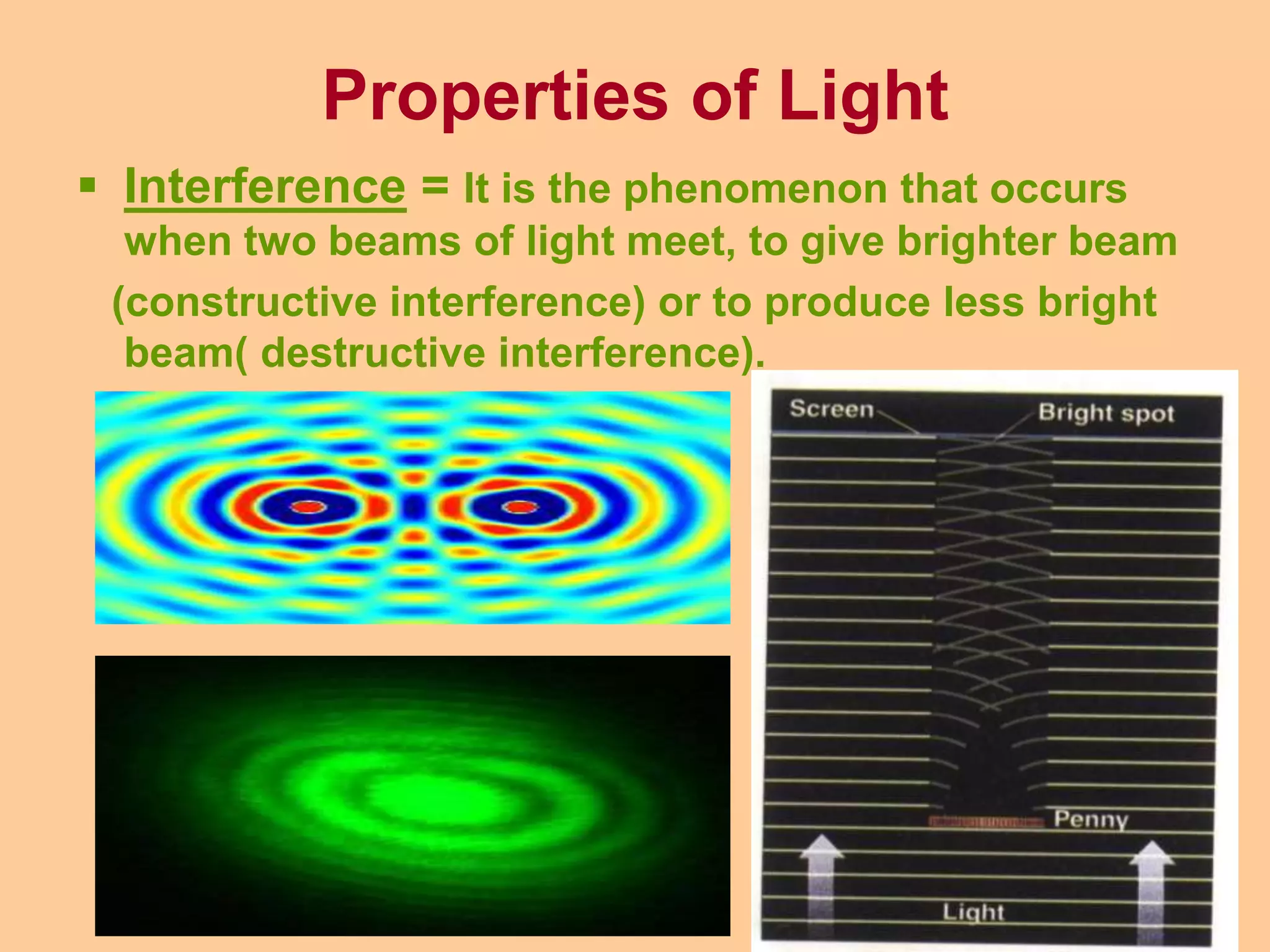
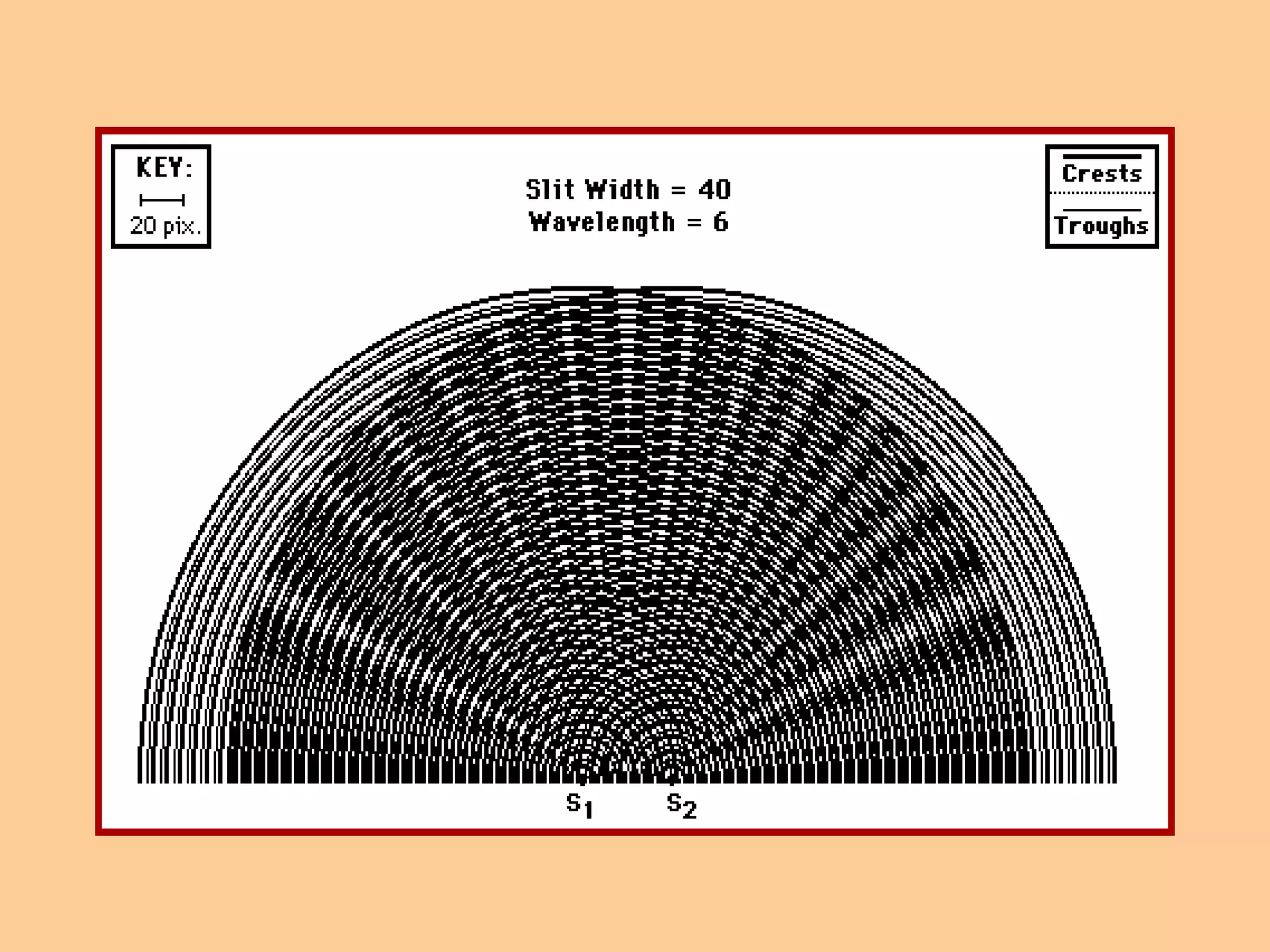
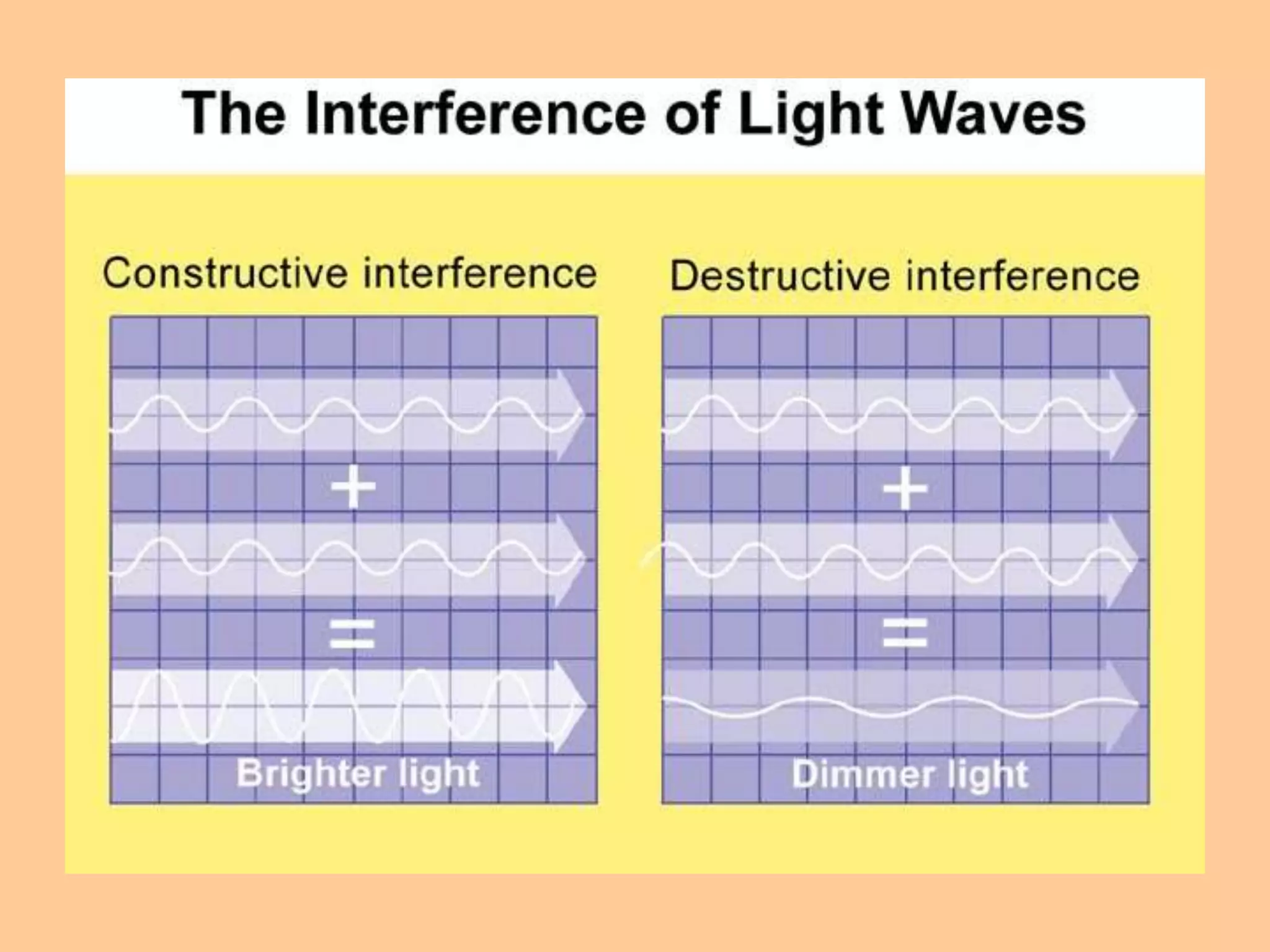
 Interference = It is the phenomenon that occurs
when two beams of light meet, to give brighter beam
(constructive interference) or to produce less bright
beam( destructive interference).
Properties of Light
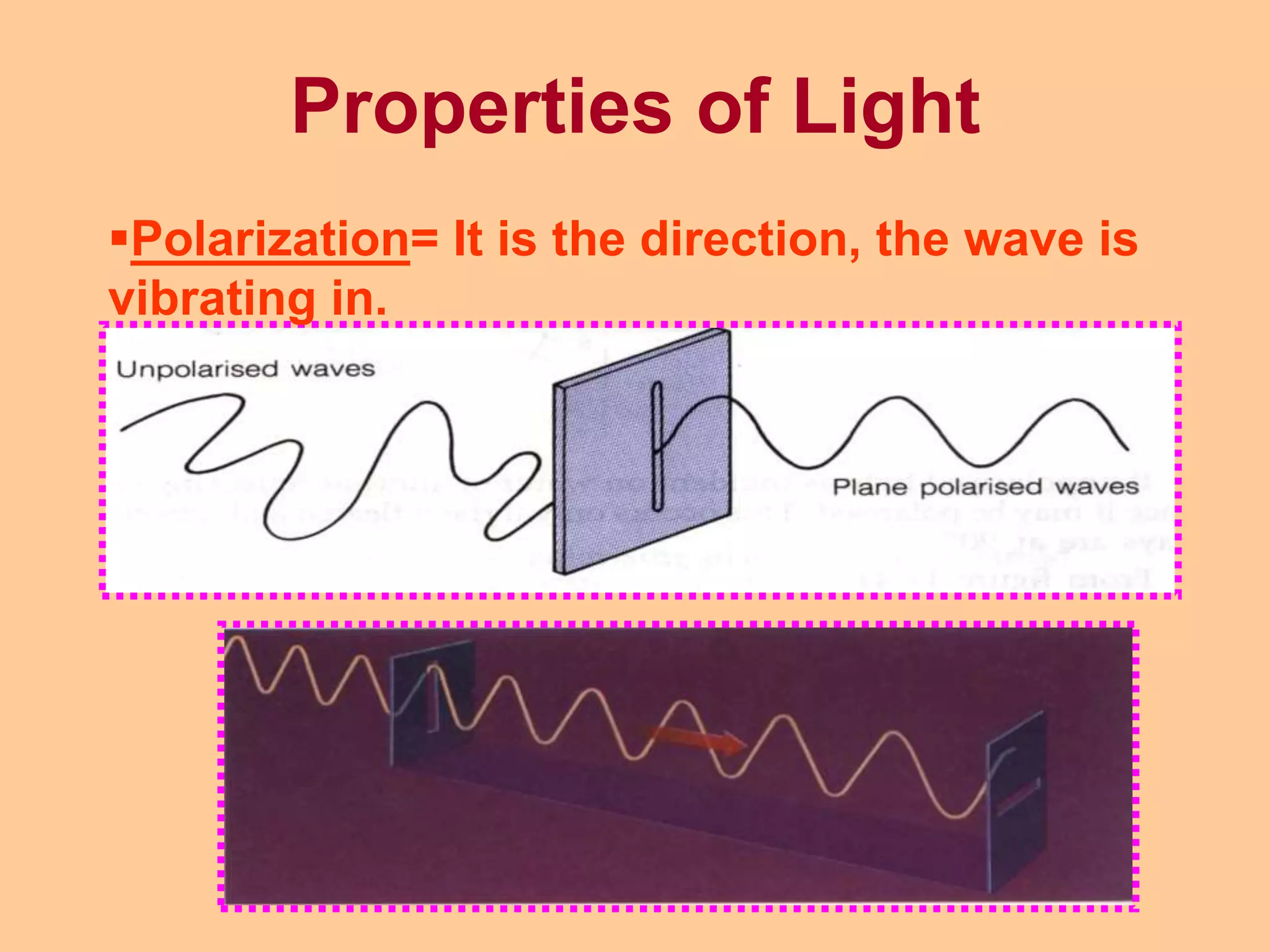
Polarization= It is the direction, the wave is
vibrating in.
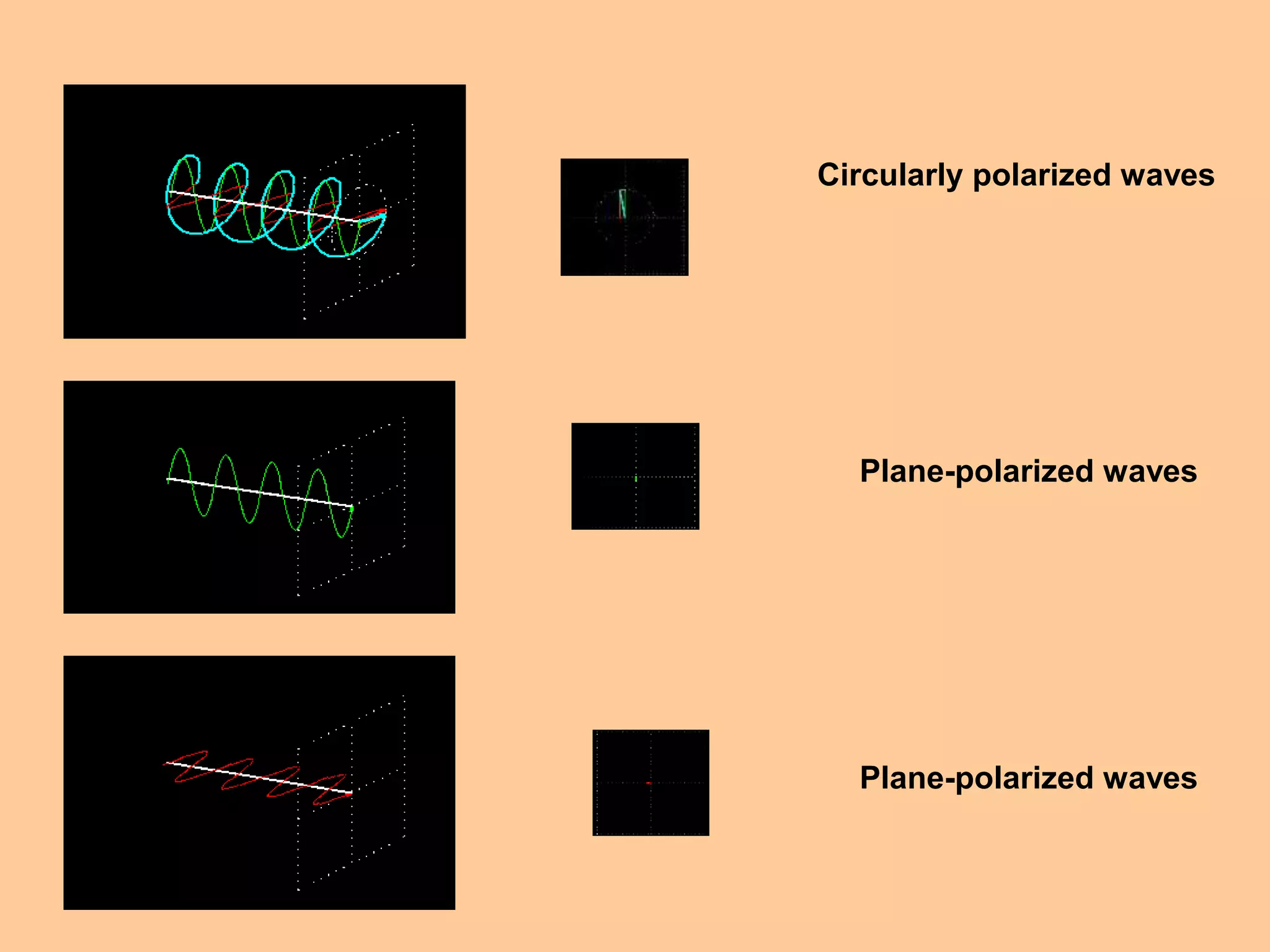
Plane-polarized waves
Circularly polarized waves
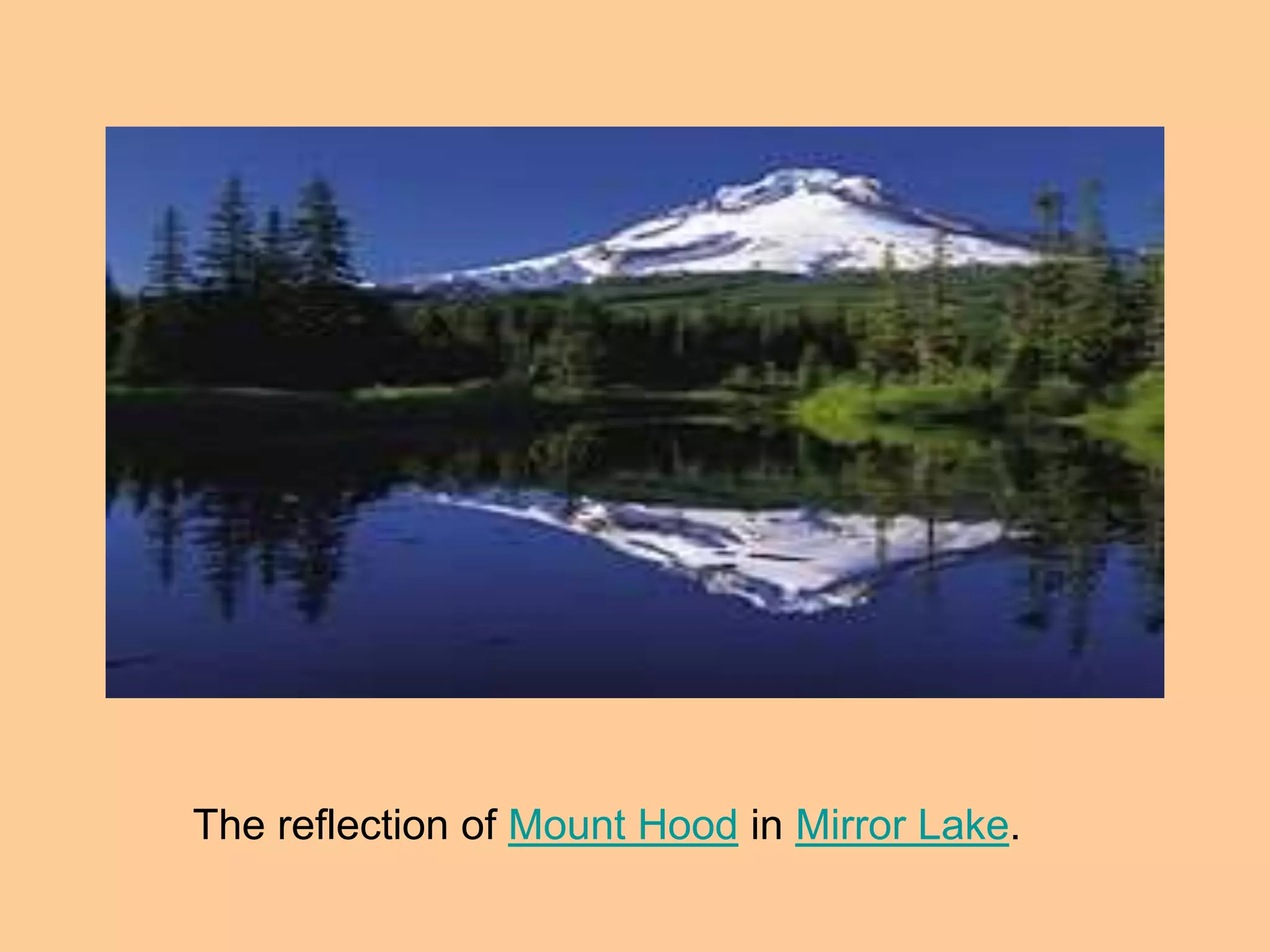
The reflection of Mount Hood in Mirror Lake.
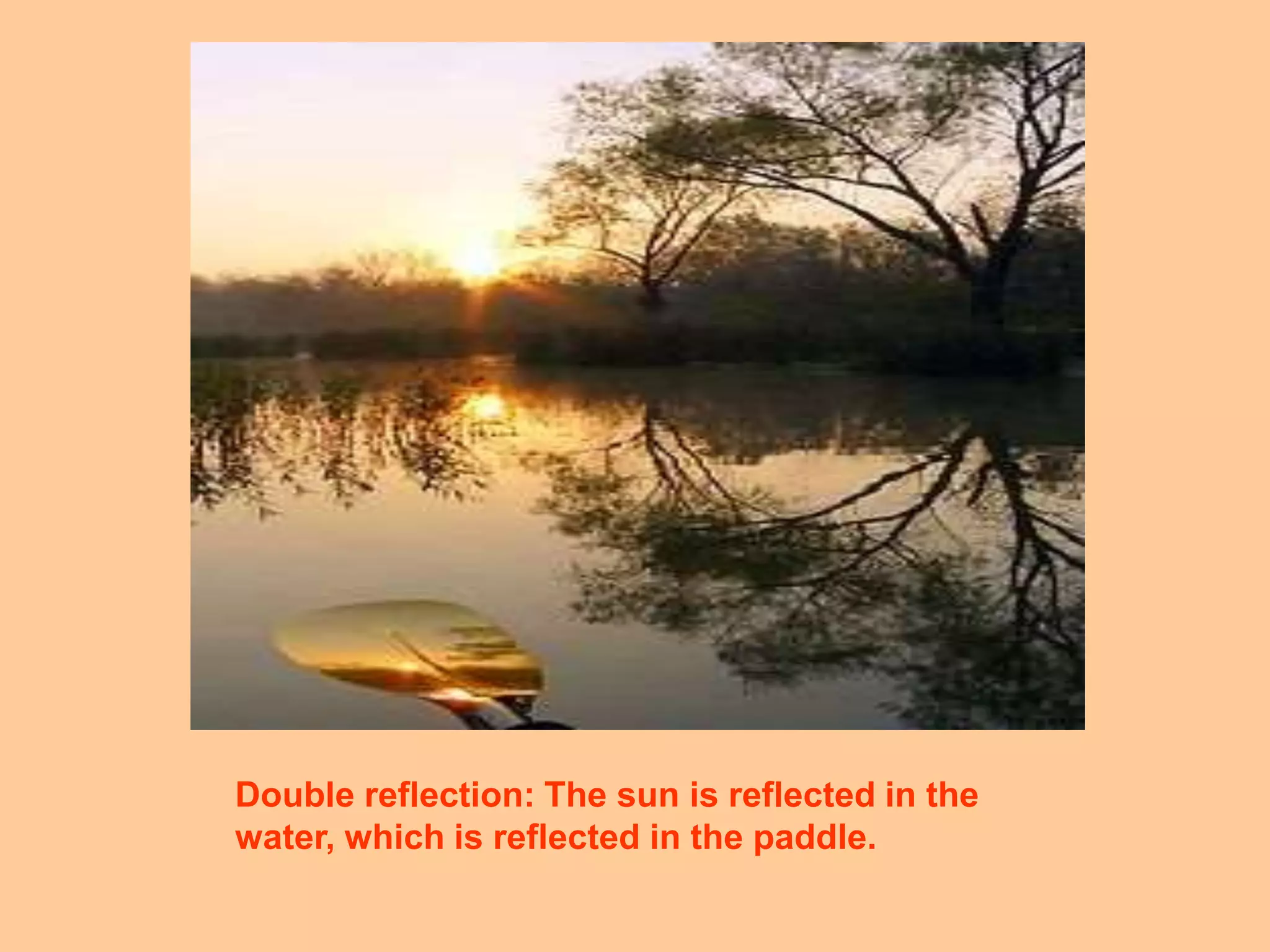
Double reflection: The sun is reflected in the
water, which is reflected in the paddle.
Reflection Of Light
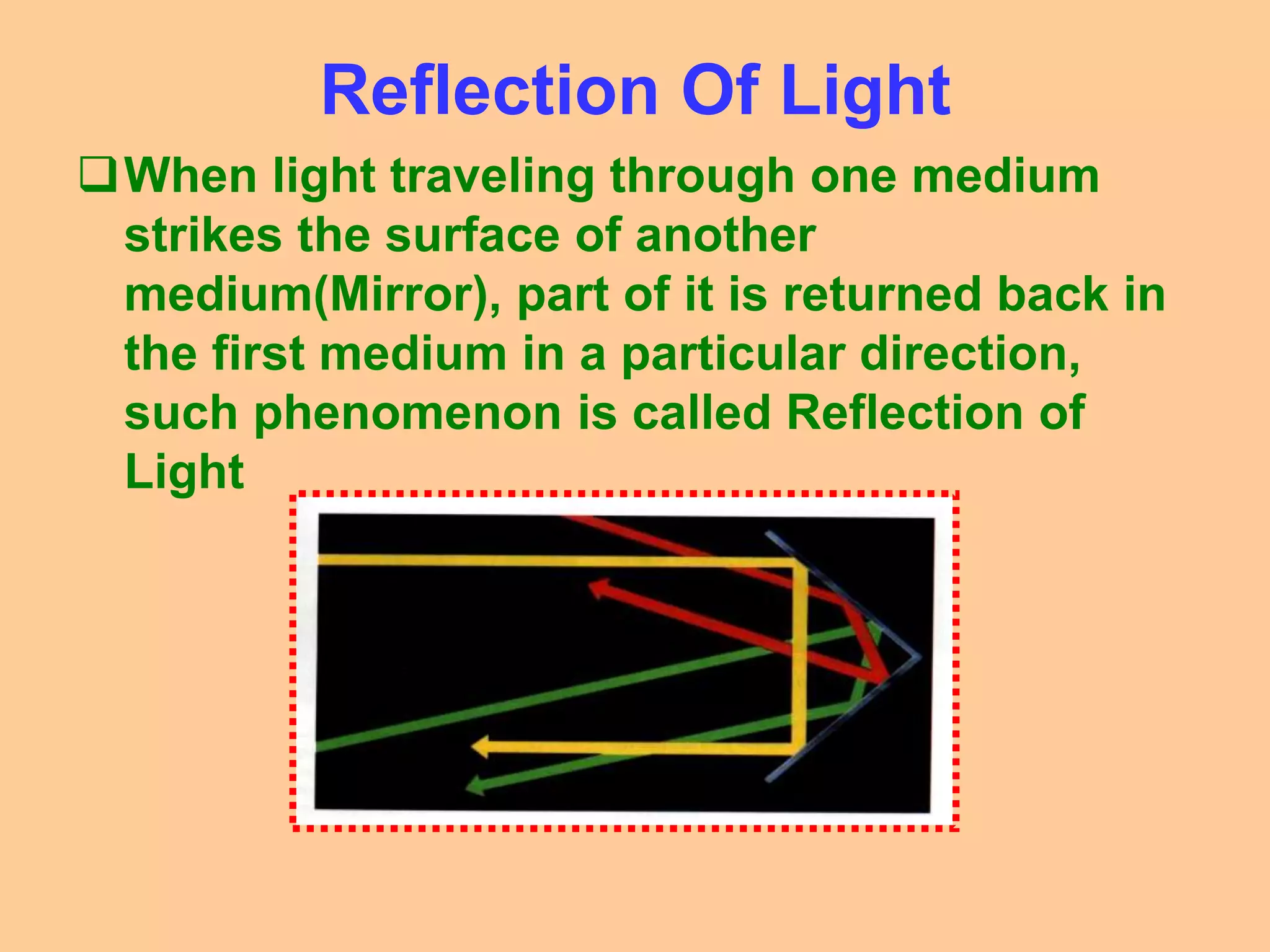
When light traveling through one medium
strikes the surface of another
medium(Mirror), part of it is returned back in
the first medium in a particular direction,
such phenomenon is called Reflection of
Light
Regular Reflection Or Specular
Reflection
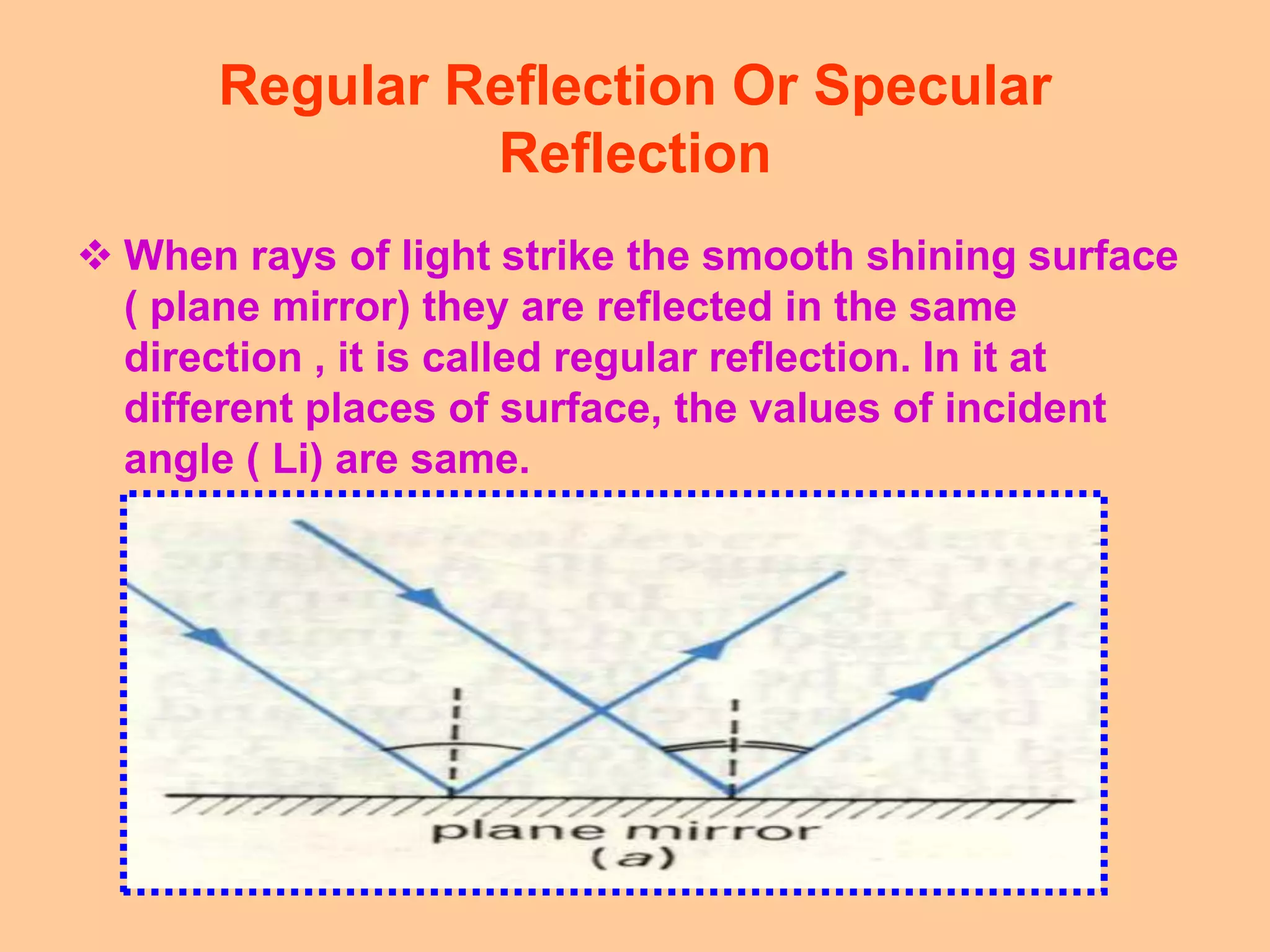
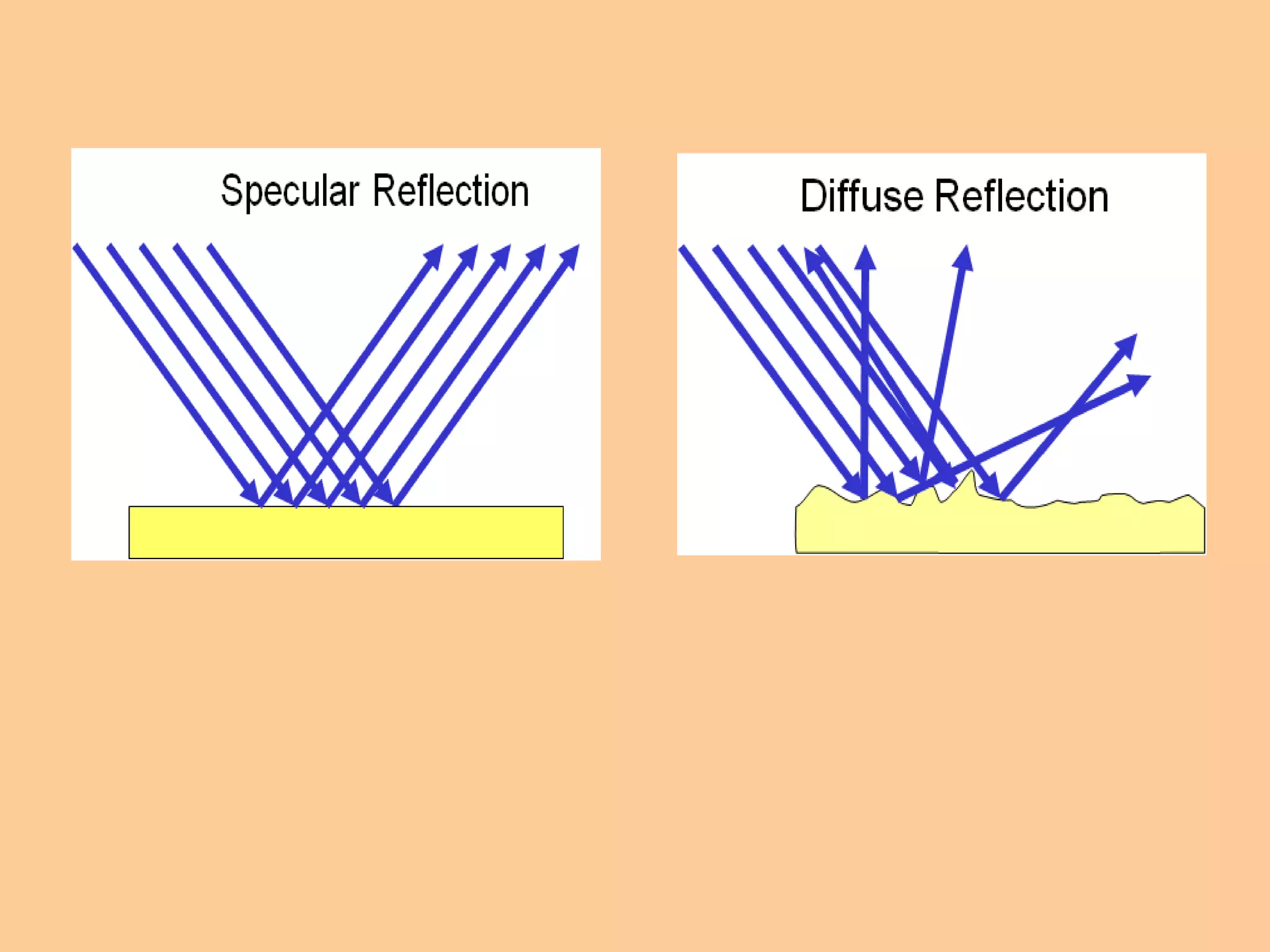
 When rays of light strike the smooth shining surface
( plane mirror) they are reflected in the same
direction , it is called regular reflection. In it at
different places of surface, the values of incident
angle ( Li) are same.
Irregular Reflection Or Diffused
Reflection
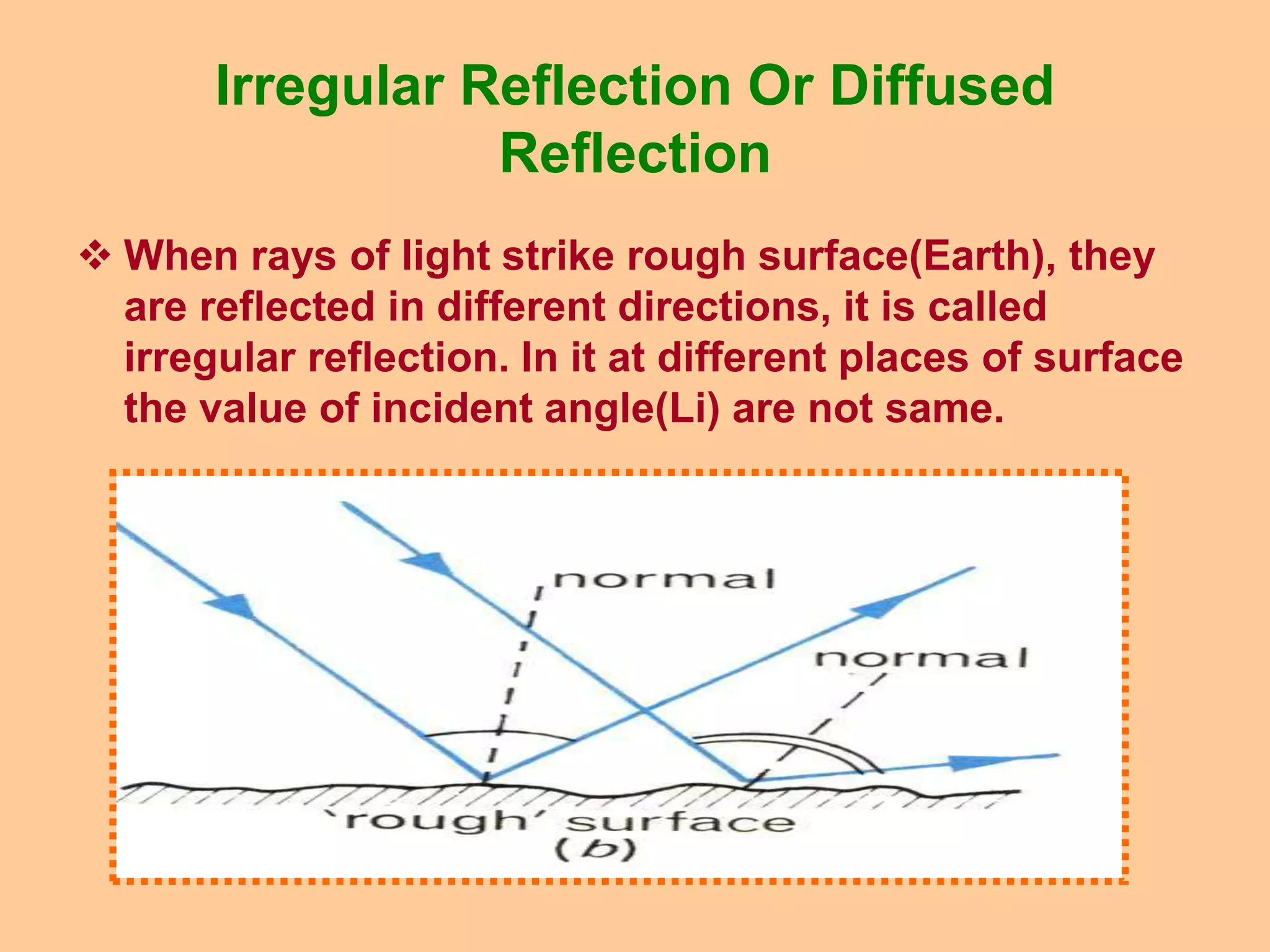
 When rays of light strike rough surface(Earth), they
are reflected in different directions, it is called
irregular reflection. In it at different places of surface
the value of incident angle(Li) are not same.
Laws Of Reflection Of Light
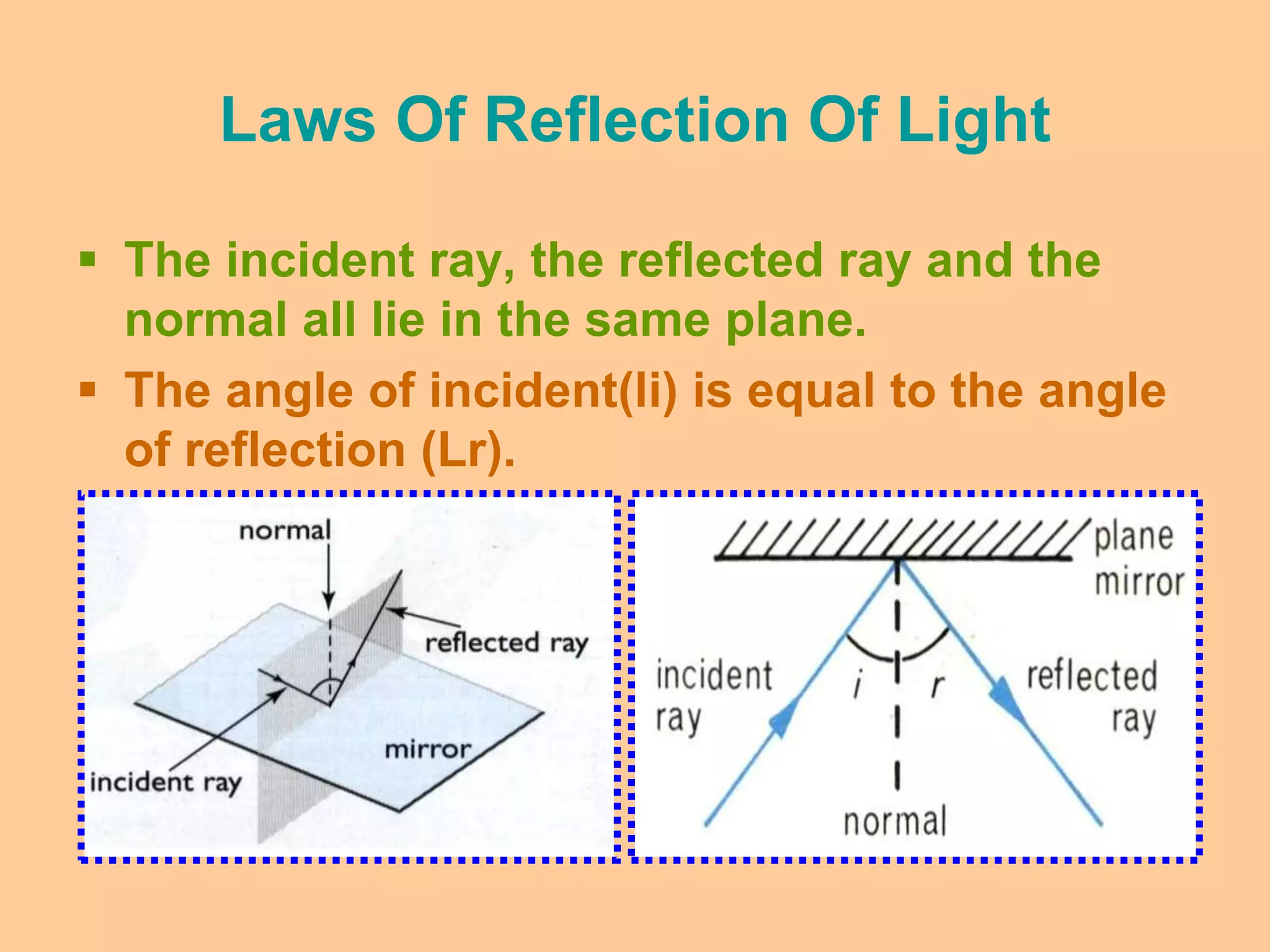
 The incident ray, the reflected ray and the
normal all lie in the same plane.
 The angle of incident(li) is equal to the angle
of reflection (Lr).
Position & Nature Of Image Formed By Plane
Mirror
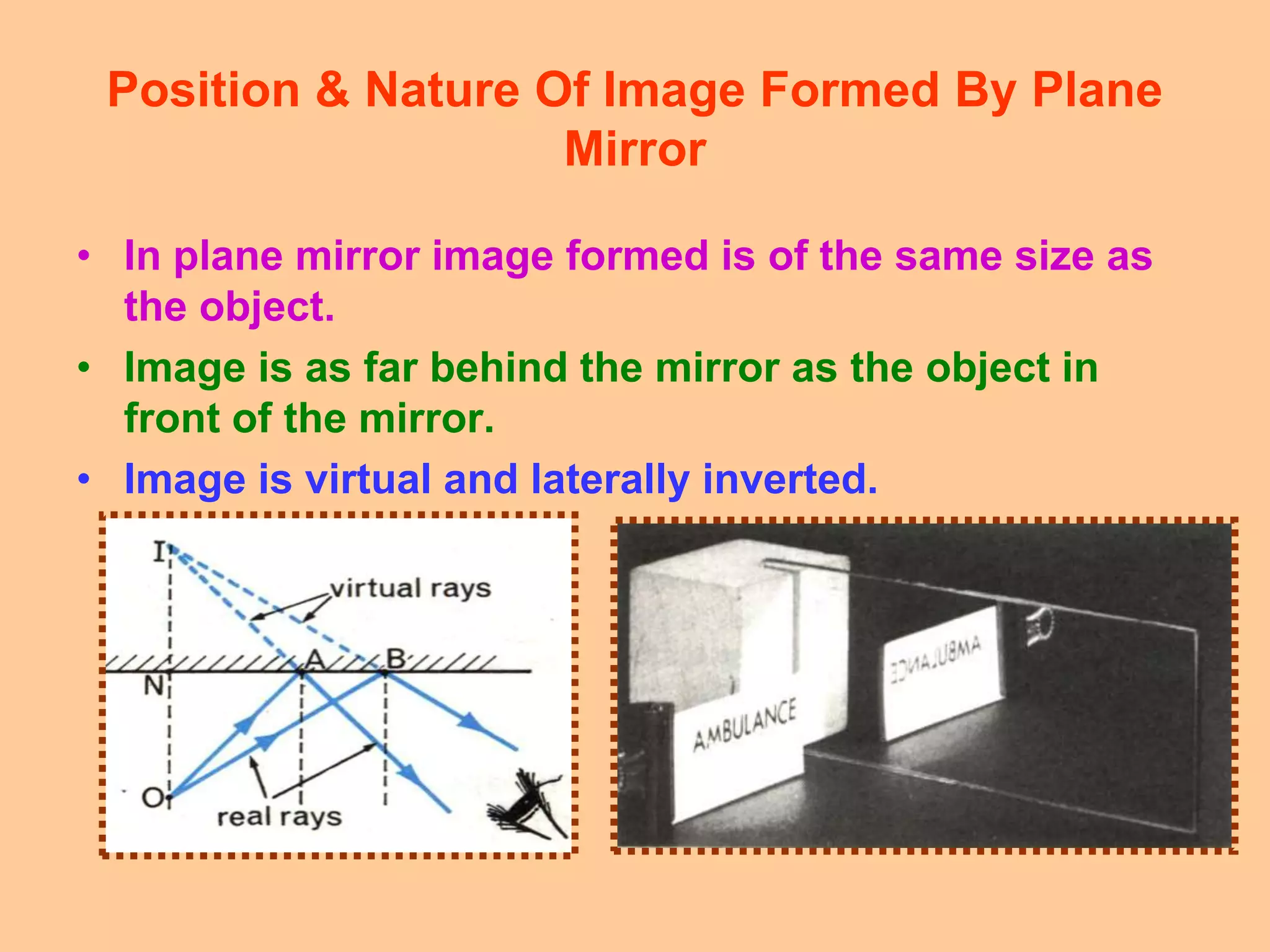
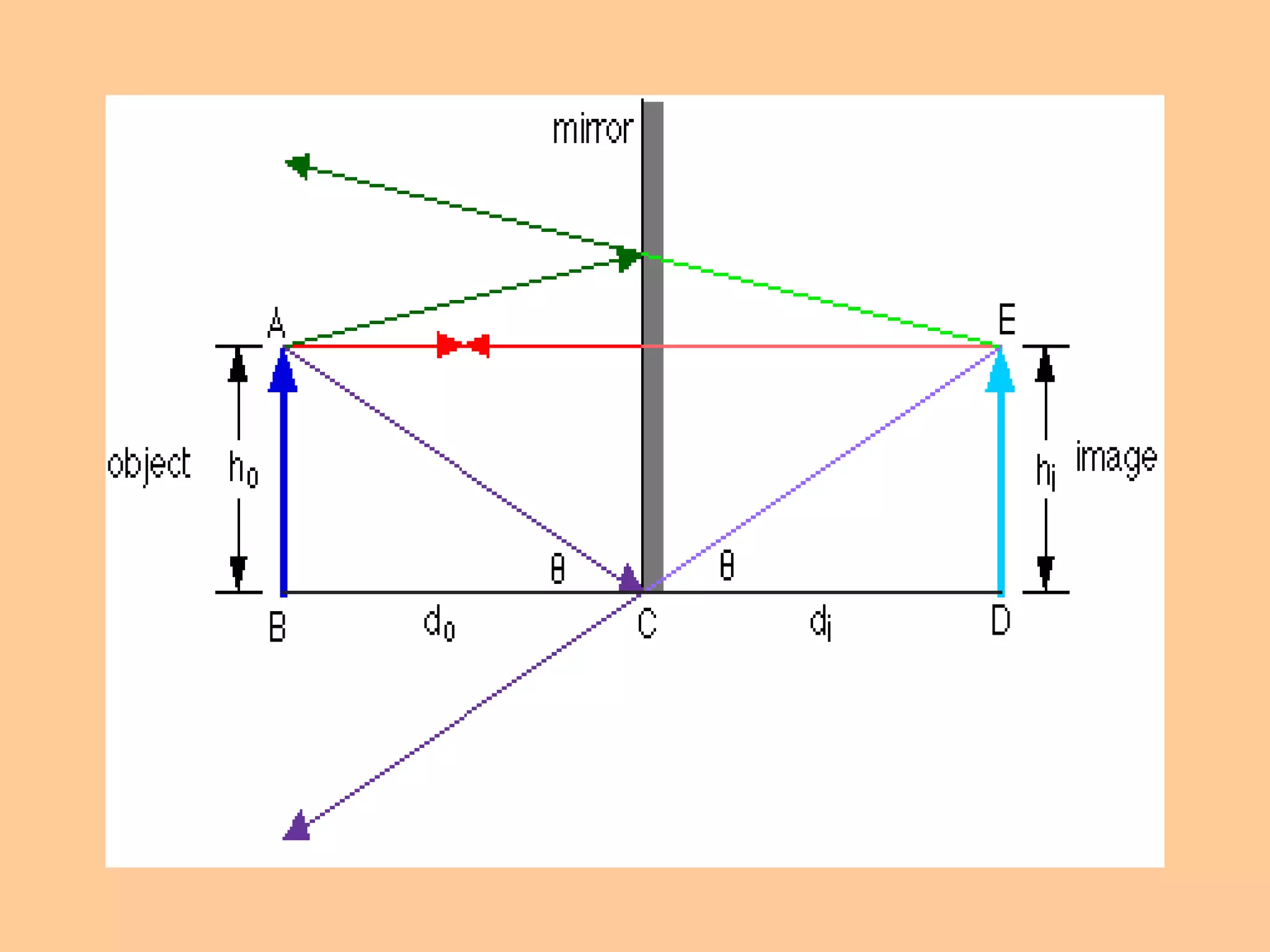
• In plane mirror image formed is of the same size as
the object.
• Image is as far behind the mirror as the object in
front of the mirror.
• Image is virtual and laterally inverted.
Applications Of Plane Mirror
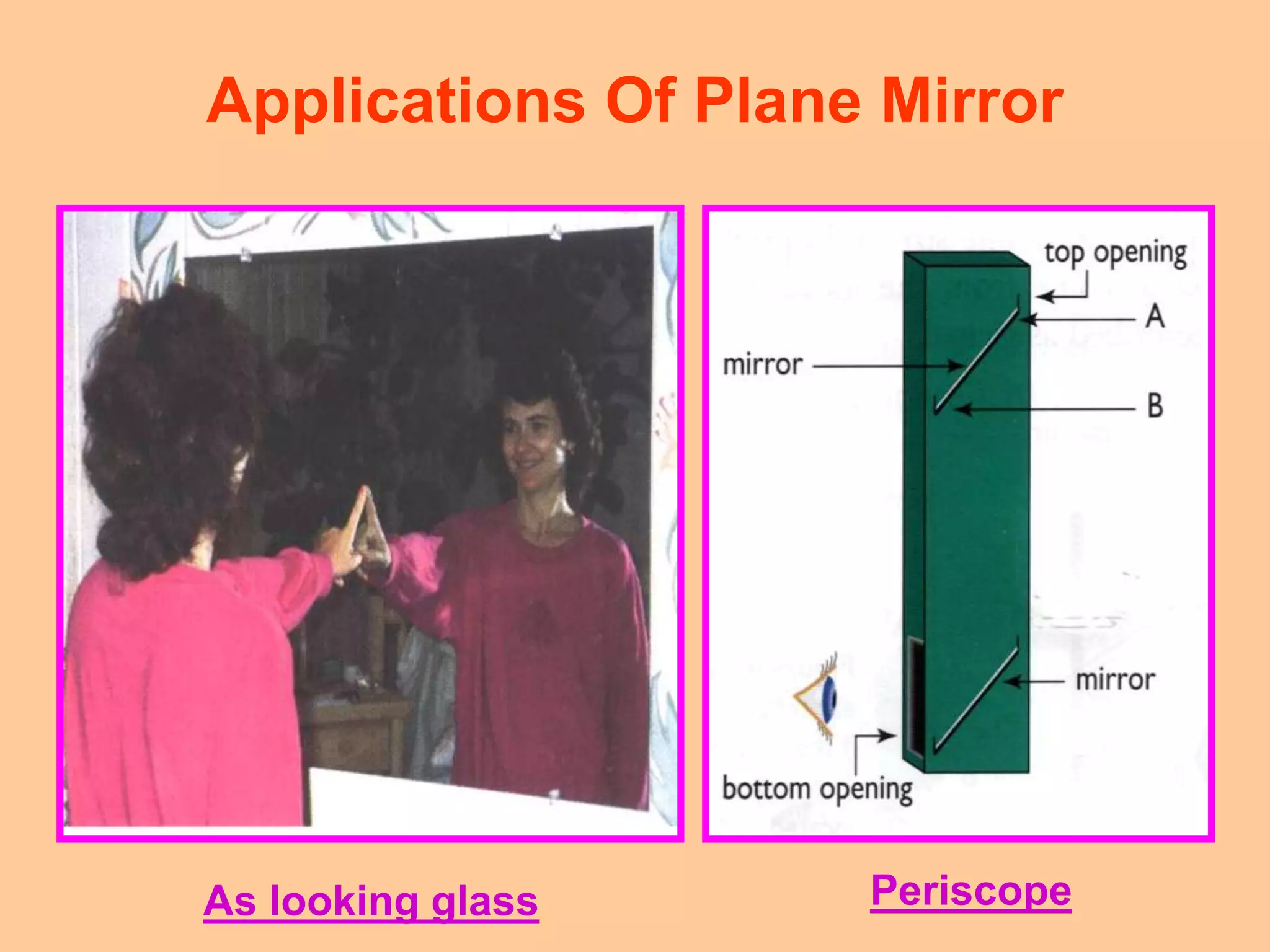
• It is used as a looking glass.
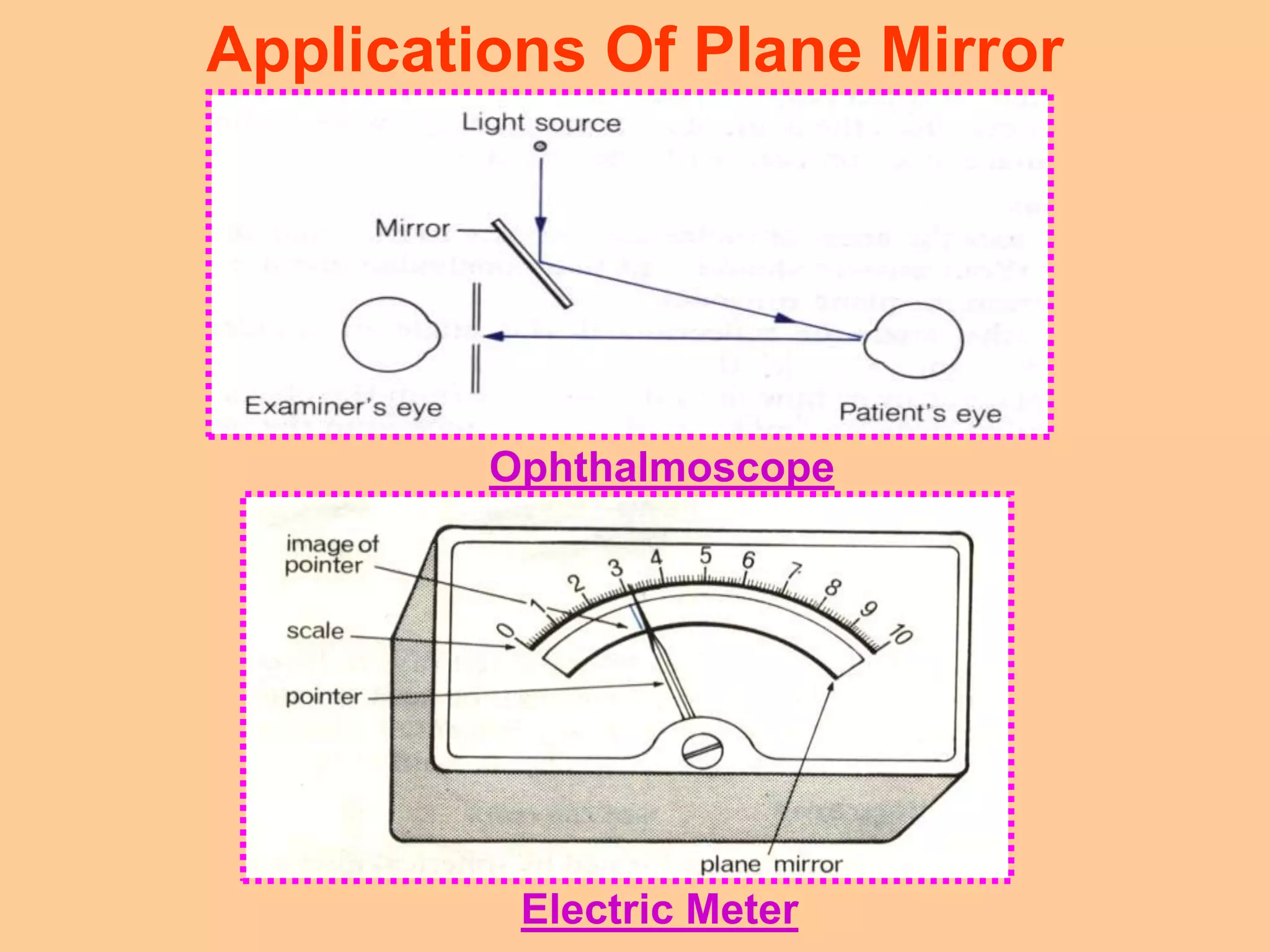
• In the field of medicine, it is used by
Dentists and Ophthalmic surgeons.
• It is used in electric meters, in special
head lights, light microscopes,
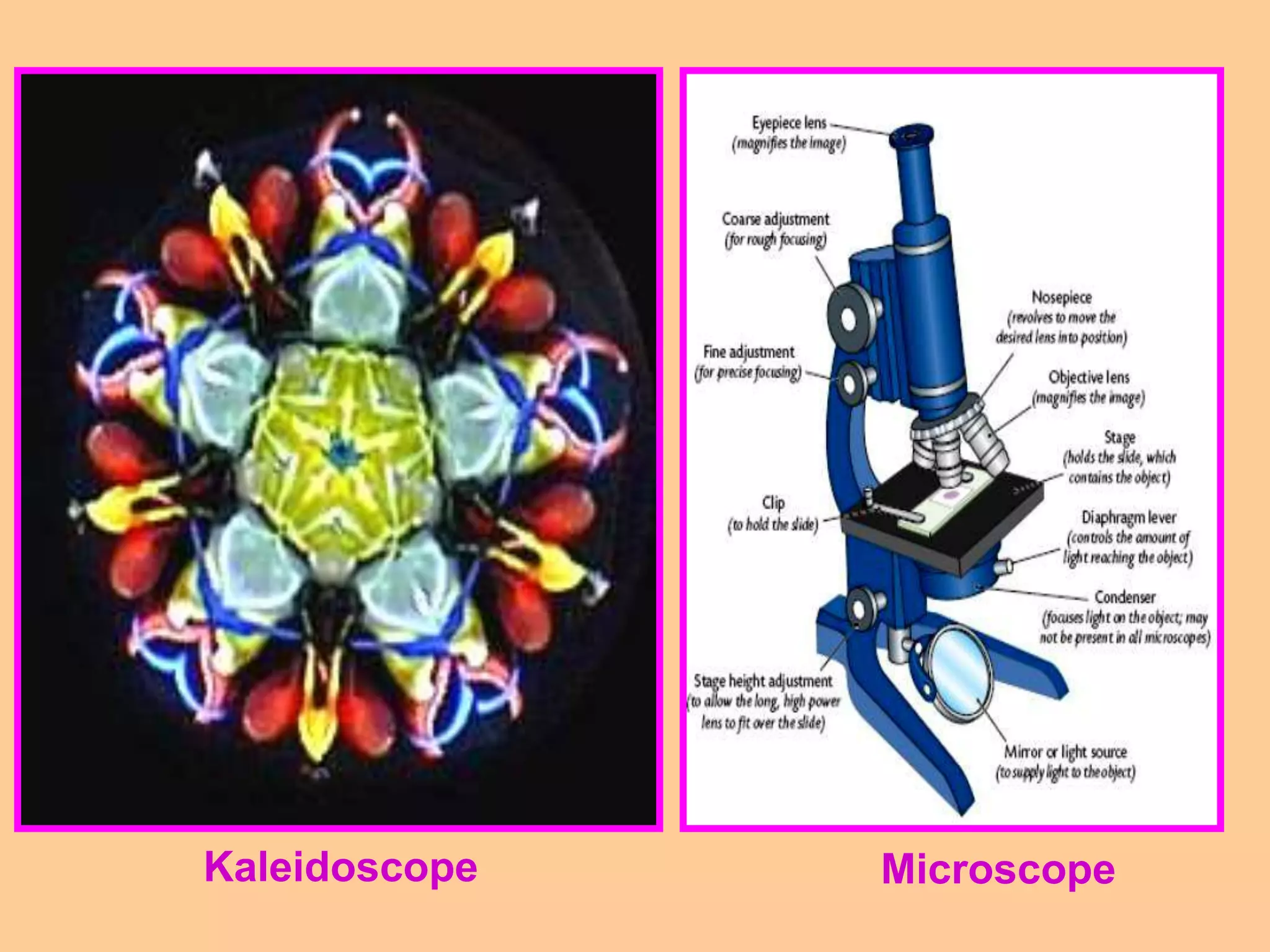
periscope and kaleidoscope.
Applications Of Plane Mirror
As looking glass Periscope
Kaleidoscope Microscope
Applications Of Plane Mirror
Ophthalmoscope
Electric Meter
Applications Of Plane Mirror
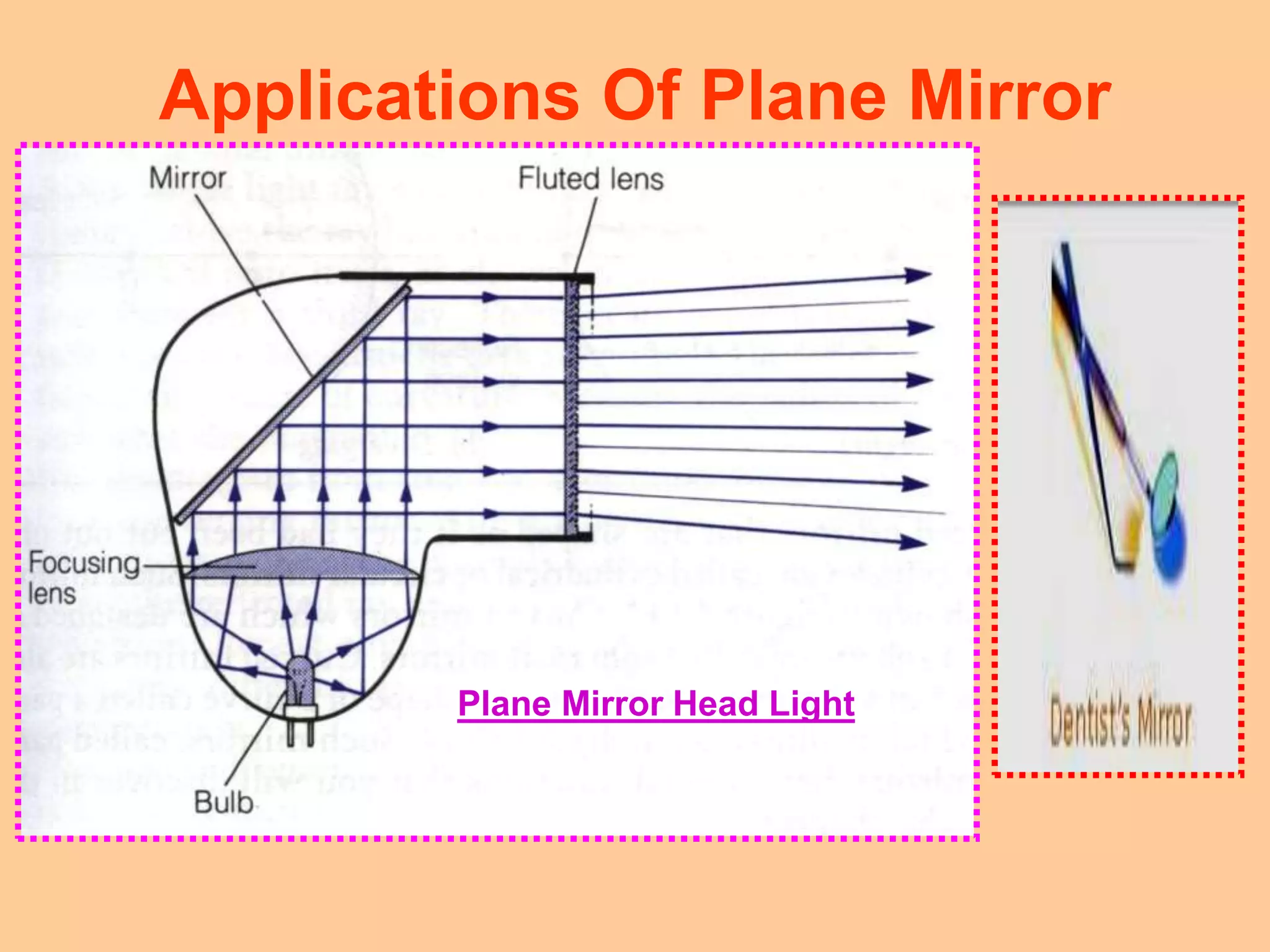
Plane Mirror Head Light
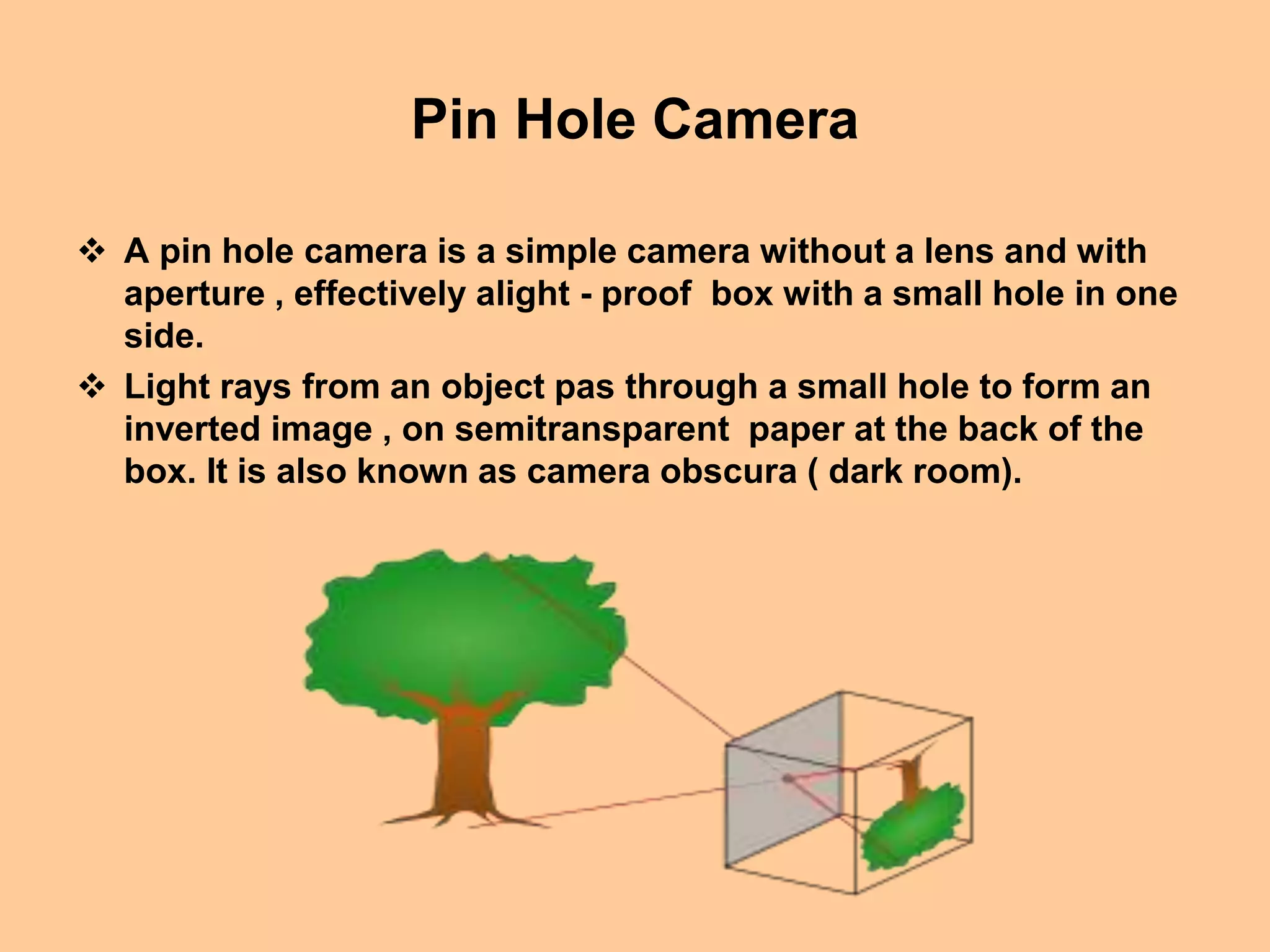
Pin Hole Camera
 A pin hole camera is a simple camera without a lens and with
aperture , effectively alight - proof box with a small hole in one
side.
 Light rays from an object pas through a small hole to form an
inverted image , on semitransparent paper at the back of the
box. It is also known as camera obscura ( dark room).
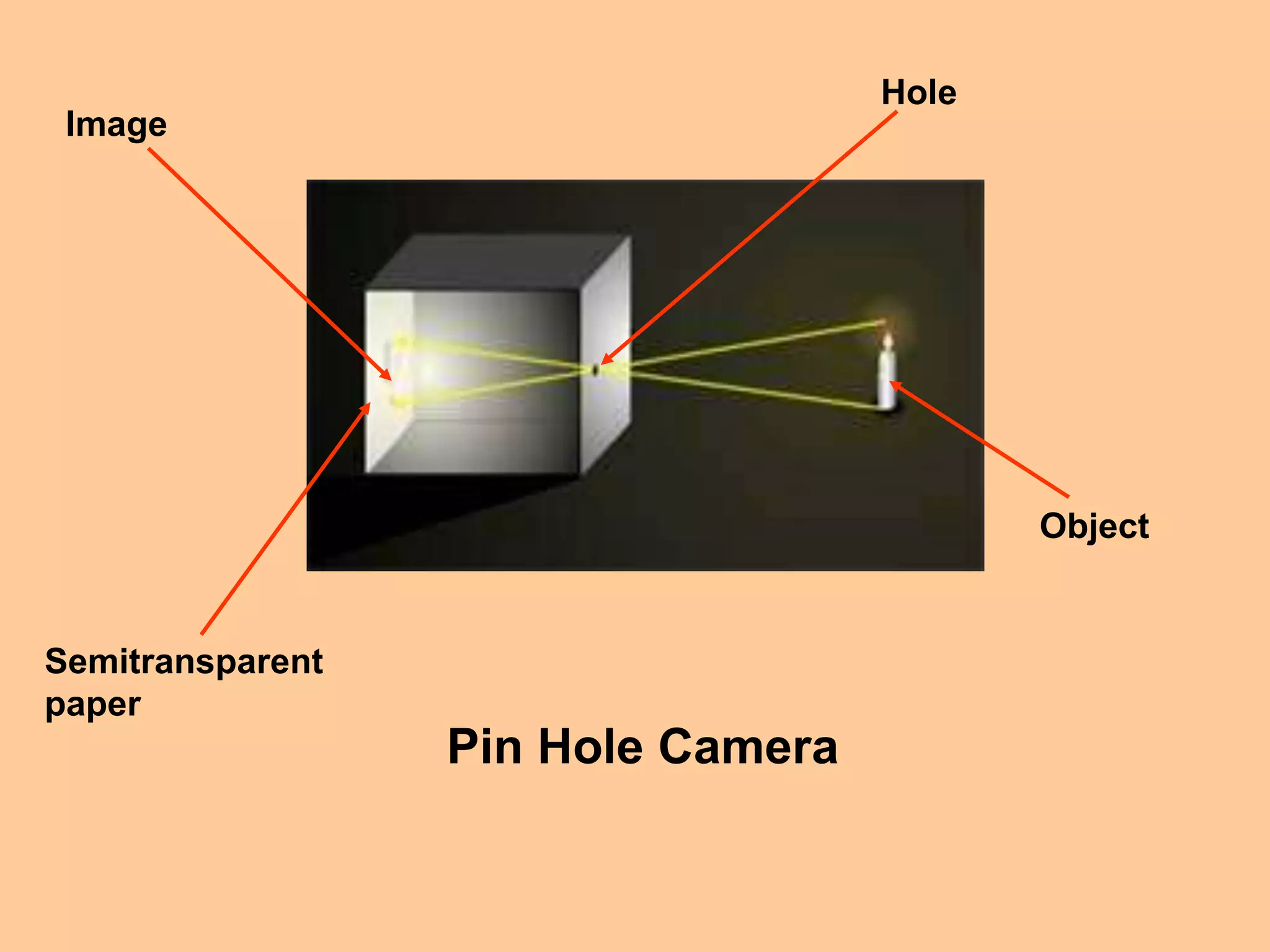
Pin Hole Camera
Hole
Image
Semitransparent
paper
Object
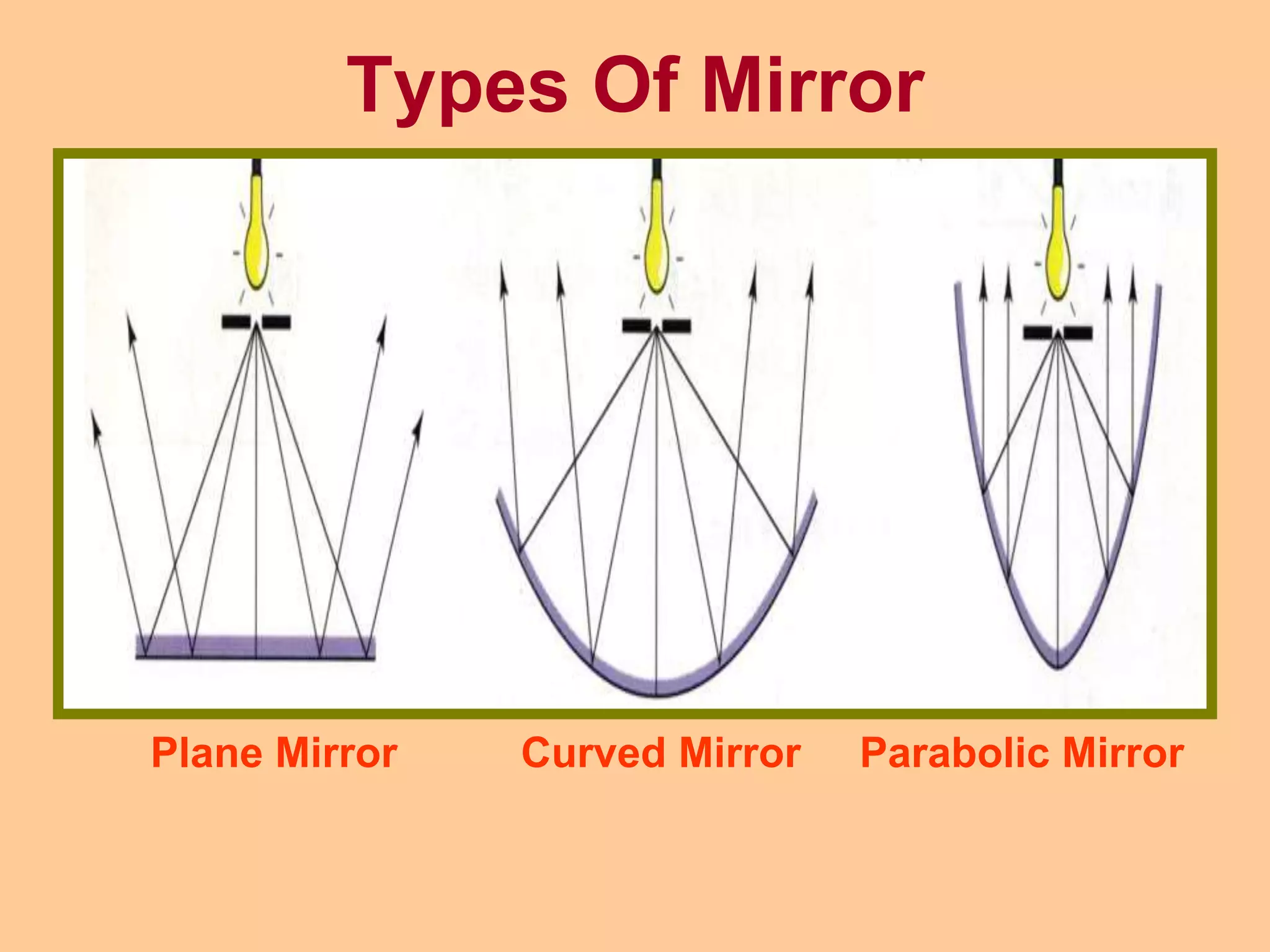
Types Of Mirror
Plane Mirror Curved Mirror Parabolic Mirror
Spherical Mirror
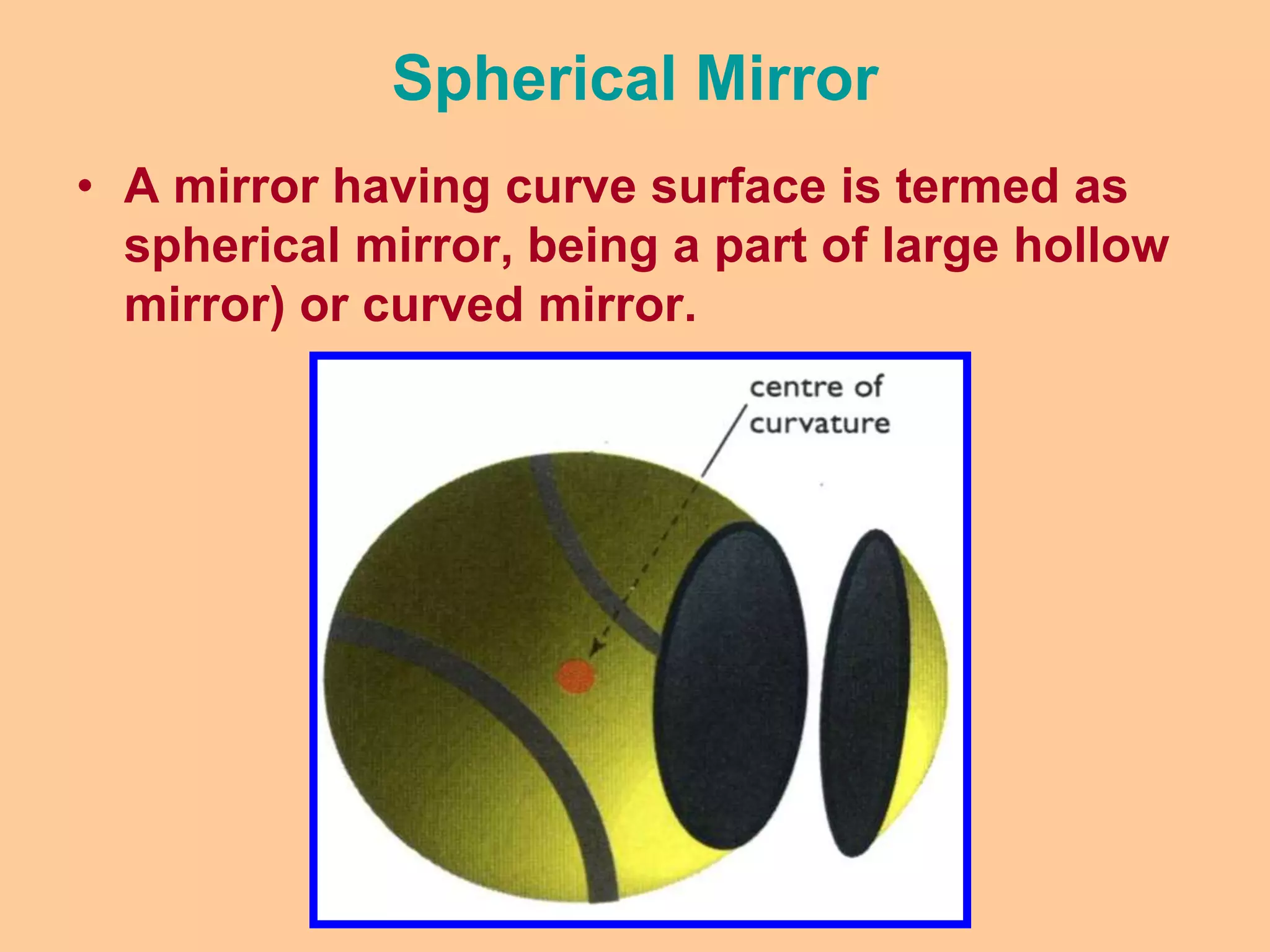
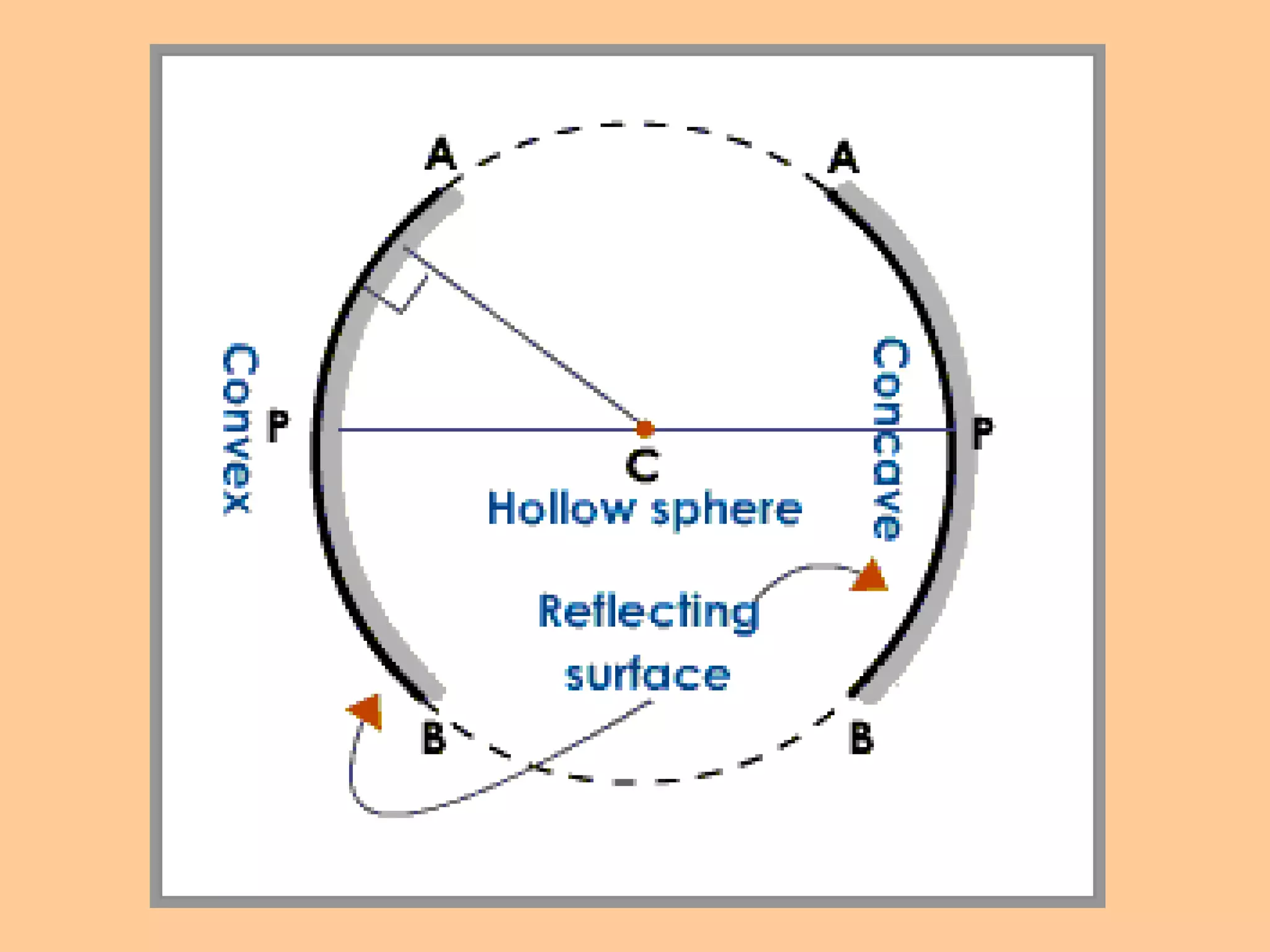
• A mirror having curve surface is termed as
spherical mirror, being a part of large hollow
mirror) or curved mirror.
Types Of Spherical Mirrors
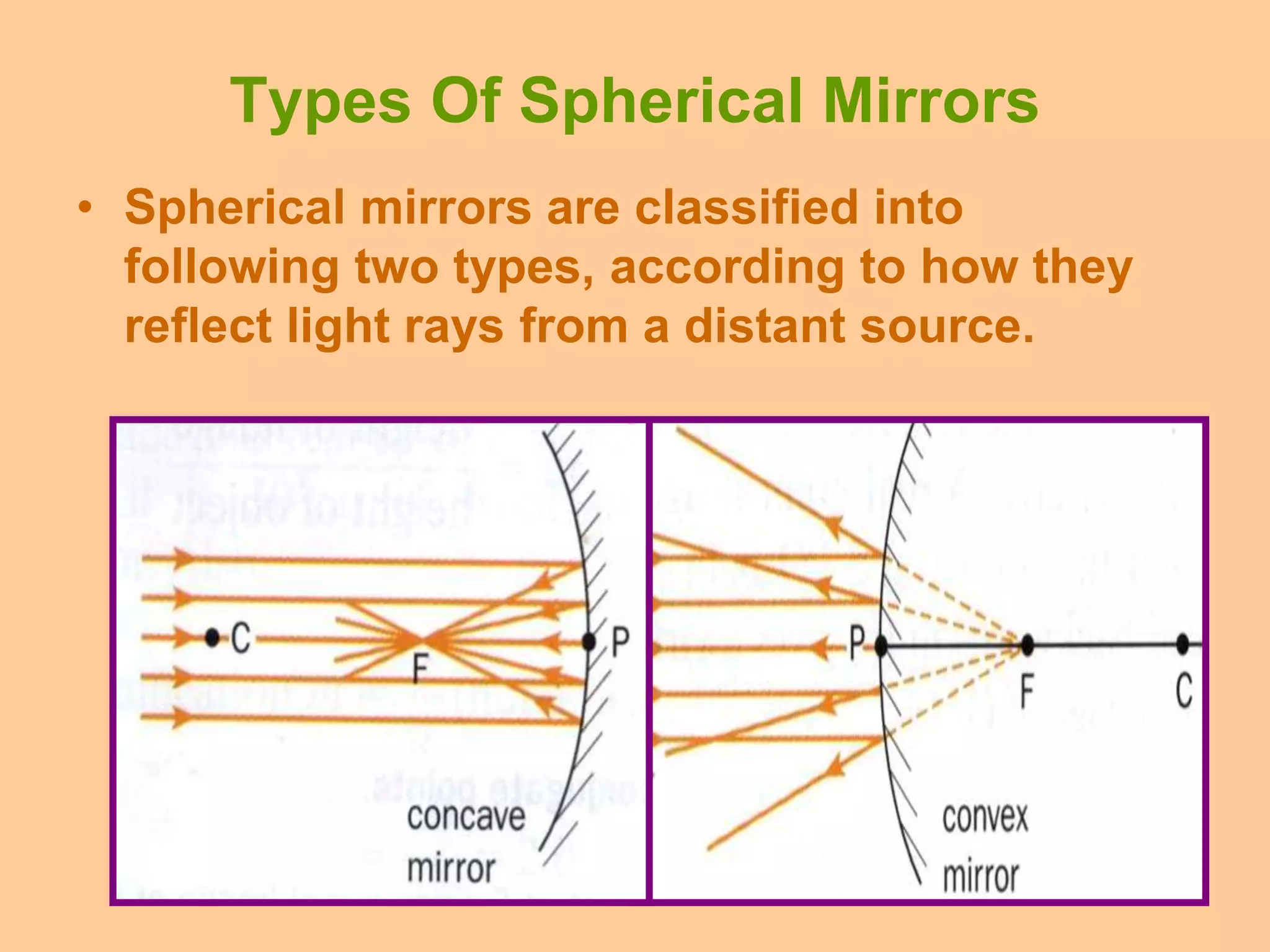
• Spherical mirrors are classified into
following two types, according to how they
reflect light rays from a distant source.
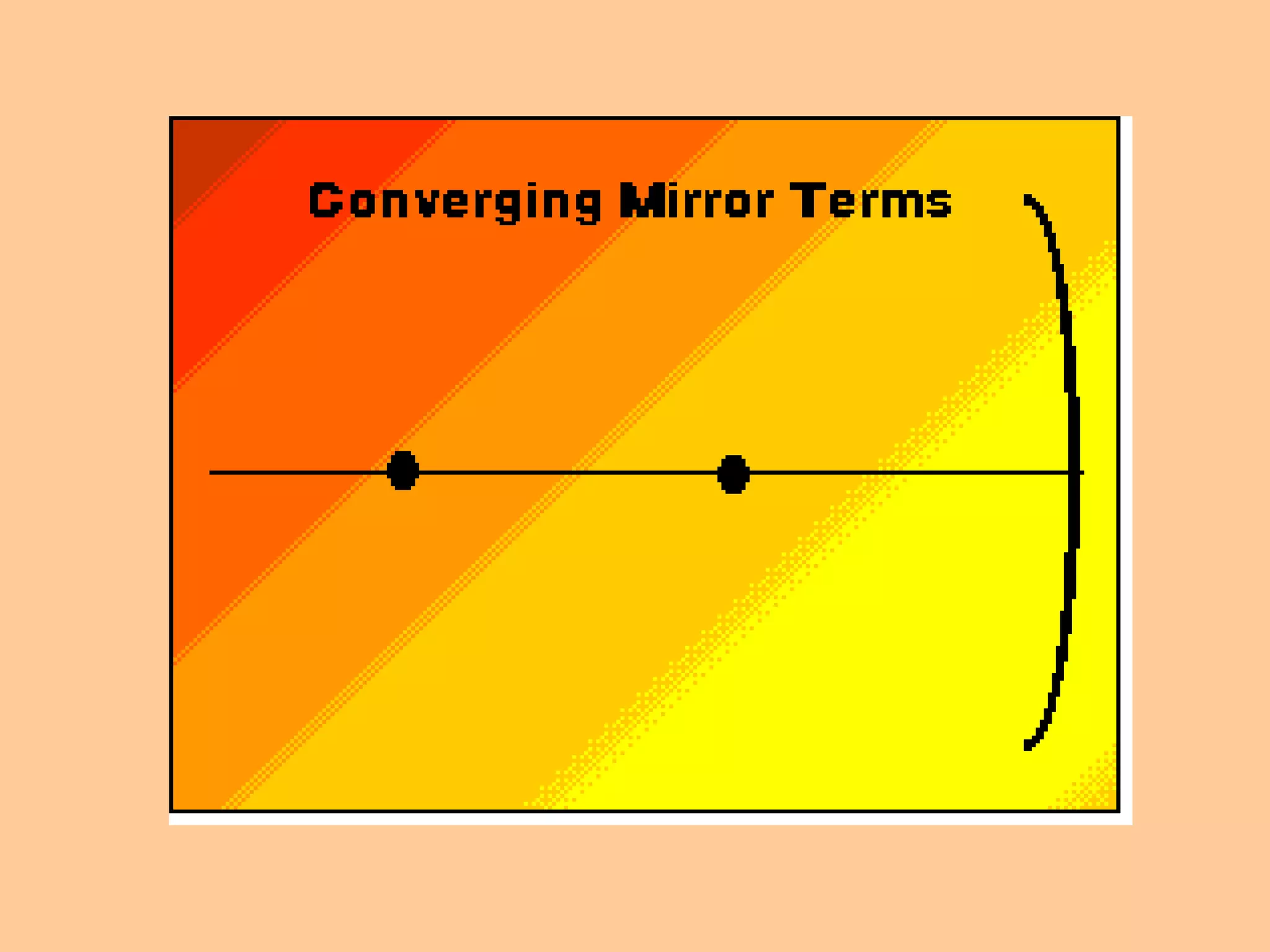
Terms Used In Spherical mirror
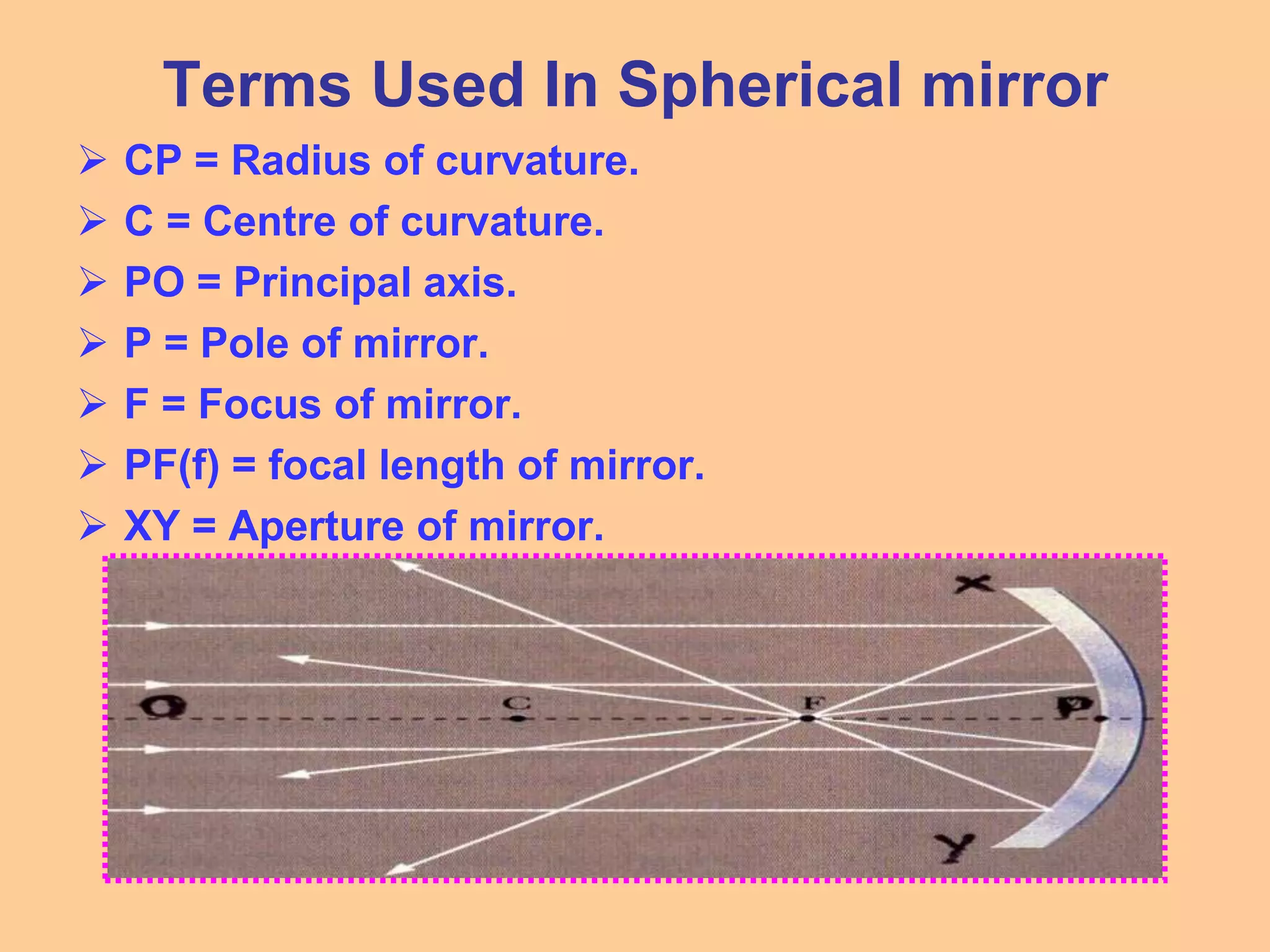
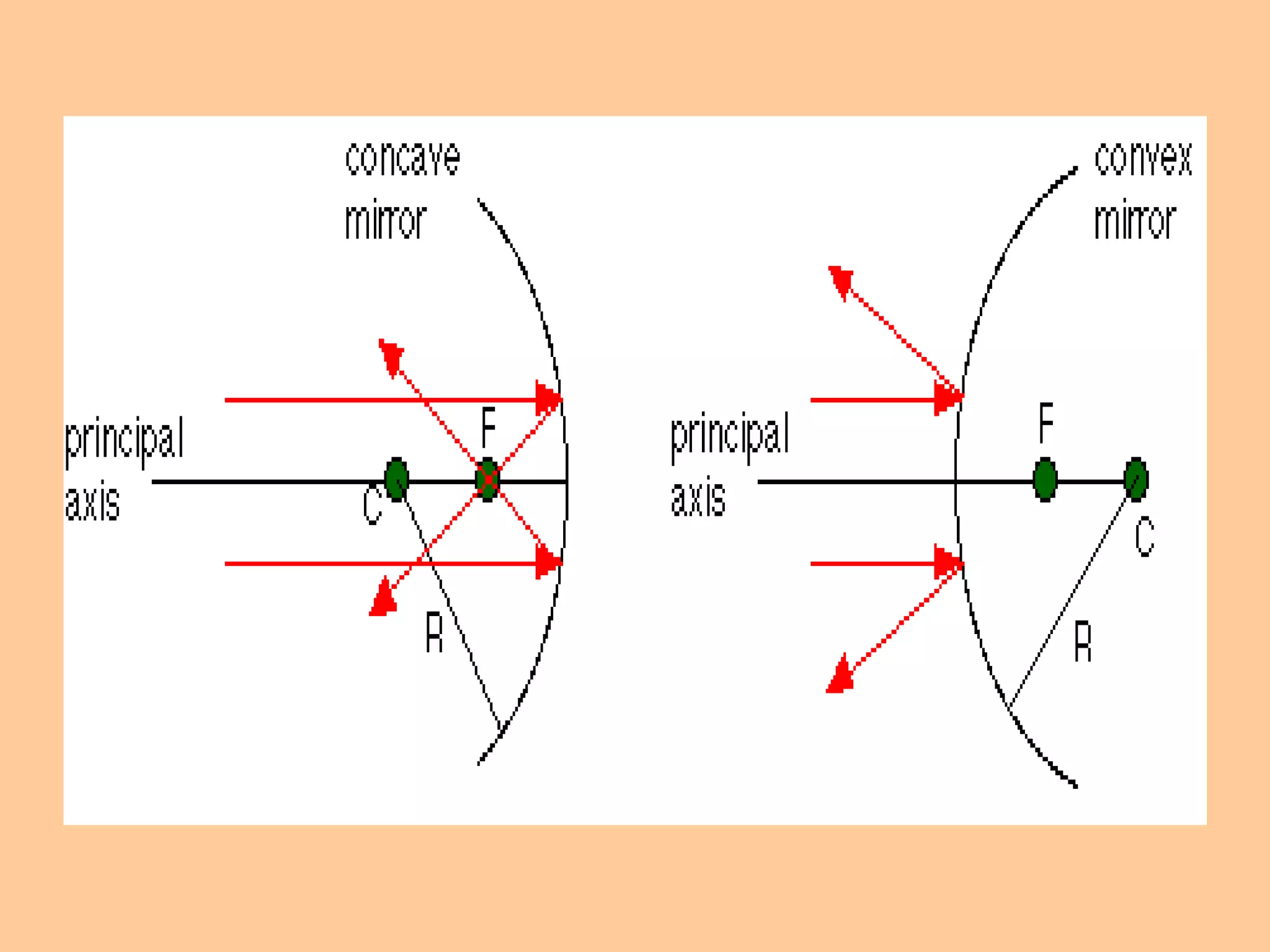
 CP = Radius of curvature.
 C = Centre of curvature.
 PO = Principal axis.
 P = Pole of mirror.
 F = Focus of mirror.
 PF(f) = focal length of mirror.
 XY = Aperture of mirror.
Concave Mirror
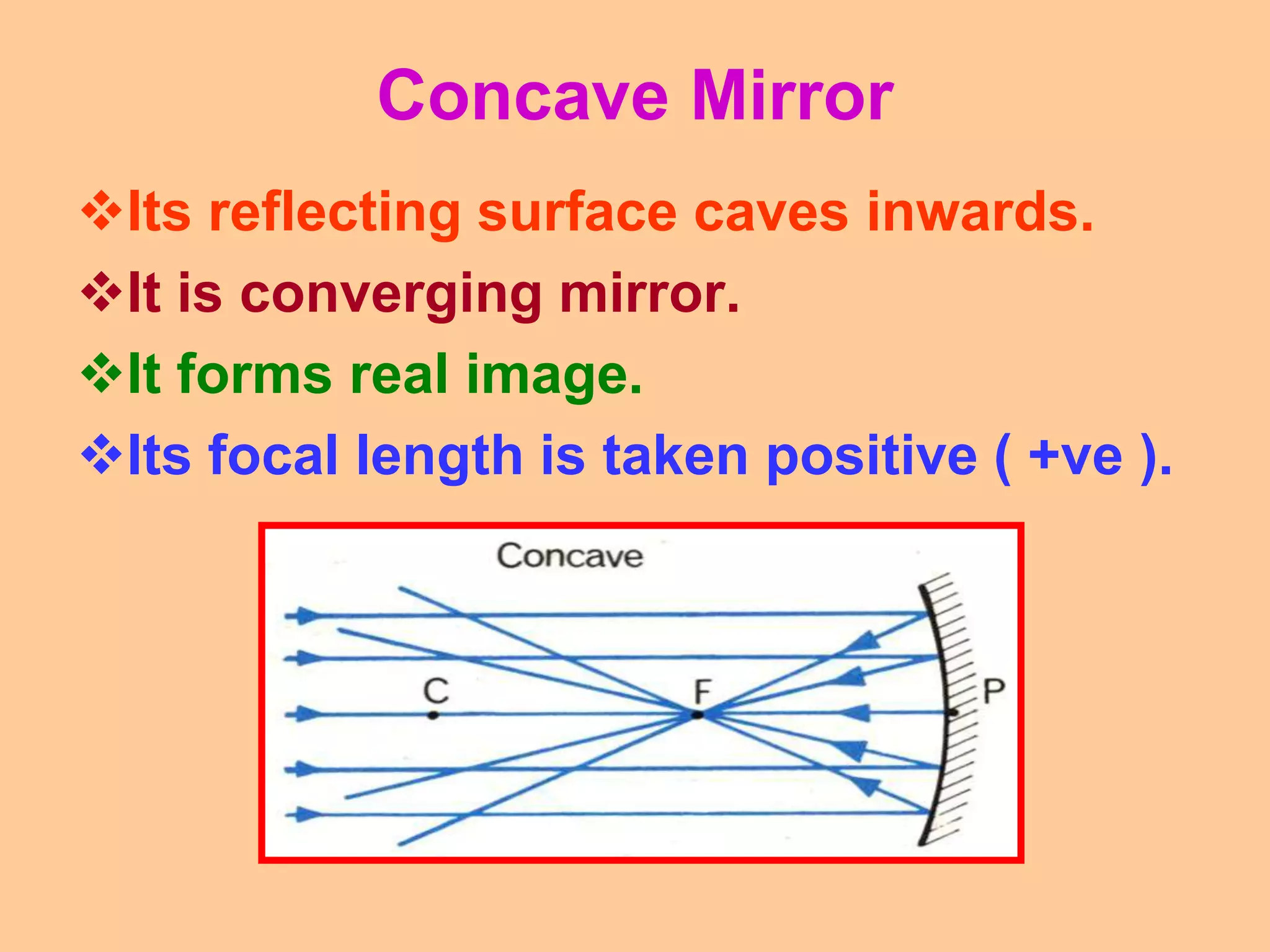
Its reflecting surface caves inwards.
It is converging mirror.
It forms real image.
Its focal length is taken positive ( +ve ).
Convex Mirror
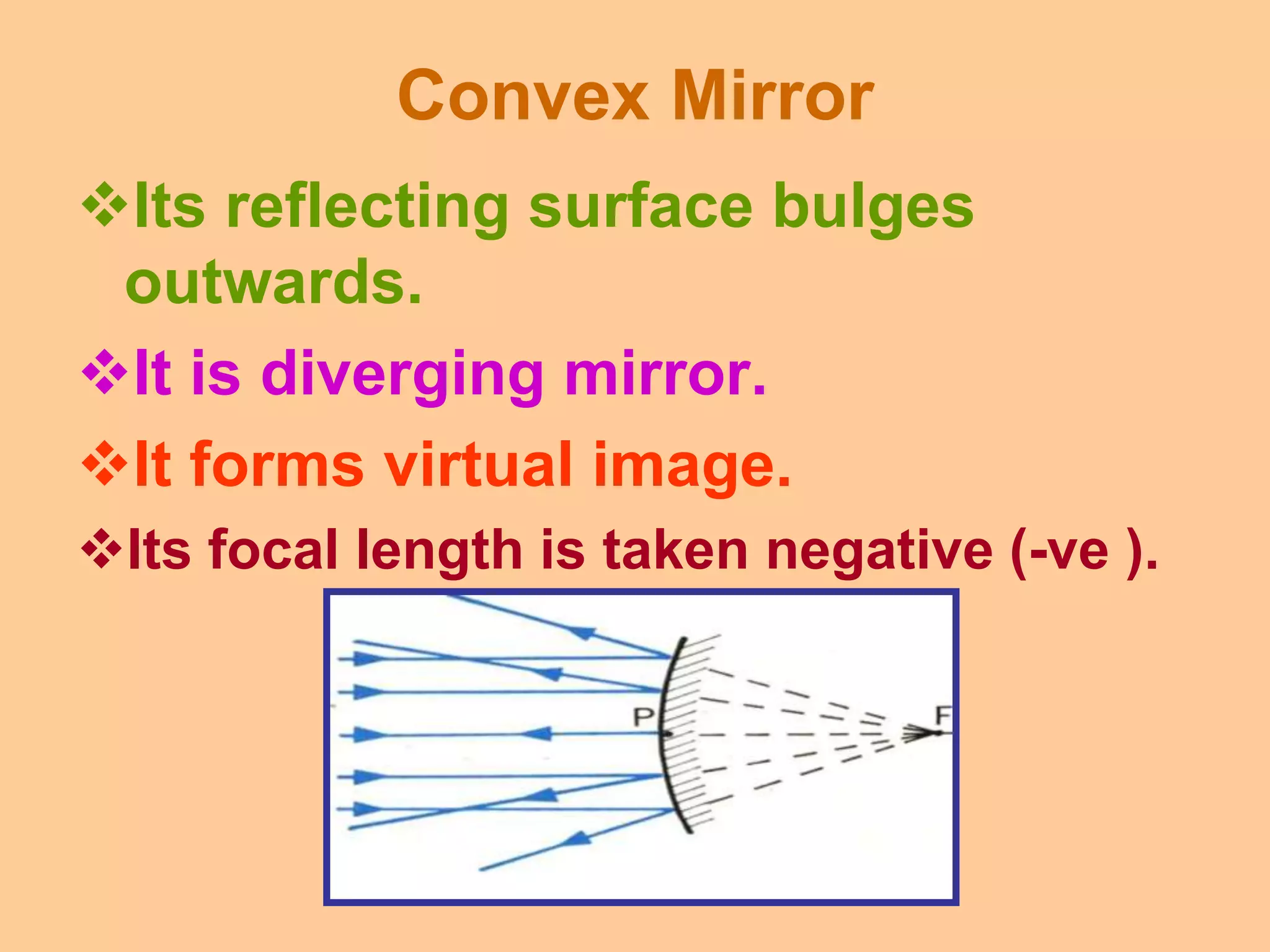
Its reflecting surface bulges
outwards.
It is diverging mirror.
It forms virtual image.
Its focal length is taken negative (-ve ).
Uses Of Spherical Mirrors
Concave Mirrors=(1)These are used in
search light, head light and flash
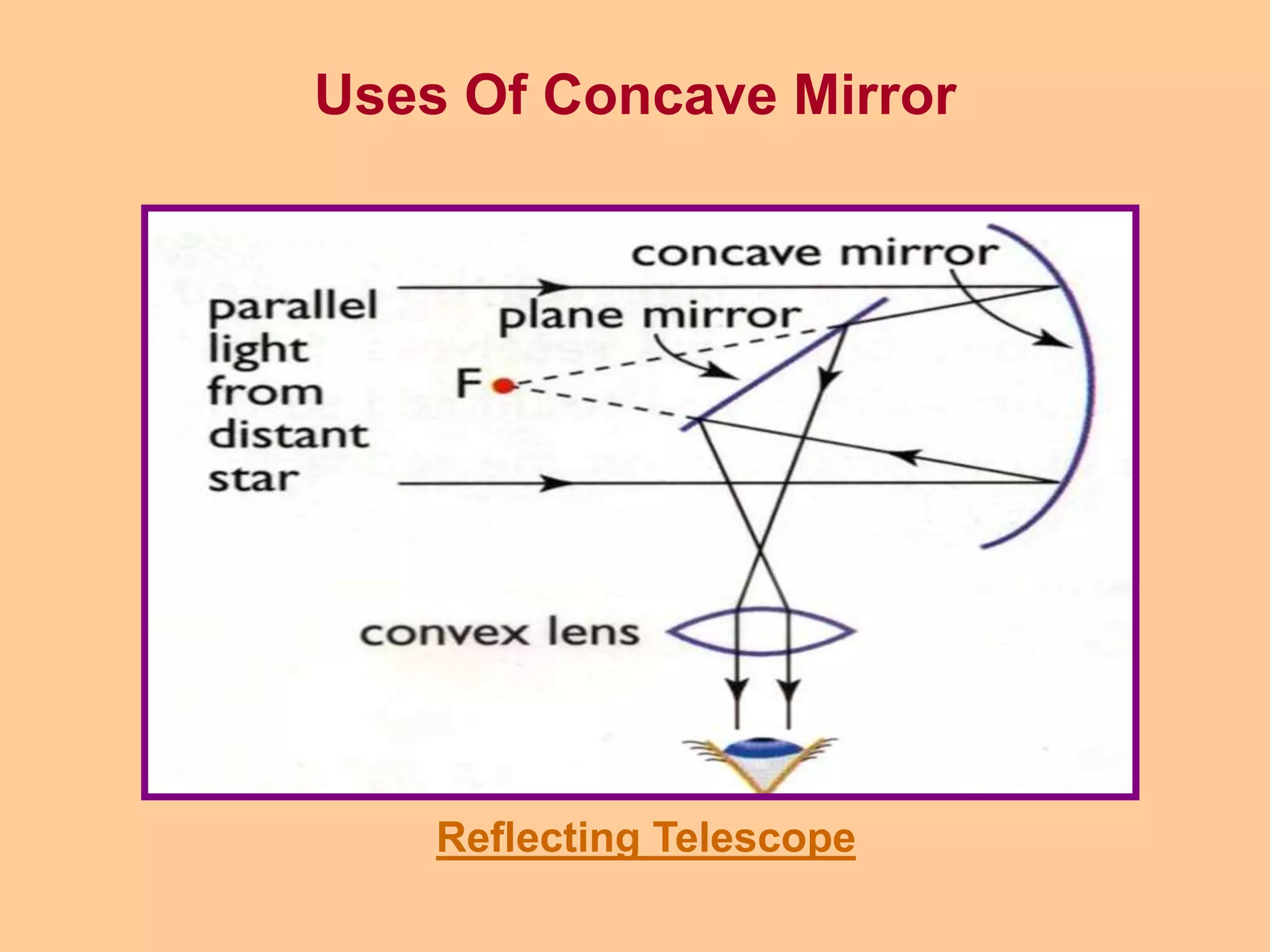
light.(2)These are used as objective in
Reflecting Telescopes.
(3) These are used as magnifiers.(4) These are
used in solar heaters.
Reflecting Telescope
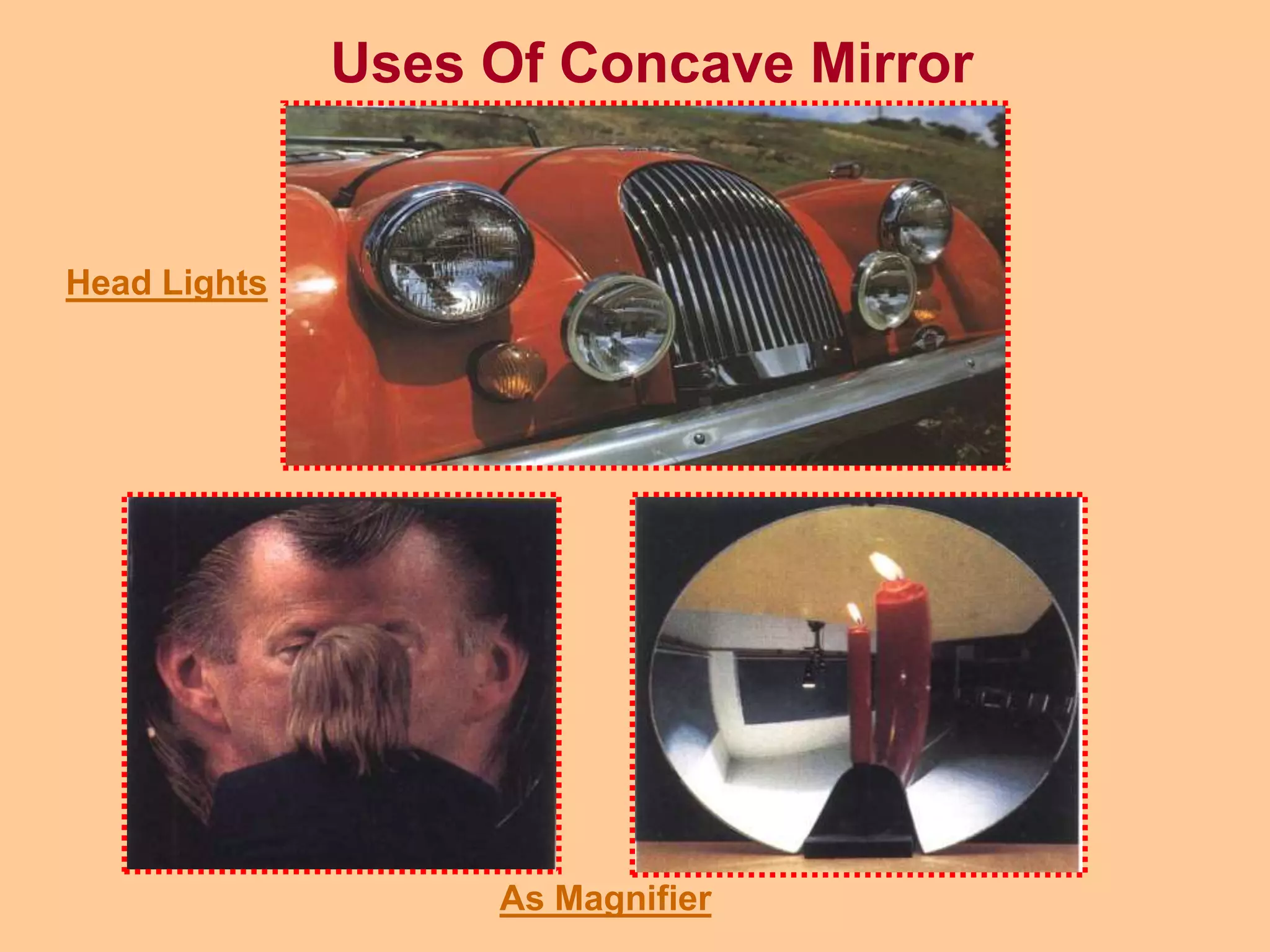
Uses Of Concave Mirror
Head Lights
As Magnifier
Uses Of Spherical Mirrors
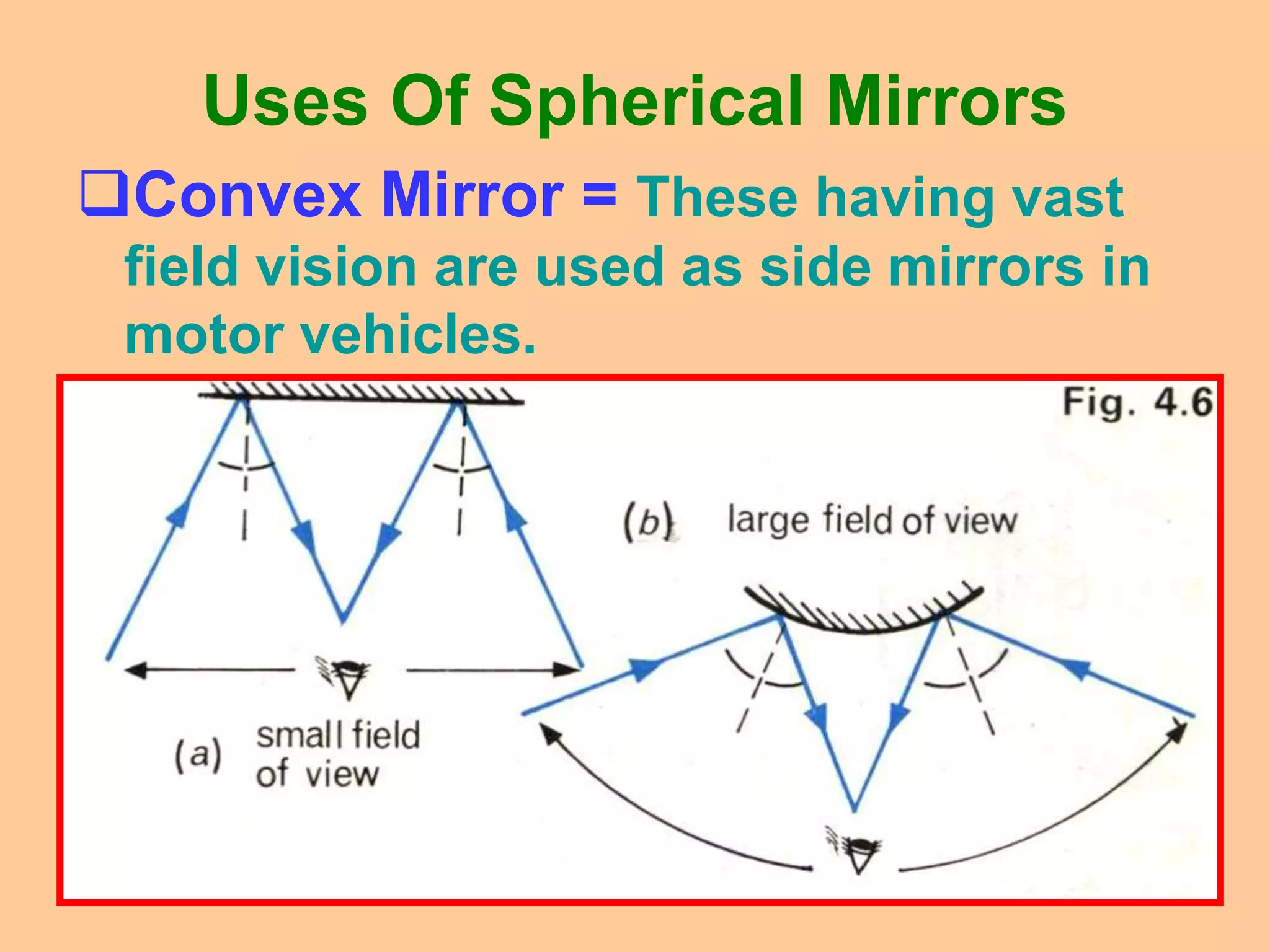
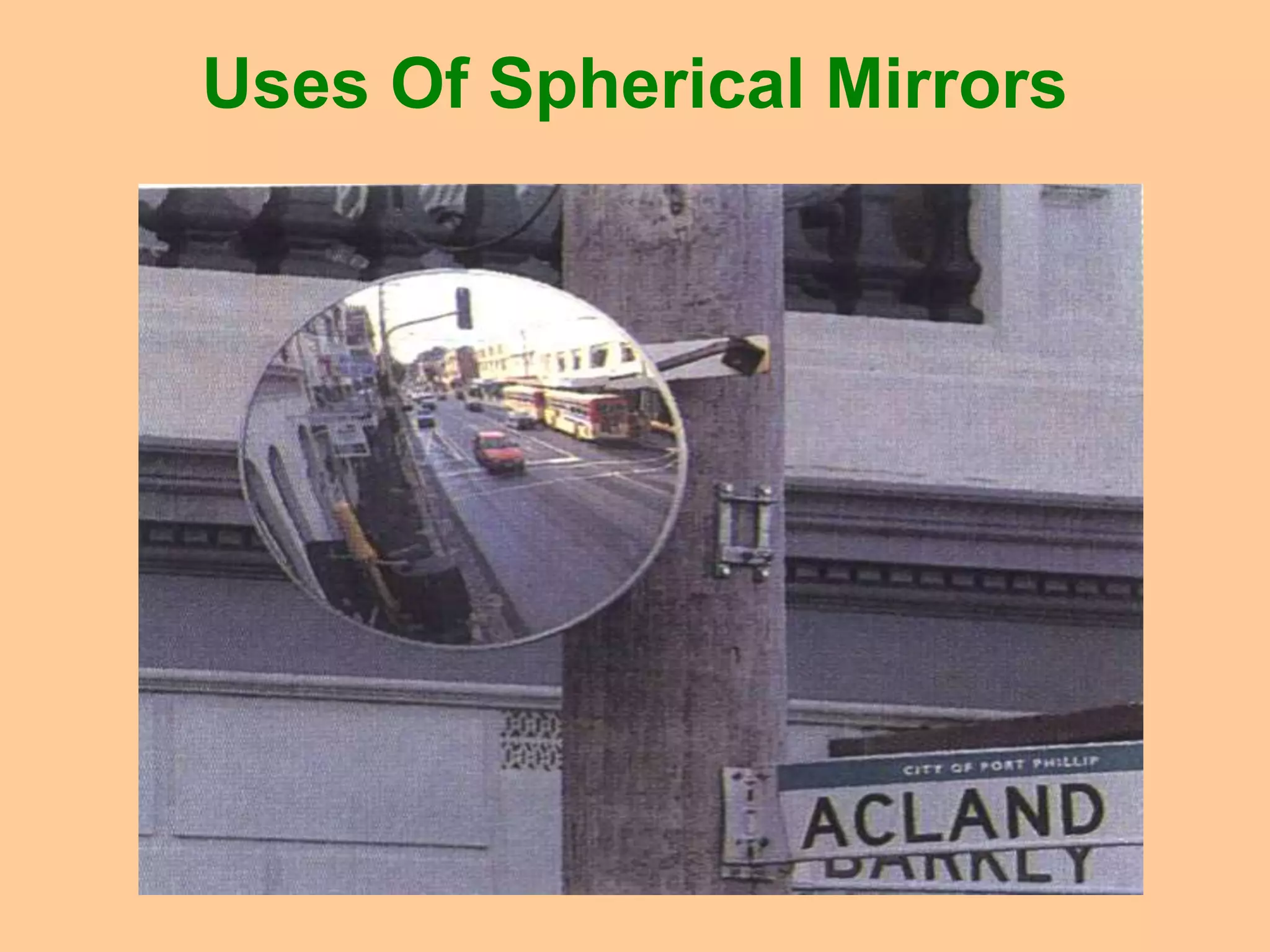
Convex Mirror = These having vast
field vision are used as side mirrors in
motor vehicles.
Uses Of Spherical Mirrors
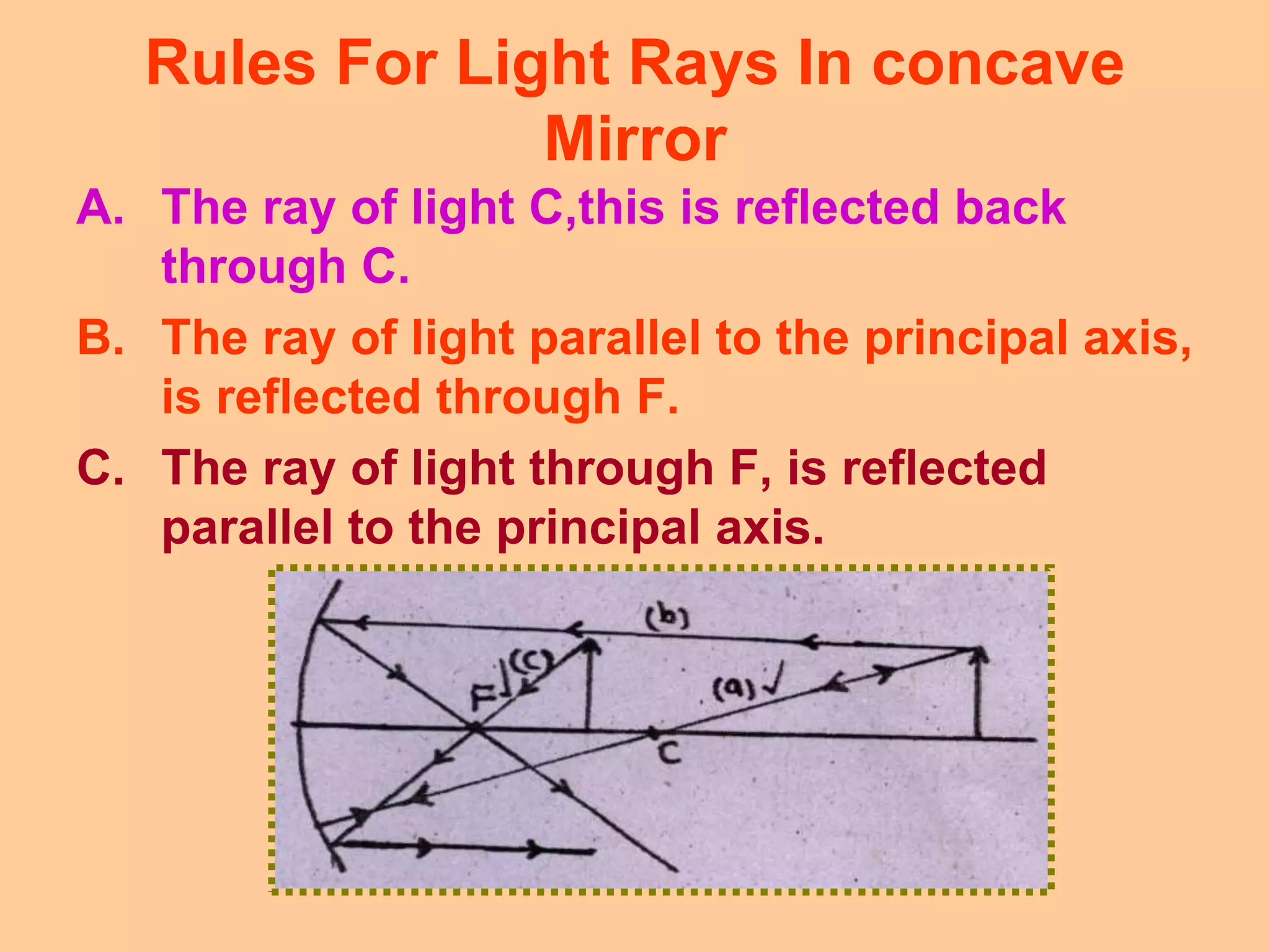
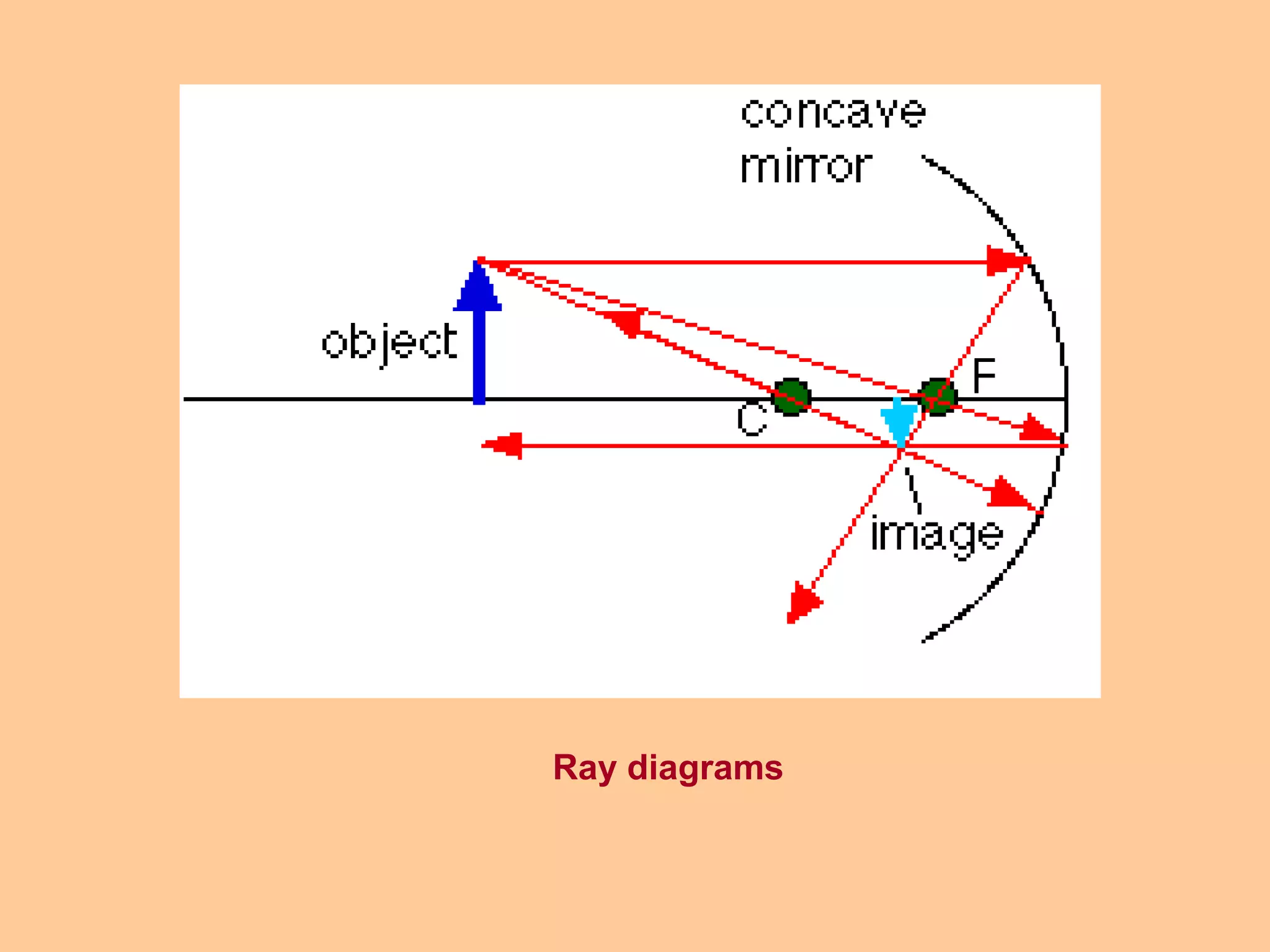
Rules For Light Rays In concave
Mirror
A. The ray of light C,this is reflected back
through C.
B. The ray of light parallel to the principal axis,
is reflected through F.
C. The ray of light through F, is reflected
parallel to the principal axis.
Ray diagrams
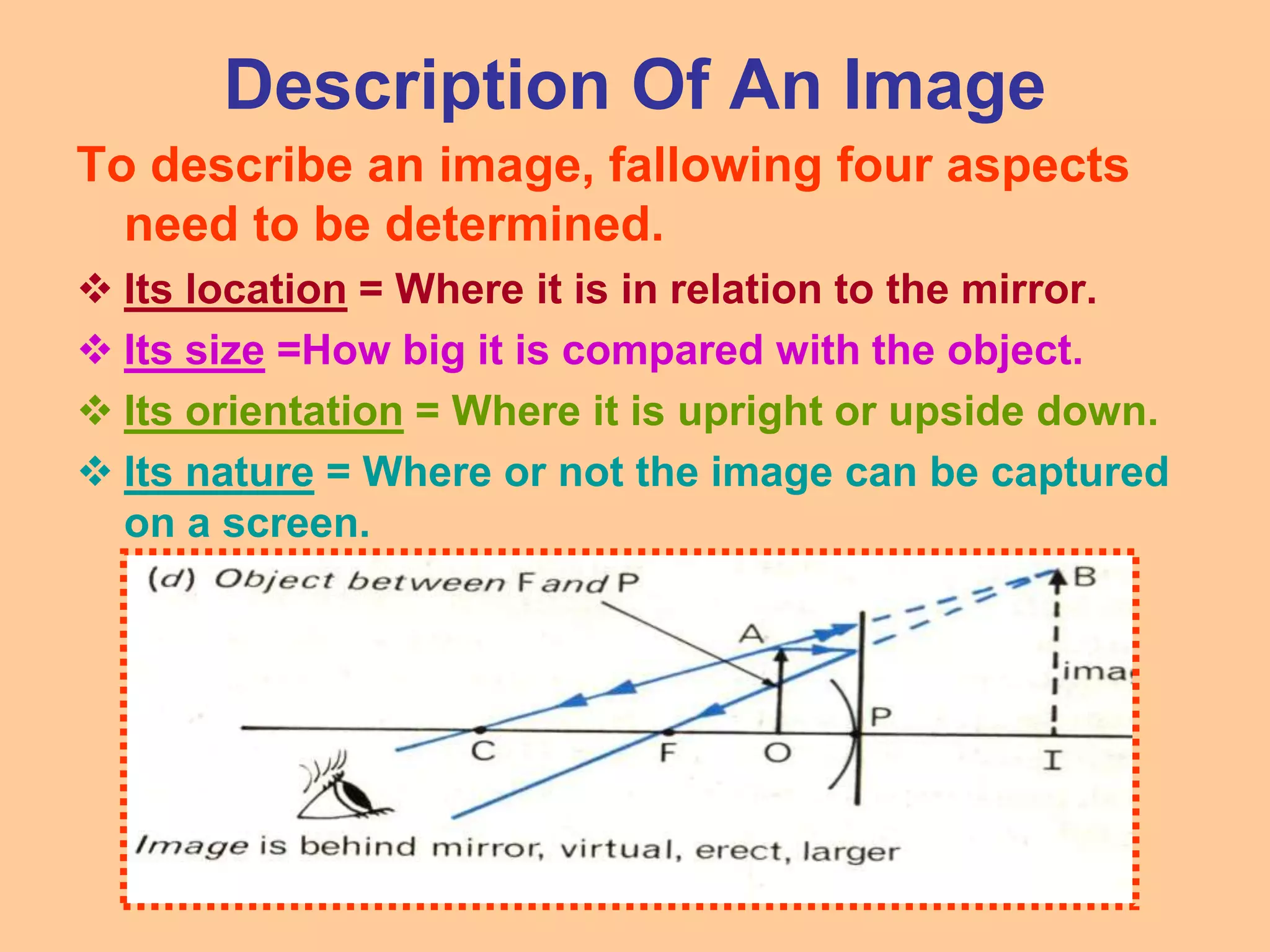
Description Of An Image
To describe an image, fallowing four aspects
need to be determined.
 Its location = Where it is in relation to the mirror.
 Its size =How big it is compared with the object.
 Its orientation = Where it is upright or upside down.
 Its nature = Where or not the image can be captured
on a screen.
Images Formed By concave Mirror
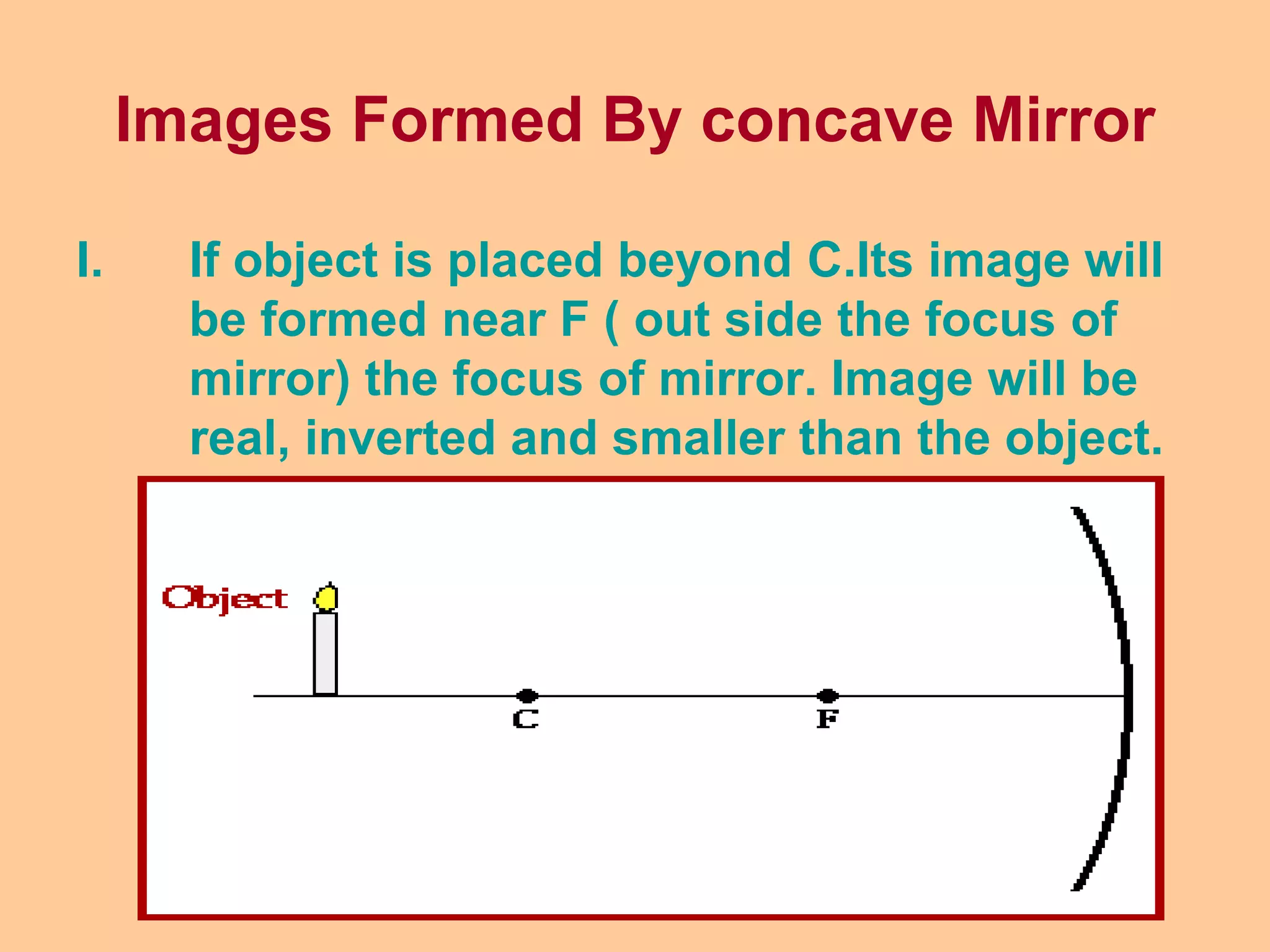
I. If object is placed beyond C.Its image will
be formed near F ( out side the focus of
mirror) the focus of mirror. Image will be
real, inverted and smaller than the object.
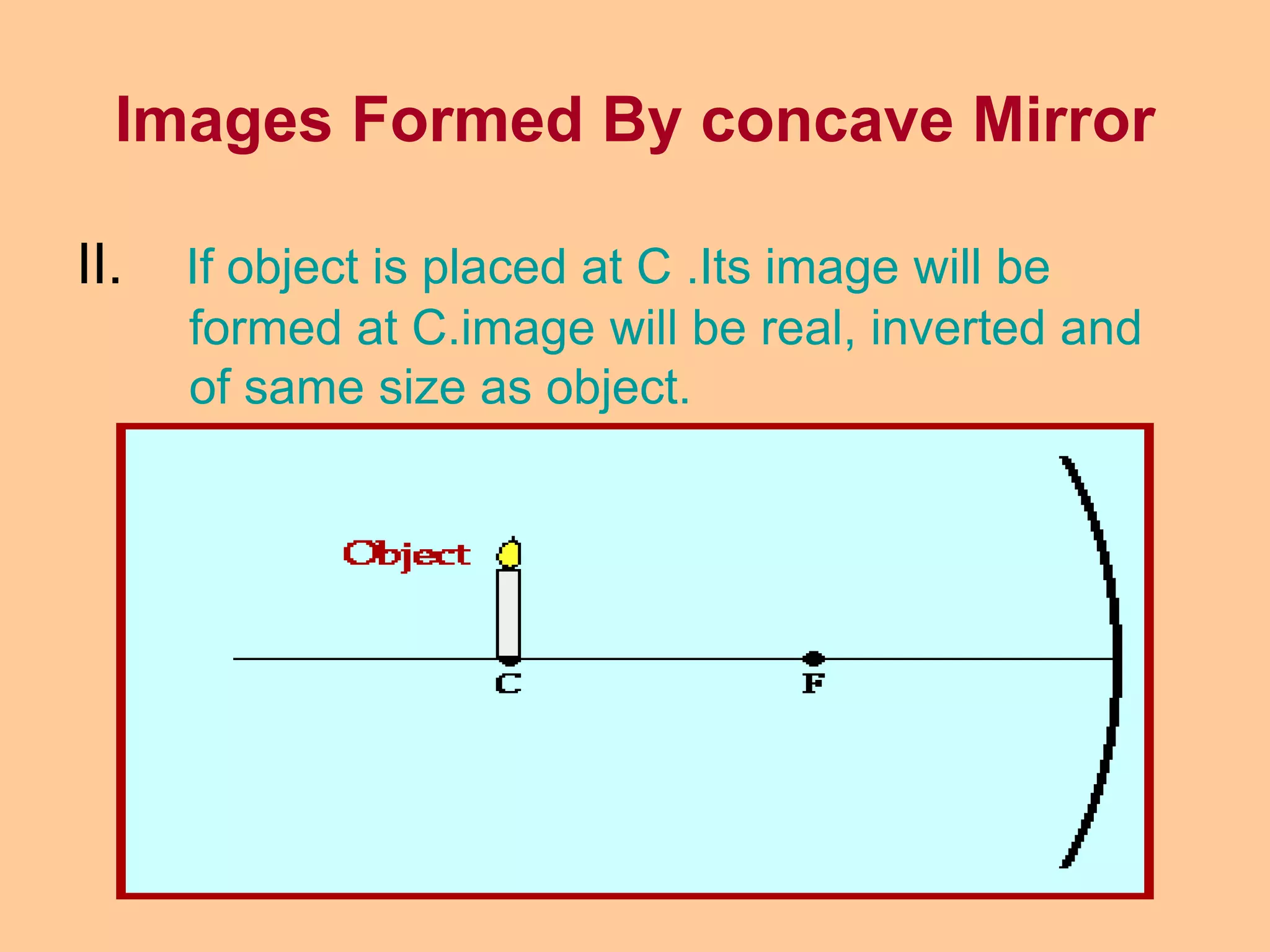
II. If object is placed at C .Its image will be
formed at C.image will be real, inverted and
of same size as object.
Images Formed By concave Mirror
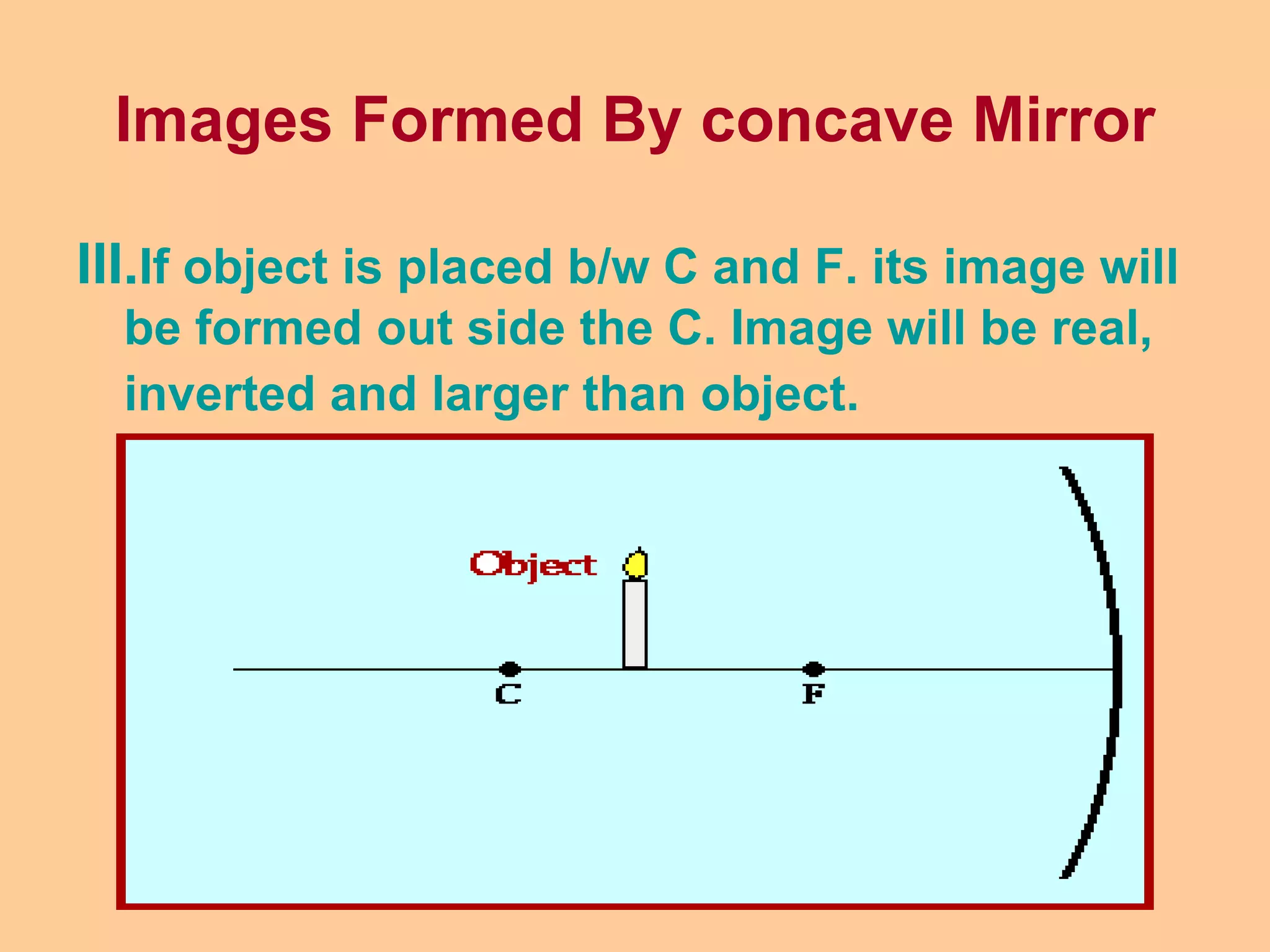
III.If object is placed b/w C and F. its image will
be formed out side the C. Image will be real,
inverted and larger than object.
Images Formed By concave Mirror
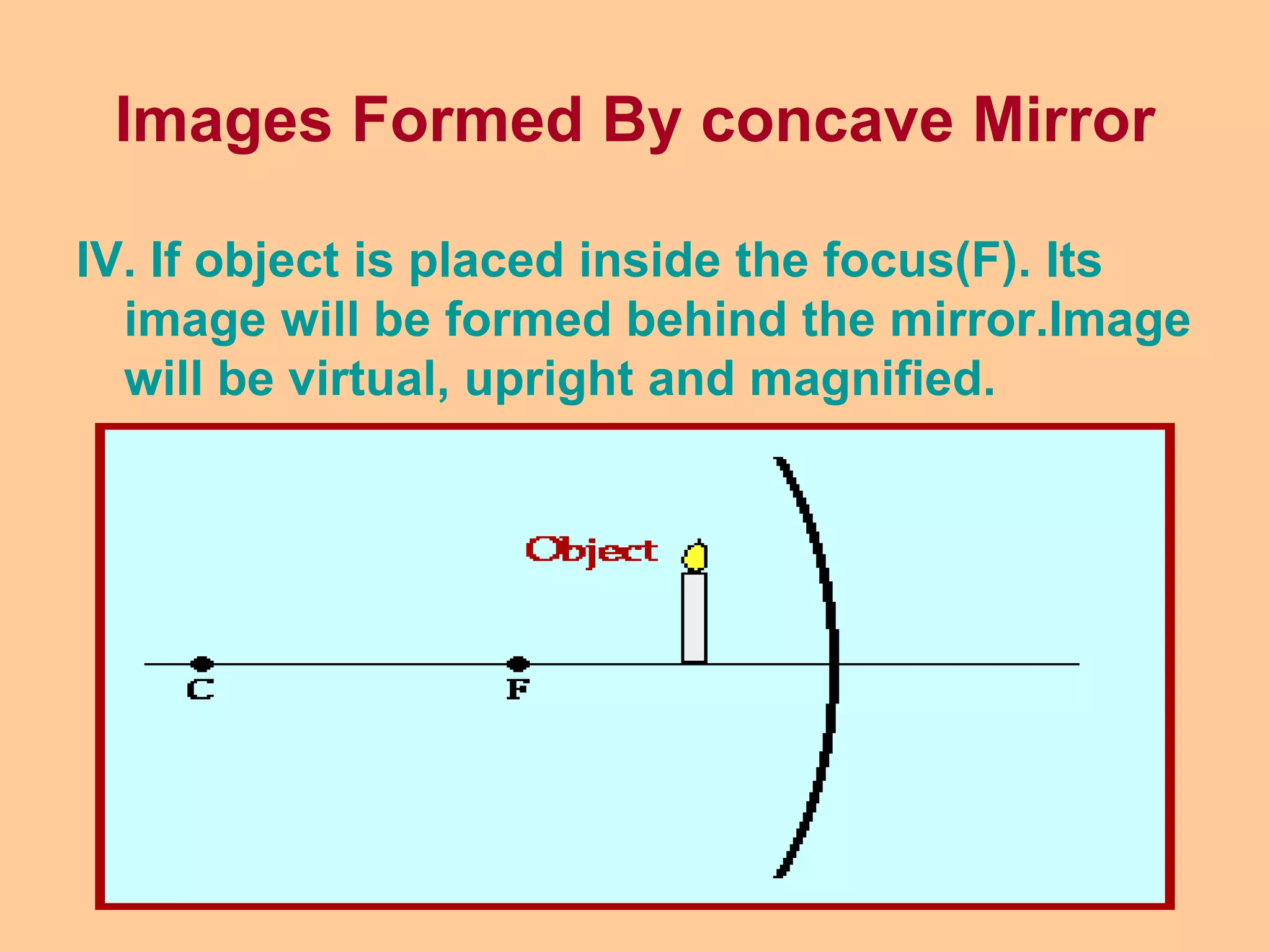
IV. If object is placed inside the focus(F). Its
image will be formed behind the mirror.Image
will be virtual, upright and magnified.
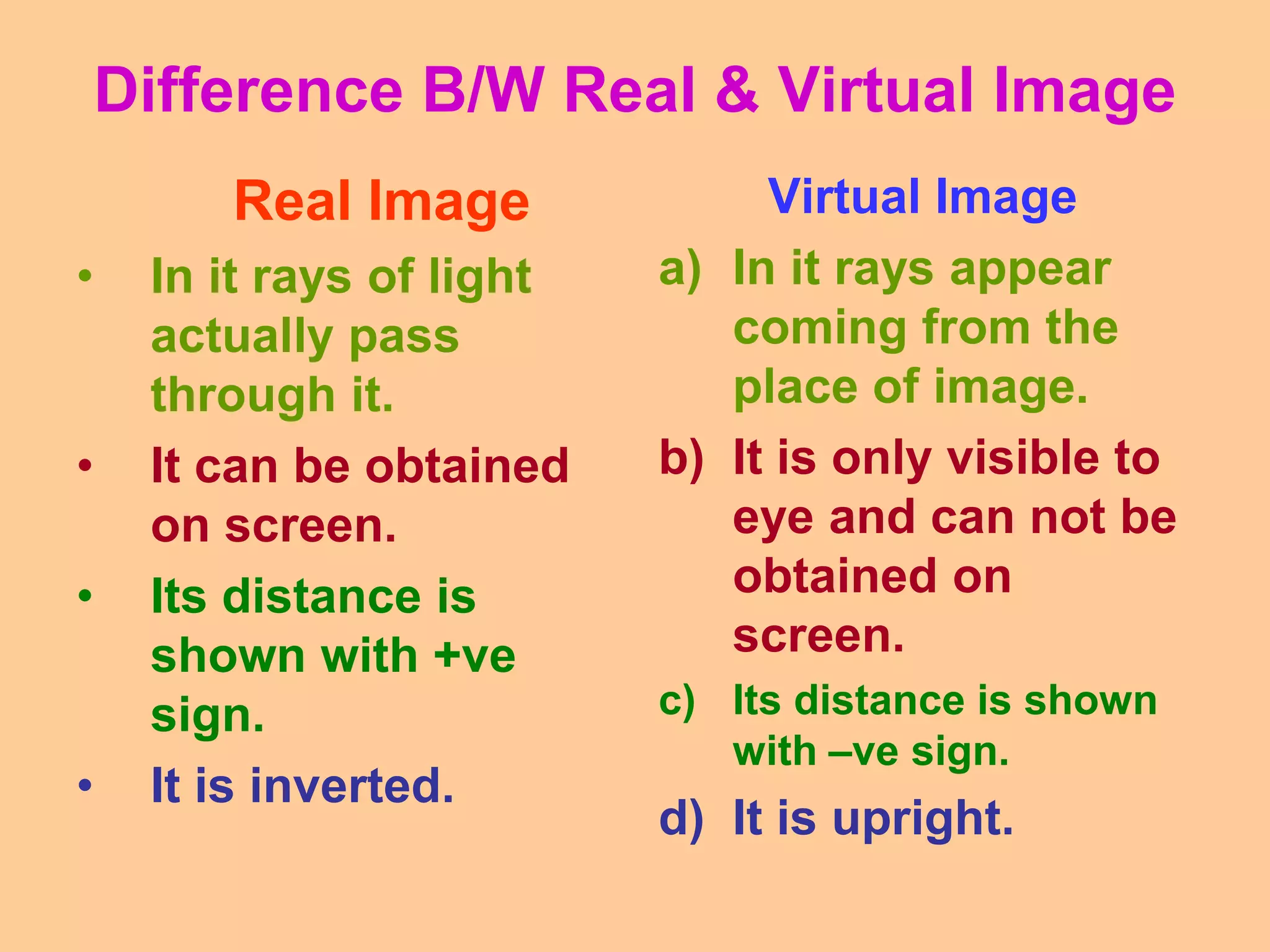
Difference B/W Real & Virtual Image
Real Image
• In it rays of light
actually pass
through it.
• It can be obtained
on screen.
• Its distance is
shown with +ve
sign.
• It is inverted.
Virtual Image
a) In it rays appear
coming from the
place of image.
b) It is only visible to
eye and can not be
obtained on
screen.
c) Its distance is shown
with –ve sign.
d) It is upright.
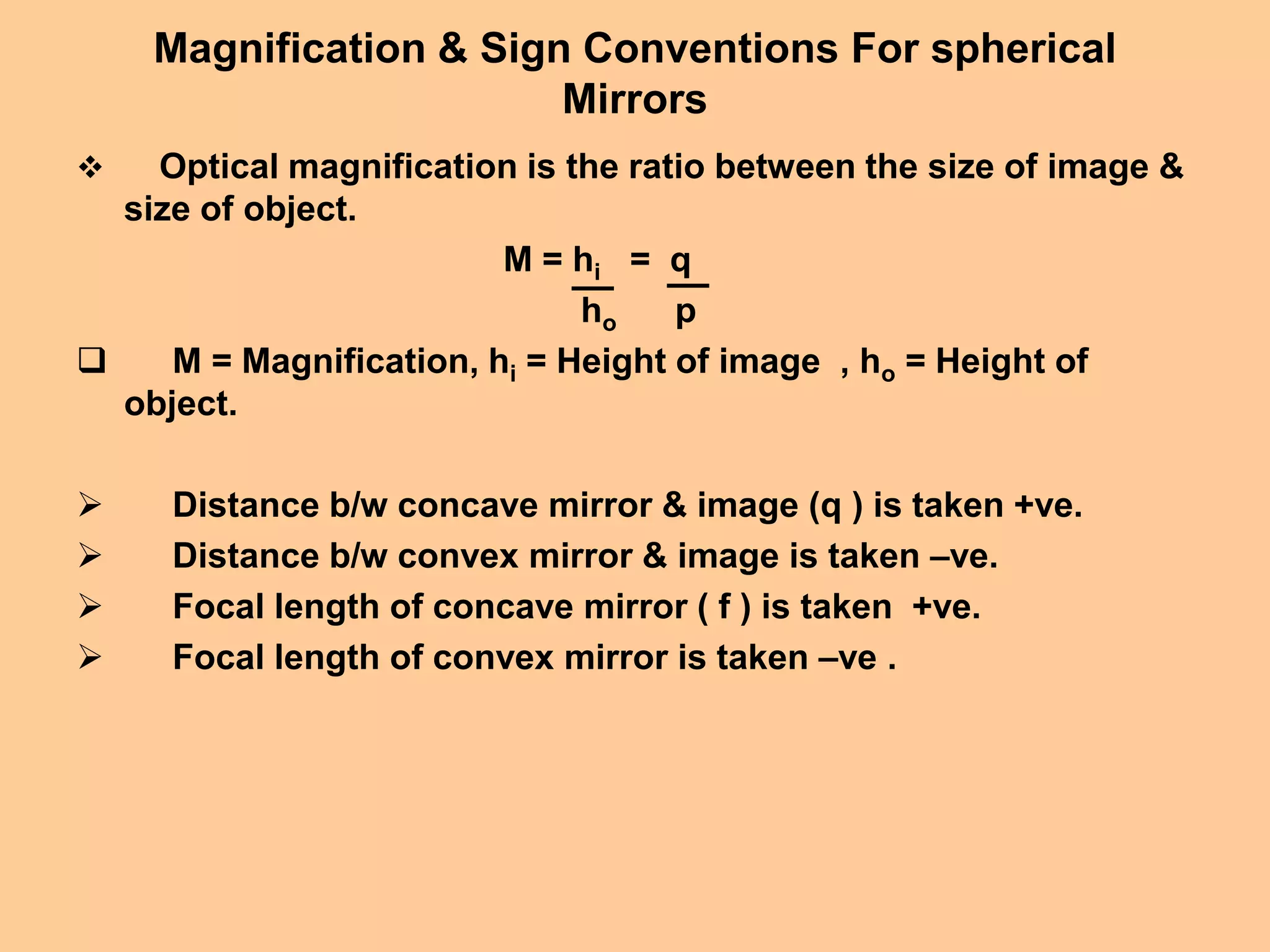
Magnification & Sign Conventions For spherical
Mirrors
 Optical magnification is the ratio between the size of image &
size of object.
M = hi = q
ho p
 M = Magnification, hi = Height of image , ho = Height of
object.
 Distance b/w concave mirror & image (q ) is taken +ve.
 Distance b/w convex mirror & image is taken –ve.
 Focal length of concave mirror ( f ) is taken +ve.
 Focal length of convex mirror is taken –ve .
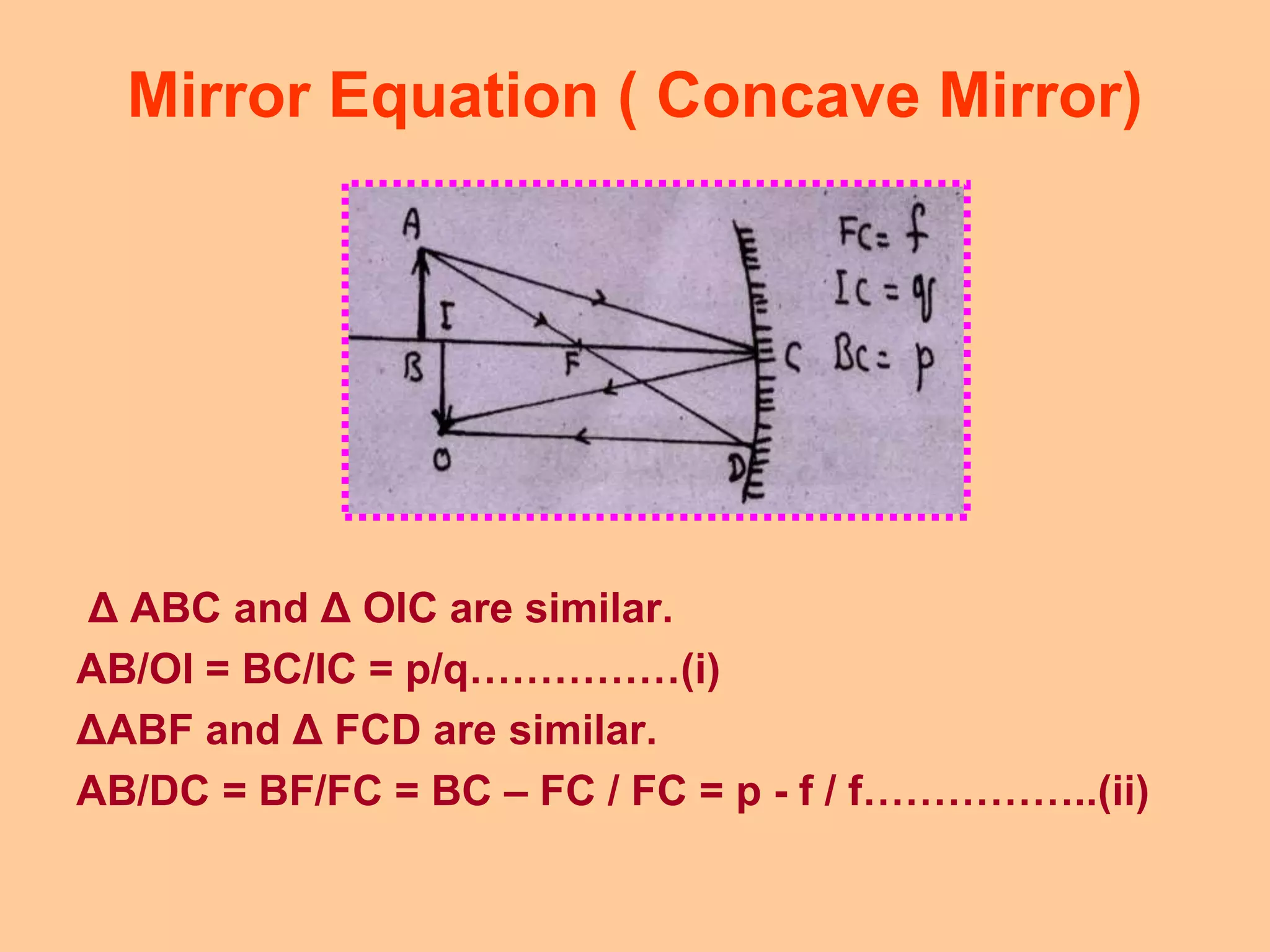
Mirror Equation ( Concave Mirror)
Δ ABC and Δ OIC are similar.
AB/OI = BC/IC = p/q……………(i)
ΔABF and Δ FCD are similar.
AB/DC = BF/FC = BC – FC / FC = p - f / f……………..(ii)
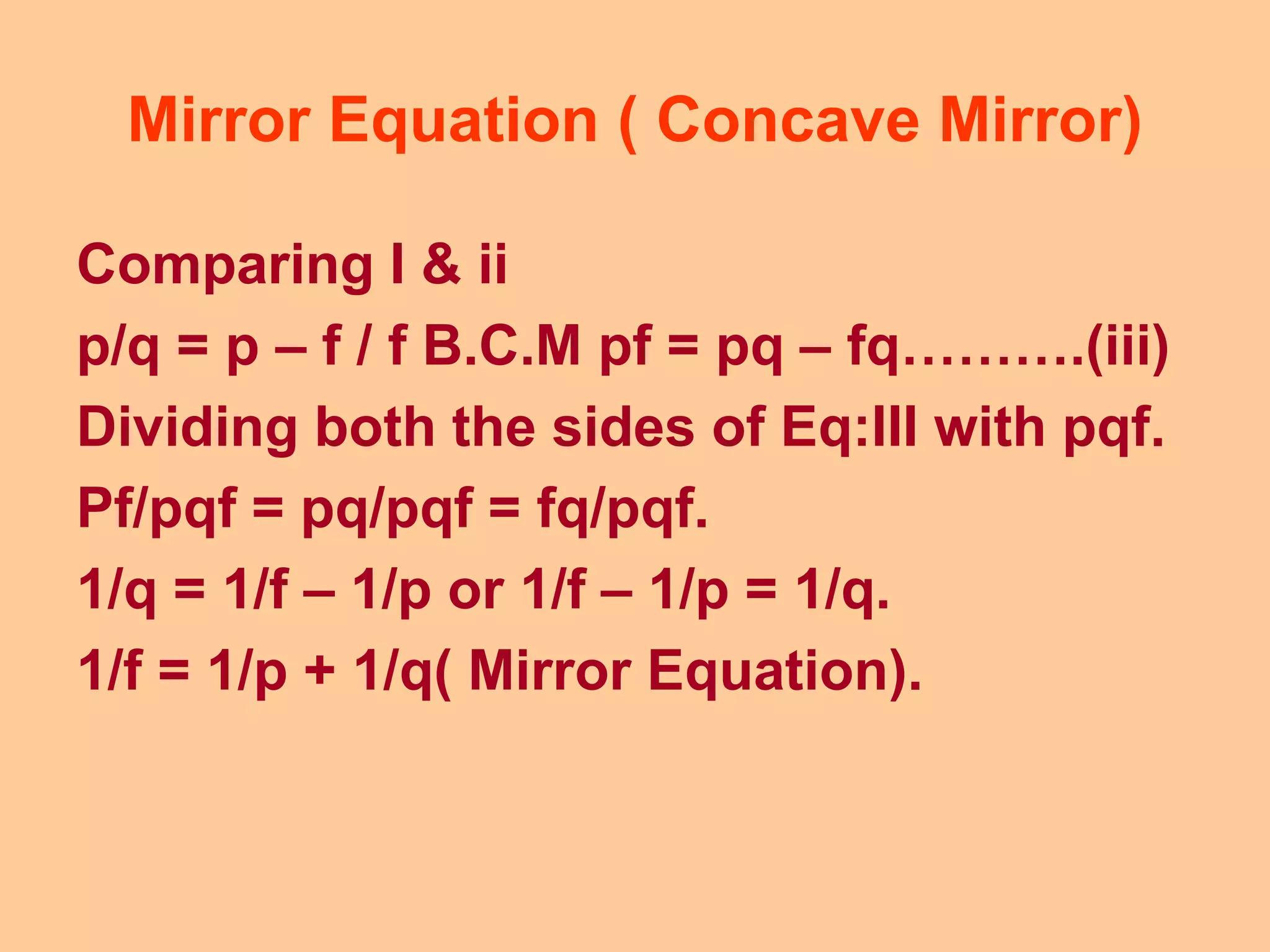
Mirror Equation ( Concave Mirror)
Comparing I & ii
p/q = p – f / f B.C.M pf = pq – fq……….(iii)
Dividing both the sides of Eq:III with pqf.
Pf/pqf = pq/pqf = fq/pqf.
1/q = 1/f – 1/p or 1/f – 1/p = 1/q.
1/f = 1/p + 1/q( Mirror Equation).
Reflection of light (Physics)

Reflection of light (Physics)

  • 1.
  • 2.
    Light • Light wasconsidered as mysterious thing in olden days. • Light deals with luminous energy, energy which causes the sensation of vision. • Light is brightness that comes from an object producing light , called luminous body (sun). • Light comes from atoms. Atoms that produce light have either gained energy by absorbing light from an other source or by being struck by other particles. It is this extra energy that causes an atom to give off light. • Study of light and interaction of light and matter is known as optics.
  • 3.
    Properties of Light Rectilinearpropagation. Shadow formation Reflection. Refraction. Diffraction. Dispersion. Polarization. Interference.
  • 4.
    Properties of Light ShadowFormation= The straight rays of light passing the edges of non transparent( opaque) body, leave a sharp shadow of that body in the way of light.
  • 5.
    Properties of Light RectilinearPropagation= Light travels in straight lines very fast. Laser
  • 6.
    Properties of Light Reflection= when light strikes smooth shining surface it returns back into same medium. Incident ray Reflected ray Normal
  • 7.
    Properties of Light Refraction= When light enters from one transparent medium into another , it changes its path.
  • 8.
  • 9.
    Properties of Light Diffraction = It is apparent bending of light waves around the obstacle in its path.
  • 10.
    Dispersion = Itrefers to the break down of white light( sun light) into its constituent colours. Properties of Light
  • 11.
    Properties of Light Interference = It is the phenomenon that occurs when two beams of light meet, to give brighter beam (constructive interference) or to produce less bright beam( destructive interference).
  • 14.
    Properties of Light Polarization=It is the direction, the wave is vibrating in.
  • 15.
  • 16.
    The reflection ofMount Hood in Mirror Lake.
  • 18.
    Double reflection: Thesun is reflected in the water, which is reflected in the paddle.
  • 19.
    Reflection Of Light Whenlight traveling through one medium strikes the surface of another medium(Mirror), part of it is returned back in the first medium in a particular direction, such phenomenon is called Reflection of Light
  • 20.
    Regular Reflection OrSpecular Reflection  When rays of light strike the smooth shining surface ( plane mirror) they are reflected in the same direction , it is called regular reflection. In it at different places of surface, the values of incident angle ( Li) are same.
  • 21.
    Irregular Reflection OrDiffused Reflection  When rays of light strike rough surface(Earth), they are reflected in different directions, it is called irregular reflection. In it at different places of surface the value of incident angle(Li) are not same.
  • 23.
    Laws Of ReflectionOf Light  The incident ray, the reflected ray and the normal all lie in the same plane.  The angle of incident(li) is equal to the angle of reflection (Lr).
  • 26.
    Position & NatureOf Image Formed By Plane Mirror • In plane mirror image formed is of the same size as the object. • Image is as far behind the mirror as the object in front of the mirror. • Image is virtual and laterally inverted.
  • 29.
    Applications Of PlaneMirror • It is used as a looking glass. • In the field of medicine, it is used by Dentists and Ophthalmic surgeons. • It is used in electric meters, in special head lights, light microscopes, periscope and kaleidoscope.
  • 30.
    Applications Of PlaneMirror As looking glass Periscope
  • 31.
  • 32.
    Applications Of PlaneMirror Ophthalmoscope Electric Meter
  • 33.
    Applications Of PlaneMirror Plane Mirror Head Light
  • 34.
    Pin Hole Camera A pin hole camera is a simple camera without a lens and with aperture , effectively alight - proof box with a small hole in one side.  Light rays from an object pas through a small hole to form an inverted image , on semitransparent paper at the back of the box. It is also known as camera obscura ( dark room).
  • 35.
  • 36.
    Types Of Mirror PlaneMirror Curved Mirror Parabolic Mirror
  • 37.
    Spherical Mirror • Amirror having curve surface is termed as spherical mirror, being a part of large hollow mirror) or curved mirror.
  • 39.
    Types Of SphericalMirrors • Spherical mirrors are classified into following two types, according to how they reflect light rays from a distant source.
  • 40.
    Terms Used InSpherical mirror  CP = Radius of curvature.  C = Centre of curvature.  PO = Principal axis.  P = Pole of mirror.  F = Focus of mirror.  PF(f) = focal length of mirror.  XY = Aperture of mirror.
  • 43.
    Concave Mirror Its reflectingsurface caves inwards. It is converging mirror. It forms real image. Its focal length is taken positive ( +ve ).
  • 44.
    Convex Mirror Its reflectingsurface bulges outwards. It is diverging mirror. It forms virtual image. Its focal length is taken negative (-ve ).
  • 45.
    Uses Of SphericalMirrors Concave Mirrors=(1)These are used in search light, head light and flash light.(2)These are used as objective in Reflecting Telescopes. (3) These are used as magnifiers.(4) These are used in solar heaters.
  • 46.
  • 47.
    Uses Of ConcaveMirror Head Lights As Magnifier
  • 48.
    Uses Of SphericalMirrors Convex Mirror = These having vast field vision are used as side mirrors in motor vehicles.
  • 49.
  • 50.
    Rules For LightRays In concave Mirror A. The ray of light C,this is reflected back through C. B. The ray of light parallel to the principal axis, is reflected through F. C. The ray of light through F, is reflected parallel to the principal axis.
  • 53.
  • 54.
    Description Of AnImage To describe an image, fallowing four aspects need to be determined.  Its location = Where it is in relation to the mirror.  Its size =How big it is compared with the object.  Its orientation = Where it is upright or upside down.  Its nature = Where or not the image can be captured on a screen.
  • 57.
    Images Formed Byconcave Mirror I. If object is placed beyond C.Its image will be formed near F ( out side the focus of mirror) the focus of mirror. Image will be real, inverted and smaller than the object.
  • 58.
    II. If objectis placed at C .Its image will be formed at C.image will be real, inverted and of same size as object. Images Formed By concave Mirror
  • 59.
    Images Formed Byconcave Mirror III.If object is placed b/w C and F. its image will be formed out side the C. Image will be real, inverted and larger than object.
  • 60.
    Images Formed Byconcave Mirror IV. If object is placed inside the focus(F). Its image will be formed behind the mirror.Image will be virtual, upright and magnified.
  • 61.
    Difference B/W Real& Virtual Image Real Image • In it rays of light actually pass through it. • It can be obtained on screen. • Its distance is shown with +ve sign. • It is inverted. Virtual Image a) In it rays appear coming from the place of image. b) It is only visible to eye and can not be obtained on screen. c) Its distance is shown with –ve sign. d) It is upright.
  • 62.
    Magnification & SignConventions For spherical Mirrors  Optical magnification is the ratio between the size of image & size of object. M = hi = q ho p  M = Magnification, hi = Height of image , ho = Height of object.  Distance b/w concave mirror & image (q ) is taken +ve.  Distance b/w convex mirror & image is taken –ve.  Focal length of concave mirror ( f ) is taken +ve.  Focal length of convex mirror is taken –ve .
  • 63.
    Mirror Equation (Concave Mirror) Δ ABC and Δ OIC are similar. AB/OI = BC/IC = p/q……………(i) ΔABF and Δ FCD are similar. AB/DC = BF/FC = BC – FC / FC = p - f / f……………..(ii)
  • 64.
    Mirror Equation (Concave Mirror) Comparing I & ii p/q = p – f / f B.C.M pf = pq – fq……….(iii) Dividing both the sides of Eq:III with pqf. Pf/pqf = pq/pqf = fq/pqf. 1/q = 1/f – 1/p or 1/f – 1/p = 1/q. 1/f = 1/p + 1/q( Mirror Equation).