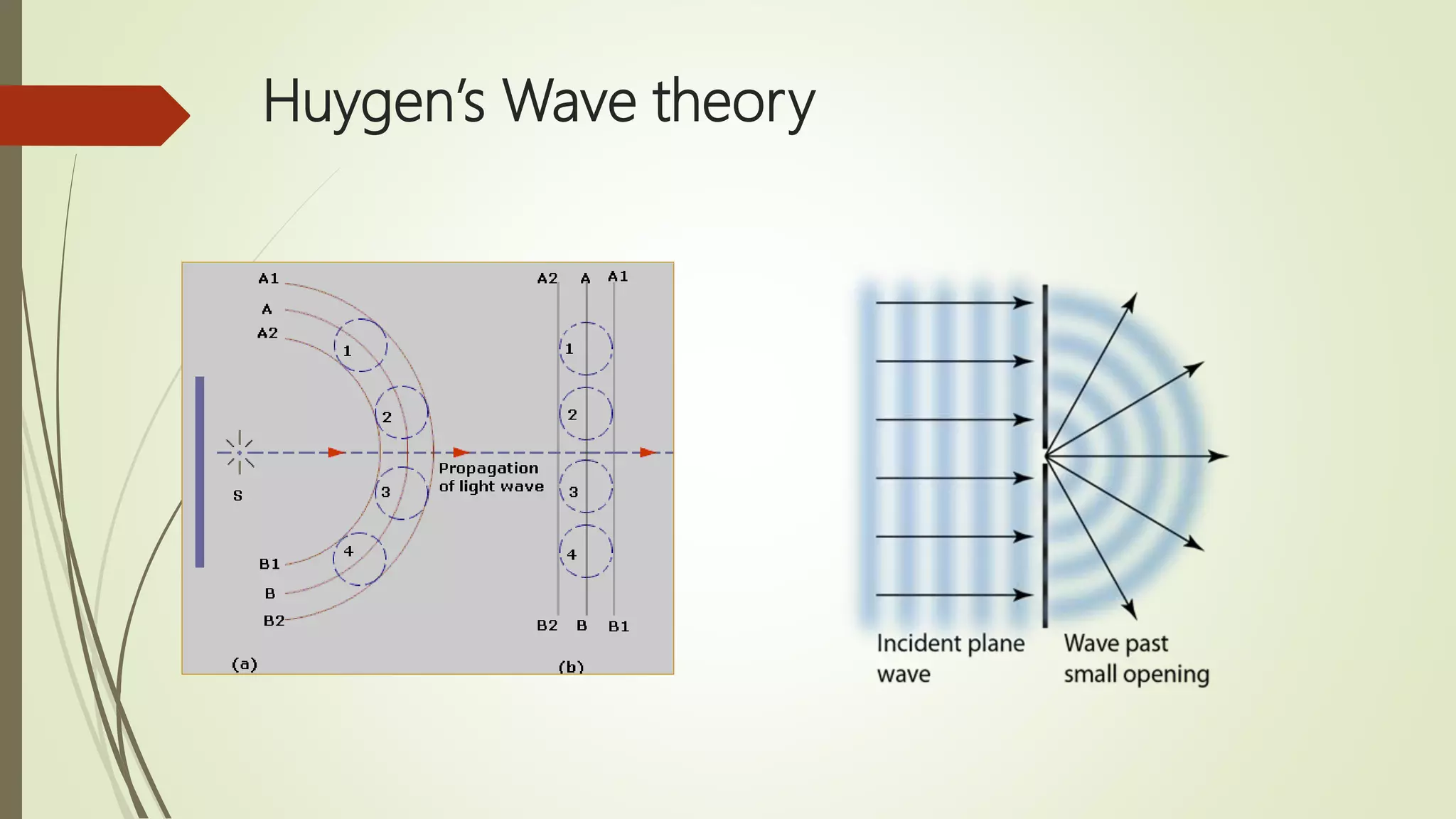
1. Huygen's wave theory proposes that light propagates as waves, with each point on a wavefront acting as a secondary source of spherical wavelets.
2. The wave theory can explain phenomena like reflection, refraction, and interference through Huygen's principle and the laws of reflection and refraction.
3. Maxwell's electromagnetic theory unified electric and magnetic fields and correctly predicted the speed of light, providing strong evidence for the wave nature of light.
• Light energyoriginates somewhere within an atom and ends its existence ,when it enters
another atom or a molecule .
• Light is transferred from the source of light to the eye,either by
1. the motion of material particles
2. means of wave disturbance travelling through the medium
• All the theories based on the experimental facts such as,
1.Light propagates through vaccum with a velocity c.
2. Light travels in a straight line in a homogeneous medium.
3.Light is refelected from a smooth surface.(Reflection)
4.Light is refracted when it travels from one medium into another(Refraction).
5. Light gets dispersed into different colours, on passing through a triangular prism
(Dispersion).
6. Light shows interference, diffraction and polarization.
7. When light of suitable frequency falls on certain metals, electrons are ejected from
(Photoelectric effect).
3.
The importanttheories of light are:
1. Newton's corpuscular theory
2. Huygen's wave theory
3. Maxwell's electromagnetic theory
4. Planck's quantum theory
Newton's corpuscular theory fails to explain the phenomena of interference, diffraction and
polarization.
Christian Huygenproposed the wave theory of light.
According to this theory, light propagates from the source in the form a wave.
Each point in a source of light sends out waves in all directions in hypothetical medium
called ether.
Ether was assumed to be continuous medium which pervades all space. Due to
tremendous velocity of light, it was assumed that ether has very large elasticity and
extremely low density.
The existence of ether had to be assumed because for the propagation of a wave
medium is necessary. Huygens assumed that light waves are longitudinal.
Using wave theory, Huygens could explain reflection, refraction, simultaneous reflection
and refraction, total internal reflection, dispersion, double refraction etc. However, it fails
explain the rectilinear propagation of light, diffraction and polarization.
However, Huygen's wave theory could not prove the presence of ether.
6.
Thomas Younganalyzed and explained the colours seen in thin films like soap bubbles
which was based on the concept of superposition of waves.
Fresnel framed a mathematical analysis of wave theory which removed the defects of
Huygen' s principle but also it explained the concept of diffraction of light and rectilinear
propagation of light at macroscopic level.
A series of experiments on diffraction of light conducted on development of
electromagnetic waves by Maxwell in 1860 which correctly predicted the speed of light.
The electromagnetic theory was highly successful in explaining the propagation of light
waves .
7.
Wavefront and differenttypes
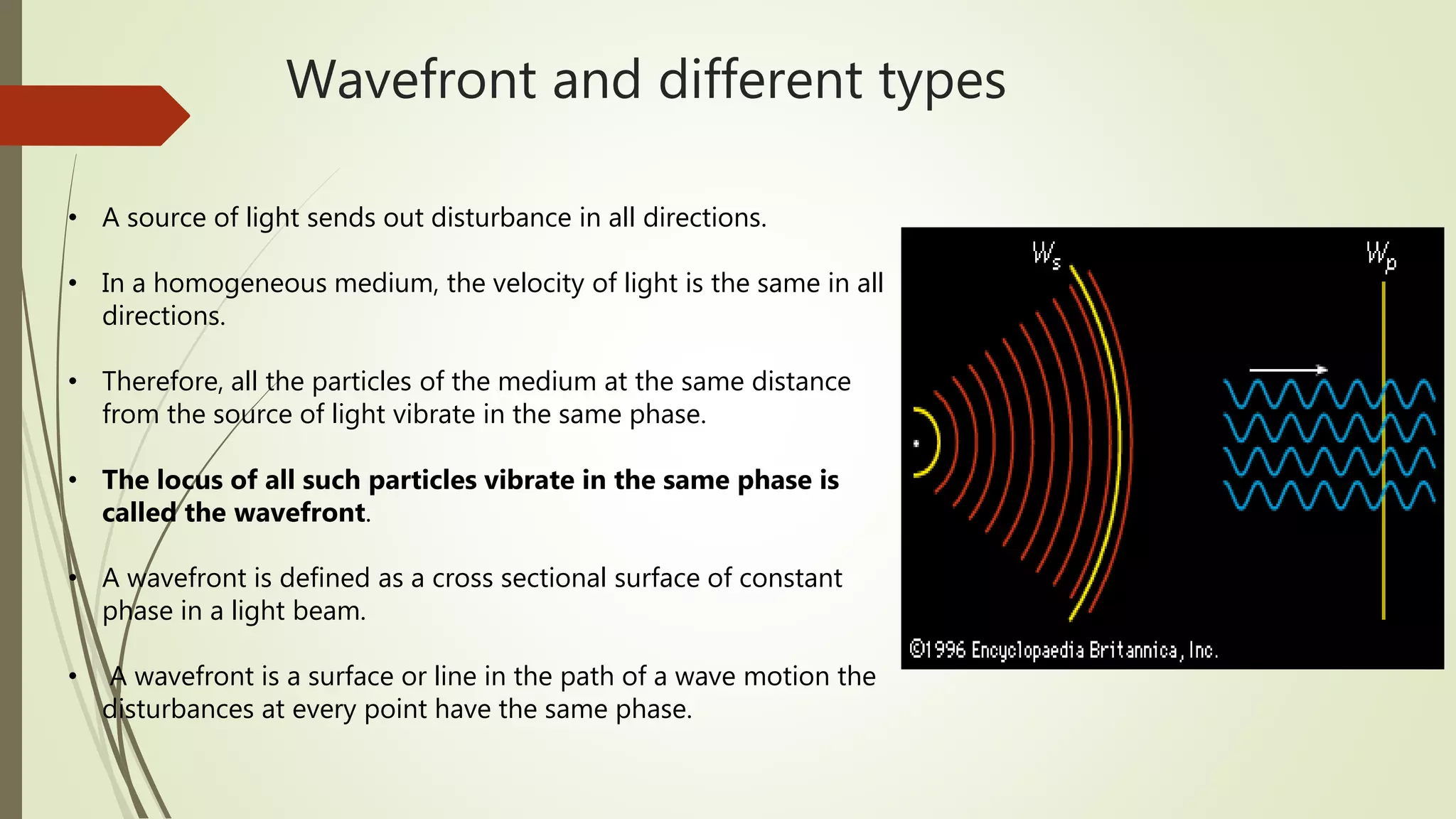
• A source of light sends out disturbance in all directions.
• In a homogeneous medium, the velocity of light is the same in all
directions.
• Therefore, all the particles of the medium at the same distance
from the source of light vibrate in the same phase.
• The locus of all such particles vibrate in the same phase is
called the wavefront.
• A wavefront is defined as a cross sectional surface of constant
phase in a light beam.
• A wavefront is a surface or line in the path of a wave motion the
disturbances at every point have the same phase.
8.
Types of Wavefront:
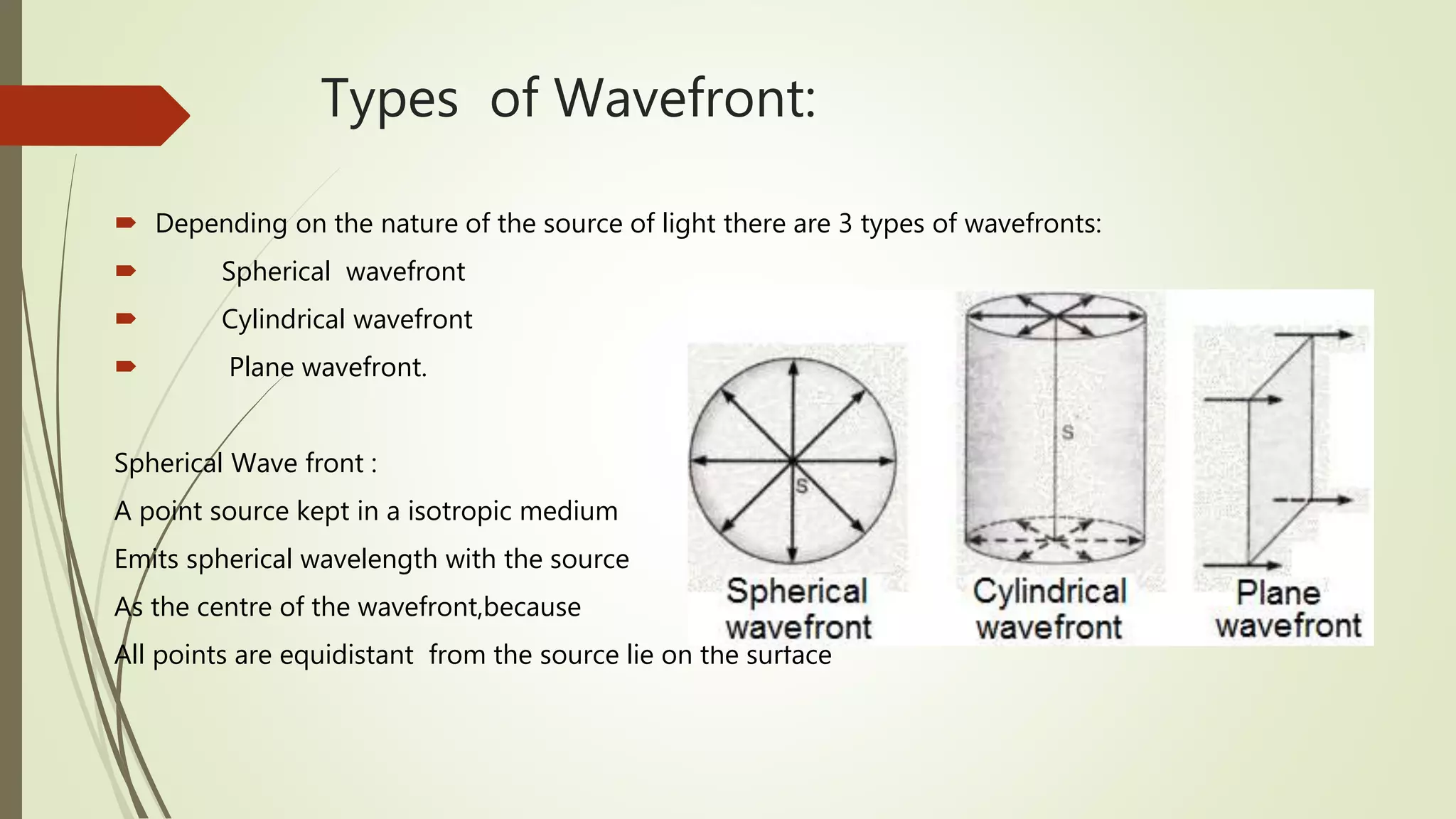
Depending on the nature of the source of light there are 3 types of wavefronts:
Spherical wavefront
Cylindrical wavefront
Plane wavefront.
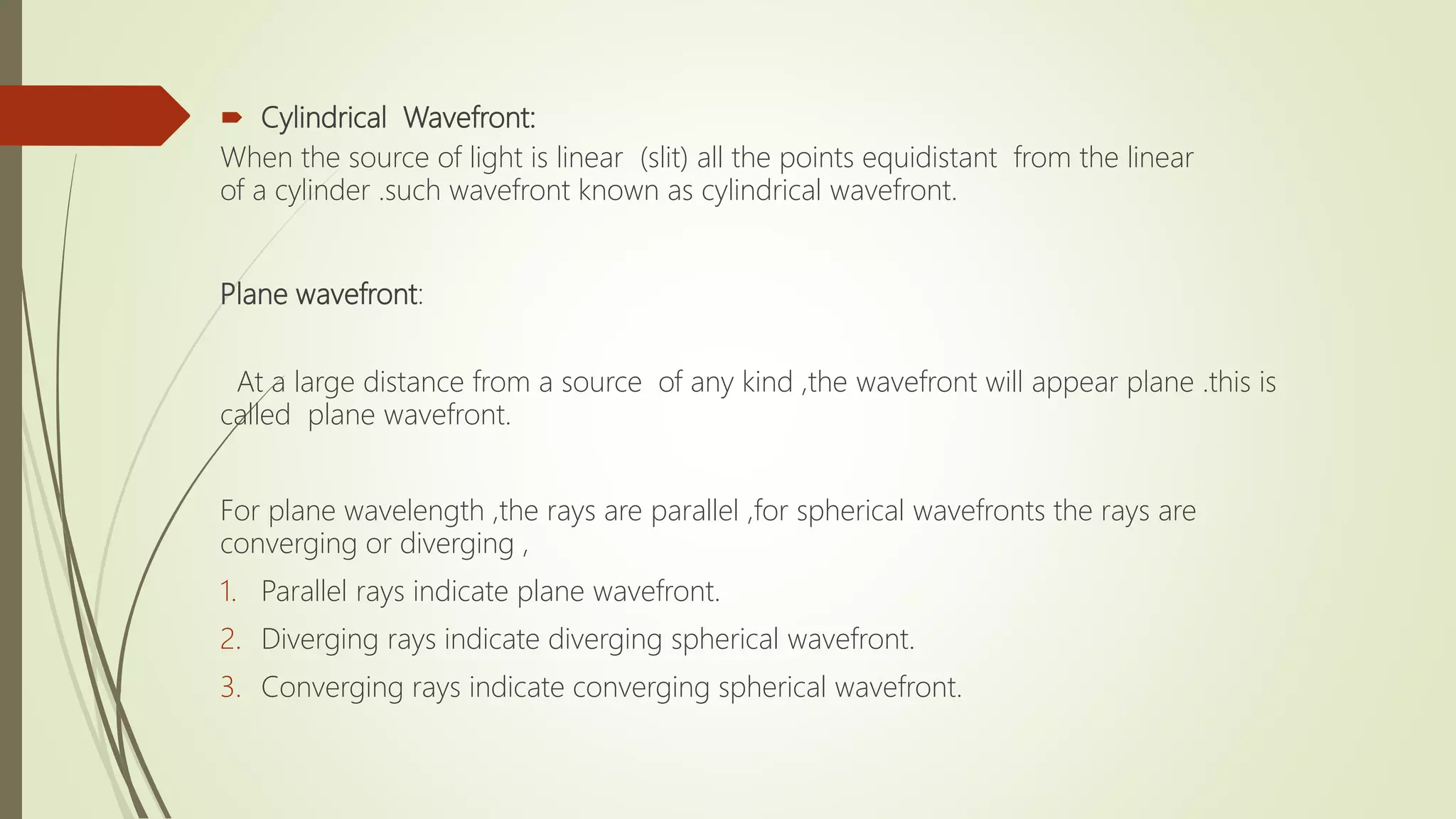
Spherical Wave front :
A point source kept in a isotropic medium
Emits spherical wavelength with the source
As the centre of the wavefront,because
All points are equidistant from the source lie on the surface
9.
Cylindrical Wavefront:
Whenthe source of light is linear (slit) all the points equidistant from the linear
of a cylinder .such wavefront known as cylindrical wavefront.
Plane wavefront:
At a large distance from a source of any kind ,the wavefront will appear plane .this is
called plane wavefront.
For plane wavelength ,the rays are parallel ,for spherical wavefronts the rays are
converging or diverging ,
1. Parallel rays indicate plane wavefront.
2. Diverging rays indicate diverging spherical wavefront.
3. Converging rays indicate converging spherical wavefront.
10.
Huygen’s Principle
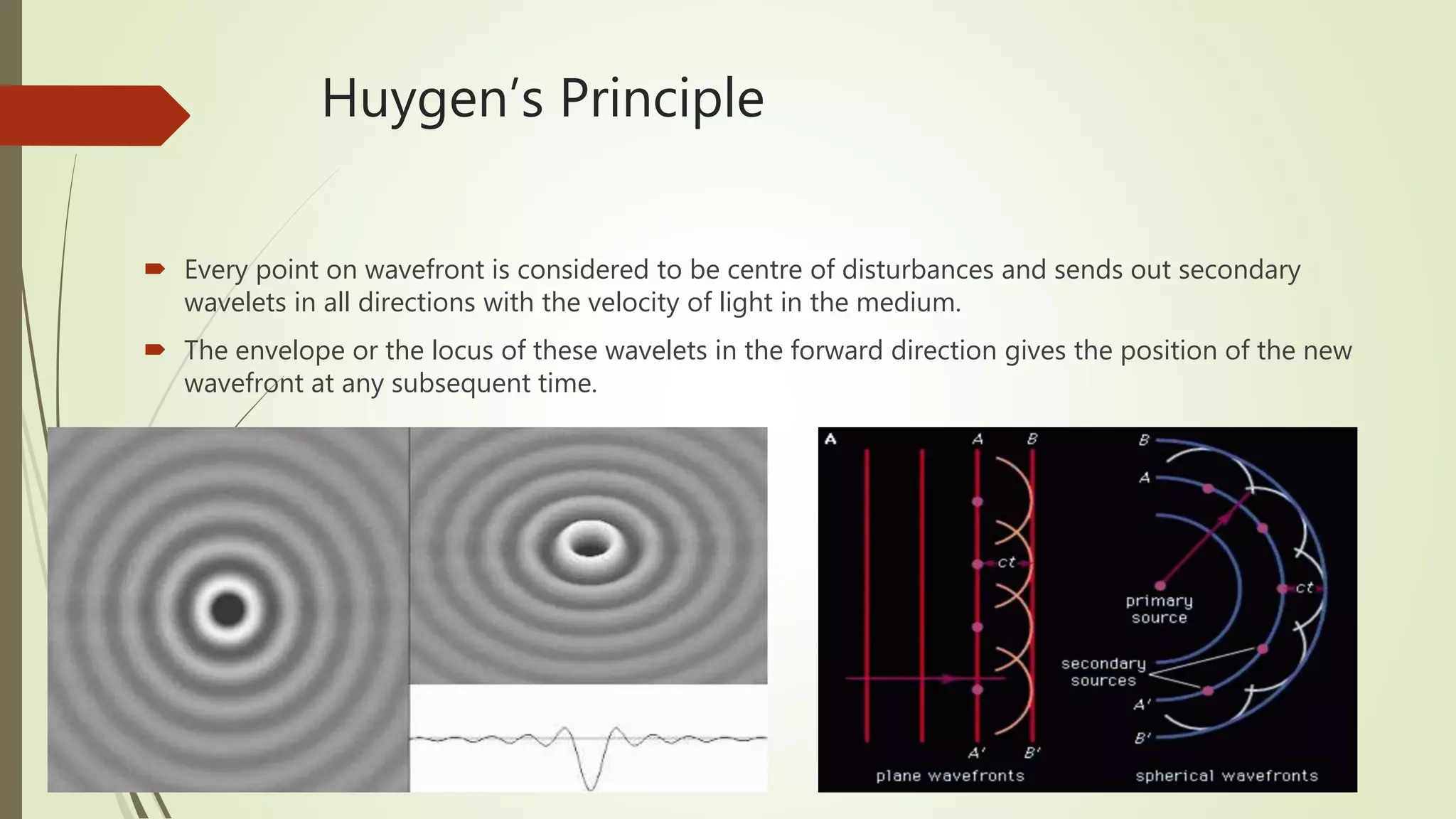
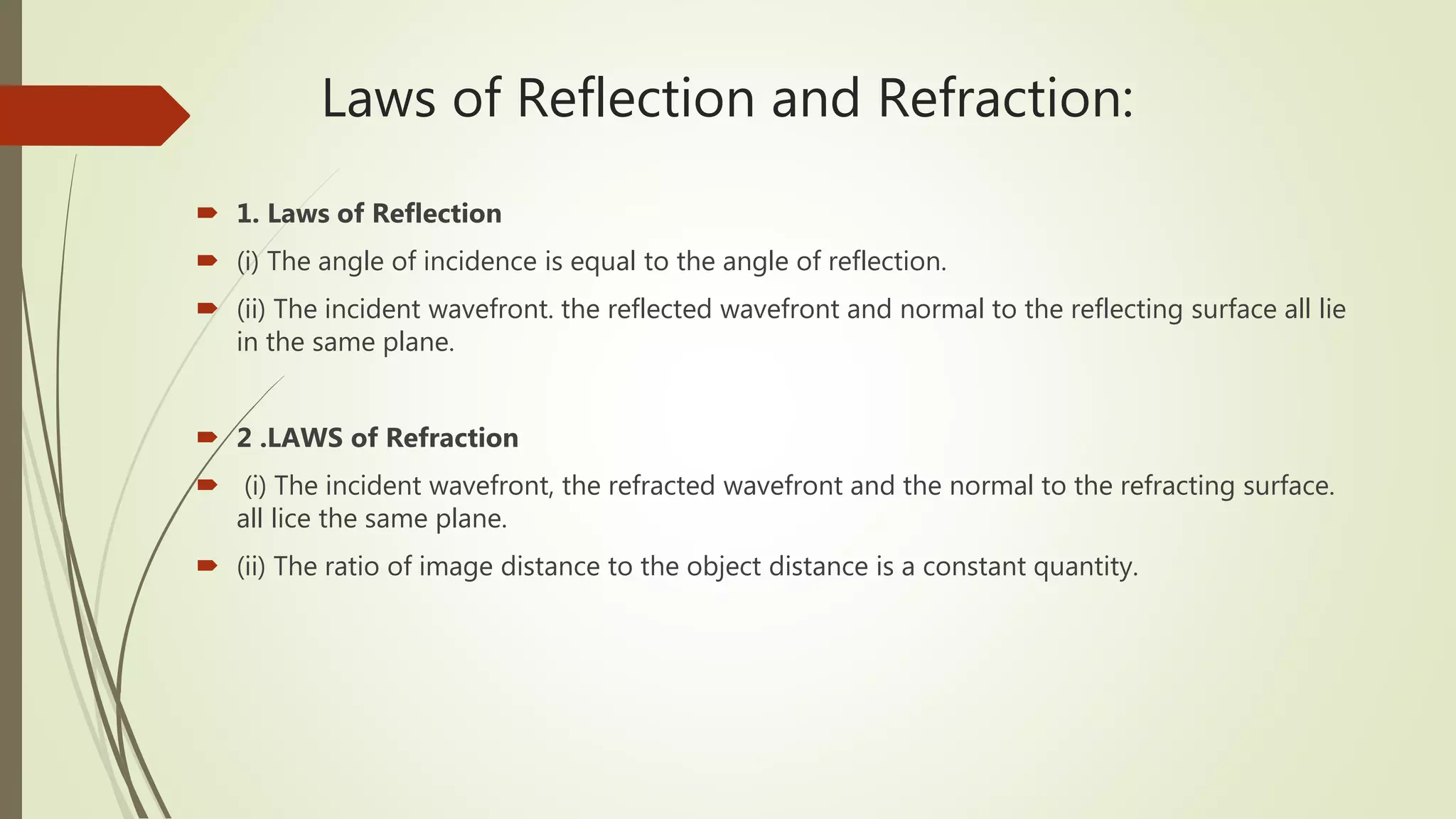
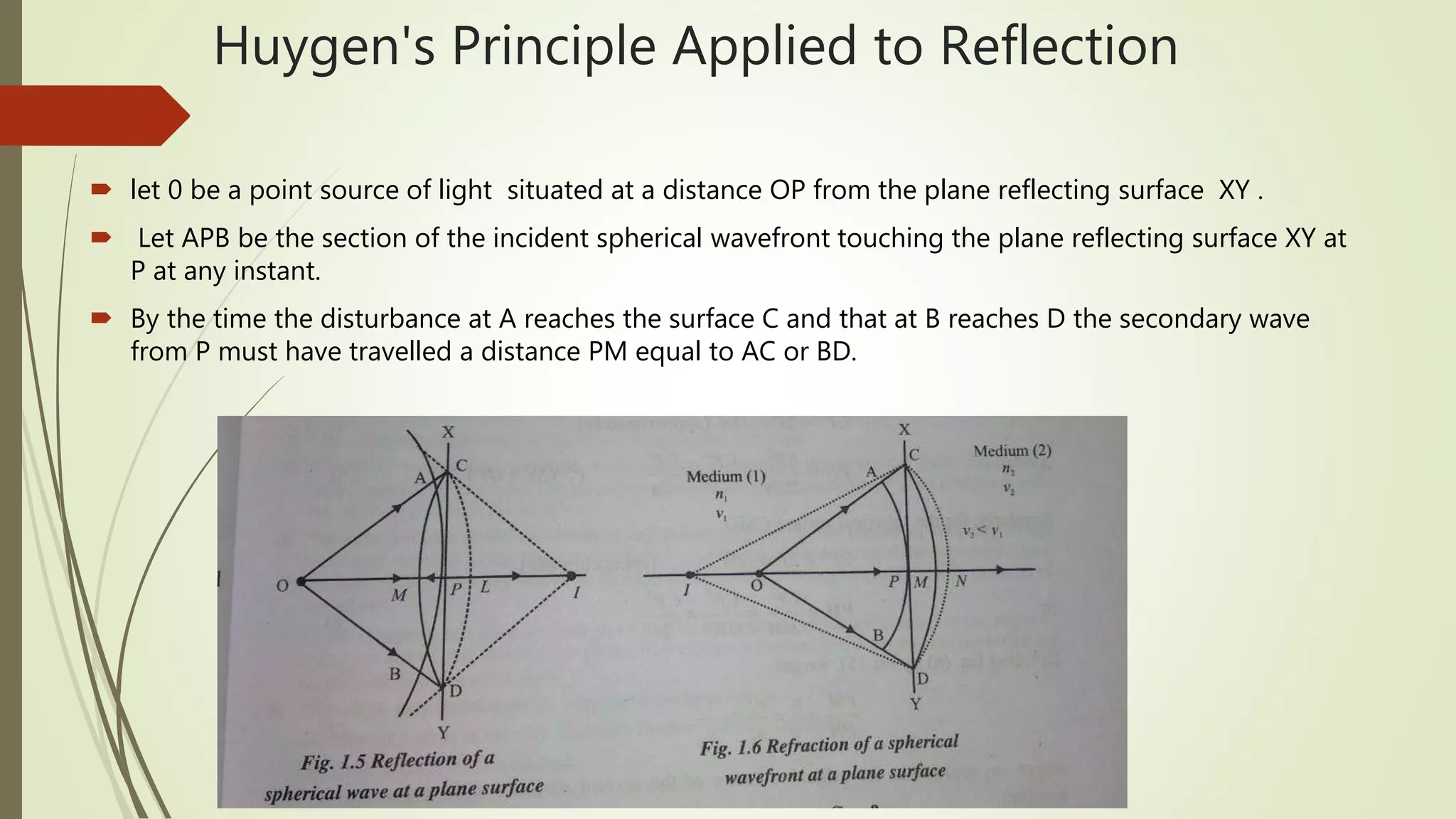
Everypoint on wavefront is considered to be centre of disturbances and sends out secondary
wavelets in all directions with the velocity of light in the medium.
The envelope or the locus of these wavelets in the forward direction gives the position of the new
wavefront at any subsequent time.
11.
Laws of Reflectionand Refraction:
1. Laws of Reflection
(i) The angle of incidence is equal to the angle of reflection.
(ii) The incident wavefront. the reflected wavefront and normal to the reflecting surface all lie
in the same plane.
2 .LAWS of Refraction
(i) The incident wavefront, the refracted wavefront and the normal to the refracting surface.
all lice the same plane.
(ii) The ratio of image distance to the object distance is a constant quantity.
12.
Huygen's Principle Appliedto Reflection
let 0 be a point source of light situated at a distance OP from the plane reflecting surface XY .
Let APB be the section of the incident spherical wavefront touching the plane reflecting surface XY at
P at any instant.
By the time the disturbance at A reaches the surface C and that at B reaches D the secondary wave
from P must have travelled a distance PM equal to AC or BD.
13.
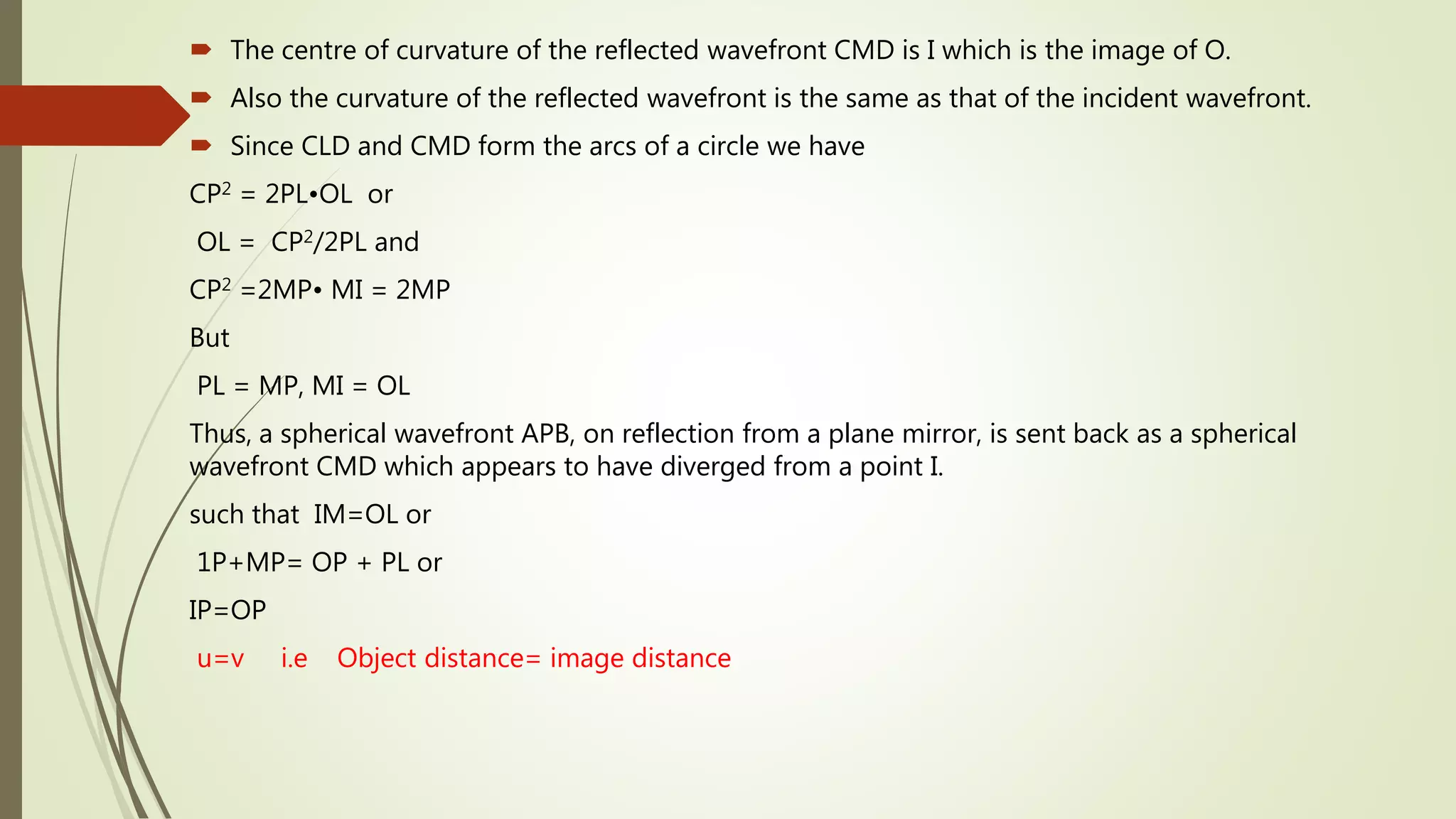
The centreof curvature of the reflected wavefront CMD is I which is the image of O.
Also the curvature of the reflected wavefront is the same as that of the incident wavefront.
Since CLD and CMD form the arcs of a circle we have
CP2 = 2PL•OL or
OL = CP2/2PL and
CP2 =2MP• MI = 2MP
But
PL = MP, MI = OL
Thus, a spherical wavefront APB, on reflection from a plane mirror, is sent back as a spherical
wavefront CMD which appears to have diverged from a point I.
such that IM=OL or
1P+MP= OP + PL or
IP=OP
u=v i.e Object distance= image distance
14.
Refraction of aspherical spherical wave at a plane
surface wavefront at a plane surface
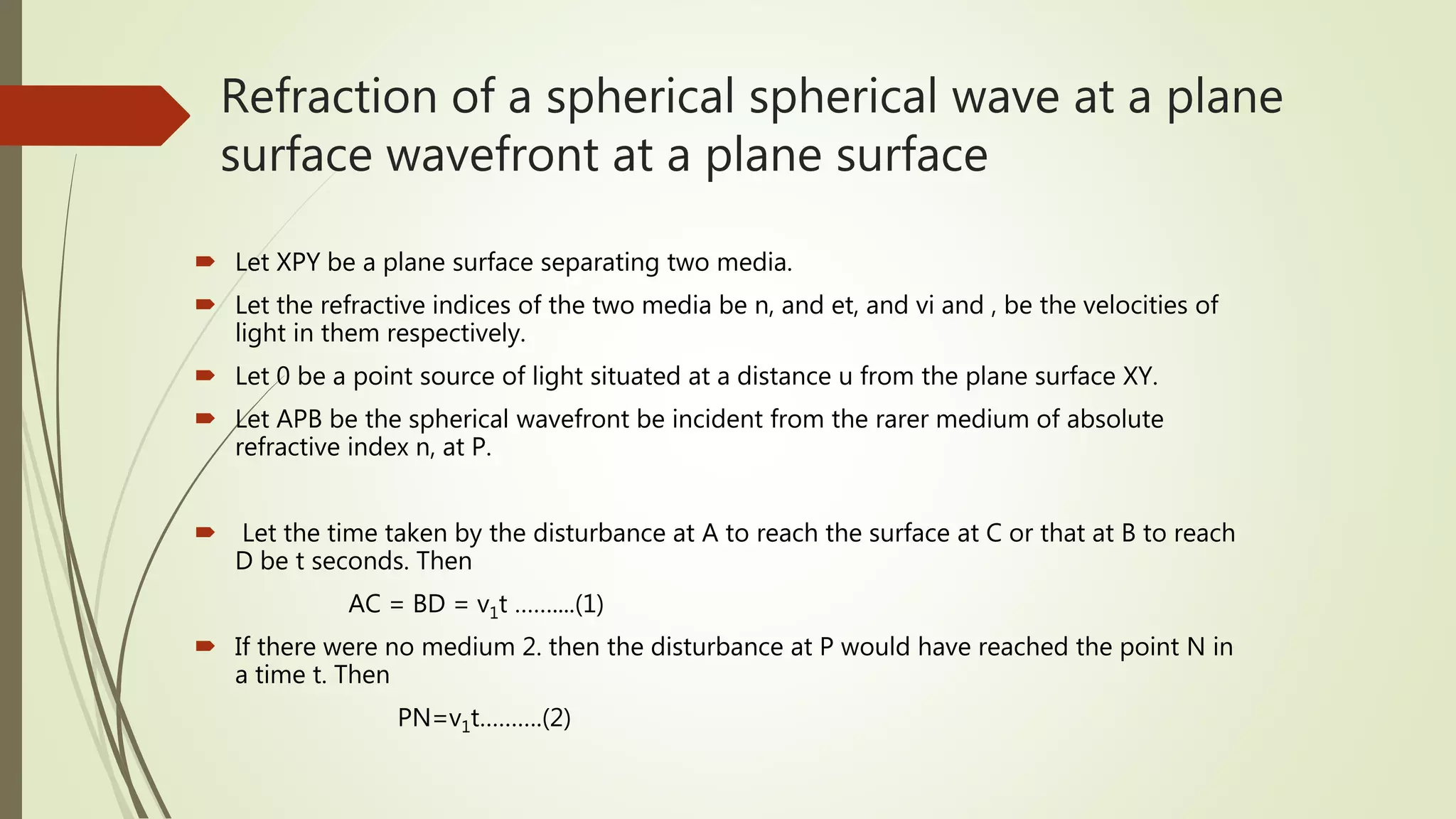
Let XPY be a plane surface separating two media.
Let the refractive indices of the two media be n, and et, and vi and , be the velocities of
light in them respectively.
Let 0 be a point source of light situated at a distance u from the plane surface XY.
Let APB be the spherical wavefront be incident from the rarer medium of absolute
refractive index n, at P.
Let the time taken by the disturbance at A to reach the surface at C or that at B to reach
D be t seconds. Then
AC = BD = v1t ……....(1)
If there were no medium 2. then the disturbance at P would have reached the point N in
a time t. Then
PN=v1t……….(2)
15.
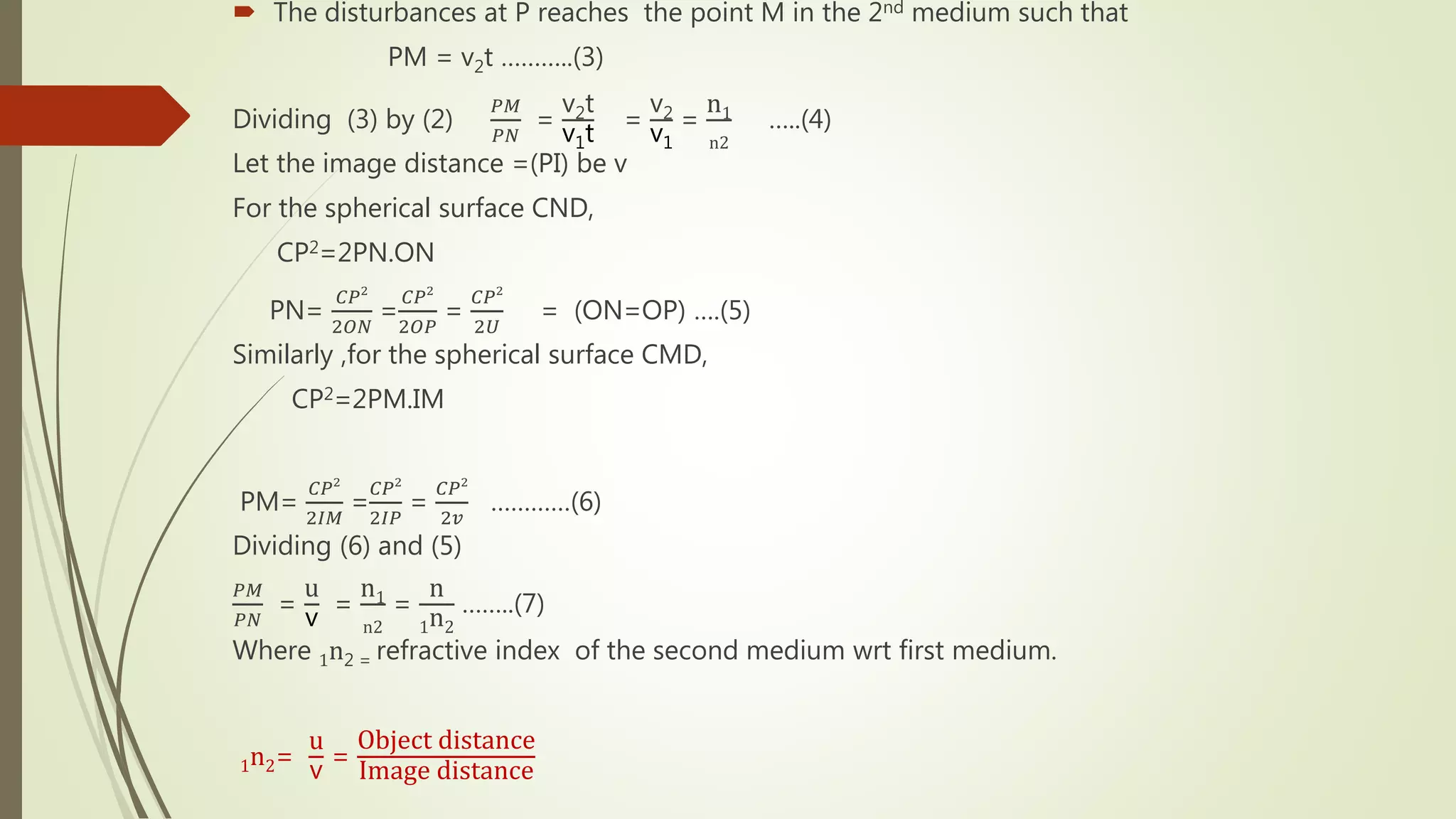
The disturbancesat P reaches the point M in the 2nd medium such that
PM = v2t ………..(3)
Dividing (3) by (2)
𝑃𝑀
𝑃𝑁
=
v2t
v1t
=
v2
v1
=
n1
n2
…..(4)
Let the image distance =(PI) be v
For the spherical surface CND,
CP2=2PN.ON
PN=
𝐶𝑃2
2𝑂𝑁
=
𝐶𝑃2
2𝑂𝑃
=
𝐶𝑃2
2𝑈
= (ON=OP) ….(5)
Similarly ,for the spherical surface CMD,
CP2=2PM.IM
PM=
𝐶𝑃2
2𝐼𝑀
=
𝐶𝑃2
2𝐼𝑃
=
𝐶𝑃2
2𝑣
…………(6)
Dividing (6) and (5)
𝑃𝑀
𝑃𝑁
=
u
v =
n1
n2
=
n
1n2
……..(7)
Where 1n2 = refractive index of the second medium wrt first medium.
1n2=
u
v
=
Object distance
Image distance