Refraction of Light
LIGHT
LIGHT
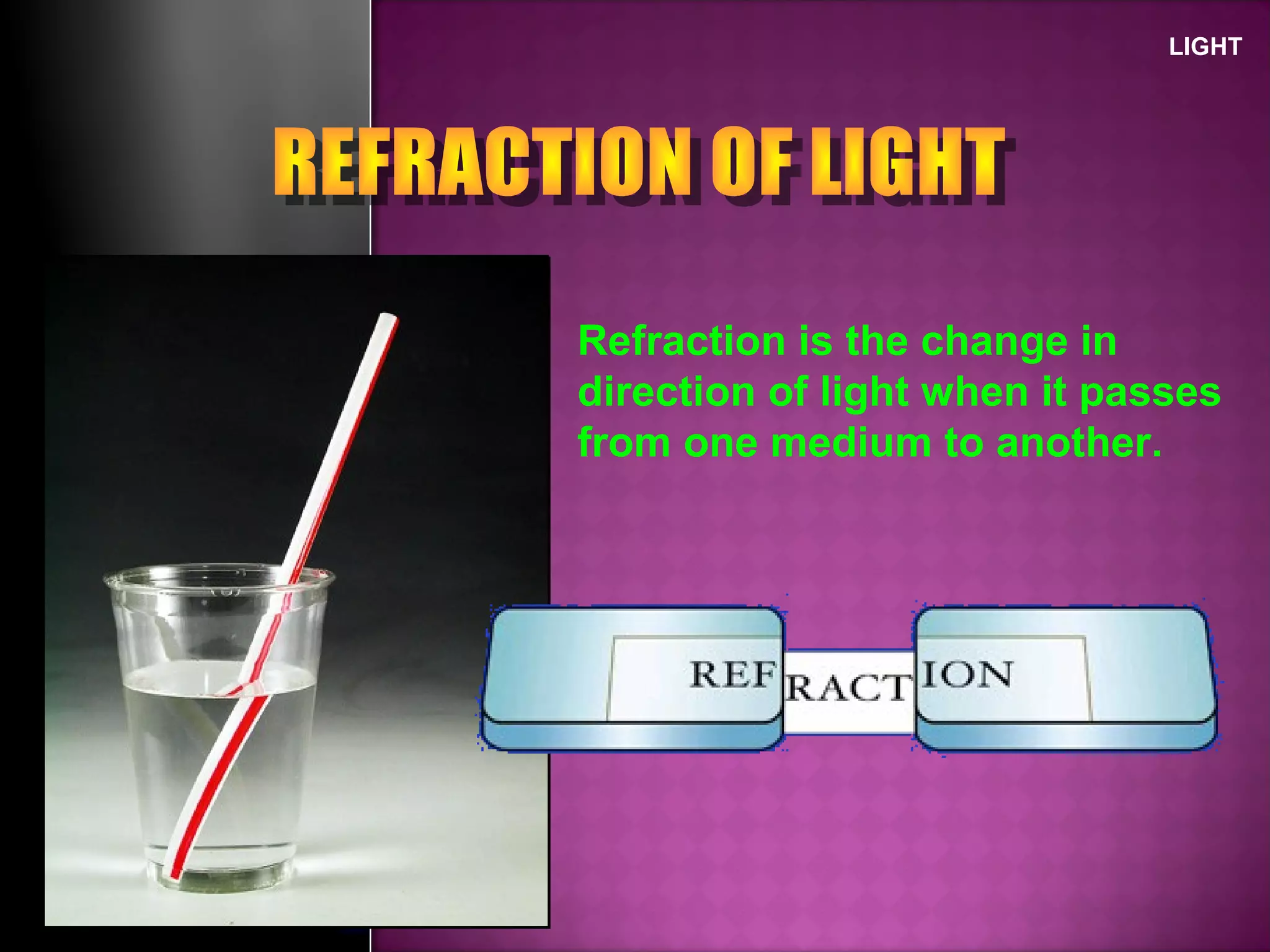
Refraction is the change in
direction of light when it passes
from one medium to another.
LIGHT
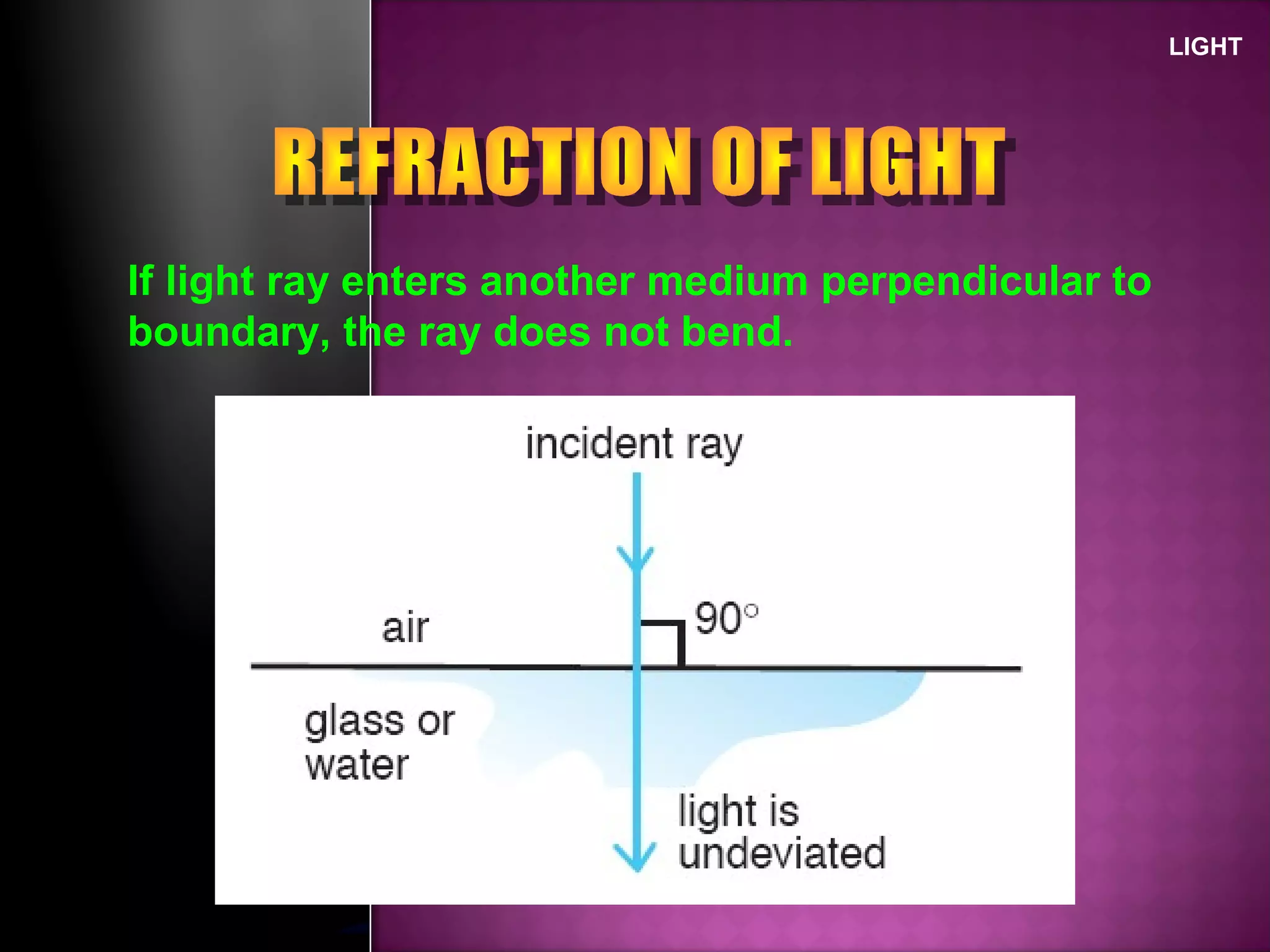
If light ray enters another medium perpendicular to
boundary, the ray does not bend.
LIGHT
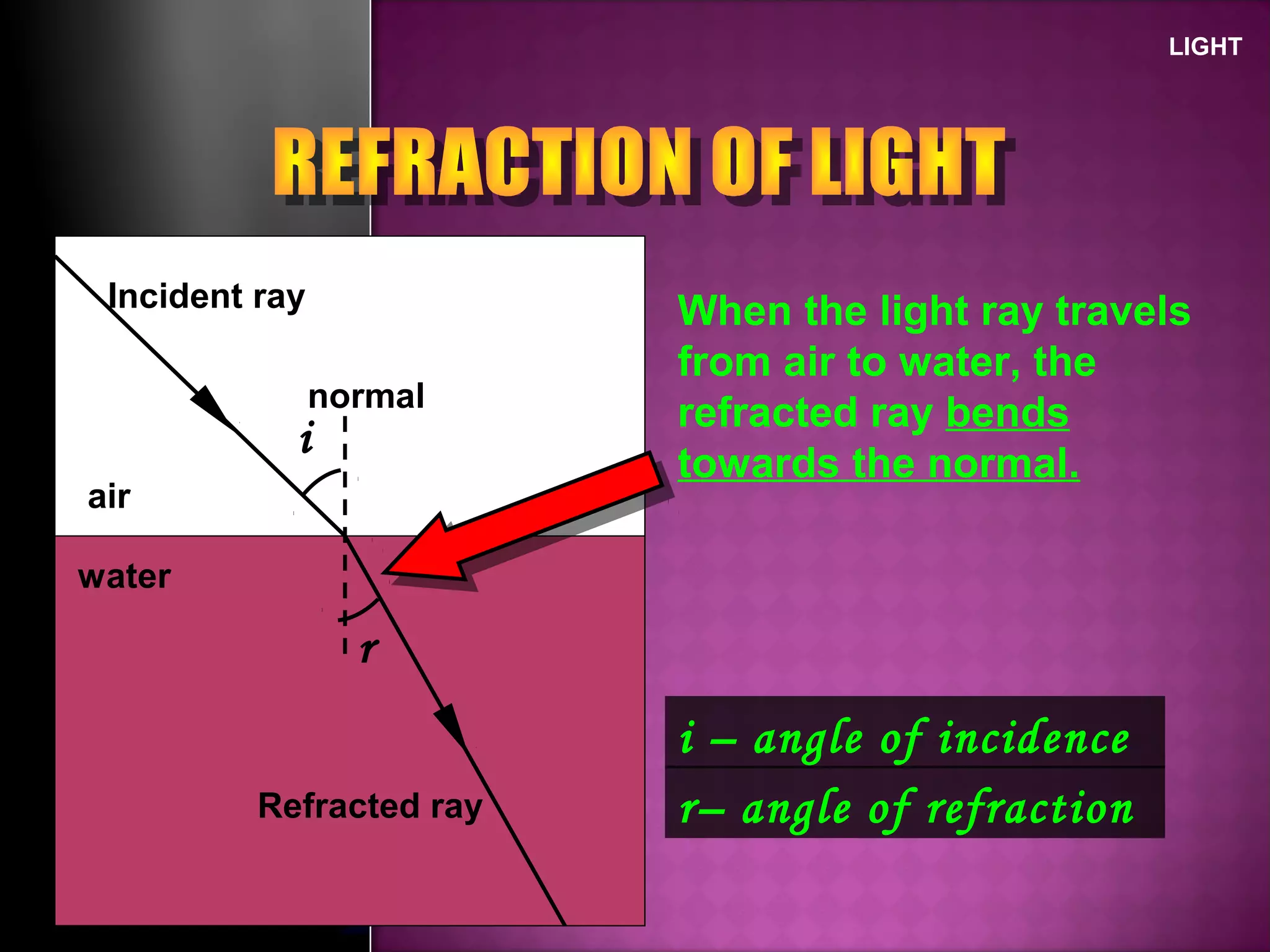
When the light ray travels
from air to water, the
refracted ray bends
towards the normal.
i
r
air
water
Incident ray
Refracted ray
normal
i – angle of incidence
r– angle of refraction
LIGHT
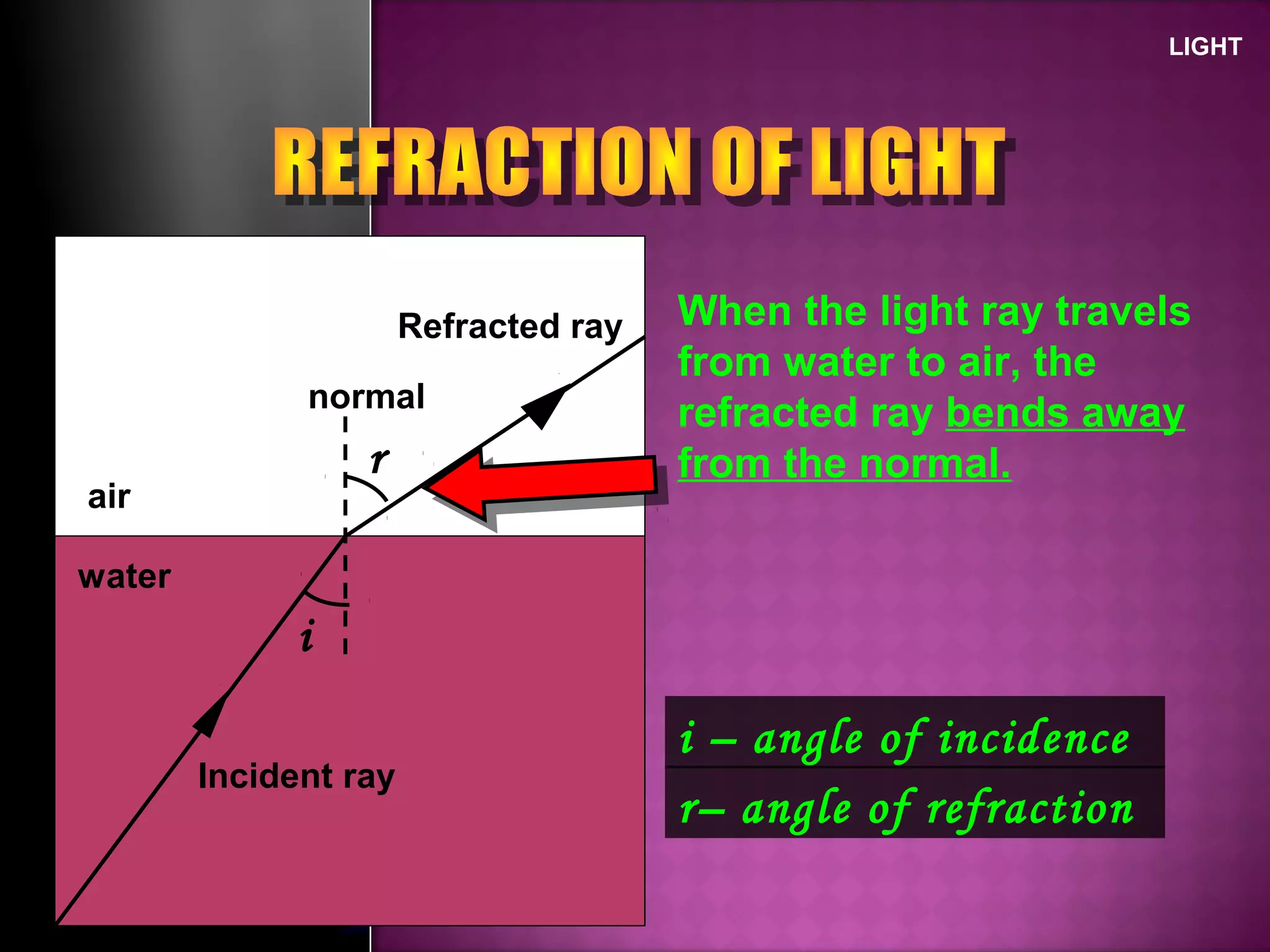
When the light ray travels
from water to air, the
refracted ray bends away
from the normal.
i
r
air
water
Incident ray
Refracted ray
normal
i – angle of incidence
r– angle of refraction
LIGHT
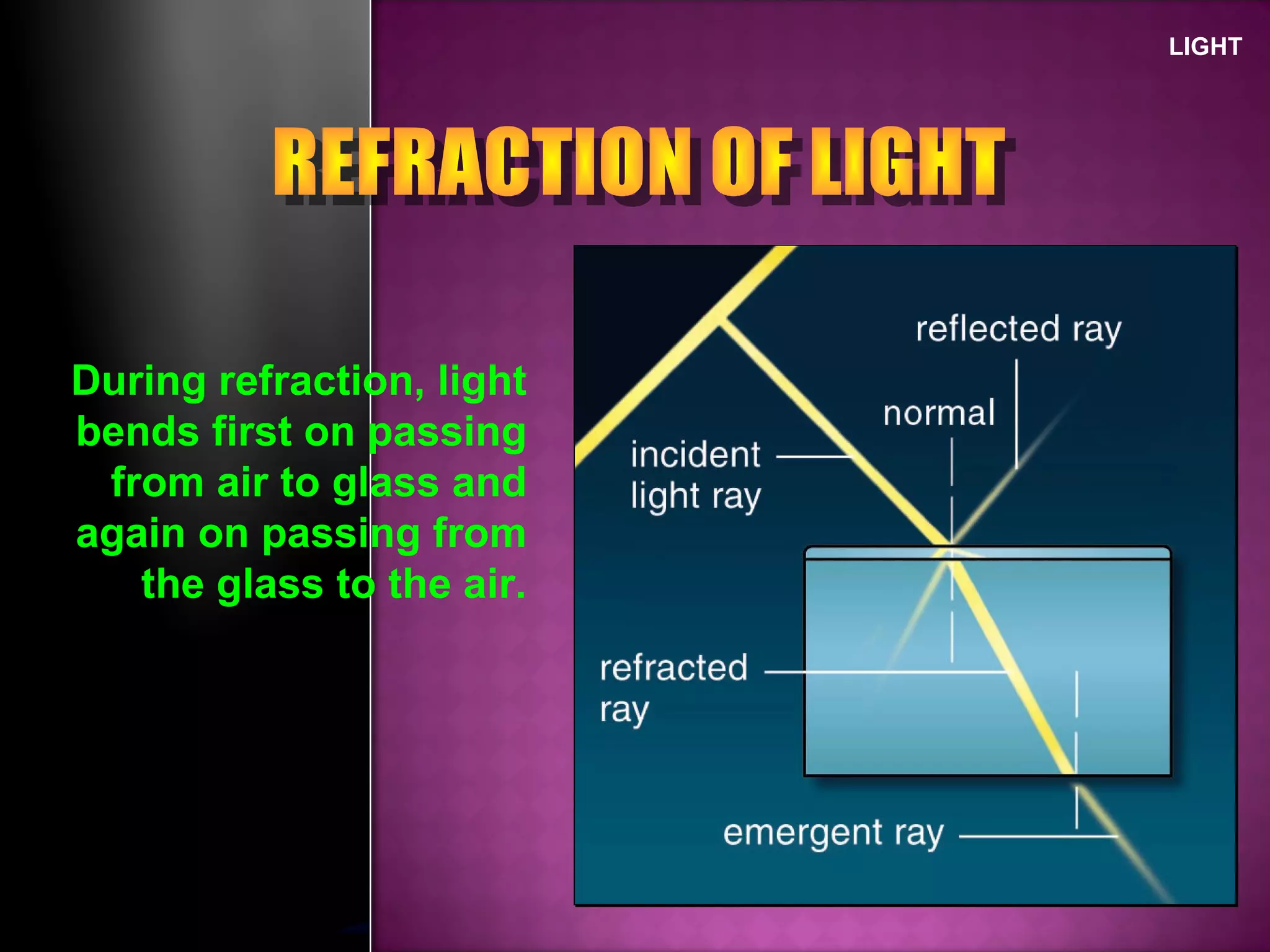
During refraction, light
bends first on passing
from air to glass and
again on passing from
the glass to the air.
LIGHT
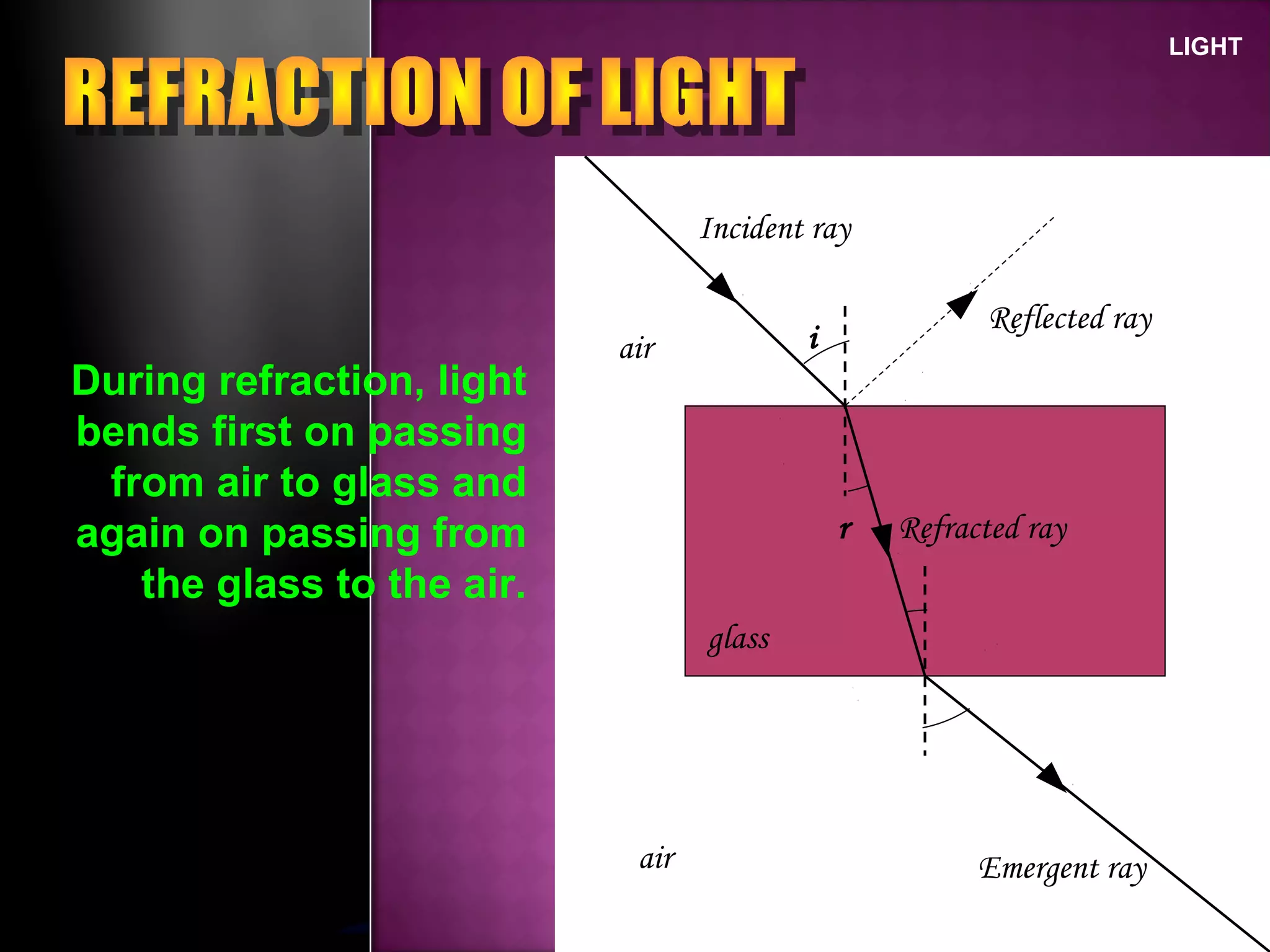
During refraction, light
bends first on passing
from air to glass and
again on passing from
the glass to the air.
i
r
Incident ray
Emergent ray
Refracted ray
Reflected ray
air
air
glass
LIGHT
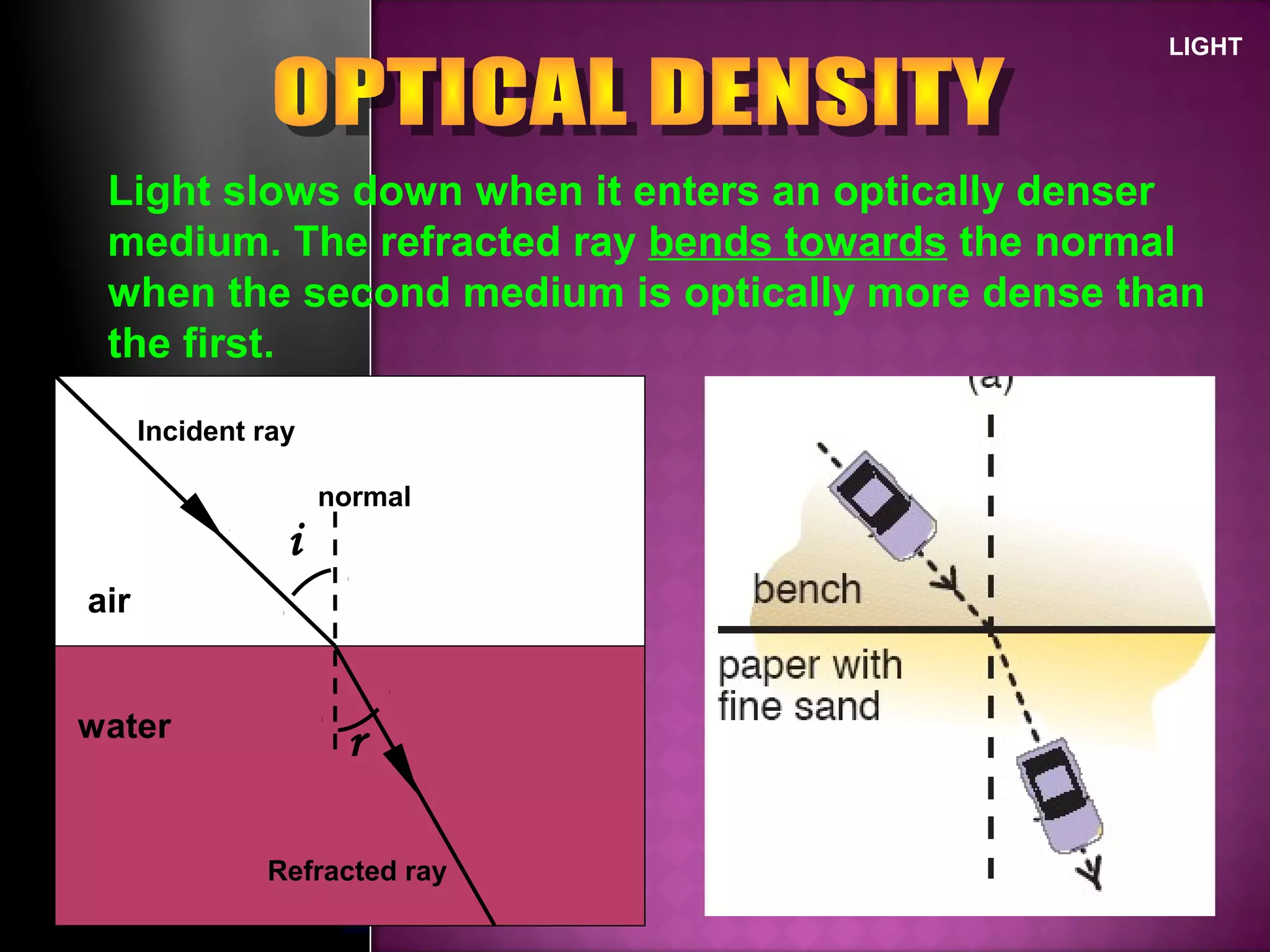
Light slows down when it enters an optically denser
medium. The refracted ray bends towards the normal
when the second medium is optically more dense than
the first.
i
r
air
water
Incident ray
Refracted ray
normal
LIGHT
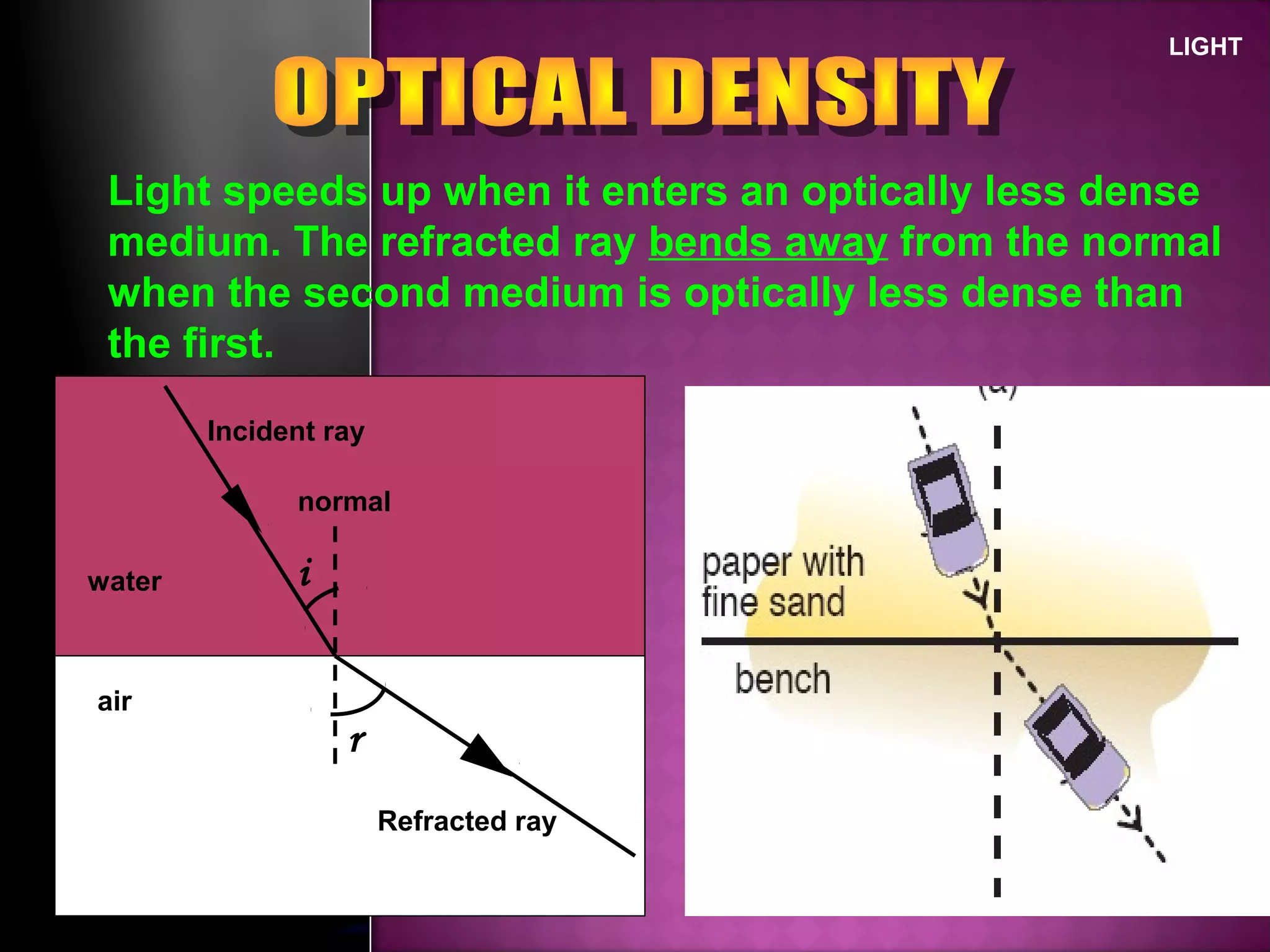
Light speeds up when it enters an optically less dense
medium. The refracted ray bends away from the normal
when the second medium is optically less dense than
the first.
air
water i
r
Incident ray
Refracted ray
normal
LIGHT
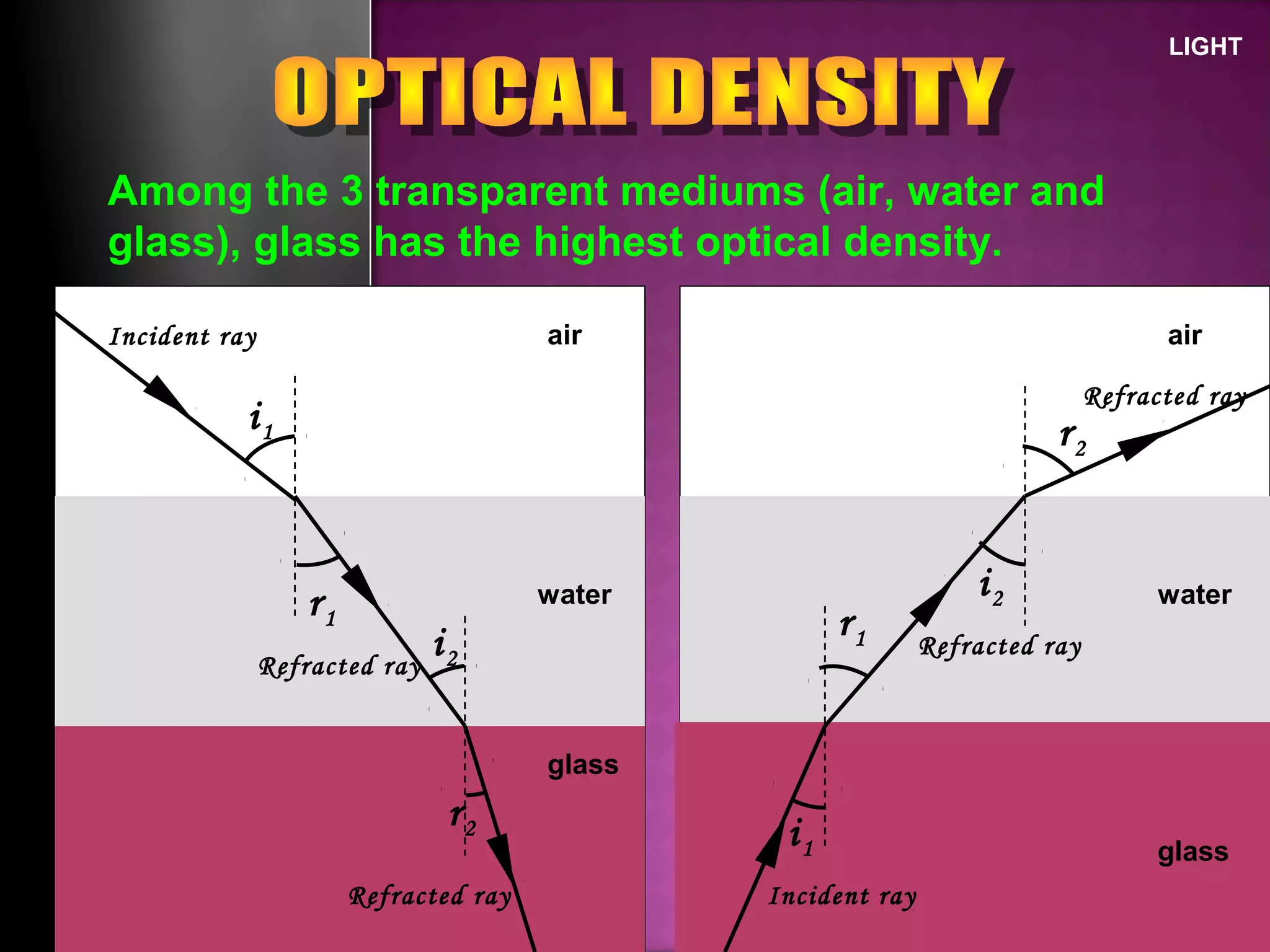
Among the 3 transparent mediums (air, water and
glass), glass has the highest optical density.
air
water
i1
r1
Incident ray
Refracted ray
glass
i2
r2
Refracted ray
air
water
i1
r1
Incident ray
glass
i2
r2
Refracted ray
Refracted ray
LIGHT
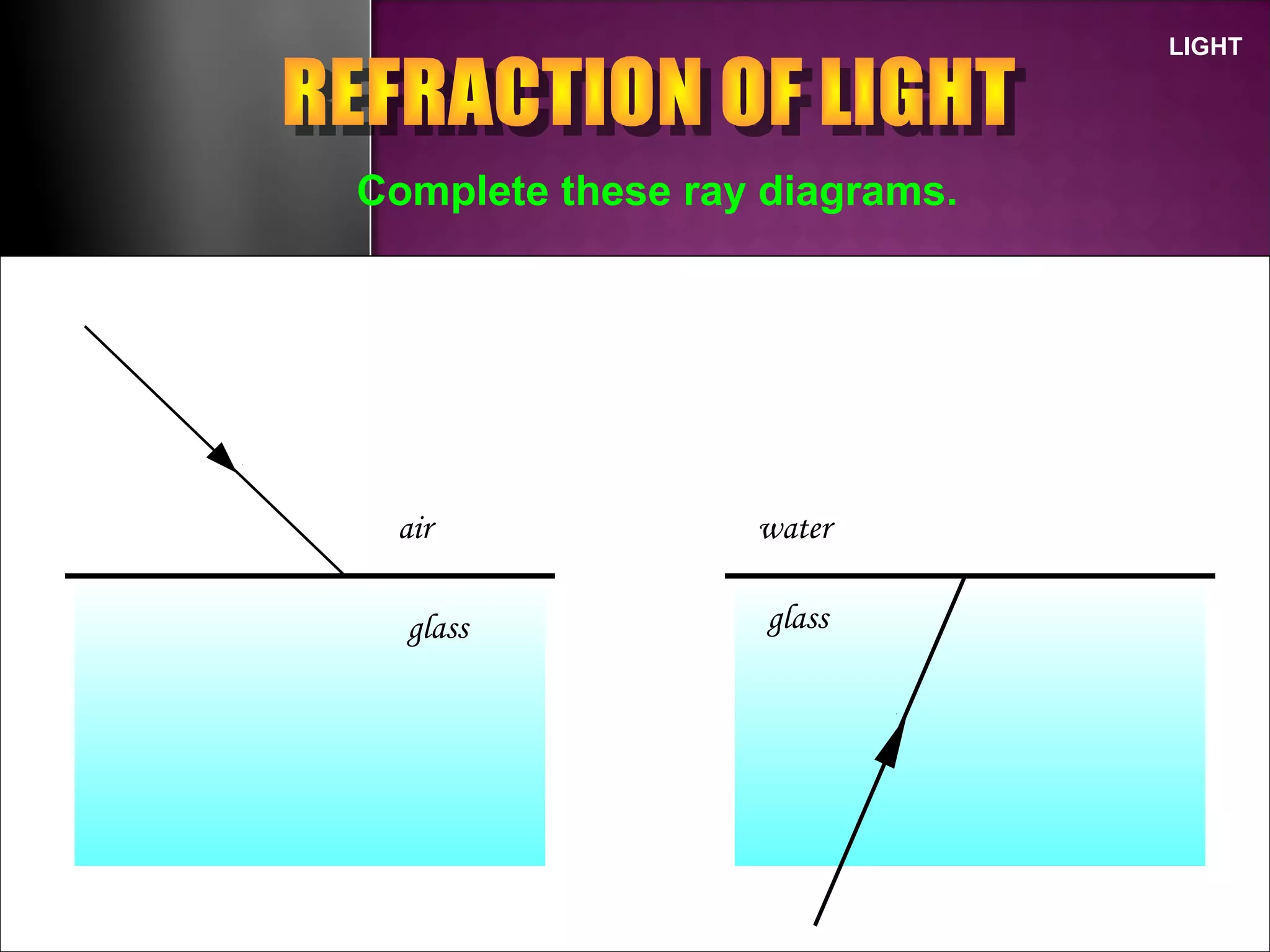
Complete these ray diagrams.
air
glass glass
water
LIGHT
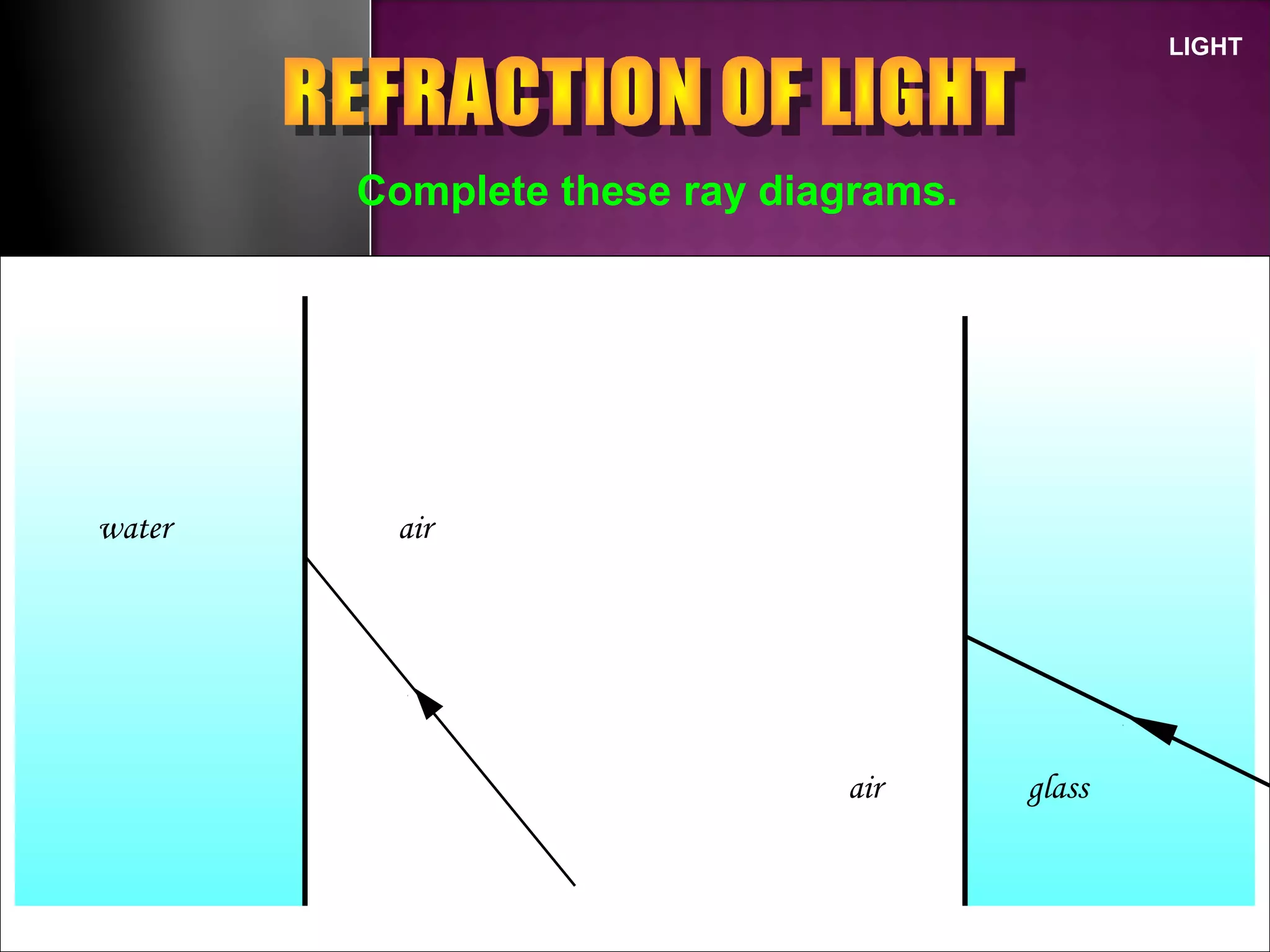
Complete these ray diagrams.
airwater
glassair
LIGHT
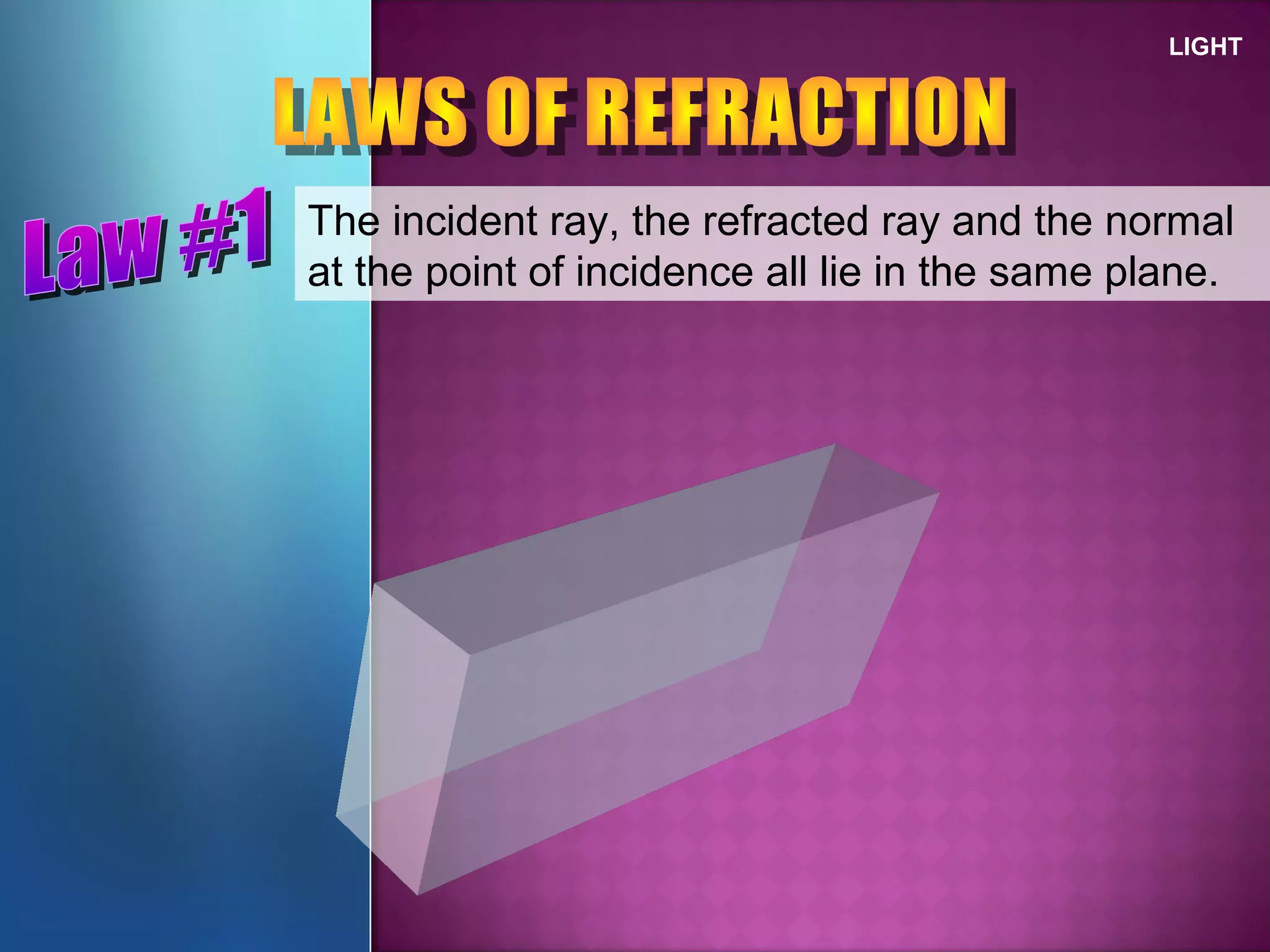
The incident ray, the refracted ray and the normal
at the point of incidence all lie in the same plane.
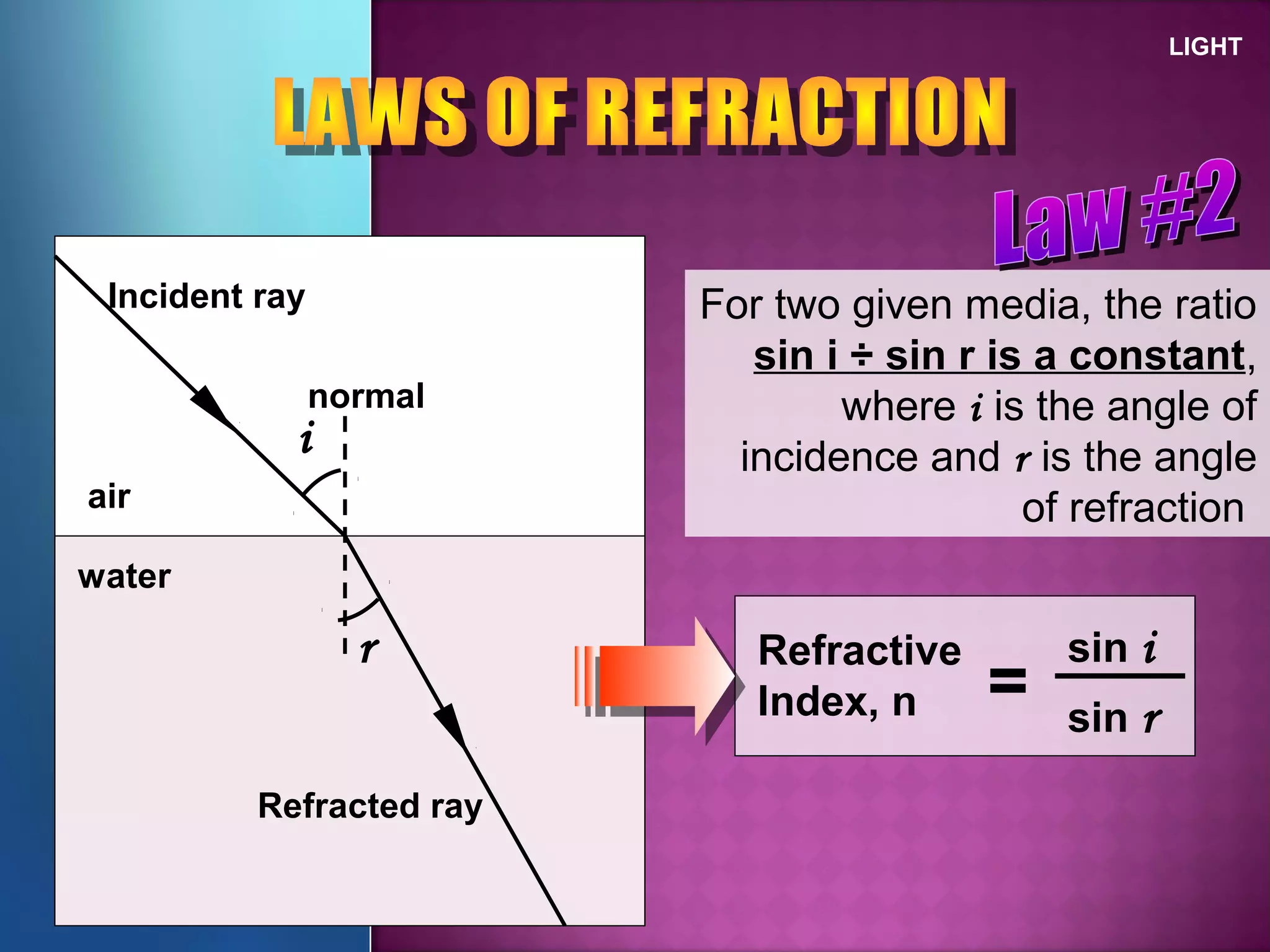
For two given media, the ratio
sin i ÷ sin r is a constant,
where i is the angle of
incidence and r is the angle
of refraction
LIGHT
i
r
air
water
Incident ray
Refracted ray
normal
Refractive
Index, n =
sin i
sin r
LIGHT
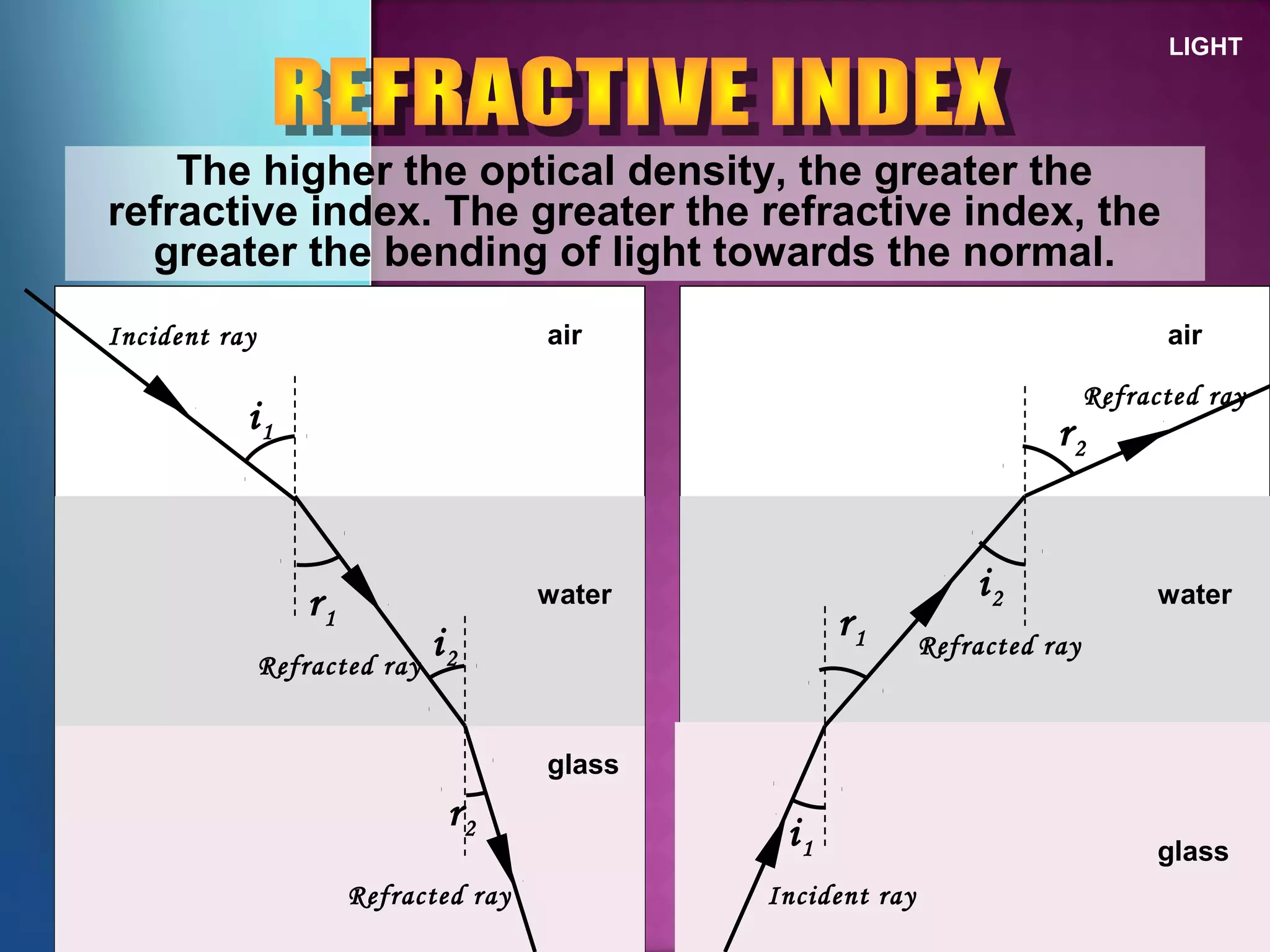
The higher the optical density, the greater the
refractive index. The greater the refractive index, the
greater the bending of light towards the normal.
air
water
i1
r1
Incident ray
Refracted ray
glass
i2
r2
Refracted ray
air
water
i1
r1
Incident ray
glass
i2
r2
Refracted ray
Refracted ray
LIGHT
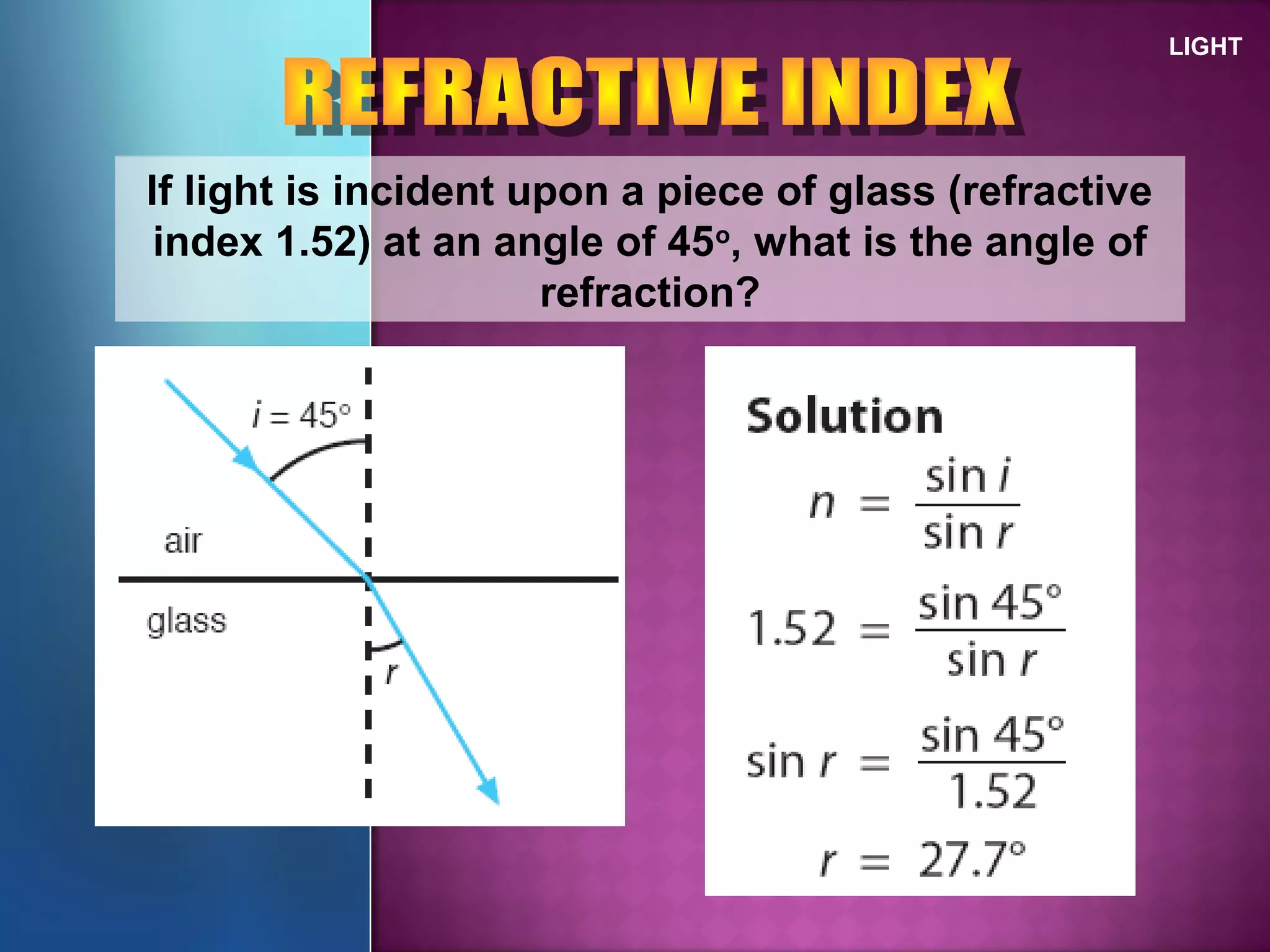
If light is incident upon a piece of glass (refractive
index 1.52) at an angle of 45o
, what is the angle of
refraction?
LIGHT
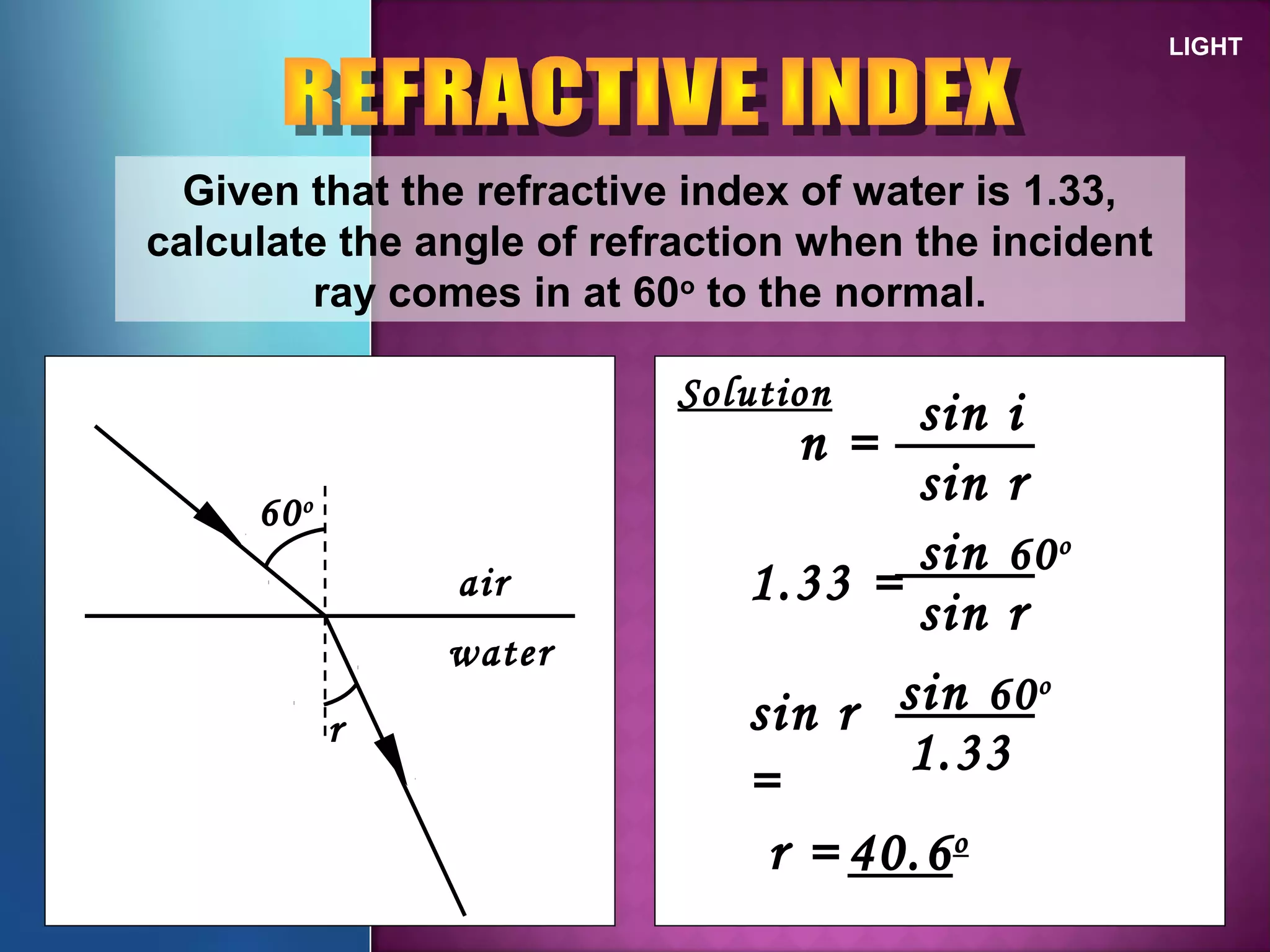
Given that the refractive index of water is 1.33,
calculate the angle of refraction when the incident
ray comes in at 60o
to the normal.
60o
r
air
water
Solution
n =
sin i
sin r
1.33 =
sin 60o
sin r
sin r
=
sin 60o
1.33
r = 40.6o
LIGHT
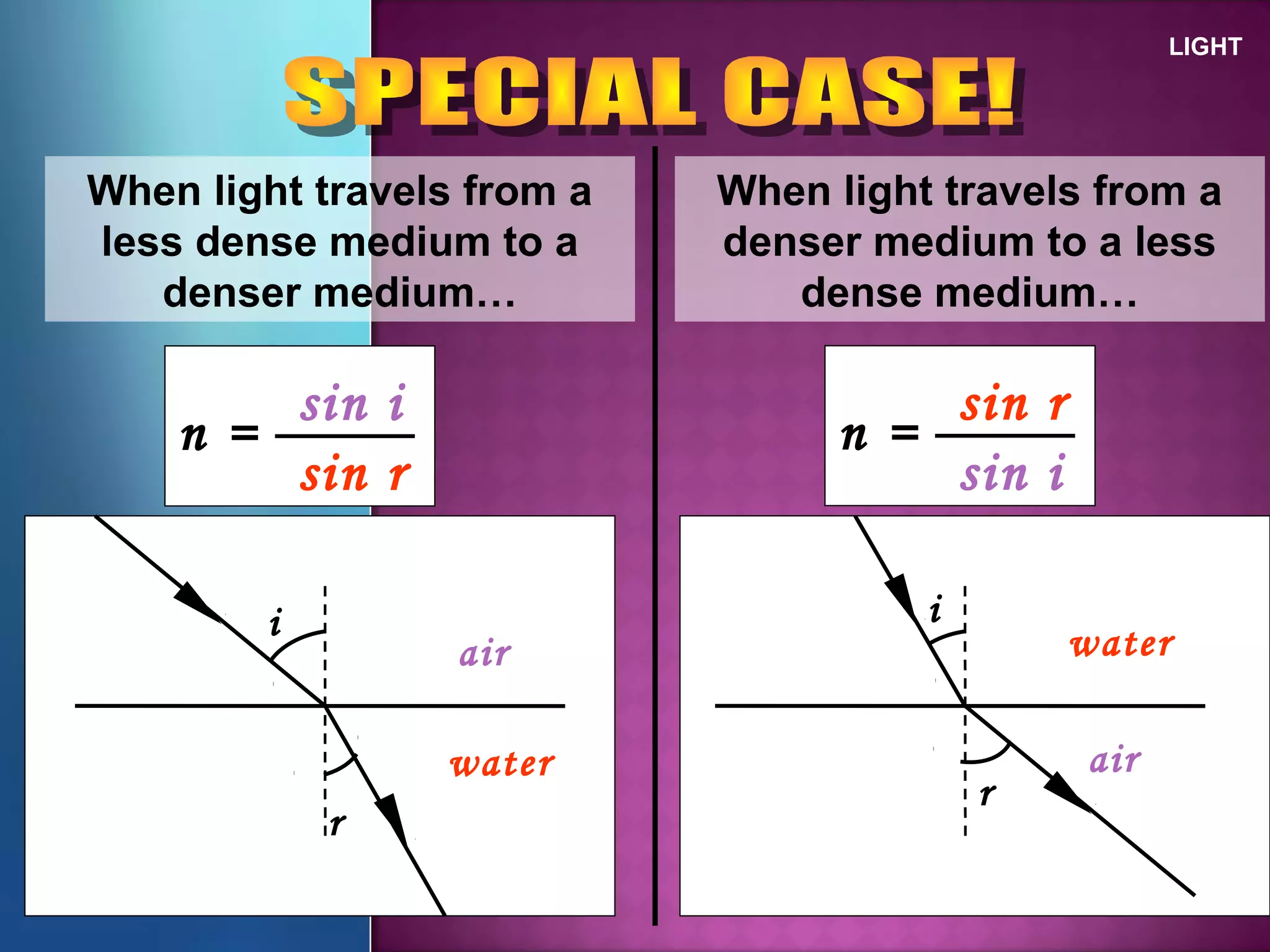
When light travels from a
less dense medium to a
denser medium…
n =
sin i
sin r
i
r
air
water
When light travels from a
denser medium to a less
dense medium…
n =
sin r
sin i
i
r
air
water
LIGHT
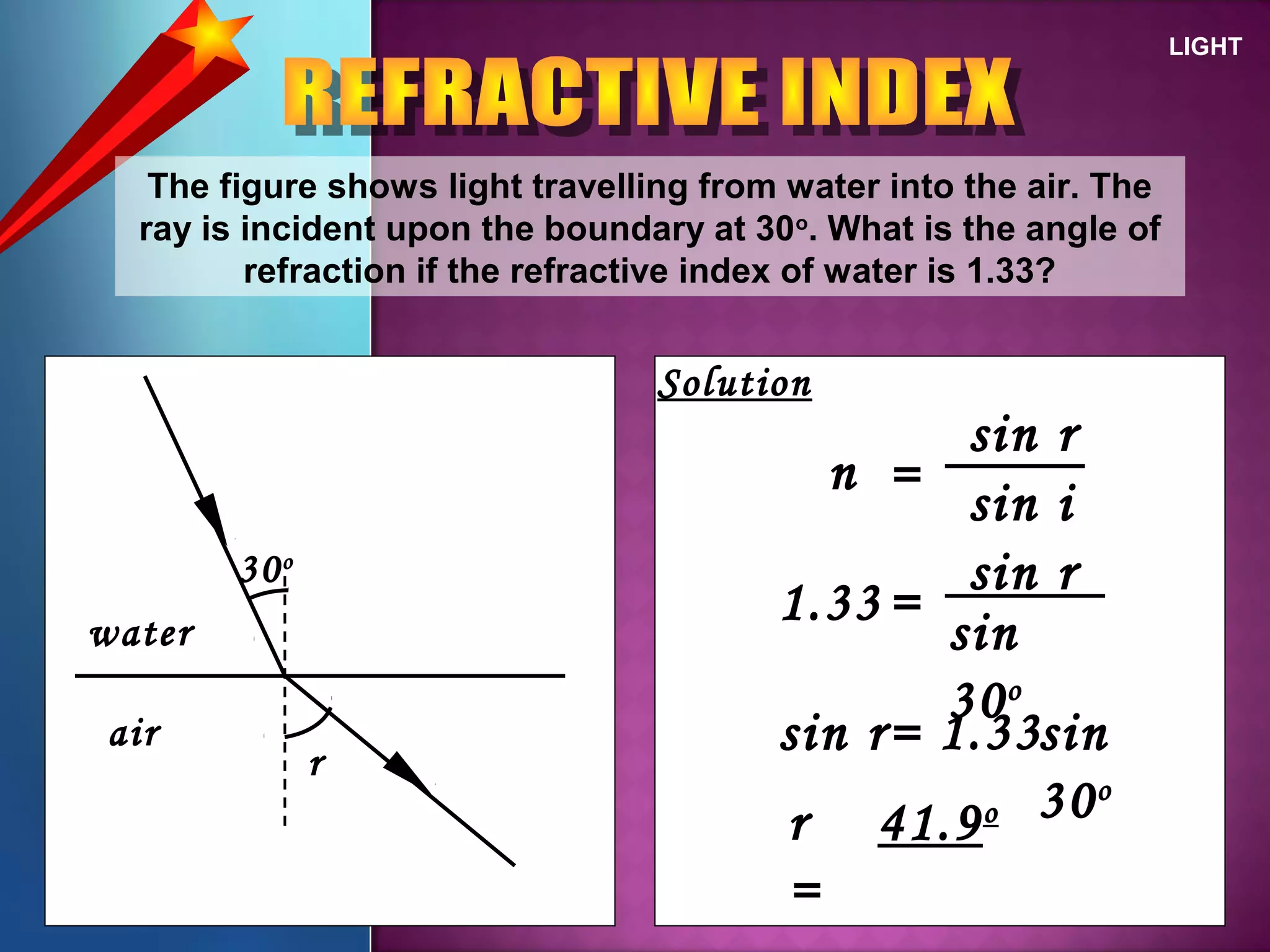
The figure shows light travelling from water into the air. The
ray is incident upon the boundary at 30o
. What is the angle of
refraction if the refractive index of water is 1.33?
30o
r
air
water
Solution
n
sin r
sin i
=
1.33
sin
30o
sin r
=
sin r= 1.33sin
30o
r
=
41.9o
LIGHT
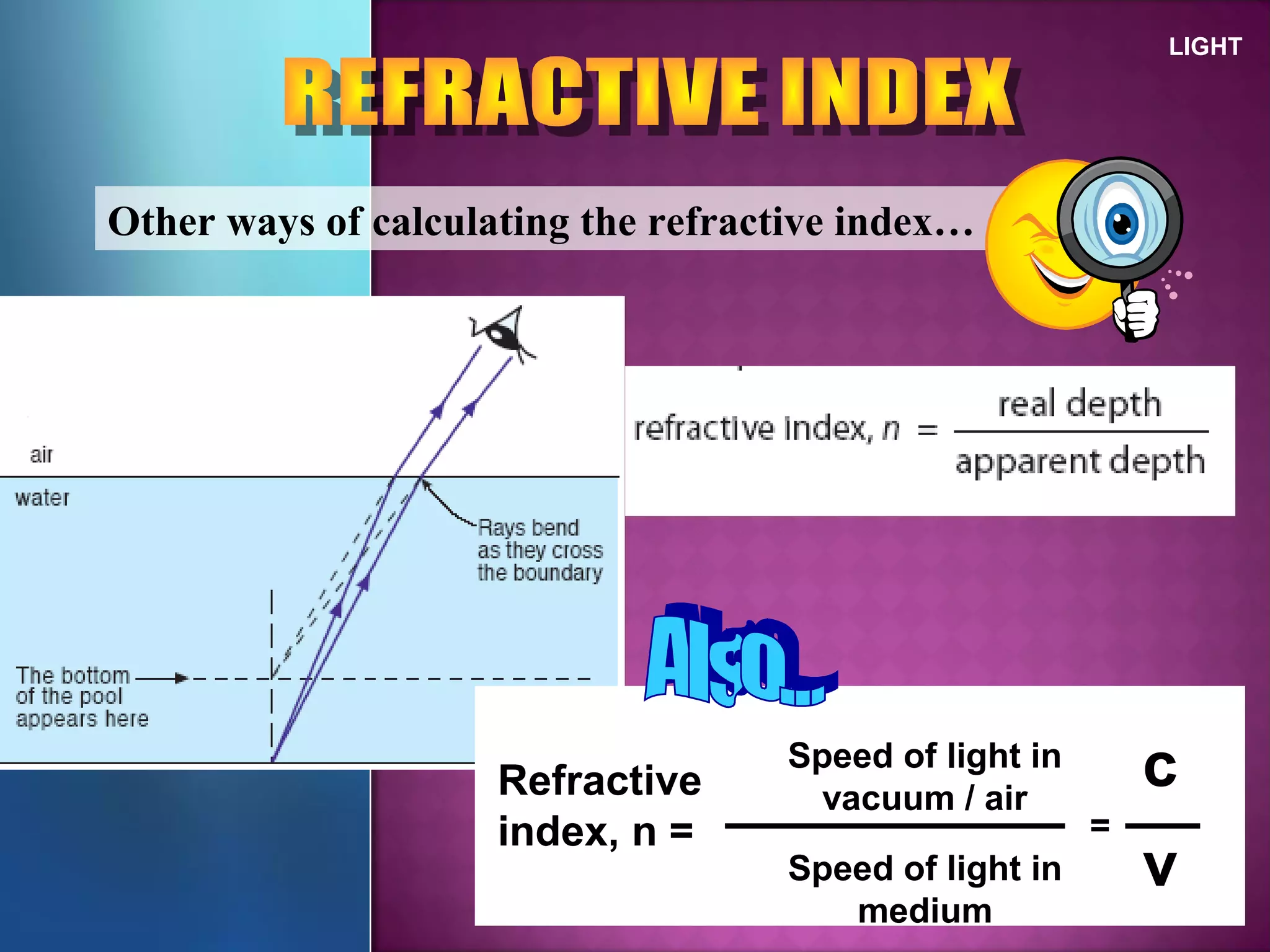
Other ways of calculating the refractive index…
Refractive
index, n =
Speed of light in
vacuum / air
Speed of light in
medium
=
c
v
LIGHT
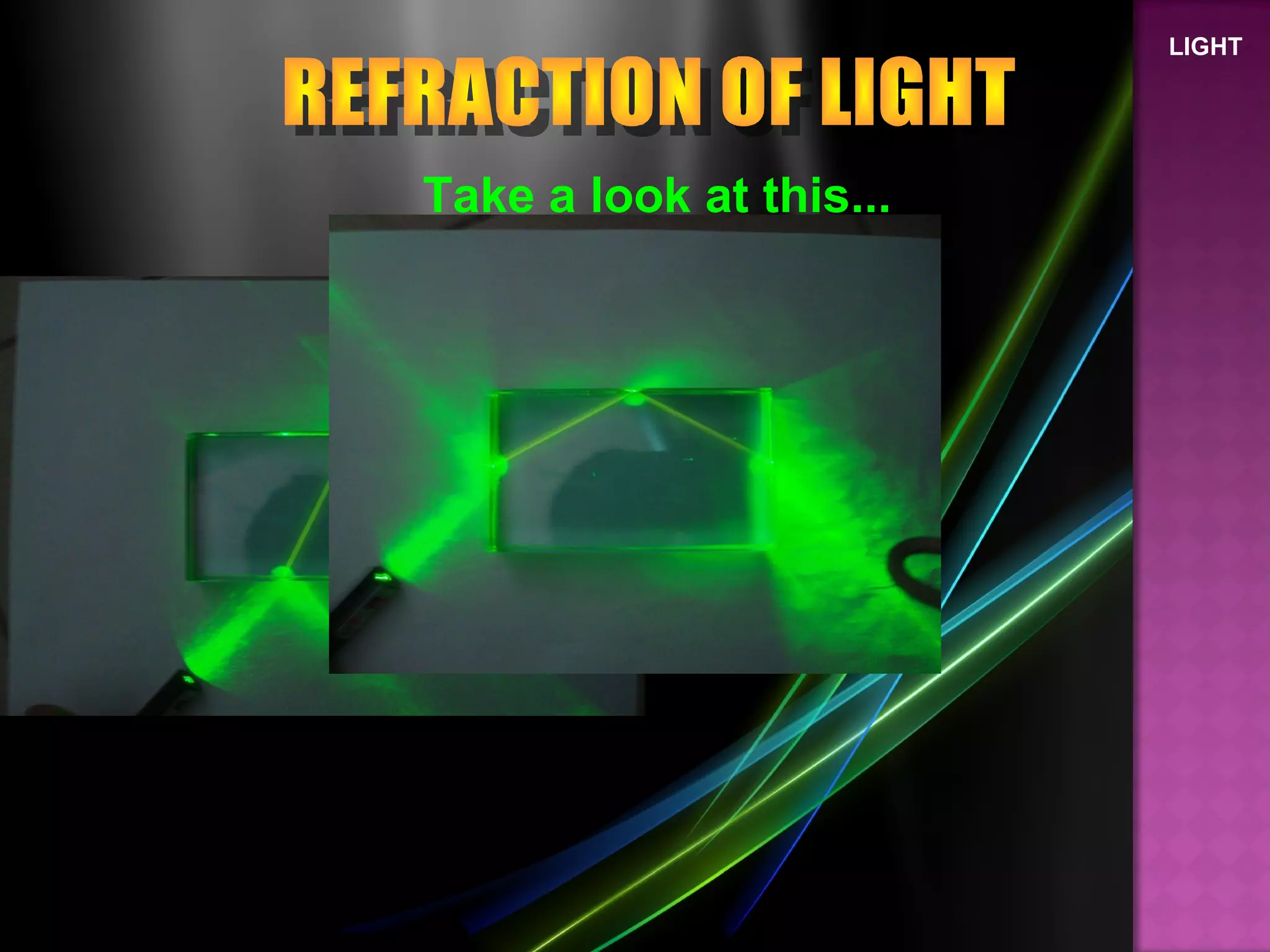
Take a look at this...
LIGHT
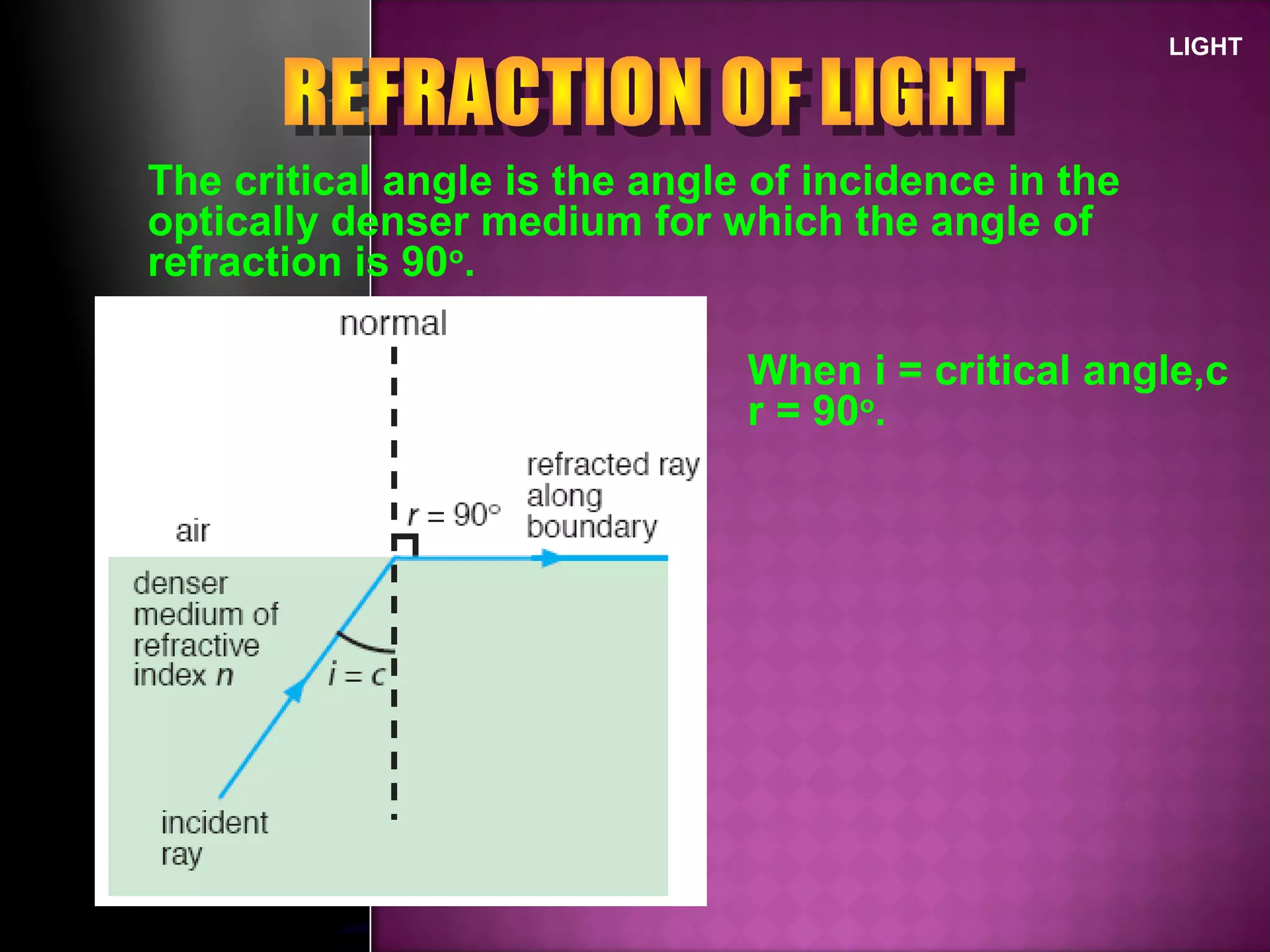
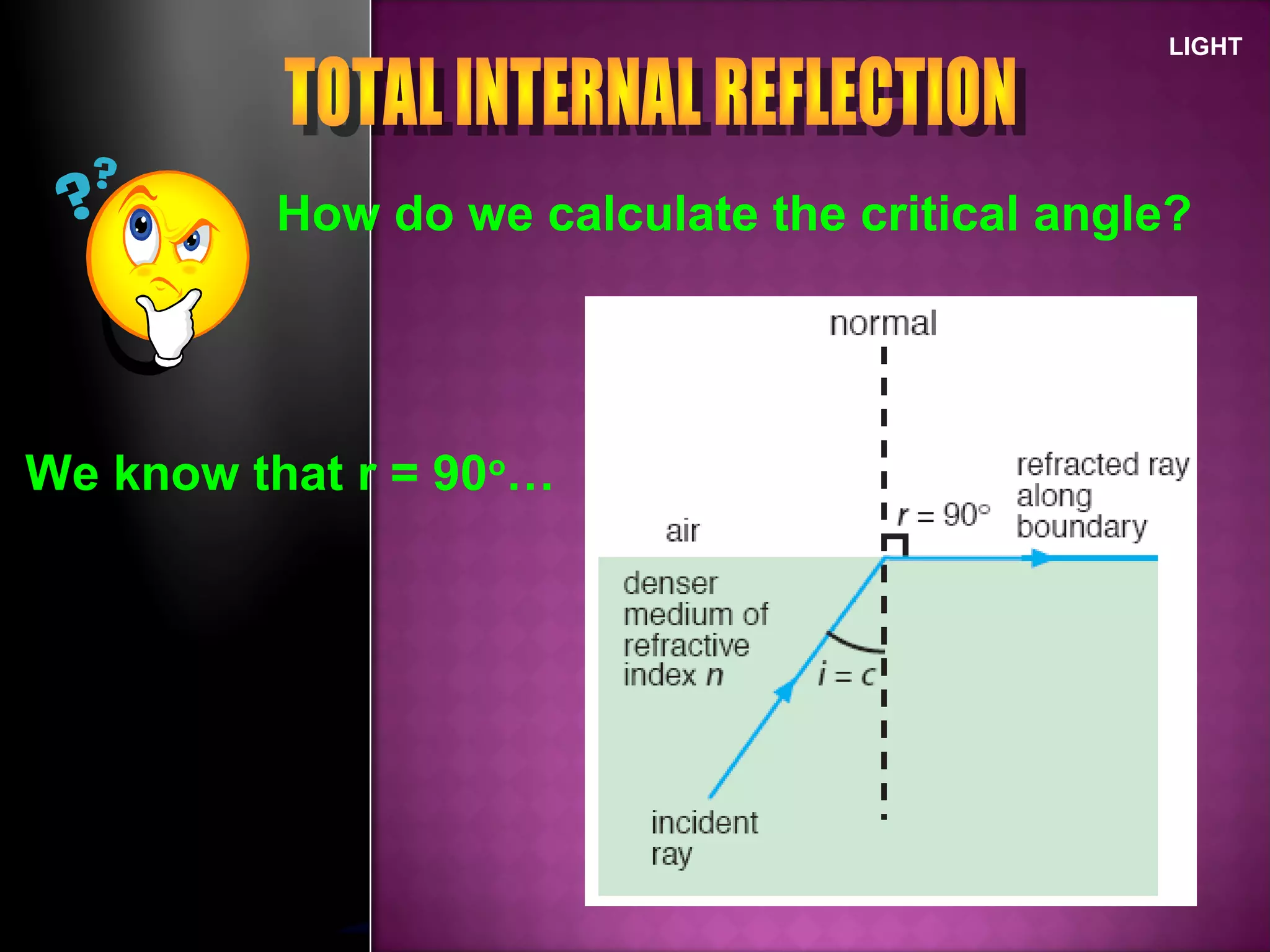
The critical angle is the angle of incidence in the
optically denser medium for which the angle of
refraction is 90o
.
When i = critical angle,c
r = 90o
.
LIGHT
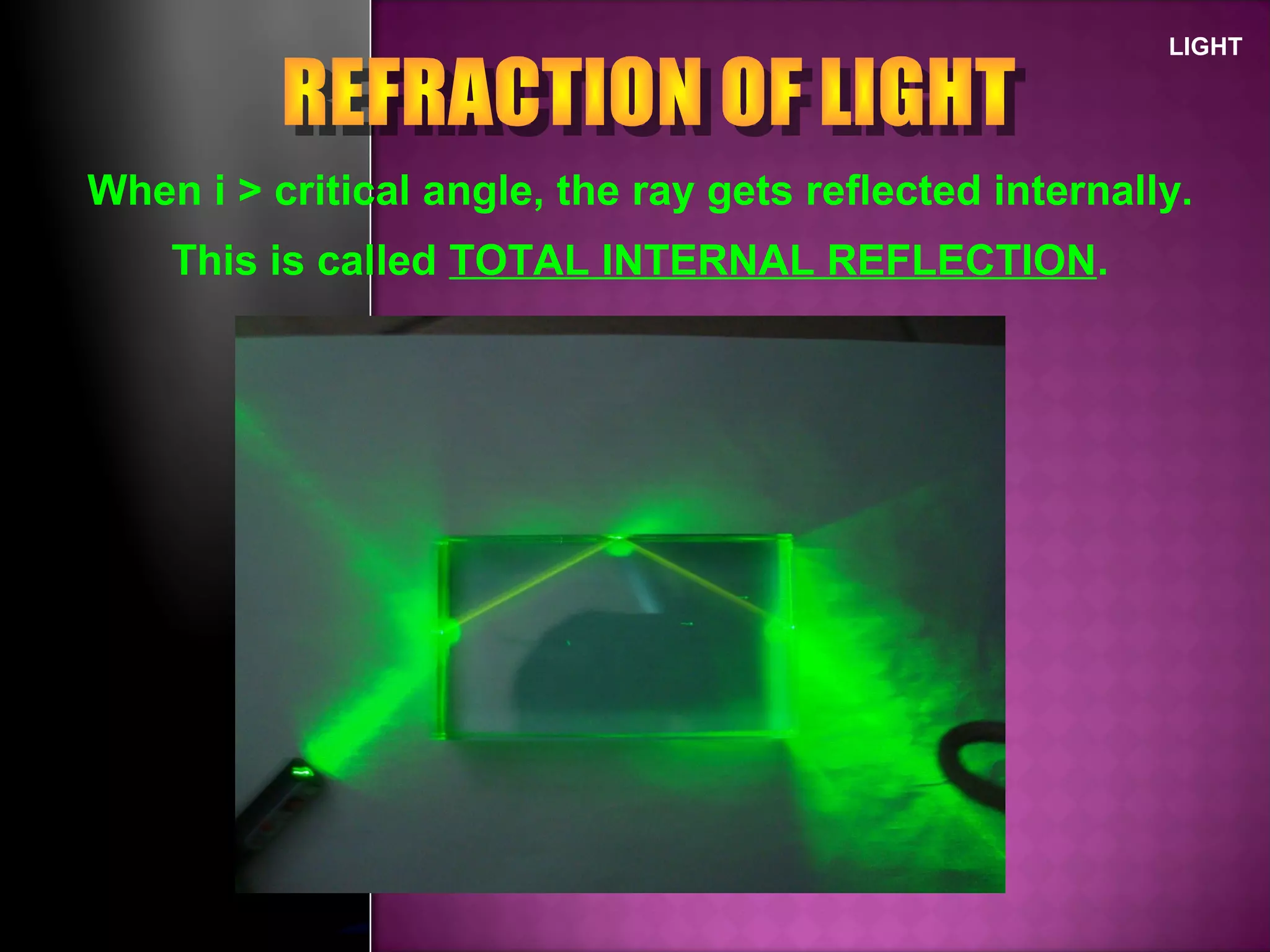
This is called TOTAL INTERNAL REFLECTION.
When i > critical angle, the ray gets reflected internally.
LIGHT
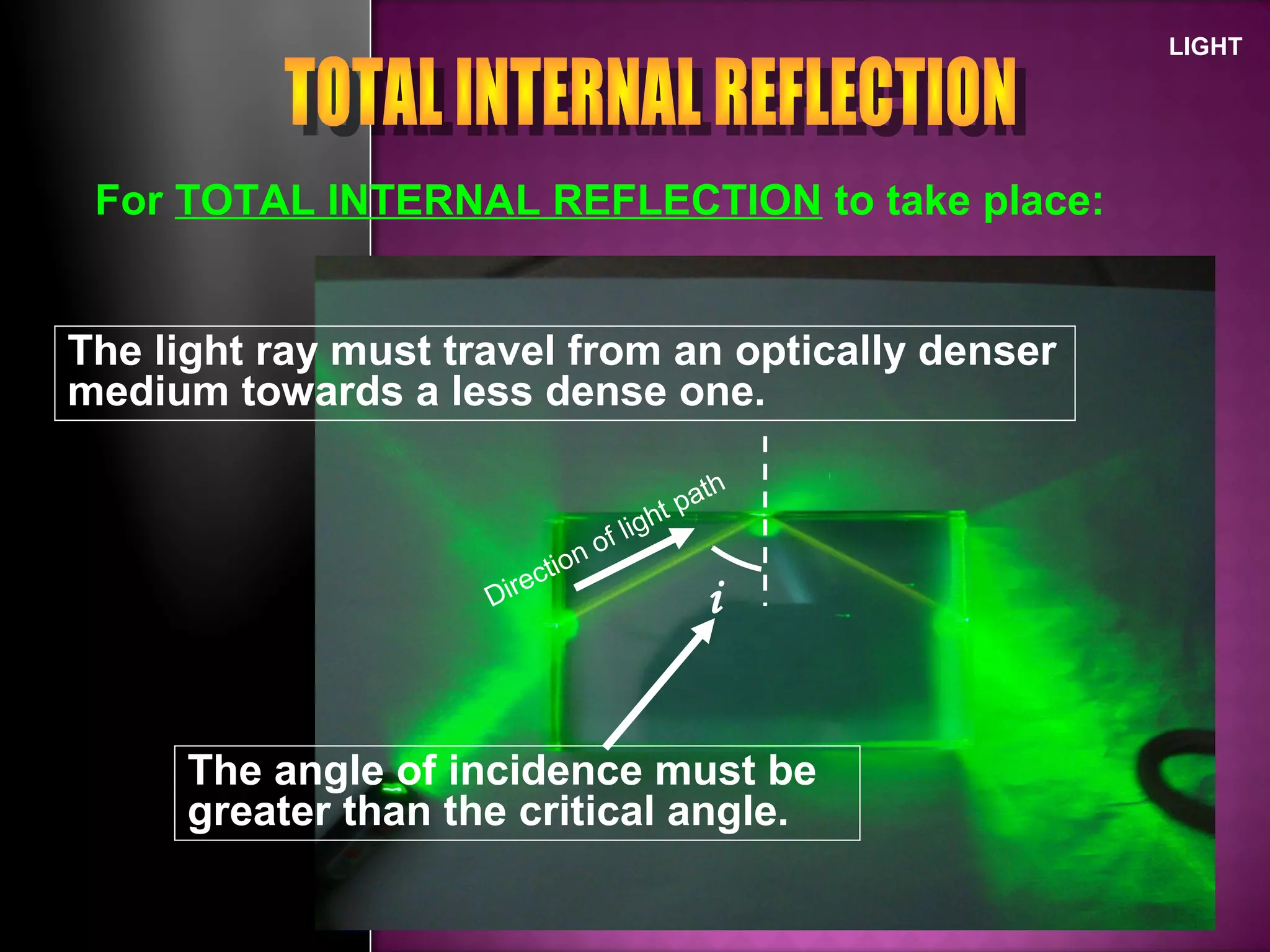
For TOTAL INTERNAL REFLECTION to take place:
The light ray must travel from an optically denser
medium towards a less dense one.
The angle of incidence must be
greater than the critical angle.
Direction of light path
i
LIGHT
How do we calculate the critical angle?
We know that r = 90o
…
LIGHT
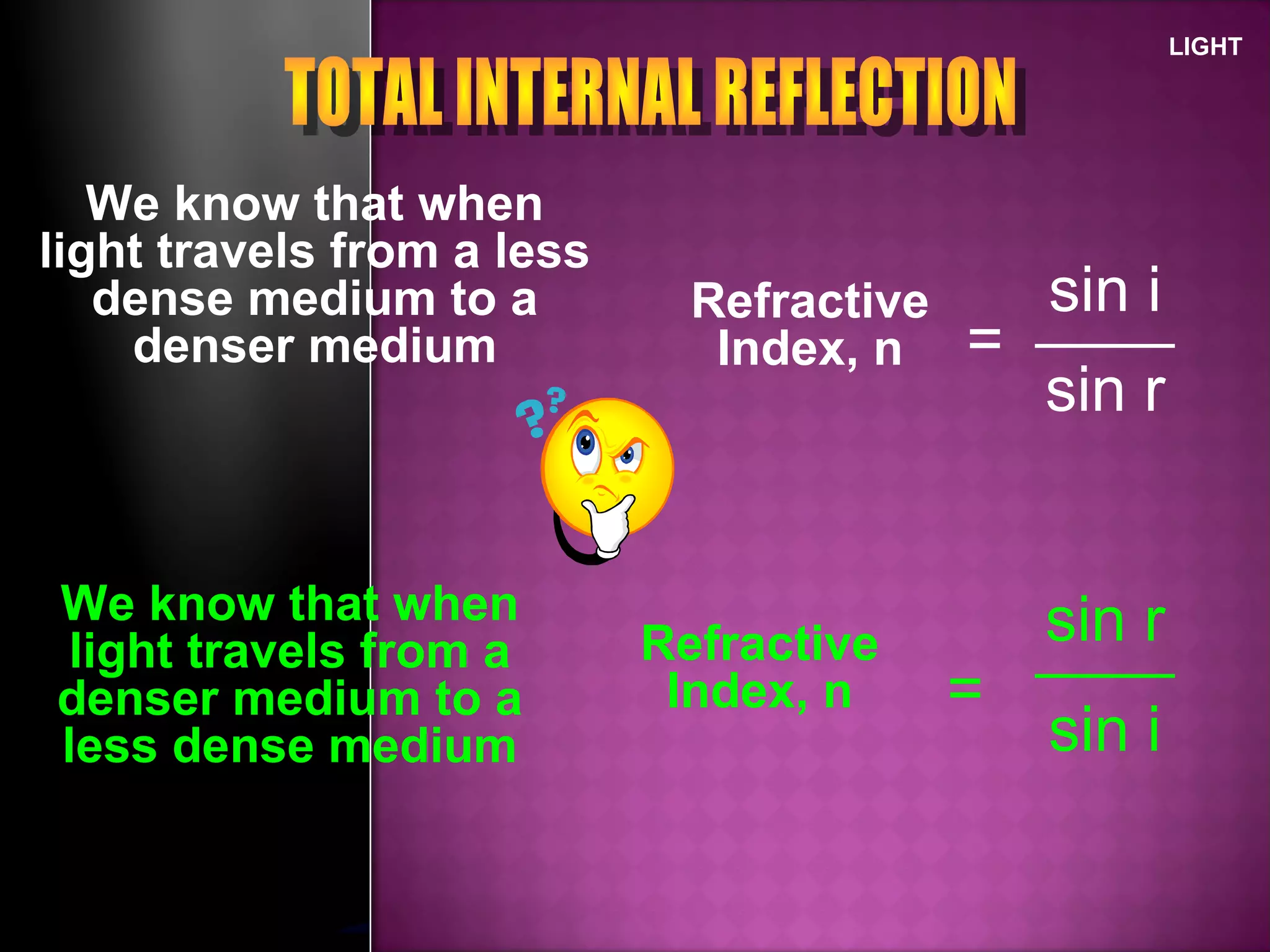
We know that when
light travels from a less
dense medium to a
denser medium
Refractive
Index, n =
sin r
sin i
We know that when
light travels from a
denser medium to a
less dense medium
Refractive
Index, n =
sin r
sin i
LIGHT
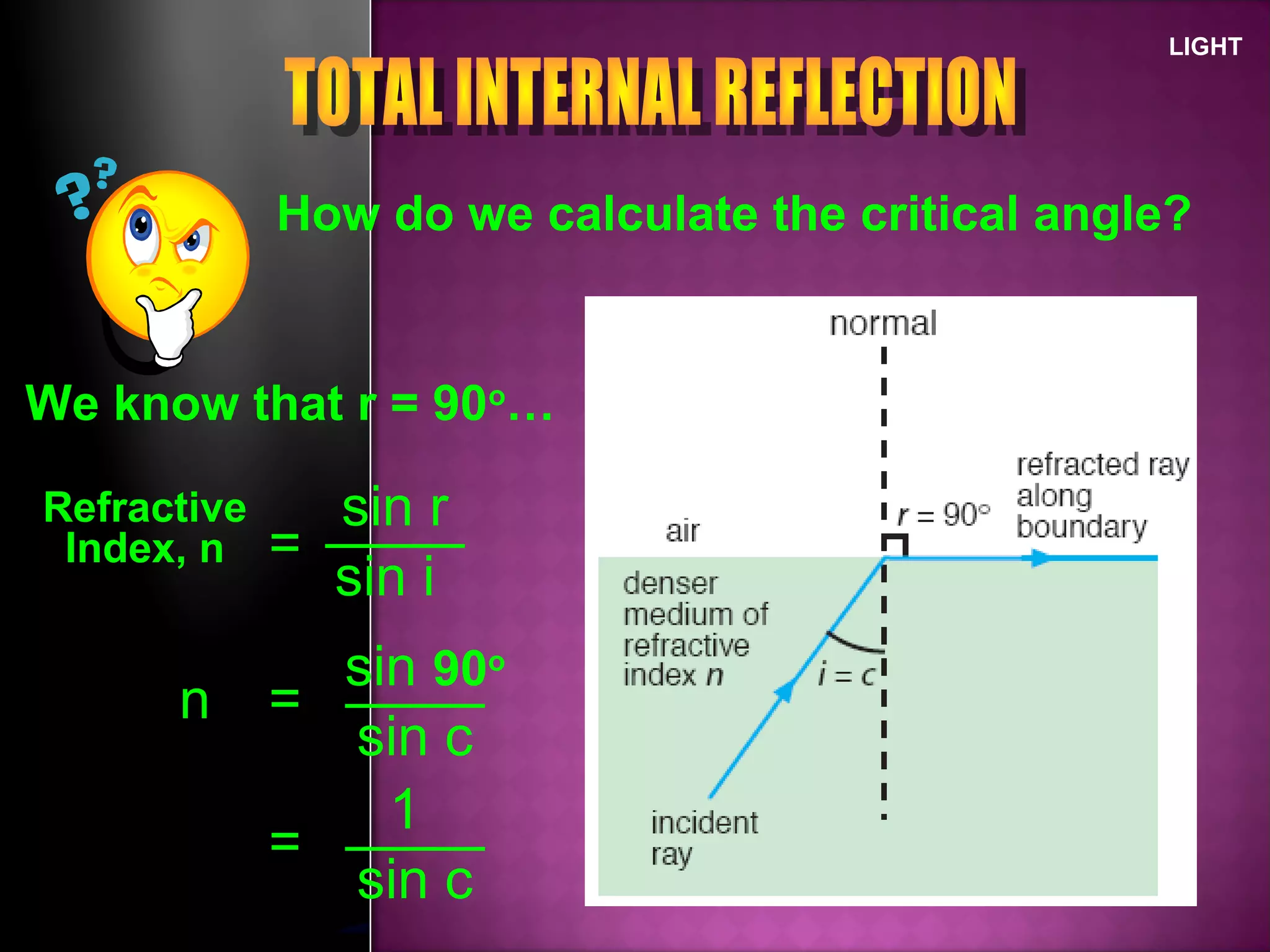
How do we calculate the critical angle?
We know that r = 90o
…
Refractive
Index, n =
sin r
sin i
n =
sin c
sin 90o
=
sin c
1
LIGHT
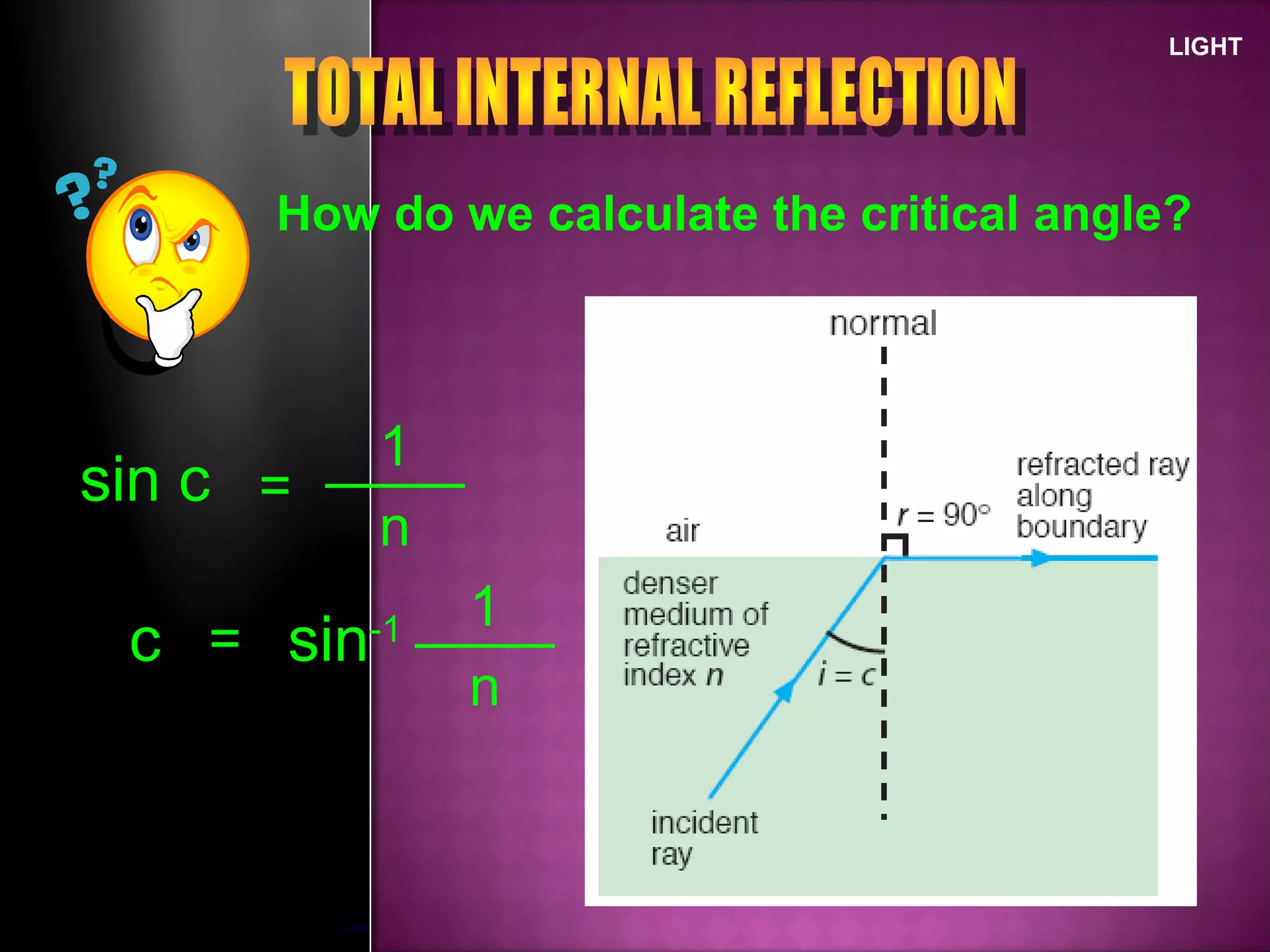
How do we calculate the critical angle?
n
=sin c
=c
1
sin-1
n
1
LIGHT
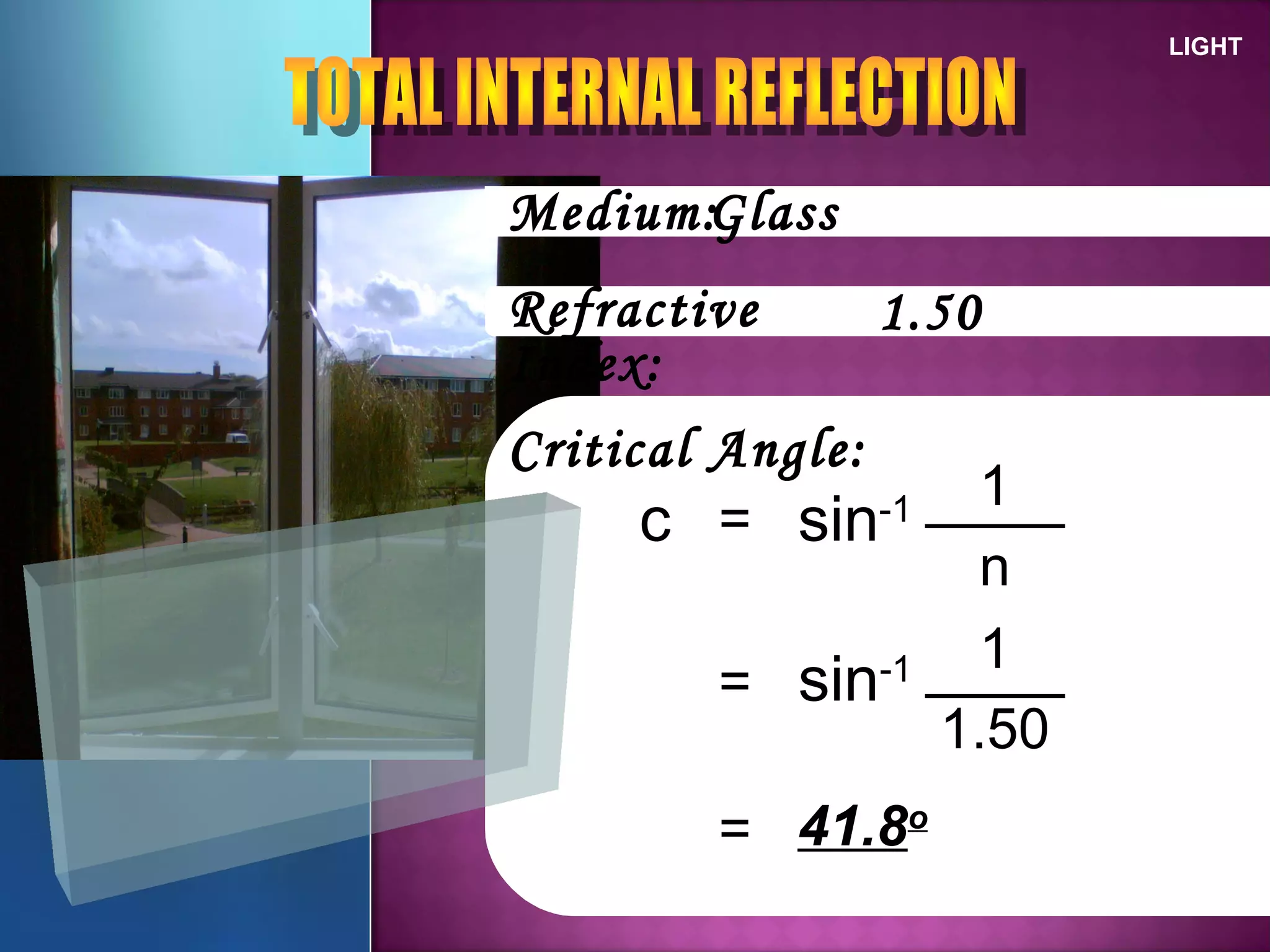
Medium:
Refractive
Index:
Critical Angle:
=c sin-1
n
1
Glass
1.50
= sin-1
1.50
1
= 41.8o
LIGHT
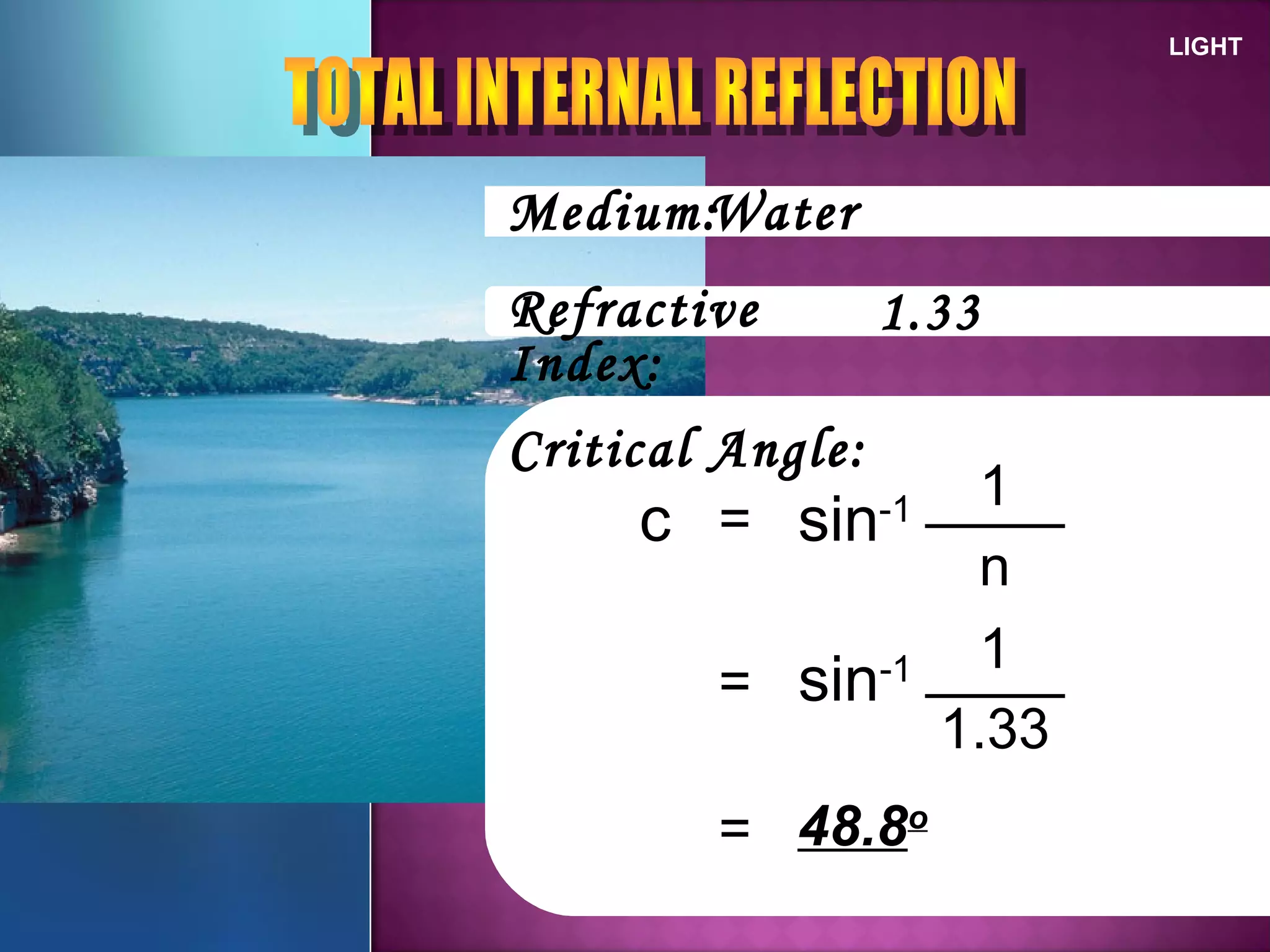
Medium:
Refractive
Index:
Critical Angle:
=c sin-1
n
1
Water
1.33
= sin-1
1.33
1
= 48.8o
LIGHT
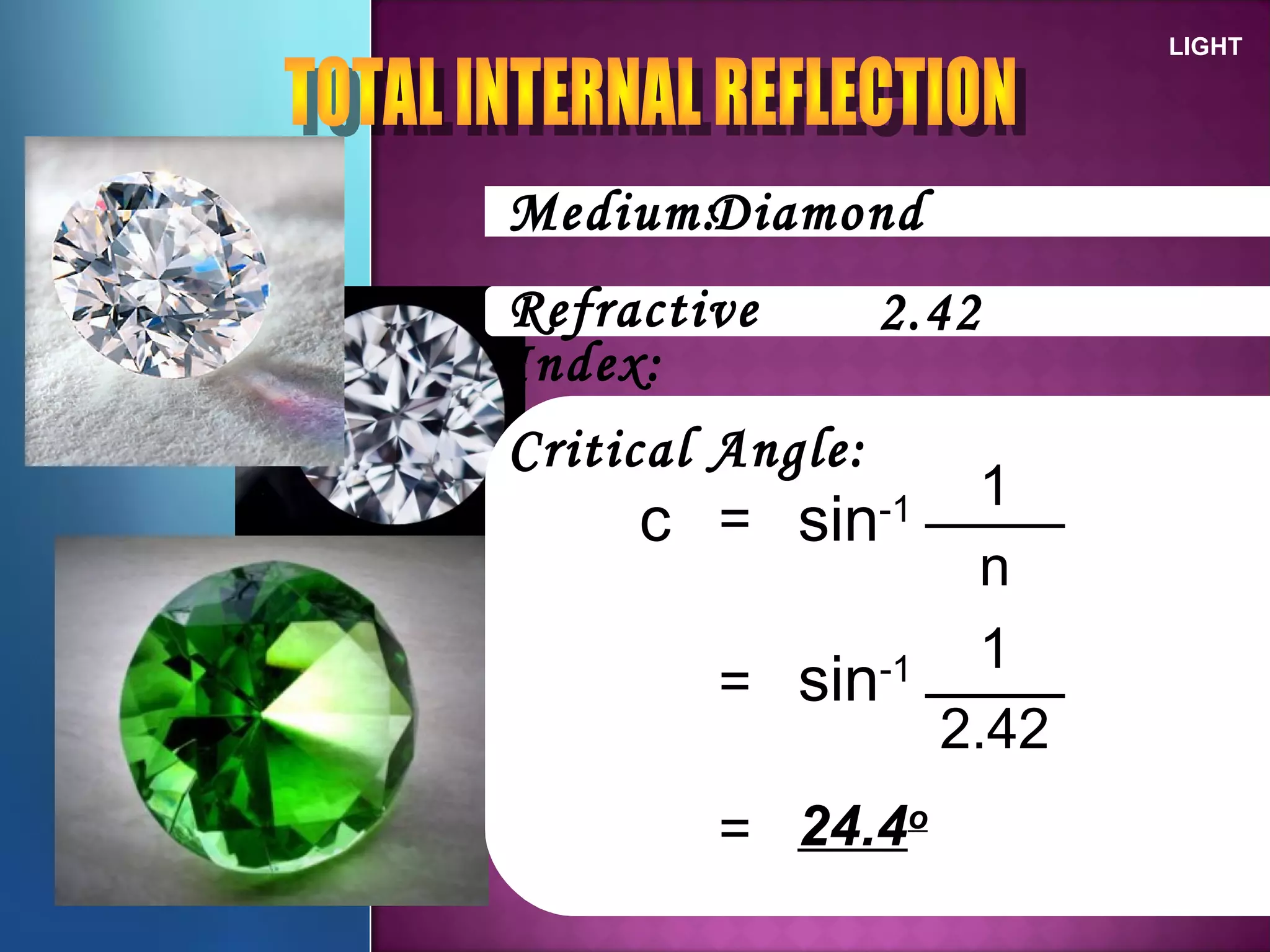
Medium:
Refractive
Index:
Critical Angle:
=c sin-1
n
1
Diamond
2.42
= sin-1
2.42
1
= 24.4o
LIGHT
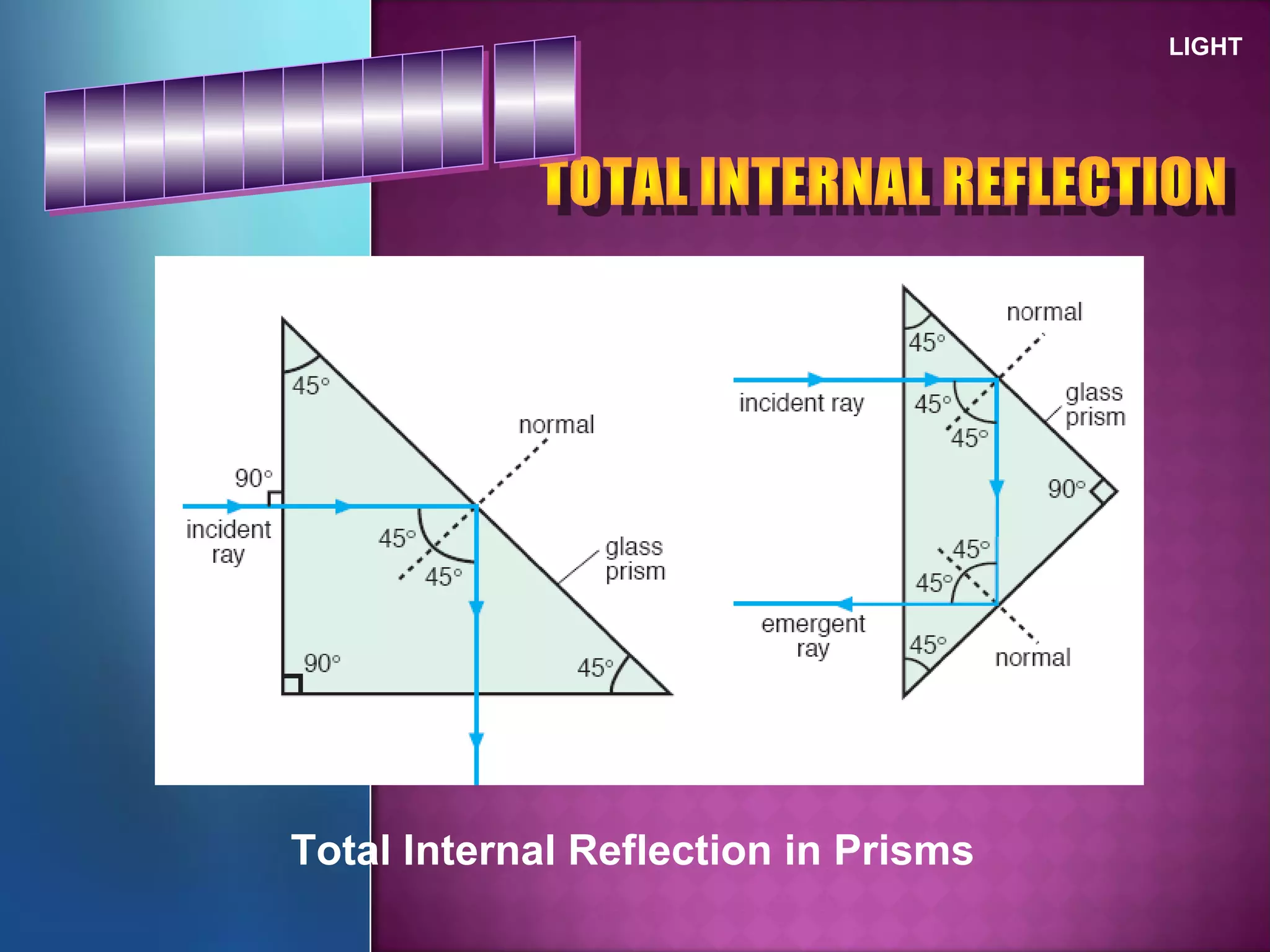
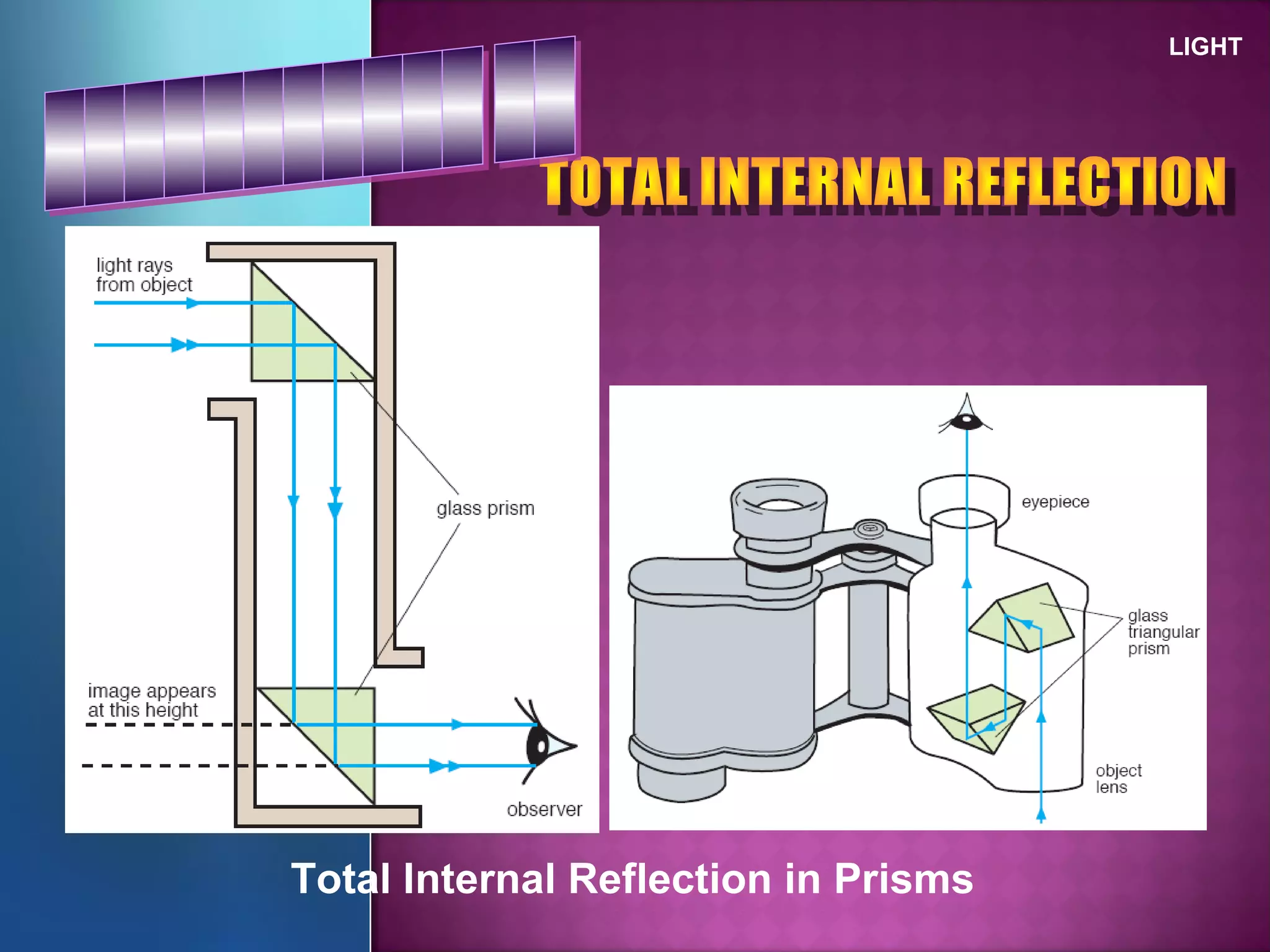
Total Internal Reflection in Prisms
LIGHT
Total Internal Reflection in Prisms
LIGHT
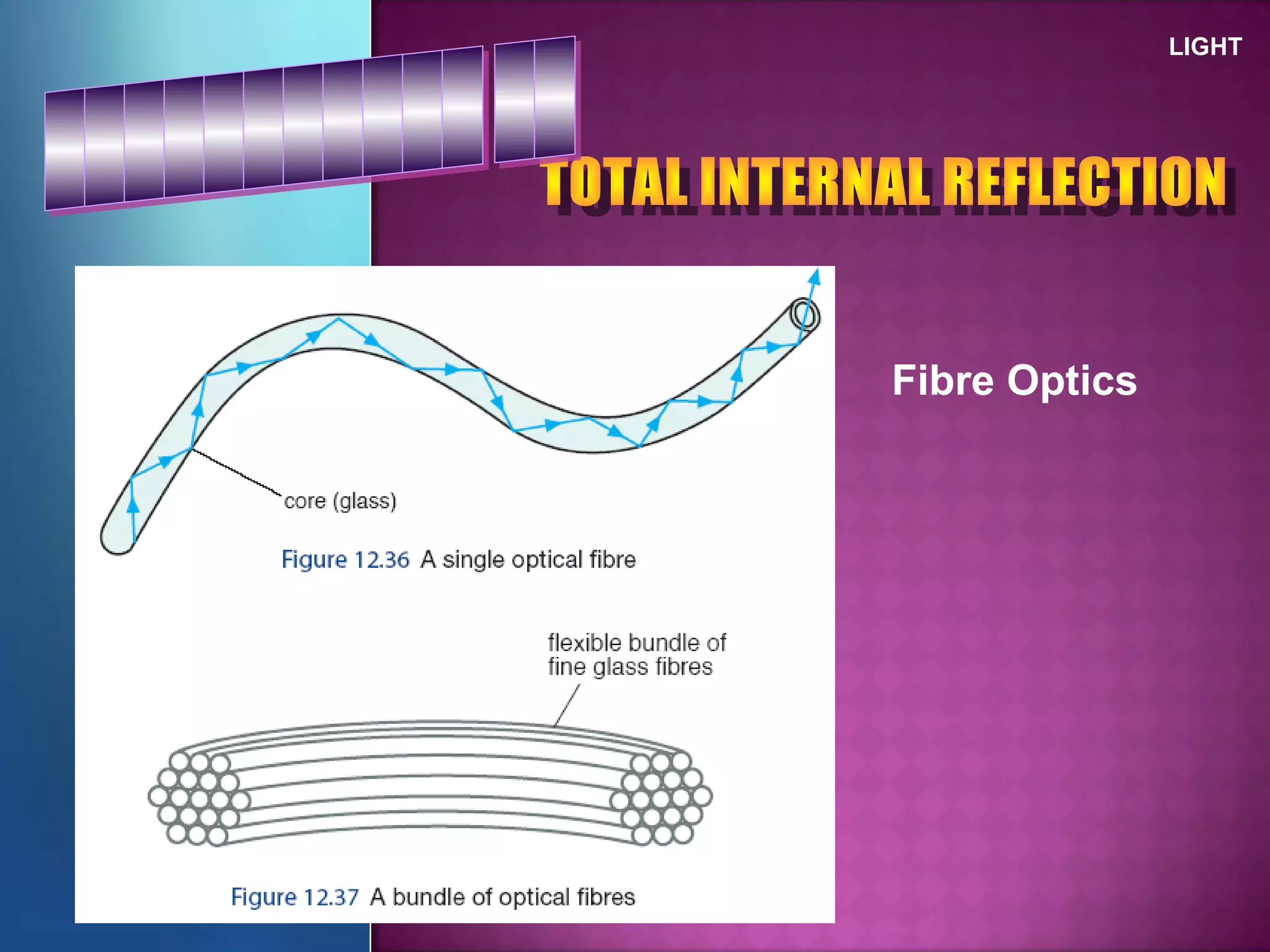
Fibre Optics
Refraction of light

Refraction of light

  • 1.
  • 2.
    LIGHT Refraction is thechange in direction of light when it passes from one medium to another.
  • 3.
    LIGHT If light rayenters another medium perpendicular to boundary, the ray does not bend.
  • 4.
    LIGHT When the lightray travels from air to water, the refracted ray bends towards the normal. i r air water Incident ray Refracted ray normal i – angle of incidence r– angle of refraction
  • 5.
    LIGHT When the lightray travels from water to air, the refracted ray bends away from the normal. i r air water Incident ray Refracted ray normal i – angle of incidence r– angle of refraction
  • 6.
    LIGHT During refraction, light bendsfirst on passing from air to glass and again on passing from the glass to the air.
  • 7.
    LIGHT During refraction, light bendsfirst on passing from air to glass and again on passing from the glass to the air. i r Incident ray Emergent ray Refracted ray Reflected ray air air glass
  • 8.
    LIGHT Light slows downwhen it enters an optically denser medium. The refracted ray bends towards the normal when the second medium is optically more dense than the first. i r air water Incident ray Refracted ray normal
  • 9.
    LIGHT Light speeds upwhen it enters an optically less dense medium. The refracted ray bends away from the normal when the second medium is optically less dense than the first. air water i r Incident ray Refracted ray normal
  • 10.
    LIGHT Among the 3transparent mediums (air, water and glass), glass has the highest optical density. air water i1 r1 Incident ray Refracted ray glass i2 r2 Refracted ray air water i1 r1 Incident ray glass i2 r2 Refracted ray Refracted ray
  • 11.
    LIGHT Complete these raydiagrams. air glass glass water
  • 12.
    LIGHT Complete these raydiagrams. airwater glassair
  • 13.
    LIGHT The incident ray,the refracted ray and the normal at the point of incidence all lie in the same plane.
  • 14.
    For two givenmedia, the ratio sin i ÷ sin r is a constant, where i is the angle of incidence and r is the angle of refraction LIGHT i r air water Incident ray Refracted ray normal Refractive Index, n = sin i sin r
  • 15.
    LIGHT The higher theoptical density, the greater the refractive index. The greater the refractive index, the greater the bending of light towards the normal. air water i1 r1 Incident ray Refracted ray glass i2 r2 Refracted ray air water i1 r1 Incident ray glass i2 r2 Refracted ray Refracted ray
  • 16.
    LIGHT If light isincident upon a piece of glass (refractive index 1.52) at an angle of 45o , what is the angle of refraction?
  • 17.
    LIGHT Given that therefractive index of water is 1.33, calculate the angle of refraction when the incident ray comes in at 60o to the normal. 60o r air water Solution n = sin i sin r 1.33 = sin 60o sin r sin r = sin 60o 1.33 r = 40.6o
  • 18.
    LIGHT When light travelsfrom a less dense medium to a denser medium… n = sin i sin r i r air water When light travels from a denser medium to a less dense medium… n = sin r sin i i r air water
  • 19.
    LIGHT The figure showslight travelling from water into the air. The ray is incident upon the boundary at 30o . What is the angle of refraction if the refractive index of water is 1.33? 30o r air water Solution n sin r sin i = 1.33 sin 30o sin r = sin r= 1.33sin 30o r = 41.9o
  • 20.
    LIGHT Other ways ofcalculating the refractive index… Refractive index, n = Speed of light in vacuum / air Speed of light in medium = c v
  • 21.
  • 22.
    LIGHT The critical angleis the angle of incidence in the optically denser medium for which the angle of refraction is 90o . When i = critical angle,c r = 90o .
  • 23.
    LIGHT This is calledTOTAL INTERNAL REFLECTION. When i > critical angle, the ray gets reflected internally.
  • 24.
    LIGHT For TOTAL INTERNALREFLECTION to take place: The light ray must travel from an optically denser medium towards a less dense one. The angle of incidence must be greater than the critical angle. Direction of light path i
  • 25.
    LIGHT How do wecalculate the critical angle? We know that r = 90o …
  • 26.
    LIGHT We know thatwhen light travels from a less dense medium to a denser medium Refractive Index, n = sin r sin i We know that when light travels from a denser medium to a less dense medium Refractive Index, n = sin r sin i
  • 27.
    LIGHT How do wecalculate the critical angle? We know that r = 90o … Refractive Index, n = sin r sin i n = sin c sin 90o = sin c 1
  • 28.
    LIGHT How do wecalculate the critical angle? n =sin c =c 1 sin-1 n 1
  • 29.
  • 30.
  • 31.
  • 32.
  • 33.
  • 34.