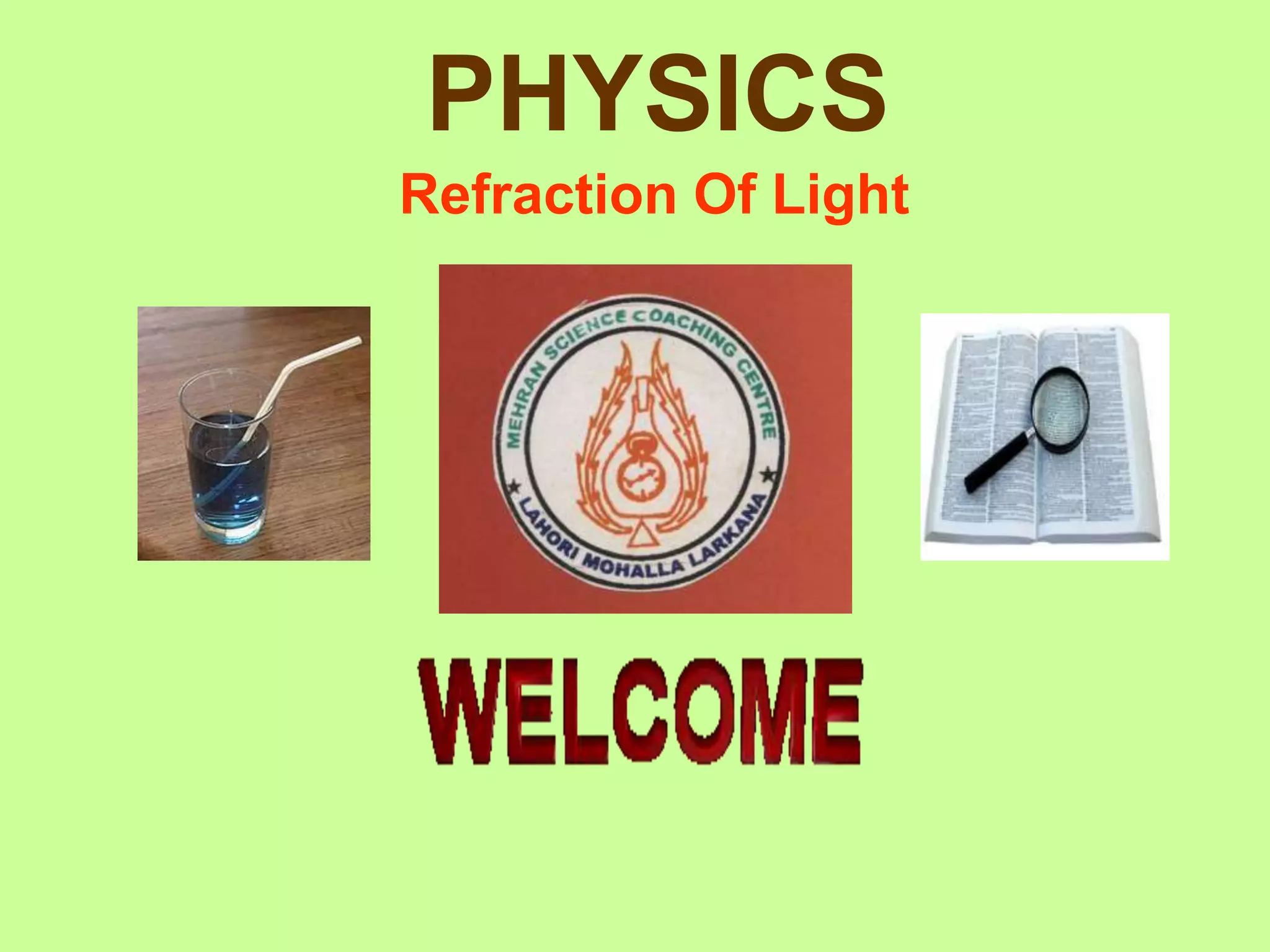
This document discusses the physics of refraction of light. Some key points:
- Refraction occurs when light travels from one medium to another with a different density, causing it to change speed and direction. It bends toward the normal when entering a denser medium and away when entering a rarer medium.
- The refractive index of a material is the ratio of the speed of light in a vacuum to its speed in the material. It characterizes how much light bends when entering the material.
- Total internal reflection occurs when light passes from a denser to a rarer medium at an angle greater than the critical angle, causing it to reflect back rather than refract. This principle is used
Refraction Of Light
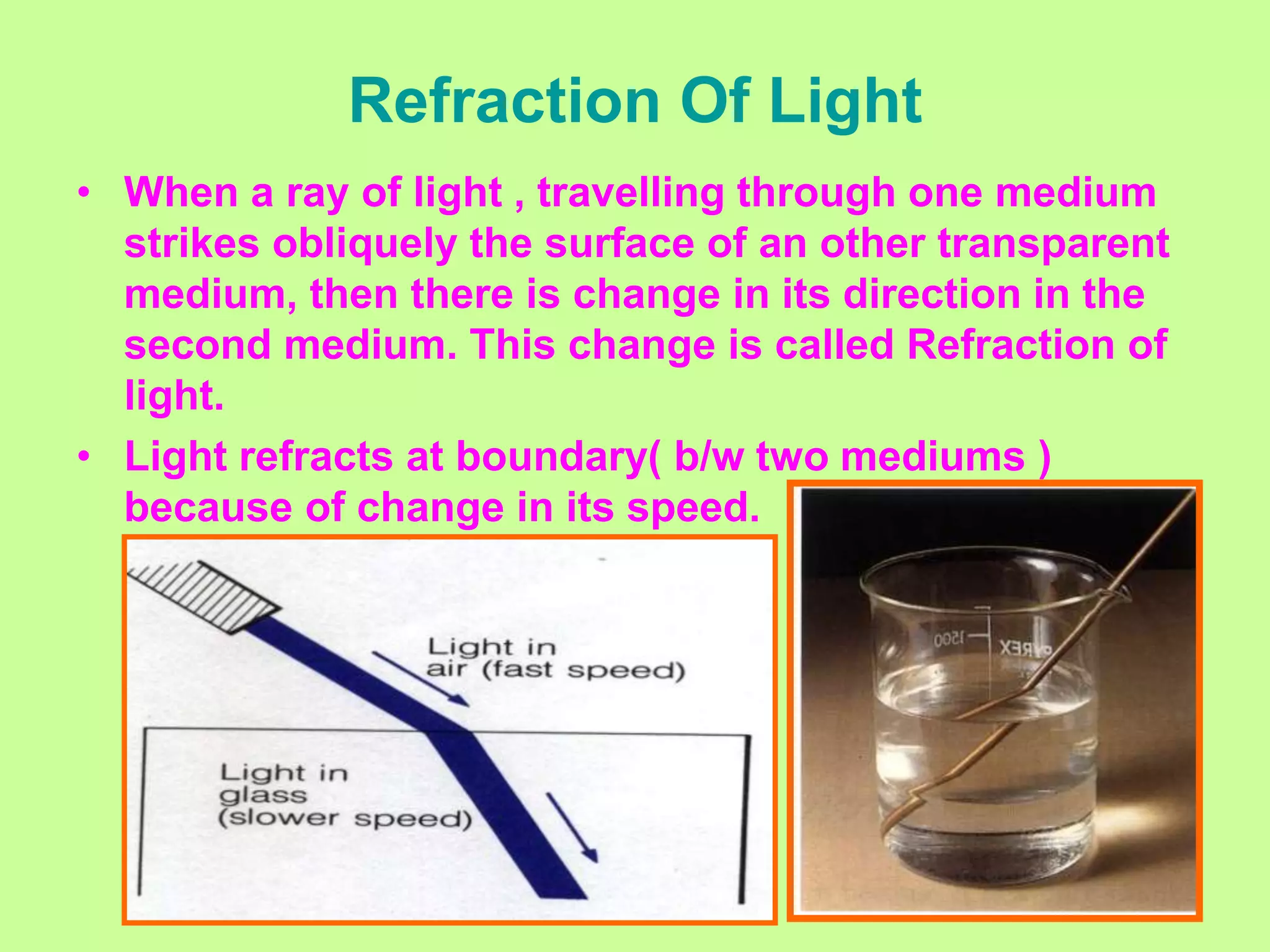
•When a ray of light , travelling through one medium
strikes obliquely the surface of an other transparent
medium, then there is change in its direction in the
second medium. This change is called Refraction of
light.
• Light refracts at boundary( b/w two mediums )
because of change in its speed.
4.
Refraction Of Light
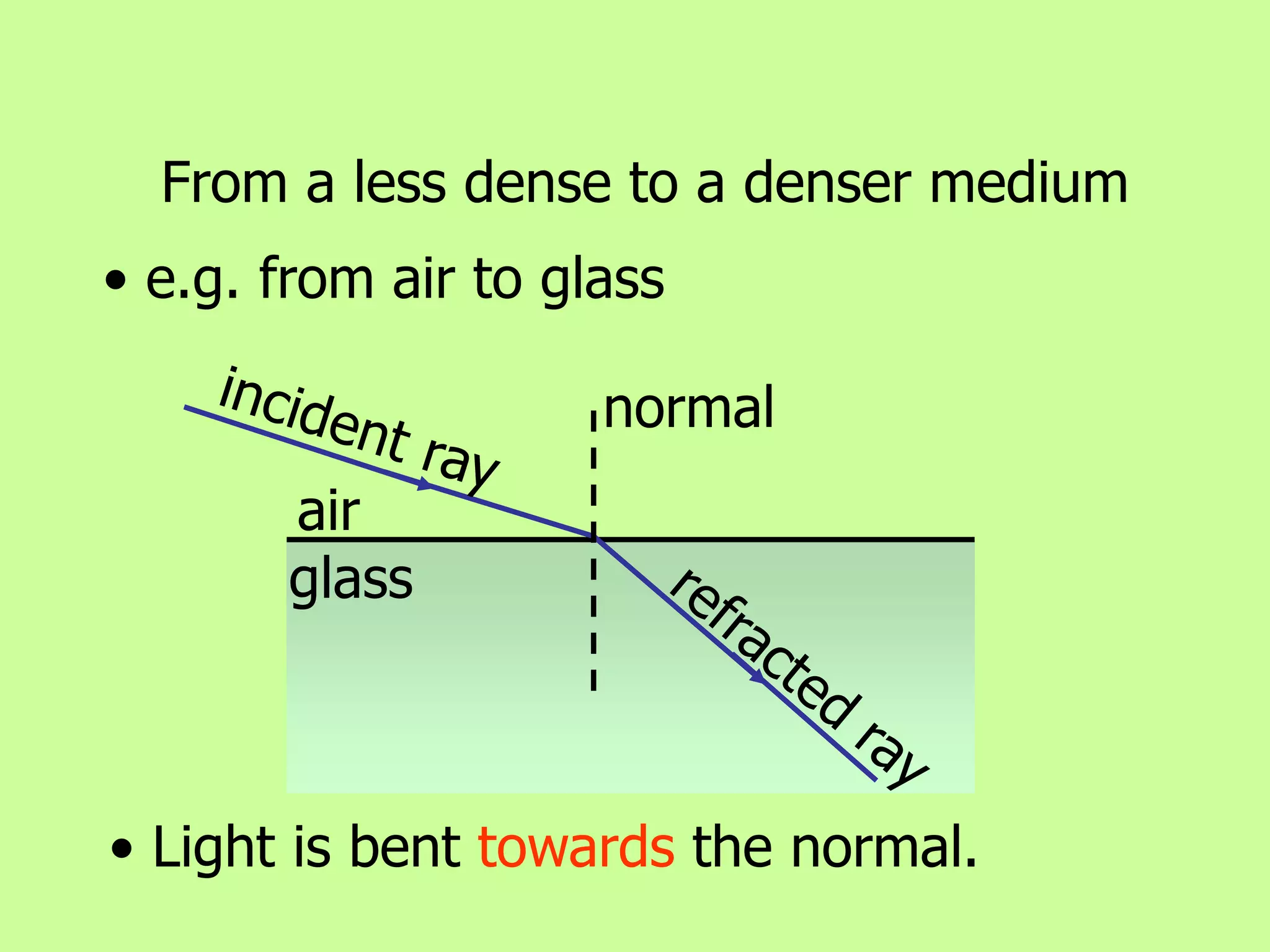
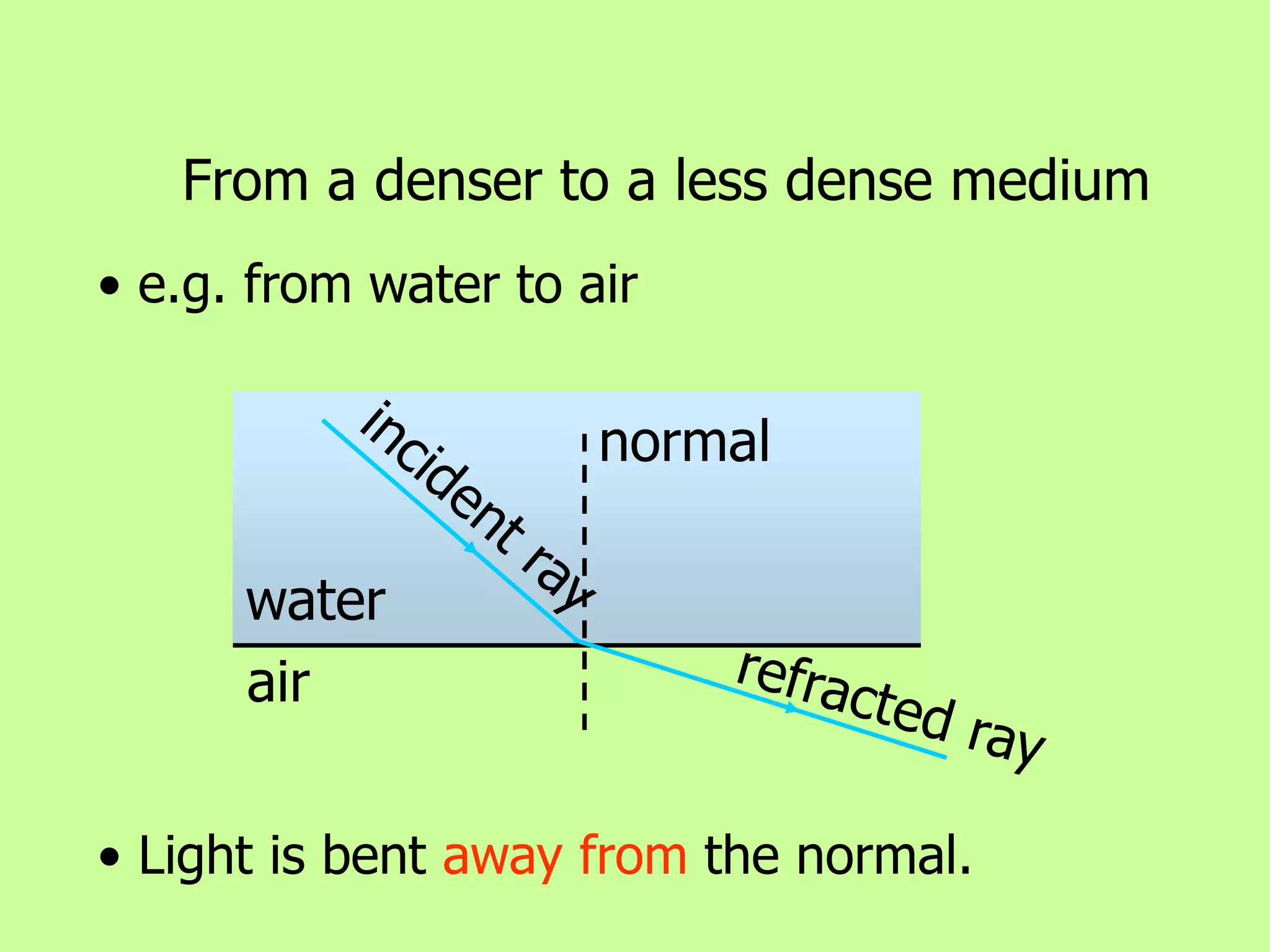
•If ray of light enters from rare into denser medium it
bends towards the normal. But when enters from
denser into rare medium, it bends away from the
normal.
5.
air
glass
• e.g. fromair to glass
• Light is bent towards the normal.
normal
From a less dense to a denser medium
6.
air
water
From a denserto a less dense medium
• e.g. from water to air
• Light is bent away from the normal.
normal
Laws Of RefractionOf Light
Incident ray, refracted ray and normal lie in the same
plane.
The ratio of sine of angle of incident to the sine of
angle of refraction is constant in any two transparent
mediums, which is termed refractive index (n).
Refractive index (n) =sin Li/Sin Lr = Constant
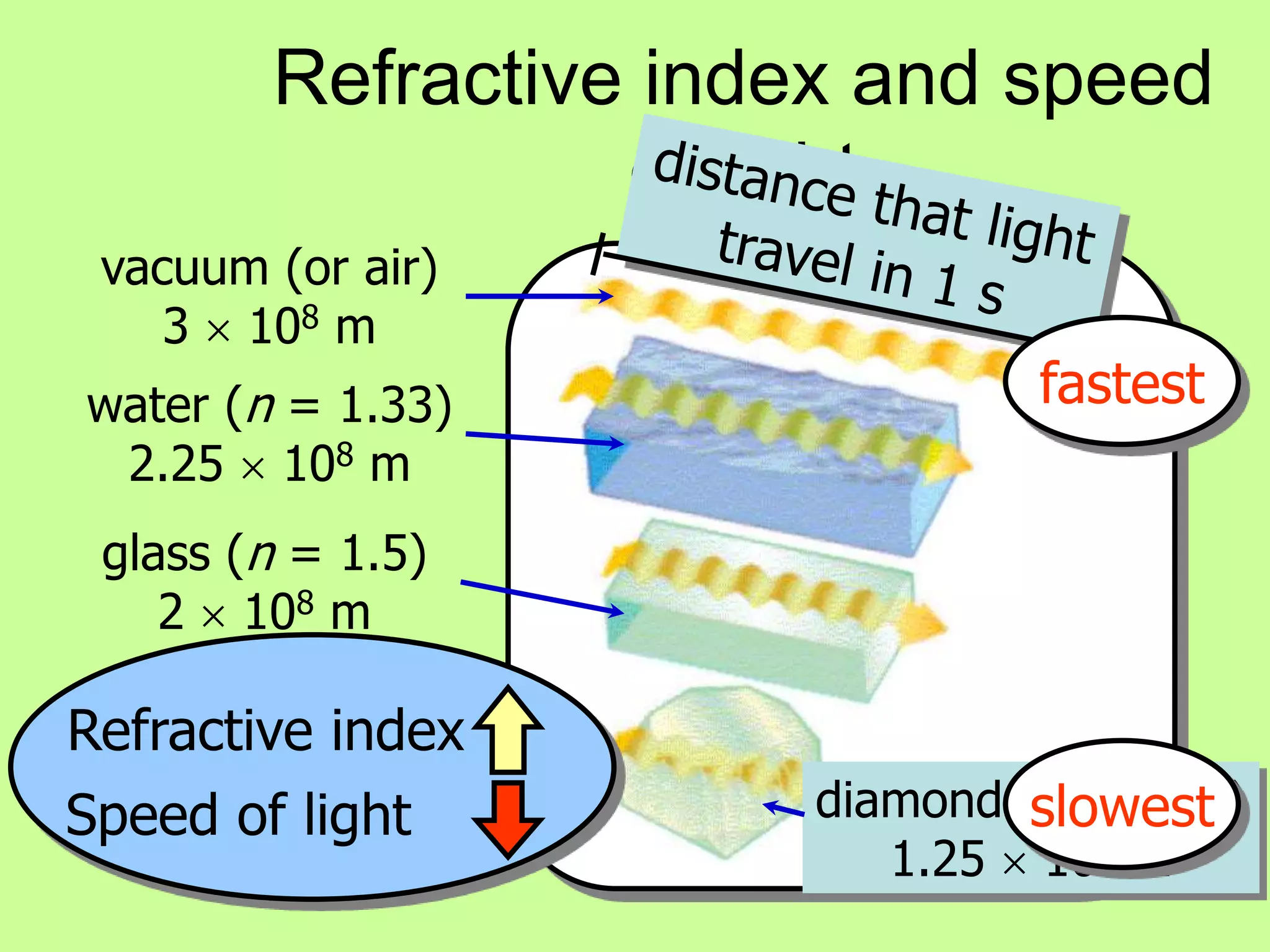
Refractive index andspeed
of light
vacuum (or air)
3 108 m
water (n = 1.33)
2.25 108 m
glass (n = 1.5)
2 108 m
diamond (n = 2.42)
1.25 108 m
Refractive index
Speed of light
fastest
slowest
Prism
• It istransparent body (Glass) ,
commonly having three sides
rectangular and two sides triangular.
16.
Refraction Of LightThrough Prism
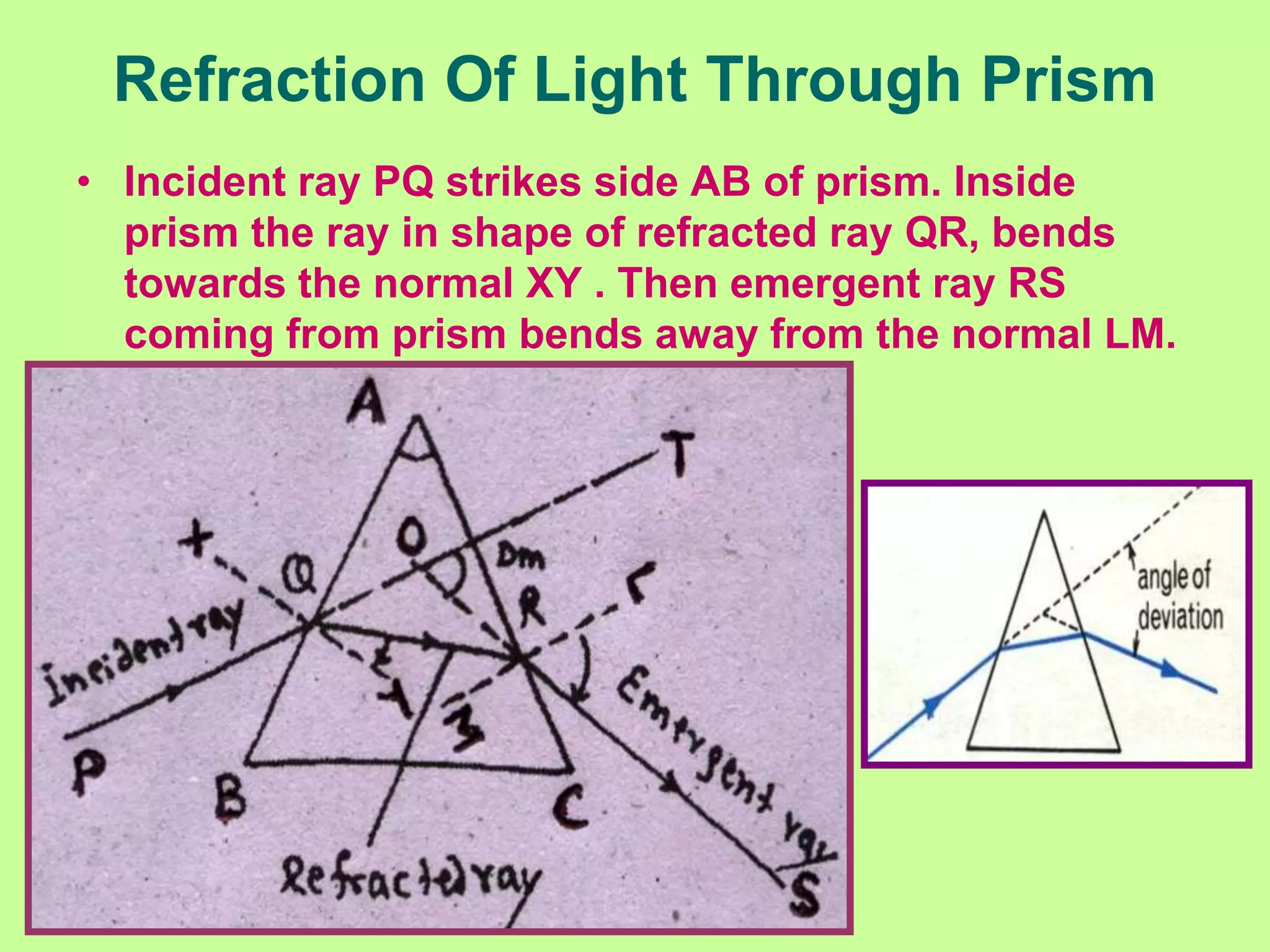
• Incident ray PQ strikes side AB of prism. Inside
prism the ray in shape of refracted ray QR, bends
towards the normal XY . Then emergent ray RS
coming from prism bends away from the normal LM.
17.
Refractive Index OfGlass Prism (nG)
• (nG)=
Sin (A + Dm)
2
Sin A
2
LA = Angle of prism.
LDm = Angle of minimum deviation.
nG = Refractive index of glass
prism
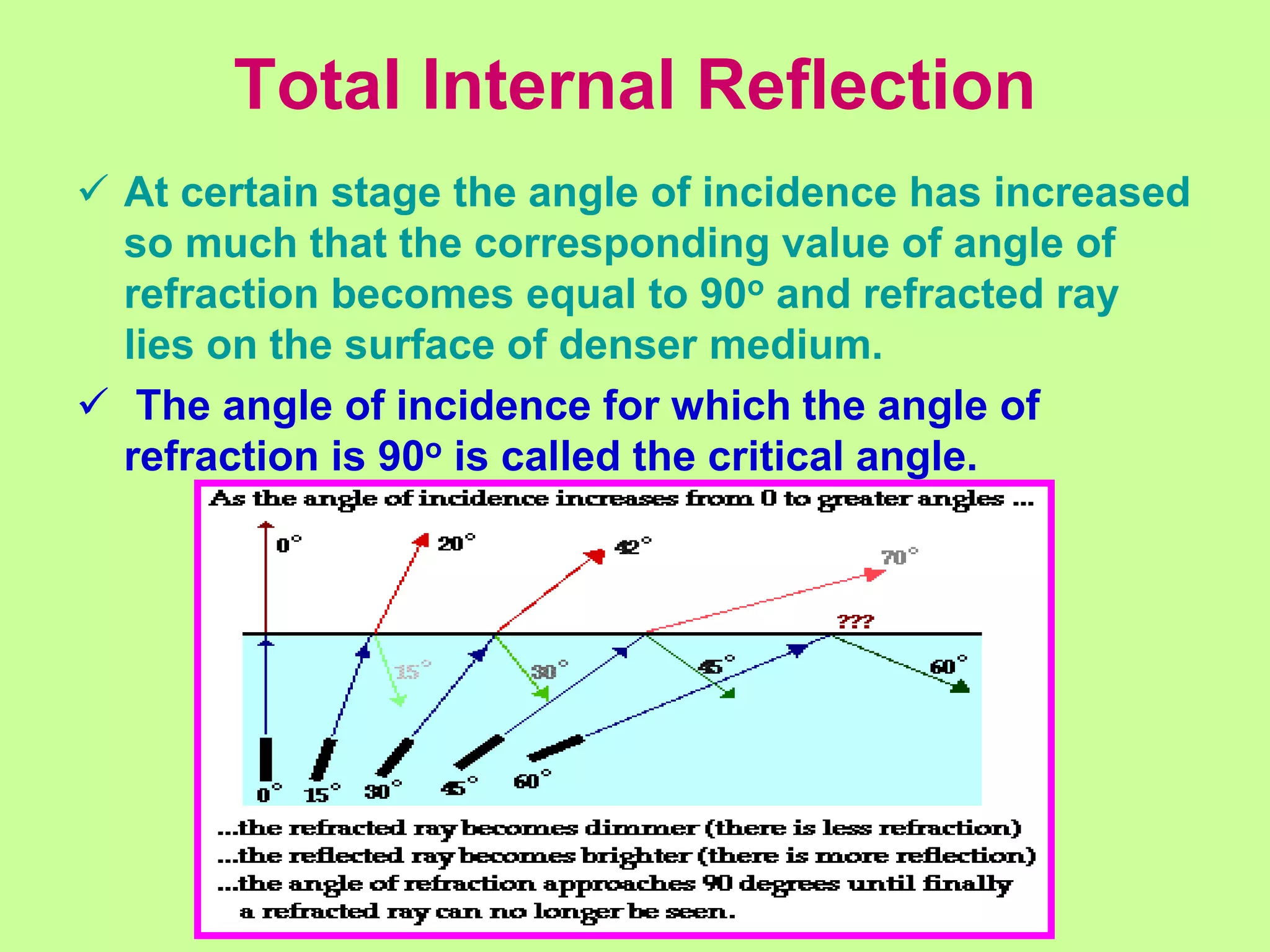
Total Internal Reflection
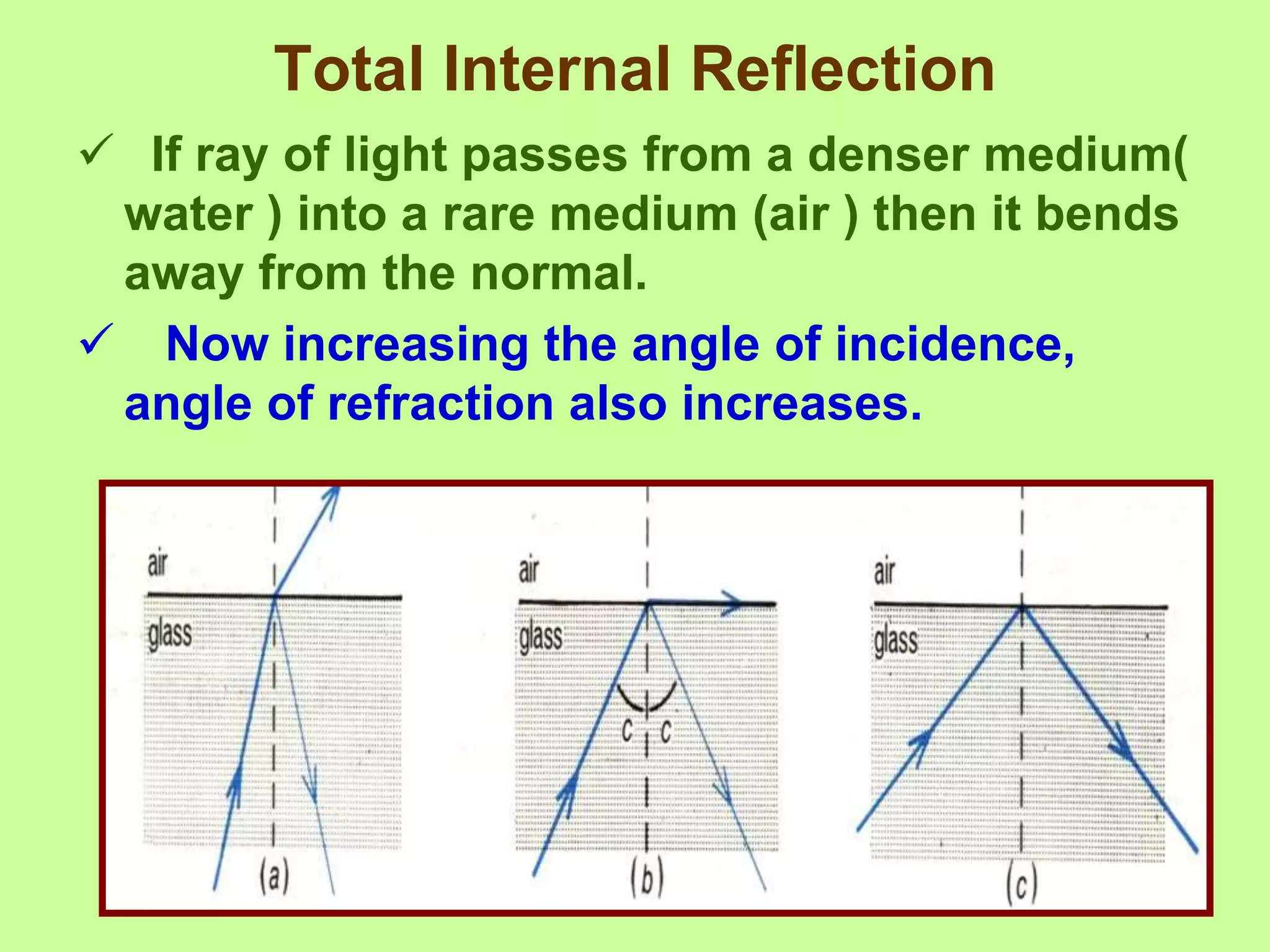
If ray of light passes from a denser medium(
water ) into a rare medium (air ) then it bends
away from the normal.
Now increasing the angle of incidence,
angle of refraction also increases.
20.
Total Internal Reflection
At certain stage the angle of incidence has increased
so much that the corresponding value of angle of
refraction becomes equal to 90o and refracted ray
lies on the surface of denser medium.
The angle of incidence for which the angle of
refraction is 90o is called the critical angle.
21.
Total Internal Reflection
Now if the value of angle of incidence is increased
so much that it becomes greater than critical angle,
then there is no more refraction but whole of it is
reflected back in the denser medium.
Such reflection of light is called total internal
reflection.
24.
Optical Fibres
• Theseare very thin, flexible glass rods, used
for carrying light by total internal reflection
from one end to other end. A bundle of
optical fibres is called light pipe.
25.
Optical Fibres
• Theglass cladding of slightly lower refractive index
than that of the core, prevents surface damage to the
core fibre, otherwise would allow light to escape.
28.
Optical Fibres (uses)
•Big advantage of an optical fibre is its
small size and weight.
• Optical fibres are successfully used in
internal surgery to examine body cavities
and in telecommunication.
29.
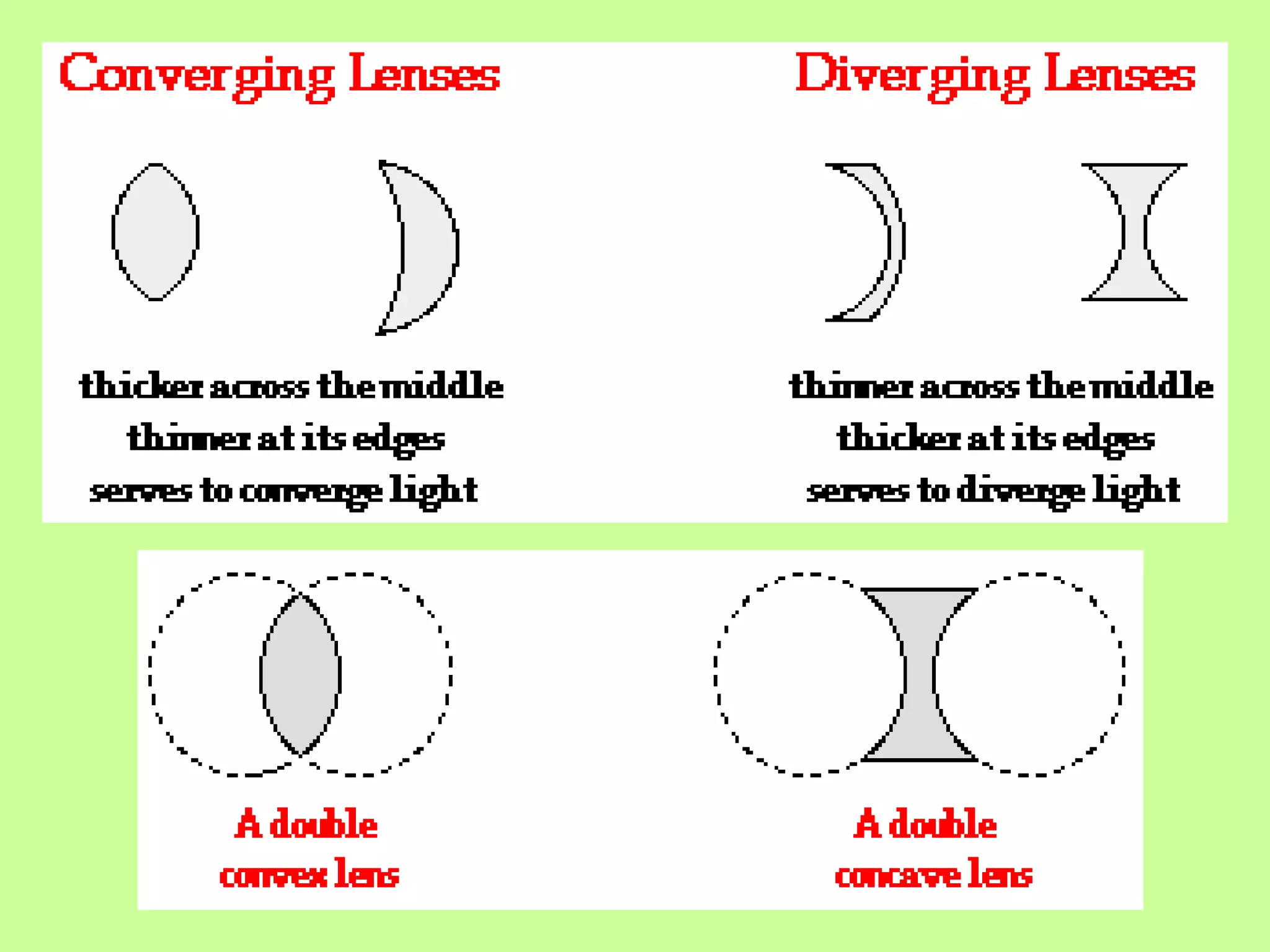
Lens & ItsKinds
LENS = It is a transparent body(glass),
bounded by one or two Curve surfaces.
KINDS OF LENS = there are two kinds of lens
(a) Convex Lens & (b) Concave Lens
32.
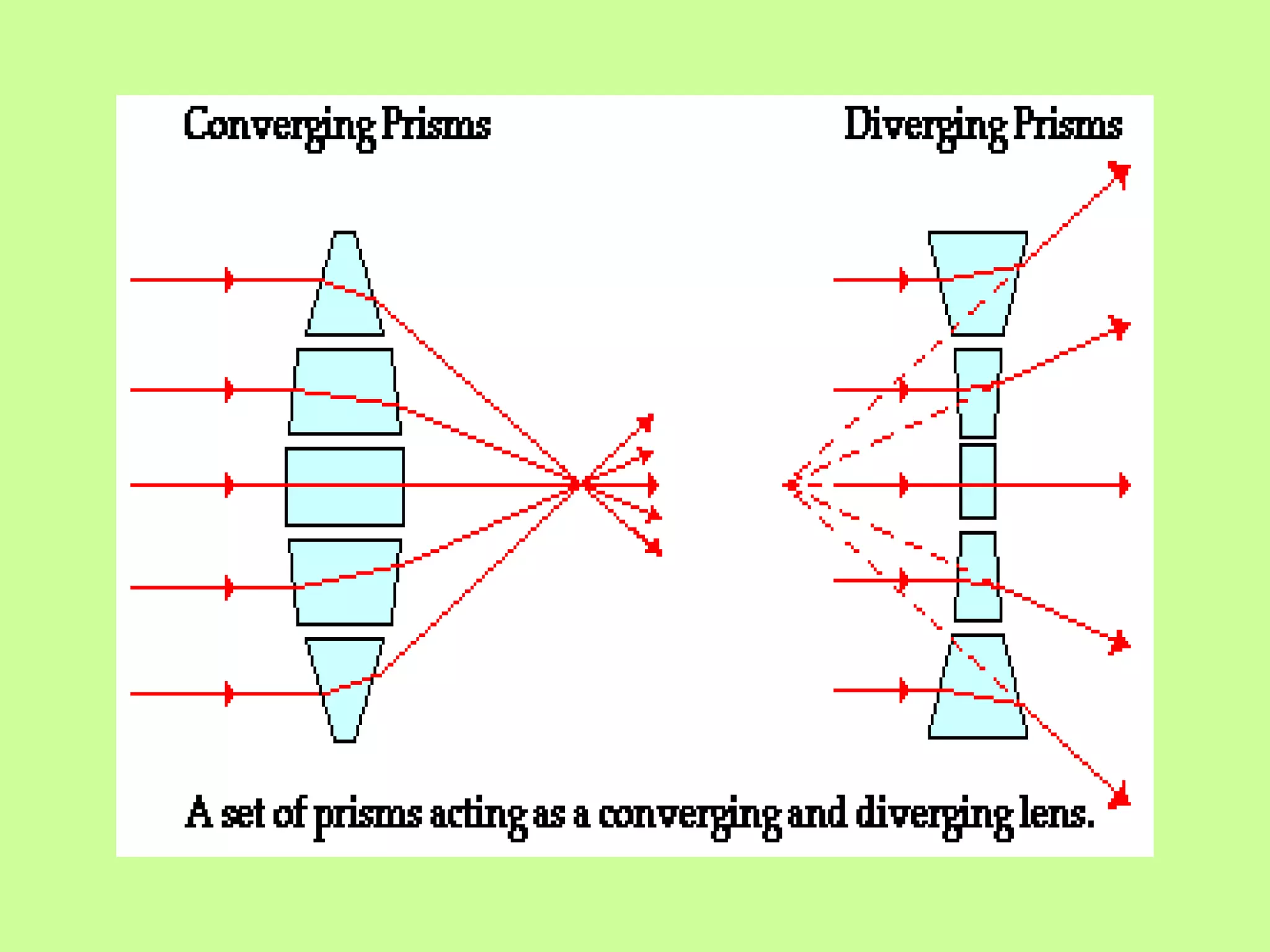
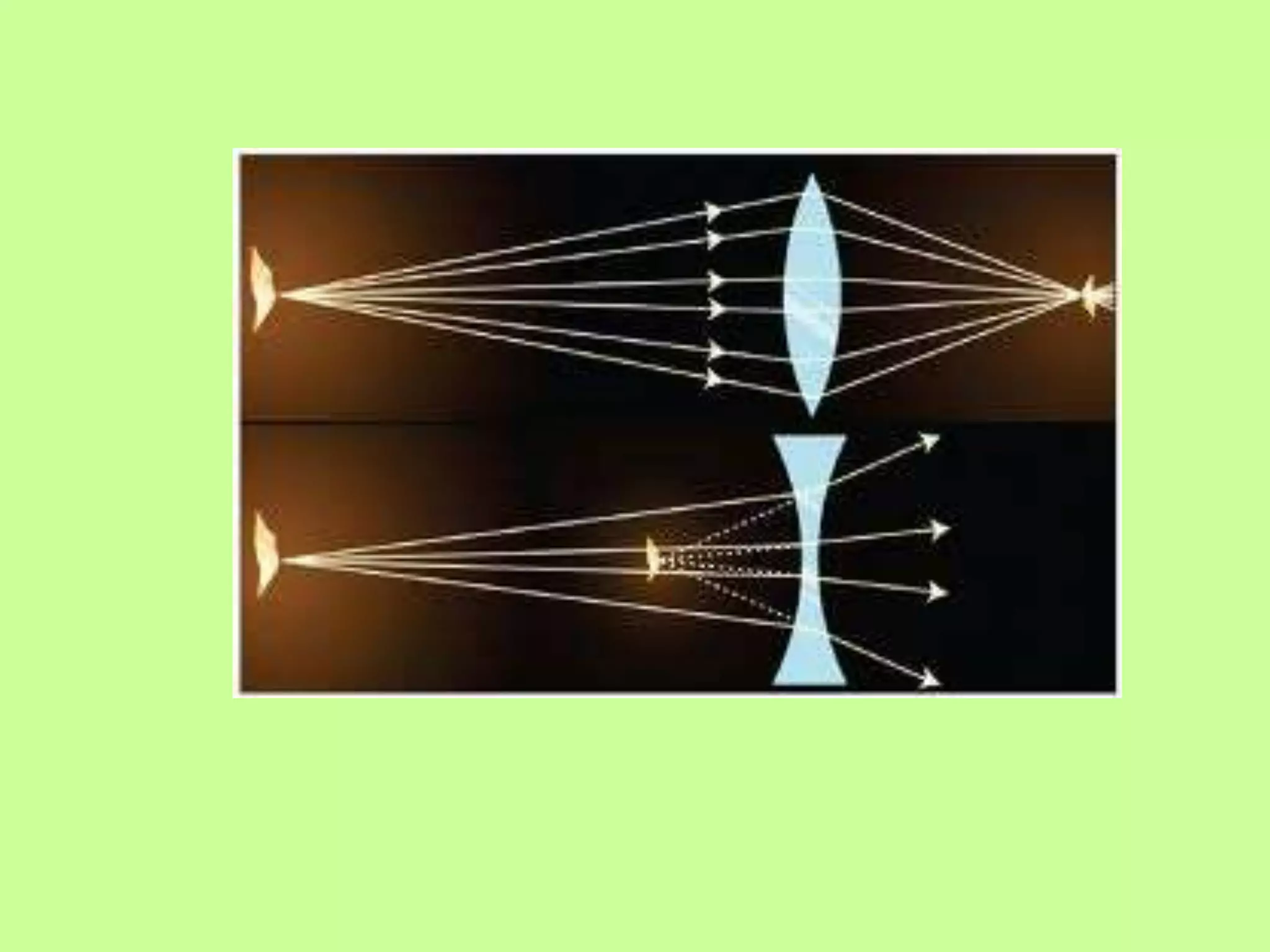
Convex Lens
Itis thickest in the centre, because its
boundaries are curving outwards.
As it bends light inwards( rays come
together), hence it is also called Converging
lens.
Its focal length is taken +ve.
It forms real image.
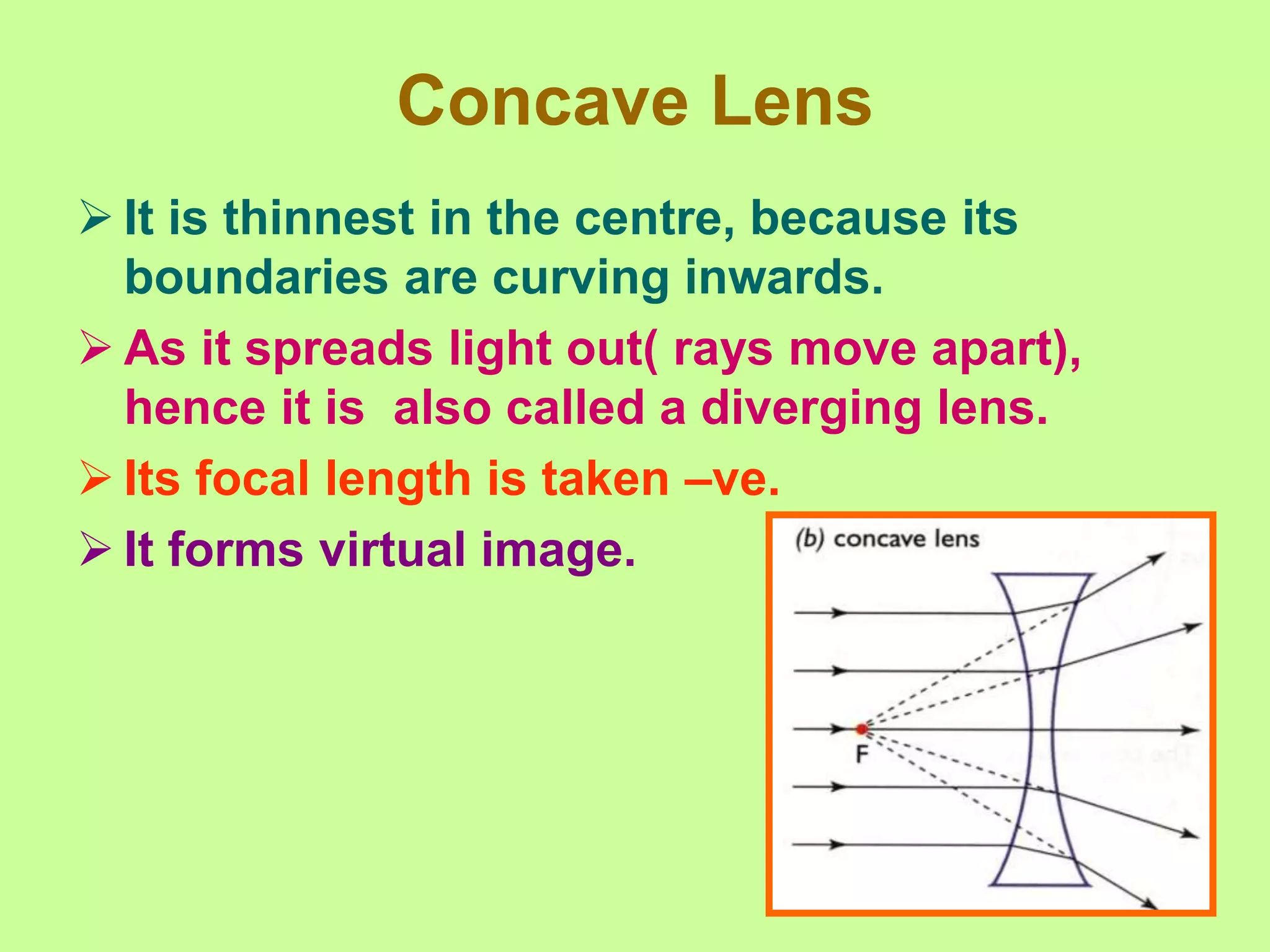
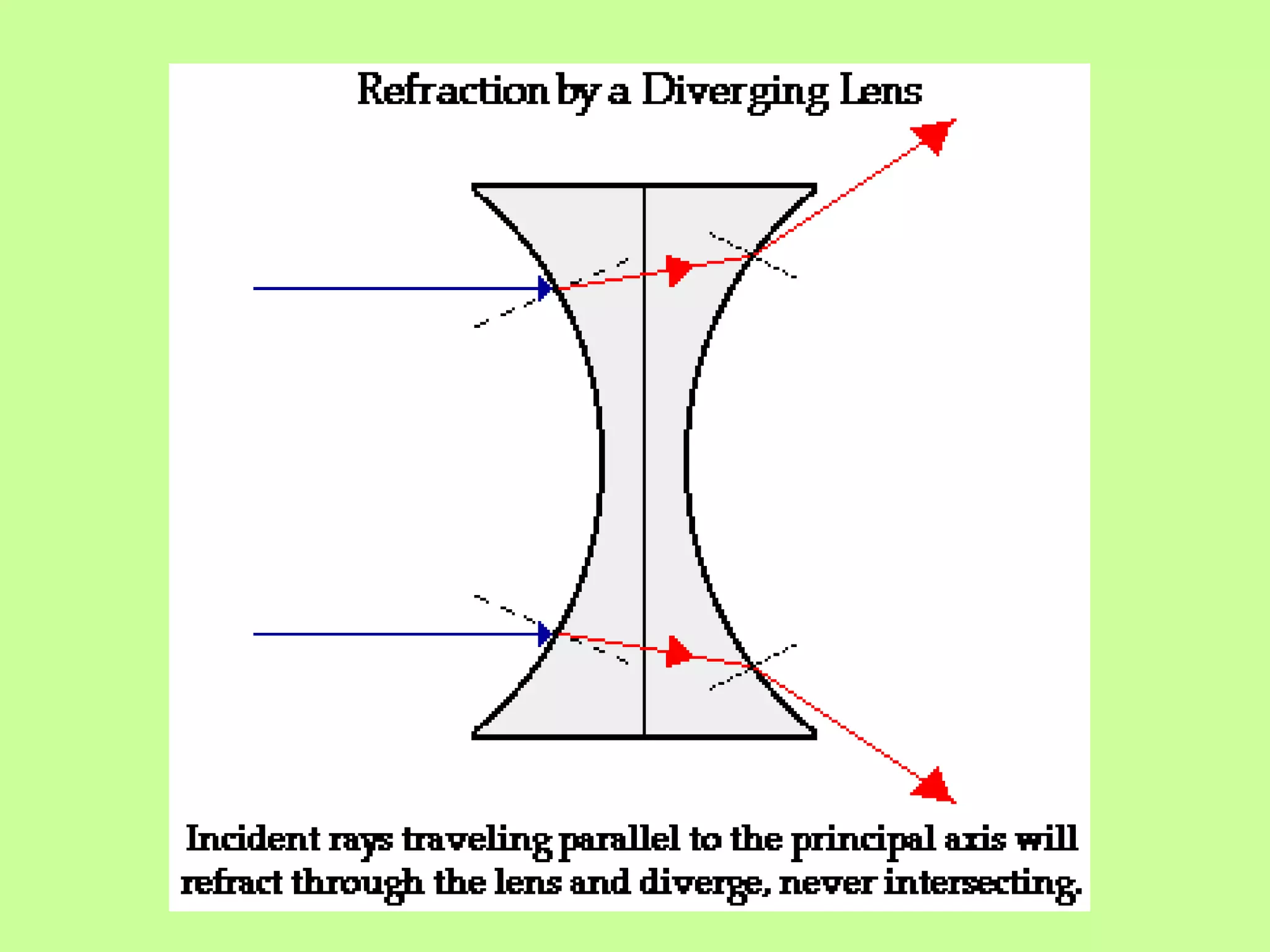
Concave Lens
Itis thinnest in the centre, because its
boundaries are curving inwards.
As it spreads light out( rays move apart),
hence it is also called a diverging lens.
Its focal length is taken –ve.
It forms virtual image.
38.
Uses Of Lenses
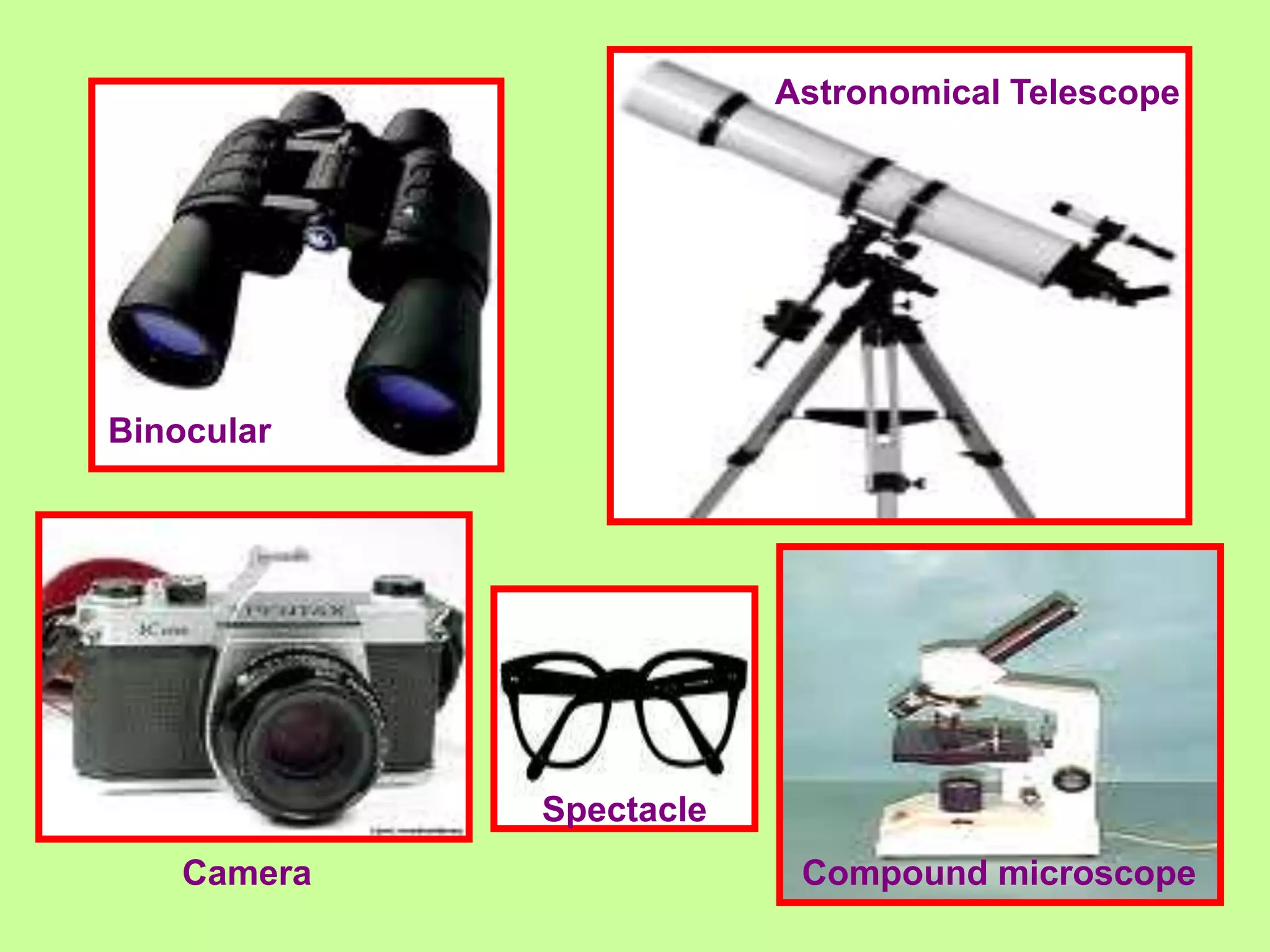
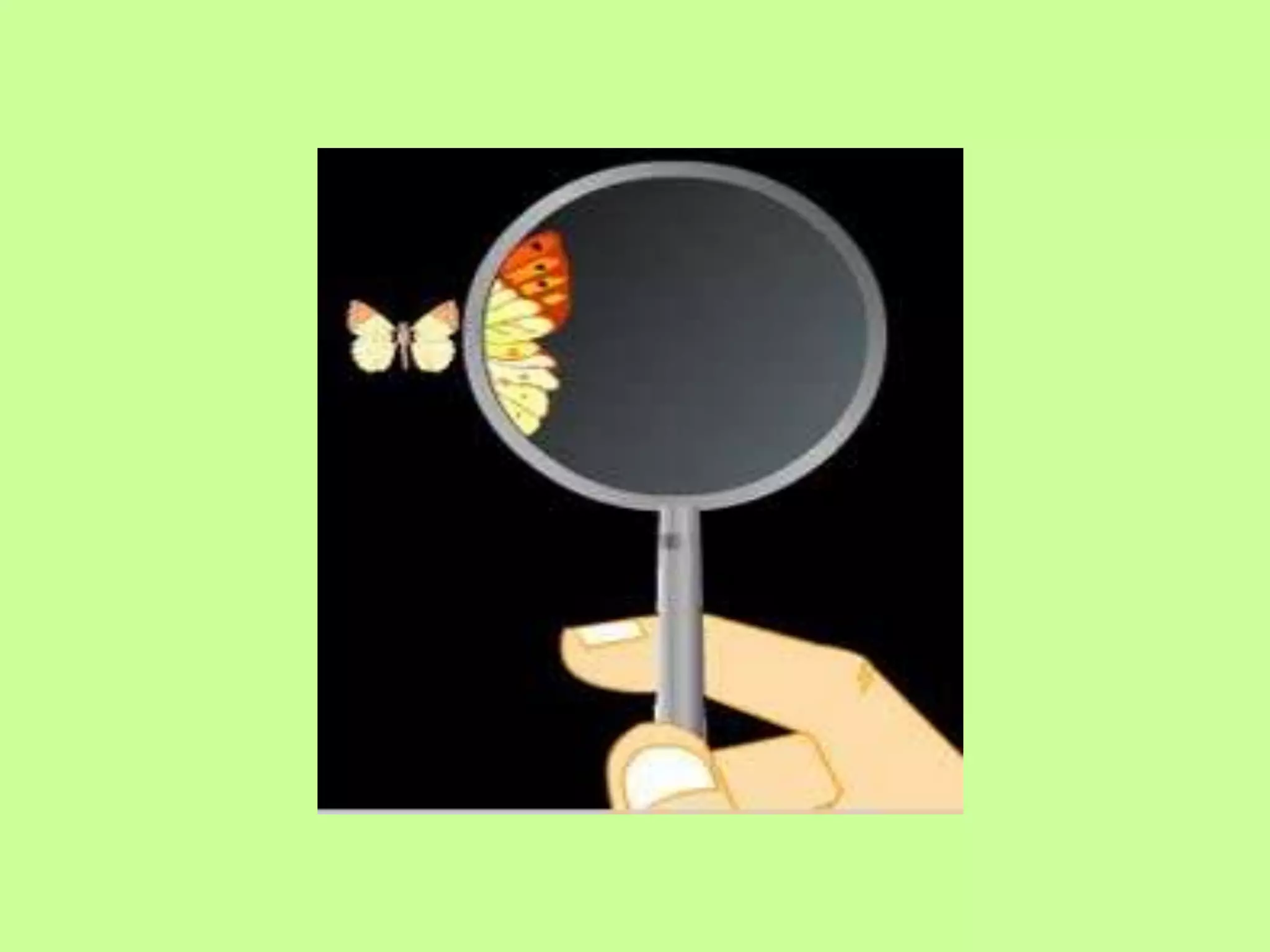
Convexlens is used in
camera,projectors,binocular,telescope,
microscope,spectacle and as magnifier
etc.
Concave lens is used in spectacle for
removing eye defect.
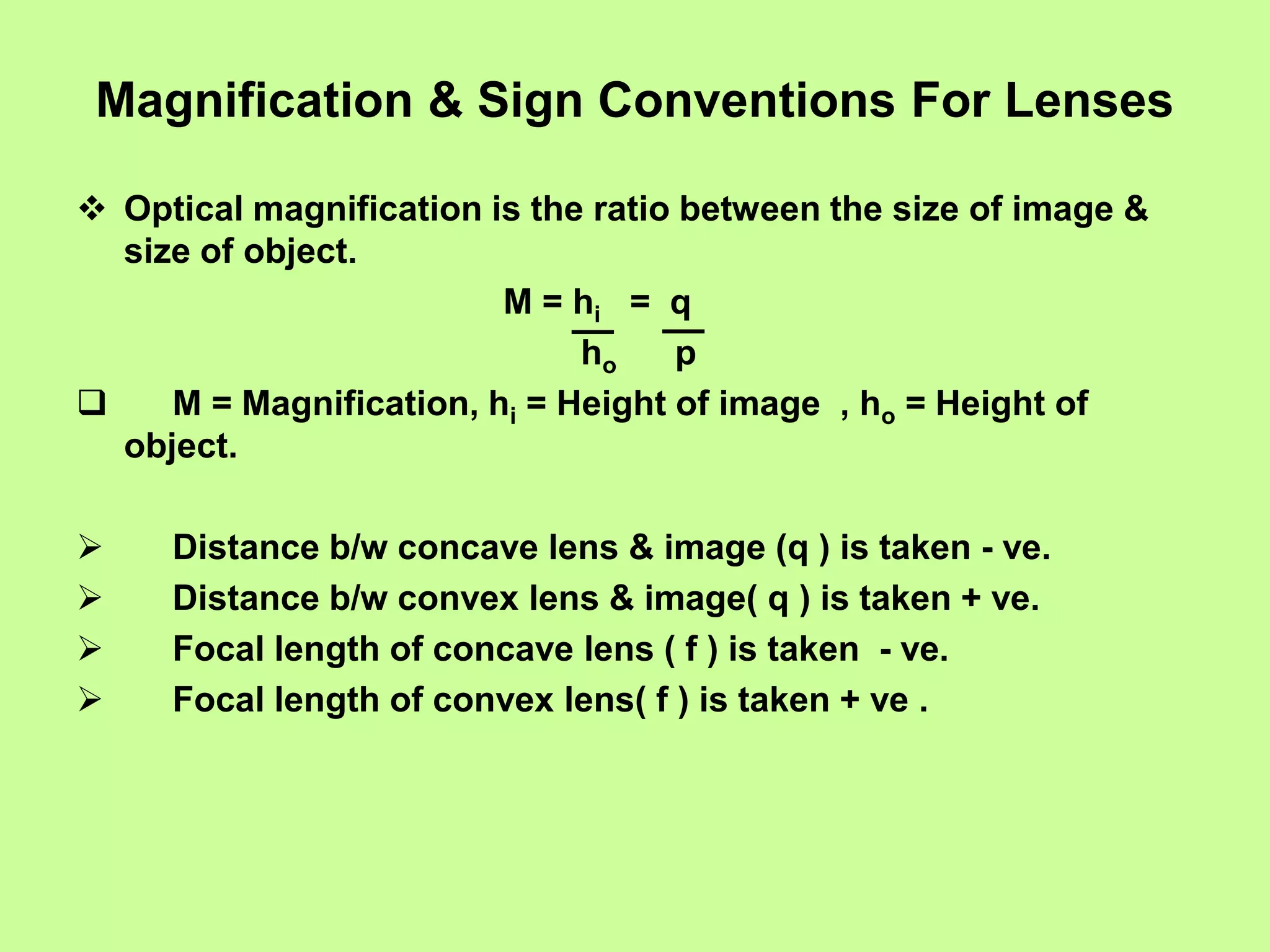
Magnification & SignConventions For Lenses
Optical magnification is the ratio between the size of image &
size of object.
M = hi = q
ho p
M = Magnification, hi = Height of image , ho = Height of
object.
Distance b/w concave lens & image (q ) is taken - ve.
Distance b/w convex lens & image( q ) is taken + ve.
Focal length of concave lens ( f ) is taken - ve.
Focal length of convex lens( f ) is taken + ve .
46.
Power Of Lens
Power of lens is the reciprocal of the focal length
expressed in meters.
Power = 1 Or P = 1
focal length (in m ) f
The unit of refractive power of a lens is the diopter(
where 1 diopter = !/meter ).
Converging lens has a positive power and diverging
lens has a negative power.
One diopter is the power of lens of focal length one
meter.
A Powerful lens deviates light rays more and thus
has a short focal length.
Magnifying glass( of f=2cm) has power
diopters,while high power microscope objective(of
f= 4mm) has power 250 diopters.
47.
Human Eye
In eyeimage is formed on retina.
In it amount of light entering into eye is
controlled by Iris.
For correct and clear image ( of near or
far objects) the thickness of eye’s lens
is increased or decreased by ciliary
muscles.
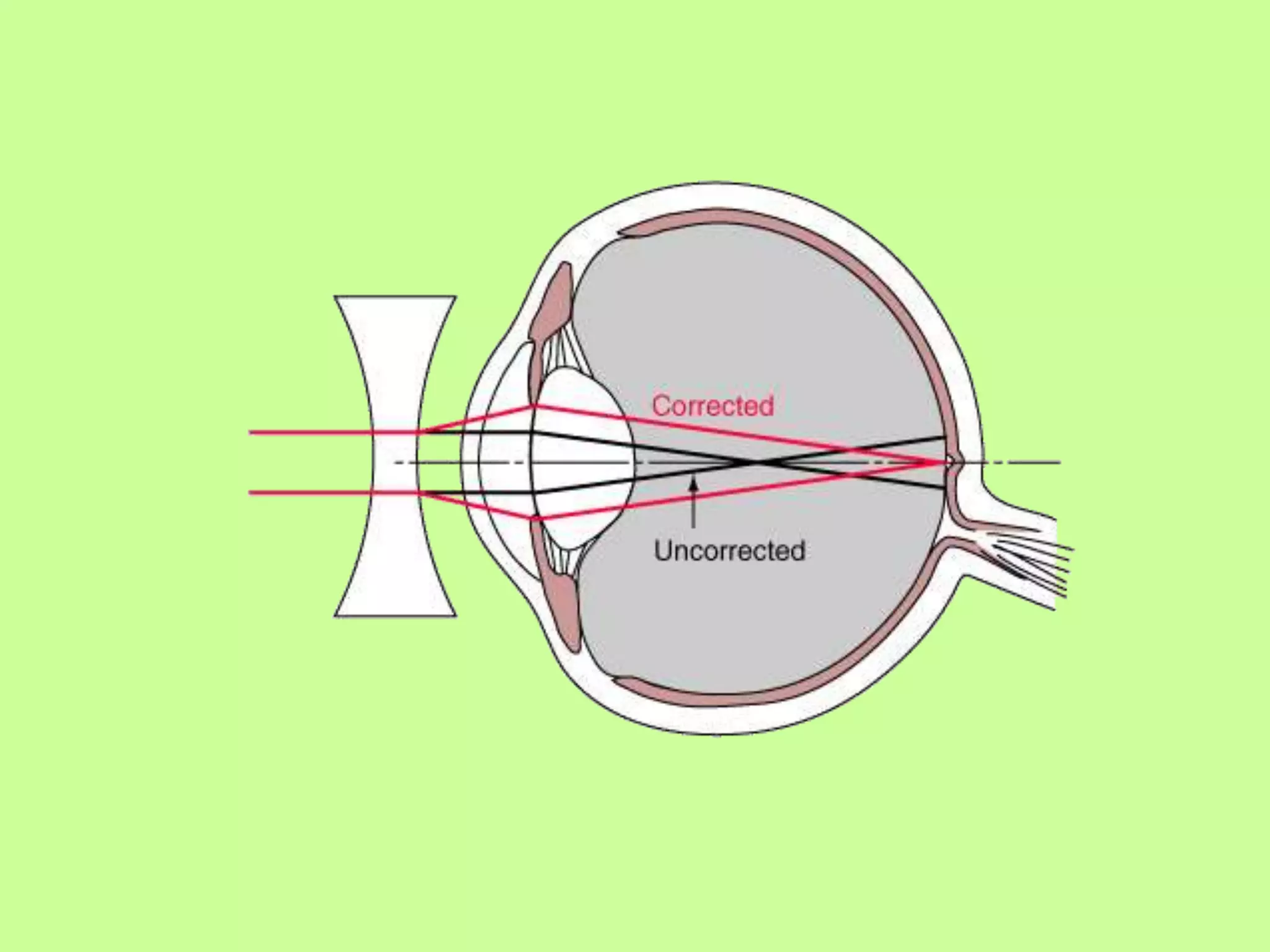
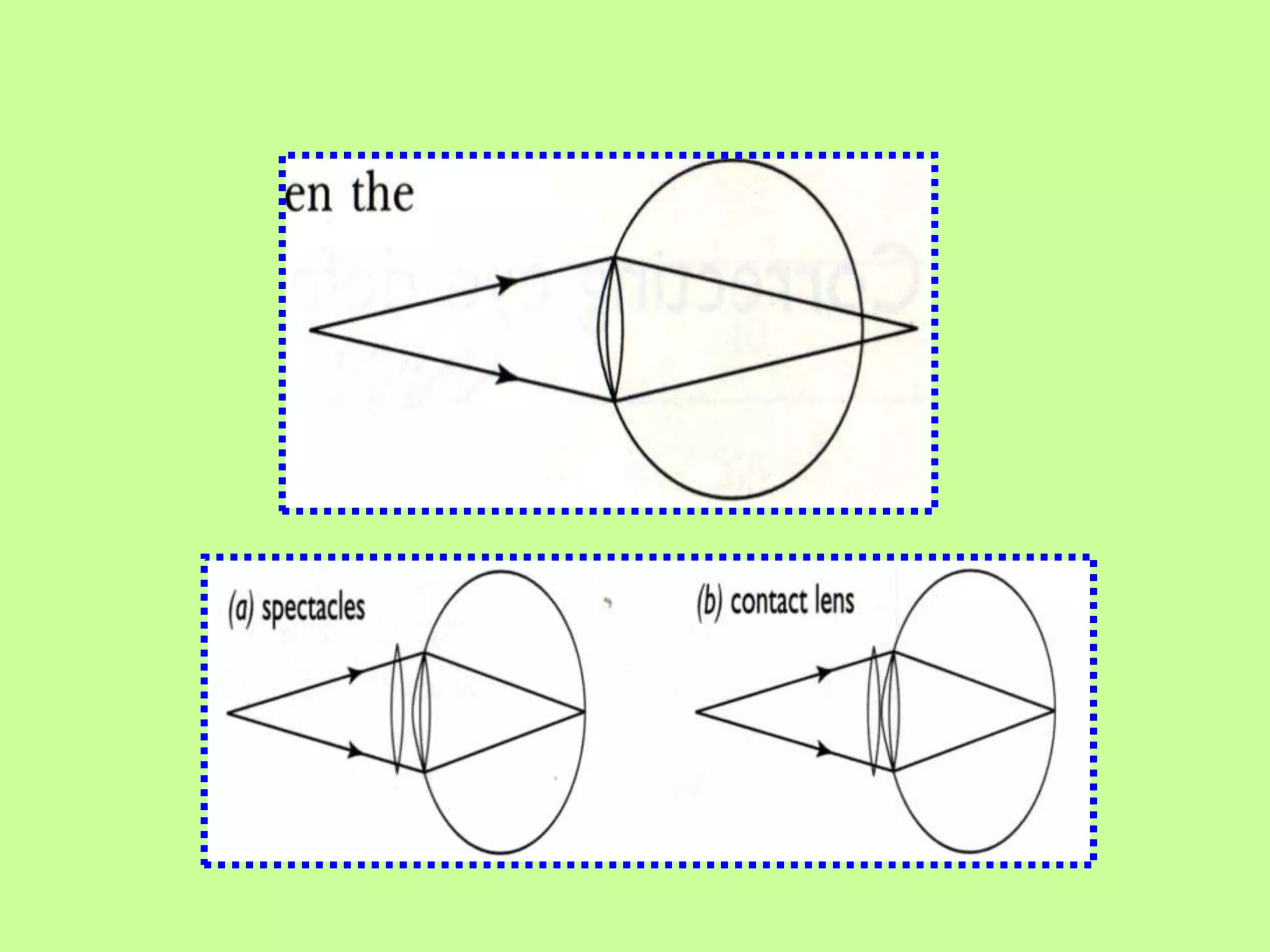
Short- Sightedness(Myopia)
Definition= In this defect of vision an eye
can see clearly only near objects,
Reason = the lens of eye becomes too much
convergent, or eye ball becomes too long. So
the images of distant objects is formed in
front of the Retina.
Remedy = For correcting this defect
concave lens ( diverging lens) of suitable
focal length is used.
53.
Long- Sightedness (Hyperopia)
Definition =In this defect of vision, an eye
can see clear only distant objects.
Reason = the lens of eye becomes less
convergent or eye ball becomes too short.
Remedy = for removing this defect convex
lens(converging lens) of suitable focal length
is used.
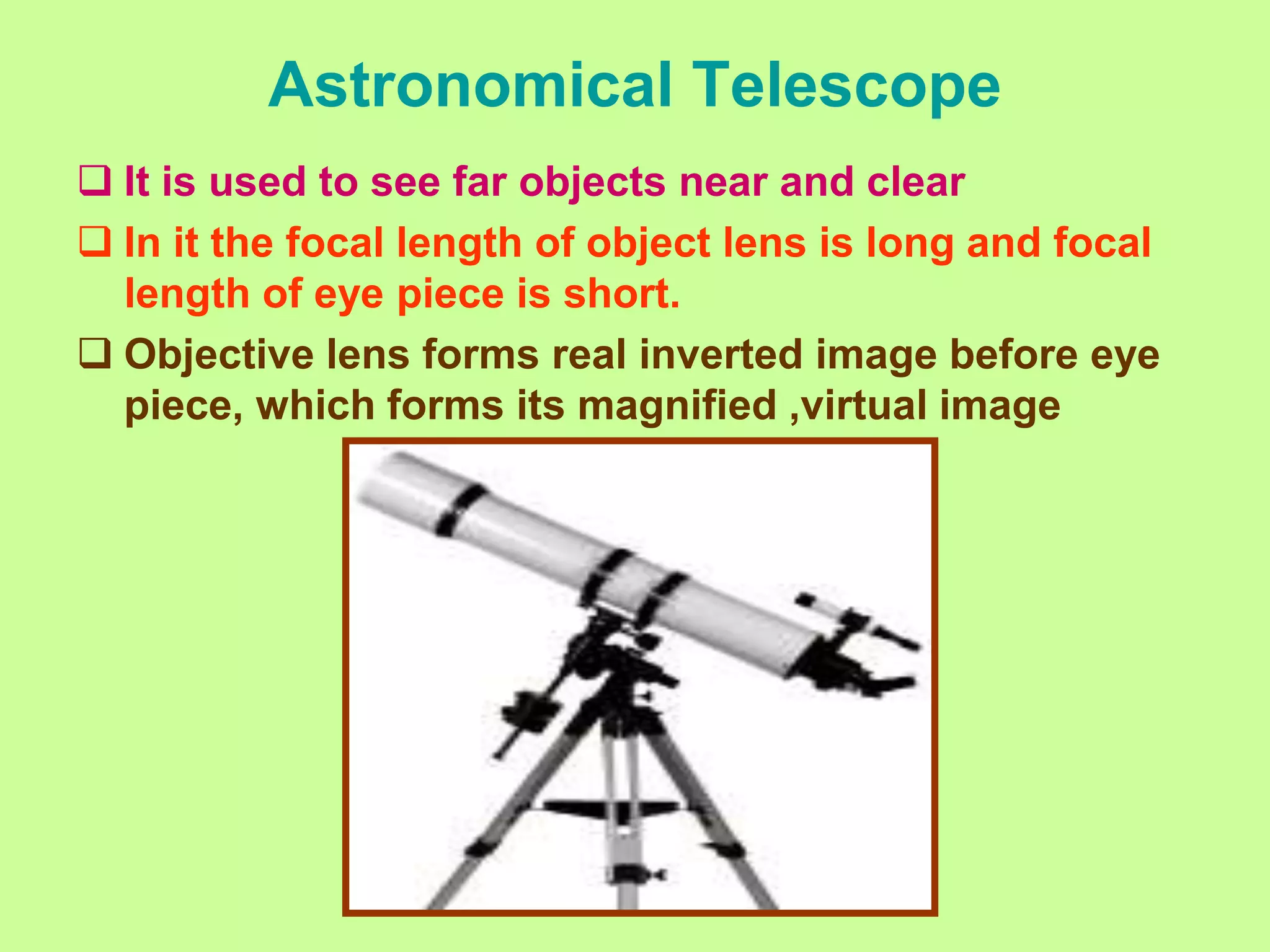
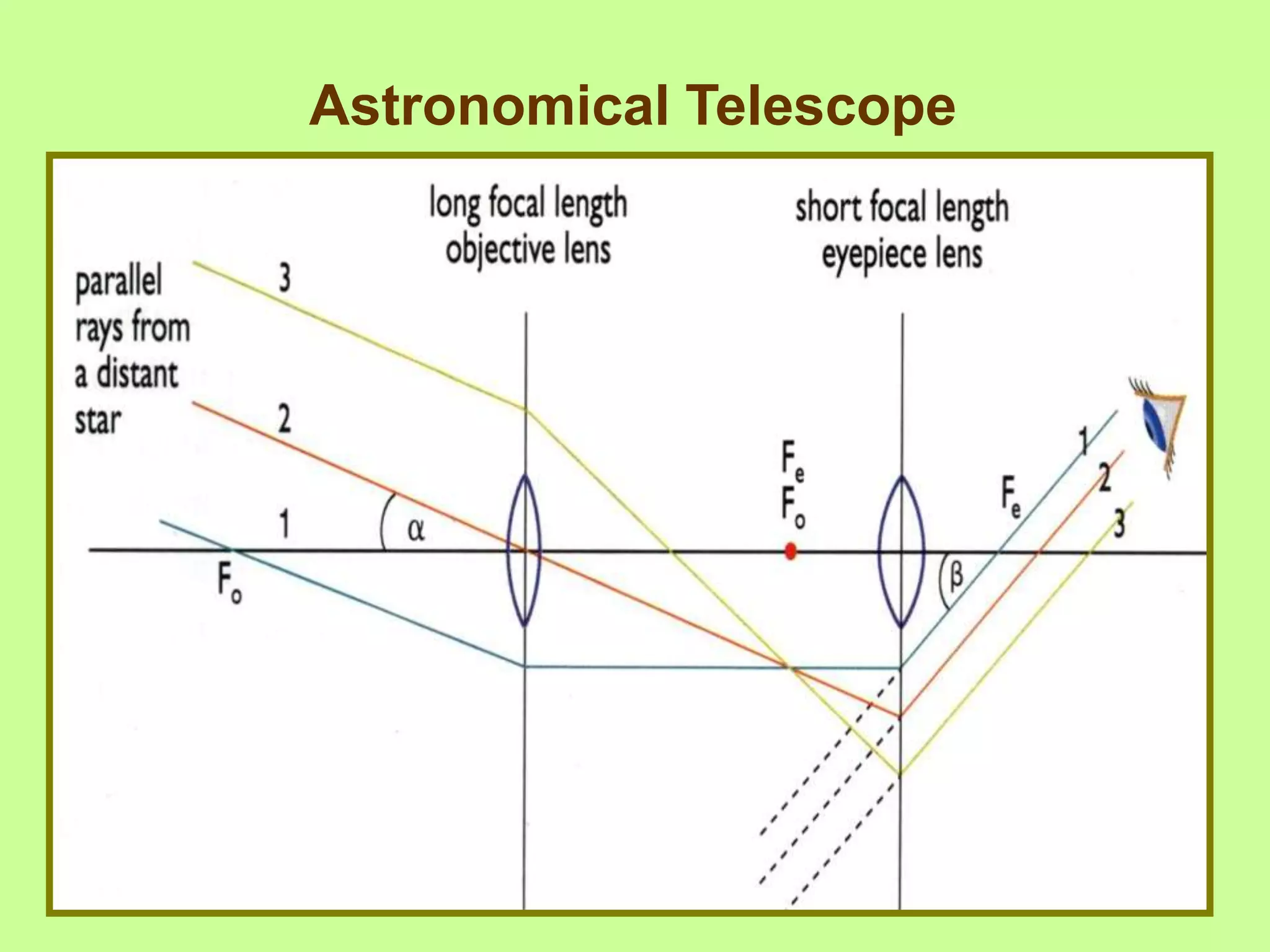
Astronomical Telescope
Itis used to see far objects near and clear
In it the focal length of object lens is long and focal
length of eye piece is short.
Objective lens forms real inverted image before eye
piece, which forms its magnified ,virtual image
Enlarged –
Image islarger
than actual
object.
Reduced –
Image is smaller
than object
59.
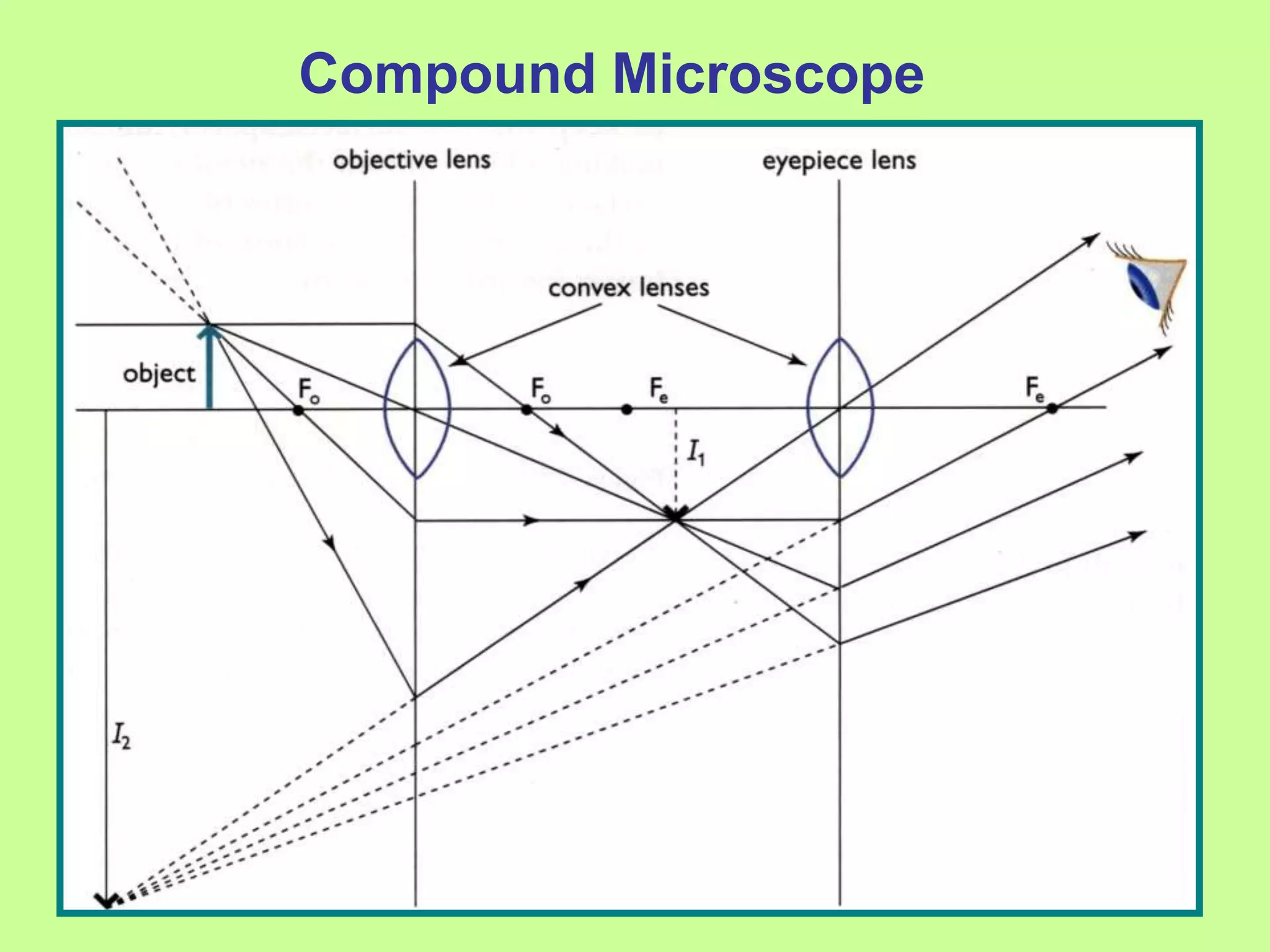
Compound Microscope
It isused to see minute near object clear and
magnified.
In it the focal length of objective lens is short and
focal length of eye piece is long.
Objective lens forms, enlarged ,inverted image,
eye piece forms its further enlarged, virtual
image.
Camera
In it imageis formed on sensitive
film.
Light reaching the film is
controlled by shutter and also by
diaphragm.
For getting correct and clear
image, convex lens is moved
forward or backward.
Lens Equation (Convex Lens )
[As BD= p,DF= f & DI = q.]
As Δ OID and Δ ABD are similar
AB/OI = BD/DI……………….(I)
AS Δ CDF and Δ OIF are similar
CD/OI = DF/IF
As CD = AB
Then AB/OI = DF/IF ……………(II)
65.
Lens Equation (Convex Lens )
[As BD= p,DF= f & DI = q.]
As Δ OID and Δ ABD are similar
AB/OI = BD/DI……………….(I)
AS Δ CDF and Δ OIF are similar
CD/OI = DF/IF
As CD = AB
Then AB/OI = DF/IF ……………(II)
comparing I and II we get.
BD/DI = DF/IF or BD/DI = DF/DI –DF……………….(III)
Put value of BD,DF and DI in equation III we get
p/q =f/q-f B.C.M we get pq- pf = qf or pq=qf+ pf.
Dividing both sides of above Equation by pqf we get
pq/pqf = qf/pqf + pf/pqf
1/f = 1/p + 1/q (Lens Equation)






















![Lens Equation ( Convex Lens )
[As BD= p,DF= f & DI = q.]
As Δ OID and Δ ABD are similar
AB/OI = BD/DI……………….(I)
AS Δ CDF and Δ OIF are similar
CD/OI = DF/IF
As CD = AB
Then AB/OI = DF/IF ……………(II)](https://image.slidesharecdn.com/refractionoflight-150604102558-lva1-app6892/75/Refraction-of-light-64-2048.jpg)
![Lens Equation ( Convex Lens )
[As BD= p,DF= f & DI = q.]
As Δ OID and Δ ABD are similar
AB/OI = BD/DI……………….(I)
AS Δ CDF and Δ OIF are similar
CD/OI = DF/IF
As CD = AB
Then AB/OI = DF/IF ……………(II)
comparing I and II we get.
BD/DI = DF/IF or BD/DI = DF/DI –DF……………….(III)
Put value of BD,DF and DI in equation III we get
p/q =f/q-f B.C.M we get pq- pf = qf or pq=qf+ pf.
Dividing both sides of above Equation by pqf we get
pq/pqf = qf/pqf + pf/pqf
1/f = 1/p + 1/q (Lens Equation)](https://image.slidesharecdn.com/refractionoflight-150604102558-lva1-app6892/75/Refraction-of-light-65-2048.jpg)


![[Unit 12.2] refraction of light](https://cdn.slidesharecdn.com/ss_thumbnails/unit12-2refractionoflight-100829070254-phpapp01-thumbnail.jpg?width=640&height=640&fit=bounds)


