REFRACTION OF LIGHT
Presented by
V. Shrivastava
P.G.T. (Physics)
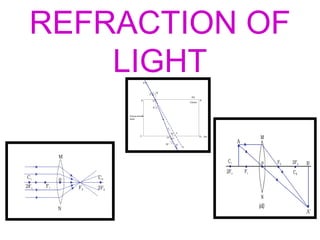
REFRACTION OF
LIGHT
REFRACTION OF LIGHT
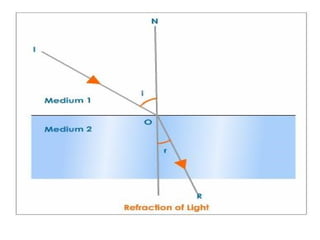
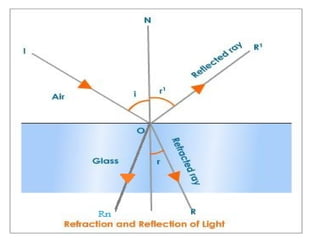
• When the light traveling obliquely from one medium to another, the
direction of propagation of light in the second medium changes.
This phenomenon is known as refraction of light.
• A light ray traveling obliquely from a denser medium to a rarer
medium bends away from the normal. A light ray bends towards the
normal when it travels obliquely from a rarer to a denser medium.
• Light travels in vacuum with an enormous speed of 3×10⁸ m s-1.
The speed of light is different in different media.
The refractive index of a transparent medium is the ratio of the speed
of light in vacuum to that in the medium.
Laws of refraction of light.
• (i) The incident ray, the refracted ray and the
normal to the interface of two transparent media
at the point of incidence, all lie in the same
plane.
• (ii) The ratio of sine of angle of incidence to the
sine of angle of refraction is a constant, for the
light of a given colour and for the given pair of
media. This law is also known as Snell’s law of
refraction.
• If i is the angle of incidence and r is the angle of
refraction, then, Sini/ sinr = constant = n
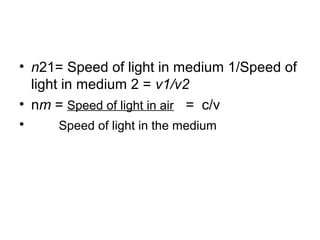
• n21= Speed of light in medium 1/Speed of
light in medium 2 = v1/v2
• nm = Speed of light in air = c/v
• Speed of light in the medium
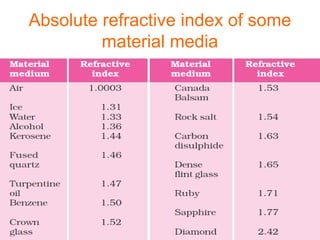
Absolute refractive index of some
material media
Optical rarer and optical denser
• In comparing two media, the one with the larger
refractive index is optically denser medium than the
other. The other medium of lower refractive index is
optically rarer. The speed of light is higher in a rarer
medium than a denser medium. Thus, a ray of light
traveling from a rarer medium to a denser medium slows
down and bends towards the normal. When it travels
from a denser medium to a rarer medium, it speeds up
and bends away from the normal.
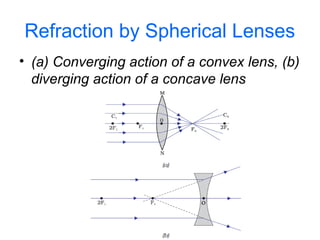
Refraction by Spherical Lenses
• (a) Converging action of a convex lens, (b)
diverging action of a concave lens
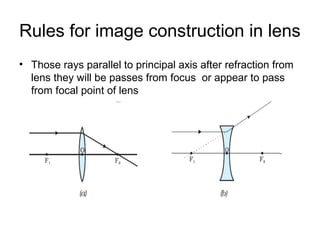
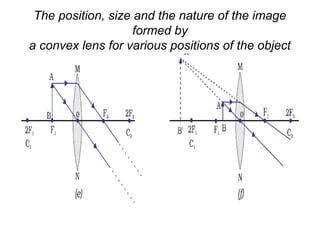
Rules for image construction in lens
• Those rays parallel to principal axis after refraction from
lens they will be passes from focus or appear to pass
from focal point of lens
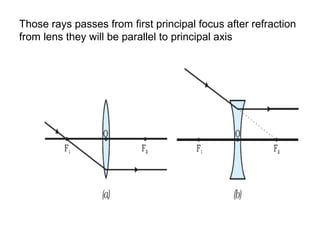
Those rays passes from first principal focus after refraction
from lens they will be parallel to principal axis
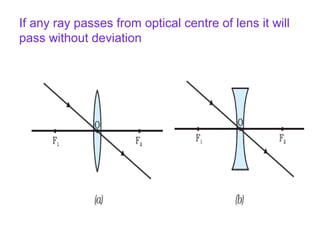
If any ray passes from optical centre of lens it will
pass without deviation
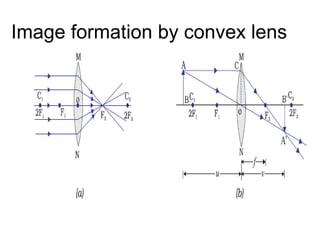
Image formation by convex lens
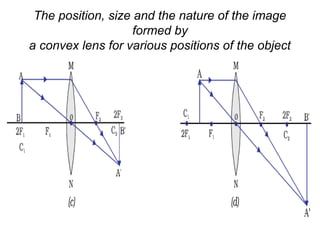
The position, size and the nature of the image
formed by
a convex lens for various positions of the object
The position, size and the nature of the image
formed by
a convex lens for various positions of the object
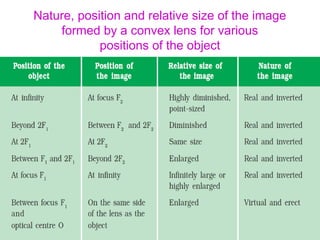
Nature, position and relative size of the image
formed by a convex lens for various
positions of the object
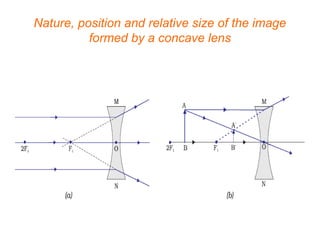
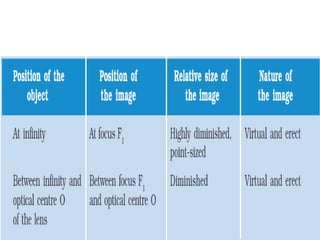
Nature, position and relative size of the image
formed by a concave lens
Refraction of light
Refraction of light
Refraction of light

Refraction of light

  • 1.
    REFRACTION OF LIGHT Presentedby V. Shrivastava P.G.T. (Physics)
  • 2.
  • 3.
    REFRACTION OF LIGHT •When the light traveling obliquely from one medium to another, the direction of propagation of light in the second medium changes. This phenomenon is known as refraction of light. • A light ray traveling obliquely from a denser medium to a rarer medium bends away from the normal. A light ray bends towards the normal when it travels obliquely from a rarer to a denser medium. • Light travels in vacuum with an enormous speed of 3×10⁸ m s-1. The speed of light is different in different media. The refractive index of a transparent medium is the ratio of the speed of light in vacuum to that in the medium.
  • 4.
    Laws of refractionof light. • (i) The incident ray, the refracted ray and the normal to the interface of two transparent media at the point of incidence, all lie in the same plane. • (ii) The ratio of sine of angle of incidence to the sine of angle of refraction is a constant, for the light of a given colour and for the given pair of media. This law is also known as Snell’s law of refraction. • If i is the angle of incidence and r is the angle of refraction, then, Sini/ sinr = constant = n
  • 8.
    • n21= Speedof light in medium 1/Speed of light in medium 2 = v1/v2 • nm = Speed of light in air = c/v • Speed of light in the medium
  • 9.
    Absolute refractive indexof some material media
  • 10.
    Optical rarer andoptical denser • In comparing two media, the one with the larger refractive index is optically denser medium than the other. The other medium of lower refractive index is optically rarer. The speed of light is higher in a rarer medium than a denser medium. Thus, a ray of light traveling from a rarer medium to a denser medium slows down and bends towards the normal. When it travels from a denser medium to a rarer medium, it speeds up and bends away from the normal.
  • 11.
    Refraction by SphericalLenses • (a) Converging action of a convex lens, (b) diverging action of a concave lens
  • 12.
    Rules for imageconstruction in lens • Those rays parallel to principal axis after refraction from lens they will be passes from focus or appear to pass from focal point of lens
  • 13.
    Those rays passesfrom first principal focus after refraction from lens they will be parallel to principal axis
  • 14.
    If any raypasses from optical centre of lens it will pass without deviation
  • 15.
    Image formation byconvex lens
  • 16.
    The position, sizeand the nature of the image formed by a convex lens for various positions of the object
  • 17.
    The position, sizeand the nature of the image formed by a convex lens for various positions of the object
  • 18.
    Nature, position andrelative size of the image formed by a convex lens for various positions of the object
  • 19.
    Nature, position andrelative size of the image formed by a concave lens