11 Reflection and Refraction
1
Introduction
To explain how light behaves, we can think of light
travelling as rays.
A ray travels in a straight line. It will change direction
if:
• It is reflected (when it strikes a surface)
• It is refracted (when it passes from one material to
another).
We can also think of light as waves
Laws of reflection
The laws of reflection tells us where a ray will go when
it is reflected.
The normal is the line at 90o to the reflecting surface
at the point where the incident ray strikes it
2
3
normal
incident ray reflected rayi r
Law 1: angle of incidence = angle of reflection, i = r
(angles measured from the normal to the ray)
Law 2: incident ray, reflected ray and the normal are all
in the same plane.
These laws not only apply for flat surfaces but also for
curved and rough surfaces
normal
i r i
r
Refraction: when it happens
Light travels fastest in a vacuum. It travels more slowly
in other media.
When light changes speed (because it travels from one
medium to another), it is refracted.
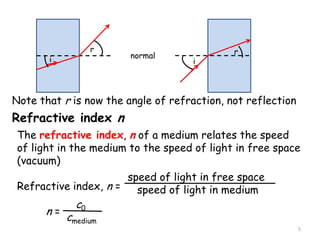
• If a ray enters a medium head-on (angle of incidence i
= 0), it travels straight on.
• If a ray enters a medium obliquely, it bends
Laws of refraction
As with reflection, angles are measured from the normal
to the ray.
Law 1: Snell’s law explains how the angles of incidence
and refraction are related.
Law 2: incident ray, refracted ray and the normal are all
in the same plane.
4
5
normal
r r
i i
Note that r is now the angle of refraction, not reflection
Refractive index n
The refractive index, n of a medium relates the speed
of light in the medium to the speed of light in free space
(vacuum)
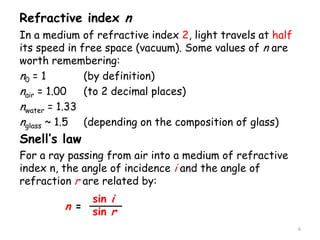
Refractive index, n =
speed of light in free space
speed of light in medium
n =
c0
cmedium
Refractive index n
In a medium of refractive index 2, light travels at half
its speed in free space (vacuum). Some values of n are
worth remembering:
n0 = 1 (by definition)
nair = 1.00 (to 2 decimal places)
nwater = 1.33
nglass ~ 1.5 (depending on the composition of glass)
Snell’s law
For a ray passing from air into a medium of refractive
index n, the angle of incidence i and the angle of
refraction r are related by:
6
n =
sin i
sin r
Snell’s law
When a ray passes from one medium to another, the
refractive index can be calculated using the equations:
7
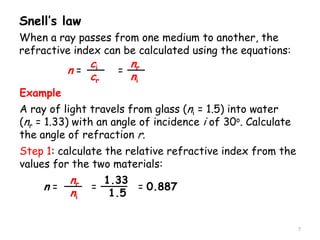
n =
ci
cr
=
nr
ni
Example
A ray of light travels from glass (ni = 1.5) into water
(nr = 1.33) with an angle of incidence i of 30o. Calculate
the angle of refraction r.
Step 1: calculate the relative refractive index from the
values for the two materials:
n =
nr
ni
=
1.33
1.5
= 0.887
8
Step 2: Substitute values into the Snell’s law
equation, rearrange and solve:
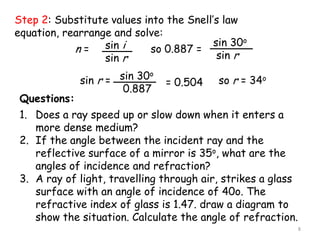
n = sin i
sin r
so 0.887 =
sin 30o
sin r
sin r = sin 30o
0.887
= 0.504 so r = 34o
Questions:
1. Does a ray speed up or slow down when it enters a
more dense medium?
2. If the angle between the incident ray and the
reflective surface of a mirror is 35o, what are the
angles of incidence and refraction?
3. A ray of light, travelling through air, strikes a glass
surface with an angle of incidence of 40o. The
refractive index of glass is 1.47. draw a diagram to
show the situation. Calculate the angle of refraction.

1 reflection and refraction

  • 1.
    11 Reflection andRefraction 1
  • 2.
    Introduction To explain howlight behaves, we can think of light travelling as rays. A ray travels in a straight line. It will change direction if: • It is reflected (when it strikes a surface) • It is refracted (when it passes from one material to another). We can also think of light as waves Laws of reflection The laws of reflection tells us where a ray will go when it is reflected. The normal is the line at 90o to the reflecting surface at the point where the incident ray strikes it 2
  • 3.
    3 normal incident ray reflectedrayi r Law 1: angle of incidence = angle of reflection, i = r (angles measured from the normal to the ray) Law 2: incident ray, reflected ray and the normal are all in the same plane. These laws not only apply for flat surfaces but also for curved and rough surfaces normal i r i r
  • 4.
    Refraction: when ithappens Light travels fastest in a vacuum. It travels more slowly in other media. When light changes speed (because it travels from one medium to another), it is refracted. • If a ray enters a medium head-on (angle of incidence i = 0), it travels straight on. • If a ray enters a medium obliquely, it bends Laws of refraction As with reflection, angles are measured from the normal to the ray. Law 1: Snell’s law explains how the angles of incidence and refraction are related. Law 2: incident ray, refracted ray and the normal are all in the same plane. 4
  • 5.
    5 normal r r i i Notethat r is now the angle of refraction, not reflection Refractive index n The refractive index, n of a medium relates the speed of light in the medium to the speed of light in free space (vacuum) Refractive index, n = speed of light in free space speed of light in medium n = c0 cmedium
  • 6.
    Refractive index n Ina medium of refractive index 2, light travels at half its speed in free space (vacuum). Some values of n are worth remembering: n0 = 1 (by definition) nair = 1.00 (to 2 decimal places) nwater = 1.33 nglass ~ 1.5 (depending on the composition of glass) Snell’s law For a ray passing from air into a medium of refractive index n, the angle of incidence i and the angle of refraction r are related by: 6 n = sin i sin r
  • 7.
    Snell’s law When aray passes from one medium to another, the refractive index can be calculated using the equations: 7 n = ci cr = nr ni Example A ray of light travels from glass (ni = 1.5) into water (nr = 1.33) with an angle of incidence i of 30o. Calculate the angle of refraction r. Step 1: calculate the relative refractive index from the values for the two materials: n = nr ni = 1.33 1.5 = 0.887
  • 8.
    8 Step 2: Substitutevalues into the Snell’s law equation, rearrange and solve: n = sin i sin r so 0.887 = sin 30o sin r sin r = sin 30o 0.887 = 0.504 so r = 34o Questions: 1. Does a ray speed up or slow down when it enters a more dense medium? 2. If the angle between the incident ray and the reflective surface of a mirror is 35o, what are the angles of incidence and refraction? 3. A ray of light, travelling through air, strikes a glass surface with an angle of incidence of 40o. The refractive index of glass is 1.47. draw a diagram to show the situation. Calculate the angle of refraction.