Dr Md Ferdous Islam
Department of Ophthalmology
CMH Dhaka
LIGHT
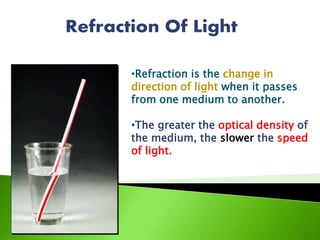
•Refraction is the change in
direction of light when it passes
from one medium to another.
•The greater the optical density of
the medium, the slower the speed
of light.
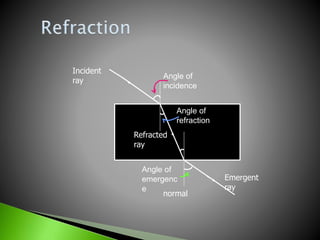
Incident
ray
Refracted
ray
Emergent
ray
Angle of
incidence
Angle of
refraction
normal
Angle of
emergenc
e
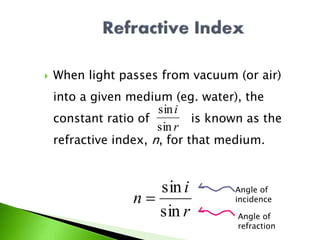
 When light passes from vacuum (or air)
into a given medium (eg. water), the
constant ratio of is known as the
refractive index, n, for that medium.
r
i
sin
sin
r
i
n
sin
sin

Angle of
incidence
Angle of
refraction
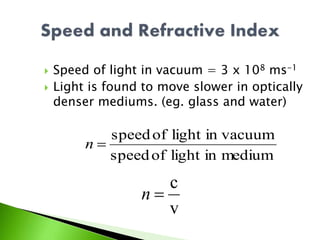
 Speed of light in vacuum = 3 x 10⁸ ms-1
 Light is found to move slower in optically
denser mediums. (eg. glass and water)
v
c
n
mediuminlightofspeed
in vacuumlightofspeed
n
LIGHT
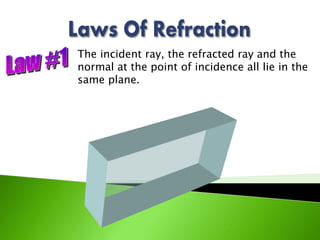
The incident ray, the refracted ray and the
normal at the point of incidence all lie in the
same plane.
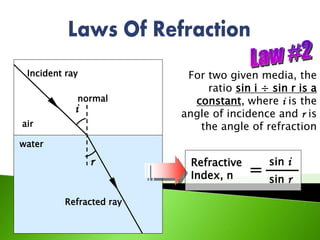
For two given media, the
ratio sin i ÷ sin r is a
constant, where i is the
angle of incidence and r is
the angle of refraction
LIGHT
i
r
air
water
Incident ray
Refracted ray
normal
Refractive
Index, n =
sin i
sin r
LIGHT
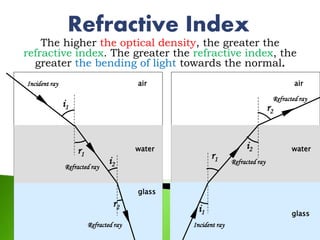
The higher the optical density, the greater the
refractive index. The greater the refractive index, the
greater the bending of light towards the normal.
air
water
i1
r1
Incident ray
Refracted ray
glass
i2
r2
Refracted ray
air
water
i1
r1
Incident ray
glass
i2
r2
Refracted ray
Refracted ray
LIGHT
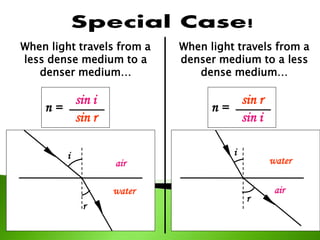
When light travels from a
less dense medium to a
denser medium…
n =
sin i
sin r
i
r
air
water
When light travels from a
denser medium to a less
dense medium…
n =
sin r
sin i
i
r
air
water
LIGHT
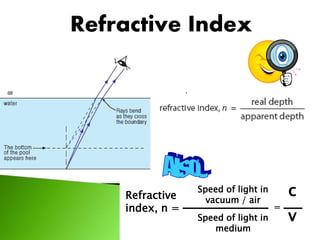
Refractive
index, n =
Speed of light in
vacuum / air
Speed of light in
medium
=
c
v
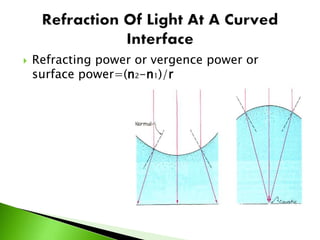
 Refracting power or vergence power or
surface power=(n2-n1)/r
LIGHT
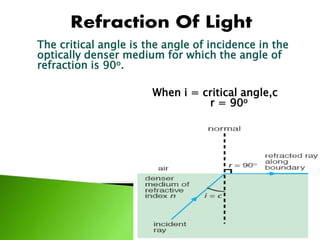
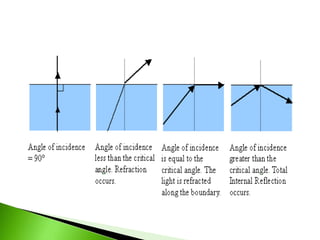
The critical angle is the angle of incidence in the
optically denser medium for which the angle of
refraction is 90o.
When i = critical angle,c
r = 90o
LIGHT
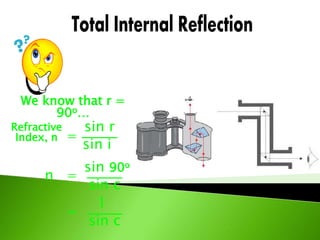
We know that r =
90o…
Refractive
Index, n =
sin r
sin i
n =
sin c
sin 90o
=
sin c
1
LIGHT
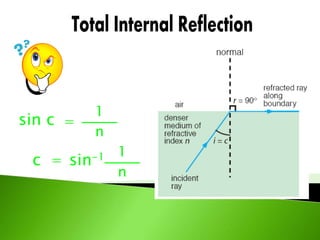
n
=sin c
=c
1
sin-1
n
1
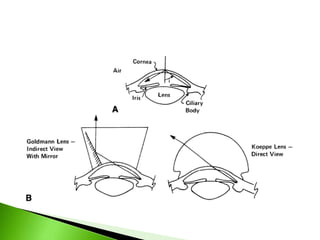
http://www.oculist.net/downaton502/
prof/ebook/duanes/graphics/figures/v
1/0300/044f.gif
 Mismatch between axial length and refractive
power.
 Parallel light rays don’t fall on the retina.
◦ Nearsightedness (Myopia)
◦ Farsightedness (Hypermetropia)
◦ Astigmatism
◦ Presbyopia
◦ Anisometropia
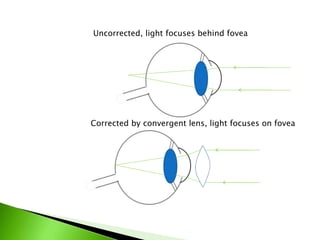
Uncorrected, light focuses behind fovea
Corrected by convergent lens, light focuses on fovea
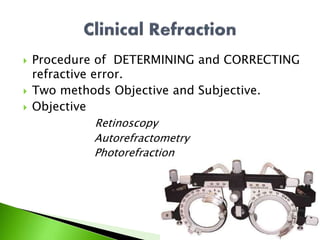
 Procedure of DETERMINING and CORRECTING
refractive error.
 Two methods Objective and Subjective.
 Objective
Retinoscopy
Autorefractometry
Photorefraction
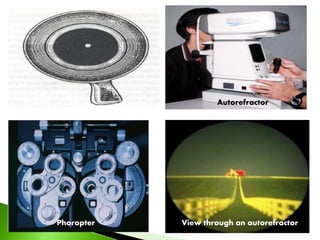
Pinhole glasses Autorefractor
View through an autorefractorPhoropter
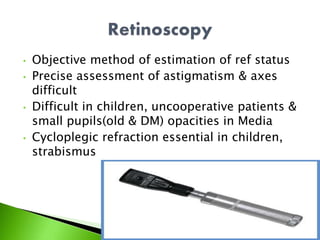
• Objective method of estimation of ref status
• Precise assessment of astigmatism & axes
difficult
• Difficult in children, uncooperative patients &
small pupils(old & DM) opacities in Media
• Cycloplegic refraction essential in children,
strabismus
 Begins with directing light into pts’ eye and
illuminating area of retina
 Emergent rays from pts eye forms an image
 It is referred to as red fundal glow
 By convention referred to patients’ pupillary
area
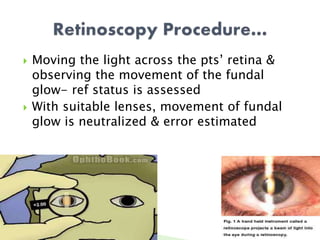
 Moving the light across the pts’ retina &
observing the movement of the fundal
glow- ref status is assessed
 With suitable lenses, movement of fundal
glow is neutralized & error estimated
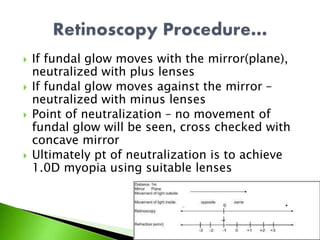
 If fundal glow moves with the mirror(plane),
neutralized with plus lenses
 If fundal glow moves against the mirror –
neutralized with minus lenses
 Point of neutralization – no movement of
fundal glow will be seen, cross checked with
concave mirror
 Ultimately pt of neutralization is to achieve
1.0D myopia using suitable lenses
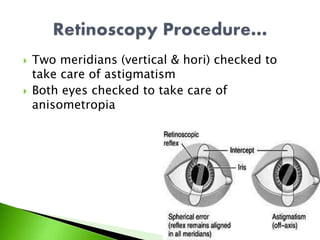
 Two meridians (vertical & hori) checked to
take care of astigmatism
 Both eyes checked to take care of
anisometropia
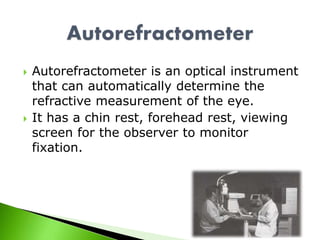
 Autorefractometer is an optical instrument
that can automatically determine the
refractive measurement of the eye.
 It has a chin rest, forehead rest, viewing
screen for the observer to monitor
fixation.
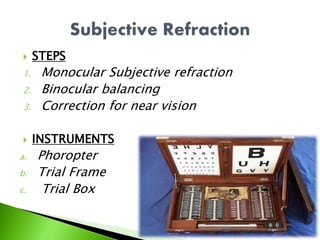
 STEPS
1. Monocular Subjective refraction
2. Binocular balancing
3. Correction for near vision
 INSTRUMENTS
a. Phoropter
b. Trial Frame
c. Trial Box
 History
 Visual Acuity
 Ext Exam
 Ophthalmoscopic exam
 Cover test to detect latent and manifest deviation
 Retinoscopy
 Subjective refraction
 Subjective refinement and finalization of lens
 Binocular balancing
 Near vision correction
 Spectacle lenses
◦ Monofocal lenses : spherical lenses , cylindrical
lenses
◦ Multifocal lenses
 Contact lenses:
◦ higher quality of optical image and less influence
on the size of retinal image than spectacle lenses
◦ indication : cosmetic , athletic activities ,
occupational , irregular corneal astigmatism , high
anisometropia , corneal disease.
◦ soft, hard, gas-permeable
 CONTACT LENSES
◦ Disadvantages : careful daily cleaning and
disinfection , expense
◦ Complication : infectious keratitis , giant papillary
conjunctivitis , corneal vascularization , severe
chronic conjunctivitis
 INTRAOCULAR LENSES
◦ replacement of cataract crystalline lens
◦ give best optical correction for aphakia , avoid
significant magnification and distortion caused by
spectacle lenses
Refraction.Dr Ferdous

Refraction.Dr Ferdous

  • 2.
    Dr Md FerdousIslam Department of Ophthalmology CMH Dhaka
  • 3.
    LIGHT •Refraction is thechange in direction of light when it passes from one medium to another. •The greater the optical density of the medium, the slower the speed of light.
  • 4.
  • 5.
     When lightpasses from vacuum (or air) into a given medium (eg. water), the constant ratio of is known as the refractive index, n, for that medium. r i sin sin r i n sin sin  Angle of incidence Angle of refraction
  • 6.
     Speed oflight in vacuum = 3 x 10⁸ ms-1  Light is found to move slower in optically denser mediums. (eg. glass and water) v c n mediuminlightofspeed in vacuumlightofspeed n
  • 7.
    LIGHT The incident ray,the refracted ray and the normal at the point of incidence all lie in the same plane.
  • 8.
    For two givenmedia, the ratio sin i ÷ sin r is a constant, where i is the angle of incidence and r is the angle of refraction LIGHT i r air water Incident ray Refracted ray normal Refractive Index, n = sin i sin r
  • 9.
    LIGHT The higher theoptical density, the greater the refractive index. The greater the refractive index, the greater the bending of light towards the normal. air water i1 r1 Incident ray Refracted ray glass i2 r2 Refracted ray air water i1 r1 Incident ray glass i2 r2 Refracted ray Refracted ray
  • 10.
    LIGHT When light travelsfrom a less dense medium to a denser medium… n = sin i sin r i r air water When light travels from a denser medium to a less dense medium… n = sin r sin i i r air water
  • 11.
    LIGHT Refractive index, n = Speedof light in vacuum / air Speed of light in medium = c v
  • 12.
     Refracting poweror vergence power or surface power=(n2-n1)/r
  • 13.
    LIGHT The critical angleis the angle of incidence in the optically denser medium for which the angle of refraction is 90o. When i = critical angle,c r = 90o
  • 15.
    LIGHT We know thatr = 90o… Refractive Index, n = sin r sin i n = sin c sin 90o = sin c 1
  • 16.
  • 17.
  • 18.
     Mismatch betweenaxial length and refractive power.  Parallel light rays don’t fall on the retina. ◦ Nearsightedness (Myopia) ◦ Farsightedness (Hypermetropia) ◦ Astigmatism ◦ Presbyopia ◦ Anisometropia
  • 19.
    Uncorrected, light focusesbehind fovea Corrected by convergent lens, light focuses on fovea
  • 20.
     Procedure ofDETERMINING and CORRECTING refractive error.  Two methods Objective and Subjective.  Objective Retinoscopy Autorefractometry Photorefraction
  • 21.
    Pinhole glasses Autorefractor Viewthrough an autorefractorPhoropter
  • 22.
    • Objective methodof estimation of ref status • Precise assessment of astigmatism & axes difficult • Difficult in children, uncooperative patients & small pupils(old & DM) opacities in Media • Cycloplegic refraction essential in children, strabismus
  • 23.
     Begins withdirecting light into pts’ eye and illuminating area of retina  Emergent rays from pts eye forms an image  It is referred to as red fundal glow  By convention referred to patients’ pupillary area
  • 24.
     Moving thelight across the pts’ retina & observing the movement of the fundal glow- ref status is assessed  With suitable lenses, movement of fundal glow is neutralized & error estimated
  • 25.
     If fundalglow moves with the mirror(plane), neutralized with plus lenses  If fundal glow moves against the mirror – neutralized with minus lenses  Point of neutralization – no movement of fundal glow will be seen, cross checked with concave mirror  Ultimately pt of neutralization is to achieve 1.0D myopia using suitable lenses
  • 26.
     Two meridians(vertical & hori) checked to take care of astigmatism  Both eyes checked to take care of anisometropia
  • 27.
     Autorefractometer isan optical instrument that can automatically determine the refractive measurement of the eye.  It has a chin rest, forehead rest, viewing screen for the observer to monitor fixation.
  • 28.
     STEPS 1. MonocularSubjective refraction 2. Binocular balancing 3. Correction for near vision  INSTRUMENTS a. Phoropter b. Trial Frame c. Trial Box
  • 29.
     History  VisualAcuity  Ext Exam  Ophthalmoscopic exam  Cover test to detect latent and manifest deviation  Retinoscopy  Subjective refraction  Subjective refinement and finalization of lens  Binocular balancing  Near vision correction
  • 30.
     Spectacle lenses ◦Monofocal lenses : spherical lenses , cylindrical lenses ◦ Multifocal lenses  Contact lenses: ◦ higher quality of optical image and less influence on the size of retinal image than spectacle lenses ◦ indication : cosmetic , athletic activities , occupational , irregular corneal astigmatism , high anisometropia , corneal disease. ◦ soft, hard, gas-permeable
  • 31.
     CONTACT LENSES ◦Disadvantages : careful daily cleaning and disinfection , expense ◦ Complication : infectious keratitis , giant papillary conjunctivitis , corneal vascularization , severe chronic conjunctivitis  INTRAOCULAR LENSES ◦ replacement of cataract crystalline lens ◦ give best optical correction for aphakia , avoid significant magnification and distortion caused by spectacle lenses