Chapter 22
Reflection and Refraction
of
Light
A Brief History of Light
 1000 AD
 It was proposed that light consisted of tiny
particles
 Newton
 Used this particle model to explain reflection
and refraction
 Huygens
 1678
 Explained many properties of light by
proposing light was wave-like
A Brief History of Light,
cont
 Young
 1801
 Strong support for wave theory by
showing interference
 Maxwell
 1865
 Electromagnetic waves travel at the
speed of light
A Brief History of Light,
final
 Planck
 EM radiation is quantized

Implies particles
 Explained light spectrum emitted by
hot objects
 Einstein
 Particle nature of light
 Explained the photoelectric effect
The Particle Nature of
Light
 “Particles” of light are called photons
 Each photon has a particular energy
 E = h ƒ
 h is Planck’s constant

h = 6.63 x 10⁻³⁴
J s
 Encompasses both natures of light

Interacts like a particle

Has a given frequency like a wave
Dual Nature of Light
 Experiments can be devised that
will display either the wave nature
or the particle nature of light
 In some experiments light acts as a
wave and in others it acts as a
particle
 Nature prevents testing both
qualities at the same time
Geometric Optics – Using
a Ray Approximation
 Light travels in a straight-line path
in a homogeneous medium until it
encounters a boundary between
two different media
 The ray approximation is used to
represent beams of light
 A ray of light is an imaginary line
drawn along the direction of travel
of the light beams
Ray Approximation
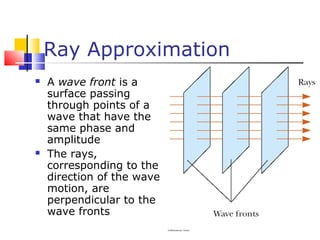
 A wave front is a
surface passing
through points of a
wave that have the
same phase and
amplitude
 The rays,
corresponding to the
direction of the wave
motion, are
perpendicular to the
wave fronts
Reflection of Light
 A ray of light, the incident ray,
travels in a medium
 When it encounters a boundary
with a second medium, part of the
incident ray is reflected back into
the first medium
 This means it is directed backward
into the first medium
Specular
Reflection
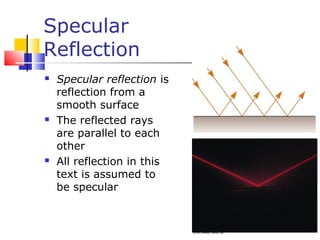
 Specular reflection is
reflection from a
smooth surface
 The reflected rays
are parallel to each
other
 All reflection in this
text is assumed to
be specular
Diffuse
Reflection
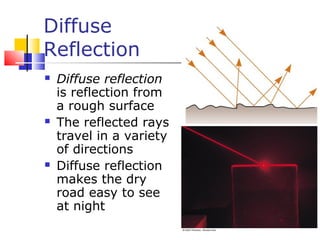
 Diffuse reflection
is reflection from
a rough surface
 The reflected rays
travel in a variety
of directions
 Diffuse reflection
makes the dry
road easy to see
at night
Law of Reflection
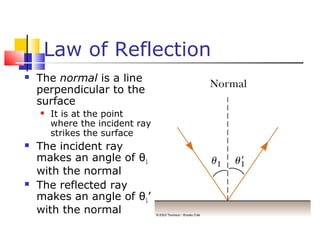
 The normal is a line
perpendicular to the
surface
 It is at the point
where the incident ray
strikes the surface
 The incident ray
makes an angle of θ1
with the normal
 The reflected ray
makes an angle of θ1’
with the normal
Law of Reflection, cont
 The angle of reflection is equal to
the angle of incidence
 θ1= θ1’
Refraction of Light
 When a ray of light traveling through a
transparent medium encounters a
boundary leading into another
transparent medium, part of the ray is
reflected and part of the ray enters the
second medium
 The ray that enters the second medium
is bent at the boundary
 This bending of the ray is called refraction
Refraction of Light, cont
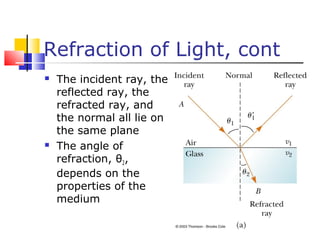
 The incident ray, the
reflected ray, the
refracted ray, and
the normal all lie on
the same plane
 The angle of
refraction, θ2,
depends on the
properties of the
medium
Following the Reflected
and Refracted Rays
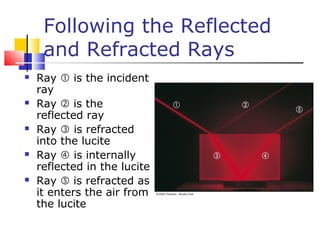
 Ray  is the incident
ray
 Ray  is the
reflected ray
 Ray  is refracted
into the lucite
 Ray  is internally
reflected in the lucite
 Ray  is refracted as
it enters the air from
the lucite
More About Refraction
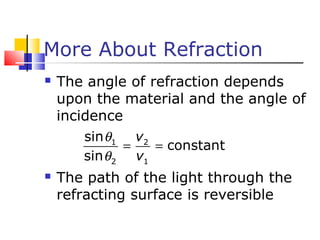
 The angle of refraction depends
upon the material and the angle of
incidence
 The path of the light through the
refracting surface is reversible
1 2
2 1
sin
constant
sin
v
v
θ
θ
= =
Refraction Details, 1
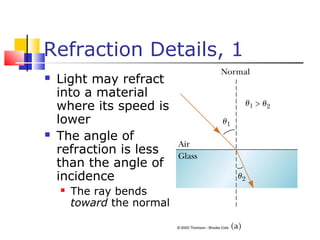
 Light may refract
into a material
where its speed is
lower
 The angle of
refraction is less
than the angle of
incidence
 The ray bends
toward the normal
Refraction Details, 2
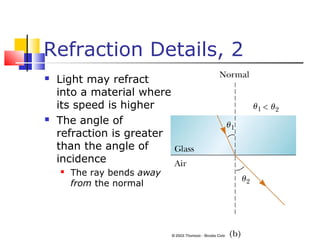
 Light may refract
into a material where
its speed is higher
 The angle of
refraction is greater
than the angle of
incidence
 The ray bends away
from the normal
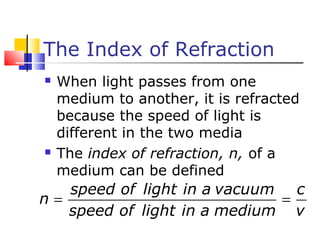
The Index of Refraction
 When light passes from one
medium to another, it is refracted
because the speed of light is
different in the two media
 The index of refraction, n, of a
medium can be defined
speed of light in a vacuum c
n
speed of light in a medium v
= =
Index of Refraction, cont
 For a vacuum, n = 1
 For other media, n > 1
 n is a unitless ratio
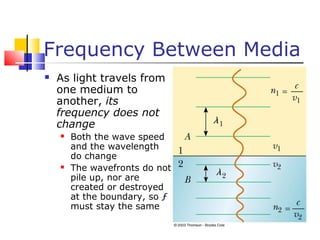
Frequency Between Media
 As light travels from
one medium to
another, its
frequency does not
change
 Both the wave speed
and the wavelength
do change
 The wavefronts do not
pile up, nor are
created or destroyed
at the boundary, so ƒ
must stay the same
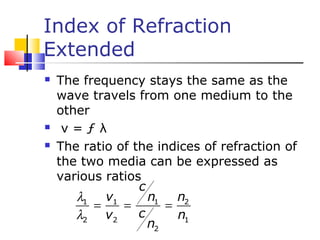
Index of Refraction
Extended
 The frequency stays the same as the
wave travels from one medium to the
other
 v = ƒ λ
 The ratio of the indices of refraction of
the two media can be expressed as
various ratios
1 1 1 2
2 2 1
2
c
v n n
cv n
n
λ
λ
= = =
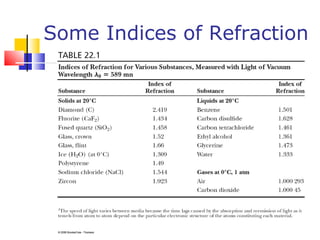
Some Indices of Refraction
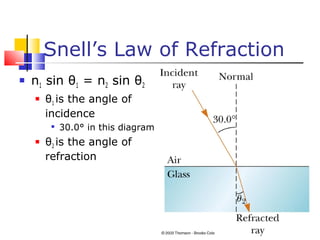
Snell’s Law of Refraction
 n1 sin θ1 = n2 sin θ2
 θ1 is the angle of
incidence

30.0° in this diagram
 θ2 is the angle of
refraction
Dispersion
 The index of refraction in anything
except a vacuum depends on the
wavelength of the light
 This dependence of n on λ is called
dispersion
 Snell’s Law indicates that the angle of
refraction made when light enters a
material depends on the wavelength of
the light
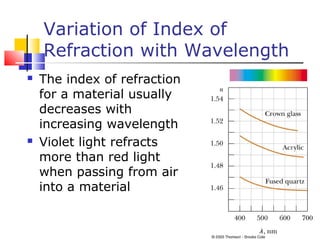
Variation of Index of
Refraction with Wavelength
 The index of refraction
for a material usually
decreases with
increasing wavelength
 Violet light refracts
more than red light
when passing from air
into a material
Refraction in a Prism
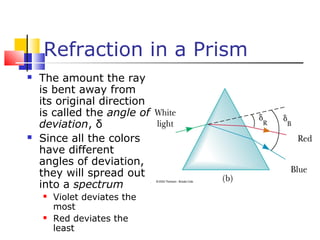
 The amount the ray
is bent away from
its original direction
is called the angle of
deviation, δ
 Since all the colors
have different
angles of deviation,
they will spread out
into a spectrum
 Violet deviates the
most
 Red deviates the
least
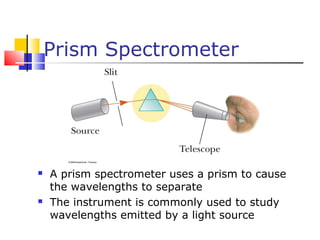
Prism Spectrometer
 A prism spectrometer uses a prism to cause
the wavelengths to separate
 The instrument is commonly used to study
wavelengths emitted by a light source
Using Spectra to Identify
Gases
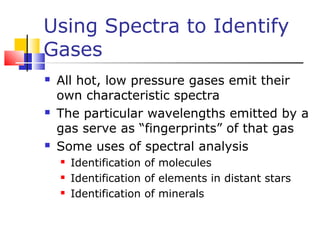
 All hot, low pressure gases emit their
own characteristic spectra
 The particular wavelengths emitted by a
gas serve as “fingerprints” of that gas
 Some uses of spectral analysis
 Identification of molecules
 Identification of elements in distant stars
 Identification of minerals
The Rainbow
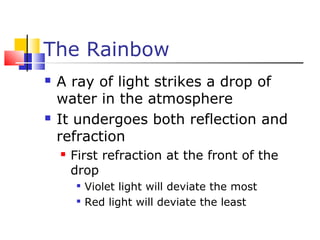
 A ray of light strikes a drop of
water in the atmosphere
 It undergoes both reflection and
refraction
 First refraction at the front of the
drop

Violet light will deviate the most

Red light will deviate the least
The Rainbow, 2
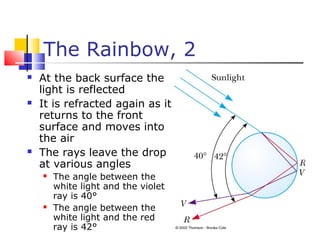
 At the back surface the
light is reflected
 It is refracted again as it
returns to the front
surface and moves into
the air
 The rays leave the drop
at various angles
 The angle between the
white light and the violet
ray is 40°
 The angle between the
white light and the red
ray is 42°
Observing the Rainbow
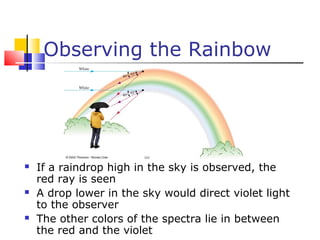
 If a raindrop high in the sky is observed, the
red ray is seen
 A drop lower in the sky would direct violet light
to the observer
 The other colors of the spectra lie in between
the red and the violet
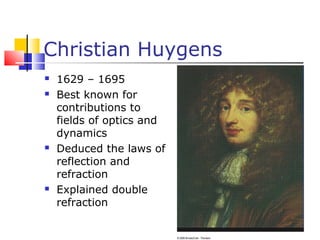
Christian Huygens
 1629 – 1695
 Best known for
contributions to
fields of optics and
dynamics
 Deduced the laws of
reflection and
refraction
 Explained double
refraction
Huygen’s Principle
 Huygen assumed that light is a
form of wave motion rather than a
stream of particles
 Huygen’s Principle is a geometric
construction for determining the
position of a new wave at some
point based on the knowledge of
the wave front that preceded it
Huygen’s Principle, cont
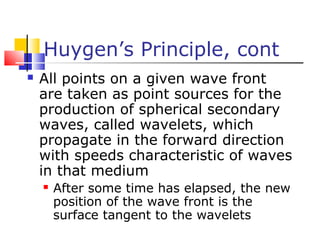
 All points on a given wave front
are taken as point sources for the
production of spherical secondary
waves, called wavelets, which
propagate in the forward direction
with speeds characteristic of waves
in that medium
 After some time has elapsed, the new
position of the wave front is the
surface tangent to the wavelets
Huygen’s Construction for
a Plane Wave
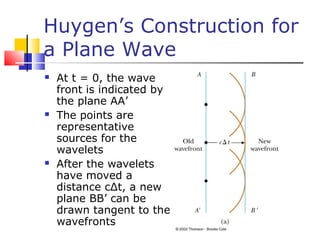
 At t = 0, the wave
front is indicated by
the plane AA’
 The points are
representative
sources for the
wavelets
 After the wavelets
have moved a
distance cΔt, a new
plane BB’ can be
drawn tangent to the
wavefronts
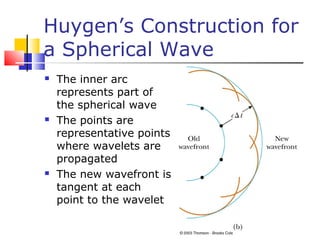
Huygen’s Construction for
a Spherical Wave
 The inner arc
represents part of
the spherical wave
 The points are
representative points
where wavelets are
propagated
 The new wavefront is
tangent at each
point to the wavelet
Huygen’s Principle and the
Law of Reflection
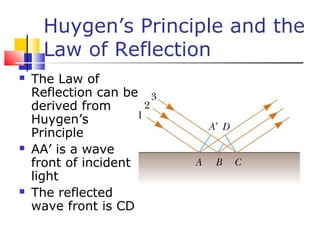
 The Law of
Reflection can be
derived from
Huygen’s
Principle
 AA’ is a wave
front of incident
light
 The reflected
wave front is CD
Huygen’s Principle and the
Law of Reflection, cont
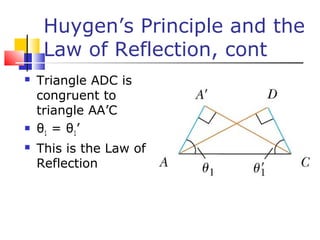
 Triangle ADC is
congruent to
triangle AA’C
 θ1 = θ1’
 This is the Law of
Reflection
Huygen’s Principle and the
Law of Refraction
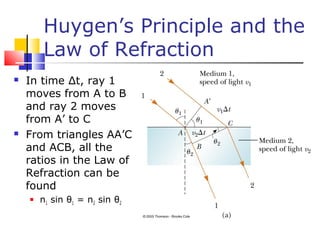
 In time Δt, ray 1
moves from A to B
and ray 2 moves
from A’ to C
 From triangles AA’C
and ACB, all the
ratios in the Law of
Refraction can be
found
 n1 sin θ1 = n2 sin θ2
Total Internal Reflection
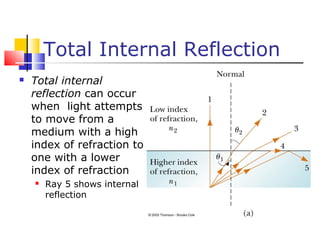
 Total internal
reflection can occur
when light attempts
to move from a
medium with a high
index of refraction to
one with a lower
index of refraction
 Ray 5 shows internal
reflection
Critical Angle
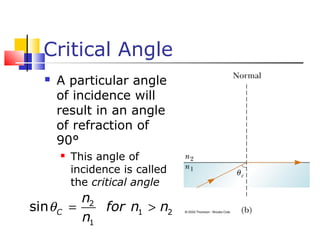
 A particular angle
of incidence will
result in an angle
of refraction of
90°
 This angle of
incidence is called
the critical angle
2
1 2
1
sin C
n
for n n
n
θ = >
Critical Angle, cont
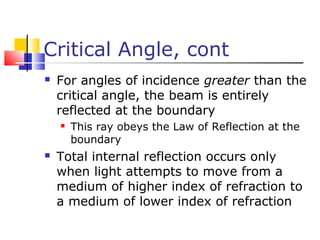
 For angles of incidence greater than the
critical angle, the beam is entirely
reflected at the boundary
 This ray obeys the Law of Reflection at the
boundary
 Total internal reflection occurs only
when light attempts to move from a
medium of higher index of refraction to
a medium of lower index of refraction
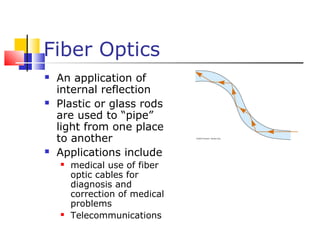
Fiber Optics
 An application of
internal reflection
 Plastic or glass rods
are used to “pipe”
light from one place
to another
 Applications include
 medical use of fiber
optic cables for
diagnosis and
correction of medical
problems
 Telecommunications

0511 week10 second_reflection

  • 1.
    Chapter 22 Reflection andRefraction of Light
  • 2.
    A Brief Historyof Light  1000 AD  It was proposed that light consisted of tiny particles  Newton  Used this particle model to explain reflection and refraction  Huygens  1678  Explained many properties of light by proposing light was wave-like
  • 3.
    A Brief Historyof Light, cont  Young  1801  Strong support for wave theory by showing interference  Maxwell  1865  Electromagnetic waves travel at the speed of light
  • 4.
    A Brief Historyof Light, final  Planck  EM radiation is quantized  Implies particles  Explained light spectrum emitted by hot objects  Einstein  Particle nature of light  Explained the photoelectric effect
  • 5.
    The Particle Natureof Light  “Particles” of light are called photons  Each photon has a particular energy  E = h ƒ  h is Planck’s constant  h = 6.63 x 10⁻³⁴ J s  Encompasses both natures of light  Interacts like a particle  Has a given frequency like a wave
  • 6.
    Dual Nature ofLight  Experiments can be devised that will display either the wave nature or the particle nature of light  In some experiments light acts as a wave and in others it acts as a particle  Nature prevents testing both qualities at the same time
  • 7.
    Geometric Optics –Using a Ray Approximation  Light travels in a straight-line path in a homogeneous medium until it encounters a boundary between two different media  The ray approximation is used to represent beams of light  A ray of light is an imaginary line drawn along the direction of travel of the light beams
  • 8.
    Ray Approximation  Awave front is a surface passing through points of a wave that have the same phase and amplitude  The rays, corresponding to the direction of the wave motion, are perpendicular to the wave fronts
  • 9.
    Reflection of Light A ray of light, the incident ray, travels in a medium  When it encounters a boundary with a second medium, part of the incident ray is reflected back into the first medium  This means it is directed backward into the first medium
  • 10.
    Specular Reflection  Specular reflectionis reflection from a smooth surface  The reflected rays are parallel to each other  All reflection in this text is assumed to be specular
  • 11.
    Diffuse Reflection  Diffuse reflection isreflection from a rough surface  The reflected rays travel in a variety of directions  Diffuse reflection makes the dry road easy to see at night
  • 12.
    Law of Reflection The normal is a line perpendicular to the surface  It is at the point where the incident ray strikes the surface  The incident ray makes an angle of θ1 with the normal  The reflected ray makes an angle of θ1’ with the normal
  • 13.
    Law of Reflection,cont  The angle of reflection is equal to the angle of incidence  θ1= θ1’
  • 14.
    Refraction of Light When a ray of light traveling through a transparent medium encounters a boundary leading into another transparent medium, part of the ray is reflected and part of the ray enters the second medium  The ray that enters the second medium is bent at the boundary  This bending of the ray is called refraction
  • 15.
    Refraction of Light,cont  The incident ray, the reflected ray, the refracted ray, and the normal all lie on the same plane  The angle of refraction, θ2, depends on the properties of the medium
  • 16.
    Following the Reflected andRefracted Rays  Ray  is the incident ray  Ray  is the reflected ray  Ray  is refracted into the lucite  Ray  is internally reflected in the lucite  Ray  is refracted as it enters the air from the lucite
  • 17.
    More About Refraction The angle of refraction depends upon the material and the angle of incidence  The path of the light through the refracting surface is reversible 1 2 2 1 sin constant sin v v θ θ = =
  • 18.
    Refraction Details, 1 Light may refract into a material where its speed is lower  The angle of refraction is less than the angle of incidence  The ray bends toward the normal
  • 19.
    Refraction Details, 2 Light may refract into a material where its speed is higher  The angle of refraction is greater than the angle of incidence  The ray bends away from the normal
  • 20.
    The Index ofRefraction  When light passes from one medium to another, it is refracted because the speed of light is different in the two media  The index of refraction, n, of a medium can be defined speed of light in a vacuum c n speed of light in a medium v = =
  • 21.
    Index of Refraction,cont  For a vacuum, n = 1  For other media, n > 1  n is a unitless ratio
  • 22.
    Frequency Between Media As light travels from one medium to another, its frequency does not change  Both the wave speed and the wavelength do change  The wavefronts do not pile up, nor are created or destroyed at the boundary, so ƒ must stay the same
  • 23.
    Index of Refraction Extended The frequency stays the same as the wave travels from one medium to the other  v = ƒ λ  The ratio of the indices of refraction of the two media can be expressed as various ratios 1 1 1 2 2 2 1 2 c v n n cv n n λ λ = = =
  • 24.
    Some Indices ofRefraction
  • 25.
    Snell’s Law ofRefraction  n1 sin θ1 = n2 sin θ2  θ1 is the angle of incidence  30.0° in this diagram  θ2 is the angle of refraction
  • 26.
    Dispersion  The indexof refraction in anything except a vacuum depends on the wavelength of the light  This dependence of n on λ is called dispersion  Snell’s Law indicates that the angle of refraction made when light enters a material depends on the wavelength of the light
  • 27.
    Variation of Indexof Refraction with Wavelength  The index of refraction for a material usually decreases with increasing wavelength  Violet light refracts more than red light when passing from air into a material
  • 28.
    Refraction in aPrism  The amount the ray is bent away from its original direction is called the angle of deviation, δ  Since all the colors have different angles of deviation, they will spread out into a spectrum  Violet deviates the most  Red deviates the least
  • 29.
    Prism Spectrometer  Aprism spectrometer uses a prism to cause the wavelengths to separate  The instrument is commonly used to study wavelengths emitted by a light source
  • 30.
    Using Spectra toIdentify Gases  All hot, low pressure gases emit their own characteristic spectra  The particular wavelengths emitted by a gas serve as “fingerprints” of that gas  Some uses of spectral analysis  Identification of molecules  Identification of elements in distant stars  Identification of minerals
  • 31.
    The Rainbow  Aray of light strikes a drop of water in the atmosphere  It undergoes both reflection and refraction  First refraction at the front of the drop  Violet light will deviate the most  Red light will deviate the least
  • 32.
    The Rainbow, 2 At the back surface the light is reflected  It is refracted again as it returns to the front surface and moves into the air  The rays leave the drop at various angles  The angle between the white light and the violet ray is 40°  The angle between the white light and the red ray is 42°
  • 33.
    Observing the Rainbow If a raindrop high in the sky is observed, the red ray is seen  A drop lower in the sky would direct violet light to the observer  The other colors of the spectra lie in between the red and the violet
  • 34.
    Christian Huygens  1629– 1695  Best known for contributions to fields of optics and dynamics  Deduced the laws of reflection and refraction  Explained double refraction
  • 35.
    Huygen’s Principle  Huygenassumed that light is a form of wave motion rather than a stream of particles  Huygen’s Principle is a geometric construction for determining the position of a new wave at some point based on the knowledge of the wave front that preceded it
  • 36.
    Huygen’s Principle, cont All points on a given wave front are taken as point sources for the production of spherical secondary waves, called wavelets, which propagate in the forward direction with speeds characteristic of waves in that medium  After some time has elapsed, the new position of the wave front is the surface tangent to the wavelets
  • 37.
    Huygen’s Construction for aPlane Wave  At t = 0, the wave front is indicated by the plane AA’  The points are representative sources for the wavelets  After the wavelets have moved a distance cΔt, a new plane BB’ can be drawn tangent to the wavefronts
  • 38.
    Huygen’s Construction for aSpherical Wave  The inner arc represents part of the spherical wave  The points are representative points where wavelets are propagated  The new wavefront is tangent at each point to the wavelet
  • 39.
    Huygen’s Principle andthe Law of Reflection  The Law of Reflection can be derived from Huygen’s Principle  AA’ is a wave front of incident light  The reflected wave front is CD
  • 40.
    Huygen’s Principle andthe Law of Reflection, cont  Triangle ADC is congruent to triangle AA’C  θ1 = θ1’  This is the Law of Reflection
  • 41.
    Huygen’s Principle andthe Law of Refraction  In time Δt, ray 1 moves from A to B and ray 2 moves from A’ to C  From triangles AA’C and ACB, all the ratios in the Law of Refraction can be found  n1 sin θ1 = n2 sin θ2
  • 42.
    Total Internal Reflection Total internal reflection can occur when light attempts to move from a medium with a high index of refraction to one with a lower index of refraction  Ray 5 shows internal reflection
  • 43.
    Critical Angle  Aparticular angle of incidence will result in an angle of refraction of 90°  This angle of incidence is called the critical angle 2 1 2 1 sin C n for n n n θ = >
  • 44.
    Critical Angle, cont For angles of incidence greater than the critical angle, the beam is entirely reflected at the boundary  This ray obeys the Law of Reflection at the boundary  Total internal reflection occurs only when light attempts to move from a medium of higher index of refraction to a medium of lower index of refraction
  • 45.
    Fiber Optics  Anapplication of internal reflection  Plastic or glass rods are used to “pipe” light from one place to another  Applications include  medical use of fiber optic cables for diagnosis and correction of medical problems  Telecommunications