Section 2-3 
Conditional Statements 
Thursday, November 6, 14
Essential Questions 
• How do you analyze statements in if-then form? 
• How do you write the converse, inverse, and 
contrapositive of if-then statements? 
Thursday, November 6, 14
Vocabulary 
1. Conditional Statement: 
2. If-Then Statement: 
3. Hypothesis: 
4. Conclusion: 
Thursday, November 6, 14
Vocabulary 
1. C o n d i t io n a l S t a t e m e n t : A statement that fits the 
if-then form, providing a connection between the 
two phrases 
2. If-Then Statement: 
3. Hypothesis: 
4. Conclusion: 
Thursday, November 6, 14
Vocabulary 
1. C o n d i t io n a l S t a t e m e n t : A statement that fits the 
if-then form, providing a connection between the 
two phrases 
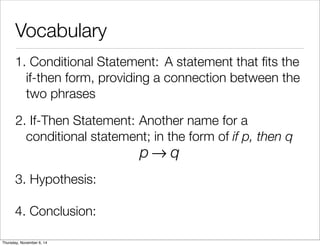
2. If - T h e n S t a t e m e n t : Another name for a 
conditional statement; in the form of if p, then q 
3. Hypothesis: 
4. Conclusion: 
Thursday, November 6, 14
Vocabulary 
1. C o n d i t io n a l S t a t e m e n t : A statement that fits the 
if-then form, providing a connection between the 
two phrases 
2. If - T h e n S t a t e m e n t : Another name for a 
conditional statement; in the form of if p, then q 
p→q 
3. Hypothesis: 
4. Conclusion: 
Thursday, November 6, 14
Vocabulary 
1. C o n d i t io n a l S t a t e m e n t : A statement that fits the 
if-then form, providing a connection between the 
two phrases 
2. If - T h e n S t a t e m e n t : Another name for a 
conditional statement; in the form of if p, then q 
p→q 
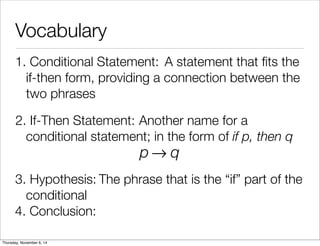
3. H y p o t h e s i s : The phrase that is the “if” part of the 
conditional 
4. Conclusion: 
Thursday, November 6, 14
Vocabulary 
1. C o n d i t io n a l S t a t e m e n t : A statement that fits the 
if-then form, providing a connection between the 
two phrases 
2. If - T h e n S t a t e m e n t : Another name for a 
conditional statement; in the form of if p, then q 
p→q 
3. H y p o t h e s i s : The phrase that is the “if” part of the 
conditional 
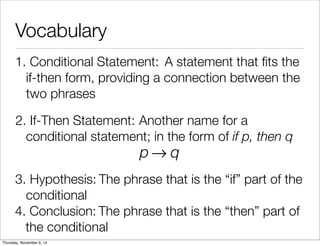
4. C o n c l u s i o n : The phrase that is the “then” part of 
the conditional 
Thursday, November 6, 14
Vocabulary 
5. Related Conditionals: 
6. Converse: 
7. Inverse: 
Thursday, November 6, 14
Vocabulary 
5. R e l a t e d C o n d i t i o n a ls : Statements that are based 
off of a given conditional statement 
6. Converse: 
7. Inverse: 
Thursday, November 6, 14
Vocabulary 
5. R e l a t e d C o n d i t i o n a ls : Statements that are based 
off of a given conditional statement 
6. C o n v e r s e : A statement that is created by 
switching the hypothesis and conclusion of a 
conditional 
7. Inverse: 
Thursday, November 6, 14
Vocabulary 
5. R e l a t e d C o n d i t i o n a ls : Statements that are based 
off of a given conditional statement 
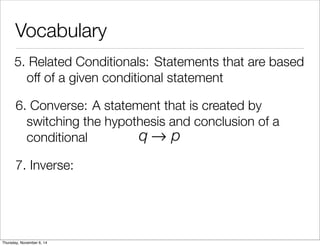
6. C o n v e r s e : A statement that is created by 
switching the hypothesis and conclusion of a 
conditional 
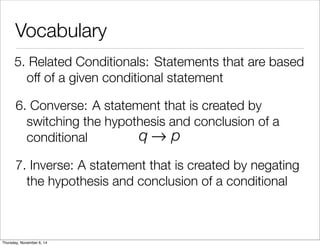
q→ p 
7. Inverse: 
Thursday, November 6, 14
Vocabulary 
5. R e l a t e d C o n d i t i o n a ls : Statements that are based 
off of a given conditional statement 
6. C o n v e r s e : A statement that is created by 
switching the hypothesis and conclusion of a 
conditional 
q→ p 
7. I n v e r s e : A statement that is created by negating 
the hypothesis and conclusion of a conditional 
Thursday, November 6, 14
Vocabulary 
5. R e l a t e d C o n d i t i o n a ls : Statements that are based 
off of a given conditional statement 
6. C o n v e r s e : A statement that is created by 
switching the hypothesis and conclusion of a 
conditional 
q→ p 
7. I n v e r s e : A statement that is created by negating 
the hypothesis and conclusion of a conditional 
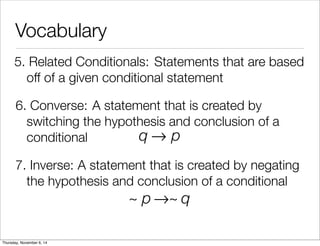
~ p→~ q 
Thursday, November 6, 14
Vocabulary 
8. Contrapositive: 
9. Logically Equivalent: 
Thursday, November 6, 14
Vocabulary 
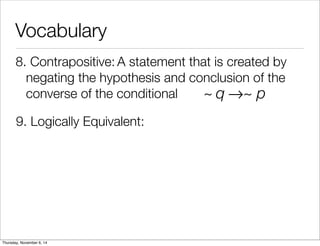
8. C o n t r a p o s i t iv e : A statement that is created by 
negating the hypothesis and conclusion of the 
converse of the conditional 
9. Logically Equivalent: 
Thursday, November 6, 14
Vocabulary 
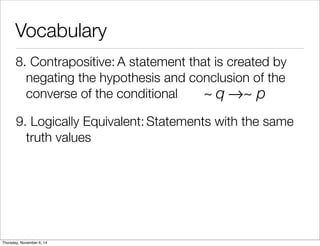
8. C o n t r a p o s i t iv e : A statement that is created by 
negating the hypothesis and conclusion of the 
converse of the conditional 
~ q→~ p 
9. Logically Equivalent: 
Thursday, November 6, 14
Vocabulary 
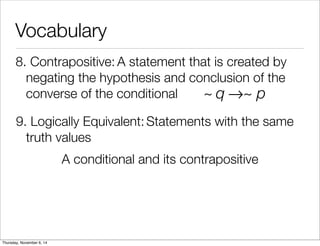
8. C o n t r a p o s i t iv e : A statement that is created by 
negating the hypothesis and conclusion of the 
converse of the conditional 
~ q→~ p 
9. L o g ic a l ly E q u i v a l e n t : Statements with the same 
truth values 
Thursday, November 6, 14
Vocabulary 
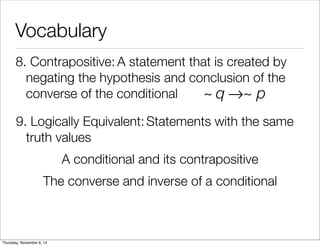
8. C o n t r a p o s i t iv e : A statement that is created by 
negating the hypothesis and conclusion of the 
converse of the conditional 
~ q→~ p 
9. L o g ic a l ly E q u i v a l e n t : Statements with the same 
truth values 
A conditional and its contrapositive 
Thursday, November 6, 14
Vocabulary 
8. C o n t r a p o s i t iv e : A statement that is created by 
negating the hypothesis and conclusion of the 
converse of the conditional 
~ q→~ p 
9. L o g ic a l ly E q u i v a l e n t : Statements with the same 
truth values 
A conditional and its contrapositive 
The converse and inverse of a conditional 
Thursday, November 6, 14
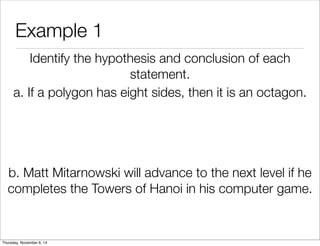
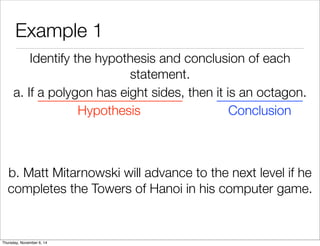
Example 1 
Identify the hypothesis and conclusion of each 
statement. 
a. If a polygon has eight sides, then it is an octagon. 
b. Matt Mitarnowski will advance to the next level if he 
completes the Towers of Hanoi in his computer game. 
Thursday, November 6, 14
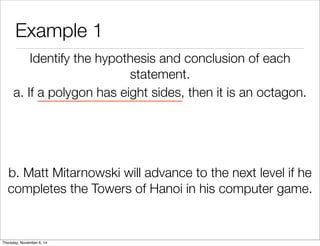
Example 1 
Identify the hypothesis and conclusion of each 
statement. 
a. If a polygon has eight sides, then it is an octagon. 
b. Matt Mitarnowski will advance to the next level if he 
completes the Towers of Hanoi in his computer game. 
Thursday, November 6, 14
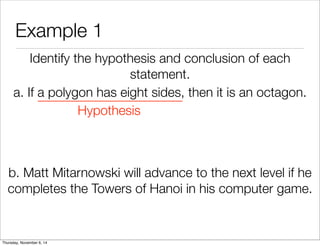
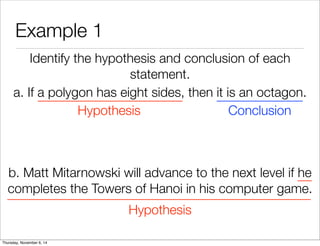
Example 1 
Identify the hypothesis and conclusion of each 
statement. 
a. If a polygon has eight sides, then it is an octagon. 
Hypothesis 
b. Matt Mitarnowski will advance to the next level if he 
completes the Towers of Hanoi in his computer game. 
Thursday, November 6, 14
Example 1 
Identify the hypothesis and conclusion of each 
statement. 
a. If a polygon has eight sides, then it is an octagon. 
Hypothesis 
b. Matt Mitarnowski will advance to the next level if he 
completes the Towers of Hanoi in his computer game. 
Thursday, November 6, 14
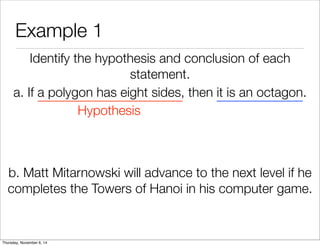
Example 1 
Identify the hypothesis and conclusion of each 
statement. 
a. If a polygon has eight sides, then it is an octagon. 
Hypothesis Conclusion 
b. Matt Mitarnowski will advance to the next level if he 
completes the Towers of Hanoi in his computer game. 
Thursday, November 6, 14
Example 1 
Identify the hypothesis and conclusion of each 
statement. 
a. If a polygon has eight sides, then it is an octagon. 
Hypothesis Conclusion 
b. Matt Mitarnowski will advance to the next level if he 
completes the Towers of Hanoi in his computer game. 
Hypothesis 
Thursday, November 6, 14
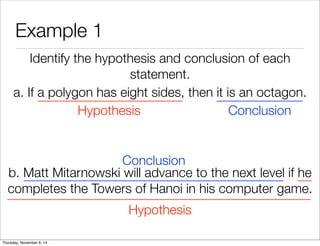
Example 1 
Identify the hypothesis and conclusion of each 
statement. 
a. If a polygon has eight sides, then it is an octagon. 
Hypothesis Conclusion 
Conclusion 
b. Matt Mitarnowski will advance to the next level if he 
completes the Towers of Hanoi in his computer game. 
Hypothesis 
Thursday, November 6, 14
Example 2 
Identify the hypothesis and conclusion of each 
statement. Then write each statement in the if-then 
form. 
a. Measured distance is positive. 
Thursday, November 6, 14
Example 2 
Identify the hypothesis and conclusion of each 
statement. Then write each statement in the if-then 
form. 
a. Measured distance is positive. 
Hypothesis: A distance is measured 
Thursday, November 6, 14
Example 2 
Identify the hypothesis and conclusion of each 
statement. Then write each statement in the if-then 
form. 
a. Measured distance is positive. 
Hypothesis: A distance is measured 
Conclusion: It is positive 
Thursday, November 6, 14
Example 2 
Identify the hypothesis and conclusion of each 
statement. Then write each statement in the if-then 
form. 
a. Measured distance is positive. 
Hypothesis: A distance is measured 
Conclusion: It is positive 
If a distance is measured, then it is positive. 
Thursday, November 6, 14
Example 2 
Identify the hypothesis and conclusion of each 
statement. Then write each statement in the if-then 
form. 
b. A six-sided polygon is a hexagon 
Thursday, November 6, 14
Example 2 
Identify the hypothesis and conclusion of each 
statement. Then write each statement in the if-then 
form. 
b. A six-sided polygon is a hexagon 
Hypothesis: A polygon has six sides 
Thursday, November 6, 14
Example 2 
Identify the hypothesis and conclusion of each 
statement. Then write each statement in the if-then 
form. 
b. A six-sided polygon is a hexagon 
Hypothesis: A polygon has six sides 
Conclusion: It is a hexagon 
Thursday, November 6, 14
Example 2 
Identify the hypothesis and conclusion of each 
statement. Then write each statement in the if-then 
form. 
b. A six-sided polygon is a hexagon 
Hypothesis: A polygon has six sides 
Conclusion: It is a hexagon 
If a polygon has six sides, then it is a hexagon. 
Thursday, November 6, 14
Example 3 
Determine the truth value of each conditional 
statement. If true, explain your reasoning. If false, 
give a counter example. 
a. If you subtract a whole number from another whole 
number, the result is also a whole number. 
Thursday, November 6, 14
Example 3 
Determine the truth value of each conditional 
statement. If true, explain your reasoning. If false, 
give a counter example. 
a. If you subtract a whole number from another whole 
number, the result is also a whole number. 
False 
Thursday, November 6, 14
Example 3 
Determine the truth value of each conditional 
statement. If true, explain your reasoning. If false, 
give a counter example. 
a. If you subtract a whole number from another whole 
number, the result is also a whole number. 
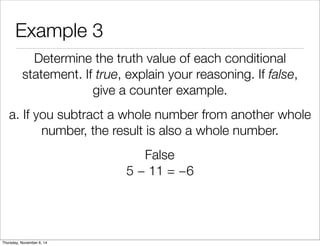
False 
5 − 11 = −6 
Thursday, November 6, 14
Example 3 
Determine the truth value of each conditional 
statement. If true, explain your reasoning. If false, 
give a counter example. 
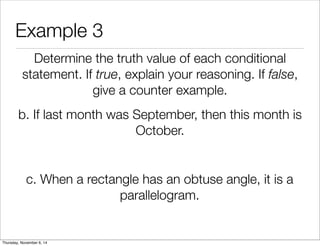
b. If last month was September, then this month is 
October. 
c. When a rectangle has an obtuse angle, it is a 
parallelogram. 
Thursday, November 6, 14
Example 3 
Determine the truth value of each conditional 
statement. If true, explain your reasoning. If false, 
give a counter example. 
b. If last month was September, then this month is 
October. 
True 
c. When a rectangle has an obtuse angle, it is a 
parallelogram. 
Thursday, November 6, 14
Example 3 
Determine the truth value of each conditional 
statement. If true, explain your reasoning. If false, 
give a counter example. 
b. If last month was September, then this month is 
October. 
True 
c. When a rectangle has an obtuse angle, it is a 
parallelogram. 
True 
Thursday, November 6, 14
Example 3 
Determine the truth value of each conditional 
statement. If true, explain your reasoning. If false, 
give a counter example. 
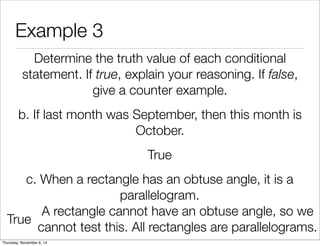
b. If last month was September, then this month is 
October. 
True 
c. When a rectangle has an obtuse angle, it is a 
parallelogram. 
True A rectangle cannot have an obtuse angle, so we 
cannot test this. All rectangles are parallelograms. 
Thursday, November 6, 14
Example 4 
Determine the converse, inverse, and contrapositive for 
the following statement. Then determine if the new 
statement is true. If false, give a counterexample. 
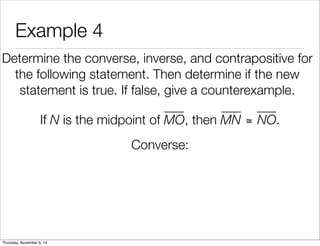
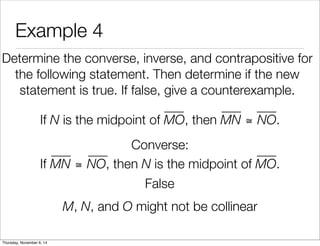
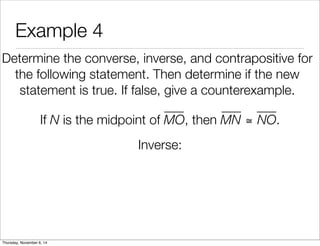
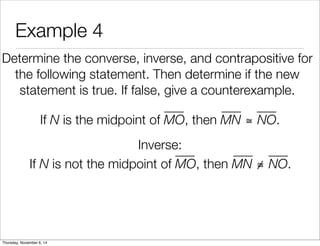
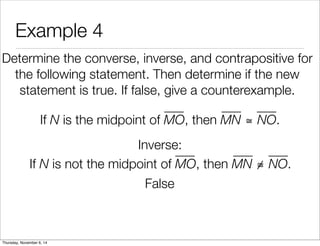
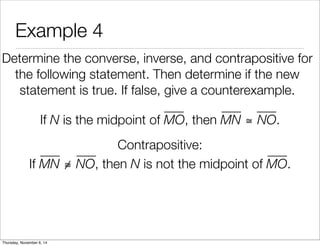
If N is the midpoint of MO, then MN ≅ NO. 
Converse: 
Thursday, November 6, 14
Example 4 
Determine the converse, inverse, and contrapositive for 
the following statement. Then determine if the new 
statement is true. If false, give a counterexample. 
If N is the midpoint of MO, then MN ≅ NO. 
Converse: 
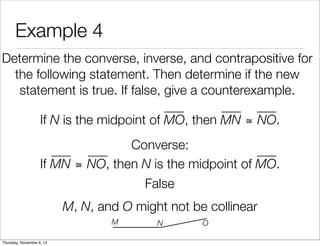
If MN ≅ NO, then N is the midpoint of MO. 
Thursday, November 6, 14
Example 4 
Determine the converse, inverse, and contrapositive for 
the following statement. Then determine if the new 
statement is true. If false, give a counterexample. 
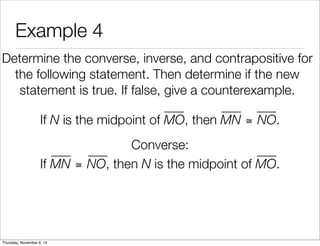
If N is the midpoint of MO, then MN ≅ NO. 
Converse: 
If MN ≅ NO, then N is the midpoint of MO. 
False 
Thursday, November 6, 14
Example 4 
Determine the converse, inverse, and contrapositive for 
the following statement. Then determine if the new 
statement is true. If false, give a counterexample. 
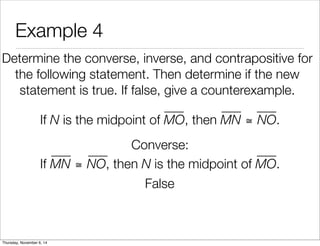
If N is the midpoint of MO, then MN ≅ NO. 
Converse: 
If MN ≅ NO, then N is the midpoint of MO. 
False 
M, N, and O might not be collinear 
Thursday, November 6, 14
Example 4 
Determine the converse, inverse, and contrapositive for 
the following statement. Then determine if the new 
statement is true. If false, give a counterexample. 
If N is the midpoint of MO, then MN ≅ NO. 
Converse: 
If MN ≅ NO, then N is the midpoint of MO. 
False 
M, N, and O might not be collinear 
M N O 
Thursday, November 6, 14
Example 4 
Determine the converse, inverse, and contrapositive for 
the following statement. Then determine if the new 
statement is true. If false, give a counterexample. 
If N is the midpoint of MO, then MN ≅ NO. 
Inverse: 
Thursday, November 6, 14
Example 4 
Determine the converse, inverse, and contrapositive for 
the following statement. Then determine if the new 
statement is true. If false, give a counterexample. 
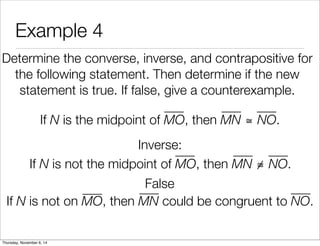
If N is the midpoint of MO, then MN ≅ NO. 
Inverse: 
If N is not the midpoint of MO, then MN ≅ NO. 
Thursday, November 6, 14
Example 4 
Determine the converse, inverse, and contrapositive for 
the following statement. Then determine if the new 
statement is true. If false, give a counterexample. 
If N is the midpoint of MO, then MN ≅ NO. 
Inverse: 
False 
If N is not the midpoint of MO, then MN ≅ NO. 
Thursday, November 6, 14
Example 4 
Determine the converse, inverse, and contrapositive for 
the following statement. Then determine if the new 
statement is true. If false, give a counterexample. 
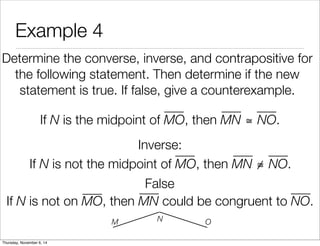
If N is the midpoint of MO, then MN ≅ NO. 
Inverse: 
False 
If N is not the midpoint of MO, then MN ≅ NO. 
If N is not on MO, then MN could be congruent to NO. 
Thursday, November 6, 14
Example 4 
Determine the converse, inverse, and contrapositive for 
the following statement. Then determine if the new 
statement is true. If false, give a counterexample. 
If N is the midpoint of MO, then MN ≅ NO. 
Inverse: 
False 
If N is not the midpoint of MO, then MN ≅ NO. 
If N is not on MO, then MN could be congruent to NO. 
M N O 
Thursday, November 6, 14
Example 4 
Determine the converse, inverse, and contrapositive for 
the following statement. Then determine if the new 
statement is true. If false, give a counterexample. 
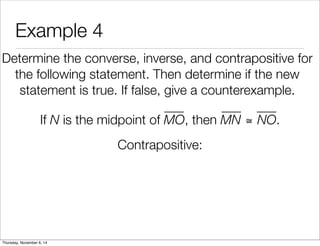
If N is the midpoint of MO, then MN ≅ NO. 
Contrapositive: 
Thursday, November 6, 14
Example 4 
Determine the converse, inverse, and contrapositive for 
the following statement. Then determine if the new 
statement is true. If false, give a counterexample. 
If N is the midpoint of MO, then MN ≅ NO. 
Contrapositive: 
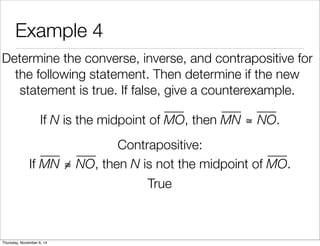
If MN ≅ NO, then N is not the midpoint of MO. 
Thursday, November 6, 14
Example 4 
Determine the converse, inverse, and contrapositive for 
the following statement. Then determine if the new 
statement is true. If false, give a counterexample. 
If N is the midpoint of MO, then MN ≅ NO. 
Contrapositive: 
If MN ≅ NO, then N is not the midpoint of MO. 
True 
Thursday, November 6, 14
Problem Set 
Thursday, November 6, 14
Problem Set 
p. 109 #1-51 odd, 63 
“Don’t be discouraged by a failure. It can be a positive experience. Failure is, in a 
sense, the highway to success, inasmuch as every discovery of what is false 
leads us to seek earnestly after what is true, and every fresh experience points 
out some form of error which we shall afterwards carefully avoid.” - John Keats 
Thursday, November 6, 14

Geometry Section 2-3 1112

  • 1.
    Section 2-3 ConditionalStatements Thursday, November 6, 14
  • 2.
    Essential Questions •How do you analyze statements in if-then form? • How do you write the converse, inverse, and contrapositive of if-then statements? Thursday, November 6, 14
  • 3.
    Vocabulary 1. ConditionalStatement: 2. If-Then Statement: 3. Hypothesis: 4. Conclusion: Thursday, November 6, 14
  • 4.
    Vocabulary 1. Co n d i t io n a l S t a t e m e n t : A statement that fits the if-then form, providing a connection between the two phrases 2. If-Then Statement: 3. Hypothesis: 4. Conclusion: Thursday, November 6, 14
  • 5.
    Vocabulary 1. Co n d i t io n a l S t a t e m e n t : A statement that fits the if-then form, providing a connection between the two phrases 2. If - T h e n S t a t e m e n t : Another name for a conditional statement; in the form of if p, then q 3. Hypothesis: 4. Conclusion: Thursday, November 6, 14
  • 6.
    Vocabulary 1. Co n d i t io n a l S t a t e m e n t : A statement that fits the if-then form, providing a connection between the two phrases 2. If - T h e n S t a t e m e n t : Another name for a conditional statement; in the form of if p, then q p→q 3. Hypothesis: 4. Conclusion: Thursday, November 6, 14
  • 7.
    Vocabulary 1. Co n d i t io n a l S t a t e m e n t : A statement that fits the if-then form, providing a connection between the two phrases 2. If - T h e n S t a t e m e n t : Another name for a conditional statement; in the form of if p, then q p→q 3. H y p o t h e s i s : The phrase that is the “if” part of the conditional 4. Conclusion: Thursday, November 6, 14
  • 8.
    Vocabulary 1. Co n d i t io n a l S t a t e m e n t : A statement that fits the if-then form, providing a connection between the two phrases 2. If - T h e n S t a t e m e n t : Another name for a conditional statement; in the form of if p, then q p→q 3. H y p o t h e s i s : The phrase that is the “if” part of the conditional 4. C o n c l u s i o n : The phrase that is the “then” part of the conditional Thursday, November 6, 14
  • 9.
    Vocabulary 5. RelatedConditionals: 6. Converse: 7. Inverse: Thursday, November 6, 14
  • 10.
    Vocabulary 5. Re l a t e d C o n d i t i o n a ls : Statements that are based off of a given conditional statement 6. Converse: 7. Inverse: Thursday, November 6, 14
  • 11.
    Vocabulary 5. Re l a t e d C o n d i t i o n a ls : Statements that are based off of a given conditional statement 6. C o n v e r s e : A statement that is created by switching the hypothesis and conclusion of a conditional 7. Inverse: Thursday, November 6, 14
  • 12.
    Vocabulary 5. Re l a t e d C o n d i t i o n a ls : Statements that are based off of a given conditional statement 6. C o n v e r s e : A statement that is created by switching the hypothesis and conclusion of a conditional q→ p 7. Inverse: Thursday, November 6, 14
  • 13.
    Vocabulary 5. Re l a t e d C o n d i t i o n a ls : Statements that are based off of a given conditional statement 6. C o n v e r s e : A statement that is created by switching the hypothesis and conclusion of a conditional q→ p 7. I n v e r s e : A statement that is created by negating the hypothesis and conclusion of a conditional Thursday, November 6, 14
  • 14.
    Vocabulary 5. Re l a t e d C o n d i t i o n a ls : Statements that are based off of a given conditional statement 6. C o n v e r s e : A statement that is created by switching the hypothesis and conclusion of a conditional q→ p 7. I n v e r s e : A statement that is created by negating the hypothesis and conclusion of a conditional ~ p→~ q Thursday, November 6, 14
  • 15.
    Vocabulary 8. Contrapositive: 9. Logically Equivalent: Thursday, November 6, 14
  • 16.
    Vocabulary 8. Co n t r a p o s i t iv e : A statement that is created by negating the hypothesis and conclusion of the converse of the conditional 9. Logically Equivalent: Thursday, November 6, 14
  • 17.
    Vocabulary 8. Co n t r a p o s i t iv e : A statement that is created by negating the hypothesis and conclusion of the converse of the conditional ~ q→~ p 9. Logically Equivalent: Thursday, November 6, 14
  • 18.
    Vocabulary 8. Co n t r a p o s i t iv e : A statement that is created by negating the hypothesis and conclusion of the converse of the conditional ~ q→~ p 9. L o g ic a l ly E q u i v a l e n t : Statements with the same truth values Thursday, November 6, 14
  • 19.
    Vocabulary 8. Co n t r a p o s i t iv e : A statement that is created by negating the hypothesis and conclusion of the converse of the conditional ~ q→~ p 9. L o g ic a l ly E q u i v a l e n t : Statements with the same truth values A conditional and its contrapositive Thursday, November 6, 14
  • 20.
    Vocabulary 8. Co n t r a p o s i t iv e : A statement that is created by negating the hypothesis and conclusion of the converse of the conditional ~ q→~ p 9. L o g ic a l ly E q u i v a l e n t : Statements with the same truth values A conditional and its contrapositive The converse and inverse of a conditional Thursday, November 6, 14
  • 21.
    Example 1 Identifythe hypothesis and conclusion of each statement. a. If a polygon has eight sides, then it is an octagon. b. Matt Mitarnowski will advance to the next level if he completes the Towers of Hanoi in his computer game. Thursday, November 6, 14
  • 22.
    Example 1 Identifythe hypothesis and conclusion of each statement. a. If a polygon has eight sides, then it is an octagon. b. Matt Mitarnowski will advance to the next level if he completes the Towers of Hanoi in his computer game. Thursday, November 6, 14
  • 23.
    Example 1 Identifythe hypothesis and conclusion of each statement. a. If a polygon has eight sides, then it is an octagon. Hypothesis b. Matt Mitarnowski will advance to the next level if he completes the Towers of Hanoi in his computer game. Thursday, November 6, 14
  • 24.
    Example 1 Identifythe hypothesis and conclusion of each statement. a. If a polygon has eight sides, then it is an octagon. Hypothesis b. Matt Mitarnowski will advance to the next level if he completes the Towers of Hanoi in his computer game. Thursday, November 6, 14
  • 25.
    Example 1 Identifythe hypothesis and conclusion of each statement. a. If a polygon has eight sides, then it is an octagon. Hypothesis Conclusion b. Matt Mitarnowski will advance to the next level if he completes the Towers of Hanoi in his computer game. Thursday, November 6, 14
  • 26.
    Example 1 Identifythe hypothesis and conclusion of each statement. a. If a polygon has eight sides, then it is an octagon. Hypothesis Conclusion b. Matt Mitarnowski will advance to the next level if he completes the Towers of Hanoi in his computer game. Hypothesis Thursday, November 6, 14
  • 27.
    Example 1 Identifythe hypothesis and conclusion of each statement. a. If a polygon has eight sides, then it is an octagon. Hypothesis Conclusion Conclusion b. Matt Mitarnowski will advance to the next level if he completes the Towers of Hanoi in his computer game. Hypothesis Thursday, November 6, 14
  • 28.
    Example 2 Identifythe hypothesis and conclusion of each statement. Then write each statement in the if-then form. a. Measured distance is positive. Thursday, November 6, 14
  • 29.
    Example 2 Identifythe hypothesis and conclusion of each statement. Then write each statement in the if-then form. a. Measured distance is positive. Hypothesis: A distance is measured Thursday, November 6, 14
  • 30.
    Example 2 Identifythe hypothesis and conclusion of each statement. Then write each statement in the if-then form. a. Measured distance is positive. Hypothesis: A distance is measured Conclusion: It is positive Thursday, November 6, 14
  • 31.
    Example 2 Identifythe hypothesis and conclusion of each statement. Then write each statement in the if-then form. a. Measured distance is positive. Hypothesis: A distance is measured Conclusion: It is positive If a distance is measured, then it is positive. Thursday, November 6, 14
  • 32.
    Example 2 Identifythe hypothesis and conclusion of each statement. Then write each statement in the if-then form. b. A six-sided polygon is a hexagon Thursday, November 6, 14
  • 33.
    Example 2 Identifythe hypothesis and conclusion of each statement. Then write each statement in the if-then form. b. A six-sided polygon is a hexagon Hypothesis: A polygon has six sides Thursday, November 6, 14
  • 34.
    Example 2 Identifythe hypothesis and conclusion of each statement. Then write each statement in the if-then form. b. A six-sided polygon is a hexagon Hypothesis: A polygon has six sides Conclusion: It is a hexagon Thursday, November 6, 14
  • 35.
    Example 2 Identifythe hypothesis and conclusion of each statement. Then write each statement in the if-then form. b. A six-sided polygon is a hexagon Hypothesis: A polygon has six sides Conclusion: It is a hexagon If a polygon has six sides, then it is a hexagon. Thursday, November 6, 14
  • 36.
    Example 3 Determinethe truth value of each conditional statement. If true, explain your reasoning. If false, give a counter example. a. If you subtract a whole number from another whole number, the result is also a whole number. Thursday, November 6, 14
  • 37.
    Example 3 Determinethe truth value of each conditional statement. If true, explain your reasoning. If false, give a counter example. a. If you subtract a whole number from another whole number, the result is also a whole number. False Thursday, November 6, 14
  • 38.
    Example 3 Determinethe truth value of each conditional statement. If true, explain your reasoning. If false, give a counter example. a. If you subtract a whole number from another whole number, the result is also a whole number. False 5 − 11 = −6 Thursday, November 6, 14
  • 39.
    Example 3 Determinethe truth value of each conditional statement. If true, explain your reasoning. If false, give a counter example. b. If last month was September, then this month is October. c. When a rectangle has an obtuse angle, it is a parallelogram. Thursday, November 6, 14
  • 40.
    Example 3 Determinethe truth value of each conditional statement. If true, explain your reasoning. If false, give a counter example. b. If last month was September, then this month is October. True c. When a rectangle has an obtuse angle, it is a parallelogram. Thursday, November 6, 14
  • 41.
    Example 3 Determinethe truth value of each conditional statement. If true, explain your reasoning. If false, give a counter example. b. If last month was September, then this month is October. True c. When a rectangle has an obtuse angle, it is a parallelogram. True Thursday, November 6, 14
  • 42.
    Example 3 Determinethe truth value of each conditional statement. If true, explain your reasoning. If false, give a counter example. b. If last month was September, then this month is October. True c. When a rectangle has an obtuse angle, it is a parallelogram. True A rectangle cannot have an obtuse angle, so we cannot test this. All rectangles are parallelograms. Thursday, November 6, 14
  • 43.
    Example 4 Determinethe converse, inverse, and contrapositive for the following statement. Then determine if the new statement is true. If false, give a counterexample. If N is the midpoint of MO, then MN ≅ NO. Converse: Thursday, November 6, 14
  • 44.
    Example 4 Determinethe converse, inverse, and contrapositive for the following statement. Then determine if the new statement is true. If false, give a counterexample. If N is the midpoint of MO, then MN ≅ NO. Converse: If MN ≅ NO, then N is the midpoint of MO. Thursday, November 6, 14
  • 45.
    Example 4 Determinethe converse, inverse, and contrapositive for the following statement. Then determine if the new statement is true. If false, give a counterexample. If N is the midpoint of MO, then MN ≅ NO. Converse: If MN ≅ NO, then N is the midpoint of MO. False Thursday, November 6, 14
  • 46.
    Example 4 Determinethe converse, inverse, and contrapositive for the following statement. Then determine if the new statement is true. If false, give a counterexample. If N is the midpoint of MO, then MN ≅ NO. Converse: If MN ≅ NO, then N is the midpoint of MO. False M, N, and O might not be collinear Thursday, November 6, 14
  • 47.
    Example 4 Determinethe converse, inverse, and contrapositive for the following statement. Then determine if the new statement is true. If false, give a counterexample. If N is the midpoint of MO, then MN ≅ NO. Converse: If MN ≅ NO, then N is the midpoint of MO. False M, N, and O might not be collinear M N O Thursday, November 6, 14
  • 48.
    Example 4 Determinethe converse, inverse, and contrapositive for the following statement. Then determine if the new statement is true. If false, give a counterexample. If N is the midpoint of MO, then MN ≅ NO. Inverse: Thursday, November 6, 14
  • 49.
    Example 4 Determinethe converse, inverse, and contrapositive for the following statement. Then determine if the new statement is true. If false, give a counterexample. If N is the midpoint of MO, then MN ≅ NO. Inverse: If N is not the midpoint of MO, then MN ≅ NO. Thursday, November 6, 14
  • 50.
    Example 4 Determinethe converse, inverse, and contrapositive for the following statement. Then determine if the new statement is true. If false, give a counterexample. If N is the midpoint of MO, then MN ≅ NO. Inverse: False If N is not the midpoint of MO, then MN ≅ NO. Thursday, November 6, 14
  • 51.
    Example 4 Determinethe converse, inverse, and contrapositive for the following statement. Then determine if the new statement is true. If false, give a counterexample. If N is the midpoint of MO, then MN ≅ NO. Inverse: False If N is not the midpoint of MO, then MN ≅ NO. If N is not on MO, then MN could be congruent to NO. Thursday, November 6, 14
  • 52.
    Example 4 Determinethe converse, inverse, and contrapositive for the following statement. Then determine if the new statement is true. If false, give a counterexample. If N is the midpoint of MO, then MN ≅ NO. Inverse: False If N is not the midpoint of MO, then MN ≅ NO. If N is not on MO, then MN could be congruent to NO. M N O Thursday, November 6, 14
  • 53.
    Example 4 Determinethe converse, inverse, and contrapositive for the following statement. Then determine if the new statement is true. If false, give a counterexample. If N is the midpoint of MO, then MN ≅ NO. Contrapositive: Thursday, November 6, 14
  • 54.
    Example 4 Determinethe converse, inverse, and contrapositive for the following statement. Then determine if the new statement is true. If false, give a counterexample. If N is the midpoint of MO, then MN ≅ NO. Contrapositive: If MN ≅ NO, then N is not the midpoint of MO. Thursday, November 6, 14
  • 55.
    Example 4 Determinethe converse, inverse, and contrapositive for the following statement. Then determine if the new statement is true. If false, give a counterexample. If N is the midpoint of MO, then MN ≅ NO. Contrapositive: If MN ≅ NO, then N is not the midpoint of MO. True Thursday, November 6, 14
  • 56.
    Problem Set Thursday,November 6, 14
  • 57.
    Problem Set p.109 #1-51 odd, 63 “Don’t be discouraged by a failure. It can be a positive experience. Failure is, in a sense, the highway to success, inasmuch as every discovery of what is false leads us to seek earnestly after what is true, and every fresh experience points out some form of error which we shall afterwards carefully avoid.” - John Keats Thursday, November 6, 14