Conditio
nal
Stateme
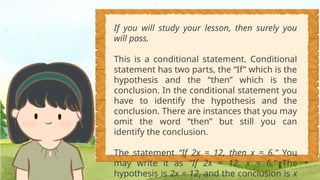
If you will study your lesson, then surely you
will pass.
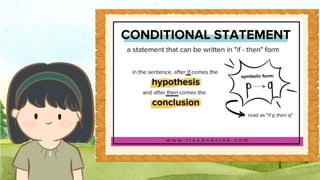
This is a conditional statement. Conditional
statement has two parts, the “If” which is the
hypothesis and the “then” which is the
conclusion. In the conditional statement you
have to identify the hypothesis and the
conclusion. There are instances that you may
omit the word “then” but still you can
identify the conclusion.
The statement “If 2x = 12, then x = 6.” You
may write it as “If 2x = 12, x = 6.” The
hypothesis is 2x = 12, and the conclusion is x
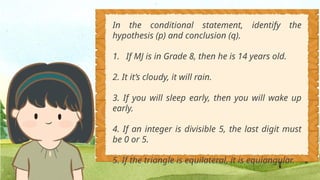
In the conditional statement, identify the
hypothesis (p) and conclusion (q).
1. If MJ is in Grade 8, then he is 14 years old.
2. It it’s cloudy, it will rain.
3. If you will sleep early, then you will wake up
early.
4. If an integer is divisible 5, the last digit must
be 0 or 5.
5. If the triangle is equilateral, it is equiangular.
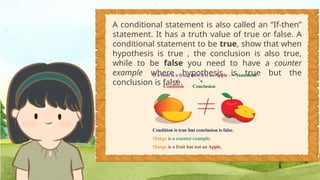
A conditional statement is also called an “If-then”
statement. It has a truth value of true or false. A
conditional statement to be true, show that when
hypothesis is true , the conclusion is also true,
while to be false you need to have a counter
example where hypothesis is true but the
conclusion is false.
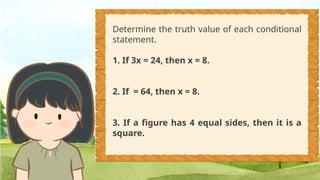
Determine the truth value of each conditional
statement.
1. If 3x = 24, then x = 8.
2. If = 64, then x = 8.
3. If a figure has 4 equal sides, then it is a
square.
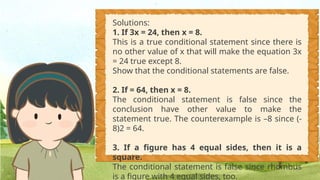
Solutions:
1. If 3x = 24, then x = 8.
This is a true conditional statement since there is
no other value of x that will make the equation 3x
= 24 true except 8.
Show that the conditional statements are false.
2. If = 64, then x = 8.
The conditional statement is false since the
conclusion have other value to make the
statement true. The counterexample is –8 since (-
8)2 = 64.
3. If a figure has 4 equal sides, then it is a
square.
The conditional statement is false since rhombus
is a figure with 4 equal sides, too.
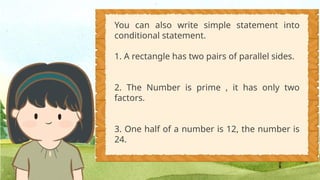
You can also write simple statement into
conditional statement.
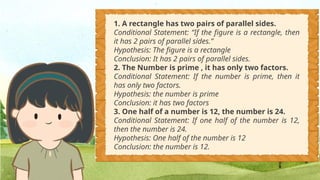
1. A rectangle has two pairs of parallel sides.
2. The Number is prime , it has only two
factors.
3. One half of a number is 12, the number is
24.
1. A rectangle has two pairs of parallel sides.
Conditional Statement: “If the figure is a rectangle, then
it has 2 pairs of parallel sides.”
Hypothesis: The figure is a rectangle
Conclusion: It has 2 pairs of parallel sides.
2. The Number is prime , it has only two factors.
Conditional Statement: If the number is prime, then it
has only two factors.
Hypothesis: the number is prime
Conclusion: it has two factors
3. One half of a number is 12, the number is 24.
Conditional Statement: If one half of the number is 12,
then the number is 24.
Hypothesis: One half of the number is 12
Conclusion: the number is 12.
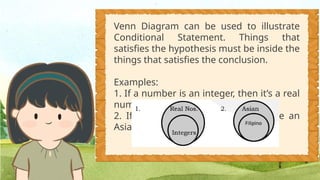
Venn Diagram can be used to illustrate
Conditional Statement. Things that
satisfies the hypothesis must be inside the
things that satisfies the conclusion.
Examples:
1. If a number is an integer, then it’s a real
number.
2. If you are a Filipino, then you are an
Asian.
Write the conditional statement for the
Venn Diagram
https://youtu.be/xeidhWmxjPs
When you switch the hypothesis and
conclusion of a conditional statement, you
form a CONVERSE statement.
Examples:
1. Conditional Statement: If the triangle is
equilateral, then it is equiangular.
Converse: If the triangle is equiangular, then
it is equilateral.
2. Conditional Statement: If a man is honest,
he does not steal.
Converse: If a man does not steal, he is
honest.
The conditional statement is true. An
equiangular triangle is always equilateral
triangle. The converse is also true. An equilateral
triangle is always equiangular. Since both
conditional and converse statements are true,
you can
connect the phrases by “if and only if “ (iff) . Thus,
it forms a biconditional statements.
Biconditional Statement: A triangle is equilateral
if and only if it is equiangular. The words “if and
only if” implies that both conditional and inverse
statements are true.
The second example both conditional and
converse statements are true. Thus, the
biconditional statement is: A man is honest if and
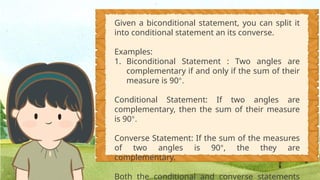
Given a biconditional statement, you can split it
into conditional statement an its converse.
Examples:
1. Biconditional Statement : Two angles are
complementary if and only if the sum of their
measure is 90°.
Conditional Statement: If two angles are
complementary, then the sum of their measure
is 90°.
Converse Statement: If the sum of the measures
of two angles is 90°, the they are
complementary.
Both the conditional and converse statements
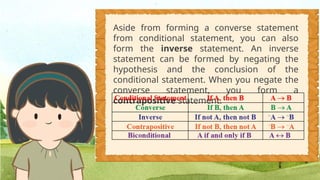
Aside from forming a converse statement
from conditional statement, you can also
form the inverse statement. An inverse
statement can be formed by negating the
hypothesis and the conclusion of the
conditional statement. When you negate the
converse statement, you form a
contrapositive statement.
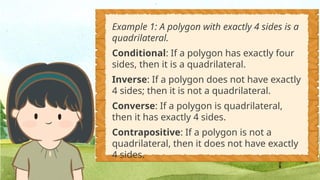
Example 1: A polygon with exactly 4 sides is a
quadrilateral.
Conditional: If a polygon has exactly four
sides, then it is a quadrilateral.
Inverse: If a polygon does not have exactly
4 sides; then it is not a quadrilateral.
Converse: If a polygon is quadrilateral,
then it has exactly 4 sides.
Contrapositive: If a polygon is not a
quadrilateral, then it does not have exactly
4 sides.
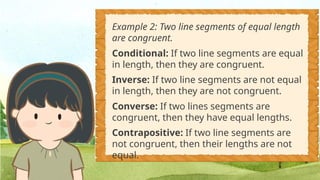
Example 2: Two line segments of equal length
are congruent.
Conditional: If two line segments are equal
in length, then they are congruent.
Inverse: If two line segments are not equal
in length, then they are not congruent.
Converse: If two lines segments are
congruent, then they have equal lengths.
Contrapositive: If two line segments are
not congruent, then their lengths are not
equal.
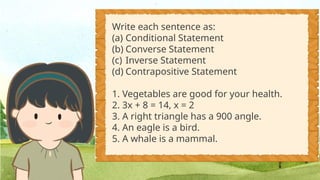
Write each sentence as:
(a) Conditional Statement
(b) Converse Statement
(c) Inverse Statement
(d) Contrapositive Statement
1. Vegetables are good for your health.
2. 3x + 8 = 14, x = 2
3. A right triangle has a 900 angle.
4. An eagle is a bird.
5. A whale is a mammal.
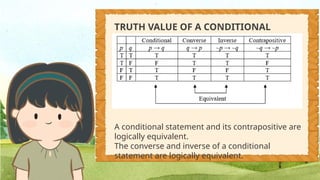
TRUTH VALUE OF A CONDITIONAL
STATEMENT
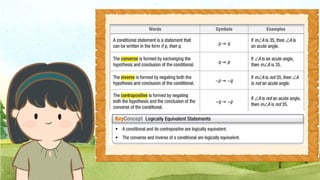
A conditional statement and its contrapositive are
logically equivalent.
The converse and inverse of a conditional
statement are logically equivalent.
Consider again the conditional “If it is raining,
then there are clouds in the sky.” It seems
reasonable to assume that this is true.
The converse would be “If there are clouds in
the sky, then it is raining.” This is not always
true.
The inverse would be “If it is not raining, then
there are not clouds in the sky.” Likewise, this
is not always true.
The contrapositive would be “If there are not
clouds in the sky, then it is not raining.” This
statement is true, and is equivalent to the
original conditional.
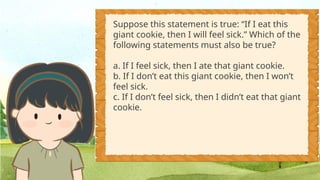
Suppose this statement is true: “If I eat this
giant cookie, then I will feel sick.” Which of the
following statements must also be true?
a. If I feel sick, then I ate that giant cookie.
b. If I don’t eat this giant cookie, then I won’t
feel sick.
c. If I don’t feel sick, then I didn’t eat that giant
cookie.
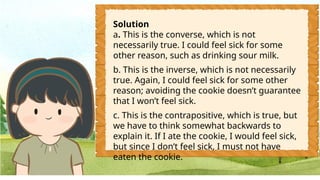
Solution
a. This is the converse, which is not
necessarily true. I could feel sick for some
other reason, such as drinking sour milk.
b. This is the inverse, which is not necessarily
true. Again, I could feel sick for some other
reason; avoiding the cookie doesn’t guarantee
that I won’t feel sick.
c. This is the contrapositive, which is true, but
we have to think somewhat backwards to
explain it. If I ate the cookie, I would feel sick,
but since I don’t feel sick, I must not have
eaten the cookie.
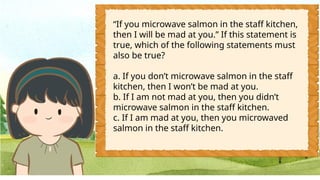
“If you microwave salmon in the staff kitchen,
then I will be mad at you.” If this statement is
true, which of the following statements must
also be true?
a. If you don’t microwave salmon in the staff
kitchen, then I won’t be mad at you.
b. If I am not mad at you, then you didn’t
microwave salmon in the staff kitchen.
c. If I am mad at you, then you microwaved
salmon in the staff kitchen.
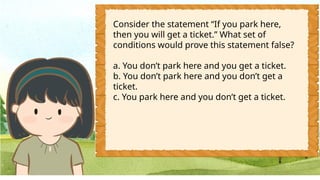
Consider the statement “If you park here,
then you will get a ticket.” What set of
conditions would prove this statement false?
a. You don’t park here and you get a ticket.
b. You don’t park here and you don’t get a
ticket.
c. You park here and you don’t get a ticket.

Conditional Statements Conditional Statements.pptx

  • 1.
  • 2.
    If you willstudy your lesson, then surely you will pass. This is a conditional statement. Conditional statement has two parts, the “If” which is the hypothesis and the “then” which is the conclusion. In the conditional statement you have to identify the hypothesis and the conclusion. There are instances that you may omit the word “then” but still you can identify the conclusion. The statement “If 2x = 12, then x = 6.” You may write it as “If 2x = 12, x = 6.” The hypothesis is 2x = 12, and the conclusion is x
  • 4.
    In the conditionalstatement, identify the hypothesis (p) and conclusion (q). 1. If MJ is in Grade 8, then he is 14 years old. 2. It it’s cloudy, it will rain. 3. If you will sleep early, then you will wake up early. 4. If an integer is divisible 5, the last digit must be 0 or 5. 5. If the triangle is equilateral, it is equiangular.
  • 5.
    A conditional statementis also called an “If-then” statement. It has a truth value of true or false. A conditional statement to be true, show that when hypothesis is true , the conclusion is also true, while to be false you need to have a counter example where hypothesis is true but the conclusion is false.
  • 6.
    Determine the truthvalue of each conditional statement. 1. If 3x = 24, then x = 8. 2. If = 64, then x = 8. 3. If a figure has 4 equal sides, then it is a square.
  • 7.
    Solutions: 1. If 3x= 24, then x = 8. This is a true conditional statement since there is no other value of x that will make the equation 3x = 24 true except 8. Show that the conditional statements are false. 2. If = 64, then x = 8. The conditional statement is false since the conclusion have other value to make the statement true. The counterexample is –8 since (- 8)2 = 64. 3. If a figure has 4 equal sides, then it is a square. The conditional statement is false since rhombus is a figure with 4 equal sides, too.
  • 8.
    You can alsowrite simple statement into conditional statement. 1. A rectangle has two pairs of parallel sides. 2. The Number is prime , it has only two factors. 3. One half of a number is 12, the number is 24.
  • 9.
    1. A rectanglehas two pairs of parallel sides. Conditional Statement: “If the figure is a rectangle, then it has 2 pairs of parallel sides.” Hypothesis: The figure is a rectangle Conclusion: It has 2 pairs of parallel sides. 2. The Number is prime , it has only two factors. Conditional Statement: If the number is prime, then it has only two factors. Hypothesis: the number is prime Conclusion: it has two factors 3. One half of a number is 12, the number is 24. Conditional Statement: If one half of the number is 12, then the number is 24. Hypothesis: One half of the number is 12 Conclusion: the number is 12.
  • 10.
    Venn Diagram canbe used to illustrate Conditional Statement. Things that satisfies the hypothesis must be inside the things that satisfies the conclusion. Examples: 1. If a number is an integer, then it’s a real number. 2. If you are a Filipino, then you are an Asian.
  • 11.
    Write the conditionalstatement for the Venn Diagram
  • 12.
  • 13.
    When you switchthe hypothesis and conclusion of a conditional statement, you form a CONVERSE statement. Examples: 1. Conditional Statement: If the triangle is equilateral, then it is equiangular. Converse: If the triangle is equiangular, then it is equilateral. 2. Conditional Statement: If a man is honest, he does not steal. Converse: If a man does not steal, he is honest.
  • 14.
    The conditional statementis true. An equiangular triangle is always equilateral triangle. The converse is also true. An equilateral triangle is always equiangular. Since both conditional and converse statements are true, you can connect the phrases by “if and only if “ (iff) . Thus, it forms a biconditional statements. Biconditional Statement: A triangle is equilateral if and only if it is equiangular. The words “if and only if” implies that both conditional and inverse statements are true. The second example both conditional and converse statements are true. Thus, the biconditional statement is: A man is honest if and
  • 15.
    Given a biconditionalstatement, you can split it into conditional statement an its converse. Examples: 1. Biconditional Statement : Two angles are complementary if and only if the sum of their measure is 90°. Conditional Statement: If two angles are complementary, then the sum of their measure is 90°. Converse Statement: If the sum of the measures of two angles is 90°, the they are complementary. Both the conditional and converse statements
  • 16.
    Aside from forminga converse statement from conditional statement, you can also form the inverse statement. An inverse statement can be formed by negating the hypothesis and the conclusion of the conditional statement. When you negate the converse statement, you form a contrapositive statement.
  • 18.
    Example 1: Apolygon with exactly 4 sides is a quadrilateral. Conditional: If a polygon has exactly four sides, then it is a quadrilateral. Inverse: If a polygon does not have exactly 4 sides; then it is not a quadrilateral. Converse: If a polygon is quadrilateral, then it has exactly 4 sides. Contrapositive: If a polygon is not a quadrilateral, then it does not have exactly 4 sides.
  • 19.
    Example 2: Twoline segments of equal length are congruent. Conditional: If two line segments are equal in length, then they are congruent. Inverse: If two line segments are not equal in length, then they are not congruent. Converse: If two lines segments are congruent, then they have equal lengths. Contrapositive: If two line segments are not congruent, then their lengths are not equal.
  • 20.
    Write each sentenceas: (a) Conditional Statement (b) Converse Statement (c) Inverse Statement (d) Contrapositive Statement 1. Vegetables are good for your health. 2. 3x + 8 = 14, x = 2 3. A right triangle has a 900 angle. 4. An eagle is a bird. 5. A whale is a mammal.
  • 21.
    TRUTH VALUE OFA CONDITIONAL STATEMENT A conditional statement and its contrapositive are logically equivalent. The converse and inverse of a conditional statement are logically equivalent.
  • 22.
    Consider again theconditional “If it is raining, then there are clouds in the sky.” It seems reasonable to assume that this is true. The converse would be “If there are clouds in the sky, then it is raining.” This is not always true. The inverse would be “If it is not raining, then there are not clouds in the sky.” Likewise, this is not always true. The contrapositive would be “If there are not clouds in the sky, then it is not raining.” This statement is true, and is equivalent to the original conditional.
  • 23.
    Suppose this statementis true: “If I eat this giant cookie, then I will feel sick.” Which of the following statements must also be true? a. If I feel sick, then I ate that giant cookie. b. If I don’t eat this giant cookie, then I won’t feel sick. c. If I don’t feel sick, then I didn’t eat that giant cookie.
  • 24.
    Solution a. This isthe converse, which is not necessarily true. I could feel sick for some other reason, such as drinking sour milk. b. This is the inverse, which is not necessarily true. Again, I could feel sick for some other reason; avoiding the cookie doesn’t guarantee that I won’t feel sick. c. This is the contrapositive, which is true, but we have to think somewhat backwards to explain it. If I ate the cookie, I would feel sick, but since I don’t feel sick, I must not have eaten the cookie.
  • 25.
    “If you microwavesalmon in the staff kitchen, then I will be mad at you.” If this statement is true, which of the following statements must also be true? a. If you don’t microwave salmon in the staff kitchen, then I won’t be mad at you. b. If I am not mad at you, then you didn’t microwave salmon in the staff kitchen. c. If I am mad at you, then you microwaved salmon in the staff kitchen.
  • 26.
    Consider the statement“If you park here, then you will get a ticket.” What set of conditions would prove this statement false? a. You don’t park here and you get a ticket. b. You don’t park here and you don’t get a ticket. c. You park here and you don’t get a ticket.