Inductive Reasoning
Inductive reasoning is the process of using examples
 and observations to reach a conclusion.
  Any time you use a pattern to predict what will come
    next, you are using inductive reasoning.
A conclusion based on inductive reasoning is called a
 conjecture.
Counterexamples
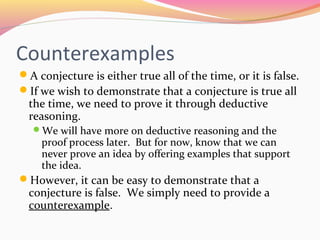
A conjecture is either true all of the time, or it is false.
If we wish to demonstrate that a conjecture is true all
  the time, we need to prove it through deductive
  reasoning.
   We will have more on deductive reasoning and the
    proof process later. But for now, know that we can
    never prove an idea by offering examples that support
    the idea.
However, it can be easy to demonstrate that a
  conjecture is false. We simply need to provide a
  counterexample.
Intro to Logic
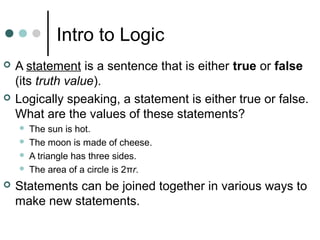
   A statement is a sentence that is either true or false
    (its truth value).
   Logically speaking, a statement is either true or false.
    What are the values of these statements?
       The sun is hot.
       The moon is made of cheese.
       A triangle has three sides.
       The area of a circle is 2πr.
   Statements can be joined together in various ways to
    make new statements.
Conditional Statements
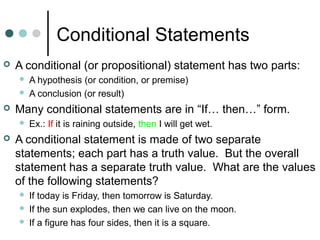
   A conditional (or propositional) statement has two parts:
       A hypothesis (or condition, or premise)
       A conclusion (or result)
   Many conditional statements are in “If… then…” form.
       Ex.: If it is raining outside, then I will get wet.
   A conditional statement is made of two separate
    statements; each part has a truth value. But the overall
    statement has a separate truth value. What are the values
    of the following statements?
       If today is Friday, then tomorrow is Saturday.
       If the sun explodes, then we can live on the moon.
       If a figure has four sides, then it is a square.
Conditional Statements
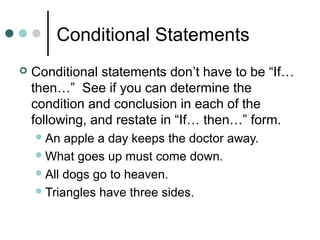
   Conditional statements don’t have to be “If…
    then…” See if you can determine the
    condition and conclusion in each of the
    following, and restate in “If… then…” form.
     An  apple a day keeps the doctor away.
     What goes up must come down.
     All dogs go to heaven.
     Triangles have three sides.
Inverse
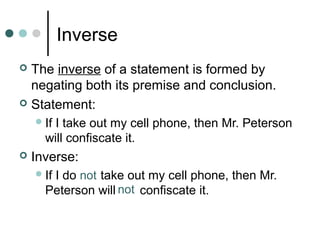
 The inverse of a statement is formed by
  negating both its premise and conclusion.
 Statement:
     IfI take out my cell phone, then Mr. Peterson
      will confiscate it.
   Inverse:
     If
       I do not take out my cell phone, then Mr.
      Peterson will not confiscate it.
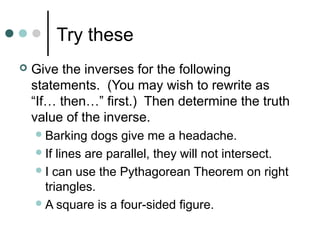
Try these
   Give the inverses for the following
    statements. (You may wish to rewrite as
    “If… then…” first.) Then determine the truth
    value of the inverse.
     Barking   dogs give me a headache.
     If lines are parallel, they will not intersect.
     I can use the Pythagorean Theorem on right
      triangles.
     A square is a four-sided figure.
Converse
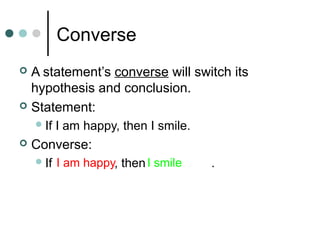
 A statement’s converse will switch its
  hypothesis and conclusion.
 Statement:
     If   I am happy, then I smile.
   Converse:
     If   I am happy, then I smile    .
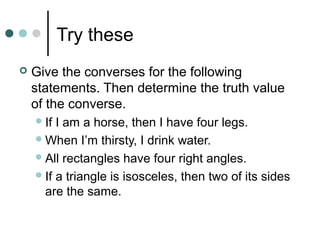
Try these
   Give the converses for the following
    statements. Then determine the truth value
    of the converse.
     If I am a horse, then I have four legs.
     When I’m thirsty, I drink water.
     All rectangles have four right angles.
     If a triangle is isosceles, then two of its sides
      are the same.
Contrapositive
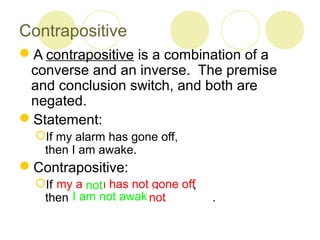
A contrapositive is a combination of a
 converse and an inverse. The premise
 and conclusion switch, and both are
 negated.
Statement:
  If my alarm has gone off,
   then I am awake.
Contrapositive:
  If my alarm has not gone off,
           not
   then I am not awakenot          .
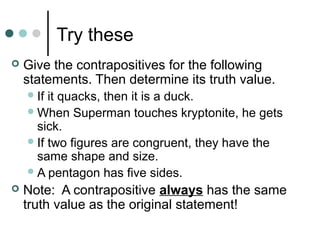
Try these
   Give the contrapositives for the following
    statements. Then determine its truth value.
     If it quacks, then it is a duck.
     When Superman touches kryptonite, he gets
      sick.
     If two figures are congruent, they have the
      same shape and size.
     A pentagon has five sides.
   Note: A contrapositive always has the same
    truth value as the original statement!
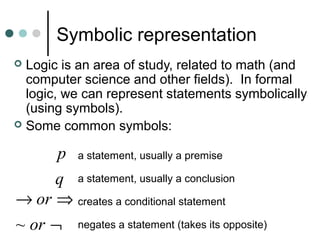
Symbolic representation
 Logic is an area of study, related to math (and
  computer science and other fields). In formal
  logic, we can represent statements symbolically
  (using symbols).
 Some common symbols:


      p a statement, usually a premise
     q a statement, usually a conclusion
→ or ⇒ creates a conditional statement
~ or ¬ negates a statement (takes its opposite)
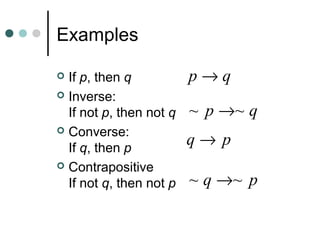
Examples

 If p, then q           p→q
 Inverse:
  If not p, then not q   ~ p →~ q
 Converse:
  If q, then p
                         q→ p
 Contrapositive
  If not q, then not p   ~ q →~ p
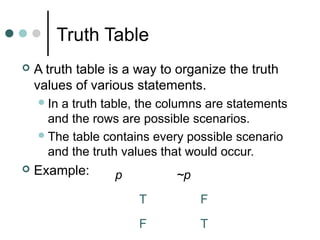
Truth Table
   A truth table is a way to organize the truth
    values of various statements.
     Ina truth table, the columns are statements
      and the rows are possible scenarios.
     The table contains every possible scenario
      and the truth values that would occur.
   Example:      p          ~p
                      T           F
                      F           T
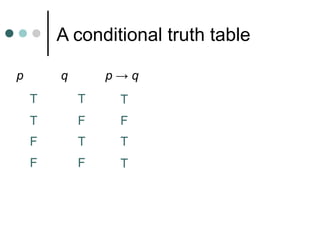
A conditional truth table

p       q       p→q
    T       T    T
    T       F    F
    F       T    T
    F       F    T
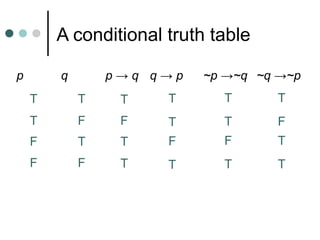
A conditional truth table

p       q       p→q q→p   ~p →~q ~q →~p
    T       T    T    T      T      T
    T       F    F    T      T      F
    F       T    T    F      F      T
    F       F    T    T      T      T
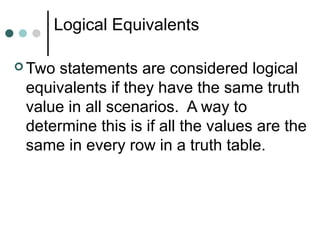
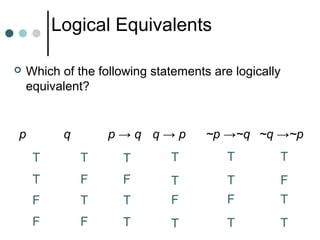
Logical Equivalents

 Two statements are considered logical
 equivalents if they have the same truth
 value in all scenarios. A way to
 determine this is if all the values are the
 same in every row in a truth table.
Logical Equivalents

   Which of the following statements are logically
    equivalent?


p         q        p→q q→p           ~p →~q ~q →~p
     T        T      T        T          T        T
     T        F      F        T          T        F
     F        T      T        F          F        T
     F        F      T        T          T        T
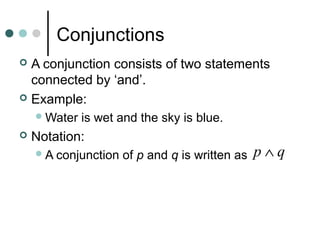
Conjunctions
 A conjunction consists of two statements
  connected by ‘and’.
 Example:
     Water   is wet and the sky is blue.
   Notation:
     A conjunction   of p and q is written as   p∧q
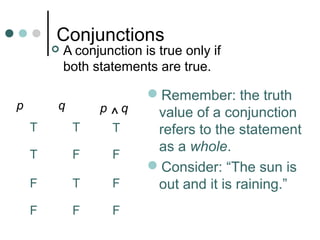
Conjunctions
           A conjunction is true only if
            both statements are true.

                           Remember: the truth
p       q         p
                      ^q    value of a conjunction
    T        T        T     refers to the statement
                            as a whole.
    T        F        F
                           Consider: “The sun is
    F        T        F     out and it is raining.”
    F        F        F
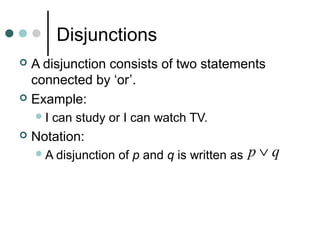
Disjunctions
 A disjunction consists of two statements
  connected by ‘or’.
 Example:
    I   can study or I can watch TV.
   Notation:
     A disjunction   of p and q is written as   p∨q
Disjunctions
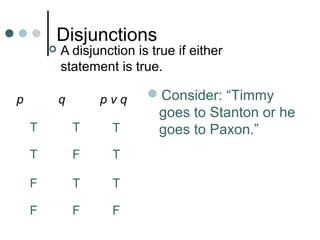
           A disjunction is true if either
            statement is true.

p           q       pvq     Consider: “Timmy
                             goes to Stanton or he
    T           T    T       goes to Paxon.”
    T           F    T

    F           T    T

    F           F    F
Biconditional

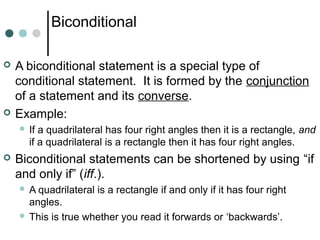
   A biconditional statement is a special type of
    conditional statement. It is formed by the conjunction
    of a statement and its converse.
   Example:
       If a quadrilateral has four right angles then it is a rectangle, and
        if a quadrilateral is a rectangle then it has four right angles.
   Biconditional statements can be shortened by using “if
    and only if” (iff.).
     A quadrilateral is a rectangle if and only if it has four right
      angles.
     This is true whether you read it forwards or ‘backwards’.
Biconditional

 A good definition will consist of a
  biconditional statement.
 Ex: A figure is a triangle if and only if it has
  three sides.
Biconditional
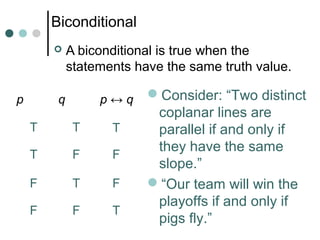
            A biconditional is true when the
             statements have the same truth value.

p        q        p↔q     Consider: “Two distinct
                           coplanar lines are
    T         T     T      parallel if and only if
                           they have the same
    T         F     F
                           slope.”
    F         T     F     “Our team will win the
                           playoffs if and only if
    F         F     T
                           pigs fly.”
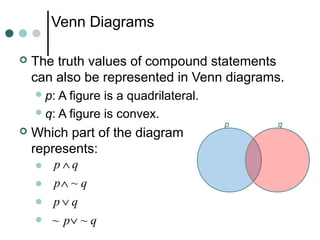
Venn Diagrams

   The truth values of compound statements
    can also be represented in Venn diagrams.
     p: A figure is a quadrilateral.
     q: A figure is convex.
                                        p   q
   Which part of the diagram
    represents:
       p∧q
       p∧ ~ q
       p∨q
       ~ p∨ ~ q
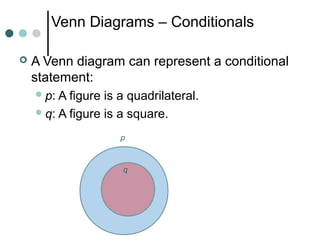
Venn Diagrams – Conditionals

   A Venn diagram can represent a conditional
    statement:
     p: A figure is a quadrilateral.
     q: A figure is a square.

                     p


                     q

Inductive reasoning & logic

  • 1.
    Inductive Reasoning Inductive reasoningis the process of using examples and observations to reach a conclusion. Any time you use a pattern to predict what will come next, you are using inductive reasoning. A conclusion based on inductive reasoning is called a conjecture.
  • 2.
    Counterexamples A conjecture iseither true all of the time, or it is false. If we wish to demonstrate that a conjecture is true all the time, we need to prove it through deductive reasoning. We will have more on deductive reasoning and the proof process later. But for now, know that we can never prove an idea by offering examples that support the idea. However, it can be easy to demonstrate that a conjecture is false. We simply need to provide a counterexample.
  • 3.
    Intro to Logic  A statement is a sentence that is either true or false (its truth value).  Logically speaking, a statement is either true or false. What are the values of these statements?  The sun is hot.  The moon is made of cheese.  A triangle has three sides.  The area of a circle is 2πr.  Statements can be joined together in various ways to make new statements.
  • 4.
    Conditional Statements  A conditional (or propositional) statement has two parts:  A hypothesis (or condition, or premise)  A conclusion (or result)  Many conditional statements are in “If… then…” form.  Ex.: If it is raining outside, then I will get wet.  A conditional statement is made of two separate statements; each part has a truth value. But the overall statement has a separate truth value. What are the values of the following statements?  If today is Friday, then tomorrow is Saturday.  If the sun explodes, then we can live on the moon.  If a figure has four sides, then it is a square.
  • 5.
    Conditional Statements  Conditional statements don’t have to be “If… then…” See if you can determine the condition and conclusion in each of the following, and restate in “If… then…” form.  An apple a day keeps the doctor away.  What goes up must come down.  All dogs go to heaven.  Triangles have three sides.
  • 6.
    Inverse  The inverseof a statement is formed by negating both its premise and conclusion.  Statement:  IfI take out my cell phone, then Mr. Peterson will confiscate it.  Inverse:  If I do not take out my cell phone, then Mr. Peterson will not confiscate it.
  • 7.
    Try these  Give the inverses for the following statements. (You may wish to rewrite as “If… then…” first.) Then determine the truth value of the inverse.  Barking dogs give me a headache.  If lines are parallel, they will not intersect.  I can use the Pythagorean Theorem on right triangles.  A square is a four-sided figure.
  • 8.
    Converse  A statement’sconverse will switch its hypothesis and conclusion.  Statement:  If I am happy, then I smile.  Converse:  If I am happy, then I smile .
  • 9.
    Try these  Give the converses for the following statements. Then determine the truth value of the converse.  If I am a horse, then I have four legs.  When I’m thirsty, I drink water.  All rectangles have four right angles.  If a triangle is isosceles, then two of its sides are the same.
  • 10.
    Contrapositive A contrapositive isa combination of a converse and an inverse. The premise and conclusion switch, and both are negated. Statement: If my alarm has gone off, then I am awake. Contrapositive: If my alarm has not gone off, not then I am not awakenot .
  • 11.
    Try these  Give the contrapositives for the following statements. Then determine its truth value.  If it quacks, then it is a duck.  When Superman touches kryptonite, he gets sick.  If two figures are congruent, they have the same shape and size.  A pentagon has five sides.  Note: A contrapositive always has the same truth value as the original statement!
  • 12.
    Symbolic representation  Logicis an area of study, related to math (and computer science and other fields). In formal logic, we can represent statements symbolically (using symbols).  Some common symbols: p a statement, usually a premise q a statement, usually a conclusion → or ⇒ creates a conditional statement ~ or ¬ negates a statement (takes its opposite)
  • 13.
    Examples  If p,then q p→q  Inverse: If not p, then not q ~ p →~ q  Converse: If q, then p q→ p  Contrapositive If not q, then not p ~ q →~ p
  • 14.
    Truth Table  A truth table is a way to organize the truth values of various statements.  Ina truth table, the columns are statements and the rows are possible scenarios.  The table contains every possible scenario and the truth values that would occur.  Example: p ~p T F F T
  • 15.
    A conditional truthtable p q p→q T T T T F F F T T F F T
  • 16.
    A conditional truthtable p q p→q q→p ~p →~q ~q →~p T T T T T T T F F T T F F T T F F T F F T T T T
  • 17.
    Logical Equivalents  Twostatements are considered logical equivalents if they have the same truth value in all scenarios. A way to determine this is if all the values are the same in every row in a truth table.
  • 18.
    Logical Equivalents  Which of the following statements are logically equivalent? p q p→q q→p ~p →~q ~q →~p T T T T T T T F F T T F F T T F F T F F T T T T
  • 19.
    Conjunctions  A conjunctionconsists of two statements connected by ‘and’.  Example:  Water is wet and the sky is blue.  Notation:  A conjunction of p and q is written as p∧q
  • 20.
    Conjunctions  A conjunction is true only if both statements are true. Remember: the truth p q p ^q value of a conjunction T T T refers to the statement as a whole. T F F Consider: “The sun is F T F out and it is raining.” F F F
  • 21.
    Disjunctions  A disjunctionconsists of two statements connected by ‘or’.  Example: I can study or I can watch TV.  Notation:  A disjunction of p and q is written as p∨q
  • 22.
    Disjunctions  A disjunction is true if either statement is true. p q pvq Consider: “Timmy goes to Stanton or he T T T goes to Paxon.” T F T F T T F F F
  • 23.
    Biconditional  A biconditional statement is a special type of conditional statement. It is formed by the conjunction of a statement and its converse.  Example:  If a quadrilateral has four right angles then it is a rectangle, and if a quadrilateral is a rectangle then it has four right angles.  Biconditional statements can be shortened by using “if and only if” (iff.).  A quadrilateral is a rectangle if and only if it has four right angles.  This is true whether you read it forwards or ‘backwards’.
  • 24.
    Biconditional  A gooddefinition will consist of a biconditional statement.  Ex: A figure is a triangle if and only if it has three sides.
  • 25.
    Biconditional  A biconditional is true when the statements have the same truth value. p q p↔q Consider: “Two distinct coplanar lines are T T T parallel if and only if they have the same T F F slope.” F T F “Our team will win the playoffs if and only if F F T pigs fly.”
  • 26.
    Venn Diagrams  The truth values of compound statements can also be represented in Venn diagrams.  p: A figure is a quadrilateral.  q: A figure is convex. p q  Which part of the diagram represents:  p∧q  p∧ ~ q  p∨q  ~ p∨ ~ q
  • 27.
    Venn Diagrams –Conditionals  A Venn diagram can represent a conditional statement:  p: A figure is a quadrilateral.  q: A figure is a square. p q