THE FIFTH
POSTULATE
CATHERINE B. MERTADO
LINDO ESTRERA
The Fifth
Postulate
“One of Euclid’s postulates—his postulate
5—had the fortune to be an epoch-making
statement—perhaps the most famous single
utterance in the history of science.”
— Cassius J. Keyser1
Introduction
► Euclid’s first four postulates have always been readily accepted by
mathematicians. The fifth postulate—the “parallel postulate”—
however, became highly controversial.
► The fifth postulate is often called the Parallel Postulate even though
it does not specifically talk about parallel lines; it actually deals with
ideas of parallelism. The consideration of alternatives to Euclid’s
parallel postulate resulted in the development of non-Euclidean
geometries.
Proposition:
► If a straight line falling on two straight lines
make the alternate angles equal to one
another, the straight lines will be parallel to one
another
Let ST be a transversal cutting lines
AB and CD in such a way that angles BST
and CT S are equal [labeled α in the figure].
Assume that AB and CD meet in a point P in
the direction of B and D. Then, in triangle SP
T, the exterior angle CT S is equal to the
interior and opposite angle T SP. But this is
impossible. It follows that AB and CD cannot
meet in the direction of B and D. By similar
argument, it can be shown that they
cannot meet in the direction of A and C.
Hence, they are parallel.
PROO
F
Proposition:
► If a straight line falling on two straight lines
make the exterior angle equal to the interior
and opposite angle on the same side, or the
interior angles on the same side equal to two
right angles, the straight lines will be parallel to
one another.
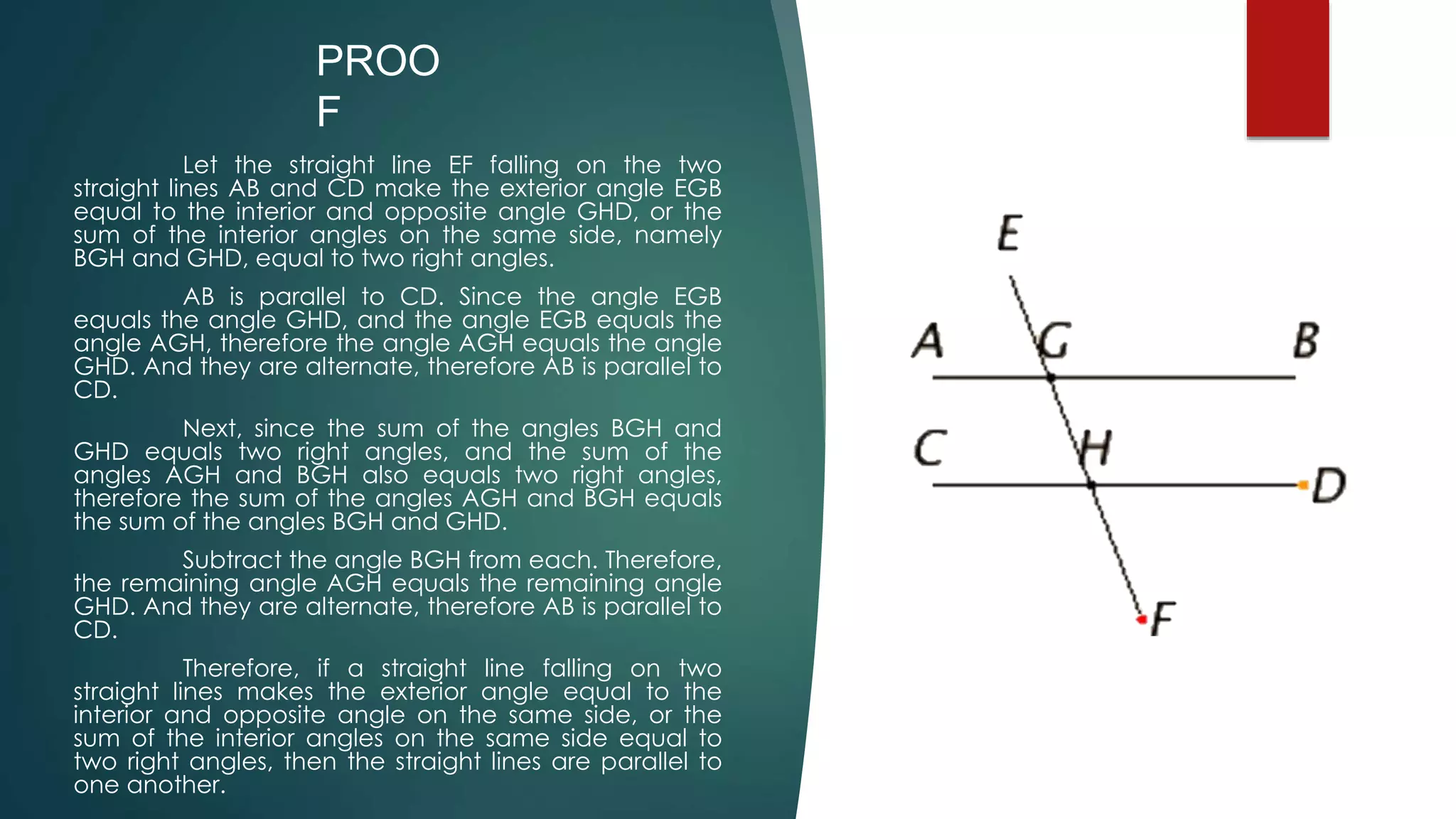
Let the straight line EF falling on the two
straight lines AB and CD make the exterior angle EGB
equal to the interior and opposite angle GHD, or the
sum of the interior angles on the same side, namely
BGH and GHD, equal to two right angles.
AB is parallel to CD. Since the angle EGB
equals the angle GHD, and the angle EGB equals the
angle AGH, therefore the angle AGH equals the angle
GHD. And they are alternate, therefore AB is parallel to
CD.
Next, since the sum of the angles BGH and
GHD equals two right angles, and the sum of the
angles AGH and BGH also equals two right angles,
therefore the sum of the angles AGH and BGH equals
the sum of the angles BGH and GHD.
Subtract the angle BGH from each. Therefore,
the remaining angle AGH equals the remaining angle
GHD. And they are alternate, therefore AB is parallel to
CD.
Therefore, if a straight line falling on two
straight lines makes the exterior angle equal to the
interior and opposite angle on the same side, or the
sum of the interior angles on the same side equal to
two right angles, then the straight lines are parallel to
one another.
PROO
F
Proposition:
► A straight line falling on parallel straight lines
makes the alternate angles equal to one
another, the exterior angle equal to the interior
and opposite angle, and the interior angles on
the same side equal to two right angles.
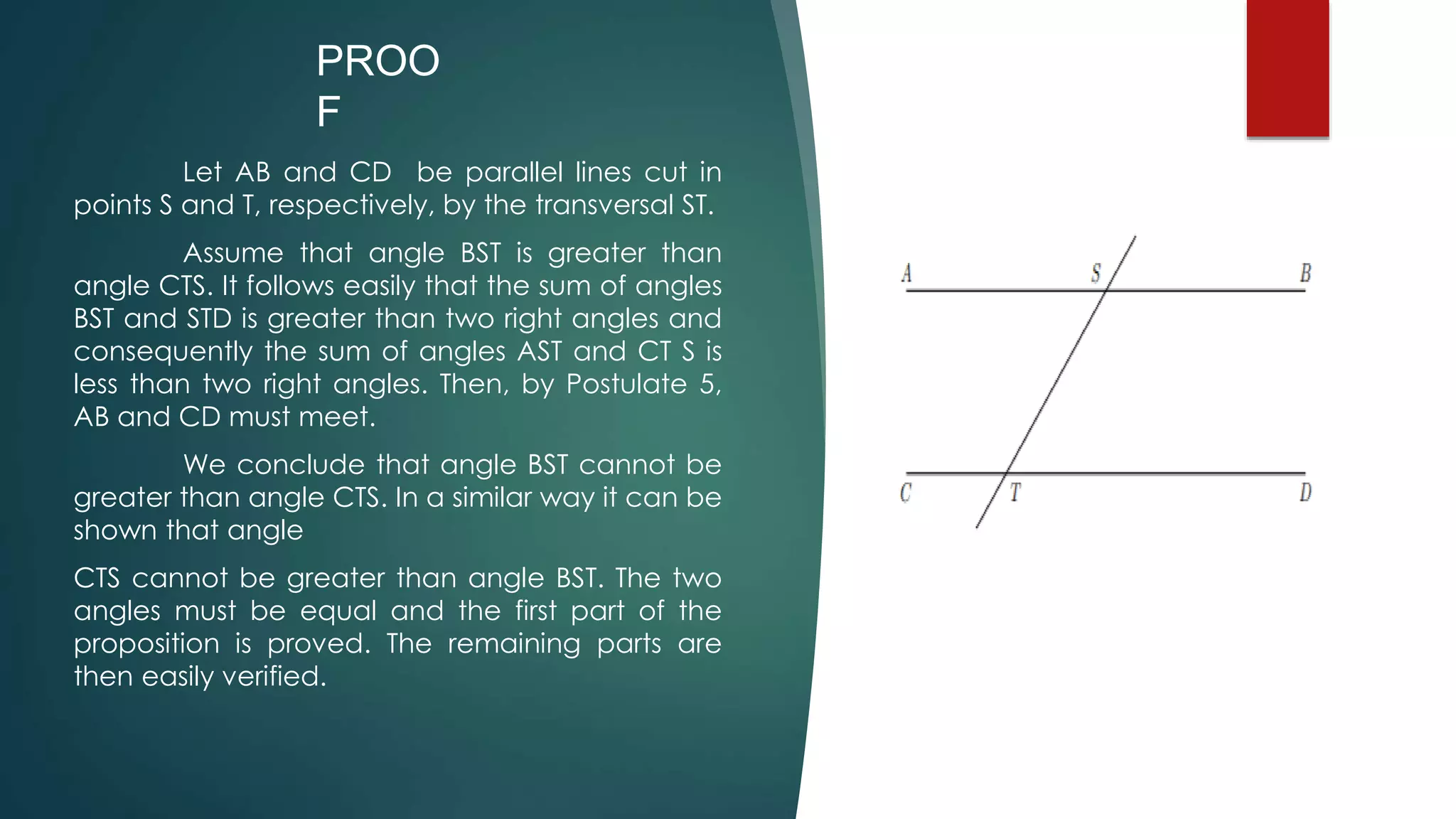
Let AB and CD be parallel lines cut in
points S and T, respectively, by the transversal ST.
Assume that angle BST is greater than
angle CTS. It follows easily that the sum of angles
BST and STD is greater than two right angles and
consequently the sum of angles AST and CT S is
less than two right angles. Then, by Postulate 5,
AB and CD must meet.
We conclude that angle BST cannot be
greater than angle CTS. In a similar way it can be
shown that angle
CTS cannot be greater than angle BST. The two
angles must be equal and the first part of the
proposition is proved. The remaining parts are
then easily verified.
PROO
F
Substitutes for the Fifth Postulate
► Most students may have the inability to recall mentions of Fifth
Postulate from the textbooks they have written due to the fact the
most writers of textbooks in geometry use some substitute postulate,
essentially equivalent to the Fifth, but simpler in statement.
► The one most commonly used is generally attributed to the
geometer, Playfair, although it was stated as early as the fifth
century by Proclus.
Playfair’s Axiom
Through a given point, not on a given line, exactly one line can
be drawn parallel to the given line
Playfair’s Axiom is equivalent to the Fifth Postulate in the sense
that it can be deduced from Euclid’s five postulates and common
notions, while, conversely, the Fifth Postulate can deduced from
Playfair’s Axiom together with the common notions and first four
postulates.
The Angle-Sum of a Triangle
A second alternative for the Fifth Postulate is the familiar theorem:
[The sum of the three angles of a triangle is always equal to two right angles.
This is a consequence of Playfair’s Axiom, and hence of the Fifth
Postulate, is well known.
The Existence of Similar Figures
► The following statement is also equivalent to the Fifth Postulate and
may be substituted for it, leading to the same consequences:
There exists a pair of similar triangles, i.e., triangles which are not
congruent, but have the three angles of one equal, respectively, to
the three angles of the other
Equidistant Straight Lines
Another noteworthy substitute is the following:
There exists a pair of straight lines everywhere equally distant from one
another.
Once the Fifth Postulate is adopted, this statement follows, for
then all parallels have this property of being everywhere equally
distant. If the above statement is postulated, we can easily deduce
the Fifth Postulate by first proving that there exists a triangle with the
sum of its angles equal to two right angles.
Attempts to Prove the Fifth
Postulate.
► We have already noted the reasons for the skepticism with which
geometers, from the very beginning, viewed the Fifth Postulate as
such. But the numerous and varied attempts, made throughout
many centuries, to deduce it as a consequence of the other
Euclidean postulates and common notions, stated or implied, all
ended unsuccessfully. Before we are done we shall show why failure
was inevitable. Today we know that the Postulate cannot be so
derived. But these attempts, futile in so far as the main objective was
concerned, are not to be ignored. Naturally it was through them
that at last the true nature and significance of the Postulate were
revealed. For this reason we shall find it profitable to give brief
accounts of a few of the countless efforts to prove the Fifth
Postulate. ***
REFERENCES
Lamb, E. (2014, February 28). Chasing the Parallel Postulate. Retrieved November 7,
2020, from Scientific American: https://blogs.scientificamerican.com/roots-of-
unity/chasing-the-parallel-postulate/
Whitman College. (n.d.). Retrieved from http://people.whitman.edu/:
http://people.whitman.edu/~gordon/wolfechap2.pdf
Wolfe, H. E. (2013). The Fifth Postulate. In H. E. Wolfe, Introduction of Non Euclidean
Geometry (pp. 17-20). Mineola, New York: Dover Publications, Inc.
The Fifth
Postulate
-- THANK YOU...

The fifth postulate

  • 1.
    THE FIFTH POSTULATE CATHERINE B.MERTADO LINDO ESTRERA
  • 2.
    The Fifth Postulate “One ofEuclid’s postulates—his postulate 5—had the fortune to be an epoch-making statement—perhaps the most famous single utterance in the history of science.” — Cassius J. Keyser1
  • 3.
    Introduction ► Euclid’s firstfour postulates have always been readily accepted by mathematicians. The fifth postulate—the “parallel postulate”— however, became highly controversial. ► The fifth postulate is often called the Parallel Postulate even though it does not specifically talk about parallel lines; it actually deals with ideas of parallelism. The consideration of alternatives to Euclid’s parallel postulate resulted in the development of non-Euclidean geometries.
  • 4.
    Proposition: ► If astraight line falling on two straight lines make the alternate angles equal to one another, the straight lines will be parallel to one another
  • 5.
    Let ST bea transversal cutting lines AB and CD in such a way that angles BST and CT S are equal [labeled α in the figure]. Assume that AB and CD meet in a point P in the direction of B and D. Then, in triangle SP T, the exterior angle CT S is equal to the interior and opposite angle T SP. But this is impossible. It follows that AB and CD cannot meet in the direction of B and D. By similar argument, it can be shown that they cannot meet in the direction of A and C. Hence, they are parallel. PROO F
  • 6.
    Proposition: ► If astraight line falling on two straight lines make the exterior angle equal to the interior and opposite angle on the same side, or the interior angles on the same side equal to two right angles, the straight lines will be parallel to one another.
  • 7.
    Let the straightline EF falling on the two straight lines AB and CD make the exterior angle EGB equal to the interior and opposite angle GHD, or the sum of the interior angles on the same side, namely BGH and GHD, equal to two right angles. AB is parallel to CD. Since the angle EGB equals the angle GHD, and the angle EGB equals the angle AGH, therefore the angle AGH equals the angle GHD. And they are alternate, therefore AB is parallel to CD. Next, since the sum of the angles BGH and GHD equals two right angles, and the sum of the angles AGH and BGH also equals two right angles, therefore the sum of the angles AGH and BGH equals the sum of the angles BGH and GHD. Subtract the angle BGH from each. Therefore, the remaining angle AGH equals the remaining angle GHD. And they are alternate, therefore AB is parallel to CD. Therefore, if a straight line falling on two straight lines makes the exterior angle equal to the interior and opposite angle on the same side, or the sum of the interior angles on the same side equal to two right angles, then the straight lines are parallel to one another. PROO F
  • 8.
    Proposition: ► A straightline falling on parallel straight lines makes the alternate angles equal to one another, the exterior angle equal to the interior and opposite angle, and the interior angles on the same side equal to two right angles.
  • 9.
    Let AB andCD be parallel lines cut in points S and T, respectively, by the transversal ST. Assume that angle BST is greater than angle CTS. It follows easily that the sum of angles BST and STD is greater than two right angles and consequently the sum of angles AST and CT S is less than two right angles. Then, by Postulate 5, AB and CD must meet. We conclude that angle BST cannot be greater than angle CTS. In a similar way it can be shown that angle CTS cannot be greater than angle BST. The two angles must be equal and the first part of the proposition is proved. The remaining parts are then easily verified. PROO F
  • 10.
    Substitutes for theFifth Postulate ► Most students may have the inability to recall mentions of Fifth Postulate from the textbooks they have written due to the fact the most writers of textbooks in geometry use some substitute postulate, essentially equivalent to the Fifth, but simpler in statement. ► The one most commonly used is generally attributed to the geometer, Playfair, although it was stated as early as the fifth century by Proclus.
  • 11.
    Playfair’s Axiom Through agiven point, not on a given line, exactly one line can be drawn parallel to the given line Playfair’s Axiom is equivalent to the Fifth Postulate in the sense that it can be deduced from Euclid’s five postulates and common notions, while, conversely, the Fifth Postulate can deduced from Playfair’s Axiom together with the common notions and first four postulates.
  • 12.
    The Angle-Sum ofa Triangle A second alternative for the Fifth Postulate is the familiar theorem: [The sum of the three angles of a triangle is always equal to two right angles. This is a consequence of Playfair’s Axiom, and hence of the Fifth Postulate, is well known.
  • 13.
    The Existence ofSimilar Figures ► The following statement is also equivalent to the Fifth Postulate and may be substituted for it, leading to the same consequences: There exists a pair of similar triangles, i.e., triangles which are not congruent, but have the three angles of one equal, respectively, to the three angles of the other
  • 14.
    Equidistant Straight Lines Anothernoteworthy substitute is the following: There exists a pair of straight lines everywhere equally distant from one another. Once the Fifth Postulate is adopted, this statement follows, for then all parallels have this property of being everywhere equally distant. If the above statement is postulated, we can easily deduce the Fifth Postulate by first proving that there exists a triangle with the sum of its angles equal to two right angles.
  • 15.
    Attempts to Provethe Fifth Postulate. ► We have already noted the reasons for the skepticism with which geometers, from the very beginning, viewed the Fifth Postulate as such. But the numerous and varied attempts, made throughout many centuries, to deduce it as a consequence of the other Euclidean postulates and common notions, stated or implied, all ended unsuccessfully. Before we are done we shall show why failure was inevitable. Today we know that the Postulate cannot be so derived. But these attempts, futile in so far as the main objective was concerned, are not to be ignored. Naturally it was through them that at last the true nature and significance of the Postulate were revealed. For this reason we shall find it profitable to give brief accounts of a few of the countless efforts to prove the Fifth Postulate. ***
  • 16.
    REFERENCES Lamb, E. (2014,February 28). Chasing the Parallel Postulate. Retrieved November 7, 2020, from Scientific American: https://blogs.scientificamerican.com/roots-of- unity/chasing-the-parallel-postulate/ Whitman College. (n.d.). Retrieved from http://people.whitman.edu/: http://people.whitman.edu/~gordon/wolfechap2.pdf Wolfe, H. E. (2013). The Fifth Postulate. In H. E. Wolfe, Introduction of Non Euclidean Geometry (pp. 17-20). Mineola, New York: Dover Publications, Inc.
  • 17.