College Math SECTION 3.2:  TRUTH TABLES FOR NEGATION, CONJUNCTION, AND DISJUNCTION
Truth Tables A  truth table  is used to determine when a compound statement is true or false. They are used to break a complicated compound statement into simple, easier to understand parts.
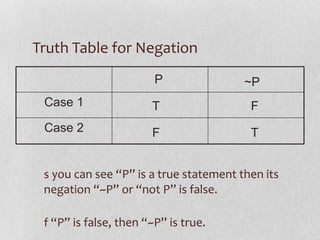
Truth Table for Negation As you can see “P” is a true statement then its negation “~P” or “not P” is false.  If “P” is false, then “~P” is true. P T T F F ~P Case 1 Case 2
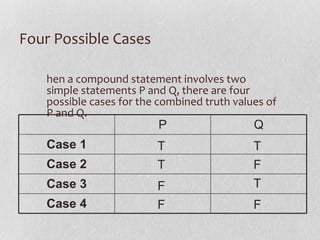
Four Possible Cases When a compound statement involves two simple statements P and Q, there are four possible cases for the combined truth values of P and Q. T T T T F F F F P Q Case 1 Case 2 Case 3 Case 4
When is a Conjunction True? Suppose I tell the class, “You can retake the last exam  and  you can turn in this lab late.” Let P be “You can retake the last exam” and Q be “You can turn in this lab late.” Which truth values for P and Q make it so that I kept my promise,  P  Λ  Q to the class?
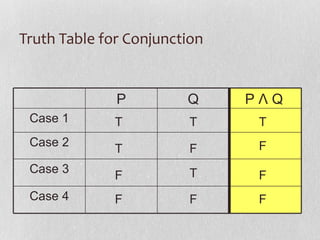
When is a Conjunction True? cont’d. P: “You can retake the last exam.” Q:  “You can turn this lab in late.” There are four possibilities. 1.  P  true  and Q  true , then P  Λ  Q is  true . 2.  P  true  and Q  false , then P  Λ  Q is  false . 3.  P  false  and Q  true , then P  Λ  Q is  false . 4.  P  false  and Q  false , then P  Λ  Q is  false .
Truth Table for Conjunction T T F F T F T F T F F F P  Λ  Q P Q Case 1 Case 2 Case 3 Case 4
3.2 Question 1  What is the truth value of the statement, “Caracas is in Venezuela AND Bogota is in Italy”? 1.  True 2.  False
When is Disjunction True? Suppose I tell the class that for this unit you will receive full credit if “ You do the homework quiz  or  you do the lab .” Let P be the statement “ You do the homework quiz ,” and let Q be the statement “ You do the lab .” In this case a “truth” is equal to receiving full credit
When is Disjunction True? cont’d. P:  “You do the homework quiz.”  Q: “You do the lab.” There are four possibilities: 1.  P  true  and Q  true , then  P  V  Q is  true . 2.  P  true  and Q  false , then  P  V  Q is  true . 3.  P  false  and Q  true , then  P  V  Q is  true . 4.  P  false  and Q  false , then  P  V  Q is  false .
Truth Table for Disjunction T T F F T F T F T T T F P  V  Q P Q Case 1 Case 2 Case 3 Case 4
3.2 Question 2 What is the truth value of the statement, “Caracas is in Venezuela  or  Bogota is in Italy”? 1.  True 2.  False
Truth Table Summary You can remember the truth tables for ~  (not) , Λ   (and) , and,  V (or)  by remembering the following: ~(not)  - Truth value is always the opposite Λ (and) - Always false, except when both are true V (or)  - Always true, except when both are false
Making a Truth Table Example Let’s look at making truth tables for a statement involving only  ONE  Λ   or   V   of simple statements P and Q and possibly negated simple statements ~P and ~Q. For example, let’s make a truth table for the statement ~P V Q
Truth Table for ~P V Q  T T F F T F T F P ~P Q Q Opposite of Column 1 F F T T Same as Column 2 T F T F T F T T Final Answer column V
Another Example: P  Λ   ~Q T T F F T F T F P P Q ~Q Same as Column 1 T T F F Opposite of Column 2 F T F T F T F F Final Answer column Λ
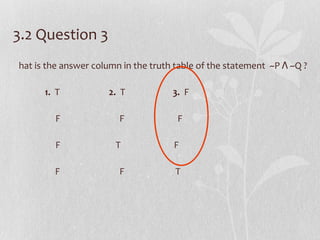
3.2 Question 3 What is the answer column in the truth table of the statement  ~P  Λ  ~Q ? 1.  T   2.  T   3.  F   F   F  F   F  T  F F  F  T
~P  Λ   ~Q  Stop Day 1 T T F F T F T F P ~P Q ~Q Opposite of   Column 1 F F T T Opposite of Column 2 F T F T F F F T Final Answer column Λ
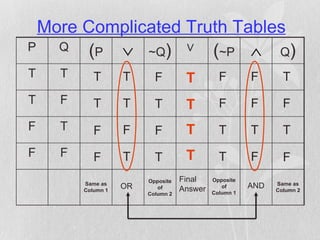
More Complicated Truth Tables Now suppose we want to make a truth table for a more complicated statement,  (P  V ~Q)  V  (~P Λ Q) We set the truth table up as before. Our final answer will go under the most dominant connective not in parentheses ( the one in the middle )
More Complicated Truth Tables Final  Answer T T F F Opposite of   Column 1 Opposite of   Column 2 Same as   Column 2 Same as   Column 1 F T F T OR T T F T F F T T T F T F AND F F T F T T T T
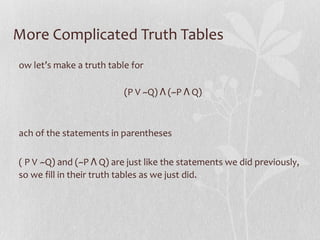
More Complicated Truth Tables Now let’s make a truth table for  (P V ~Q)  Λ  (~P  Λ  Q) Each of the statements in parentheses ( P V   ~Q) and (~P  Λ  Q) are just like the statements we did previously, so we fill in their truth tables as we just did.
More Complicated Truth Tables Final  Answer T T F F Opposite of   Column 1 Opposite of   Column 2 Same as   Column 2 Same as   Column 1 F T F T OR T T F T F F T T T F T F AND F F T F F F F F P Q ( P ~Q ) ( ~P Q ) T T T F F T F F
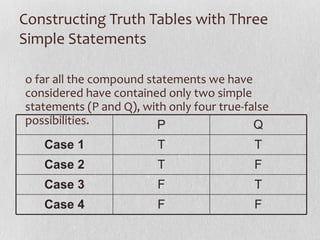
Constructing Truth Tables with Three Simple Statements So far all the compound statements we have considered have contained only two simple statements (P and Q), with only four true-false possibilities. P Q Case 1 T T Case 2 T F Case 3 F T Case 4 F F
Constructing Truth Tables with Three Simple Statements cont’d. When a compound statement consists of three simple statements (P, Q, and R), there are now eight possible true-false combinations.
Constructing Truth Tables with Three Simple Statements cont’d. P Q R Case 1 T T T Case 2 T T F Case 3 T F T Case 4 T F F Case 5 F T T Case 6 F T F Case 7 F F T Case 8 F F F
A Three Statement Example Lets construct a truth table for the statement (P V Q)  Λ  ~R using the same techniques as before.  Remember, there are not more possible combinations because we added a third statement
A Three Statement Example T T T T F F F F T T F F T T F F F T F T F T F T T T T T T T F F F T F T F T F F P Q R (P Q) ~R T T T T T F T F T T F F F T T F T F F F T F F F Final Answer
Practice Determine the Truth Value for the statement IF: P is true, Q is false, and R is true (~ P V ~ Q)  Λ  ( ~R V ~ P)
Practice Translate into symbols.  Then construct a truth table and indicate under what conditions the compound statement is TRUE. Tanisha owns a convertible and Joan does not own a Volvo.
Practice Construct a Truth Table for the following compound statement: R V(P  Λ  ~ Q)
DeMorgans Law (this guy again?)
More Complicated Truths; Quantifiers Quantifiers- Give an Amount to a statement Examples; All No/None Some Half At least one This makes a Negation (~) more difficult to define Find the Negation of; Some Do All do None do At least one
Negations of Quantifiers Some do All do  None do At least one does None do (All do not) Some do Not (Not all do) Some do (None do not) None do
Examples of Negations with quantifiers Some girls play soccer All boys are immature No students read books At least one person likes anchovies No Girls play soccer Not all boys are immature (some are not immature) Some students read books No one likes anchovies

Truth tables

  • 1.
    College Math SECTION3.2: TRUTH TABLES FOR NEGATION, CONJUNCTION, AND DISJUNCTION
  • 2.
    Truth Tables A truth table is used to determine when a compound statement is true or false. They are used to break a complicated compound statement into simple, easier to understand parts.
  • 3.
    Truth Table forNegation As you can see “P” is a true statement then its negation “~P” or “not P” is false. If “P” is false, then “~P” is true. P T T F F ~P Case 1 Case 2
  • 4.
    Four Possible CasesWhen a compound statement involves two simple statements P and Q, there are four possible cases for the combined truth values of P and Q. T T T T F F F F P Q Case 1 Case 2 Case 3 Case 4
  • 5.
    When is aConjunction True? Suppose I tell the class, “You can retake the last exam and you can turn in this lab late.” Let P be “You can retake the last exam” and Q be “You can turn in this lab late.” Which truth values for P and Q make it so that I kept my promise, P Λ Q to the class?
  • 6.
    When is aConjunction True? cont’d. P: “You can retake the last exam.” Q: “You can turn this lab in late.” There are four possibilities. 1. P true and Q true , then P Λ Q is true . 2. P true and Q false , then P Λ Q is false . 3. P false and Q true , then P Λ Q is false . 4. P false and Q false , then P Λ Q is false .
  • 7.
    Truth Table forConjunction T T F F T F T F T F F F P Λ Q P Q Case 1 Case 2 Case 3 Case 4
  • 8.
    3.2 Question 1 What is the truth value of the statement, “Caracas is in Venezuela AND Bogota is in Italy”? 1. True 2. False
  • 9.
    When is DisjunctionTrue? Suppose I tell the class that for this unit you will receive full credit if “ You do the homework quiz or you do the lab .” Let P be the statement “ You do the homework quiz ,” and let Q be the statement “ You do the lab .” In this case a “truth” is equal to receiving full credit
  • 10.
    When is DisjunctionTrue? cont’d. P: “You do the homework quiz.” Q: “You do the lab.” There are four possibilities: 1. P true and Q true , then P V Q is true . 2. P true and Q false , then P V Q is true . 3. P false and Q true , then P V Q is true . 4. P false and Q false , then P V Q is false .
  • 11.
    Truth Table forDisjunction T T F F T F T F T T T F P V Q P Q Case 1 Case 2 Case 3 Case 4
  • 12.
    3.2 Question 2What is the truth value of the statement, “Caracas is in Venezuela or Bogota is in Italy”? 1. True 2. False
  • 13.
    Truth Table SummaryYou can remember the truth tables for ~ (not) , Λ (and) , and, V (or) by remembering the following: ~(not) - Truth value is always the opposite Λ (and) - Always false, except when both are true V (or) - Always true, except when both are false
  • 14.
    Making a TruthTable Example Let’s look at making truth tables for a statement involving only ONE Λ or V of simple statements P and Q and possibly negated simple statements ~P and ~Q. For example, let’s make a truth table for the statement ~P V Q
  • 15.
    Truth Table for~P V Q T T F F T F T F P ~P Q Q Opposite of Column 1 F F T T Same as Column 2 T F T F T F T T Final Answer column V
  • 16.
    Another Example: P Λ ~Q T T F F T F T F P P Q ~Q Same as Column 1 T T F F Opposite of Column 2 F T F T F T F F Final Answer column Λ
  • 17.
    3.2 Question 3What is the answer column in the truth table of the statement ~P Λ ~Q ? 1. T 2. T 3. F F F F F T F F F T
  • 18.
    ~P Λ ~Q Stop Day 1 T T F F T F T F P ~P Q ~Q Opposite of Column 1 F F T T Opposite of Column 2 F T F T F F F T Final Answer column Λ
  • 19.
    More Complicated TruthTables Now suppose we want to make a truth table for a more complicated statement, (P V ~Q) V (~P Λ Q) We set the truth table up as before. Our final answer will go under the most dominant connective not in parentheses ( the one in the middle )
  • 20.
    More Complicated TruthTables Final Answer T T F F Opposite of Column 1 Opposite of Column 2 Same as Column 2 Same as Column 1 F T F T OR T T F T F F T T T F T F AND F F T F T T T T
  • 21.
    More Complicated TruthTables Now let’s make a truth table for (P V ~Q) Λ (~P Λ Q) Each of the statements in parentheses ( P V ~Q) and (~P Λ Q) are just like the statements we did previously, so we fill in their truth tables as we just did.
  • 22.
    More Complicated TruthTables Final Answer T T F F Opposite of Column 1 Opposite of Column 2 Same as Column 2 Same as Column 1 F T F T OR T T F T F F T T T F T F AND F F T F F F F F P Q ( P ~Q ) ( ~P Q ) T T T F F T F F
  • 23.
    Constructing Truth Tableswith Three Simple Statements So far all the compound statements we have considered have contained only two simple statements (P and Q), with only four true-false possibilities. P Q Case 1 T T Case 2 T F Case 3 F T Case 4 F F
  • 24.
    Constructing Truth Tableswith Three Simple Statements cont’d. When a compound statement consists of three simple statements (P, Q, and R), there are now eight possible true-false combinations.
  • 25.
    Constructing Truth Tableswith Three Simple Statements cont’d. P Q R Case 1 T T T Case 2 T T F Case 3 T F T Case 4 T F F Case 5 F T T Case 6 F T F Case 7 F F T Case 8 F F F
  • 26.
    A Three StatementExample Lets construct a truth table for the statement (P V Q) Λ ~R using the same techniques as before. Remember, there are not more possible combinations because we added a third statement
  • 27.
    A Three StatementExample T T T T F F F F T T F F T T F F F T F T F T F T T T T T T T F F F T F T F T F F P Q R (P Q) ~R T T T T T F T F T T F F F T T F T F F F T F F F Final Answer
  • 28.
    Practice Determine theTruth Value for the statement IF: P is true, Q is false, and R is true (~ P V ~ Q) Λ ( ~R V ~ P)
  • 29.
    Practice Translate intosymbols. Then construct a truth table and indicate under what conditions the compound statement is TRUE. Tanisha owns a convertible and Joan does not own a Volvo.
  • 30.
    Practice Construct aTruth Table for the following compound statement: R V(P Λ ~ Q)
  • 31.
  • 32.
    More Complicated Truths;Quantifiers Quantifiers- Give an Amount to a statement Examples; All No/None Some Half At least one This makes a Negation (~) more difficult to define Find the Negation of; Some Do All do None do At least one
  • 33.
    Negations of QuantifiersSome do All do None do At least one does None do (All do not) Some do Not (Not all do) Some do (None do not) None do
  • 34.
    Examples of Negationswith quantifiers Some girls play soccer All boys are immature No students read books At least one person likes anchovies No Girls play soccer Not all boys are immature (some are not immature) Some students read books No one likes anchovies