Logic
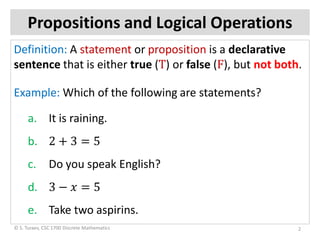
Propositions and Logical Operations
Definition: A statement or proposition is a declarative
sentence that is either true (T) or false (F), but not both.
Example: Which of the following are statements?
a. It is raining.
b. 2 + 3 = 5
c. Do you speak English?
d. 3 − 𝑥𝑥 = 5
e. Take two aspirins.
© S. Turaev, CSC 1700 Discrete Mathematics 2
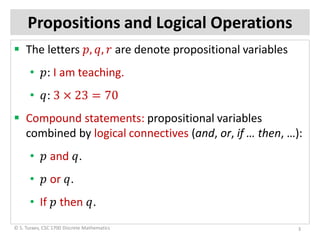
Propositions and Logical Operations
 The letters 𝑝𝑝, 𝑞𝑞, 𝑟𝑟 are denote propositional variables
• 𝑝𝑝: I am teaching.
• 𝑞𝑞: 3 × 23 = 70
 Compound statements: propositional variables
combined by logical connectives (and, or, if … then, …):
• 𝑝𝑝 and 𝑞𝑞.
• 𝑝𝑝 or 𝑞𝑞.
• If 𝑝𝑝 then 𝑞𝑞.
3© S. Turaev, CSC 1700 Discrete Mathematics
Propositions and Logical Operations
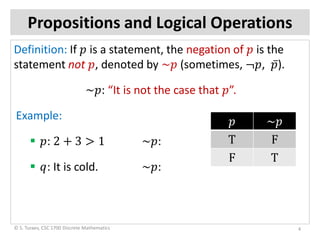
Definition: If 𝑝𝑝 is a statement, the negation of 𝑝𝑝 is the
statement not 𝑝𝑝, denoted by ~𝑝𝑝 (sometimes, ¬𝑝𝑝, ̅𝑝𝑝).
~𝑝𝑝: “It is not the case that 𝑝𝑝”.
Example:
 𝑝𝑝: 2 + 3 > 1 ~𝑝𝑝:
 𝑞𝑞: It is cold. ~𝑝𝑝:
4© S. Turaev, CSC 1700 Discrete Mathematics
𝑝𝑝 ~𝑝𝑝
T F
F T
Propositions and Logical Operations
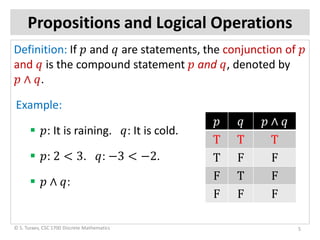
Definition: If 𝑝𝑝 and 𝑞𝑞 are statements, the conjunction of 𝑝𝑝
and 𝑞𝑞 is the compound statement 𝑝𝑝 and 𝑞𝑞, denoted by
𝑝𝑝 ∧ 𝑞𝑞.
Example:
 𝑝𝑝: It is raining. 𝑞𝑞: It is cold.
 𝑝𝑝: 2 < 3. 𝑞𝑞: −3 < −2.
 𝑝𝑝 ∧ 𝑞𝑞:
5© S. Turaev, CSC 1700 Discrete Mathematics
𝑝𝑝 𝑞𝑞 𝑝𝑝 ∧ 𝑞𝑞
T T T
T F F
F T F
F F F
Propositions and Logical Operations
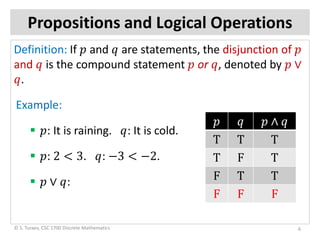
Definition: If 𝑝𝑝 and 𝑞𝑞 are statements, the disjunction of 𝑝𝑝
and 𝑞𝑞 is the compound statement 𝑝𝑝 or 𝑞𝑞, denoted by 𝑝𝑝 ∨
𝑞𝑞.
Example:
 𝑝𝑝: It is raining. 𝑞𝑞: It is cold.
 𝑝𝑝: 2 < 3. 𝑞𝑞: −3 < −2.
 𝑝𝑝 ∨ 𝑞𝑞:
6© S. Turaev, CSC 1700 Discrete Mathematics
𝑝𝑝 𝑞𝑞 𝑝𝑝 ∧ 𝑞𝑞
T T T
T F T
F T T
F F F
Propositions and Logical Operations
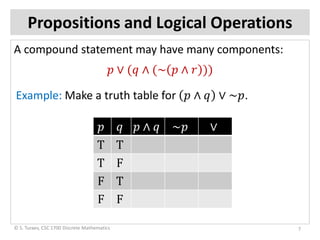
A compound statement may have many components:
𝑝𝑝 ∨ (𝑞𝑞 ∧ (~ 𝑝𝑝 ∧ 𝑟𝑟 ))
Example: Make a truth table for 𝑝𝑝 ∧ 𝑞𝑞 ∨ ~𝑝𝑝.
7© S. Turaev, CSC 1700 Discrete Mathematics
𝑝𝑝 𝑞𝑞 𝑝𝑝 ∧ 𝑞𝑞 ~𝑝𝑝 ∨
T T
T F
F T
F F
Propositions and Logical Operations
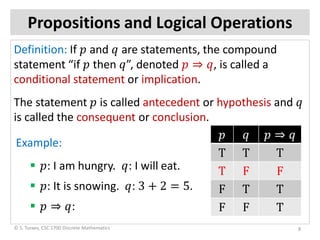
Definition: If 𝑝𝑝 and 𝑞𝑞 are statements, the compound
statement “if 𝑝𝑝 then 𝑞𝑞”, denoted 𝑝𝑝 ⇒ 𝑞𝑞, is called a
conditional statement or implication.
The statement 𝑝𝑝 is called antecedent or hypothesis and 𝑞𝑞
is called the consequent or conclusion.
Example:
 𝑝𝑝: I am hungry. 𝑞𝑞: I will eat.
 𝑝𝑝: It is snowing. 𝑞𝑞: 3 + 2 = 5.
 𝑝𝑝 ⇒ 𝑞𝑞:
8© S. Turaev, CSC 1700 Discrete Mathematics
𝑝𝑝 𝑞𝑞 𝑝𝑝 ⇒ 𝑞𝑞
T T T
T F F
F T T
F F T
Propositions and Logical Operations
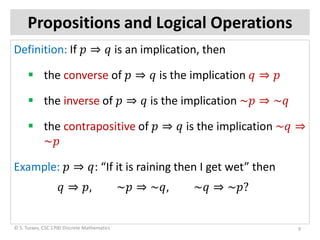
Definition: If 𝑝𝑝 ⇒ 𝑞𝑞 is an implication, then
 the converse of 𝑝𝑝 ⇒ 𝑞𝑞 is the implication 𝑞𝑞 ⇒ 𝑝𝑝
 the inverse of 𝑝𝑝 ⇒ 𝑞𝑞 is the implication ~𝑝𝑝 ⇒ ~𝑞𝑞
 the contrapositive of 𝑝𝑝 ⇒ 𝑞𝑞 is the implication ~𝑞𝑞 ⇒
~𝑝𝑝
Example: 𝑝𝑝 ⇒ 𝑞𝑞: “If it is raining then I get wet” then
𝑞𝑞 ⇒ 𝑝𝑝, ~𝑝𝑝 ⇒ ~𝑞𝑞, ~𝑞𝑞 ⇒ ~𝑝𝑝?
9© S. Turaev, CSC 1700 Discrete Mathematics
Propositions and Logical Operations
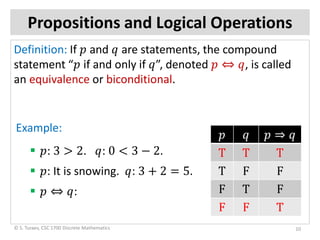
Definition: If 𝑝𝑝 and 𝑞𝑞 are statements, the compound
statement “𝑝𝑝 if and only if 𝑞𝑞”, denoted 𝑝𝑝 ⇔ 𝑞𝑞, is called
an equivalence or biconditional.
Example:
 𝑝𝑝: 3 > 2. 𝑞𝑞: 0 < 3 − 2.
 𝑝𝑝: It is snowing. 𝑞𝑞: 3 + 2 = 5.
 𝑝𝑝 ⇔ 𝑞𝑞:
10© S. Turaev, CSC 1700 Discrete Mathematics
𝑝𝑝 𝑞𝑞 𝑝𝑝 ⇒ 𝑞𝑞
T T T
T F F
F T F
F F T
Propositions and Logical Operations
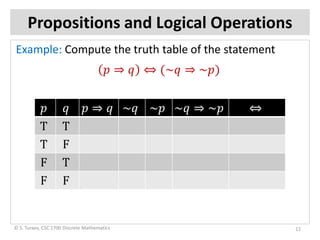
Example: Compute the truth table of the statement
𝑝𝑝 ⇒ 𝑞𝑞 ⇔ (~𝑞𝑞 ⇒ ~𝑝𝑝)
11© S. Turaev, CSC 1700 Discrete Mathematics
𝑝𝑝 𝑞𝑞 𝑝𝑝 ⇒ 𝑞𝑞 ~𝑞𝑞 ~𝑝𝑝 ~𝑞𝑞 ⇒ ~𝑝𝑝 ⇔
T T
T F
F T
F F
Propositions and Logical Operations
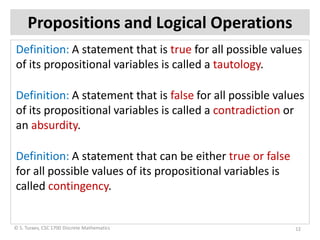
Definition: A statement that is true for all possible values
of its propositional variables is called a tautology.
Definition: A statement that is false for all possible values
of its propositional variables is called a contradiction or
an absurdity.
Definition: A statement that can be either true or false
for all possible values of its propositional variables is
called contingency.
12© S. Turaev, CSC 1700 Discrete Mathematics
Propositions and Logical Operations
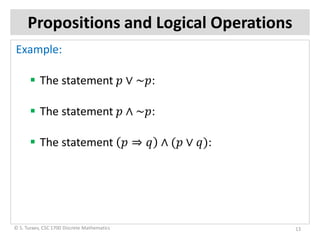
Example:
 The statement 𝑝𝑝 ∨ ~𝑝𝑝:
 The statement 𝑝𝑝 ∧ ~𝑝𝑝:
 The statement 𝑝𝑝 ⇒ 𝑞𝑞 ∧ (𝑝𝑝 ∨ 𝑞𝑞):
13© S. Turaev, CSC 1700 Discrete Mathematics
Propositions and Logical Operations
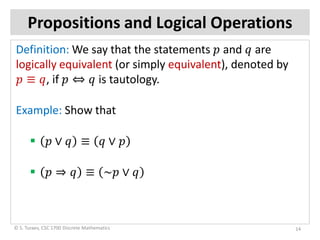
Definition: We say that the statements 𝑝𝑝 and 𝑞𝑞 are
logically equivalent (or simply equivalent), denoted by
𝑝𝑝 ≡ 𝑞𝑞, if 𝑝𝑝 ⇔ 𝑞𝑞 is tautology.
Example: Show that
 𝑝𝑝 ∨ 𝑞𝑞 ≡ 𝑞𝑞 ∨ 𝑝𝑝
 𝑝𝑝 ⇒ 𝑞𝑞 ≡ ~𝑝𝑝 ∨ 𝑞𝑞
14© S. Turaev, CSC 1700 Discrete Mathematics
Propositions and Logical Operations
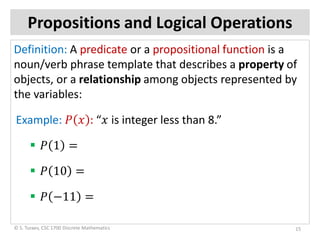
Definition: A predicate or a propositional function is a
noun/verb phrase template that describes a property of
objects, or a relationship among objects represented by
the variables:
Example: 𝑃𝑃 𝑥𝑥 : “𝑥𝑥 is integer less than 8.”
 𝑃𝑃 1 =
 𝑃𝑃 10 =
 𝑃𝑃 −11 =
15© S. Turaev, CSC 1700 Discrete Mathematics
Propositions and Logical Operations
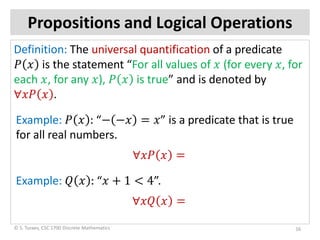
Definition: The universal quantification of a predicate
𝑃𝑃 𝑥𝑥 is the statement “For all values of 𝑥𝑥 (for every 𝑥𝑥, for
each 𝑥𝑥, for any 𝑥𝑥), 𝑃𝑃 𝑥𝑥 is true” and is denoted by
∀𝑥𝑥𝑥𝑥 𝑥𝑥 .
Example: 𝑃𝑃 𝑥𝑥 : “− −𝑥𝑥 = 𝑥𝑥” is a predicate that is true
for all real numbers.
∀𝑥𝑥𝑥𝑥 𝑥𝑥 =
Example: 𝑄𝑄 𝑥𝑥 : “𝑥𝑥 + 1 < 4”.
∀𝑥𝑥𝑥𝑥 𝑥𝑥 =
16© S. Turaev, CSC 1700 Discrete Mathematics
Propositions and Logical Operations
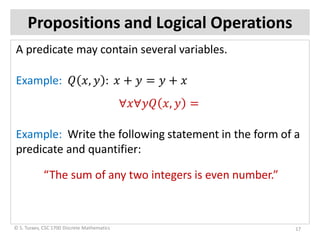
A predicate may contain several variables.
Example: 𝑄𝑄 𝑥𝑥, 𝑦𝑦 : 𝑥𝑥 + 𝑦𝑦 = 𝑦𝑦 + 𝑥𝑥
∀𝑥𝑥∀𝑦𝑦𝑦𝑦 𝑥𝑥, 𝑦𝑦 =
Example: Write the following statement in the form of a
predicate and quantifier:
“The sum of any two integers is even number.”
17© S. Turaev, CSC 1700 Discrete Mathematics
Propositions and Logical Operations
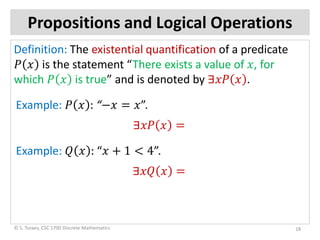
Definition: The existential quantification of a predicate
𝑃𝑃 𝑥𝑥 is the statement “There exists a value of 𝑥𝑥, for
which 𝑃𝑃 𝑥𝑥 is true” and is denoted by ∃𝑥𝑥𝑥𝑥 𝑥𝑥 .
Example: 𝑃𝑃 𝑥𝑥 : “−𝑥𝑥 = 𝑥𝑥”.
∃𝑥𝑥𝑥𝑥 𝑥𝑥 =
Example: 𝑄𝑄 𝑥𝑥 : “𝑥𝑥 + 1 < 4”.
∃𝑥𝑥𝑥𝑥 𝑥𝑥 =
18© S. Turaev, CSC 1700 Discrete Mathematics
Algebraic Properties
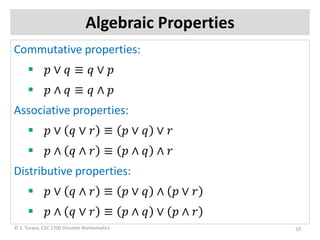
Commutative properties:
 𝑝𝑝 ∨ 𝑞𝑞 ≡ 𝑞𝑞 ∨ 𝑝𝑝
 𝑝𝑝 ∧ 𝑞𝑞 ≡ 𝑞𝑞 ∧ 𝑝𝑝
Associative properties:
 𝑝𝑝 ∨ 𝑞𝑞 ∨ 𝑟𝑟 ≡ 𝑝𝑝 ∨ 𝑞𝑞 ∨ 𝑟𝑟
 𝑝𝑝 ∧ 𝑞𝑞 ∧ 𝑟𝑟 ≡ 𝑝𝑝 ∧ 𝑞𝑞 ∧ 𝑟𝑟
Distributive properties:
 𝑝𝑝 ∨ 𝑞𝑞 ∧ 𝑟𝑟 ≡ 𝑝𝑝 ∨ 𝑞𝑞 ∧ 𝑝𝑝 ∨ 𝑟𝑟
 𝑝𝑝 ∧ 𝑞𝑞 ∨ 𝑟𝑟 ≡ 𝑝𝑝 ∧ 𝑞𝑞 ∨ 𝑝𝑝 ∧ 𝑟𝑟
19© S. Turaev, CSC 1700 Discrete Mathematics
Algebraic Properties
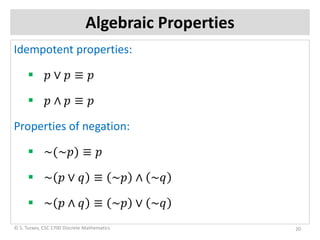
Idempotent properties:
 𝑝𝑝 ∨ 𝑝𝑝 ≡ 𝑝𝑝
 𝑝𝑝 ∧ 𝑝𝑝 ≡ 𝑝𝑝
Properties of negation:
 ~(~𝑝𝑝) ≡ 𝑝𝑝
 ~ 𝑝𝑝 ∨ 𝑞𝑞 ≡ ~𝑝𝑝 ∧ ~𝑞𝑞
 ~ 𝑝𝑝 ∧ 𝑞𝑞 ≡ ~𝑝𝑝 ∨ ~𝑞𝑞
20© S. Turaev, CSC 1700 Discrete Mathematics
Algebraic Properties
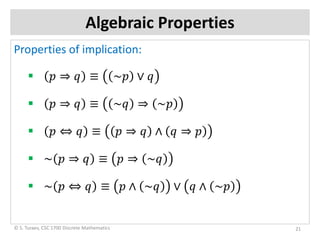
Properties of implication:
 𝑝𝑝 ⇒ 𝑞𝑞 ≡ ~𝑝𝑝 ∨ 𝑞𝑞
 𝑝𝑝 ⇒ 𝑞𝑞 ≡ ~𝑞𝑞 ⇒ ~𝑝𝑝
 𝑝𝑝 ⇔ 𝑞𝑞 ≡ 𝑝𝑝 ⇒ 𝑞𝑞 ∧ 𝑞𝑞 ⇒ 𝑝𝑝
 ~ 𝑝𝑝 ⇒ 𝑞𝑞 ≡ 𝑝𝑝 ⇒ ~𝑞𝑞
 ~ 𝑝𝑝 ⇔ 𝑞𝑞 ≡ 𝑝𝑝 ∧ ~𝑞𝑞 ∨ 𝑞𝑞 ∧ ~𝑝𝑝
21© S. Turaev, CSC 1700 Discrete Mathematics
Algebraic Properties
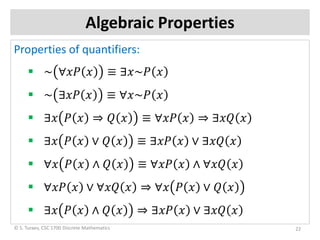
Properties of quantifiers:
 ~ ∀𝑥𝑥𝑥𝑥 𝑥𝑥 ≡ ∃𝑥𝑥~𝑃𝑃 𝑥𝑥
 ~ ∃𝑥𝑥𝑥𝑥 𝑥𝑥 ≡ ∀𝑥𝑥~𝑃𝑃 𝑥𝑥
 ∃𝑥𝑥 𝑃𝑃 𝑥𝑥 ⇒ 𝑄𝑄 𝑥𝑥 ≡ ∀𝑥𝑥𝑥𝑥 𝑥𝑥 ⇒ ∃𝑥𝑥𝑥𝑥 𝑥𝑥
 ∃𝑥𝑥 𝑃𝑃 𝑥𝑥 ∨ 𝑄𝑄 𝑥𝑥 ≡ ∃𝑥𝑥𝑥𝑥 𝑥𝑥 ∨ ∃𝑥𝑥𝑥𝑥 𝑥𝑥
 ∀𝑥𝑥 𝑃𝑃 𝑥𝑥 ∧ 𝑄𝑄 𝑥𝑥 ≡ ∀𝑥𝑥𝑥𝑥 𝑥𝑥 ∧ ∀𝑥𝑥𝑥𝑥 𝑥𝑥
 ∀𝑥𝑥𝑥𝑥 𝑥𝑥 ∨ ∀𝑥𝑥𝑥𝑥 𝑥𝑥 ⇒ ∀𝑥𝑥 𝑃𝑃 𝑥𝑥 ∨ 𝑄𝑄 𝑥𝑥
 ∃𝑥𝑥 𝑃𝑃 𝑥𝑥 ∧ 𝑄𝑄 𝑥𝑥 ⇒ ∃𝑥𝑥𝑥𝑥 𝑥𝑥 ∨ ∃𝑥𝑥𝑥𝑥 𝑥𝑥
22© S. Turaev, CSC 1700 Discrete Mathematics
Algebraic Properties
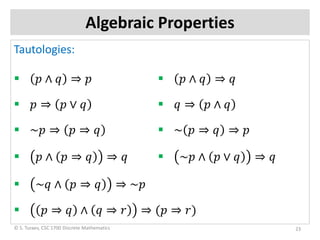
Tautologies:
 𝑝𝑝 ⇒ 𝑞𝑞 ∧ 𝑞𝑞 ⇒ 𝑟𝑟 ⇒ (𝑝𝑝 ⇒ 𝑟𝑟)
23© S. Turaev, CSC 1700 Discrete Mathematics
 𝑝𝑝 ∧ 𝑞𝑞 ⇒ 𝑝𝑝
 𝑝𝑝 ⇒ 𝑝𝑝 ∨ 𝑞𝑞
 ~𝑝𝑝 ⇒ 𝑝𝑝 ⇒ 𝑞𝑞
 𝑝𝑝 ∧ 𝑝𝑝 ⇒ 𝑞𝑞 ⇒ 𝑞𝑞
 ~𝑞𝑞 ∧ 𝑝𝑝 ⇒ 𝑞𝑞 ⇒ ~𝑝𝑝
 𝑝𝑝 ∧ 𝑞𝑞 ⇒ 𝑞𝑞
 𝑞𝑞 ⇒ 𝑝𝑝 ∧ 𝑞𝑞
 ~ 𝑝𝑝 ⇒ 𝑞𝑞 ⇒ 𝑝𝑝
 ~𝑝𝑝 ∧ 𝑝𝑝 ∨ 𝑞𝑞 ⇒ 𝑞𝑞

Logic (slides)

  • 1.
  • 2.
    Propositions and LogicalOperations Definition: A statement or proposition is a declarative sentence that is either true (T) or false (F), but not both. Example: Which of the following are statements? a. It is raining. b. 2 + 3 = 5 c. Do you speak English? d. 3 − 𝑥𝑥 = 5 e. Take two aspirins. © S. Turaev, CSC 1700 Discrete Mathematics 2
  • 3.
    Propositions and LogicalOperations  The letters 𝑝𝑝, 𝑞𝑞, 𝑟𝑟 are denote propositional variables • 𝑝𝑝: I am teaching. • 𝑞𝑞: 3 × 23 = 70  Compound statements: propositional variables combined by logical connectives (and, or, if … then, …): • 𝑝𝑝 and 𝑞𝑞. • 𝑝𝑝 or 𝑞𝑞. • If 𝑝𝑝 then 𝑞𝑞. 3© S. Turaev, CSC 1700 Discrete Mathematics
  • 4.
    Propositions and LogicalOperations Definition: If 𝑝𝑝 is a statement, the negation of 𝑝𝑝 is the statement not 𝑝𝑝, denoted by ~𝑝𝑝 (sometimes, ¬𝑝𝑝, ̅𝑝𝑝). ~𝑝𝑝: “It is not the case that 𝑝𝑝”. Example:  𝑝𝑝: 2 + 3 > 1 ~𝑝𝑝:  𝑞𝑞: It is cold. ~𝑝𝑝: 4© S. Turaev, CSC 1700 Discrete Mathematics 𝑝𝑝 ~𝑝𝑝 T F F T
  • 5.
    Propositions and LogicalOperations Definition: If 𝑝𝑝 and 𝑞𝑞 are statements, the conjunction of 𝑝𝑝 and 𝑞𝑞 is the compound statement 𝑝𝑝 and 𝑞𝑞, denoted by 𝑝𝑝 ∧ 𝑞𝑞. Example:  𝑝𝑝: It is raining. 𝑞𝑞: It is cold.  𝑝𝑝: 2 < 3. 𝑞𝑞: −3 < −2.  𝑝𝑝 ∧ 𝑞𝑞: 5© S. Turaev, CSC 1700 Discrete Mathematics 𝑝𝑝 𝑞𝑞 𝑝𝑝 ∧ 𝑞𝑞 T T T T F F F T F F F F
  • 6.
    Propositions and LogicalOperations Definition: If 𝑝𝑝 and 𝑞𝑞 are statements, the disjunction of 𝑝𝑝 and 𝑞𝑞 is the compound statement 𝑝𝑝 or 𝑞𝑞, denoted by 𝑝𝑝 ∨ 𝑞𝑞. Example:  𝑝𝑝: It is raining. 𝑞𝑞: It is cold.  𝑝𝑝: 2 < 3. 𝑞𝑞: −3 < −2.  𝑝𝑝 ∨ 𝑞𝑞: 6© S. Turaev, CSC 1700 Discrete Mathematics 𝑝𝑝 𝑞𝑞 𝑝𝑝 ∧ 𝑞𝑞 T T T T F T F T T F F F
  • 7.
    Propositions and LogicalOperations A compound statement may have many components: 𝑝𝑝 ∨ (𝑞𝑞 ∧ (~ 𝑝𝑝 ∧ 𝑟𝑟 )) Example: Make a truth table for 𝑝𝑝 ∧ 𝑞𝑞 ∨ ~𝑝𝑝. 7© S. Turaev, CSC 1700 Discrete Mathematics 𝑝𝑝 𝑞𝑞 𝑝𝑝 ∧ 𝑞𝑞 ~𝑝𝑝 ∨ T T T F F T F F
  • 8.
    Propositions and LogicalOperations Definition: If 𝑝𝑝 and 𝑞𝑞 are statements, the compound statement “if 𝑝𝑝 then 𝑞𝑞”, denoted 𝑝𝑝 ⇒ 𝑞𝑞, is called a conditional statement or implication. The statement 𝑝𝑝 is called antecedent or hypothesis and 𝑞𝑞 is called the consequent or conclusion. Example:  𝑝𝑝: I am hungry. 𝑞𝑞: I will eat.  𝑝𝑝: It is snowing. 𝑞𝑞: 3 + 2 = 5.  𝑝𝑝 ⇒ 𝑞𝑞: 8© S. Turaev, CSC 1700 Discrete Mathematics 𝑝𝑝 𝑞𝑞 𝑝𝑝 ⇒ 𝑞𝑞 T T T T F F F T T F F T
  • 9.
    Propositions and LogicalOperations Definition: If 𝑝𝑝 ⇒ 𝑞𝑞 is an implication, then  the converse of 𝑝𝑝 ⇒ 𝑞𝑞 is the implication 𝑞𝑞 ⇒ 𝑝𝑝  the inverse of 𝑝𝑝 ⇒ 𝑞𝑞 is the implication ~𝑝𝑝 ⇒ ~𝑞𝑞  the contrapositive of 𝑝𝑝 ⇒ 𝑞𝑞 is the implication ~𝑞𝑞 ⇒ ~𝑝𝑝 Example: 𝑝𝑝 ⇒ 𝑞𝑞: “If it is raining then I get wet” then 𝑞𝑞 ⇒ 𝑝𝑝, ~𝑝𝑝 ⇒ ~𝑞𝑞, ~𝑞𝑞 ⇒ ~𝑝𝑝? 9© S. Turaev, CSC 1700 Discrete Mathematics
  • 10.
    Propositions and LogicalOperations Definition: If 𝑝𝑝 and 𝑞𝑞 are statements, the compound statement “𝑝𝑝 if and only if 𝑞𝑞”, denoted 𝑝𝑝 ⇔ 𝑞𝑞, is called an equivalence or biconditional. Example:  𝑝𝑝: 3 > 2. 𝑞𝑞: 0 < 3 − 2.  𝑝𝑝: It is snowing. 𝑞𝑞: 3 + 2 = 5.  𝑝𝑝 ⇔ 𝑞𝑞: 10© S. Turaev, CSC 1700 Discrete Mathematics 𝑝𝑝 𝑞𝑞 𝑝𝑝 ⇒ 𝑞𝑞 T T T T F F F T F F F T
  • 11.
    Propositions and LogicalOperations Example: Compute the truth table of the statement 𝑝𝑝 ⇒ 𝑞𝑞 ⇔ (~𝑞𝑞 ⇒ ~𝑝𝑝) 11© S. Turaev, CSC 1700 Discrete Mathematics 𝑝𝑝 𝑞𝑞 𝑝𝑝 ⇒ 𝑞𝑞 ~𝑞𝑞 ~𝑝𝑝 ~𝑞𝑞 ⇒ ~𝑝𝑝 ⇔ T T T F F T F F
  • 12.
    Propositions and LogicalOperations Definition: A statement that is true for all possible values of its propositional variables is called a tautology. Definition: A statement that is false for all possible values of its propositional variables is called a contradiction or an absurdity. Definition: A statement that can be either true or false for all possible values of its propositional variables is called contingency. 12© S. Turaev, CSC 1700 Discrete Mathematics
  • 13.
    Propositions and LogicalOperations Example:  The statement 𝑝𝑝 ∨ ~𝑝𝑝:  The statement 𝑝𝑝 ∧ ~𝑝𝑝:  The statement 𝑝𝑝 ⇒ 𝑞𝑞 ∧ (𝑝𝑝 ∨ 𝑞𝑞): 13© S. Turaev, CSC 1700 Discrete Mathematics
  • 14.
    Propositions and LogicalOperations Definition: We say that the statements 𝑝𝑝 and 𝑞𝑞 are logically equivalent (or simply equivalent), denoted by 𝑝𝑝 ≡ 𝑞𝑞, if 𝑝𝑝 ⇔ 𝑞𝑞 is tautology. Example: Show that  𝑝𝑝 ∨ 𝑞𝑞 ≡ 𝑞𝑞 ∨ 𝑝𝑝  𝑝𝑝 ⇒ 𝑞𝑞 ≡ ~𝑝𝑝 ∨ 𝑞𝑞 14© S. Turaev, CSC 1700 Discrete Mathematics
  • 15.
    Propositions and LogicalOperations Definition: A predicate or a propositional function is a noun/verb phrase template that describes a property of objects, or a relationship among objects represented by the variables: Example: 𝑃𝑃 𝑥𝑥 : “𝑥𝑥 is integer less than 8.”  𝑃𝑃 1 =  𝑃𝑃 10 =  𝑃𝑃 −11 = 15© S. Turaev, CSC 1700 Discrete Mathematics
  • 16.
    Propositions and LogicalOperations Definition: The universal quantification of a predicate 𝑃𝑃 𝑥𝑥 is the statement “For all values of 𝑥𝑥 (for every 𝑥𝑥, for each 𝑥𝑥, for any 𝑥𝑥), 𝑃𝑃 𝑥𝑥 is true” and is denoted by ∀𝑥𝑥𝑥𝑥 𝑥𝑥 . Example: 𝑃𝑃 𝑥𝑥 : “− −𝑥𝑥 = 𝑥𝑥” is a predicate that is true for all real numbers. ∀𝑥𝑥𝑥𝑥 𝑥𝑥 = Example: 𝑄𝑄 𝑥𝑥 : “𝑥𝑥 + 1 < 4”. ∀𝑥𝑥𝑥𝑥 𝑥𝑥 = 16© S. Turaev, CSC 1700 Discrete Mathematics
  • 17.
    Propositions and LogicalOperations A predicate may contain several variables. Example: 𝑄𝑄 𝑥𝑥, 𝑦𝑦 : 𝑥𝑥 + 𝑦𝑦 = 𝑦𝑦 + 𝑥𝑥 ∀𝑥𝑥∀𝑦𝑦𝑦𝑦 𝑥𝑥, 𝑦𝑦 = Example: Write the following statement in the form of a predicate and quantifier: “The sum of any two integers is even number.” 17© S. Turaev, CSC 1700 Discrete Mathematics
  • 18.
    Propositions and LogicalOperations Definition: The existential quantification of a predicate 𝑃𝑃 𝑥𝑥 is the statement “There exists a value of 𝑥𝑥, for which 𝑃𝑃 𝑥𝑥 is true” and is denoted by ∃𝑥𝑥𝑥𝑥 𝑥𝑥 . Example: 𝑃𝑃 𝑥𝑥 : “−𝑥𝑥 = 𝑥𝑥”. ∃𝑥𝑥𝑥𝑥 𝑥𝑥 = Example: 𝑄𝑄 𝑥𝑥 : “𝑥𝑥 + 1 < 4”. ∃𝑥𝑥𝑥𝑥 𝑥𝑥 = 18© S. Turaev, CSC 1700 Discrete Mathematics
  • 19.
    Algebraic Properties Commutative properties: 𝑝𝑝 ∨ 𝑞𝑞 ≡ 𝑞𝑞 ∨ 𝑝𝑝  𝑝𝑝 ∧ 𝑞𝑞 ≡ 𝑞𝑞 ∧ 𝑝𝑝 Associative properties:  𝑝𝑝 ∨ 𝑞𝑞 ∨ 𝑟𝑟 ≡ 𝑝𝑝 ∨ 𝑞𝑞 ∨ 𝑟𝑟  𝑝𝑝 ∧ 𝑞𝑞 ∧ 𝑟𝑟 ≡ 𝑝𝑝 ∧ 𝑞𝑞 ∧ 𝑟𝑟 Distributive properties:  𝑝𝑝 ∨ 𝑞𝑞 ∧ 𝑟𝑟 ≡ 𝑝𝑝 ∨ 𝑞𝑞 ∧ 𝑝𝑝 ∨ 𝑟𝑟  𝑝𝑝 ∧ 𝑞𝑞 ∨ 𝑟𝑟 ≡ 𝑝𝑝 ∧ 𝑞𝑞 ∨ 𝑝𝑝 ∧ 𝑟𝑟 19© S. Turaev, CSC 1700 Discrete Mathematics
  • 20.
    Algebraic Properties Idempotent properties: 𝑝𝑝 ∨ 𝑝𝑝 ≡ 𝑝𝑝  𝑝𝑝 ∧ 𝑝𝑝 ≡ 𝑝𝑝 Properties of negation:  ~(~𝑝𝑝) ≡ 𝑝𝑝  ~ 𝑝𝑝 ∨ 𝑞𝑞 ≡ ~𝑝𝑝 ∧ ~𝑞𝑞  ~ 𝑝𝑝 ∧ 𝑞𝑞 ≡ ~𝑝𝑝 ∨ ~𝑞𝑞 20© S. Turaev, CSC 1700 Discrete Mathematics
  • 21.
    Algebraic Properties Properties ofimplication:  𝑝𝑝 ⇒ 𝑞𝑞 ≡ ~𝑝𝑝 ∨ 𝑞𝑞  𝑝𝑝 ⇒ 𝑞𝑞 ≡ ~𝑞𝑞 ⇒ ~𝑝𝑝  𝑝𝑝 ⇔ 𝑞𝑞 ≡ 𝑝𝑝 ⇒ 𝑞𝑞 ∧ 𝑞𝑞 ⇒ 𝑝𝑝  ~ 𝑝𝑝 ⇒ 𝑞𝑞 ≡ 𝑝𝑝 ⇒ ~𝑞𝑞  ~ 𝑝𝑝 ⇔ 𝑞𝑞 ≡ 𝑝𝑝 ∧ ~𝑞𝑞 ∨ 𝑞𝑞 ∧ ~𝑝𝑝 21© S. Turaev, CSC 1700 Discrete Mathematics
  • 22.
    Algebraic Properties Properties ofquantifiers:  ~ ∀𝑥𝑥𝑥𝑥 𝑥𝑥 ≡ ∃𝑥𝑥~𝑃𝑃 𝑥𝑥  ~ ∃𝑥𝑥𝑥𝑥 𝑥𝑥 ≡ ∀𝑥𝑥~𝑃𝑃 𝑥𝑥  ∃𝑥𝑥 𝑃𝑃 𝑥𝑥 ⇒ 𝑄𝑄 𝑥𝑥 ≡ ∀𝑥𝑥𝑥𝑥 𝑥𝑥 ⇒ ∃𝑥𝑥𝑥𝑥 𝑥𝑥  ∃𝑥𝑥 𝑃𝑃 𝑥𝑥 ∨ 𝑄𝑄 𝑥𝑥 ≡ ∃𝑥𝑥𝑥𝑥 𝑥𝑥 ∨ ∃𝑥𝑥𝑥𝑥 𝑥𝑥  ∀𝑥𝑥 𝑃𝑃 𝑥𝑥 ∧ 𝑄𝑄 𝑥𝑥 ≡ ∀𝑥𝑥𝑥𝑥 𝑥𝑥 ∧ ∀𝑥𝑥𝑥𝑥 𝑥𝑥  ∀𝑥𝑥𝑥𝑥 𝑥𝑥 ∨ ∀𝑥𝑥𝑥𝑥 𝑥𝑥 ⇒ ∀𝑥𝑥 𝑃𝑃 𝑥𝑥 ∨ 𝑄𝑄 𝑥𝑥  ∃𝑥𝑥 𝑃𝑃 𝑥𝑥 ∧ 𝑄𝑄 𝑥𝑥 ⇒ ∃𝑥𝑥𝑥𝑥 𝑥𝑥 ∨ ∃𝑥𝑥𝑥𝑥 𝑥𝑥 22© S. Turaev, CSC 1700 Discrete Mathematics
  • 23.
    Algebraic Properties Tautologies:  𝑝𝑝⇒ 𝑞𝑞 ∧ 𝑞𝑞 ⇒ 𝑟𝑟 ⇒ (𝑝𝑝 ⇒ 𝑟𝑟) 23© S. Turaev, CSC 1700 Discrete Mathematics  𝑝𝑝 ∧ 𝑞𝑞 ⇒ 𝑝𝑝  𝑝𝑝 ⇒ 𝑝𝑝 ∨ 𝑞𝑞  ~𝑝𝑝 ⇒ 𝑝𝑝 ⇒ 𝑞𝑞  𝑝𝑝 ∧ 𝑝𝑝 ⇒ 𝑞𝑞 ⇒ 𝑞𝑞  ~𝑞𝑞 ∧ 𝑝𝑝 ⇒ 𝑞𝑞 ⇒ ~𝑝𝑝  𝑝𝑝 ∧ 𝑞𝑞 ⇒ 𝑞𝑞  𝑞𝑞 ⇒ 𝑝𝑝 ∧ 𝑞𝑞  ~ 𝑝𝑝 ⇒ 𝑞𝑞 ⇒ 𝑝𝑝  ~𝑝𝑝 ∧ 𝑝𝑝 ∨ 𝑞𝑞 ⇒ 𝑞𝑞