INTRODUCTION OF
PROPOSITIONAL LOGICS
Prof. Neeraj Bhargava
Kapil Chauhan
Department of Computer Science
School of Engineering & Systems Sciences
MDS University, Ajmer
Outline
 Syntax vs Semantics.
 Syntax of L
 Semantics of L
 Truth-Table .
Syntax
 Syntax is all about expressions: words and sentences.
Examples of syntactic claims
• ‘Bertrand Russell’ is a proper noun.
• ‘likes logic’ is a verb phrase.
• ‘Bertrand Russell likes logic’ is a sentence.
• Combining a proper noun and a verb phrase in this way makes a sentence
Semantics
 Semantics is all about meanings of expressions.
Examples of semantic claims
• ‘Bertrand Russell’ refers to a British philosopher.
•‘Bertrand Russell’ refers to Bertrand Russell.
•‘likes logic’ expresses a property Russell has.
•‘Bertrand Russell likes logic’ is true.
Syntax: English vs. L1.
 English has many different sorts of expression.
Some expressions of English
(1) Sentences: ‘Bertrand Russell likes logic’, ‘Philosophers like conceptual analysis’,
etc..
(2) Connectives: ‘it is not the case that’, ‘and’, etc..
(3) Noun phrases: ‘Bertrand Russell’, ‘Philosophers’, etc..
(4) Verb phrases: ‘likes logic’, ‘like conceptual analysis’, etc..
(5) Also: nouns, verbs, pronouns, etc., etc., etc..
L1 has just two sorts of basic expression.
Some basic expressions of L1
(1) Sentence letters: e.g. ‘P’, ‘Q’.
(2) Connectives: e.g. ‘¬’, ‘∧’.
Combining sentences and connectives makes new sentences.
 Some complex sentences
‘It is not the case that’ and ‘Bertrand Russell likes logic’ make:
‘It is not the case that Bertrand Russell likes logic’. ‘¬’ and ‘P’ make: ‘¬P’.
‘Bertrand Russell likes logic’ and ‘and’ and ‘Philosophers like conceptual analysis’
make: ‘Bertrand Russell likes logic and philosophers like conceptual analysis’.
‘P’, ‘∧’ and ‘Q’ make: ‘(P ∧ Q)’.
Logic convention: no quotes around L1-expressions.
P, ∧ and Q make: (P ∧ Q).
Connectives
 Here’s the full list of L1-connectives.
Name in English symbol
Conjunction and ∧
disjunction or ∨
negation it is not the case that ¬
arrow if . . . then →
double arrow if and only if ↔
Semantics
 Recall the characterisation of validity from week 1.
Characterisation
An argument is logically valid if and only if there is no interpretation of
subject-specific expressions under which:
(i) the premises are all true, and
(ii) the conclusion is false.
We’ll adapt this characterisation to L1.
Logical expressions: ¬, ∧, ∨,→ and ↔.
Subject specific expressions: P, Q, R, . . .
Interpretation:
Truth-values of complex sentences
 L1-structures only directly specify truth-values for P, Q, R, . . .
 The logical connectives have fixed meanings.
 These determine the truth-values of complex sentences.
 Notation: |φ|A is the truth-value of φ under A.
 Truth-conditions for ¬
 The meaning of ¬ is summarised in its truth table
φ ¬φ
T F
F T
Truth-values of complex sentences
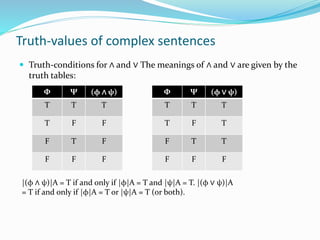
 Truth-conditions for ∧ and ∨ The meanings of ∧ and ∨ are given by the
truth tables:
Φ Ψ (φ ∧ ψ)
T T T
T F F
F T F
F F F
|(φ ∧ ψ)|A = T if and only if |φ|A = T and |ψ|A = T. |(φ ∨ ψ)|A
= T if and only if |φ|A = T or |ψ|A = T (or both).
Φ Ψ (φ ∨ ψ)
T T T
T F T
F T T
F F F
Truth-values of complex sentences
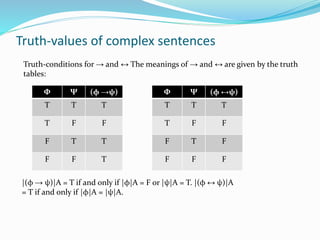
Truth-conditions for → and ↔ The meanings of → and ↔ are given by the truth
tables:
Φ Ψ (φ →ψ)
T T T
T F F
F T T
F F T
|(φ → ψ)|A = T if and only if |φ|A = F or |ψ|A = T. |(φ ↔ ψ)|A
= T if and only if |φ|A = |ψ|A.
Φ Ψ (φ ↔ψ)
T T T
T F F
F T F
F F F
Assignment
 Explain logics in AI and describe propositional logic
with all different logics with example.

Propositional logic

  • 1.
    INTRODUCTION OF PROPOSITIONAL LOGICS Prof.Neeraj Bhargava Kapil Chauhan Department of Computer Science School of Engineering & Systems Sciences MDS University, Ajmer
  • 2.
    Outline  Syntax vsSemantics.  Syntax of L  Semantics of L  Truth-Table .
  • 3.
    Syntax  Syntax isall about expressions: words and sentences. Examples of syntactic claims • ‘Bertrand Russell’ is a proper noun. • ‘likes logic’ is a verb phrase. • ‘Bertrand Russell likes logic’ is a sentence. • Combining a proper noun and a verb phrase in this way makes a sentence
  • 4.
    Semantics  Semantics isall about meanings of expressions. Examples of semantic claims • ‘Bertrand Russell’ refers to a British philosopher. •‘Bertrand Russell’ refers to Bertrand Russell. •‘likes logic’ expresses a property Russell has. •‘Bertrand Russell likes logic’ is true.
  • 5.
    Syntax: English vs.L1.  English has many different sorts of expression. Some expressions of English (1) Sentences: ‘Bertrand Russell likes logic’, ‘Philosophers like conceptual analysis’, etc.. (2) Connectives: ‘it is not the case that’, ‘and’, etc.. (3) Noun phrases: ‘Bertrand Russell’, ‘Philosophers’, etc.. (4) Verb phrases: ‘likes logic’, ‘like conceptual analysis’, etc.. (5) Also: nouns, verbs, pronouns, etc., etc., etc.. L1 has just two sorts of basic expression. Some basic expressions of L1 (1) Sentence letters: e.g. ‘P’, ‘Q’. (2) Connectives: e.g. ‘¬’, ‘∧’.
  • 6.
    Combining sentences andconnectives makes new sentences.  Some complex sentences ‘It is not the case that’ and ‘Bertrand Russell likes logic’ make: ‘It is not the case that Bertrand Russell likes logic’. ‘¬’ and ‘P’ make: ‘¬P’. ‘Bertrand Russell likes logic’ and ‘and’ and ‘Philosophers like conceptual analysis’ make: ‘Bertrand Russell likes logic and philosophers like conceptual analysis’. ‘P’, ‘∧’ and ‘Q’ make: ‘(P ∧ Q)’. Logic convention: no quotes around L1-expressions. P, ∧ and Q make: (P ∧ Q).
  • 7.
    Connectives  Here’s thefull list of L1-connectives. Name in English symbol Conjunction and ∧ disjunction or ∨ negation it is not the case that ¬ arrow if . . . then → double arrow if and only if ↔
  • 8.
    Semantics  Recall thecharacterisation of validity from week 1. Characterisation An argument is logically valid if and only if there is no interpretation of subject-specific expressions under which: (i) the premises are all true, and (ii) the conclusion is false. We’ll adapt this characterisation to L1. Logical expressions: ¬, ∧, ∨,→ and ↔. Subject specific expressions: P, Q, R, . . . Interpretation:
  • 9.
    Truth-values of complexsentences  L1-structures only directly specify truth-values for P, Q, R, . . .  The logical connectives have fixed meanings.  These determine the truth-values of complex sentences.  Notation: |φ|A is the truth-value of φ under A.  Truth-conditions for ¬  The meaning of ¬ is summarised in its truth table φ ¬φ T F F T
  • 10.
    Truth-values of complexsentences  Truth-conditions for ∧ and ∨ The meanings of ∧ and ∨ are given by the truth tables: Φ Ψ (φ ∧ ψ) T T T T F F F T F F F F |(φ ∧ ψ)|A = T if and only if |φ|A = T and |ψ|A = T. |(φ ∨ ψ)|A = T if and only if |φ|A = T or |ψ|A = T (or both). Φ Ψ (φ ∨ ψ) T T T T F T F T T F F F
  • 11.
    Truth-values of complexsentences Truth-conditions for → and ↔ The meanings of → and ↔ are given by the truth tables: Φ Ψ (φ →ψ) T T T T F F F T T F F T |(φ → ψ)|A = T if and only if |φ|A = F or |ψ|A = T. |(φ ↔ ψ)|A = T if and only if |φ|A = |ψ|A. Φ Ψ (φ ↔ψ) T T T T F F F T F F F F
  • 12.
    Assignment  Explain logicsin AI and describe propositional logic with all different logics with example.