

MATHEMATICAL LOGIC

By
Septi Ratnasari
(4101412082)

SEMARANG STATE UNIVERSITY
2013


Statement
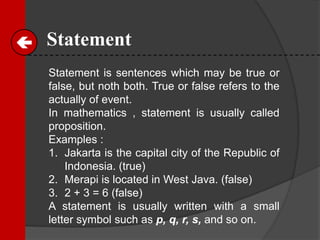
Statement is sentences which may be true or
false, but noth both. True or false refers to the
actually of event.
In mathematics , statement is usually called
proposition.
Examples :
1. Jakarta is the capital city of the Republic of
Indonesia. (true)
2. Merapi is located in West Java. (false)
3. 2 + 3 = 6 (false)
A statement is usually written with a small
letter symbol such as p, q, r, s, and so on.


Truth Value of a Statement
A truth value is used to determine whether a
statement is true or false
The truth value of a statement can be denoted
as .
= tao, which is a Greek letter that chosen to
represent the word truth.
Examples
1. p : Human is breathing with lungs.
(p) = T ( read : the truth value of p is
true )
2. q : 12 + 3 = 5
(q) = F ( read : the truth value of q is
false )


Open Sentence
An open sentence is a sentence that still contain a
variable, hence its truth value cannot yet be
determined.
A variable is a symbol that is used to represent an
arbitrary element of a universal set.
Examples :
 2x – 3 < 9, x∈R
 x is prime number less than 20

A constant that replaces a variable which converts an
open sentence into a true statement is called an open
sentence solution.
A set that consists of all solutions is called a set of
 Negation of a Statement
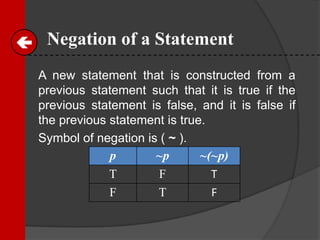
A new statement that is constructed from a
previous statement such that it is true if the
previous statement is false, and it is false if
the previous statement is true.
Symbol of negation is ( ~ ).
p
~p
~(~p)
T
F
T
F
T
F
Truth Value of Compound Statements

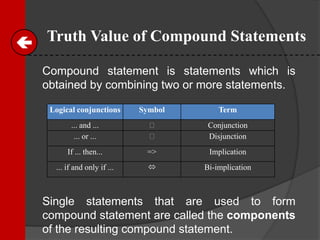
Compound statement is statements which is
obtained by combining two or more statements.
Logical conjunctions

Symbol

Term

... and ...
... or ...

˄
˄

Conjunction
Disjunction

If ... then...

=>

Implication

... if and only if ...



Bi-implication

Single statements that are used to form
compound statement are called the components
of the resulting compound statement.


1. Conjunction

A compound statement is called
p
q
p ˄q
T
T
T
a conjunction if two statements
T
F
F
p and q are combined to form a
F
T
F
compound statement with a
F
F
F
conjunction “and”, denoted as
“p ˄ q”.
The truth value of p ˄ q is true
Examples :
(T)pif both + 3 =components
a)
: 2 of its 5 ( T )
b) p
: 12 is completely
areqtrue. 5 is a prime
:
divided by 3. ( T )
number. ( T )
q
: 15 is completely
p ˄ q : 2 + 3 = 5 and divided by 2. ( F )
5 is a prime
p ˄ q : 12 is completely


2. Disjunction

A compound statement is called
a disjunction if two statements
p and q can be combined by
using the logical conjunction
“or”, denoted by “p ˄ q” which
is read “p or q”.
The truth value of p ˄ q is only
Examples :
true if :at least= 8 ( Tp or q is
a)p
5 + 3 either )
b) p
true. : 8 is an even
q
number. ( T )
p˄q :5+3=8
or 8 is an even

p
T
T
F
F

q
T
F
T
F

pvq
T
T
T
F

:8>8(F)
q :8=8(T)
p ˄ q : 8 > 8 or 8 = 8 (
T ), can also be
stated
as 8 ≥ 8. ( T )


3. Implication
A compound statement is called an implication if two
statements p and q are combined to form a compound
statement by using the logical conjunction “if ... then ...”
, denoted by “p => q”, which can be read :
1. If p then q,
2. p implies q,
3. q only if p,
4. p is sufficient for q,
5. q is required for p.
p is called the antecedent (hypothesis) and q is called
the consequant.
The truth value of p => q is false (F) if p is true and q
is false. And for all the other composition of p => q is

p
T
T
F
F

q
T
F
T
F

p => q
T
F
T
T

Examples :
a) p : 5 + 3 = 8 ( T )
q : 8 is an even number. ( T )
p => q : If 5 + 3 = 8, then 8 is an even
number. ( T )
b) p : 5 > 3 ( T )
q : 5 is an even number. ( F )
p => q : If 5 > 3, then 5 is an even number.


4. Bi-implication
A compound statement is called a bi-implication if two
statements p and q are combined to form a compound
statement with a logical conjunction “... if and only if
...”, denoted by “p  q” that means “p if and only if q”,
i.e “if p then q and if q then p”. Hence p  q ≅ (p =>
q) ˄(q =>qp). p => q
(p => q) ˄ ( => p) ≅ p
q
p
q => p
q
T

T

T

T

T

T

F

F

T

F

F

T

T

F

F

F

F

T

T

T
Tautology



Tautology is a compound statement which is always
true for all possibilities from its components.
Example of Tautology :
p

q

~p

~q

p => q

(p => q) ˄ ~q

((p => q) ˄ ~q) =>
~p

T

T

F

F

T

F

T

T

F

F

T

F

F

T

F

T

T

F

T

F

T

F

F

T

T

T

T

T


Contradiction
Contradiction (the reverse of tautology) is a
compound statement which is false for all
possibilities from its components.
Example of Contradiction :
p

q

p˄q

~ (p ˄ q)

~ (p ˄ q) ˄ p

T

T

T

F

F

T

F

T

F

F

F

T

T

F

F

F

F

F

T

F


Contingency
Contingency is a compound statement
which is not a tautology and not a
contradiction for all possibilities from its
components.
p

q

p˄q

(p  q)  p

T

T

T

T

T

F

T

T

F

T

T

F

F

F

F

T


Negation of Compound Statements

a. Negation of Conjunction
p

q

~p

~q

p˄q

~(p ˄ q)

~p ˄ ~q

T

T

F

F

T

F

F

T

F

F

T

F

T

T

F

T

T

F

F

T

T

F

F

T

T

F

T

T

equivalent

From the truth table above we see that ~(p ˄q) ≅ ~p ˄~q. Therefore,
(~p ˄~q) is the negation of (p ˄q).

It can be concluded that :

~(p ˄q) ≅ ~p ˄~q

b. Negation of Disjunction
p

q

~p

~q

p˄q

~(p ˄ q)

~p ˄ ~q

T

T

F

F

T

F

F

T

F

F

T

T

F

F

F

T

T

F

T

F

F

F

F

T

T

F

T

T

equivalent

From the truth table above we see that ~(p ˄q) ≅ ~p ˄~q. Therefore,
(~p ˄~q) is the negation of (p ˄q).
It can be concluded that :

~(p ˄q) ≅ ~p ˄~q

c. Negation of Implication
p

q

~p

~q

p => q

~p ˄ q

~( p => q)

~(~p ˄ q) ≅ (p ˄ ~q)

T

T

F

F

T

T

F

F

T

F

F

T

F

F

T

T

F

T

T

F

T

T

F

F

F

F

T

T

T

T

F

F

equivalent

From the table, we can conclude that :

~( p => q) ≅ ~(~p ˄q) ≅ (p ˄~q)

equivalent
d. Negation of Bi-implication
p  q ≅ (p => q) ˄ ( => p)
q






Remember that

From this equivalence, we can derive :
~( p  q)

=

~((p => q) ˄ ( => p))
q

=
=
=

~(p => q) ˄ ~( => p)
q
~(~p ˄q) ˄~(~q ˄p)
(p ˄~q) ˄ ( ˄~p)
q

p

q

~p

~q

pq

~( p  q)

T

T

F

F

T

F

F

F

F

T

F

F

T

F

T

T

F

T

F

T

T

F

F

T

F

T

T

F

F

T

T

T

F

F

F

F

(p ˄ ~q) (q ˄ ~p)

equivalent

Hence,

~( p  q) ≅ (p ˄~q) ˄ ( ˄~p)
q

(p ˄ ~q) ˄ (q ˄
~p)


Converse, Inverse, and Contrapositive

Implication

=

p => q

Converse

=

q => p

Inverce

=

~p => ~q

Contrapositive =

~q => ~p
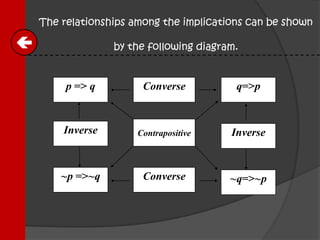
The relationships among the implications can be shown



by the following diagram.

p => q

Converse

q=>p

Inverse

Contrapositive

Inverse

~p =>~q

Converse

~q=>~p

implication

converse

inverse

contrapositive

p

q

~p

~q

p => q

q => p

~p => ~q

~q => ~p

T

T

F

F

T

T

T

T

T

F

F

T

F

T

T

F

F

T

T

F

T

F

F

T

F

F

T

T

T

T

T

T

equivalent

equivalent


Statements with Quantor

1. Universal Quantor


2. Exsistential Quantor


The solution set from an open sentence p(x) which
has at least one member of the whole set S, can be
written as follow

Symbol
is called existential quantor, read as '
There exists' or 'At least one of '.

Example
Given an open sentence 2x + 1 = 7. Expree it by using
exsistential quantor, and then determine its truth value,
whether the whole set is real number R.
Answer :
Negation of Quantor Statement


Making Conclusion


•

One of the important purposes of mathematical logic is to
have knowledge regarding testing argument or making
conclusion.

•

In logic, a premise is a claim that is a reason ( or element
of a set of reason ) for, or objection against, some other claim.
In other words, it is a statement presumed true within the
context of an argument toward a conclusion.

•

In the context of ordinary argumentation, the rational
acceptability of a disputed conclusion depends on both the
1. Modus Ponens

Premise 1
Premise 2
Conclusion

: p => q
: p
: q

The argument above can be written in a form of
implication as follow
[(p => q) ˄p] => q


1. Modus Tollens
Premise 1
Premise 2
Conclusion

: p => q
: ~q
: ~p

The argument above can be written in a
form of implication as follow
[(p => q) ˄~q ] => ~p
3. Syllogism

Premise 1
Premise 2
Conclusion

: p => q
: q => r
: p => r

The argument above can be written in a
form of implication as follow
[(p => q) ˄(q => r)] => (p => r)


Direct and Indirect Proof
1.

Direct Proof
In order to direcly prove a conditional statement of the
form ( p =>

q ), it is only necessary to consider

situations where the statement p is true to conclution q.
The common proof rules used are modus ponens,
modus tollens, and syllogism.


Example
Show that for all integer n, if n is an odd numbers, then n2 is
also an odd number !
Answer :
For example
p : n is an odd integer
q : n2 is an odd integer
It will be shown that p => q is true.
Because n is an odd number, thus n = 2k + 1, k ∊ C
Then, we have n2
= (2k + 1)2
= 4k2 + 4k + 1
= 2(2k2 + 2k) + 1
= 2m + 1
Where m = 2k2 + 2k, so n2 is an odd integer.
Thus, it is shown that p => q is true.


2.
a.

Indirect proof
Indirect Proof by Contradiction
To prove statement (p => q) is true, we can
proceed by assuming ~q is true. And show that it
leads to a logical contradiction.

Thus, according to the law of contradiction, ~q
must be true, and so, statement (p => q) is true.


Example
Show that ' If n2 is an odd number, then n will be also an
odd number ' by using indirect proof by contradiction.
Answer :
Suppose that n is an even number, that is n = 2k, k ∊ B.
Because n = 2k
Then n2 = (2k) 2 = 4k2 = 2(2k2 ) = 2m
Where m = 2k2
We get n2 is an even number, contradiction with n2 is an
odd number.
Thus, it is shown that if If n2 is an odd number, then n
will be also an odd number.
 b. Indirect Proof by Contraposition
To prove statement (p => q) is true, we can proceed
by assuming ~q is true. And show that it leads ~p is
true.
Thus ~q according to the law of contraposition ~p, is

true.
So statement (~q => ~p) is true.
 Example
Show that for all integer n2 is an odd number, then n will be also an odd
number.
Answer :
Use the indirect contraposition to prove the statement above.
Suppose that

p : n2 is an odd number
q : n is an odd number

We asssume that ~q is true, it is mean that n is an even number, n = 2k
We will get n2 = (2k2) = 4k2 = 2(2k2) = 2m, where m = 2k2
It is mean that n2 is an even number.

Thus, ~p : n2 is an even number
~q : n is an even number
Because (~q => ~p) is true and p => q ≅ (~q => ~p)
Then, p => q is true.

Thus, it is shown that if n2 is an odd number, then n will be also an odd
 Exercises
Give the negation of the statement “If all leaders put
forward the interest of their people, then all people will
live prosperously”.
2. Determine the inverse,converse, and contrapositive of
the statement form (p ˄q) =>r.
3. Write the valid conclusions of these premises.
p1 : Students do not like math or teachers like to teach.
p2 : If teachers like to teach, then math grades are good.
p3 : Students like math.
1.

∴ ...


4.

Write the valid conclusions of the following premises.

Mathematical Logic

  • 1.
  • 2.
     Statement Statement is sentenceswhich may be true or false, but noth both. True or false refers to the actually of event. In mathematics , statement is usually called proposition. Examples : 1. Jakarta is the capital city of the Republic of Indonesia. (true) 2. Merapi is located in West Java. (false) 3. 2 + 3 = 6 (false) A statement is usually written with a small letter symbol such as p, q, r, s, and so on.
  • 3.
     Truth Value ofa Statement A truth value is used to determine whether a statement is true or false The truth value of a statement can be denoted as . = tao, which is a Greek letter that chosen to represent the word truth. Examples 1. p : Human is breathing with lungs. (p) = T ( read : the truth value of p is true ) 2. q : 12 + 3 = 5 (q) = F ( read : the truth value of q is false )
  • 4.
     Open Sentence An opensentence is a sentence that still contain a variable, hence its truth value cannot yet be determined. A variable is a symbol that is used to represent an arbitrary element of a universal set. Examples :  2x – 3 < 9, x∈R  x is prime number less than 20 A constant that replaces a variable which converts an open sentence into a true statement is called an open sentence solution. A set that consists of all solutions is called a set of
  • 5.
     Negation ofa Statement A new statement that is constructed from a previous statement such that it is true if the previous statement is false, and it is false if the previous statement is true. Symbol of negation is ( ~ ). p ~p ~(~p) T F T F T F
  • 6.
    Truth Value ofCompound Statements  Compound statement is statements which is obtained by combining two or more statements. Logical conjunctions Symbol Term ... and ... ... or ... ˄ ˄ Conjunction Disjunction If ... then... => Implication ... if and only if ...  Bi-implication Single statements that are used to form compound statement are called the components of the resulting compound statement.
  • 7.
     1. Conjunction A compoundstatement is called p q p ˄q T T T a conjunction if two statements T F F p and q are combined to form a F T F compound statement with a F F F conjunction “and”, denoted as “p ˄ q”. The truth value of p ˄ q is true Examples : (T)pif both + 3 =components a) : 2 of its 5 ( T ) b) p : 12 is completely areqtrue. 5 is a prime : divided by 3. ( T ) number. ( T ) q : 15 is completely p ˄ q : 2 + 3 = 5 and divided by 2. ( F ) 5 is a prime p ˄ q : 12 is completely
  • 8.
     2. Disjunction A compoundstatement is called a disjunction if two statements p and q can be combined by using the logical conjunction “or”, denoted by “p ˄ q” which is read “p or q”. The truth value of p ˄ q is only Examples : true if :at least= 8 ( Tp or q is a)p 5 + 3 either ) b) p true. : 8 is an even q number. ( T ) p˄q :5+3=8 or 8 is an even p T T F F q T F T F pvq T T T F :8>8(F) q :8=8(T) p ˄ q : 8 > 8 or 8 = 8 ( T ), can also be stated as 8 ≥ 8. ( T )
  • 9.
     3. Implication A compoundstatement is called an implication if two statements p and q are combined to form a compound statement by using the logical conjunction “if ... then ...” , denoted by “p => q”, which can be read : 1. If p then q, 2. p implies q, 3. q only if p, 4. p is sufficient for q, 5. q is required for p. p is called the antecedent (hypothesis) and q is called the consequant. The truth value of p => q is false (F) if p is true and q is false. And for all the other composition of p => q is
  • 10.
     p T T F F q T F T F p => q T F T T Examples: a) p : 5 + 3 = 8 ( T ) q : 8 is an even number. ( T ) p => q : If 5 + 3 = 8, then 8 is an even number. ( T ) b) p : 5 > 3 ( T ) q : 5 is an even number. ( F ) p => q : If 5 > 3, then 5 is an even number.
  • 11.
     4. Bi-implication A compoundstatement is called a bi-implication if two statements p and q are combined to form a compound statement with a logical conjunction “... if and only if ...”, denoted by “p  q” that means “p if and only if q”, i.e “if p then q and if q then p”. Hence p  q ≅ (p => q) ˄(q =>qp). p => q (p => q) ˄ ( => p) ≅ p q p q => p q T T T T T T F F T F F T T F F F F T T T
  • 12.
    Tautology  Tautology is acompound statement which is always true for all possibilities from its components. Example of Tautology : p q ~p ~q p => q (p => q) ˄ ~q ((p => q) ˄ ~q) => ~p T T F F T F T T F F T F F T F T T F T F T F F T T T T T
  • 13.
     Contradiction Contradiction (the reverseof tautology) is a compound statement which is false for all possibilities from its components. Example of Contradiction : p q p˄q ~ (p ˄ q) ~ (p ˄ q) ˄ p T T T F F T F T F F F T T F F F F F T F
  • 14.
     Contingency Contingency is acompound statement which is not a tautology and not a contradiction for all possibilities from its components. p q p˄q (p  q)  p T T T T T F T T F T T F F F F T
  • 15.
     Negation of CompoundStatements a. Negation of Conjunction p q ~p ~q p˄q ~(p ˄ q) ~p ˄ ~q T T F F T F F T F F T F T T F T T F F T T F F T T F T T equivalent From the truth table above we see that ~(p ˄q) ≅ ~p ˄~q. Therefore, (~p ˄~q) is the negation of (p ˄q). It can be concluded that : ~(p ˄q) ≅ ~p ˄~q
  • 16.
     b. Negation ofDisjunction p q ~p ~q p˄q ~(p ˄ q) ~p ˄ ~q T T F F T F F T F F T T F F F T T F T F F F F T T F T T equivalent From the truth table above we see that ~(p ˄q) ≅ ~p ˄~q. Therefore, (~p ˄~q) is the negation of (p ˄q). It can be concluded that : ~(p ˄q) ≅ ~p ˄~q
  • 17.
     c. Negation ofImplication p q ~p ~q p => q ~p ˄ q ~( p => q) ~(~p ˄ q) ≅ (p ˄ ~q) T T F F T T F F T F F T F F T T F T T F T T F F F F T T T T F F equivalent From the table, we can conclude that : ~( p => q) ≅ ~(~p ˄q) ≅ (p ˄~q) equivalent
  • 18.
    d. Negation ofBi-implication p  q ≅ (p => q) ˄ ( => p) q    Remember that From this equivalence, we can derive : ~( p  q) = ~((p => q) ˄ ( => p)) q = = = ~(p => q) ˄ ~( => p) q ~(~p ˄q) ˄~(~q ˄p) (p ˄~q) ˄ ( ˄~p) q p q ~p ~q pq ~( p  q) T T F F T F F F F T F F T F T T F T F T T F F T F T T F F T T T F F F F (p ˄ ~q) (q ˄ ~p) equivalent Hence, ~( p  q) ≅ (p ˄~q) ˄ ( ˄~p) q (p ˄ ~q) ˄ (q ˄ ~p)
  • 19.
     Converse, Inverse, andContrapositive Implication = p => q Converse = q => p Inverce = ~p => ~q Contrapositive = ~q => ~p
  • 20.
    The relationships amongthe implications can be shown  by the following diagram. p => q Converse q=>p Inverse Contrapositive Inverse ~p =>~q Converse ~q=>~p
  • 21.
     implication converse inverse contrapositive p q ~p ~q p => q q=> p ~p => ~q ~q => ~p T T F F T T T T T F F T F T T F F T T F T F F T F F T T T T T T equivalent equivalent
  • 22.
  • 23.
     2. Exsistential Quantor  Thesolution set from an open sentence p(x) which has at least one member of the whole set S, can be written as follow Symbol is called existential quantor, read as ' There exists' or 'At least one of '.
  • 24.
     Example Given an opensentence 2x + 1 = 7. Expree it by using exsistential quantor, and then determine its truth value, whether the whole set is real number R. Answer :
  • 25.
    Negation of QuantorStatement 
  • 26.
  • 27.
    Making Conclusion  • One ofthe important purposes of mathematical logic is to have knowledge regarding testing argument or making conclusion. • In logic, a premise is a claim that is a reason ( or element of a set of reason ) for, or objection against, some other claim. In other words, it is a statement presumed true within the context of an argument toward a conclusion. • In the context of ordinary argumentation, the rational acceptability of a disputed conclusion depends on both the
  • 28.
    1. Modus Ponens  Premise1 Premise 2 Conclusion : p => q : p : q The argument above can be written in a form of implication as follow [(p => q) ˄p] => q
  • 29.
     1. Modus Tollens Premise1 Premise 2 Conclusion : p => q : ~q : ~p The argument above can be written in a form of implication as follow [(p => q) ˄~q ] => ~p
  • 30.
    3. Syllogism  Premise 1 Premise2 Conclusion : p => q : q => r : p => r The argument above can be written in a form of implication as follow [(p => q) ˄(q => r)] => (p => r)
  • 31.
     Direct and IndirectProof 1. Direct Proof In order to direcly prove a conditional statement of the form ( p => q ), it is only necessary to consider situations where the statement p is true to conclution q. The common proof rules used are modus ponens, modus tollens, and syllogism.
  • 32.
     Example Show that forall integer n, if n is an odd numbers, then n2 is also an odd number ! Answer : For example p : n is an odd integer q : n2 is an odd integer It will be shown that p => q is true. Because n is an odd number, thus n = 2k + 1, k ∊ C Then, we have n2 = (2k + 1)2 = 4k2 + 4k + 1 = 2(2k2 + 2k) + 1 = 2m + 1 Where m = 2k2 + 2k, so n2 is an odd integer. Thus, it is shown that p => q is true.
  • 33.
     2. a. Indirect proof Indirect Proofby Contradiction To prove statement (p => q) is true, we can proceed by assuming ~q is true. And show that it leads to a logical contradiction. Thus, according to the law of contradiction, ~q must be true, and so, statement (p => q) is true.
  • 34.
     Example Show that 'If n2 is an odd number, then n will be also an odd number ' by using indirect proof by contradiction. Answer : Suppose that n is an even number, that is n = 2k, k ∊ B. Because n = 2k Then n2 = (2k) 2 = 4k2 = 2(2k2 ) = 2m Where m = 2k2 We get n2 is an even number, contradiction with n2 is an odd number. Thus, it is shown that if If n2 is an odd number, then n will be also an odd number.
  • 35.
     b. IndirectProof by Contraposition To prove statement (p => q) is true, we can proceed by assuming ~q is true. And show that it leads ~p is true. Thus ~q according to the law of contraposition ~p, is true. So statement (~q => ~p) is true.
  • 36.
     Example Show thatfor all integer n2 is an odd number, then n will be also an odd number. Answer : Use the indirect contraposition to prove the statement above. Suppose that p : n2 is an odd number q : n is an odd number We asssume that ~q is true, it is mean that n is an even number, n = 2k We will get n2 = (2k2) = 4k2 = 2(2k2) = 2m, where m = 2k2 It is mean that n2 is an even number. Thus, ~p : n2 is an even number ~q : n is an even number Because (~q => ~p) is true and p => q ≅ (~q => ~p) Then, p => q is true. Thus, it is shown that if n2 is an odd number, then n will be also an odd
  • 37.
     Exercises Give thenegation of the statement “If all leaders put forward the interest of their people, then all people will live prosperously”. 2. Determine the inverse,converse, and contrapositive of the statement form (p ˄q) =>r. 3. Write the valid conclusions of these premises. p1 : Students do not like math or teachers like to teach. p2 : If teachers like to teach, then math grades are good. p3 : Students like math. 1. ∴ ...
  • 38.
     4. Write the validconclusions of the following premises.