Dr.S.Alexandar,M.Pharm,Ph.D,
Associate Professor
Vinayaka Missions College of Pharmacy,
Yercaud main road,
Kondappanaickanpatty,
Salem, Tamilnadu,
Pin:636008
Oxidation reductionOxidation reduction
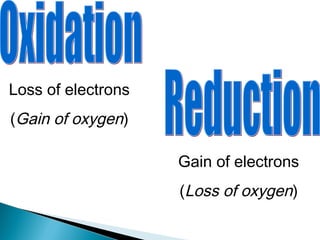
Loss of electrons
(Gain of oxygen)
Gain of electrons
(Loss of oxygen)
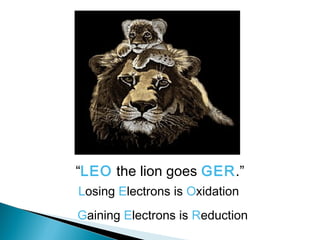
“LEO the lion goes GER.”
Losing Electrons is Oxidation
Gaining Electrons is Reduction
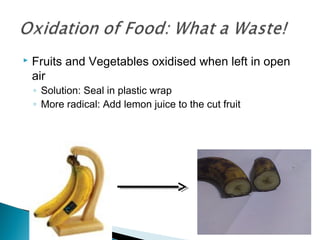
 Fruits and Vegetables oxidised when left in open
air
◦ Solution: Seal in plastic wrap
◦ More radical: Add lemon juice to the cut fruit
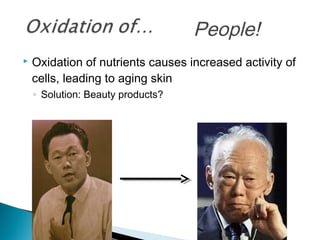
 Oxidation of nutrients causes increased activity of
cells, leading to aging skin
◦ Solution: Beauty products?
People!
 Redox – reduction + oxidation
 Both processes occur simultaneously
 Hence, one species is oxidised, another is
reduced
 So, what is oxidation, and what is reduction?
 3 different versions of the definition:
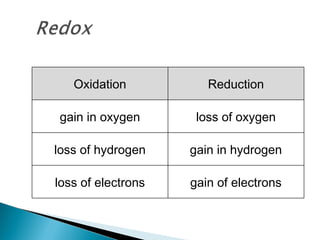
gain of electronsloss of electrons
gain in hydrogenloss of hydrogen
loss of oxygengain in oxygen
ReductionOxidation
 In terms of Oxygen:
◦ Oxidation: Gain of oxygen in a species
 E.g. Mg is oxidized to MgO
◦ Reduction: Loss of oxygen in a species
 E.g. H2O is reduced to H2
◦ Note: It’s the gain or loss of O, not O2-
 In terms of Hydrogen:
◦ Oxidation: Loss of hydrogen in a species
 E.g. H2O is oxidised to O2
◦ Reduction: Gain of hydrogen in a species
 E.g. O2 is reduced to H2O2
◦ Note: It’s the gain or loss of H, not H+
 In terms of Electrons (OIL RIG: Oxidation Is Loss,
Reduction Is Gain):
◦ Oxidation: Loss of electrons in a species
 E.g. Mg is oxidized to MgO (Mg from 12 electrons to 10
electrons in Mg2+
)
◦ Reduction: Gain of electrons in a species
 E.g. O2 is reduced to H2O2 (O from 8 electrons to 9 electrons
per O in O2
2-
)
 An oxidising agent is a chemical species that
causes the other reactant in a redox reaction to be
oxidised, and it is always reduced in the process.
 A reducing agent is a chemical species that
causes the other reactant in a redox reaction to be
reduced, and it is always oxidised in the process.
12
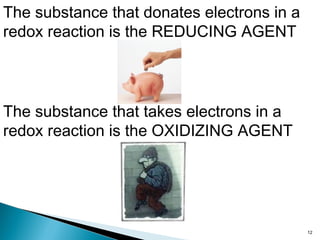
The substance that donates electrons in a
redox reaction is the REDUCING AGENT
 
The substance that takes electrons in a
redox reaction is the OXIDIZING AGENT
13
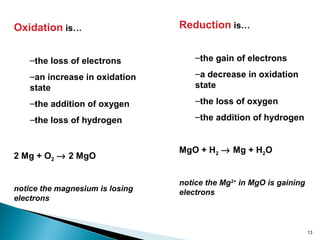
Oxidation is…
–the loss of electrons
–an increase in oxidation
state
–the addition of oxygen
–the loss of hydrogen
2 Mg + O2 → 2 MgO
notice the magnesium is losing
electrons
Reduction is…
–the gain of electrons
–a decrease in oxidation
state
–the loss of oxygen
–the addition of hydrogen
MgO + H2 → Mg + H2O
notice the Mg2+
in MgO is gaining
electrons
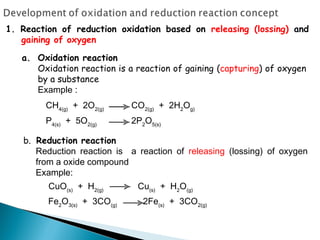
1. Reaction of reduction oxidation based on releasing (lossing) and
gaining of oxygen
a. Oxidation reaction
Oxidation reaction is a reaction of gaining (capturing) of oxygen
by a substance
Example :
CH4(g)
+ 2O2(g)
CO2(g)
+ 2H2
Og)
b. Reduction reaction
Reduction reaction is a reaction of releasing (lossing) of oxygen
from a oxide compound
Example:
Fe2
O3(s)
+ 3CO(g)
2Fe(s)
+ 3CO2(g)
P4(s)
+ 5O2(g)
2P2
O5(s)
CuO(s)
+ H2(g)
Cu(s)
+ H2
O(g)
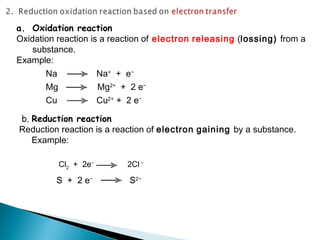
a. Oxidation reaction
Oxidation reaction is a reaction of electron releasing (lossing) from a
substance.
Example:
b. Reduction reaction
Reduction reaction is a reaction of electron gaining by a substance.
Example:
Na Na+
+ e−
Mg Mg2+
+ 2 e−
Cu Cu2+
+ 2 e−
Cl2
+ 2e−
2Cl −
S + 2 e−
S2−
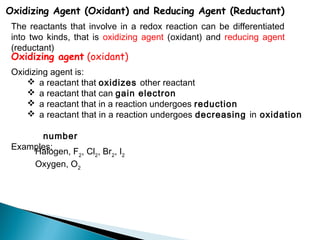
The reactants that involve in a redox reaction can be differentiated
into two kinds, that is oxidizing agent (oxidant) and reducing agent
(reductant)
Oxidizing Agent (Oxidant) and Reducing Agent (Reductant)
Oxidizing agent (oxidant)
Oxidizing agent is:
 a reactant that oxidizes other reactant
 a reactant that can gain electron
 a reactant that in a reaction undergoes reduction
 a reactant that in a reaction undergoes decreasing in oxidation
number
Examples:
Halogen, F2
, Cl2
, Br2
, I2
Oxygen, O2
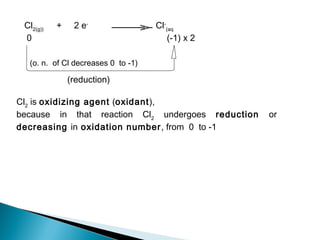
Cl2(g))
+ 2 e-
Cl-
(aq
0 (-1) x 2
Cl2
is oxidizing agent (oxidant),
because in that reaction Cl2
undergoes reduction or
decreasing in oxidation number, from 0 to -1
(o. n. of Cl decreases 0 to -1)
(reduction)
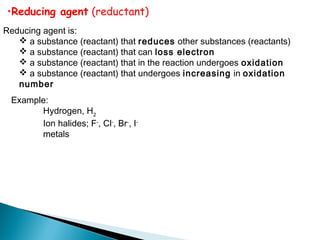
Reducing agent is:
 a substance (reactant) that reduces other substances (reactants)
 a substance (reactant) that can loss electron
 a substance (reactant) that in the reaction undergoes oxidation
 a substance (reactant) that undergoes increasing in oxidation
number
•Reducing agent (reductant)
Example:
Hydrogen, H2
Ion halides; F-
, Cl-
, Br-
, I-
metals
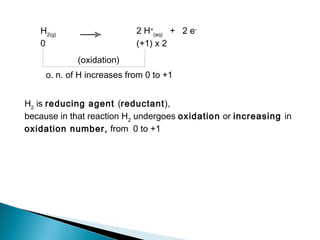
H2(g)
2 H+
(aq)
+ 2 e-
0 (+1) x 2
(oxidation)
o. n. of H increases from 0 to +1
H2
is reducing agent (reductant),
because in that reaction H2
undergoes oxidation or increasing in
oxidation number, from 0 to +1
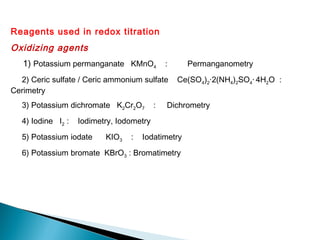
Reagents used in redox titration
Oxidizing agents
1) Potassium permanganate KMnO4 : Permanganometry
2) Ceric sulfate / Ceric ammonium sulfate Ce(SO4)2·2(NH4)2SO4· 4H2O :
Cerimetry
3) Potassium dichromate K2Cr2O7 : Dichrometry
4) Iodine I2 : Iodimetry, Iodometry
5) Potassium iodate KIO3 : Iodatimetry
6) Potassium bromate KBrO3 : Bromatimetry
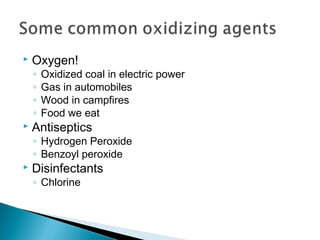
 Oxygen!
◦ Oxidized coal in electric power
◦ Gas in automobiles
◦ Wood in campfires
◦ Food we eat
 Antiseptics
◦ Hydrogen Peroxide
◦ Benzoyl peroxide
 Disinfectants
◦ Chlorine
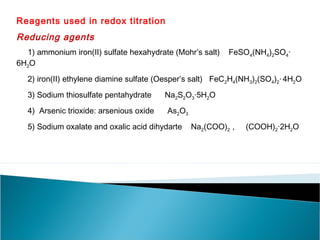
Reagents used in redox titration
Reducing agents
1) ammonium iron(II) sulfate hexahydrate (Mohr’s salt) FeSO4(NH4)2SO4·
6H2O
2) iron(II) ethylene diamine sulfate (Oesper’s salt) FeC2H4(NH3)2(SO4)2· 4H2O
3) Sodium thiosulfate pentahydrate Na2S2O3·5H2O
4) Arsenic trioxide: arsenious oxide As2O3
5) Sodium oxalate and oxalic acid dihydarte Na2(COO)2 , (COOH)2·2H2O
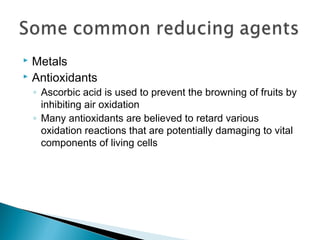
 Metals
 Antioxidants
◦ Ascorbic acid is used to prevent the browning of fruits by
inhibiting air oxidation
◦ Many antioxidants are believed to retard various
oxidation reactions that are potentially damaging to vital
components of living cells
 Electrical production (batteries, fuel cells)
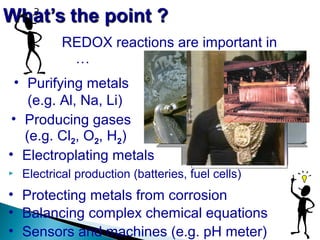
REDOX reactions are important in
…
• Purifying metals
(e.g. Al, Na, Li)
• Producing gases
(e.g. Cl2, O2, H2)
• Electroplating metals
• Protecting metals from corrosion
• Balancing complex chemical equations
• Sensors and machines (e.g. pH meter)
C3H8O + CrO3 + H2SO4 → Cr2(SO4)3
+ C3H6O + H2O
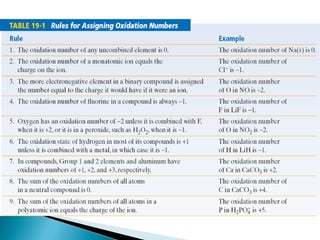
 An oxidation number is a positive or negative number
assigned to an atom to indicate its degree of oxidation
or reduction.
As a general rule, a bonded atom’s oxidation # is the
charge that it would have if the electrons
in the bond were assigned to the atom of
the more electronegative element.
J Deutsch 2003 27
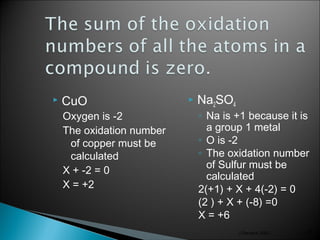
 Na2SO4
◦ Na is +1 because it is
a group 1 metal
◦ O is -2
◦ The oxidation number
of Sulfur must be
calculated
2(+1) + X + 4(-2) = 0
(2 ) + X + (-8) =0
X = +6
 CuO
Oxygen is -2
The oxidation number
of copper must be
calculated
X + -2 = 0
X = +2
J Deutsch 2003 28
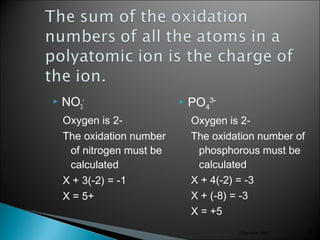
 PO4
3-
Oxygen is 2-
The oxidation number of
phosphorous must be
calculated
X + 4(-2) = -3
X + (-8) = -3
X = +5
 NO3
-
Oxygen is 2-
The oxidation number
of nitrogen must be
calculated
X + 3(-2) = -1
X = 5+
29
20.5 Balancing Redox Equations
1)the oxidation number change
method
There are two methods used to balance
redox reactions
2)the half reaction method
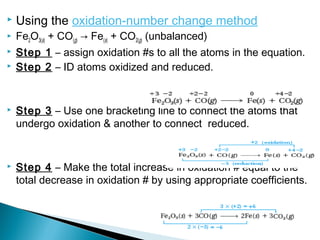
 Using the oxidation-number change method
 Fe2O3(s) + CO(g) → Fe(s) + CO2(g) (unbalanced)
 Step 1 – assign oxidation #s to all the atoms in the equation.
 Step 2 – ID atoms oxidized and reduced.
 Step 3 – Use one bracketing line to connect the atoms that
undergo oxidation & another to connect reduced.
 Step 4 – Make the total increase in oxidation # equal to the
total decrease in oxidation # by using appropriate coefficients.
There are two kinds of electro chemical cells, galvanic or
electrolytic.
In galvanic cells, the chemical reaction occurs spontaneously
to produce electrical energy.
In a electrolytic cell, electrical energy is used to force the non
spontaneous chemical reaction.
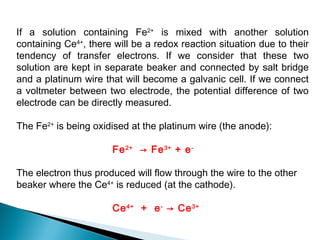
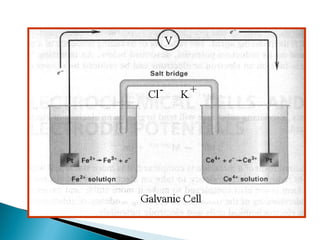
If a solution containing Fe2+
is mixed with another solution
containing Ce4+
, there will be a redox reaction situation due to their
tendency of transfer electrons. If we consider that these two
solution are kept in separate beaker and connected by salt bridge
and a platinum wire that will become a galvanic cell. If we connect
a voltmeter between two electrode, the potential difference of two
electrode can be directly measured.
The Fe2+
is being oxidised at the platinum wire (the anode):
Fe2+
→ Fe3+
+ e-
The electron thus produced will flow through the wire to the other
beaker where the Ce4+
is reduced (at the cathode).
Ce4+
+ e-
→ Ce3+
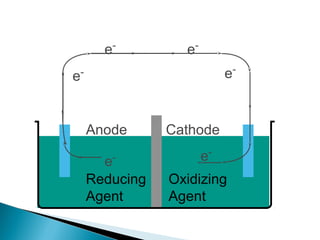
Reducing
Agent
Oxidizing
Agent
e-
e-
e-
e-
e-
e-
Anode Cathode
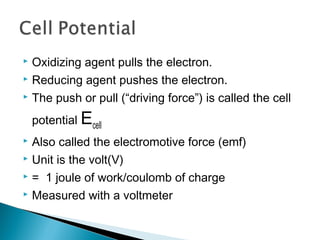
 Oxidizing agent pulls the electron.
 Reducing agent pushes the electron.
 The push or pull (“driving force”) is called the cell
potential Ecell
 Also called the electromotive force (emf)
 Unit is the volt(V)
 = 1 joule of work/coulomb of charge
 Measured with a voltmeter
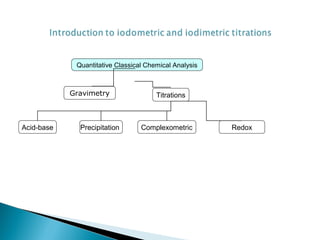
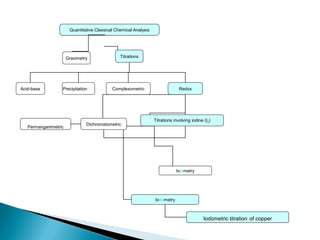
Quantitative Classical Chemical Analysis
Titrations
Acid-base Precipitation Complexometric Redox
Gravimetry
Quantitative Classical Chemical Analysis
Titrations
Acid-base Precipitation Complexometric Redox
Titrations involving iodine (I2)
Iodimetry
Iodometry
Iodometric titration of copper
Gravimetry
Dichromatometric
Permanganimetric
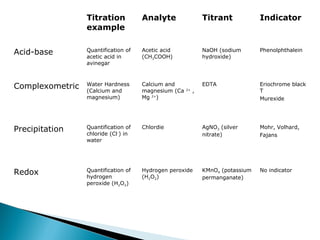
Titration
example
Analyte Titrant Indicator
Acid-base Quantification of
acetic acid in
avinegar
Acetic acid
(CH3COOH)
NaOH (sodium
hydroxide)
Phenolphthalein
Complexometric Water Hardness
(Calcium and
magnesium)
Calcium and
magnesium (Ca 2+
,
Mg 2+
)
EDTA Eriochrome black
T
Murexide
Precipitation Quantification of
chloride (Cl-
) in
water
Chlordie AgNO3 (silver
nitrate)
Mohr, Volhard,
Fajans
Redox Quantification of
hydrogen
peroxide (H2O2)
Hydrogen peroxide
(H2O2)
KMnO4 (potassium
permanganate)
No indicator
Titrations:
 Direct Titrations
 Indirect Titrations
 Back Titrations
 Iodometry
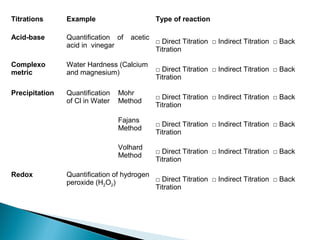
Titrations Example Type of reaction
Acid-base Quantification of acetic
acid in vinegar
□ Direct Titration □ Indirect Titration □ Back
Titration
Complexo
metric
Water Hardness (Calcium
and magnesium) □ Direct Titration □ Indirect Titration □ Back
Titration
Precipitation Quantification
of Cl in Water
Mohr
Method
□ Direct Titration □ Indirect Titration □ Back
Titration
Fajans
Method
□ Direct Titration □ Indirect Titration □ Back
Titration
Volhard
Method
□ Direct Titration □ Indirect Titration □ Back
Titration
Redox Quantification of hydrogen
peroxide (H2O2) □ Direct Titration □ Indirect Titration □ Back
Titration
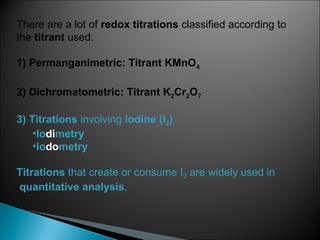
There are a lot of redox titrations classified according to
the titrant used.
1) Permanganimetric: Titrant KMnO4
2) Dichromatometric: Titrant K2Cr2O7
3) Titrations involving iodine (I2)
•Iodimetry
•Iodometry
Titrations that create or consume I2 are widely used in
quantitative analysis.
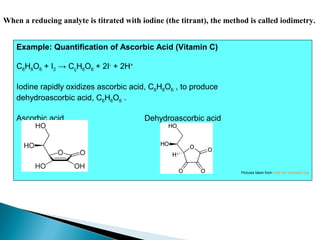
When a reducing analyte is titrated with iodine (the titrant), the method is called iodimetry.
Example: Quantification of Ascorbic Acid (Vitamin C)
C6H8O6 + I2 → CçH6O6 + 2I-
+ 2H+
Iodine rapidly oxidizes ascorbic acid, C6H8O6 , to produce
dehydroascorbic acid, C6H6O6 .
Ascorbic acid Dehydroascorbic acid
Pictures taken from: http://en.wikipedia.org
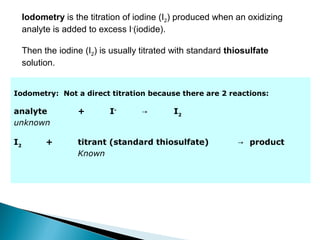
Iodometry is the titration of iodine (I2) produced when an oxidizing
analyte is added to excess I-
(iodide).
Then the iodine (I2) is usually titrated with standard thiosulfate
solution.
Iodometry: Not a direct titration because there are 2 reactions:
analyte + I-
→ I2
unknown
I2
+ titrant (standard thiosulfate) product→
Known
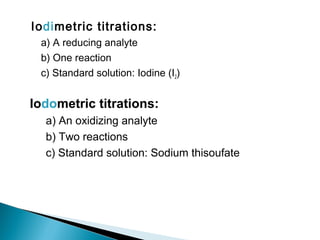
Iodimetric titrations:
a) A reducing analyte
b) One reaction
c) Standard solution: Iodine (I2)
Iodometric titrations:
a) An oxidizing analyte
b) Two reactions
c) Standard solution: Sodium thisoufate
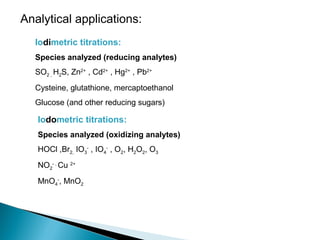
Analytical applications:
Iodimetric titrations:
Species analyzed (reducing analytes)
SO2 , H2S, Zn2+
, Cd2+
, Hg2+
, Pb2+
Cysteine, glutathione, mercaptoethanol
Glucose (and other reducing sugars)
Iodometric titrations:
Species analyzed (oxidizing analytes)
HOCl ,Br2, IO3
-
, IO4
-
, O2, H2O2, O3
NO2
- ,
Cu 2+
MnO4
-
, MnO2
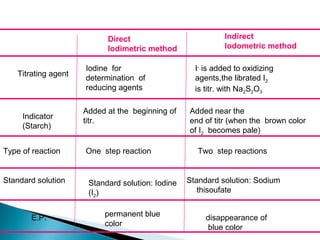
Direct
Iodimetric method
Indirect
Iodometric method
Titrating agent
Iodine for
determination of
reducing agents
I-
is added to oxidizing
agents,the librated I2
is titr. with Na2S2O3
Indicator
(Starch)
Added at the beginning of
titr.
Added near the
end of titr (when the brown color
of I2 becomes pale)
E.P. permanent blue
color
disappearance of
blue color
Type of reaction One step reaction Two step reactions
Standard solution Standard solution: Iodine
(I2)
Standard solution: Sodium
thisoufate
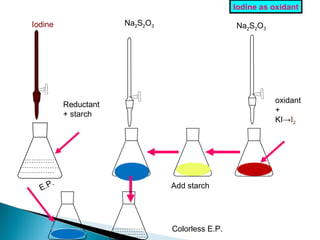
Reductant
+ starch
Iodine
E.P.
oxidant
+
KI→I2
Na2S2O3
Add starch
Na2S2O3
Colorless E.P.
Iodine as oxidant

Redox titration

  • 1.
    Dr.S.Alexandar,M.Pharm,Ph.D, Associate Professor Vinayaka MissionsCollege of Pharmacy, Yercaud main road, Kondappanaickanpatty, Salem, Tamilnadu, Pin:636008 Oxidation reductionOxidation reduction
  • 2.
    Loss of electrons (Gainof oxygen) Gain of electrons (Loss of oxygen)
  • 3.
    “LEO the liongoes GER.” Losing Electrons is Oxidation Gaining Electrons is Reduction
  • 4.
     Fruits andVegetables oxidised when left in open air ◦ Solution: Seal in plastic wrap ◦ More radical: Add lemon juice to the cut fruit
  • 5.
     Oxidation ofnutrients causes increased activity of cells, leading to aging skin ◦ Solution: Beauty products? People!
  • 6.
     Redox –reduction + oxidation  Both processes occur simultaneously  Hence, one species is oxidised, another is reduced  So, what is oxidation, and what is reduction?  3 different versions of the definition:
  • 7.
    gain of electronslossof electrons gain in hydrogenloss of hydrogen loss of oxygengain in oxygen ReductionOxidation
  • 8.
     In termsof Oxygen: ◦ Oxidation: Gain of oxygen in a species  E.g. Mg is oxidized to MgO ◦ Reduction: Loss of oxygen in a species  E.g. H2O is reduced to H2 ◦ Note: It’s the gain or loss of O, not O2-
  • 9.
     In termsof Hydrogen: ◦ Oxidation: Loss of hydrogen in a species  E.g. H2O is oxidised to O2 ◦ Reduction: Gain of hydrogen in a species  E.g. O2 is reduced to H2O2 ◦ Note: It’s the gain or loss of H, not H+
  • 10.
     In termsof Electrons (OIL RIG: Oxidation Is Loss, Reduction Is Gain): ◦ Oxidation: Loss of electrons in a species  E.g. Mg is oxidized to MgO (Mg from 12 electrons to 10 electrons in Mg2+ ) ◦ Reduction: Gain of electrons in a species  E.g. O2 is reduced to H2O2 (O from 8 electrons to 9 electrons per O in O2 2- )
  • 11.
     An oxidisingagent is a chemical species that causes the other reactant in a redox reaction to be oxidised, and it is always reduced in the process.  A reducing agent is a chemical species that causes the other reactant in a redox reaction to be reduced, and it is always oxidised in the process.
  • 12.
    12 The substance thatdonates electrons in a redox reaction is the REDUCING AGENT   The substance that takes electrons in a redox reaction is the OXIDIZING AGENT
  • 13.
    13 Oxidation is… –the lossof electrons –an increase in oxidation state –the addition of oxygen –the loss of hydrogen 2 Mg + O2 → 2 MgO notice the magnesium is losing electrons Reduction is… –the gain of electrons –a decrease in oxidation state –the loss of oxygen –the addition of hydrogen MgO + H2 → Mg + H2O notice the Mg2+ in MgO is gaining electrons
  • 14.
    1. Reaction ofreduction oxidation based on releasing (lossing) and gaining of oxygen a. Oxidation reaction Oxidation reaction is a reaction of gaining (capturing) of oxygen by a substance Example : CH4(g) + 2O2(g) CO2(g) + 2H2 Og) b. Reduction reaction Reduction reaction is a reaction of releasing (lossing) of oxygen from a oxide compound Example: Fe2 O3(s) + 3CO(g) 2Fe(s) + 3CO2(g) P4(s) + 5O2(g) 2P2 O5(s) CuO(s) + H2(g) Cu(s) + H2 O(g)
  • 15.
    a. Oxidation reaction Oxidationreaction is a reaction of electron releasing (lossing) from a substance. Example: b. Reduction reaction Reduction reaction is a reaction of electron gaining by a substance. Example: Na Na+ + e− Mg Mg2+ + 2 e− Cu Cu2+ + 2 e− Cl2 + 2e− 2Cl − S + 2 e− S2−
  • 16.
    The reactants thatinvolve in a redox reaction can be differentiated into two kinds, that is oxidizing agent (oxidant) and reducing agent (reductant) Oxidizing Agent (Oxidant) and Reducing Agent (Reductant) Oxidizing agent (oxidant) Oxidizing agent is:  a reactant that oxidizes other reactant  a reactant that can gain electron  a reactant that in a reaction undergoes reduction  a reactant that in a reaction undergoes decreasing in oxidation number Examples: Halogen, F2 , Cl2 , Br2 , I2 Oxygen, O2
  • 17.
    Cl2(g)) + 2 e- Cl- (aq 0(-1) x 2 Cl2 is oxidizing agent (oxidant), because in that reaction Cl2 undergoes reduction or decreasing in oxidation number, from 0 to -1 (o. n. of Cl decreases 0 to -1) (reduction)
  • 18.
    Reducing agent is: a substance (reactant) that reduces other substances (reactants)  a substance (reactant) that can loss electron  a substance (reactant) that in the reaction undergoes oxidation  a substance (reactant) that undergoes increasing in oxidation number •Reducing agent (reductant) Example: Hydrogen, H2 Ion halides; F- , Cl- , Br- , I- metals
  • 19.
    H2(g) 2 H+ (aq) + 2e- 0 (+1) x 2 (oxidation) o. n. of H increases from 0 to +1 H2 is reducing agent (reductant), because in that reaction H2 undergoes oxidation or increasing in oxidation number, from 0 to +1
  • 20.
    Reagents used inredox titration Oxidizing agents 1) Potassium permanganate KMnO4 : Permanganometry 2) Ceric sulfate / Ceric ammonium sulfate Ce(SO4)2·2(NH4)2SO4· 4H2O : Cerimetry 3) Potassium dichromate K2Cr2O7 : Dichrometry 4) Iodine I2 : Iodimetry, Iodometry 5) Potassium iodate KIO3 : Iodatimetry 6) Potassium bromate KBrO3 : Bromatimetry
  • 21.
     Oxygen! ◦ Oxidizedcoal in electric power ◦ Gas in automobiles ◦ Wood in campfires ◦ Food we eat  Antiseptics ◦ Hydrogen Peroxide ◦ Benzoyl peroxide  Disinfectants ◦ Chlorine
  • 22.
    Reagents used inredox titration Reducing agents 1) ammonium iron(II) sulfate hexahydrate (Mohr’s salt) FeSO4(NH4)2SO4· 6H2O 2) iron(II) ethylene diamine sulfate (Oesper’s salt) FeC2H4(NH3)2(SO4)2· 4H2O 3) Sodium thiosulfate pentahydrate Na2S2O3·5H2O 4) Arsenic trioxide: arsenious oxide As2O3 5) Sodium oxalate and oxalic acid dihydarte Na2(COO)2 , (COOH)2·2H2O
  • 23.
     Metals  Antioxidants ◦Ascorbic acid is used to prevent the browning of fruits by inhibiting air oxidation ◦ Many antioxidants are believed to retard various oxidation reactions that are potentially damaging to vital components of living cells
  • 24.
     Electrical production(batteries, fuel cells) REDOX reactions are important in … • Purifying metals (e.g. Al, Na, Li) • Producing gases (e.g. Cl2, O2, H2) • Electroplating metals • Protecting metals from corrosion • Balancing complex chemical equations • Sensors and machines (e.g. pH meter) C3H8O + CrO3 + H2SO4 → Cr2(SO4)3 + C3H6O + H2O
  • 25.
     An oxidationnumber is a positive or negative number assigned to an atom to indicate its degree of oxidation or reduction. As a general rule, a bonded atom’s oxidation # is the charge that it would have if the electrons in the bond were assigned to the atom of the more electronegative element.
  • 27.
    J Deutsch 200327  Na2SO4 ◦ Na is +1 because it is a group 1 metal ◦ O is -2 ◦ The oxidation number of Sulfur must be calculated 2(+1) + X + 4(-2) = 0 (2 ) + X + (-8) =0 X = +6  CuO Oxygen is -2 The oxidation number of copper must be calculated X + -2 = 0 X = +2
  • 28.
    J Deutsch 200328  PO4 3- Oxygen is 2- The oxidation number of phosphorous must be calculated X + 4(-2) = -3 X + (-8) = -3 X = +5  NO3 - Oxygen is 2- The oxidation number of nitrogen must be calculated X + 3(-2) = -1 X = 5+
  • 29.
    29 20.5 Balancing RedoxEquations 1)the oxidation number change method There are two methods used to balance redox reactions 2)the half reaction method
  • 30.
     Using theoxidation-number change method  Fe2O3(s) + CO(g) → Fe(s) + CO2(g) (unbalanced)  Step 1 – assign oxidation #s to all the atoms in the equation.  Step 2 – ID atoms oxidized and reduced.  Step 3 – Use one bracketing line to connect the atoms that undergo oxidation & another to connect reduced.  Step 4 – Make the total increase in oxidation # equal to the total decrease in oxidation # by using appropriate coefficients.
  • 31.
    There are twokinds of electro chemical cells, galvanic or electrolytic. In galvanic cells, the chemical reaction occurs spontaneously to produce electrical energy. In a electrolytic cell, electrical energy is used to force the non spontaneous chemical reaction.
  • 32.
    If a solutioncontaining Fe2+ is mixed with another solution containing Ce4+ , there will be a redox reaction situation due to their tendency of transfer electrons. If we consider that these two solution are kept in separate beaker and connected by salt bridge and a platinum wire that will become a galvanic cell. If we connect a voltmeter between two electrode, the potential difference of two electrode can be directly measured. The Fe2+ is being oxidised at the platinum wire (the anode): Fe2+ → Fe3+ + e- The electron thus produced will flow through the wire to the other beaker where the Ce4+ is reduced (at the cathode). Ce4+ + e- → Ce3+
  • 34.
  • 35.
     Oxidizing agentpulls the electron.  Reducing agent pushes the electron.  The push or pull (“driving force”) is called the cell potential Ecell  Also called the electromotive force (emf)  Unit is the volt(V)  = 1 joule of work/coulomb of charge  Measured with a voltmeter
  • 36.
    Quantitative Classical ChemicalAnalysis Titrations Acid-base Precipitation Complexometric Redox Gravimetry
  • 37.
    Quantitative Classical ChemicalAnalysis Titrations Acid-base Precipitation Complexometric Redox Titrations involving iodine (I2) Iodimetry Iodometry Iodometric titration of copper Gravimetry Dichromatometric Permanganimetric
  • 38.
    Titration example Analyte Titrant Indicator Acid-baseQuantification of acetic acid in avinegar Acetic acid (CH3COOH) NaOH (sodium hydroxide) Phenolphthalein Complexometric Water Hardness (Calcium and magnesium) Calcium and magnesium (Ca 2+ , Mg 2+ ) EDTA Eriochrome black T Murexide Precipitation Quantification of chloride (Cl- ) in water Chlordie AgNO3 (silver nitrate) Mohr, Volhard, Fajans Redox Quantification of hydrogen peroxide (H2O2) Hydrogen peroxide (H2O2) KMnO4 (potassium permanganate) No indicator
  • 39.
    Titrations:  Direct Titrations Indirect Titrations  Back Titrations  Iodometry
  • 40.
    Titrations Example Typeof reaction Acid-base Quantification of acetic acid in vinegar □ Direct Titration □ Indirect Titration □ Back Titration Complexo metric Water Hardness (Calcium and magnesium) □ Direct Titration □ Indirect Titration □ Back Titration Precipitation Quantification of Cl in Water Mohr Method □ Direct Titration □ Indirect Titration □ Back Titration Fajans Method □ Direct Titration □ Indirect Titration □ Back Titration Volhard Method □ Direct Titration □ Indirect Titration □ Back Titration Redox Quantification of hydrogen peroxide (H2O2) □ Direct Titration □ Indirect Titration □ Back Titration
  • 41.
    There are alot of redox titrations classified according to the titrant used. 1) Permanganimetric: Titrant KMnO4 2) Dichromatometric: Titrant K2Cr2O7 3) Titrations involving iodine (I2) •Iodimetry •Iodometry Titrations that create or consume I2 are widely used in quantitative analysis.
  • 42.
    When a reducinganalyte is titrated with iodine (the titrant), the method is called iodimetry. Example: Quantification of Ascorbic Acid (Vitamin C) C6H8O6 + I2 → CçH6O6 + 2I- + 2H+ Iodine rapidly oxidizes ascorbic acid, C6H8O6 , to produce dehydroascorbic acid, C6H6O6 . Ascorbic acid Dehydroascorbic acid Pictures taken from: http://en.wikipedia.org
  • 43.
    Iodometry is thetitration of iodine (I2) produced when an oxidizing analyte is added to excess I- (iodide). Then the iodine (I2) is usually titrated with standard thiosulfate solution. Iodometry: Not a direct titration because there are 2 reactions: analyte + I- → I2 unknown I2 + titrant (standard thiosulfate) product→ Known
  • 44.
    Iodimetric titrations: a) Areducing analyte b) One reaction c) Standard solution: Iodine (I2) Iodometric titrations: a) An oxidizing analyte b) Two reactions c) Standard solution: Sodium thisoufate
  • 45.
    Analytical applications: Iodimetric titrations: Speciesanalyzed (reducing analytes) SO2 , H2S, Zn2+ , Cd2+ , Hg2+ , Pb2+ Cysteine, glutathione, mercaptoethanol Glucose (and other reducing sugars) Iodometric titrations: Species analyzed (oxidizing analytes) HOCl ,Br2, IO3 - , IO4 - , O2, H2O2, O3 NO2 - , Cu 2+ MnO4 - , MnO2
  • 46.
    Direct Iodimetric method Indirect Iodometric method Titratingagent Iodine for determination of reducing agents I- is added to oxidizing agents,the librated I2 is titr. with Na2S2O3 Indicator (Starch) Added at the beginning of titr. Added near the end of titr (when the brown color of I2 becomes pale) E.P. permanent blue color disappearance of blue color Type of reaction One step reaction Two step reactions Standard solution Standard solution: Iodine (I2) Standard solution: Sodium thisoufate
  • 47.

Editor's Notes

  • #18 ction) o. n. of Cl decreases 0 to -1 (reduction) o. n. of Cl decreases 0 to -1 (reduction) o. n. of Cl decreases 0 to -1 (reduction) o. n. of Cl decreases 0 to -1 (reduction) o. n. of Cl decreases 0 to -1 (reduction) o. n. of Cl decreases 0 to -1 (reduction) o. n. of Cl decreases 0 to -1   (reduction) o. n. of Cl decreases 0 to -1 Cl2 is called oxidizing agent (oxidant), because in that reaction Cl2 undergoes reduction or decreasing in oxidation number.   (reduction) o. n. of Cl decreases 0 to -1 Cl2 is called oxidizing agent (oxidant), because in that reaction Cl2 undergoes reduction or decreasing in oxidation number.
  • #38 Slide 2: Titrations are one of the two types of Classical Quantitative Analysis. What is the other classical quantitative analysis? Exactly, the other classical quantitative chemical analysis is gravimetry. You will see gravimetry in other parts of the course. Let’s continue by asking about titrations. What are the four types of titrations? Yes, remember the four types are: Firstly, acid-base titrations, secondly complexometric titrations, thirdly precipitation titrations and fourthly redox titrations. Remember that we started working with acid-base titrations, then we moved on to complexometric titrations and finally we saw precipitation titrations. Today we will be looking at iodometric and iodimetric titrations, which are examples of redox titrations. We have left redox titrations until now, because you needed to be familiar with the other three type of titrations. So, let’s look at redox titrations in more detail. Do you remember other redox titrations that we have done in the laboratory? Yes, we have done other redox titrations like the determination of the percent of hydrogen peroxide and other ones. Now, we are going to look at the redox titrations involving iodine. Notice here that there are two types of redox titrations involving iodine. The most important thing in this presentation is for you to understand the differences between iodometric and iodimetric titrations. Both involve iodine, but as you will see there are some differences. The analysis that we will perform in the laboratory is the iodometric titration of cooper, which is a classical quantitative chemical analysis, a redox titration involving iodine. It is used because it is necessary to quantify copper in water, alloys, minerals and so on
  • #42 Slide 5: As we saw in slide 2, we classify redox titrations according to the titrant which is being used. There are a lot of redox titrations and the most common ones are: First we have Permanganimetric redox titrations where the titrant is KMnO4 (Potassium permanganate). Then we have dichromatometric redox titrations where the titrant is K2Cr2O7 (Potassium dichromate). And finally the titrations that interest us today are the titrations involving iodine (I2). We divide these titrations into two types. Iodimetry –that is, i-o-DI-metry Iodometry – and i-o-DO-metry Notice that the two names are very similar; the objective of this talk is for you to learn the difference between the two types. As we said before titrations that create or consume I2 are widely used in quantitative analysis.
  • #44 Slide 7: Now let’s move on to iodometric titrations Unlike iodimetric titrations , in the iodometric ones two reactions are involved. Let’s analyze these two reactions. In this case the analyte is an oxidizing agent. Consequently, in the first reaction The analyte reacts with an excess of iodur to generate iode
  • #45 Slide 8: To summarise the main information about iodimetric and iodometric titrations: In iodimetric titrations: The anlyte is a reducing agent. One reaction is involved. The standard solution is Iodine (I2) On the other hand in iodometric titrations: The analyte is an oxidizing agent. Two reactions are involved. The standard solution is sodium thiosulfate.