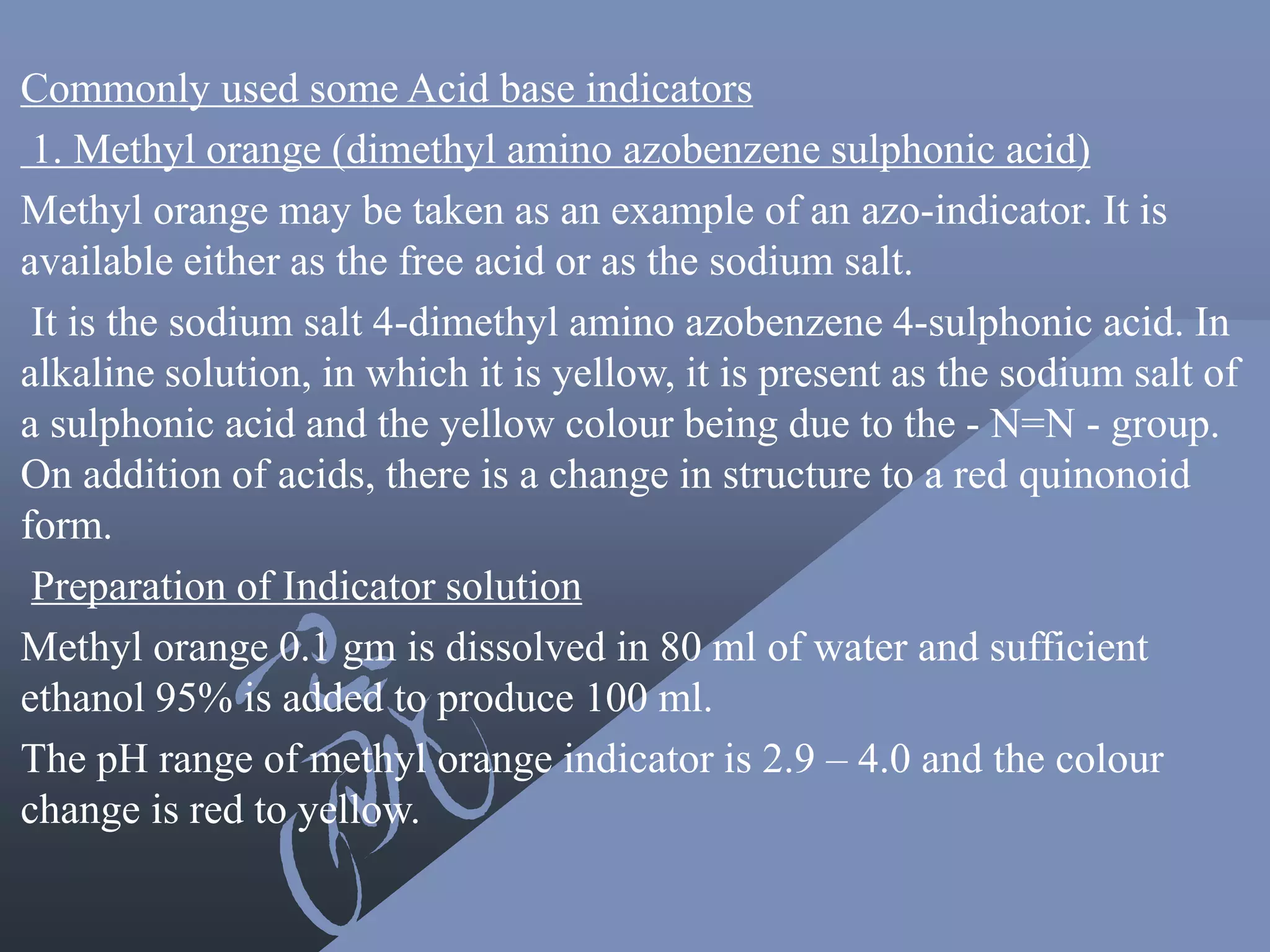
NEUTRALIZATION CURVES
Indicators used in acid base titrations
INDICATORS
Definition
Indicators may be defined as organic substances which show
well marked changes of colour in certain intervals of pH.
To explain the change in colour of indicators, three theories have
been proposed which briefly stated as follows.
1. The physico-chemical theory attributes the colour to certain
ions an increase in which causes the appearance of a new colour,
and a decrease in which causes the disappearance of a colour or
the appearance of a different colour.
2.The organic theory attributes the colour of indicator to certain
groupings of the elements in a compound, and the change in
colour to a change in molecular structure.
3. The colloidal theory assumes that indicators form colloidal
solutions, the change in colour of which is dependent upon
change in size of the colloidal particle.
The following rules should be observed in the use of indicators:
1. Use 3 drops of indicator test solution for a titration unless
otherwise directed.
2. When a strong acid is titrated with a strong alkali, or a strong alkali
with a strong acid methyl orange, methyl red, or phenolphthalein may be
used.
3. When a weak acid is titrated with a strong alkali, use phenolphthalein
as the indicator.
4. When a weak alkali is titrated with a strong acid, use methyl red as
the indicator.
5. A weak alkali should never be titrated with a weak acid, or
vice versa, since no indicator will give a sharp end point.
6. The appearance of a colour is more easily observable than
is the disappearance. Therefore, always titrate where possible to the
appearance of a colour.
These acid-base indicators are complex organic compound and
can be classified as:
1.Azo dyes
Methyl orange, Methyl red, Congo red, Chyrsoidine
2.Phthaleins
Phenolphthalein, Eosin", Fluorescein*
3.Sulphonphthaleins : Bromo cresol green, Bromo cresol
purple, Bromophenol blue, Bromothymol blue, cresol red,
phenol red, Thymol blue
4.Triphenyl methane dyes: Crystal violet, Rosaniline (magenta)
(*Adsorption indicator used in precipitation titration
Commonly used some Acid base indicators
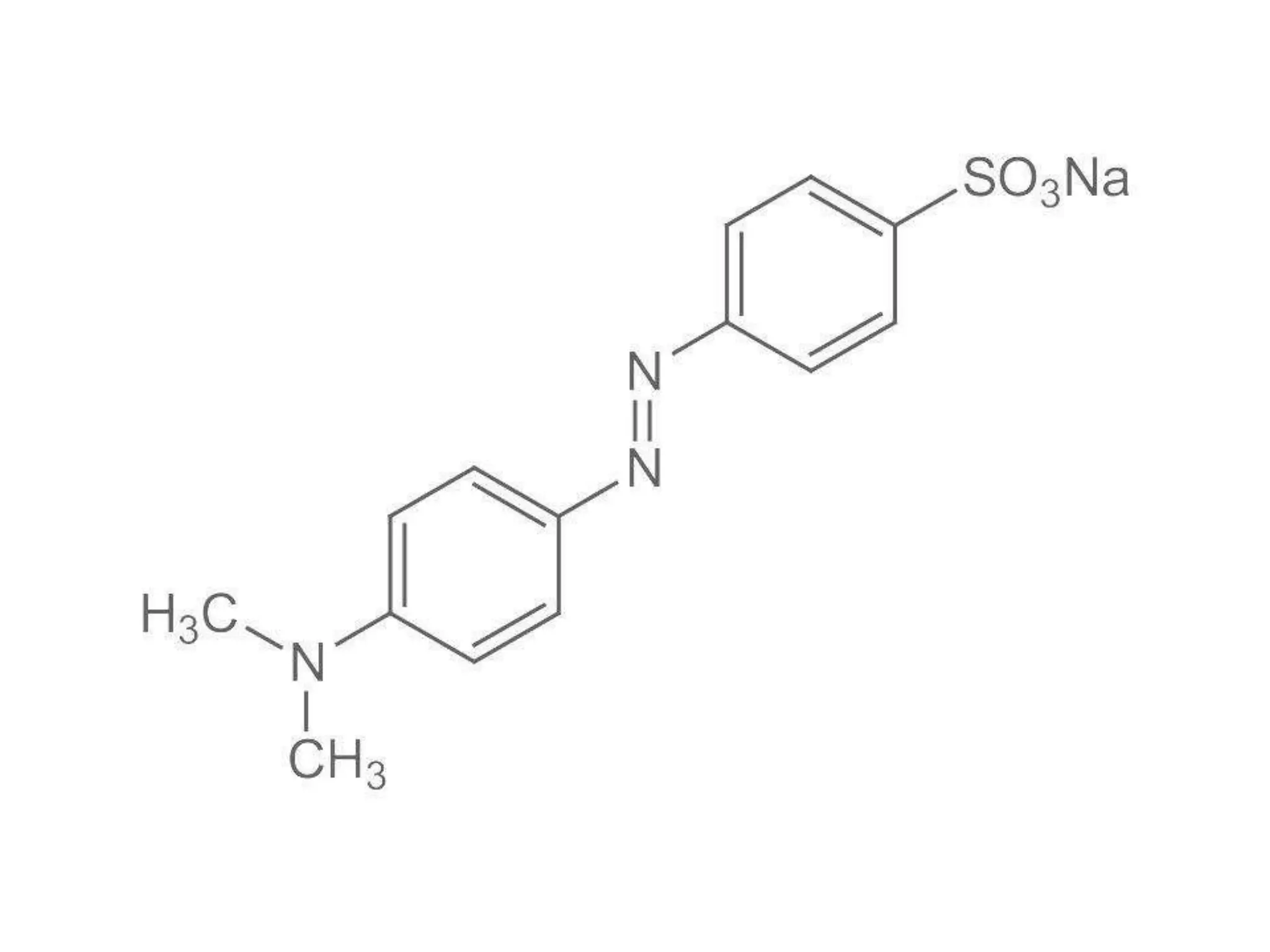
1. Methyl orange (dimethyl amino azobenzene sulphonic acid)
Methyl orange may be taken as an example of an azo-indicator. It is
available either as the free acid or as the sodium salt.
It is the sodium salt 4-dimethyl amino azobenzene 4-sulphonic acid. In
alkaline solution, in which it is yellow, it is present as the sodium salt of
a sulphonic acid and the yellow colour being due to the - N=N - group.
On addition of acids, there is a change in structure to a red quinonoid
form.
Preparation of Indicator solution
Methyl orange 0.1 gm is dissolved in 80 ml of water and sufficient
ethanol 95% is added to produce 100 ml.
The pH range of methyl orange indicator is 2.9 – 4.0 and the colour
change is red to yellow.
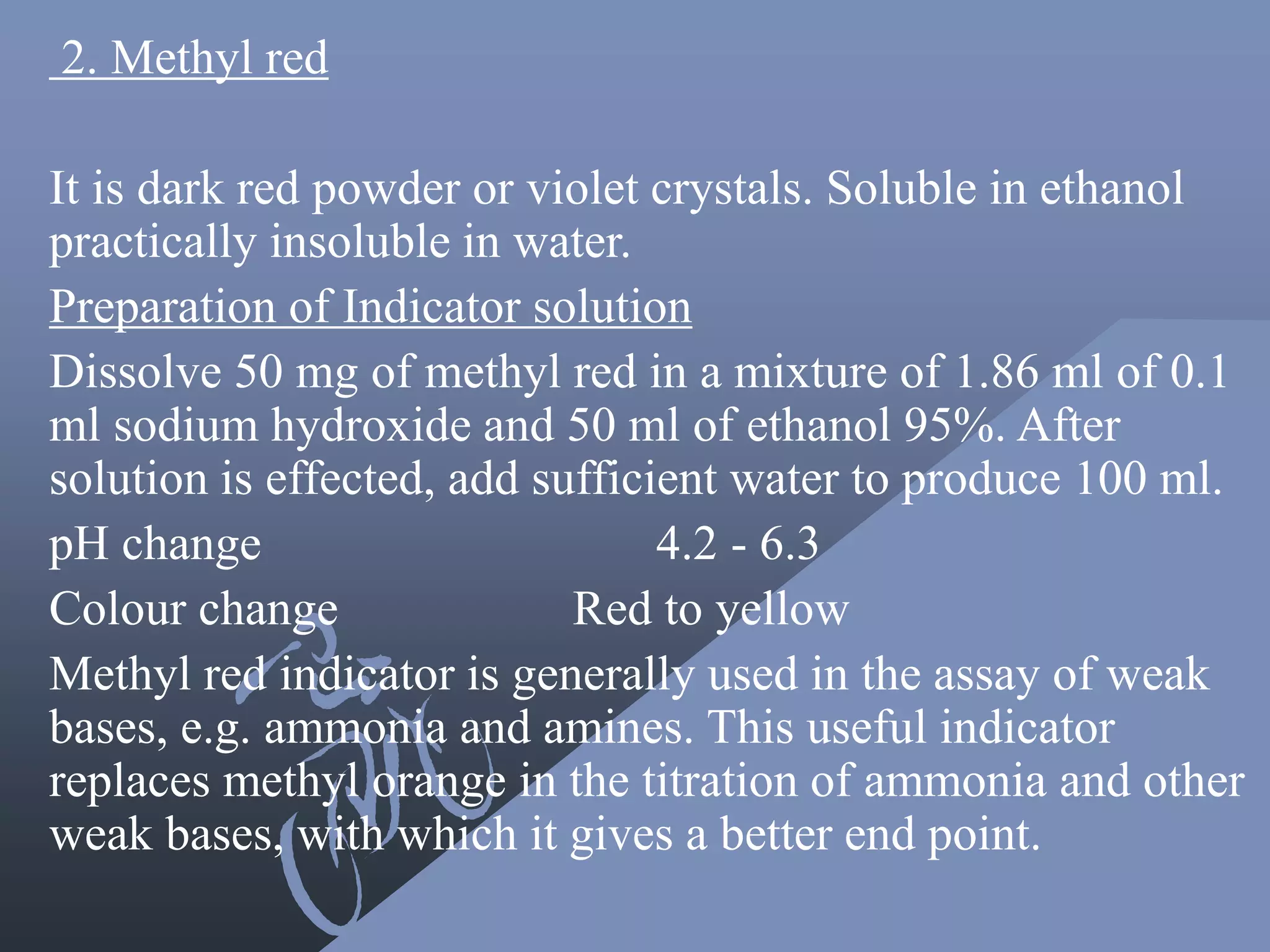
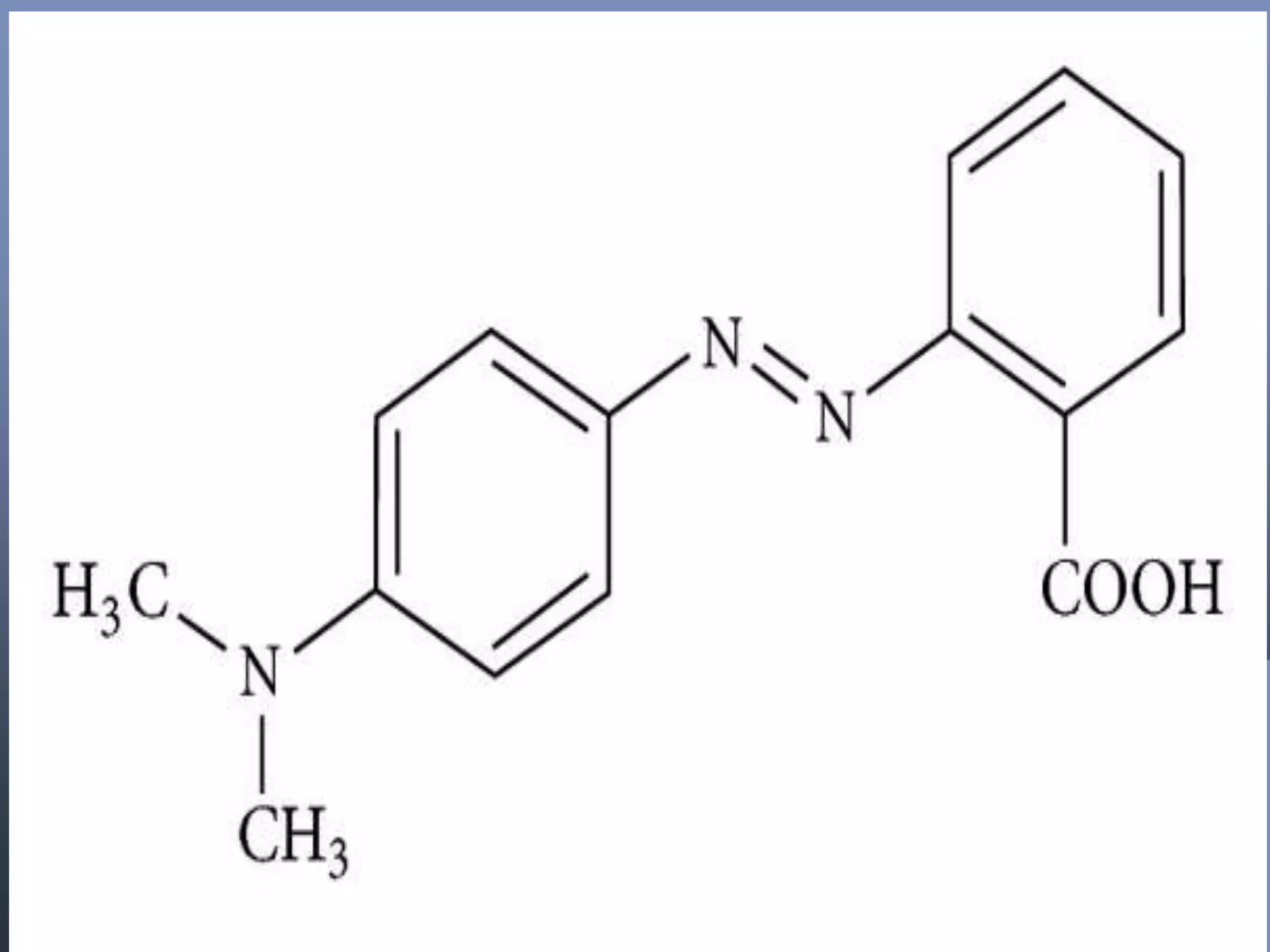
2. Methyl red
It is dark red powder or violet crystals. Soluble in ethanol
practically insoluble in water.
Preparation of Indicator solution
Dissolve 50 mg of methyl red in a mixture of 1.86 ml of 0.1
ml sodium hydroxide and 50 ml of ethanol 95%. After
solution is effected, add sufficient water to produce 100 ml.
pH change 4.2 - 6.3
Colour change Red to yellow
Methyl red indicator is generally used in the assay of weak
bases, e.g. ammonia and amines. This useful indicator
replaces methyl orange in the titration of ammonia and other
weak bases, with which it gives a better end point.
3. Congo Red
It is Diphenyl di azobis-1-naphthylamine sulphonic
acid
pH range 3.0 - 5.0
Colour change Blue to red
4. Phenolphthalein
•It is one of the simplest substances of the
phthaleins group is prepared by heating phthalic
anhydride with phenol in the presence of conc.
H2SO4 as a dehydrating agent.
•Phenolphthalein is the typical indicator, most
commonly used in acid base titration.
•It is a white crystalline powder, almost insoluble in
water, but readily soluble in alcohol.
•It is well known that, phenolphthalein which is
colourless in acid or neutral solution, becomes red
in slightly alkaline solution, and the red colour
fades in strongly alkaline solution.
PREPARATION OF INDICATOR SOLUTION
(i) Phenolphthalein solution
Dissolve 1 gm of phenolphthalein in 10 ml ethanol
95% and add sufficient quantity of ethiano 95% to
produce 100 ml.
(ii) Phenolphthalein solution Dilute
Dissolve 0.1 gm of phenolphthalein in 80 ml of
ethanol 95% and add sufficient water to produce
100 ml.
UNIVERSAL INDICATORS (Multiple-Range Indicators)
By mixing suitable indicators together changes in colour
may be obtained over a considerable portion of the pH
range. Such mixtures are usually called 'Universal
indicators'. They are not suitable for quantitative titrations,
but may be employed for the determination of the
approximate pH of a solution by the colorimetric method.
EXAMPLES
1. Methyl red - Thymol blue Universal Indicator
Methyl red 0.125 gm
Thymol blue 0.375 gm
Ethyl alcohol 70 % upto 100 ml
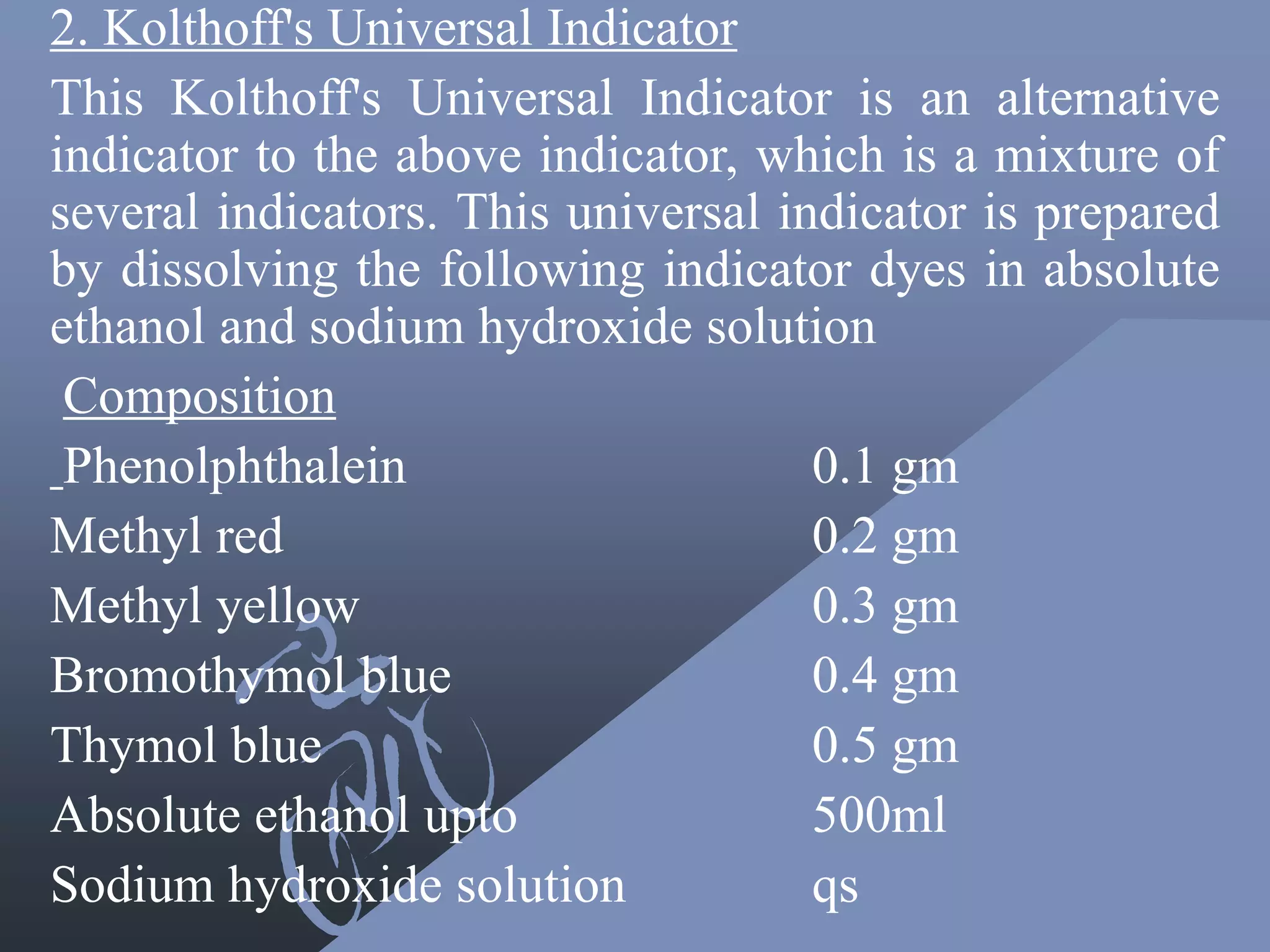
2. Kolthoff's Universal Indicator
This Kolthoff's Universal Indicator is an alternative
indicator to the above indicator, which is a mixture of
several indicators. This universal indicator is prepared
by dissolving the following indicator dyes in absolute
ethanol and sodium hydroxide solution
Composition
Phenolphthalein 0.1 gm
Methyl red 0.2 gm
Methyl yellow 0.3 gm
Bromothymol blue 0.4 gm
Thymol blue 0.5 gm
Absolute ethanol upto 500ml
Sodium hydroxide solution qs
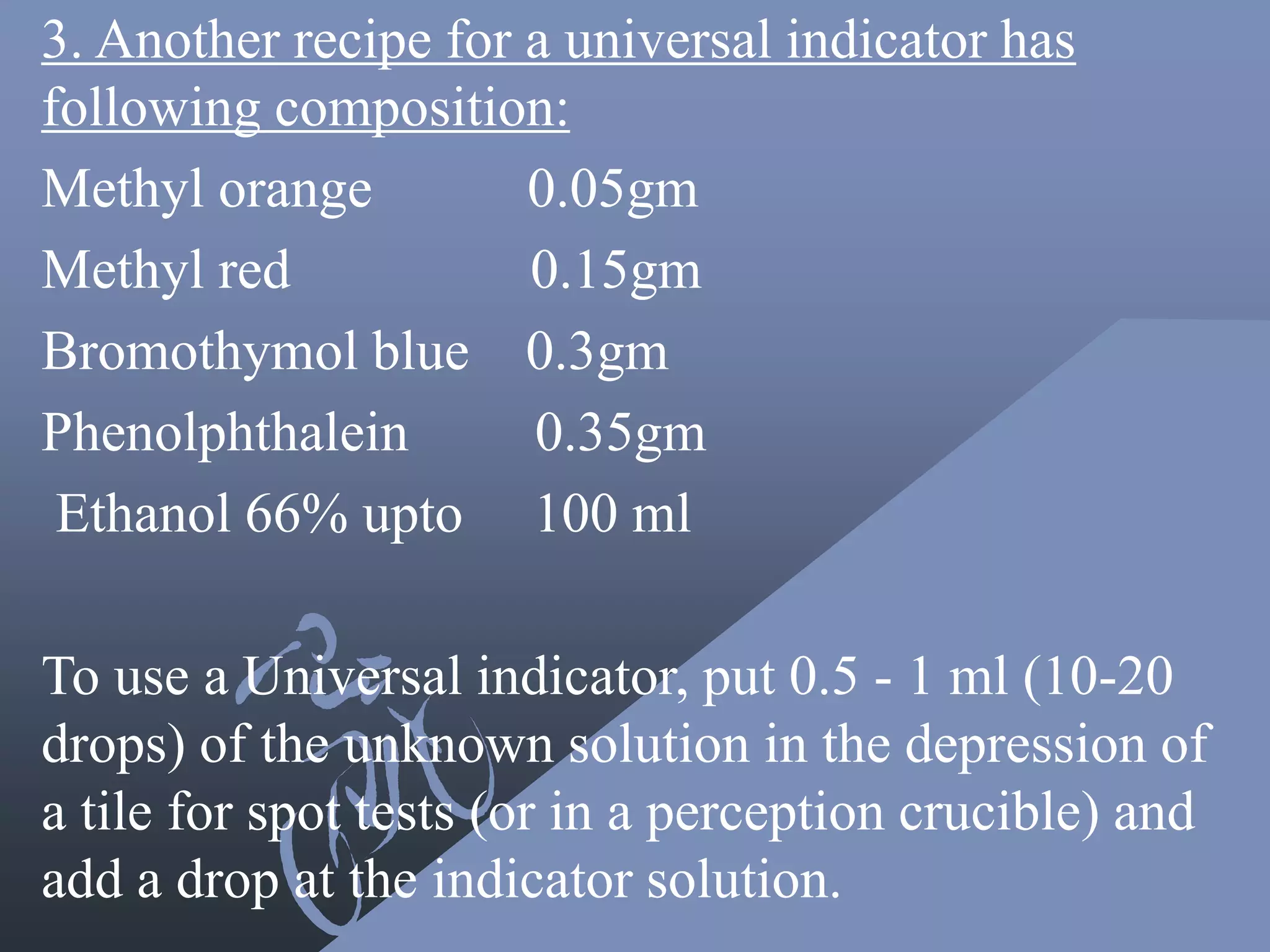
3. Another recipe for a universal indicator has
following composition:
Methyl orange 0.05gm
Methyl red 0.15gm
Bromothymol blue 0.3gm
Phenolphthalein 0.35gm
Ethanol 66% upto 100 ml
To use a Universal indicator, put 0.5 - 1 ml (10-20
drops) of the unknown solution in the depression of
a tile for spot tests (or in a perception crucible) and
add a drop at the indicator solution.
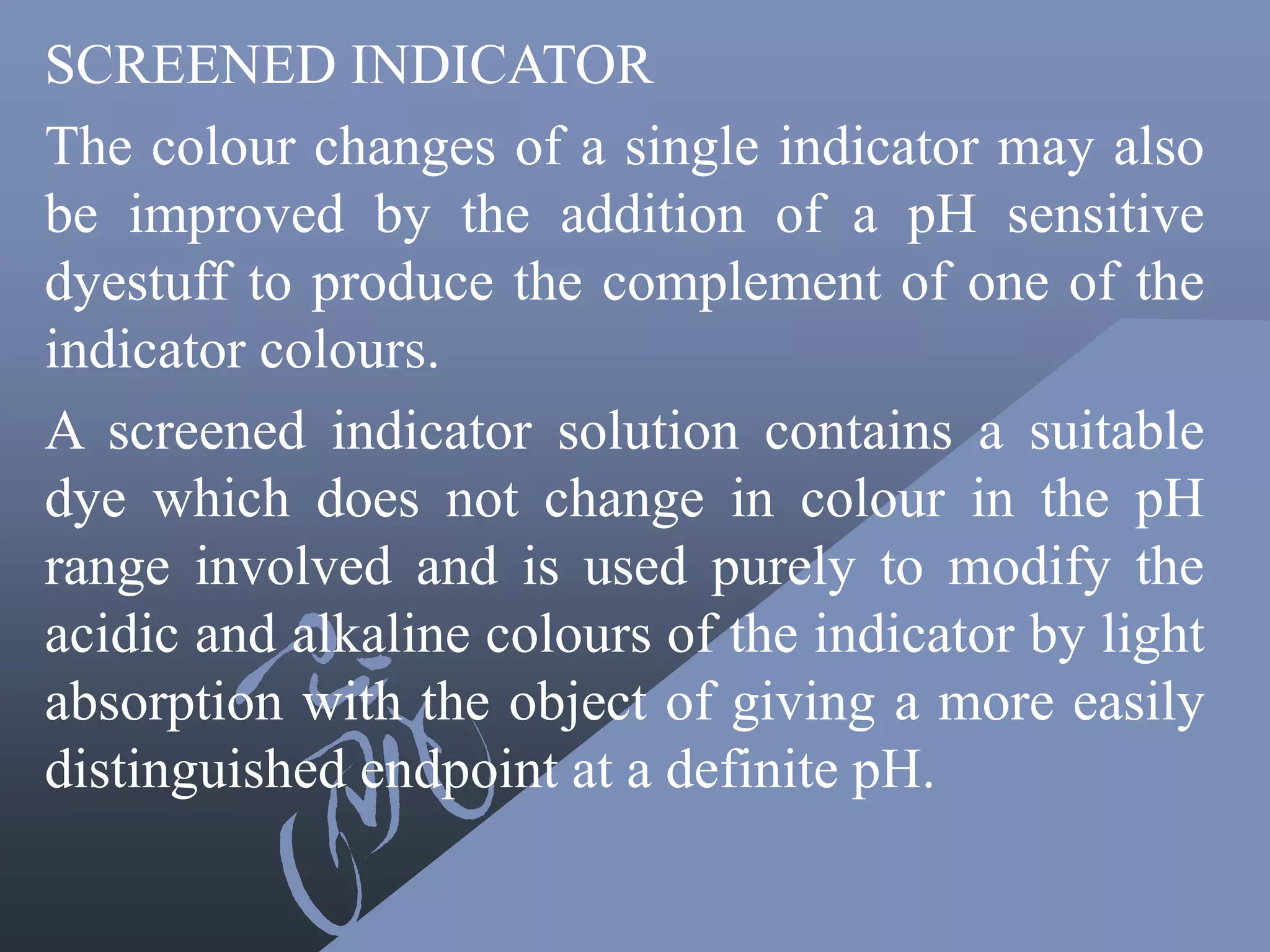
SCREENED INDICATOR
The colour changes of a single indicator may also
be improved by the addition of a pH sensitive
dyestuff to produce the complement of one of the
indicator colours.
A screened indicator solution contains a suitable
dye which does not change in colour in the pH
range involved and is used purely to modify the
acidic and alkaline colours of the indicator by light
absorption with the object of giving a more easily
distinguished endpoint at a definite pH.
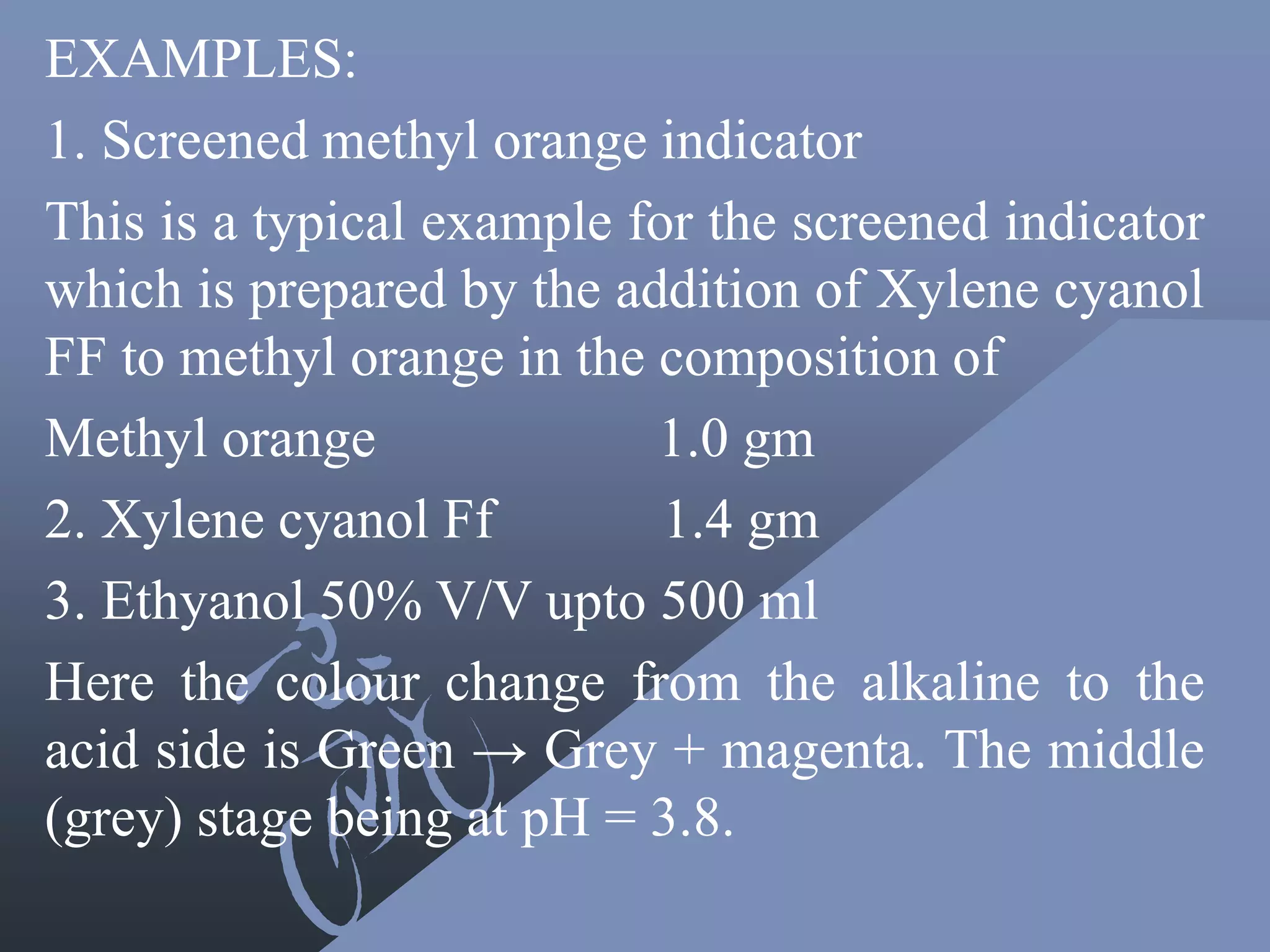
EXAMPLES:
1. Screened methyl orange indicator
This is a typical example for the screened indicator
which is prepared by the addition of Xylene cyanol
FF to methyl orange in the composition of
Methyl orange 1.0 gm
2. Xylene cyanol Ff 1.4 gm
3. Ethyanol 50% V/V upto 500 ml
Here the colour change from the alkaline to the
acid side is Green → Grey + magenta. The middle
(grey) stage being at pH = 3.8.
Screened Methyl red: (Methyl red with
methylene blue)
It has of course, the same range as
unscreened methyl red, but its colour change is
from red-violet (acid solution) to green (alkaline
solution).
Theory of Indicator Acid-base
Indicators
Theory of acid-base indicators: Two theories
have been proposed to explain the change of
colour of acid-base indicators with change in
pH.
•Ostwald's theory
•Quinonoid theory
1) Ostwald's theory
According to this theory:
•The colour change is due to ionisation of the acid-
base indicator. The unionised form has different
colour than the ionised form.
•The ionisation of the indicator is largely affected in
acids and bases as it is either a weak acid or a weak
base.
In case, the indicator is a weak acid, its ionisation is
very much low in acids due to common H+ ions
while it is fairly ionised in alkalies. Similarly if the
indicator is a weak base, its ionisation is large in
acids and low in alkalies due to common OH- ions.
Considering two important indicators phenolphthalein
(a weak acid) and methyl orange (a weak base),
Ostwald theory can be illustrated as follows:
Phenolphthalein: It can be represented as HPh.
It ionises in solution to a small extent as:
HPh ↔ H+ + Ph
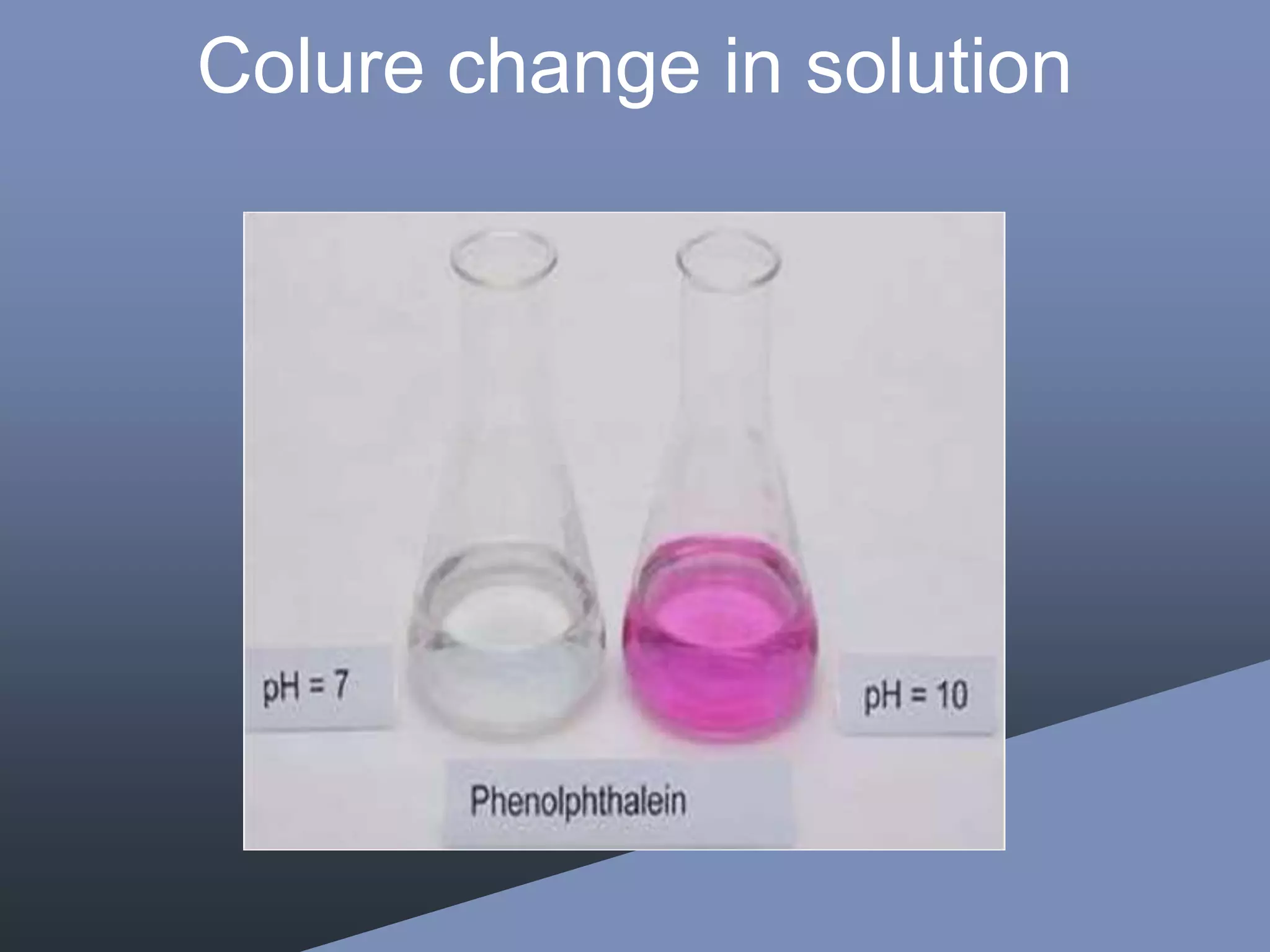
Colourles Pink
Applying law of mass action
K= [H+][Ph- ]/[HpH]
•The undissociated molecules of phenolphthalein are
colourless while Ph- ions are pink in colour.
•In presence of an acid the ionisation of HPh is
practically negligible as the equilibrium shifts to left
hand side due to high concentration of H+ ions. Thus,
the solution would remain colourless.
•On addition of alkali, hydrogen ions are removed by
OH- ions in the form of water molecules and the
equilibrium shifts to right hand side.
•Thus, the concentration of Ph- ions increases in
solution and they impart pink colour to the solution.
Colure change in solution
Methyl orange: It is a very weak base and can be
represented as MeOH. It is ionized in solution to give
Me+ and OH- ions.
MeOH↔ Me+ + OH-
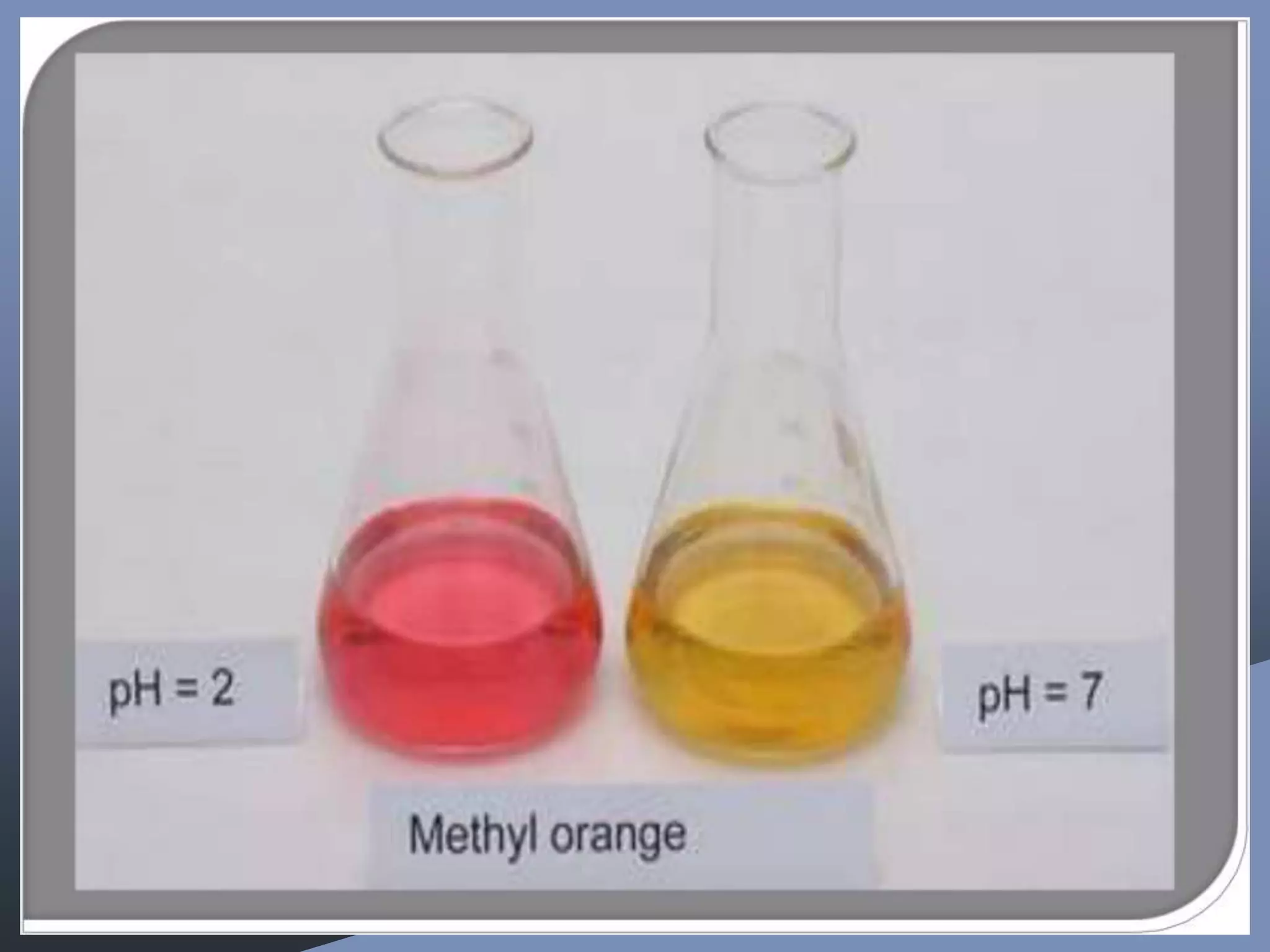
Yellow Red
•In presence of an acid, OH- ions are removed in the
form of water molecules and the above equilibrium shifts
to right hand side.
•Thus, sufficient Me+ ions are produced which impart red
colour to the solution. On addition of alkali, the
concentration of OH" ions increases in the solution and
the equilibrium shifts to left hand side, i.e., the ionisation
of MeOH is practically negligible. Thus, the solution
acquires the colour of unionised methyl orange
molecules, i.e., yellow.
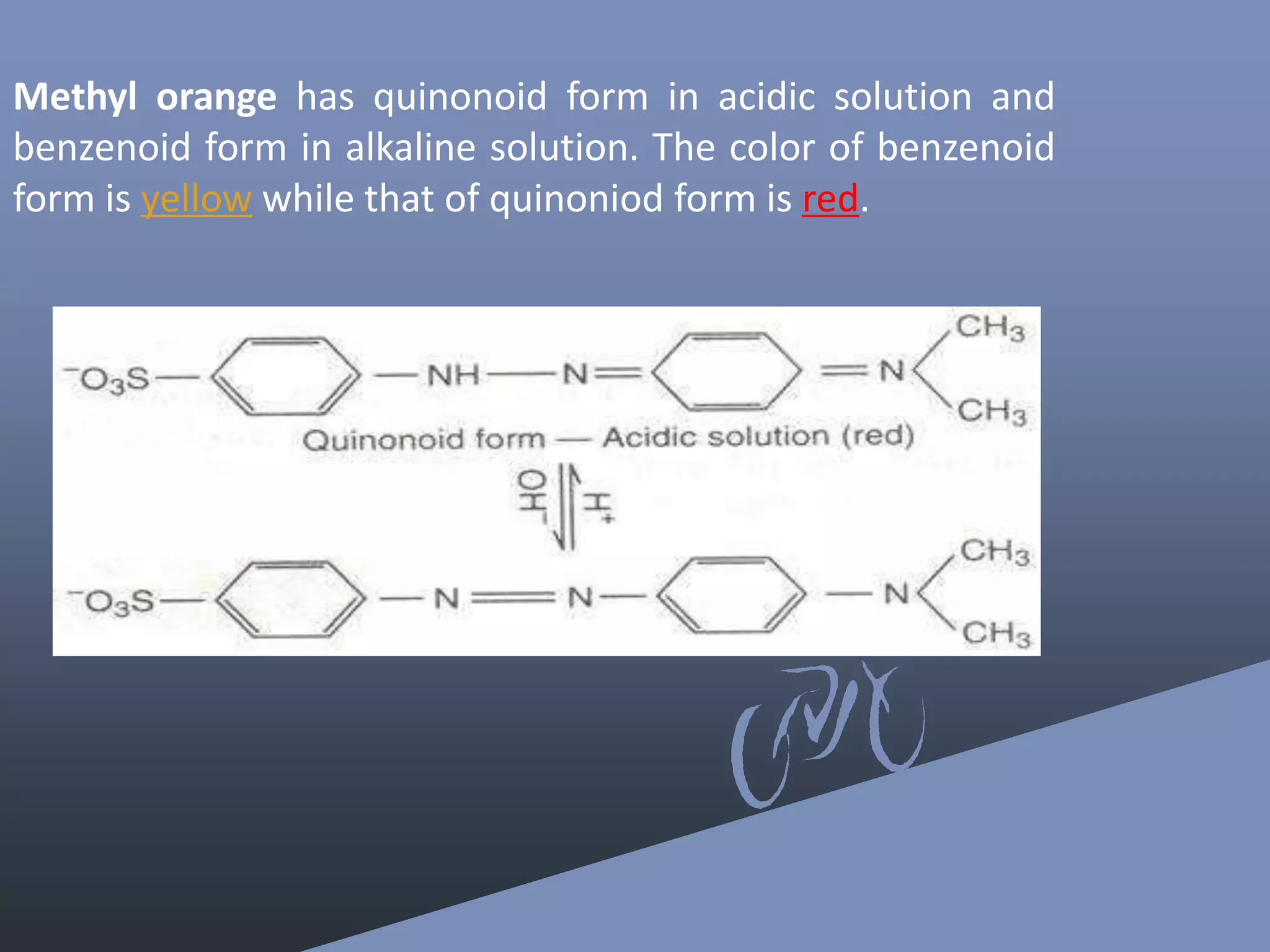
2) ​Quinonoid theory
• According to quinonoid theory, an acid-base
indicators exist in two tautomeric forms
having different structures which are in
equilibrium.
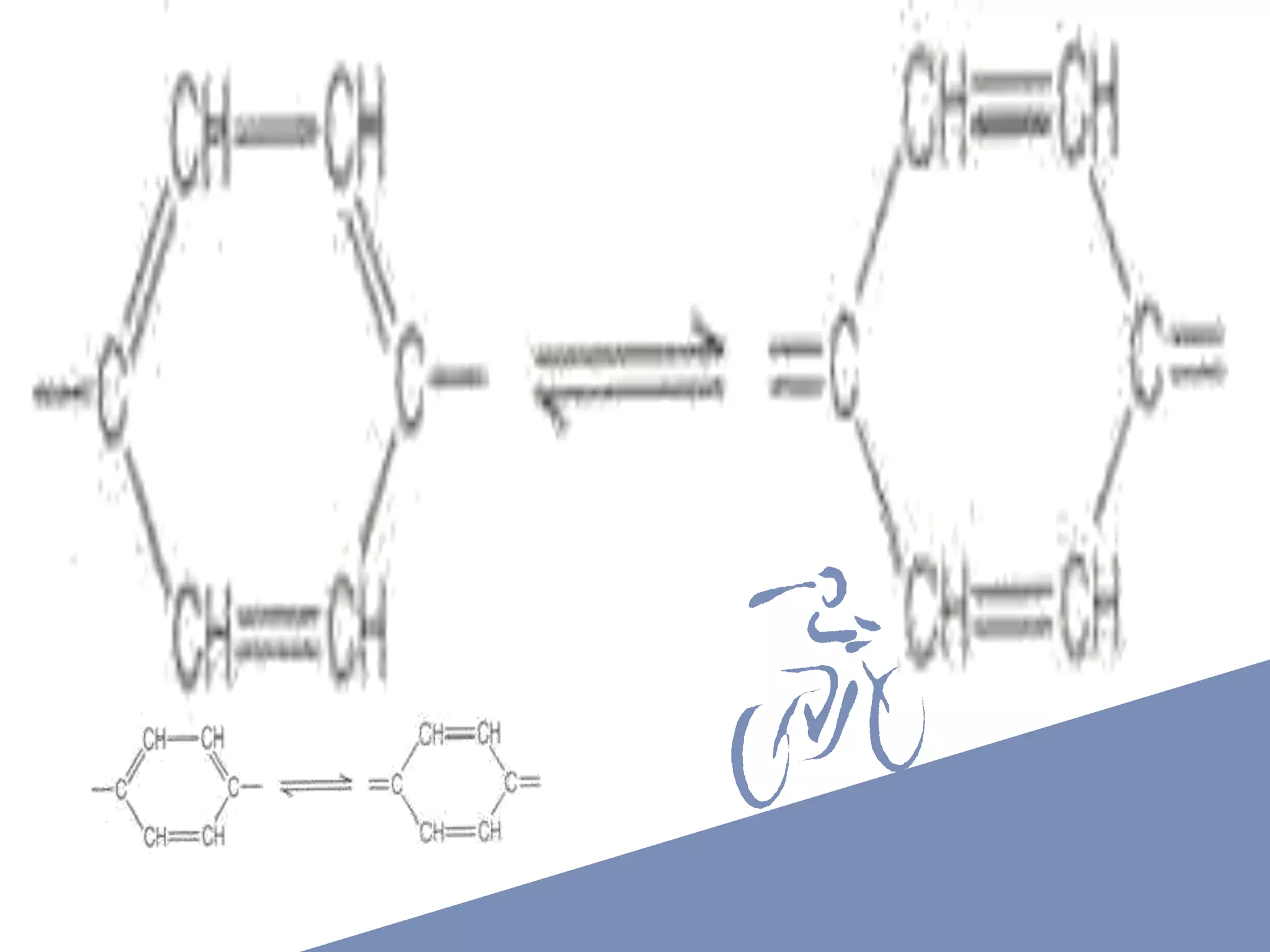
• One form is termed benzenoid form and the
other quinonoid form.
• The two forms have different colors. The color
change is due to the interconversation of one
tautomeric form into other. One form mainly
exists in acidic medium and the other in
alkaline medium.
• Thus, during titration the medium changes from
acidic to alkaline or vice-versa. The change in pH
converts one tautomeric form into other and
thus, the colour change occurs.
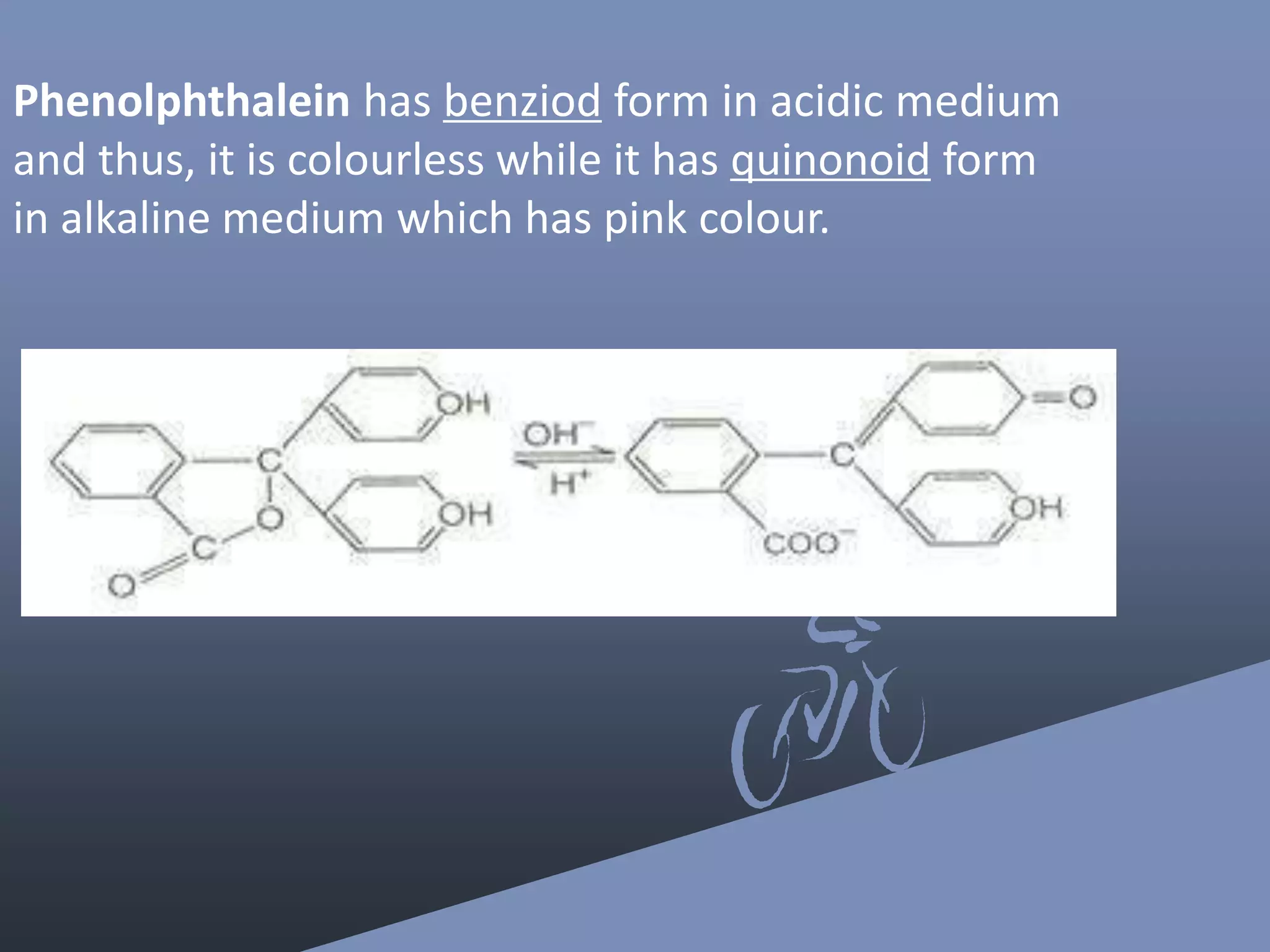
Phenolphthalein has benziod form in acidic medium
and thus, it is colourless while it has quinonoid form
in alkaline medium which has pink colour.
Methyl orange has quinonoid form in acidic solution and
benzenoid form in alkaline solution. The color of benzenoid
form is yellow while that of quinoniod form is red.
TYPES OF ACID BASE TITRATIONS
Aqueous acid base titration
It is the titration between acids and bases
dissolved in water.
Types of acid-base titrations:
1)strong acid – strong base titration
2)weak acid – strong base titration
3)strong acid – weak base titration
4) weak acid - weak base
strong acid – strong base titration
Strong acid + strong base ---->salt + H2O
Reaction occurs in stochiometric form
Each molecule of acid reacts with the corresponding
molecule
At the end point no molecule of acid and base exist
Hence endpoint is precise and sharp.
Example:
Acid: Hcl, H2SO4, HNO3, HBr, HclO4, H3PO4
Base: NaOH, MgOH2, Al2OH3
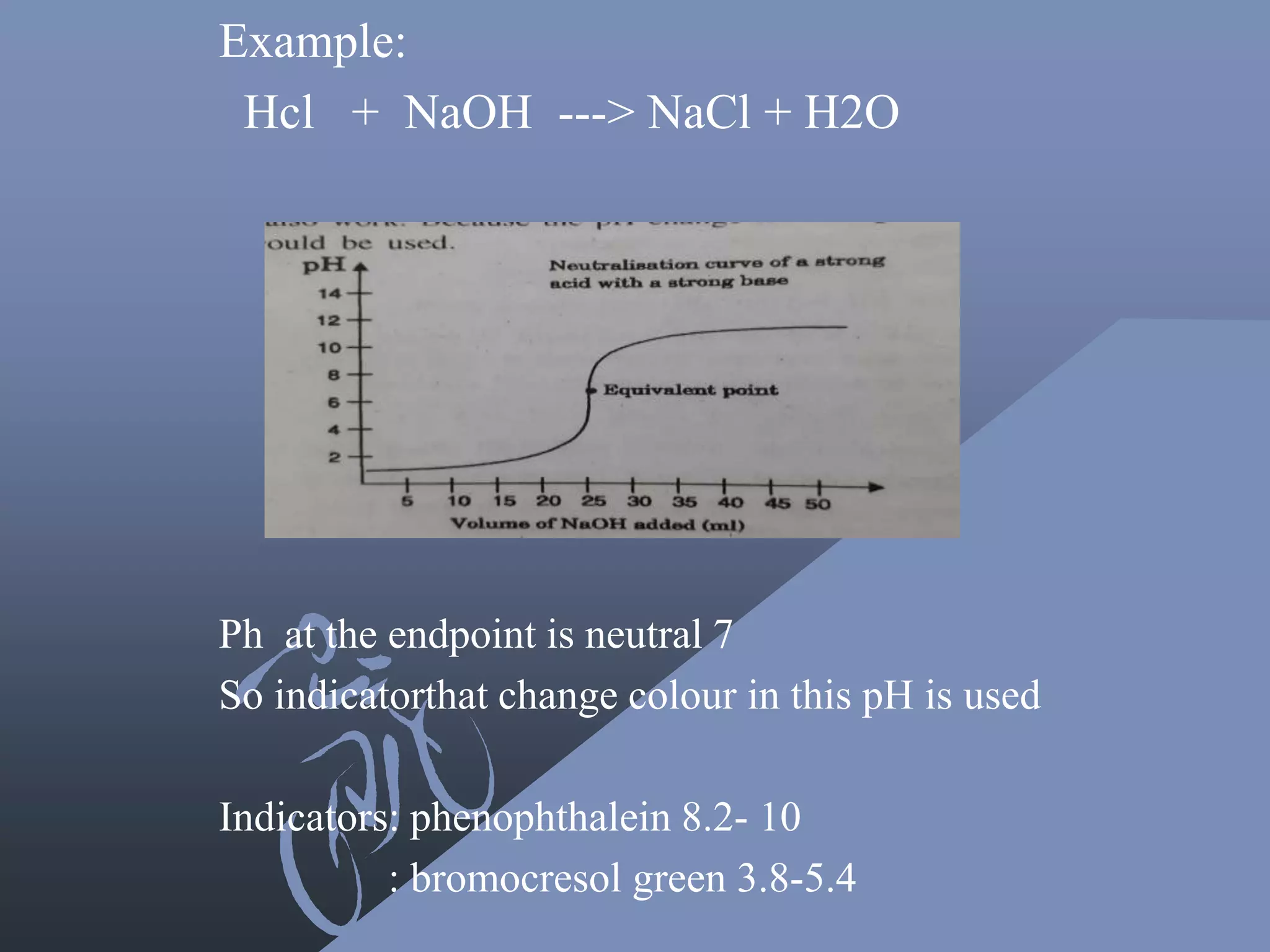
Example:
Hcl + NaOH ---> NaCl + H2O
Ph at the endpoint is neutral 7
So indicatorthat change colour in this pH is used
Indicators: phenophthalein 8.2- 10
: bromocresol green 3.8-5.4
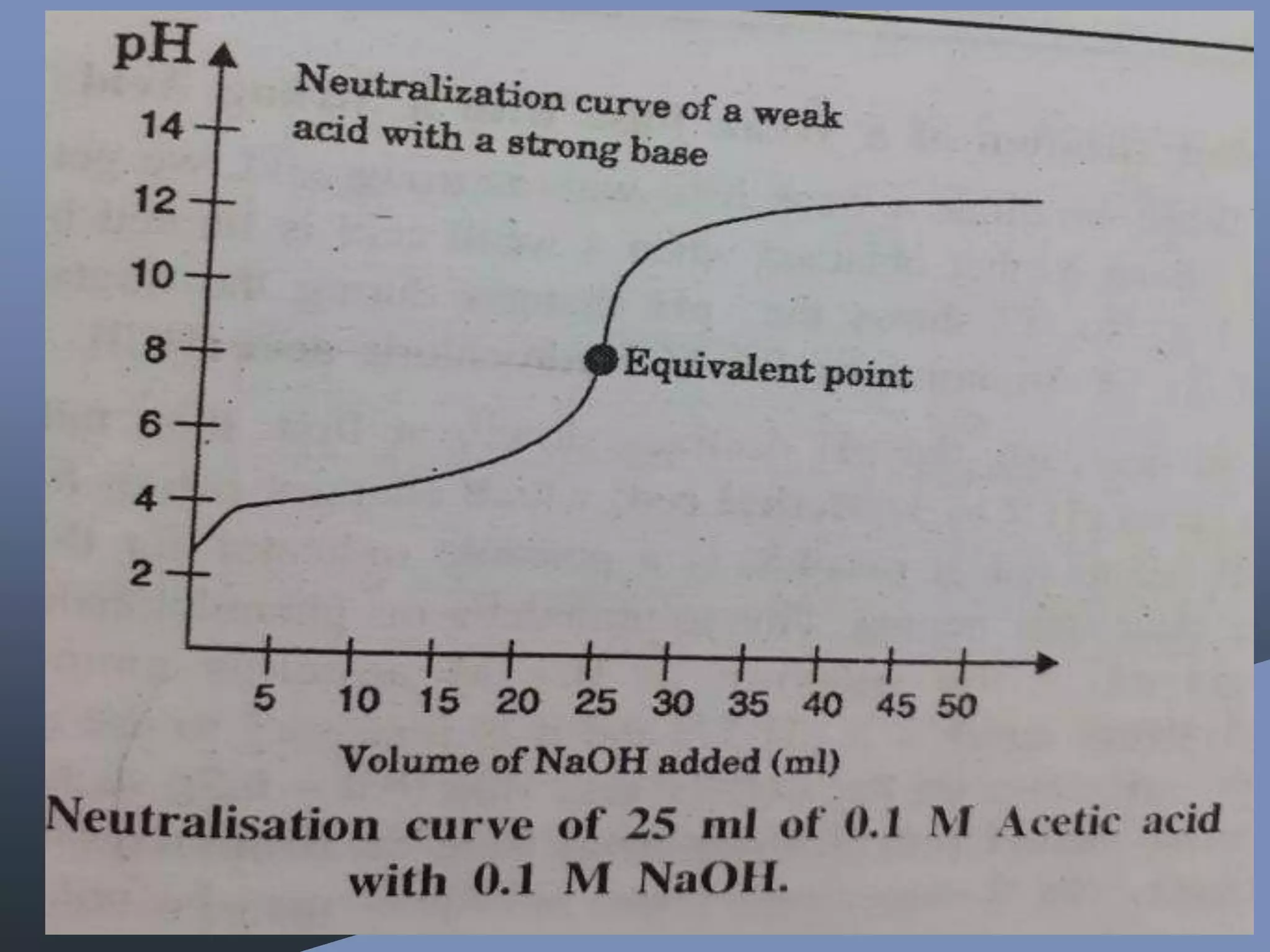
2)Titration with weak acid by strong base
0.1 M acetic acid with 0.1 M NaOH
• Titration starts at high pH because acetic acid
is weak acid
• pH changes slowly at first and rapidly
increases at equivalence point ( rapid change
occurs at pH 7-11)
• As pH range is shorter the choice of indicator
is more critical
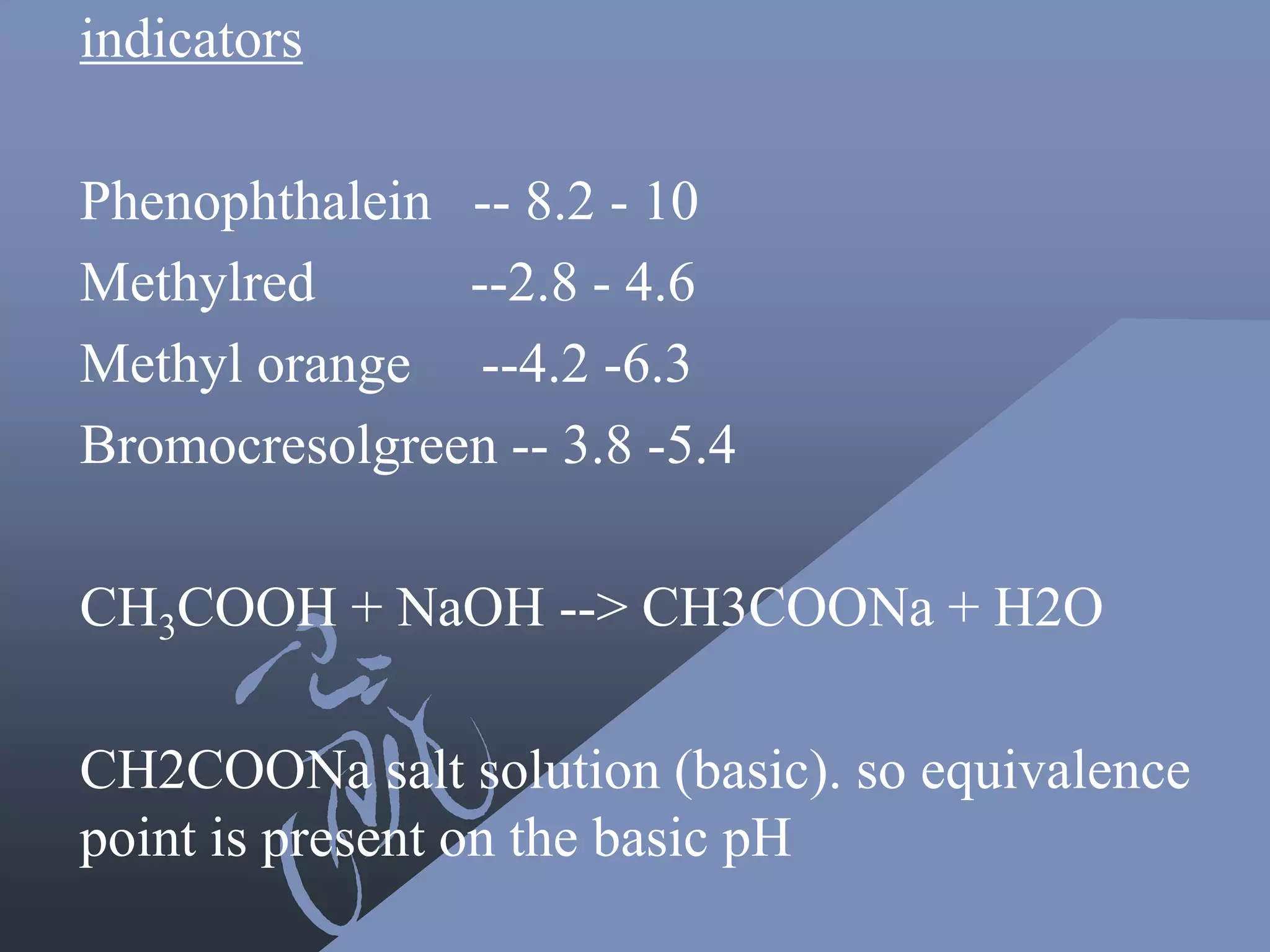
indicators
Phenophthalein -- 8.2 - 10
Methylred --2.8 - 4.6
Methyl orange --4.2 -6.3
Bromocresolgreen -- 3.8 -5.4
CH3COOH + NaOH --> CH3COONa + H2O
CH2COONa salt solution (basic). so equivalence
point is present on the basic pH
100 ml of 0.1 N CH3COOH solution is titrated with 0.1 N NaOH
We know
[H+][CH3COO-]
-------------------- = Kacid
CH3COOH
From law of mass action it is constant.
Initially
CH3COOH ---> H+ + CH3COO-
[H+][CH3COO-]
Kacid = --------------------
CH3COOH
[CH3COO-] = [H+]
[H+]2
Kacid = --------------------
CH3COOH
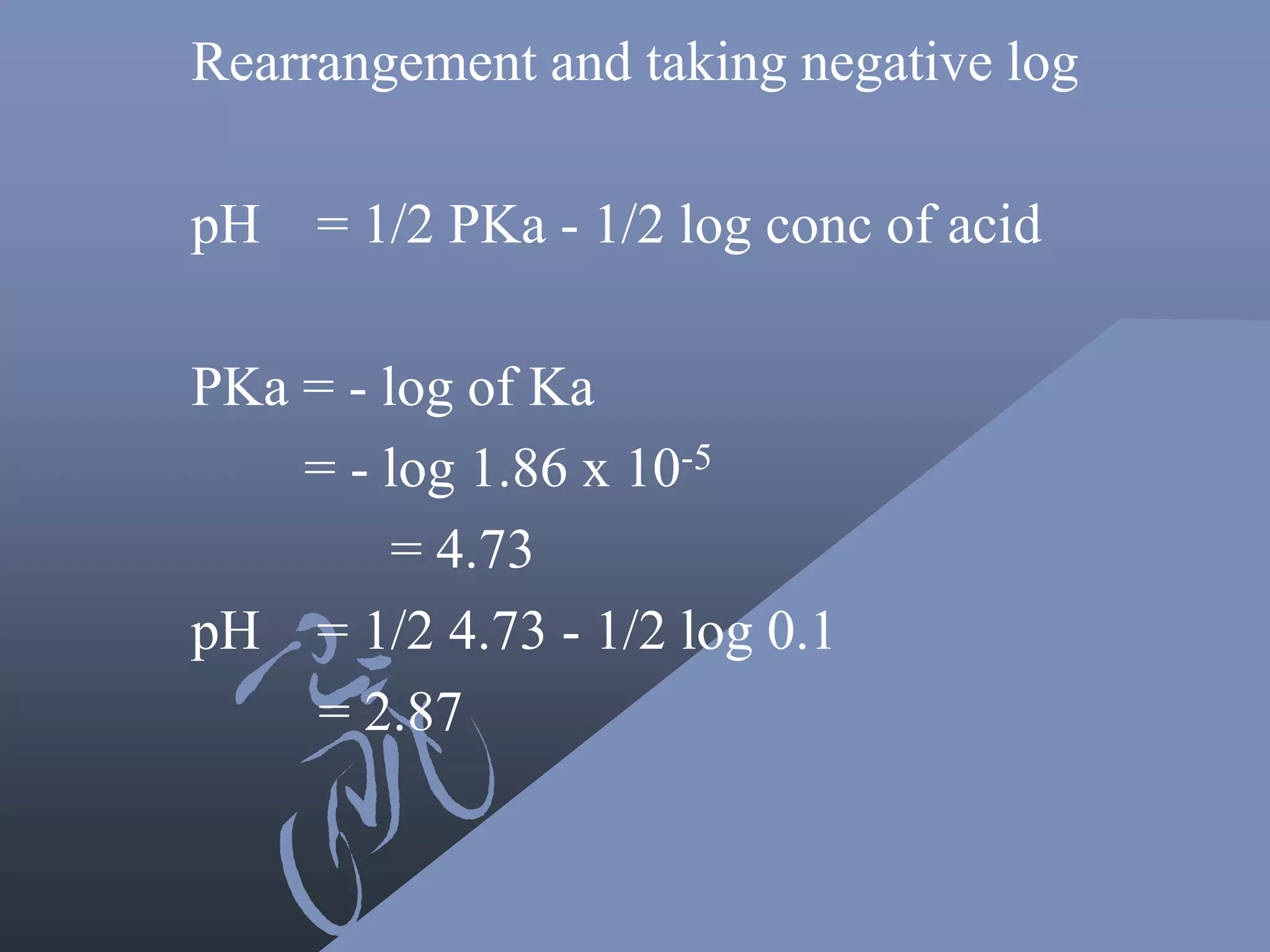
Rearrangement and taking negative log
pH = 1/2 PKa - 1/2 log conc of acid
PKa = - log of Ka
= - log 1.86 x 10-5
= 4.73
pH = 1/2 4.73 - 1/2 log 0.1
= 2.87
pH of intermediate points
pH = PKa - log [acid]/[salt]
Consider if 50% acetic acid is titrated with 50 ml of NaOH
Then pH = PKa - log [50]/[50]
= 4.73
Consider if 0.1 ml of acetic acid is remaining
Then,
pH = PKa - log [0.1]/[99.9]
= 7.73
pH at equivalance point
H20 + CH3COO- ---> CH3COOH + OH-
Partially hydrolyses becoz acetic acid is weaker acid . strong base does not
hydrolysis. Applying law of mass action,
[CH3COOH][ OH-]
------------------------ = K
[H20] [CH3COO- ]
pH = 7+ 1/2 PKa + 1/2 log conc of salt
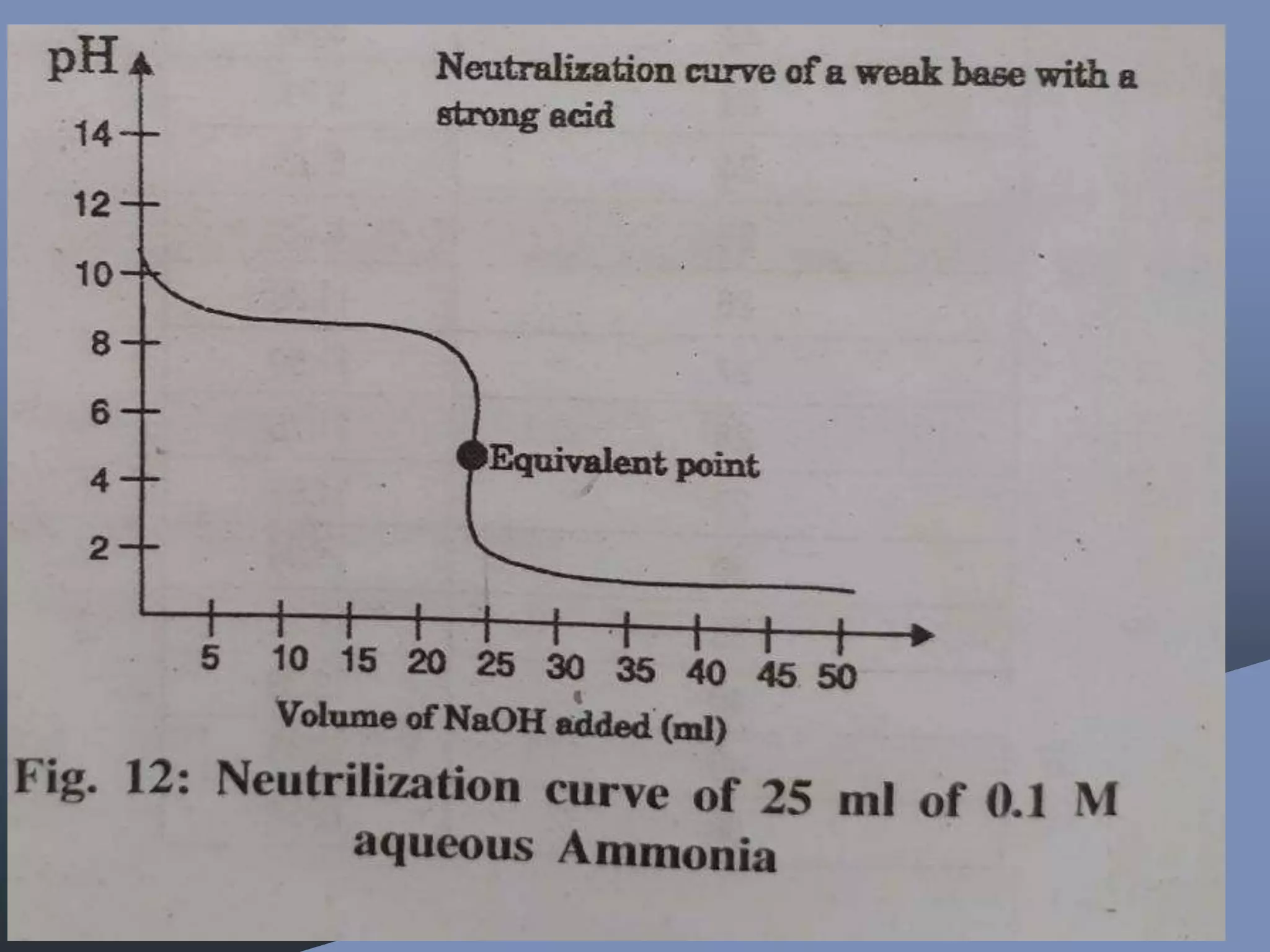
3)Titration of weak base with strong acid
NH4OH + HCL ---> NH4Cl + H2O
pH declines slowly at first and falls abruptly from pH 7 to 3.
Indicators: methyl red,
Methyl orange
Bromophenol blue
Bromocresolgreen
Equivalence point: 5.3 pH
Initial pH = 14 - 1/2 Pkbase + 1/2 log [base]
Intermediate pH = 14 - Pkbase + log [base]/[salt]
Equivalence point pH: 7-1/2 Pkbase - 1/2 log [salt]
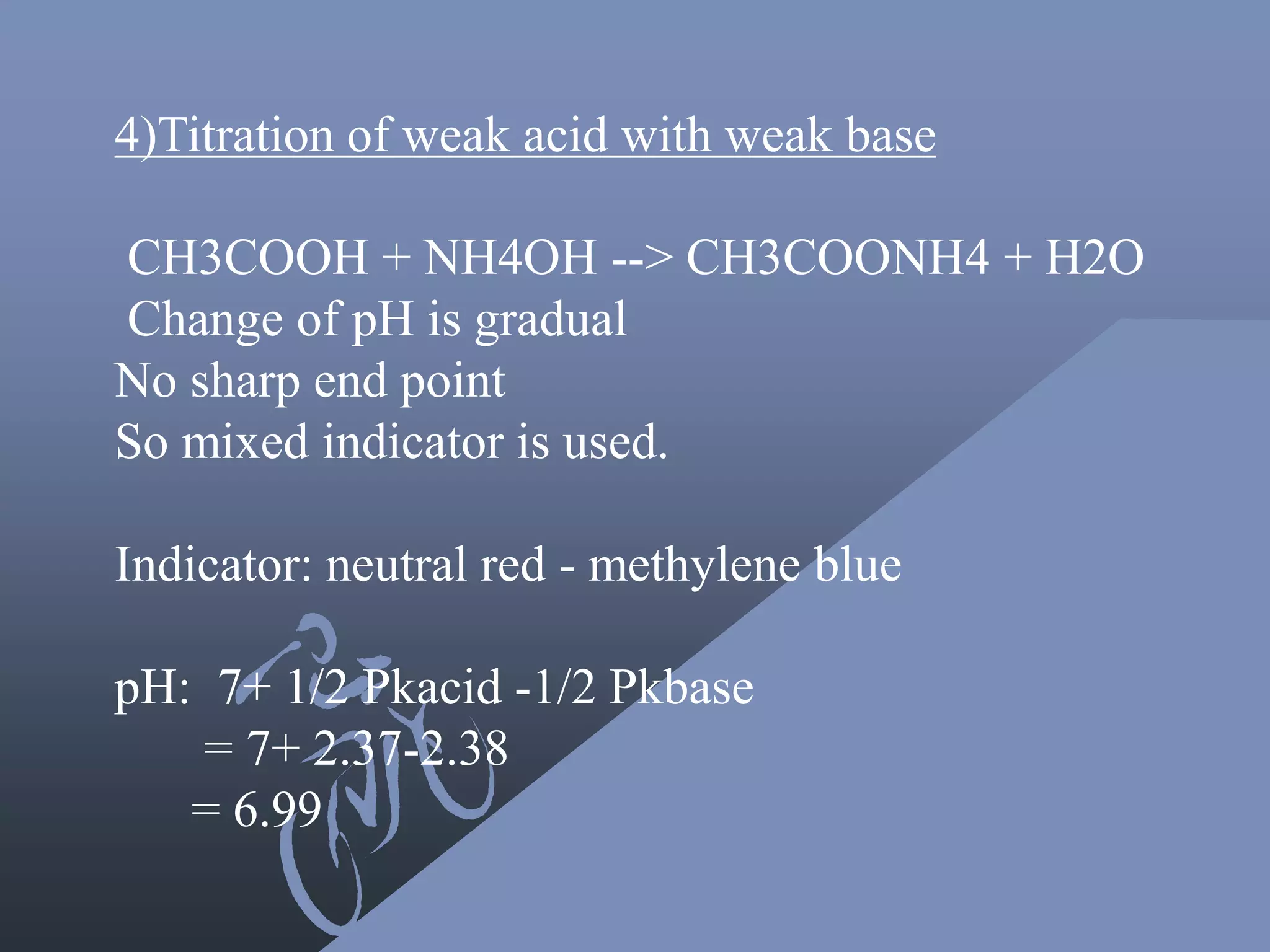
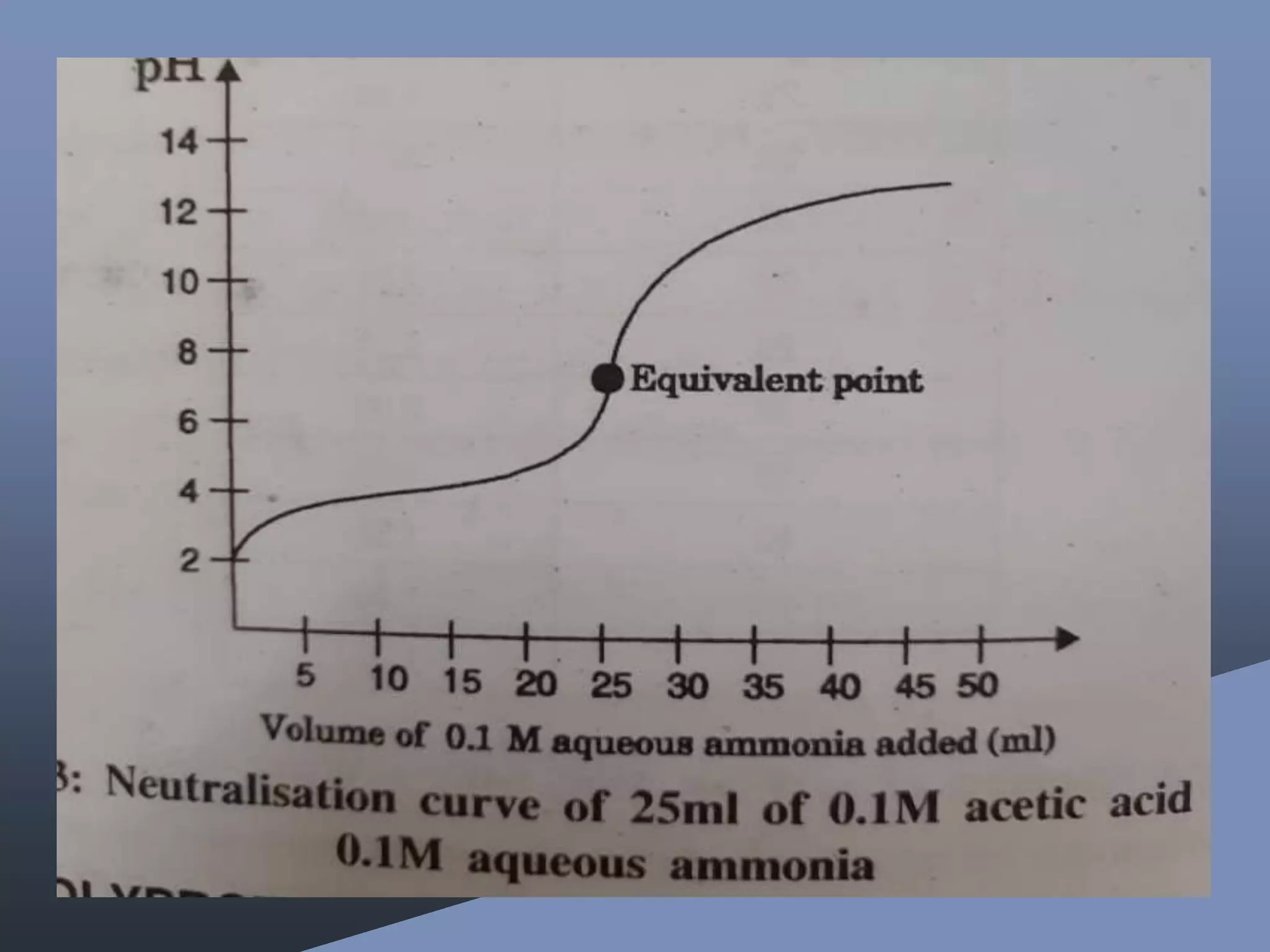
4)Titration of weak acid with weak base
CH3COOH + NH4OH --> CH3COONH4 + H2O
Change of pH is gradual
No sharp end point
So mixed indicator is used.
Indicator: neutral red - methylene blue
pH: 7+ 1/2 Pkacid -1/2 Pkbase
= 7+ 2.37-2.38
= 6.99
Neutralization curves in acid base analytical titrations, indicators.

Neutralization curves in acid base analytical titrations, indicators.

  • 1.
  • 2.
    INDICATORS Definition Indicators may bedefined as organic substances which show well marked changes of colour in certain intervals of pH. To explain the change in colour of indicators, three theories have been proposed which briefly stated as follows. 1. The physico-chemical theory attributes the colour to certain ions an increase in which causes the appearance of a new colour, and a decrease in which causes the disappearance of a colour or the appearance of a different colour. 2.The organic theory attributes the colour of indicator to certain groupings of the elements in a compound, and the change in colour to a change in molecular structure. 3. The colloidal theory assumes that indicators form colloidal solutions, the change in colour of which is dependent upon change in size of the colloidal particle.
  • 3.
    The following rulesshould be observed in the use of indicators: 1. Use 3 drops of indicator test solution for a titration unless otherwise directed. 2. When a strong acid is titrated with a strong alkali, or a strong alkali with a strong acid methyl orange, methyl red, or phenolphthalein may be used. 3. When a weak acid is titrated with a strong alkali, use phenolphthalein as the indicator. 4. When a weak alkali is titrated with a strong acid, use methyl red as the indicator. 5. A weak alkali should never be titrated with a weak acid, or vice versa, since no indicator will give a sharp end point. 6. The appearance of a colour is more easily observable than is the disappearance. Therefore, always titrate where possible to the appearance of a colour.
  • 4.
    These acid-base indicatorsare complex organic compound and can be classified as: 1.Azo dyes Methyl orange, Methyl red, Congo red, Chyrsoidine 2.Phthaleins Phenolphthalein, Eosin", Fluorescein* 3.Sulphonphthaleins : Bromo cresol green, Bromo cresol purple, Bromophenol blue, Bromothymol blue, cresol red, phenol red, Thymol blue 4.Triphenyl methane dyes: Crystal violet, Rosaniline (magenta) (*Adsorption indicator used in precipitation titration
  • 5.
    Commonly used someAcid base indicators 1. Methyl orange (dimethyl amino azobenzene sulphonic acid) Methyl orange may be taken as an example of an azo-indicator. It is available either as the free acid or as the sodium salt. It is the sodium salt 4-dimethyl amino azobenzene 4-sulphonic acid. In alkaline solution, in which it is yellow, it is present as the sodium salt of a sulphonic acid and the yellow colour being due to the - N=N - group. On addition of acids, there is a change in structure to a red quinonoid form. Preparation of Indicator solution Methyl orange 0.1 gm is dissolved in 80 ml of water and sufficient ethanol 95% is added to produce 100 ml. The pH range of methyl orange indicator is 2.9 – 4.0 and the colour change is red to yellow.
  • 7.
    2. Methyl red Itis dark red powder or violet crystals. Soluble in ethanol practically insoluble in water. Preparation of Indicator solution Dissolve 50 mg of methyl red in a mixture of 1.86 ml of 0.1 ml sodium hydroxide and 50 ml of ethanol 95%. After solution is effected, add sufficient water to produce 100 ml. pH change 4.2 - 6.3 Colour change Red to yellow Methyl red indicator is generally used in the assay of weak bases, e.g. ammonia and amines. This useful indicator replaces methyl orange in the titration of ammonia and other weak bases, with which it gives a better end point.
  • 9.
    3. Congo Red Itis Diphenyl di azobis-1-naphthylamine sulphonic acid pH range 3.0 - 5.0 Colour change Blue to red
  • 10.
    4. Phenolphthalein •It isone of the simplest substances of the phthaleins group is prepared by heating phthalic anhydride with phenol in the presence of conc. H2SO4 as a dehydrating agent. •Phenolphthalein is the typical indicator, most commonly used in acid base titration. •It is a white crystalline powder, almost insoluble in water, but readily soluble in alcohol. •It is well known that, phenolphthalein which is colourless in acid or neutral solution, becomes red in slightly alkaline solution, and the red colour fades in strongly alkaline solution.
  • 11.
    PREPARATION OF INDICATORSOLUTION (i) Phenolphthalein solution Dissolve 1 gm of phenolphthalein in 10 ml ethanol 95% and add sufficient quantity of ethiano 95% to produce 100 ml. (ii) Phenolphthalein solution Dilute Dissolve 0.1 gm of phenolphthalein in 80 ml of ethanol 95% and add sufficient water to produce 100 ml.
  • 12.
    UNIVERSAL INDICATORS (Multiple-RangeIndicators) By mixing suitable indicators together changes in colour may be obtained over a considerable portion of the pH range. Such mixtures are usually called 'Universal indicators'. They are not suitable for quantitative titrations, but may be employed for the determination of the approximate pH of a solution by the colorimetric method. EXAMPLES 1. Methyl red - Thymol blue Universal Indicator Methyl red 0.125 gm Thymol blue 0.375 gm Ethyl alcohol 70 % upto 100 ml
  • 13.
    2. Kolthoff's UniversalIndicator This Kolthoff's Universal Indicator is an alternative indicator to the above indicator, which is a mixture of several indicators. This universal indicator is prepared by dissolving the following indicator dyes in absolute ethanol and sodium hydroxide solution Composition Phenolphthalein 0.1 gm Methyl red 0.2 gm Methyl yellow 0.3 gm Bromothymol blue 0.4 gm Thymol blue 0.5 gm Absolute ethanol upto 500ml Sodium hydroxide solution qs
  • 14.
    3. Another recipefor a universal indicator has following composition: Methyl orange 0.05gm Methyl red 0.15gm Bromothymol blue 0.3gm Phenolphthalein 0.35gm Ethanol 66% upto 100 ml To use a Universal indicator, put 0.5 - 1 ml (10-20 drops) of the unknown solution in the depression of a tile for spot tests (or in a perception crucible) and add a drop at the indicator solution.
  • 15.
    SCREENED INDICATOR The colourchanges of a single indicator may also be improved by the addition of a pH sensitive dyestuff to produce the complement of one of the indicator colours. A screened indicator solution contains a suitable dye which does not change in colour in the pH range involved and is used purely to modify the acidic and alkaline colours of the indicator by light absorption with the object of giving a more easily distinguished endpoint at a definite pH.
  • 16.
    EXAMPLES: 1. Screened methylorange indicator This is a typical example for the screened indicator which is prepared by the addition of Xylene cyanol FF to methyl orange in the composition of Methyl orange 1.0 gm 2. Xylene cyanol Ff 1.4 gm 3. Ethyanol 50% V/V upto 500 ml Here the colour change from the alkaline to the acid side is Green → Grey + magenta. The middle (grey) stage being at pH = 3.8.
  • 17.
    Screened Methyl red:(Methyl red with methylene blue) It has of course, the same range as unscreened methyl red, but its colour change is from red-violet (acid solution) to green (alkaline solution).
  • 18.
    Theory of IndicatorAcid-base Indicators
  • 19.
    Theory of acid-baseindicators: Two theories have been proposed to explain the change of colour of acid-base indicators with change in pH. •Ostwald's theory •Quinonoid theory
  • 20.
    1) Ostwald's theory Accordingto this theory: •The colour change is due to ionisation of the acid- base indicator. The unionised form has different colour than the ionised form. •The ionisation of the indicator is largely affected in acids and bases as it is either a weak acid or a weak base. In case, the indicator is a weak acid, its ionisation is very much low in acids due to common H+ ions while it is fairly ionised in alkalies. Similarly if the indicator is a weak base, its ionisation is large in acids and low in alkalies due to common OH- ions.
  • 21.
    Considering two importantindicators phenolphthalein (a weak acid) and methyl orange (a weak base), Ostwald theory can be illustrated as follows: Phenolphthalein: It can be represented as HPh. It ionises in solution to a small extent as: HPh ↔ H+ + Ph Colourles Pink
  • 22.
    Applying law ofmass action K= [H+][Ph- ]/[HpH] •The undissociated molecules of phenolphthalein are colourless while Ph- ions are pink in colour. •In presence of an acid the ionisation of HPh is practically negligible as the equilibrium shifts to left hand side due to high concentration of H+ ions. Thus, the solution would remain colourless. •On addition of alkali, hydrogen ions are removed by OH- ions in the form of water molecules and the equilibrium shifts to right hand side. •Thus, the concentration of Ph- ions increases in solution and they impart pink colour to the solution.
  • 23.
  • 24.
    Methyl orange: Itis a very weak base and can be represented as MeOH. It is ionized in solution to give Me+ and OH- ions. MeOH↔ Me+ + OH- Yellow Red •In presence of an acid, OH- ions are removed in the form of water molecules and the above equilibrium shifts to right hand side. •Thus, sufficient Me+ ions are produced which impart red colour to the solution. On addition of alkali, the concentration of OH" ions increases in the solution and the equilibrium shifts to left hand side, i.e., the ionisation of MeOH is practically negligible. Thus, the solution acquires the colour of unionised methyl orange molecules, i.e., yellow.
  • 26.
    2) ​Quinonoid theory •According to quinonoid theory, an acid-base indicators exist in two tautomeric forms having different structures which are in equilibrium. • One form is termed benzenoid form and the other quinonoid form.
  • 27.
    • The twoforms have different colors. The color change is due to the interconversation of one tautomeric form into other. One form mainly exists in acidic medium and the other in alkaline medium. • Thus, during titration the medium changes from acidic to alkaline or vice-versa. The change in pH converts one tautomeric form into other and thus, the colour change occurs.
  • 29.
    Phenolphthalein has benziodform in acidic medium and thus, it is colourless while it has quinonoid form in alkaline medium which has pink colour.
  • 30.
    Methyl orange hasquinonoid form in acidic solution and benzenoid form in alkaline solution. The color of benzenoid form is yellow while that of quinoniod form is red.
  • 31.
    TYPES OF ACIDBASE TITRATIONS Aqueous acid base titration It is the titration between acids and bases dissolved in water. Types of acid-base titrations: 1)strong acid – strong base titration 2)weak acid – strong base titration 3)strong acid – weak base titration 4) weak acid - weak base
  • 32.
    strong acid –strong base titration Strong acid + strong base ---->salt + H2O Reaction occurs in stochiometric form Each molecule of acid reacts with the corresponding molecule At the end point no molecule of acid and base exist Hence endpoint is precise and sharp. Example: Acid: Hcl, H2SO4, HNO3, HBr, HclO4, H3PO4 Base: NaOH, MgOH2, Al2OH3
  • 33.
    Example: Hcl + NaOH---> NaCl + H2O Ph at the endpoint is neutral 7 So indicatorthat change colour in this pH is used Indicators: phenophthalein 8.2- 10 : bromocresol green 3.8-5.4
  • 34.
    2)Titration with weakacid by strong base 0.1 M acetic acid with 0.1 M NaOH • Titration starts at high pH because acetic acid is weak acid • pH changes slowly at first and rapidly increases at equivalence point ( rapid change occurs at pH 7-11) • As pH range is shorter the choice of indicator is more critical
  • 36.
    indicators Phenophthalein -- 8.2- 10 Methylred --2.8 - 4.6 Methyl orange --4.2 -6.3 Bromocresolgreen -- 3.8 -5.4 CH3COOH + NaOH --> CH3COONa + H2O CH2COONa salt solution (basic). so equivalence point is present on the basic pH
  • 37.
    100 ml of0.1 N CH3COOH solution is titrated with 0.1 N NaOH We know [H+][CH3COO-] -------------------- = Kacid CH3COOH From law of mass action it is constant. Initially CH3COOH ---> H+ + CH3COO- [H+][CH3COO-] Kacid = -------------------- CH3COOH [CH3COO-] = [H+] [H+]2 Kacid = -------------------- CH3COOH
  • 38.
    Rearrangement and takingnegative log pH = 1/2 PKa - 1/2 log conc of acid PKa = - log of Ka = - log 1.86 x 10-5 = 4.73 pH = 1/2 4.73 - 1/2 log 0.1 = 2.87
  • 39.
    pH of intermediatepoints pH = PKa - log [acid]/[salt] Consider if 50% acetic acid is titrated with 50 ml of NaOH Then pH = PKa - log [50]/[50] = 4.73 Consider if 0.1 ml of acetic acid is remaining Then, pH = PKa - log [0.1]/[99.9] = 7.73 pH at equivalance point H20 + CH3COO- ---> CH3COOH + OH- Partially hydrolyses becoz acetic acid is weaker acid . strong base does not hydrolysis. Applying law of mass action, [CH3COOH][ OH-] ------------------------ = K [H20] [CH3COO- ] pH = 7+ 1/2 PKa + 1/2 log conc of salt
  • 40.
    3)Titration of weakbase with strong acid NH4OH + HCL ---> NH4Cl + H2O pH declines slowly at first and falls abruptly from pH 7 to 3. Indicators: methyl red, Methyl orange Bromophenol blue Bromocresolgreen Equivalence point: 5.3 pH Initial pH = 14 - 1/2 Pkbase + 1/2 log [base] Intermediate pH = 14 - Pkbase + log [base]/[salt] Equivalence point pH: 7-1/2 Pkbase - 1/2 log [salt]
  • 42.
    4)Titration of weakacid with weak base CH3COOH + NH4OH --> CH3COONH4 + H2O Change of pH is gradual No sharp end point So mixed indicator is used. Indicator: neutral red - methylene blue pH: 7+ 1/2 Pkacid -1/2 Pkbase = 7+ 2.37-2.38 = 6.99