PRECIPITATION TITRATIONS
G. Nikitha, M.Pharmacy
Assistant Professor
Department of Pharmaceutical Chemistry
Sree Dattha Institute of Pharmacy
Hyderabad
Subject: Pharmaceutical Inorganic Chemistry
Year: Pharm-D 1st Year
CONTENTS
 Learning Objectives
 Introduction
 Determination of end point
 Mohr’s Method
 Volhard’s Method
 Fajan’s Method
 Application
 Conclusion
 Reference
LEARNING OBJECTIVES
In these topic we will discuss about
 Introduction and definition of Precipitation Titration
 Determination of end point
 Mohr’s Method Introduction
 Volhard’s Method Introduction
 Fajan’s Method
 Applications
INTRODUCTION
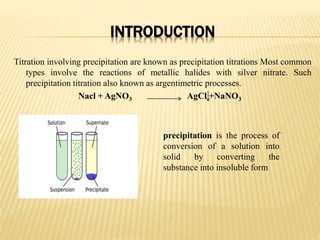
Titration involving precipitation are known as precipitation titrations Most common
types involve the reactions of metallic halides with silver nitrate. Such
precipitation titration also known as argentimetric processes.
Nacl + AgNO3 AgCl +NaNO3
precipitation is the process of
conversion of a solution into
solid by converting the
substance into insoluble form
DETERMINATION OF END POINT
Three different methods are used by which end point in argentimetric titration can
be determined. In these three methods different visual indicators have been
used.
1. Mohr’s Method
2.Volhard’s Method
3.Fajan’s Method
MOHR’S METHOD
 This method was developed by Mohr in 1856 using
Potassium Chromate as indicator.
 This method involves the titration of silver nitrate against
halides in neutral solution using Potassium Chromate as
indicator.
The end point is marked by the appearance of brick red
Precipitate due to the formation of silver chromate with an
Excess of silver nitrate.
Ag+ + Cl- AgCl
2Ag+ + CrO4
2- Ag2CrO4
 This method is based on the fact that silver halide is more insoluble than silver
chromate. Hence so long as there is any chloride or bromide left in the solution
no silver chromate is formed. In fact silver chromate even if formed will
immediately change to silver chloride or bromide by interaction with chloride or
bromide
Example:
Ag2CrO4 + 2Cl- 2AgCl + CrO4
2-
When the whole of chloride has been used up sliver chromate will be formed and
brick red coloration or precipitate will appear.
Principle:
This method determines the chloride ion concentration of a solution by titration
with silver nitrate. As the silver nitrate solution is slowly added, a precipitate of
silver chloride forms. The end point of the titration occurs when all the chloride
ions are precipitated.
VOLHARD’S METHOD
 The method was designed by volhard (1874) for the
Estimation of silver in dilute nitric acid solution by titration
Against a standard thiocynate solution in the presence of ferric
salt as indicator.
 But latter on it has been extended to the estimation of
Chlorides, bromides and several other indirect analysis.
 When a standard solution of ammonium or potassium thiocynate is added from
a burette to a solution of silver salt in presence of nitric acid and ferric indicator
in the titration flask a precipitate of silver thiocyanate continues to be formed
till the silver gets completely precipitated.
Ag+ +CNS- AgCNS
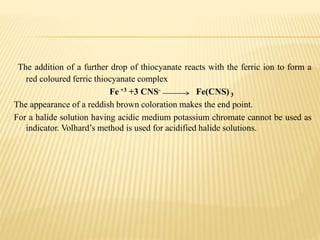
The addition of a further drop of thiocyanate reacts with the ferric ion to form a
red coloured ferric thiocyanate complex
Fe +3 +3 CNS- Fe(CNS) 3
The appearance of a reddish brown coloration makes the end point.
For a halide solution having acidic medium potassium chromate cannot be used as
indicator. Volhard’s method is used for acidified halide solutions.
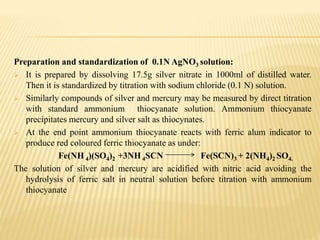
Preparation and standardization of 0.1N AgNO3 solution:
 It is prepared by dissolving 17.5g silver nitrate in 1000ml of distilled water.
Then it is standardized by titration with sodium chloride (0.1 N) solution.
 Similarly compounds of silver and mercury may be measured by direct titration
with standard ammonium thiocyanate solution. Ammonium thiocyanate
precipitates mercury and silver salt as thiocynates.
 At the end point ammonium thiocyanate reacts with ferric alum indicator to
produce red coloured ferric thiocyanate as under:
Fe(NH 4)(SO4)2 +3NH 4SCN Fe(SCN)3 + 2(NH4)2 SO4.
The solution of silver and mercury are acidified with nitric acid avoiding the
hydrolysis of ferric salt in neutral solution before titration with ammonium
thiocyanate
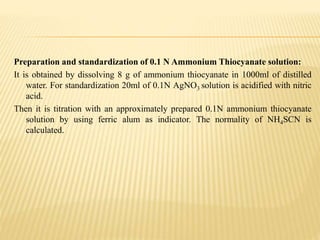
Preparation and standardization of 0.1 N Ammonium Thiocyanate solution:
It is obtained by dissolving 8 g of ammonium thiocyanate in 1000ml of distilled
water. For standardization 20ml of 0.1N AgNO3 solution is acidified with nitric
acid.
Then it is titration with an approximately prepared 0.1N ammonium thiocyanate
solution by using ferric alum as indicator. The normality of NH4SCN is
calculated.
FAJAN’S METHOD
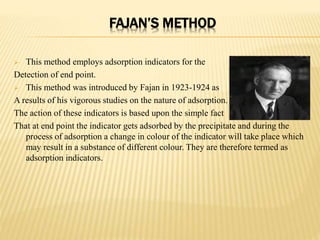
 This method employs adsorption indicators for the
Detection of end point.
 This method was introduced by Fajan in 1923-1924 as
A results of his vigorous studies on the nature of adsorption.
The action of these indicators is based upon the simple fact
That at end point the indicator gets adsorbed by the precipitate and during the
process of adsorption a change in colour of the indicator will take place which
may result in a substance of different colour. They are therefore termed as
adsorption indicators.
Commonly used indicator for titrations of chloride against silver nitrate are:
1. Fluorescein
2. Dichlorofluorescein
3. Eosin
4. Di-iodo diethylfluorescein
CONCLUSION
In these topic we have discussed
 Introduction and definition of Precipitation Titration
 Determination of end point
 Mohr’s Method Introduction
 Volhard’s Method Introduction
 Fajan’s Method
 Applications
REFERENCE
 Pharmaceutical Chemistry -Inorganic Volume-1 by G. R. Chatwal.
 Essentials of Inorganic Chemistry by Katja A. Strohfeldt.
 Indian Pharmacopoeia.
 M.L Schroff, Inorganic Pharmaceutical Chemistry.
 P. GunduRao, Inorganic Pharmaceutical Chemistry, 3rd Edition
 A.I. Vogel, Text Book of Quantitative Inorganic analysis.
 Bentley and Driver's Textbook of Pharmaceutical Chemistry.
THANK YOU