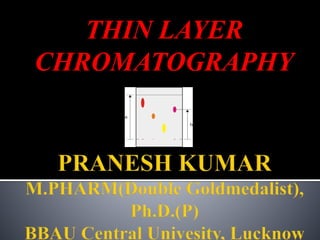
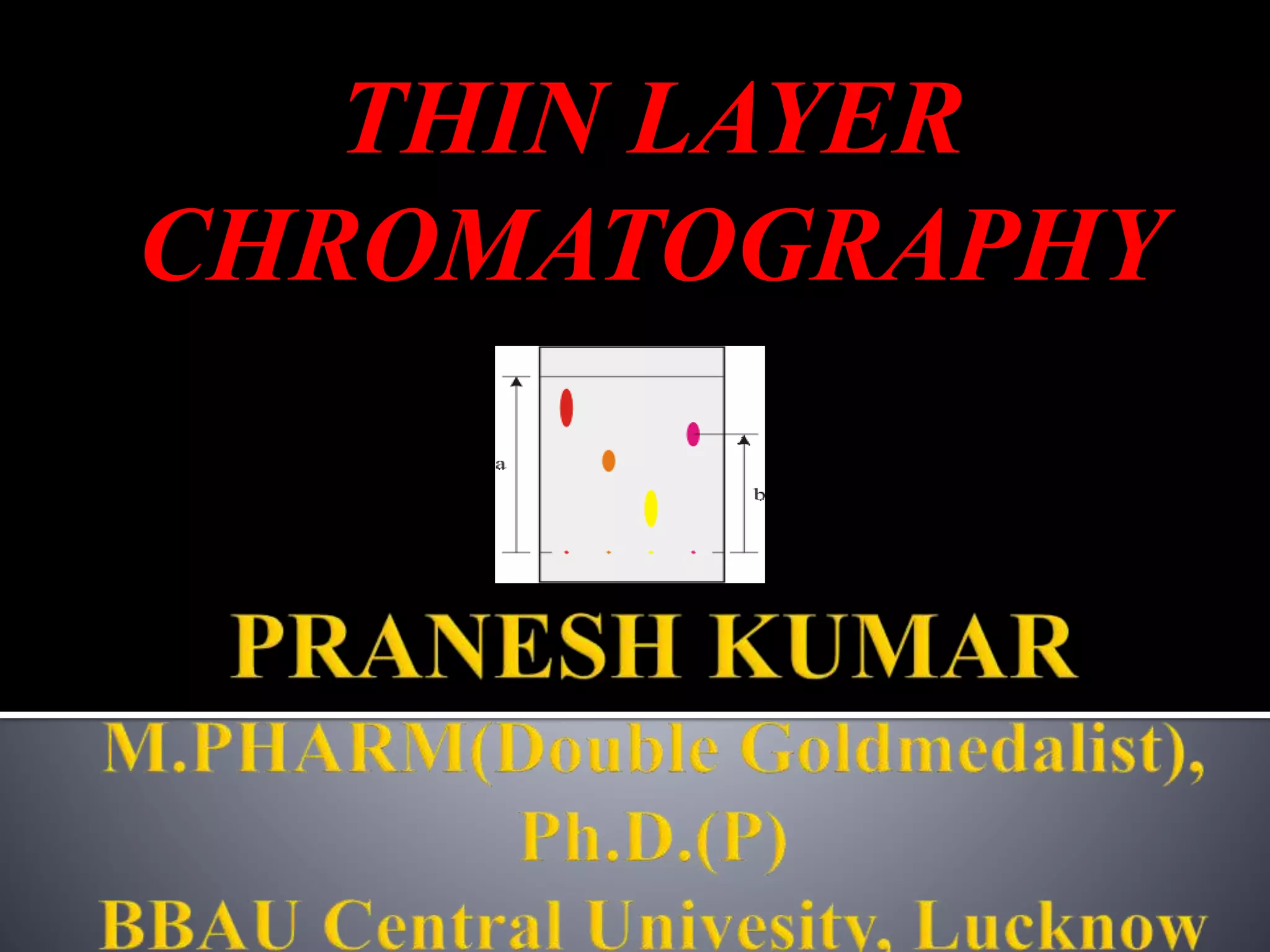
THIN LAYER
CHROMATOGRAPHY
 INTRODUCTION
 PRINCIPLE
 EXPERIMENTAL TECHNIQUE
 EVALUATION OF CHROMATOGRAM
 APPLICATION
 REFERENCES
 Thin Layer Chromatography: “The separation of
moderately volatile or nonvolatile substances based
upon differential adsorption on an inert solid
(stationary phase) immersed in a organic solvent or
solvent mixture (mobile phase)”
 Thin layer chromatography was first introduced by
IZMAILOV & SHRAIBER in 1938.
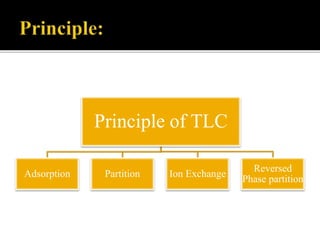
Principle of TLC
Adsorption Partition Ion Exchange
Reversed
Phase partition
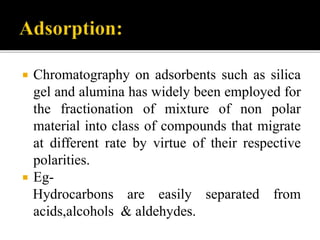
 Chromatography on adsorbents such as silica
gel and alumina has widely been employed for
the fractionation of mixture of non polar
material into class of compounds that migrate
at different rate by virtue of their respective
polarities.
 Eg-
Hydrocarbons are easily separated from
acids,alcohols & aldehydes.
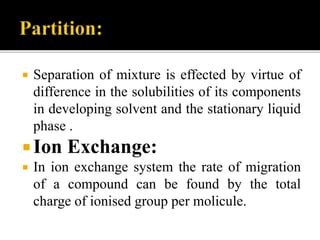
 Separation of mixture is effected by virtue of
difference in the solubilities of its components
in developing solvent and the stationary liquid
phase .
Ion Exchange:
 In ion exchange system the rate of migration
of a compound can be found by the total
charge of ionised group per molicule.
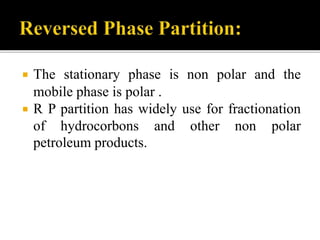
 The stationary phase is non polar and the
mobile phase is polar .
 R P partition has widely use for fractionation
of hydrocorbons and other non polar
petroleum products.
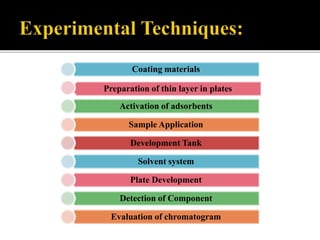
Coating materials
Preparation of thin layer in plates
Activation of adsorbents
Sample Application
Development Tank
Solvent system
Plate Development
Detection of Component
Evaluation of chromatogram
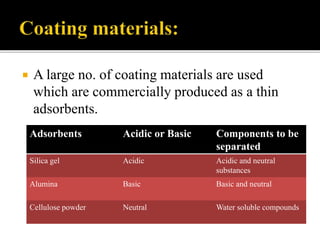
 A large no. of coating materials are used
which are commercially produced as a thin
adsorbents.
Adsorbents Acidic or Basic Components to be
separated
Silica gel Acidic Acidic and neutral
substances
Alumina Basic Basic and neutral
Cellulose powder Neutral Water soluble compounds
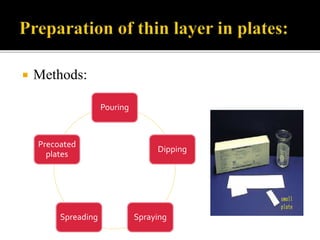
 Methods:
Pouring
Dipping
SprayingSpreading
Precoated
plates
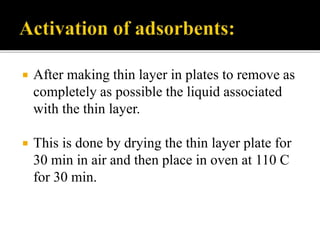
 After making thin layer in plates to remove as
completely as possible the liquid associated
with the thin layer.
 This is done by drying the thin layer plate for
30 min in air and then place in oven at 110 C
for 30 min.
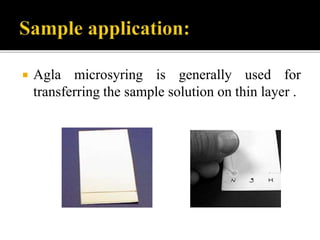
 Agla microsyring is generally used for
transferring the sample solution on thin layer .
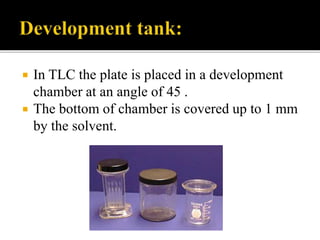
 In TLC the plate is placed in a development
chamber at an angle of 45 .
 The bottom of chamber is covered up to 1 mm
by the solvent.
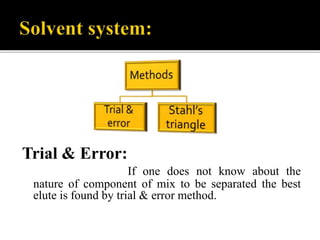
Trial & Error:
If one does not know about the
nature of component of mix to be separated the best
elute is found by trial & error method.
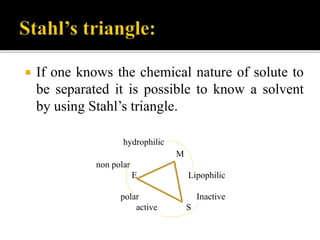
 If one knows the chemical nature of solute to
be separated it is possible to know a solvent
by using Stahl’s triangle.
hydrophilic
M
non polar
E Lipophilic
polar Inactive
active S
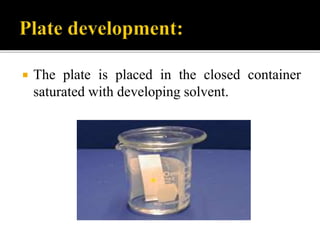
 The plate is placed in the closed container
saturated with developing solvent.
 Most of methods are used for detection of
separated salute on TLC.
 One can see coloured compound usually.
 One can detect colourless compound by UV
light or with treatment of visualising agent.
Eg.
Iodine vapour
Bromocresol green
Ninhydrine
Dragondroff reagent
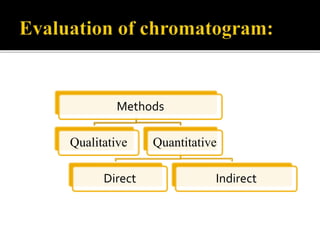
Methods
Qualitative Quantitative
Direct Indirect
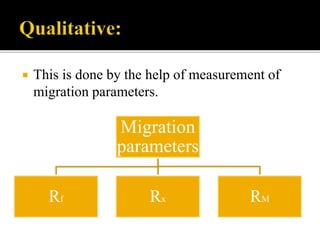
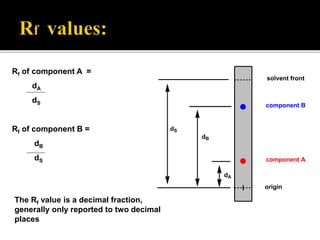
 This is done by the help of measurement of
migration parameters.
Migration
parameters
Rf Rx RM
solvent front
component B
component A
origin
dS
dB
dA
Rf of component A =
dA
dS
Rf of component B =
dB
dS
The Rf value is a decimal fraction,
generally only reported to two decimal
places
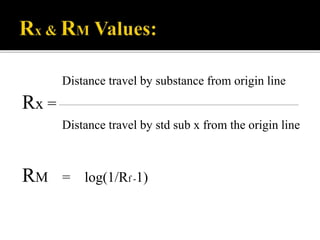
Distance travel by substance from origin line
Rx =
Distance travel by std sub x from the origin line
RM = log(1/Rf -1)
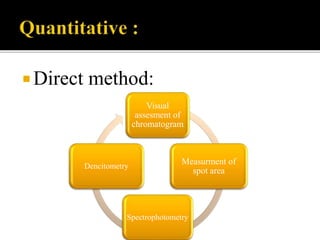
Direct method:
Visual
assesment of
chromatogram
Measurment of
spot area
Spectrophotometry
Dencitometry
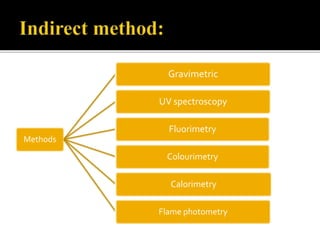
Methods
Gravimetric
UV spectroscopy
Fluorimetry
Colourimetry
Calorimetry
Flame photometry
 For checking the purity of sample.
 Examination of reactions.
 Identification of organic compounds.
 Separation of amino acids.
 Separation of inorganic ions.
 Progress of chemical reaction .
 As a purification process.
1. R.A.Day, Jr. A.L.Undewood(1987). Analisis
Kualititatif. Edisi ke Empat, ms: 474-529.
2. David G. Watson(2005). Pharmaceutical
analysis. Edisi ke-2, ms 315-331
3. http//orgchem.colorado.edu/hndbooksupport/
TLC/TLCprocedure.html
4. Chatewal R.G.Instrumentatal methods of
chemical analysis,fifth edition 2002
Himalaya publishing house pg no. 2.599
Thin Layer Chromatography

Thin Layer Chromatography

  • 1.
  • 2.
     INTRODUCTION  PRINCIPLE EXPERIMENTAL TECHNIQUE  EVALUATION OF CHROMATOGRAM  APPLICATION  REFERENCES
  • 3.
     Thin LayerChromatography: “The separation of moderately volatile or nonvolatile substances based upon differential adsorption on an inert solid (stationary phase) immersed in a organic solvent or solvent mixture (mobile phase)”  Thin layer chromatography was first introduced by IZMAILOV & SHRAIBER in 1938.
  • 4.
    Principle of TLC AdsorptionPartition Ion Exchange Reversed Phase partition
  • 5.
     Chromatography onadsorbents such as silica gel and alumina has widely been employed for the fractionation of mixture of non polar material into class of compounds that migrate at different rate by virtue of their respective polarities.  Eg- Hydrocarbons are easily separated from acids,alcohols & aldehydes.
  • 6.
     Separation ofmixture is effected by virtue of difference in the solubilities of its components in developing solvent and the stationary liquid phase . Ion Exchange:  In ion exchange system the rate of migration of a compound can be found by the total charge of ionised group per molicule.
  • 7.
     The stationaryphase is non polar and the mobile phase is polar .  R P partition has widely use for fractionation of hydrocorbons and other non polar petroleum products.
  • 8.
    Coating materials Preparation ofthin layer in plates Activation of adsorbents Sample Application Development Tank Solvent system Plate Development Detection of Component Evaluation of chromatogram
  • 9.
     A largeno. of coating materials are used which are commercially produced as a thin adsorbents. Adsorbents Acidic or Basic Components to be separated Silica gel Acidic Acidic and neutral substances Alumina Basic Basic and neutral Cellulose powder Neutral Water soluble compounds
  • 10.
  • 11.
     After makingthin layer in plates to remove as completely as possible the liquid associated with the thin layer.  This is done by drying the thin layer plate for 30 min in air and then place in oven at 110 C for 30 min.
  • 12.
     Agla microsyringis generally used for transferring the sample solution on thin layer .
  • 13.
     In TLCthe plate is placed in a development chamber at an angle of 45 .  The bottom of chamber is covered up to 1 mm by the solvent.
  • 14.
    Trial & Error: Ifone does not know about the nature of component of mix to be separated the best elute is found by trial & error method.
  • 15.
     If oneknows the chemical nature of solute to be separated it is possible to know a solvent by using Stahl’s triangle. hydrophilic M non polar E Lipophilic polar Inactive active S
  • 16.
     The plateis placed in the closed container saturated with developing solvent.
  • 17.
     Most ofmethods are used for detection of separated salute on TLC.  One can see coloured compound usually.  One can detect colourless compound by UV light or with treatment of visualising agent. Eg. Iodine vapour Bromocresol green Ninhydrine Dragondroff reagent
  • 18.
  • 19.
     This isdone by the help of measurement of migration parameters. Migration parameters Rf Rx RM
  • 20.
    solvent front component B componentA origin dS dB dA Rf of component A = dA dS Rf of component B = dB dS The Rf value is a decimal fraction, generally only reported to two decimal places
  • 21.
    Distance travel bysubstance from origin line Rx = Distance travel by std sub x from the origin line RM = log(1/Rf -1)
  • 22.
    Direct method: Visual assesment of chromatogram Measurmentof spot area Spectrophotometry Dencitometry
  • 23.
  • 24.
     For checkingthe purity of sample.  Examination of reactions.  Identification of organic compounds.  Separation of amino acids.  Separation of inorganic ions.  Progress of chemical reaction .  As a purification process.
  • 25.
    1. R.A.Day, Jr.A.L.Undewood(1987). Analisis Kualititatif. Edisi ke Empat, ms: 474-529. 2. David G. Watson(2005). Pharmaceutical analysis. Edisi ke-2, ms 315-331 3. http//orgchem.colorado.edu/hndbooksupport/ TLC/TLCprocedure.html 4. Chatewal R.G.Instrumentatal methods of chemical analysis,fifth edition 2002 Himalaya publishing house pg no. 2.599