CHAPTER

  20
“Oxidation-Reduction Reactions”


                      EO SAYS
                     LEO SAYS GER

                      GER
Section 20.1
        The Meaning of Oxidation and Reduction (called “redox”)
         •   OBJECTIVES
             o Define oxidation and reduction in terms of the loss or gain of oxygen, and
               the loss or gain of electrons.
             o State the characteristics of a redox reaction and identify the oxidizing
               agent and reducing agent.

Oxidation and Reduction (Redox)

•   Early chemists saw “oxidation” reactions only as the combination of a material with
    oxygen to produce an oxide.
    • For example, when methane burns in air, it oxidizes and forms oxides of carbon
       and hydrogen, as shown

                                 CH4 + 2O2  CO2 + 2H2O

•   But, not all oxidation processes that use oxygen involve burning:
    • Elemental iron slowly oxidizes to compounds such as iron (III) oxide, commonly
       called “rust”
    • Bleaching stains in fabrics
    • Hydrogen peroxide also releases oxygen when it decomposes

    •    A process called _______________________________ is the opposite of
         oxidation, and originally meant the loss of oxygen from a compound
    •    Oxidation and reduction always occur simultaneously
    •    The substance gaining oxygen (or losing electrons) is
         _______________________, while the substance losing oxygen (or gaining
         electrons) is __________________________.

    •    Today, many of these reactions may not even involve oxygen
    •    Redox currently says that electrons are __________________________________

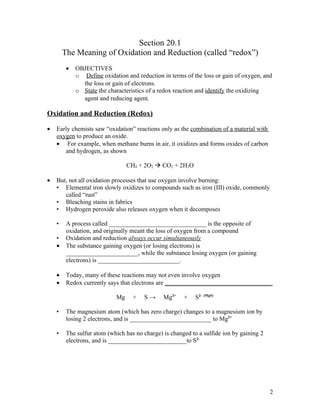
                            Mg     +   S→      Mg2+    +    S2- (MgS)

    •    The magnesium atom (which has zero charge) changes to a magnesium ion by
         losing 2 electrons, and is __________________________ to Mg2+

    •    The sulfur atom (which has no charge) is changed to a sulfide ion by gaining 2
         electrons, and is _________________________to S2-


                                                                                          2
Oxidation and Reduction (Redox)


Each sodium atom loses one electron:


Each chlorine atom gains one electron:


LEO says GER :

___ose ___lectrons = ___xidation

    0         +1
Na → Na + e −             Sodium is ___________________________

___ain ___lectrons = ___eduction
    0              −1
Cl + e − → Cl             Chlorine is __________________________


•       Losing electrons is oxidation, and the substance that loses the electrons is called the
        ________________________________________.

•       Gaining electrons is reduction, and the substance that gains the electrons is called the
        ________________________________________.


Example Problem:
What is oxidized and what is reduced in this single replacement reaction? What is the
oxidizing agent? What is the reducing agent?

                                 2AgNO3 + Cu  Cu(NO3)2 + Ag


                                                                                                  3
Oxidation and Reduction (Redox)

•      It is easy to see the loss and gain of electrons in ionic compounds, but what about
       covalent compounds?
•       In water, we learned that oxygen is highly electronegative, so:
             the oxygen gains electrons (is _______________________ and is the
                oxidizing agent), and the hydrogen loses electrons (is
                ___________________________ and is the reducing agent)
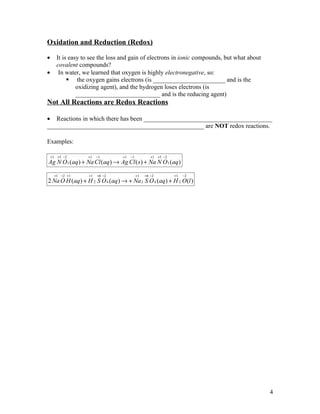
Not All Reactions are Redox Reactions

• Reactions in which there has been _________________________________________
__________________________________________________ are NOT redox reactions.

Examples:

    +1 +5 −2       +1    −1      +1   −1           +1 +5 −2
Ag N O3 (aq ) + Na Cl (aq ) → Ag Cl ( s ) + Na N O3 (aq )

     +1 −2 +1       +1   +6 −2             +1   +6 −2         +1   −2
2 Na O H (aq ) + H 2 S O 4 (aq ) → + Na 2 S O 4 (aq ) + H 2 O(l )


                                                                                             4
Section 20.2
                              Oxidation Numbers
OBJECTIVES
     • Determine the oxidation number of an atom of any element in a pure
        substance.
     • Define oxidation and reduction in terms of a change in oxidation number, and
        identify atoms being oxidized or reduced in redox reactions.

Assigning Oxidation Numbers

   •   An “oxidation number” is a positive or negative number assigned to an atom to
       indicate its degree of oxidation or reduction.
   •   Generally, a bonded atom’s oxidation number is the charge it would have if the
       electrons in the bond were assigned to the atom of the more electronegative
       element

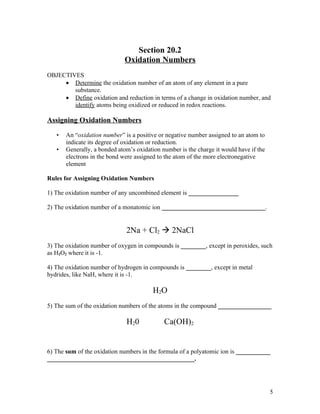
Rules for Assigning Oxidation Numbers

1) The oxidation number of any uncombined element is ________________

2) The oxidation number of a monatomic ion _________________________________.


                              2Na + Cl2  2NaCl
3) The oxidation number of oxygen in compounds is ________, except in peroxides, such
as H2O2 where it is -1.

4) The oxidation number of hydrogen in compounds is ________, except in metal
hydrides, like NaH, where it is -1.

                                         H2O
5) The sum of the oxidation numbers of the atoms in the compound _________________

                              H20            Ca(OH)2


6) The sum of the oxidation numbers in the formula of a polyatomic ion is ___________
_______________________________________________.


                                                                                        5
NO3            SO4
Example Problem: What is the oxidizing number of each kind of atom in the following
compounds?

   a.   SO2                        b.   CO32-                     c.   K2SO4

Reducing Agents and Oxidizing Agents

   •    An increase in oxidation number = ____________________________________
   •    A decrease in oxidation number = _____________________________________

                                  Na  Na + e-
Sodium is ____________________________ - it is the ___________________________


                                   Cl + e-  Cl
Chlorine is ____________________________- its is the __________________________

Trends in Oxidation and Reduction

Active metals:
• Lose electrons easily
• Are easily oxidized
• Are strong reducing agents

Active nonmetals:
• Gain electrons easily
• Are easily reduced
• Are strong oxidizing agents

Example Problem:

Use the changes in oxidation number to identify which atoms are oxidized and which are
reduced in each reaction.

   a. Cl2 + 2HBr  2HCl + Br2

   b. C + O2  CO2


Name ___________________________________ Date __________________________


                                                                                      6
10.1 and 10.2 Section Review

1. State the characteristics of a redox reaction, and explain how to identify the oxidizing
agent and the reducing agent?


2. Determine which reactant is oxidized and which reactant is reduced.

   a. H2 + Cl2  2HCl

   b. S + Cl  SCl2

   c. N2 + 2O2  2NO2

   d. 2Li + F2  2LiF

   e. H2 + S  H2S


3. In the equations above a-e, determine which reactant is the reducing agent and which is
the oxidizing agent.


                                 Section 20.3
                          Balancing Redox Equations
   OBJECTIVES
     • Describe how oxidation numbers are used to identify redox reactions.
     • Balance a redox equation using the oxidation-number-change method.


                                                                                              7
•   Balance a redox equation by breaking the equation into oxidation and
             reduction half-reactions, and then using the half-reaction method.

Identifying Redox Equations

In general, all chemical reactions can be assigned to one of two classes:

    1. oxidation-reduction, in which electrons are transferred:
        • Single-replacement, combination, decomposition, and combustion
    2. this second class has no electron transfer, and includes all others:
        • Double-replacement and acid-base reactions

Identifying Redox Equations

•    In an electrical storm, nitrogen and oxygen react to form nitrogen monoxide:

                N2(g) + O2(g) → 2NO(g)

     •   Is this a redox reaction?
             • If the oxidation number of an element in a reacting species changes, then
                  that element has undergone either oxidation or reduction; therefore, the
                  reaction as a whole must be a _______________________.

Example Problem

Use the change in oxidation number to identify whether each reaction is a redox reaction
or a reaction of some other type. If a reaction is a redox reaction, identify the element
reduced, the element oxidized, the reducing agent, and the oxidizing agent.

     a. N2O4  2NO2


     b. Cl2 +NaBr  2NaCl + Br2


     c. PbCl2 + K2SO4  2KCl + PbSO4


     d. 2NaOH + H2SO4  Na2SO4 + 2H2O

Balancing Redox Equations

     •   It is essential to write a correctly balanced equation that represents what happens
         in a chemical reaction


                                                                                               8
•  Fortunately, two systematic methods are available, and are based on the
              fact that the total electrons gained in reduction _________________ the
              total lost in oxidation. The two methods:
           1. Use oxidation-number changes
           2. Use half-reactions (you only need to know this method)

Using half-reactions

   •   A half-reaction is an equation showing just the oxidation or just the reduction that
       takes place
   •    they are then balanced separately, and finally combined
           • Step 1: write unbalanced equation in ionic form
           • Step 2: write separate half-reaction equations for oxidation and reduction
           • Step 3: balance the atoms in the half-reactions
           • Step 4: add enough electrons to one side of each half-reaction to balance
               the charges
           • Step 5: multiply each half-reaction by a number to make the electrons
               equal in both
           • Step 6: add the balanced half-reactions to show an overall equation
           • Step 7: add the spectator ions and balance the equation
   •   Rules shown on page 665 – 666

Example problem:

Use the half reaction method to balance the equation for the following redox reaction.


                                                                                          9

Chemistry - Chp 20 - Oxidation Reduction - Notes

  • 1.
    CHAPTER 20 “Oxidation-ReductionReactions” EO SAYS LEO SAYS GER GER
  • 2.
    Section 20.1 The Meaning of Oxidation and Reduction (called “redox”) • OBJECTIVES o Define oxidation and reduction in terms of the loss or gain of oxygen, and the loss or gain of electrons. o State the characteristics of a redox reaction and identify the oxidizing agent and reducing agent. Oxidation and Reduction (Redox) • Early chemists saw “oxidation” reactions only as the combination of a material with oxygen to produce an oxide. • For example, when methane burns in air, it oxidizes and forms oxides of carbon and hydrogen, as shown CH4 + 2O2  CO2 + 2H2O • But, not all oxidation processes that use oxygen involve burning: • Elemental iron slowly oxidizes to compounds such as iron (III) oxide, commonly called “rust” • Bleaching stains in fabrics • Hydrogen peroxide also releases oxygen when it decomposes • A process called _______________________________ is the opposite of oxidation, and originally meant the loss of oxygen from a compound • Oxidation and reduction always occur simultaneously • The substance gaining oxygen (or losing electrons) is _______________________, while the substance losing oxygen (or gaining electrons) is __________________________. • Today, many of these reactions may not even involve oxygen • Redox currently says that electrons are __________________________________ Mg + S→ Mg2+ + S2- (MgS) • The magnesium atom (which has zero charge) changes to a magnesium ion by losing 2 electrons, and is __________________________ to Mg2+ • The sulfur atom (which has no charge) is changed to a sulfide ion by gaining 2 electrons, and is _________________________to S2- 2
  • 3.
    Oxidation and Reduction(Redox) Each sodium atom loses one electron: Each chlorine atom gains one electron: LEO says GER : ___ose ___lectrons = ___xidation 0 +1 Na → Na + e − Sodium is ___________________________ ___ain ___lectrons = ___eduction 0 −1 Cl + e − → Cl Chlorine is __________________________ • Losing electrons is oxidation, and the substance that loses the electrons is called the ________________________________________. • Gaining electrons is reduction, and the substance that gains the electrons is called the ________________________________________. Example Problem: What is oxidized and what is reduced in this single replacement reaction? What is the oxidizing agent? What is the reducing agent? 2AgNO3 + Cu  Cu(NO3)2 + Ag 3
  • 4.
    Oxidation and Reduction(Redox) • It is easy to see the loss and gain of electrons in ionic compounds, but what about covalent compounds? • In water, we learned that oxygen is highly electronegative, so:  the oxygen gains electrons (is _______________________ and is the oxidizing agent), and the hydrogen loses electrons (is ___________________________ and is the reducing agent) Not All Reactions are Redox Reactions • Reactions in which there has been _________________________________________ __________________________________________________ are NOT redox reactions. Examples: +1 +5 −2 +1 −1 +1 −1 +1 +5 −2 Ag N O3 (aq ) + Na Cl (aq ) → Ag Cl ( s ) + Na N O3 (aq ) +1 −2 +1 +1 +6 −2 +1 +6 −2 +1 −2 2 Na O H (aq ) + H 2 S O 4 (aq ) → + Na 2 S O 4 (aq ) + H 2 O(l ) 4
  • 5.
    Section 20.2 Oxidation Numbers OBJECTIVES • Determine the oxidation number of an atom of any element in a pure substance. • Define oxidation and reduction in terms of a change in oxidation number, and identify atoms being oxidized or reduced in redox reactions. Assigning Oxidation Numbers • An “oxidation number” is a positive or negative number assigned to an atom to indicate its degree of oxidation or reduction. • Generally, a bonded atom’s oxidation number is the charge it would have if the electrons in the bond were assigned to the atom of the more electronegative element Rules for Assigning Oxidation Numbers 1) The oxidation number of any uncombined element is ________________ 2) The oxidation number of a monatomic ion _________________________________. 2Na + Cl2  2NaCl 3) The oxidation number of oxygen in compounds is ________, except in peroxides, such as H2O2 where it is -1. 4) The oxidation number of hydrogen in compounds is ________, except in metal hydrides, like NaH, where it is -1. H2O 5) The sum of the oxidation numbers of the atoms in the compound _________________ H20 Ca(OH)2 6) The sum of the oxidation numbers in the formula of a polyatomic ion is ___________ _______________________________________________. 5
  • 6.
    NO3 SO4 Example Problem: What is the oxidizing number of each kind of atom in the following compounds? a. SO2 b. CO32- c. K2SO4 Reducing Agents and Oxidizing Agents • An increase in oxidation number = ____________________________________ • A decrease in oxidation number = _____________________________________ Na  Na + e- Sodium is ____________________________ - it is the ___________________________ Cl + e-  Cl Chlorine is ____________________________- its is the __________________________ Trends in Oxidation and Reduction Active metals: • Lose electrons easily • Are easily oxidized • Are strong reducing agents Active nonmetals: • Gain electrons easily • Are easily reduced • Are strong oxidizing agents Example Problem: Use the changes in oxidation number to identify which atoms are oxidized and which are reduced in each reaction. a. Cl2 + 2HBr  2HCl + Br2 b. C + O2  CO2 Name ___________________________________ Date __________________________ 6
  • 7.
    10.1 and 10.2Section Review 1. State the characteristics of a redox reaction, and explain how to identify the oxidizing agent and the reducing agent? 2. Determine which reactant is oxidized and which reactant is reduced. a. H2 + Cl2  2HCl b. S + Cl  SCl2 c. N2 + 2O2  2NO2 d. 2Li + F2  2LiF e. H2 + S  H2S 3. In the equations above a-e, determine which reactant is the reducing agent and which is the oxidizing agent. Section 20.3 Balancing Redox Equations OBJECTIVES • Describe how oxidation numbers are used to identify redox reactions. • Balance a redox equation using the oxidation-number-change method. 7
  • 8.
    Balance a redox equation by breaking the equation into oxidation and reduction half-reactions, and then using the half-reaction method. Identifying Redox Equations In general, all chemical reactions can be assigned to one of two classes: 1. oxidation-reduction, in which electrons are transferred: • Single-replacement, combination, decomposition, and combustion 2. this second class has no electron transfer, and includes all others: • Double-replacement and acid-base reactions Identifying Redox Equations • In an electrical storm, nitrogen and oxygen react to form nitrogen monoxide: N2(g) + O2(g) → 2NO(g) • Is this a redox reaction? • If the oxidation number of an element in a reacting species changes, then that element has undergone either oxidation or reduction; therefore, the reaction as a whole must be a _______________________. Example Problem Use the change in oxidation number to identify whether each reaction is a redox reaction or a reaction of some other type. If a reaction is a redox reaction, identify the element reduced, the element oxidized, the reducing agent, and the oxidizing agent. a. N2O4  2NO2 b. Cl2 +NaBr  2NaCl + Br2 c. PbCl2 + K2SO4  2KCl + PbSO4 d. 2NaOH + H2SO4  Na2SO4 + 2H2O Balancing Redox Equations • It is essential to write a correctly balanced equation that represents what happens in a chemical reaction 8
  • 9.
    • Fortunately,two systematic methods are available, and are based on the fact that the total electrons gained in reduction _________________ the total lost in oxidation. The two methods: 1. Use oxidation-number changes 2. Use half-reactions (you only need to know this method) Using half-reactions • A half-reaction is an equation showing just the oxidation or just the reduction that takes place • they are then balanced separately, and finally combined • Step 1: write unbalanced equation in ionic form • Step 2: write separate half-reaction equations for oxidation and reduction • Step 3: balance the atoms in the half-reactions • Step 4: add enough electrons to one side of each half-reaction to balance the charges • Step 5: multiply each half-reaction by a number to make the electrons equal in both • Step 6: add the balanced half-reactions to show an overall equation • Step 7: add the spectator ions and balance the equation • Rules shown on page 665 – 666 Example problem: Use the half reaction method to balance the equation for the following redox reaction. 9