Medical Chemistry Lecture  4  2007 (J.S.) Oxidation-reduction reactions Dissolution equilibria Precipitation reactions
Oxidation-reduction reactions   ( redox reactions ) are common events in everyday life: e.g. combustion of fossil fuels, corrosion of metals, dry cells and accumulators, metabolism of nutrients in human bodies , photosynthesis in green plants .
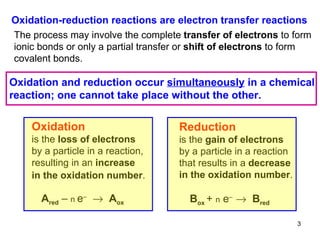
Oxidation-reduction reactions are electron transfer reactions  The process may involve the complete  transfer of electrons  to form ionic bonds or only a partial transfer or  shift of electrons  to form covalent bonds. Oxidation and reduction occur  simultaneously  in a chemical reaction; one cannot take place without the other.  A red  –  n  e –      A ox Oxidation is the  loss of electrons by a particle in a reaction, resulting in an  increase in the oxidation number .   B ox   +  n   e –     B red Reduction is the  gain of electrons by a particle in a reaction that results in a  decrease in the oxidation number .
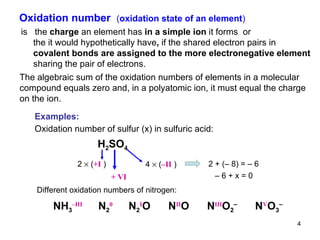
Oxidation number  ( oxidation state of an element ) is  the  charge  an element has  in a simple ion  it forms   or the it would hypothetically have ,  if the shared electron pairs in covalent bonds are assigned to the more electronegative element sharing the pair of electrons.  The algebraic sum of the oxidation numbers of elements in a molecular compound equals zero and, in a polyatomic ion, it must equal the charge on the ion. Examples: Oxidation number of sulfur (x) in sulfuric acid: H 2 SO 4 2    ( +I  ) 4    ( –II  ) 2 + (– 8) = – 6 –  6 + x = 0   + VI Different oxidation numbers of nitrogen:   NH 3 –III   N 2 0   N 2 I O  N II O  N III O 2 –   N V O 3 –
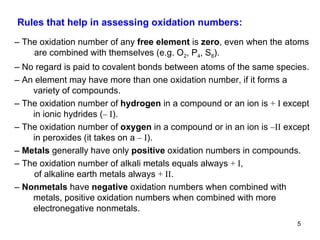
Rules that help in assessing oxidation numbers:  –  The oxidation number of any  free element  is  zero ,   even when the atoms are combined with themselves (e.g. O 2 , P 4 , S 8 ). –  No regard is paid to covalent bonds between atoms of the same species. –  An element may have more than one oxidation number, if it forms a variety of compounds. –  The oxidation number of  hydrogen  in a compound or an ion is  + I  except in ionic hydrides ( – I ). –  The oxidation number of  oxygen  in a compound or in an ion is  –II  except in peroxides (it takes on a  – I ). –  Metals  generally have only  positive  oxidation numbers in compounds. –  The oxidation number of alkali metals equals always  + I ,  of alkaline earth metals always  + II . –  Nonmetals  have  negative  oxidation numbers when combined with metals, positive oxidation numbers when combined with more electronegative nonmetals.
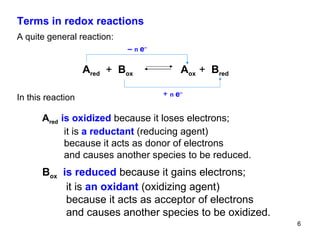
Terms in redox reactions A quite general reaction: In this reaction A red   is oxidized  because it loses electrons; it   is  a reductant  (reducing agent) because it acts as donor of electrons and causes another species to be reduced. B ox   is reduced  because it gains electrons; it   is  an oxidant  (oxidizing agent) because it acts as acceptor of electrons and causes another species to be oxidized. A red   +   B ox   A ox  +   B red   +   n  e – –  n  e –
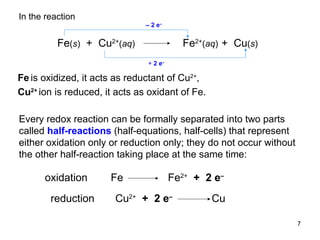
In the reaction Fe   is oxidized, it acts as reductant of Cu 2+ , Cu 2+  ion is reduced, it acts as oxidant of Fe. Fe ( s )   +   Cu 2+ ( aq )   Fe 2+ ( aq )   +   Cu ( s )   +  2 e – –  2 e – Every redox reaction can be formally separated into two parts called  half-reactions  (half-equations, half-cells)   that represent either oxidation only or reduction only; they do not occur without the other half-reaction taking place at the same time: Fe  Fe 2+   +  2 e –   oxidation reduction  Cu 2+   +  2 e –  Cu
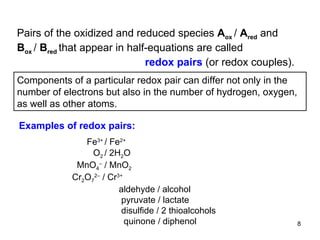
Pairs of the oxidized and reduced species  A ox  /  A red   and  B ox  /  B red  that appear in half-equations are called   redox pairs  (or redox couples).   Components of a particular redox pair can differ not only in the number of electrons but also in the number of hydrogen, oxygen, as well as other atoms. Fe 3+  / Fe 2+   O 2  / 2H 2 O MnO 4 –  / MnO 2 Cr 2 O 7 2–  / Cr 3+    aldehyde / alcohol   pyruvate / lactate   disulfide / 2 thioalcohols     quinone / diphenol Examples of redox pairs:
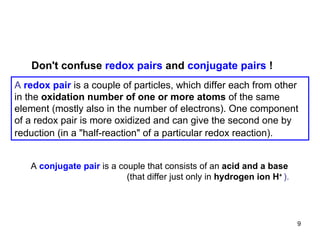
A   redox pair  is a couple of particles, which differ each from other in the  oxidation number of one or more atoms  of the same element (mostly also in the number of electrons). One component of a redox pair is more oxidized and can give the second one by reduction (in a  "half-reaction" of a particular redox reaction).   Don 't confuse  redox pairs  and  conjugate pairs  ! A   conjugate pair   is a couple that consists of an  acid and a base (that differ just only in  hydrogen ion H +   ).
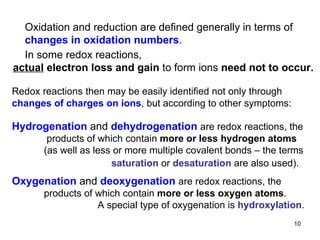
Redox reactions   then may be easily identified not only through  changes of charges on ions , but according to other symptoms: Oxidation and reduction are defined generally in terms of  changes in oxidation numbers . In some redox reactions, actual  electron loss and gain  to form ions  need not to occur.   Hydrogenation  and  dehydrogenation   are redox reactions, the   products of which contain  more or less hydrogen atoms (as well as less or more multiple covalent bonds – the terms   saturation  or  desaturation  are also used).   Oxygenation  and  deoxygenation  are redox reactions, the products of which contain  more or less oxygen atoms .    A special type of oxygenation is  hydroxylation .
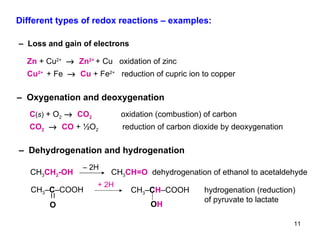
Different types of redox reactions – examples: –  Loss and gain of electrons –  Oxygenation and deoxygenation –  Dehydrogenation and hydrogenation Cu 2+   + Fe     Cu  + Fe 2+   reduction of cupric ion to copper  Zn   +   Cu 2+      Zn 2+   + Cu  oxidation of zinc CO 2      CO   + ½O 2  reduction of carbon dioxide by deoxygenation   C ( s )   + O 2     CO 2   oxidation (combustion) of carbon CH 3 CH 2 -OH  CH 3 CH=O  dehydrogenation of ethanol to acetaldehyde –  2H + 2H CH 3 – C –COOH O CH 3 – C H –COOH O H hydrogenation (reduction) of pyruvate to lactate
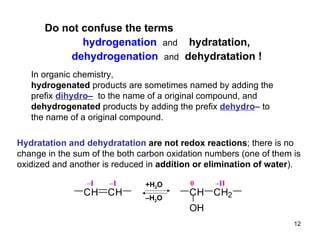
Do not confuse the terms   hydrogenation  and   hydratation, dehydrogenation  and   dehydratation   ! In organic chemistry,  hydrogenated  products are sometimes named by adding the prefix  dihydro–   to the name of a original compound, and dehydrogenated  products by adding the prefix  dehydro –  to  the   name of a original compound. Hydratation and dehydratation  are not redox reactions ; there is no change in the sum of the both carbon oxidation numbers (one of them is oxidized and another is reduced in  addition or elimination of water ). C H C H – I – I – II C H C H 2 O H 0 +H 2 O – H 2 O
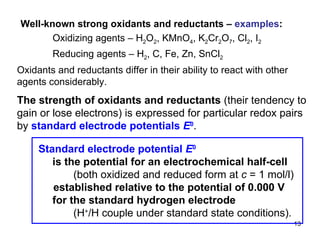
Well-known strong oxidants and reductants –  examples : Oxidizing agents – H 2 O 2 , KMnO 4 , K 2 Cr 2 O 7 , Cl 2 , I 2 Reducing agents – H 2 , C, Fe, Zn, SnCl 2 Oxidants and reductants differ in their ability to react with other agents considerably. The strength of oxidants and reductants  (their tendency to gain or lose electrons) is expressed for particular redox pairs by  standard electrode potentials  E 0 .  Standard electrode potential  E 0     is the potential for an electrochemical half-cell   (both oxidized and reduced form at  c  = 1 mol/l) established relative to the potential of 0.000 V   for the standard hydrogen electrode   (H + /H couple under standard state conditions).
Standard state of a half-cell: –  both oxidized and reduced form of a redox pair at  c  = 1  mol/l –  specified  temperature , usually  25  °C –  atmospheric pressure 101.3 kPa is important only when there is a gaseous component of the redox pair  H 2 H + [ H + ]   =  1  mol / l p H 2   =  101.3  kPa E 0 (H + /H) =  0.000 V  (25  °C) Standard hydrogen electrode –  reference electrode electrode  - an  inert metal A ox A red [ A ox ]   =   [ A red ]   =  1  mol/l Half-cell  to be measured in the standard state
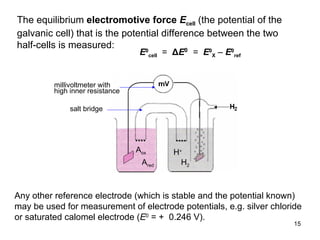
The equilibrium  electromotive force  E cell   (the potential of the galvanic cell) that is the potential difference between the two half-cells is measured:  Any other reference electrode (which is stable and the potential known) may be used for measurement of electrode potentials, e.g. silver chloride or saturated calomel electrode ( E 0  = +  0.246 V). E 0 cell   =   Δ E 0   =  E 0 X  –  E 0 ref H + H 2 A ox A red salt bridge millivoltmeter with high inner resistance
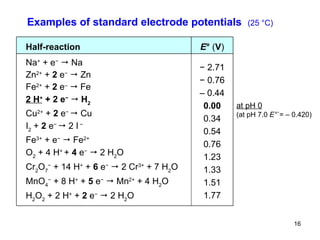
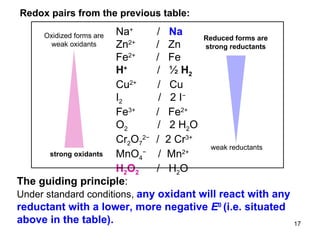
Examples of standard electrode potentials  (25  °C) at pH 0 (at pH 7.0  E ° ´= – 0.420) −  2.71 −  0.76 –  0.44 0.00 0.34 0.54 0.76 1.23 1.33 1.51 1.77 Na +  + e −     Na Zn 2+  +  2  e −     Zn Fe 2+  +  2  e –     Fe 2 H +  + 2 e −      H 2 Cu 2+  +  2  e −    Cu I 2  +  2  e −    2 I  − Fe 3+  + e −     Fe 2+ O 2  + 4 H +   +  4  e −     2 H 2 O Cr 2 O 7 −  + 14 H +  +  6  e −     2 Cr 3+  + 7 H 2 O MnO 4 −  + 8 H +  +  5  e −     Mn 2+  + 4 H 2 O H 2 O 2  + 2 H +  +  2  e −     2 H 2 O E °  ( V ) Half-reaction
Redox pairs from the previous table: The guiding principle : Under standard conditions,  any oxidant will react with any reductant with a lower, more negative  E 0  (i.e. situated above in the table). Na +   /  Na Zn 2+   /  Zn Fe 2+   /   Fe H +   /   ½   H 2 Cu 2+   /   Cu I 2   /  2 I − Fe 3+   /  Fe 2+ O 2   /  2 H 2 O Cr 2 O 7 2−  /  2 Cr 3+ MnO 4 −   /  Mn 2+ H 2 O 2   /  H 2 O strong oxidants Oxidized forms are weak oxidants Reduced forms are strong reductants weak reductants
If the difference  Δ E 0   between both redox pairs is  greater than 0.400 V,  the  reaction is irreversible  (i.e. proceeds to completion) even under various non-standard concentrations of the reactants. If the difference between both  E 0   is less than 0.400 V , then the reaction will reach equilibrium, the position of which depends on the initial concentrations of components of both redox pairs; the  direction of such a reaction may be reversed .  Electrode potentials  E  under  non-standard  conditions for a redox pair   a   A ox  +  n   e –     b   A red Nernst equation RT n F ln E   =  E 0   + [ A ox ] a   [ A red ] b [ A ox ] and [ A red  ]  relevant  concentrations of reactants R  =  8.314   kPa K –1  mol –1 F  =  96 500 C mol –1 n   =  number of  moles of electrons  transferred  E ,  E 0  el. potentials in volts
After expressing  R ,  T  (298 K), and  F  in numbers and transposing natural logarithm into decadic (ln x = 2.3 log x), the equation will take the form  (in volts;  t  = 25  °C) The electrode poten t ial   of half-cells at various concentrations of redox pair components can be calculated. On the contrary, the ratio of both redox pair components can be estimated from the measured values of electrode potentials. Galvanic cells  (electrochemical cells) are two half-cells connected by an external conductor . This arrangement allows discharging of the cell , the  spontaneous cell reaction  (the sum of the chemical half-reactions).  The electrons lost flow in the external circuit from the substance that is being oxidized in one of the half-cells to the substance that is being reduced in another half-cell  till the cell reaches an equilibrium .  The free energy  resulting from the spontaneous reaction is released as electrical energy and/or heat.  0.059 n log E   =  E 0   +  [ A ox ] a   [ A red ] b
Before  a conductive connection of the half-cells, the  electromotive force  of the galvanic cell  E cell  equals E cell   =   Δ E   =  E A  –  E B  . The expected cell reaction is According to Nernst equation, The  cell potential   Δ E  is sometimes described  as the "driving force" of the cell reaction. It is related to the amount of electrical work that a cell can perform. After  the external circuit is closed, the cell reaction is started. It goes on till the Δ E  equals zero  (the equilibrium state is reached) .  A red   +   B ox   A ox   +   B red the external circuit E cell  =  Δ E   =  Δ E 0   + RT n F ln [ A ox ] i   [ B red ] i [ A red ] i  [ B ox ] i (in volts, 25  °C)
A general rule suggests that the oxidized form of a redox pair with the more positive  E  is able to oxidize the reduced form of the redox pair with the less positive  E. that iodine will  Example: Redox reaction: Half-reactions: The oxidation of iodide to elemental iodine  will not be complete , the difference Δ E 0  is less than 0.40 V. Under which condition  is iodine able to oxidize Fe 2+  ? It follows from oxidize Fe 2+  to Fe 3+  only if there is much higher initial concentration of I 2  and Fe 2+  than of I –  and Fe 3+  (the ratio of the products [I] i     [Fe 2+ ] i  and [I – ] i     [Fe 3+ ] i   must be greater than approx. 2500). Even so, the equilibrium will be reached after oxidation of a very small amount of Fe 2+ . Fe 3+  + e –   Fe 2+  E 2 0  = 0.75 V I 2  + 2 e –  2 I –  E 1 0  = 0.55 V Conventionally, the more positive  E  in the cell is described as  E 2   .   Fe 2+  +  I 2   Fe 3+  + 2 I – The preferred reaction  is then Fe 2+  +  I 2   Fe 3+  + 2 I –  ln [ Fe 3+ ] i  [ I –   ] i [ Fe 2+ ] i  [ ½ I 2 ] i Δ E  =  Δ E 0   +  RT n F
Relationship between the free energy change  Δ G  of redox reactions and the cell potential Δ E  The cell potential  Δ E  is a measure of whether a redox reaction is spontaneous. F or the reaction  A red  + B ox  -> A ox  + B red  it equals   The Gibbs free energy change Δ G   is the quite general measure of reaction spontaneity and equals the free energy to do useful work. For the reaction A + B  -> C + D, The electrical work available from a redox reaction  – Δ G  is equal to electrochemical potential  Δ E  times the electrical charge  q  (equal to  n F ) transferred in a redox reaction. If a redox reaction starts at the standard state,   –   G 0   =   n F   E 0 .   Δ G  =   Δ G 0   +  RT  ln  [A] ï  [B] i [C] i  [D] i ln Δ E  =   Δ E 0   +  RT n F [A red ] ï  [B ox ] i [A ox ] i  [B red ] i –   G   =   n F   E   ( J mol –1  )
Relationship beween  Δ E 0  and the equilibrium constant  K ln Δ E  =   0  =  Δ E 0  –   RT n F [A red ] a eq  [B ox ] c eq [A ox ] b eq  [B red ] d eq The equilibrium constant  K eq   of a redox reaction a  A red  +   c   B ox   b  A ox   +   d  B red  is  K eq   =   [ A red ] a eq  [ B ox ] c eq [ A ox ] b eq   [ B red ] d eq After the galvanic cell reaction reaches its equilibrium (the cell is  discharged),  Δ E  equals zero (  E 1   =  E 2  ).   Δ E 0   =  ln   K   and   ln  K   =  Δ E 0  After expressing  R ,  T  (298 K), and  F  in numbers and transposing natural logarithm into decadic (ln x = 2.3 log x), the equation will take the form   log  K   =  Δ E 0   (25  °C)   RT n F n 0.059 RT n F
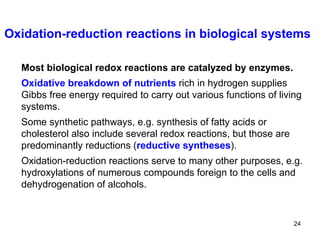
Oxidation-reduction reactions in biological systems Most biological redox reactions are catalyzed by enzymes. Oxidative breakdown of nutrients   rich in hydrogen supplies Gibbs free energy required to carry out various functions of living systems. Some synthetic pathways, e.g. synthesis of fatty acids or cholesterol also include several redox reactions, but those are predominantly reductions   ( reductive syntheses ).   Oxidation-reduction reactions serve to many other purposes, e.g. hydroxylations of numerous compounds foreign to the cells and  dehydrogenation of alcohols.
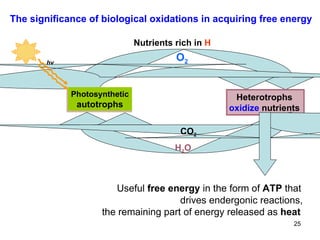
Useful  free energy  in the form of  ATP  that   drives endergonic reactions,  the remaining part of energy released as  heat The significance of biological oxidations in acquiring free energy Photosynthetic autotrophs Heterotrophs oxidize  nutrients CO 2 H 2 O O 2 Nutrients rich in   H   hν
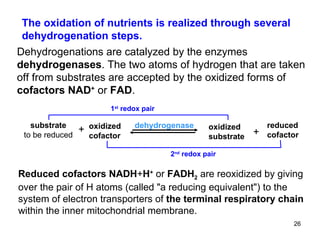
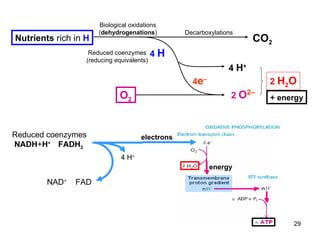
Reduced cofactors NADH + H +   or  FADH 2  are reoxidized by giving over the pair of H atoms (called  "a reducing equivalent") to the system of electron transporters of  the terminal respiratory chain  within the inner mitochondrial membrane. The oxidation of nutrients is realized through several  dehydrogenation steps. Dehydrogenations are catalyzed by the enzymes  dehydrogenases . The two atoms of hydrogen that are taken off from substrates are accepted by the oxidized forms of  cofactors NAD +   or  FAD . + substrate to be reduced oxidized cofactor + 2 nd  redox pair 1 st  redox pair dehydrogenase oxidized substrate reduced cofactor
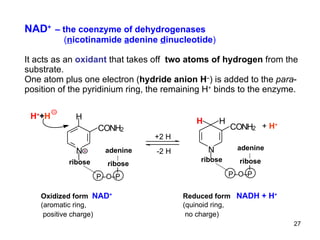
NAD +   – the coenzyme of dehydrogenases    ( n icotinamide  a denine  d inucleotide ) It acts as an  oxidant  that takes off  two atoms of hydrogen  from the substrate. One atom plus one electron ( hydride anion H – ) is added to the  para -position of the pyridinium ring, the remaining H +  binds to the enzyme. Oxidized form  NAD + (aromatic ring, positive charge)   H N C O N H 2 H + + H Reduced form  NADH + H + (quinoid ring, no charge)   N C O N H 2 H H +  H + P – O–P ribose adenine ribose P – O–P ribose adenine ribose +2 H -2 H
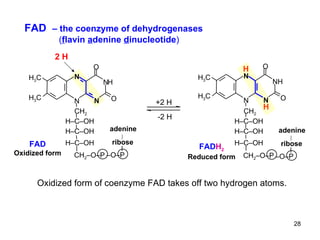
Oxidized form of coenzyme FAD takes off two hydrogen atoms. FAD  – the coenzyme of dehydrogenases   ( f lavin  a denine  d inucleotide ) +2 H -2 H N N N N H O O H 3 C CH 2 FAD Oxidized form H 3 C CH 2 –O–P H–C–OH H–C–OH H–C–OH – O–P ribose adenine N N N NH O O CH 2 H–C–OH H H FAD H 2 Reduced form H 3 C H 3 C H–C–OH H–C–OH CH 2 –O–P – O–P ribose adenine 2 H
electrons energy 4  H 4  H + 2  O 2– CO 2 Biological oxidations ( dehydrogenations ) Decarboxylations Reduced coenzymes (reducing equivalents) 4 e – 2  H 2 O Nutrients  rich in  H O 2 + energy Reduced coenzymes NADH + H +  FADH 2 4 H + NAD +   FAD
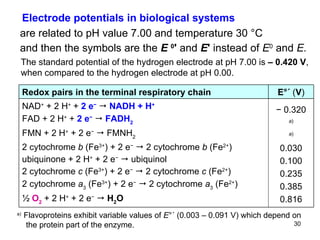
a)  Flavoproteins exhibit variable values of  E °´ (0.003 – 0.091 V) which depend on the protein part of the enzyme. Electrode potentials in biological systems are related to pH value 7.00 and temperature 30  °C and then the symbols are the  E  0 '  and  E '  instead of  E 0  and  E. The standard potential of the hydrogen electrode at pH 7.00 is  – 0.420 V , when compared to the hydrogen electrode at pH 0.00. −  0.320 a ) a ) 0.030 0.100 0.235 0.385 0.816 NAD +  + 2 H +  +  2 e −      NADH + H + FAD + 2 H +  +  2 e −      FADH 2 FMN + 2 H +  + 2 e −     FMNH 2 2 cytochrome  b  (Fe 3+ ) + 2 e −     2 cytochrome  b  (Fe 2+ )  ubiquinone + 2 H +  + 2 e −     ubiquinol 2 cytochrome  c  (Fe 3+ ) + 2 e −     2 cytochrome  c  (Fe 2+ ) 2 cytochrome  a 3  (Fe 3+ ) + 2 e −     2 cytochrome  a 3  (Fe 2+ ) ½  O 2  + 2 H +  + 2 e −      H 2 O E°´  ( V ) Redox pairs in the terminal respiratory chain
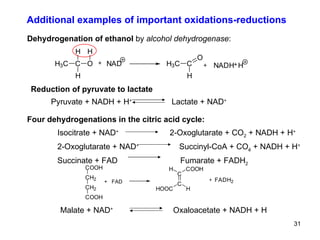
Additional examples of important oxidations-reductions Dehydrogenation of ethanol  by  alcohol dehydrogenase : Four dehydrogenations in the citric acid cycle: Isocitrate + NAD +  2-Oxoglutarate + CO 2  + NADH + H +   2-Oxoglutarate + NAD +   Succinyl-CoA + CO ě  + NADH + H + Succinate + FAD  Fumarate + FADH 2 C O O H C H 2 C H 2 C O O H +  FAD C C C O O H H H O O C H +  F A D H 2 Malate + NAD +  Oxaloacetate + NADH + H Reduction of pyruvate to lactate Pyruvate + NADH + H +  Lactate + NAD +
Dissolution equilibria Precipitation reactions
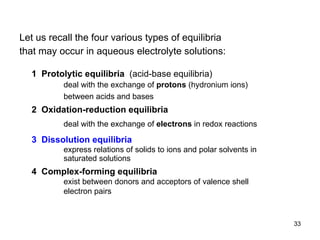
1  Protolytic equilibria  (acid-base equilibria) deal with the exchange of  protons  (hydronium ions) between acids and bases 2  Oxidation-reduction equilibria deal with the exchange of  electrons  in redox reactions 3  Dissolution equilibria express relations of solids to ions and polar solvents in saturated solutions  4  Complex-forming equilibria exist between donors and acceptors of valence shell electron pairs  Let us recall the four various types of equilibria   that may occur in aqueous electrolyte solutions:
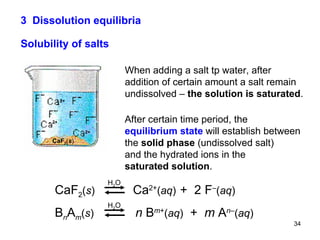
3  Dissolution equilibria Solubility of salts When adding a salt tp water, after addition of certain amount a salt remain undissolved –  the solution is saturated . After certain time period, the  equilibrium state  will establish between  the  solid phase  (undissolved salt) and the hydrated ions in the saturated solution . CaF 2 ( s )   Ca 2+ ( aq )   +  2 F – ( aq ) B n A m ( s )   n  B m + ( aq )   +  m  A n – ( aq ) H 2 O H 2 O 2+ 2+ 2+ CaF 2 ( s )
is described by the  equilibrium constant Because the activity (then also  " concentration ") of any solid is taken as equal to unit ones and the amount of undissolved solid salt does not influence the ion concentration in a saturated solution, the simplified constant is called the  solubility product  K S  : e.g., B n A m ( s )  n  B m + ( aq )  +  m  A n – ( aq ) H 2 O The equilibrium state of a saturated solution CaF 2 ( s )  Ca 2+ ( aq )   +  2 F – ( aq ) H 2 O or [ B m + ] [ A n – ] K S (B n A m )   =   [ Ca 2+ ] [ F – ] 2 K S (CaF 2 )   =   K   =  [ B m + ] n  [ A n – ] m [ B n A m ] [ Ca 2+ ] [ F – ] 2 [ CaF 2 ] K  =   or
The  solubility product  indicates the maximal value of the product of ion concentrations (at a specified temperature). If the higher value than  K S  is reached, no matter in which way, the surplus of ions is separated out from the solution in the form of solid compound.   There are many  precipitation reaction  that are utilized in  analytical chemistry  and in syntheses of slightly soluble compounds. The knowledge of calcium salts solubility helps in understanding the formation of renal stones, mineralization of bones and teeth, etc.
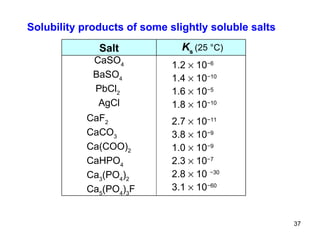
Solubility products of some slightly soluble salts 1.2    10 −6   1.4    10 −10   1.6    10 −5 1.8    10 −10 2.7    10 −11   3.8    10 −9 1.0    10 −9   2.3    10 −7 2.8    10  −30 3.1    10 −60 CaSO 4 BaSO 4   PbCl 2   AgCl CaF 2 CaCO 3 Ca(COO) 2 CaHPO 4 Ca 3 (PO 4 ) 2 Ca 5 (PO 4 ) 3 F  K s  (25  °C) Salt
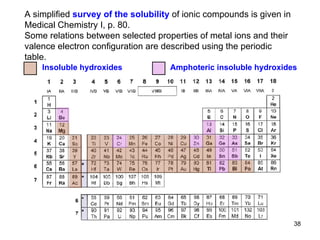
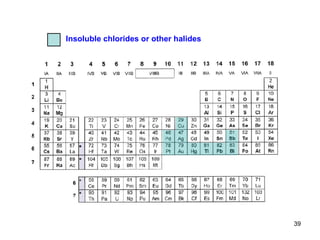
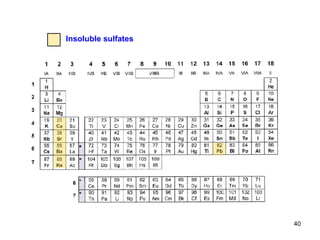
A simplified  survey of the solubility  of ionic compounds is given in Medical Chemistry I, p. 80.  Some relations between selected properties of metal ions and their valence electron configuration are described using the periodic table. Insoluble hydroxides Amphoteric insoluble hydroxides
Insoluble chlorides or other halides
Insoluble sulfates
The common ion effect An example: To a saturated AgCl solution ( K S  = 1.7    10 –10 ) solution of hydrochloric acid is added until the chloride concentration  [Cl – ]  is 0.1 mol/l. The concentration of silver ion  [Ag + ] in saturated solution equals  1.3    10 –5 . K S  = [Ag + ]   [Cl – ]   = 1.7    10 –10   is the constant and remains the same no matter how the concentration [Cl – ] is changed. Then  K S  = 1.7    10 –10  = 0.1  x  and  x  =  [Ag + ] =  1.7    10 –9   after Cl –  addition. In this case, a 10 000-fold reduction of Ag +  ions in solution is shown. The extinct free Ag +  ions were precipitated as AgCl. The common ion effect  is the process, in which increasing the concentration of one of the ions in an equilibrium results in a decrease of the concentration of the other ions.
4   Complex-forming equilibria Complex compounds originate in reactions, in which some cations of transition metals bind donors of electron pairs (ligands with unshared electron pairs, e.g. ammonia, chloride or cyanide anions) through coordinate covalent bonds. Under certain conditions, the complex particles dissociate to primary components. The stability of a complex particle, which is determined by the strength of the coordinate bond, may be expressed in the form of  either the  equilibrium dissociation constant of a complex or, more frequently, as the  reciprocal  of that dissociation constant called the  stability constant of a complex .

04 redox reactions__dissoln.__precip

  • 1.
    Medical Chemistry Lecture 4 2007 (J.S.) Oxidation-reduction reactions Dissolution equilibria Precipitation reactions
  • 2.
    Oxidation-reduction reactions ( redox reactions ) are common events in everyday life: e.g. combustion of fossil fuels, corrosion of metals, dry cells and accumulators, metabolism of nutrients in human bodies , photosynthesis in green plants .
  • 3.
    Oxidation-reduction reactions areelectron transfer reactions The process may involve the complete transfer of electrons to form ionic bonds or only a partial transfer or shift of electrons to form covalent bonds. Oxidation and reduction occur simultaneously in a chemical reaction; one cannot take place without the other. A red – n e –  A ox Oxidation is the loss of electrons by a particle in a reaction, resulting in an increase in the oxidation number . B ox + n e –  B red Reduction is the gain of electrons by a particle in a reaction that results in a decrease in the oxidation number .
  • 4.
    Oxidation number ( oxidation state of an element ) is the charge an element has in a simple ion it forms or the it would hypothetically have , if the shared electron pairs in covalent bonds are assigned to the more electronegative element sharing the pair of electrons. The algebraic sum of the oxidation numbers of elements in a molecular compound equals zero and, in a polyatomic ion, it must equal the charge on the ion. Examples: Oxidation number of sulfur (x) in sulfuric acid: H 2 SO 4 2  ( +I ) 4  ( –II ) 2 + (– 8) = – 6 – 6 + x = 0 + VI Different oxidation numbers of nitrogen: NH 3 –III N 2 0 N 2 I O N II O N III O 2 – N V O 3 –
  • 5.
    Rules that helpin assessing oxidation numbers: – The oxidation number of any free element is zero , even when the atoms are combined with themselves (e.g. O 2 , P 4 , S 8 ). – No regard is paid to covalent bonds between atoms of the same species. – An element may have more than one oxidation number, if it forms a variety of compounds. – The oxidation number of hydrogen in a compound or an ion is + I except in ionic hydrides ( – I ). – The oxidation number of oxygen in a compound or in an ion is –II except in peroxides (it takes on a – I ). – Metals generally have only positive oxidation numbers in compounds. – The oxidation number of alkali metals equals always + I , of alkaline earth metals always + II . – Nonmetals have negative oxidation numbers when combined with metals, positive oxidation numbers when combined with more electronegative nonmetals.
  • 6.
    Terms in redoxreactions A quite general reaction: In this reaction A red is oxidized because it loses electrons; it is a reductant (reducing agent) because it acts as donor of electrons and causes another species to be reduced. B ox is reduced because it gains electrons; it is an oxidant (oxidizing agent) because it acts as acceptor of electrons and causes another species to be oxidized. A red + B ox A ox + B red + n e – – n e –
  • 7.
    In the reactionFe is oxidized, it acts as reductant of Cu 2+ , Cu 2+ ion is reduced, it acts as oxidant of Fe. Fe ( s ) + Cu 2+ ( aq ) Fe 2+ ( aq ) + Cu ( s ) + 2 e – – 2 e – Every redox reaction can be formally separated into two parts called half-reactions (half-equations, half-cells) that represent either oxidation only or reduction only; they do not occur without the other half-reaction taking place at the same time: Fe Fe 2+ + 2 e – oxidation reduction Cu 2+ + 2 e – Cu
  • 8.
    Pairs of theoxidized and reduced species A ox / A red and B ox / B red that appear in half-equations are called redox pairs (or redox couples). Components of a particular redox pair can differ not only in the number of electrons but also in the number of hydrogen, oxygen, as well as other atoms. Fe 3+ / Fe 2+ O 2 / 2H 2 O MnO 4 – / MnO 2 Cr 2 O 7 2– / Cr 3+ aldehyde / alcohol pyruvate / lactate disulfide / 2 thioalcohols quinone / diphenol Examples of redox pairs:
  • 9.
    A redox pair is a couple of particles, which differ each from other in the oxidation number of one or more atoms of the same element (mostly also in the number of electrons). One component of a redox pair is more oxidized and can give the second one by reduction (in a "half-reaction" of a particular redox reaction). Don 't confuse redox pairs and conjugate pairs ! A conjugate pair is a couple that consists of an acid and a base (that differ just only in hydrogen ion H + ).
  • 10.
    Redox reactions then may be easily identified not only through changes of charges on ions , but according to other symptoms: Oxidation and reduction are defined generally in terms of changes in oxidation numbers . In some redox reactions, actual electron loss and gain to form ions need not to occur. Hydrogenation and dehydrogenation are redox reactions, the products of which contain more or less hydrogen atoms (as well as less or more multiple covalent bonds – the terms saturation or desaturation are also used). Oxygenation and deoxygenation are redox reactions, the products of which contain more or less oxygen atoms . A special type of oxygenation is hydroxylation .
  • 11.
    Different types ofredox reactions – examples: – Loss and gain of electrons – Oxygenation and deoxygenation – Dehydrogenation and hydrogenation Cu 2+ + Fe  Cu + Fe 2+ reduction of cupric ion to copper Zn + Cu 2+  Zn 2+ + Cu oxidation of zinc CO 2  CO + ½O 2 reduction of carbon dioxide by deoxygenation C ( s ) + O 2  CO 2 oxidation (combustion) of carbon CH 3 CH 2 -OH CH 3 CH=O dehydrogenation of ethanol to acetaldehyde – 2H + 2H CH 3 – C –COOH O CH 3 – C H –COOH O H hydrogenation (reduction) of pyruvate to lactate
  • 12.
    Do not confusethe terms hydrogenation and hydratation, dehydrogenation and dehydratation ! In organic chemistry, hydrogenated products are sometimes named by adding the prefix dihydro– to the name of a original compound, and dehydrogenated products by adding the prefix dehydro – to the name of a original compound. Hydratation and dehydratation are not redox reactions ; there is no change in the sum of the both carbon oxidation numbers (one of them is oxidized and another is reduced in addition or elimination of water ). C H C H – I – I – II C H C H 2 O H 0 +H 2 O – H 2 O
  • 13.
    Well-known strong oxidantsand reductants – examples : Oxidizing agents – H 2 O 2 , KMnO 4 , K 2 Cr 2 O 7 , Cl 2 , I 2 Reducing agents – H 2 , C, Fe, Zn, SnCl 2 Oxidants and reductants differ in their ability to react with other agents considerably. The strength of oxidants and reductants (their tendency to gain or lose electrons) is expressed for particular redox pairs by standard electrode potentials E 0 . Standard electrode potential E 0 is the potential for an electrochemical half-cell (both oxidized and reduced form at c = 1 mol/l) established relative to the potential of 0.000 V for the standard hydrogen electrode (H + /H couple under standard state conditions).
  • 14.
    Standard state ofa half-cell: – both oxidized and reduced form of a redox pair at c = 1 mol/l – specified temperature , usually 25 °C – atmospheric pressure 101.3 kPa is important only when there is a gaseous component of the redox pair H 2 H + [ H + ] = 1 mol / l p H 2 = 101.3 kPa E 0 (H + /H) = 0.000 V (25 °C) Standard hydrogen electrode – reference electrode electrode - an inert metal A ox A red [ A ox ] = [ A red ] = 1 mol/l Half-cell to be measured in the standard state
  • 15.
    The equilibrium electromotive force E cell (the potential of the galvanic cell) that is the potential difference between the two half-cells is measured: Any other reference electrode (which is stable and the potential known) may be used for measurement of electrode potentials, e.g. silver chloride or saturated calomel electrode ( E 0 = + 0.246 V). E 0 cell = Δ E 0 = E 0 X – E 0 ref H + H 2 A ox A red salt bridge millivoltmeter with high inner resistance
  • 16.
    Examples of standardelectrode potentials (25 °C) at pH 0 (at pH 7.0 E ° ´= – 0.420) − 2.71 − 0.76 – 0.44 0.00 0.34 0.54 0.76 1.23 1.33 1.51 1.77 Na + + e −  Na Zn 2+ + 2 e −  Zn Fe 2+ + 2 e –  Fe 2 H + + 2 e −  H 2 Cu 2+ + 2 e −  Cu I 2 + 2 e −  2 I − Fe 3+ + e −  Fe 2+ O 2 + 4 H + + 4 e −  2 H 2 O Cr 2 O 7 − + 14 H + + 6 e −  2 Cr 3+ + 7 H 2 O MnO 4 − + 8 H + + 5 e −  Mn 2+ + 4 H 2 O H 2 O 2 + 2 H + + 2 e −  2 H 2 O E ° ( V ) Half-reaction
  • 17.
    Redox pairs fromthe previous table: The guiding principle : Under standard conditions, any oxidant will react with any reductant with a lower, more negative E 0 (i.e. situated above in the table). Na + / Na Zn 2+ / Zn Fe 2+ / Fe H + / ½ H 2 Cu 2+ / Cu I 2 / 2 I − Fe 3+ / Fe 2+ O 2 / 2 H 2 O Cr 2 O 7 2− / 2 Cr 3+ MnO 4 − / Mn 2+ H 2 O 2 / H 2 O strong oxidants Oxidized forms are weak oxidants Reduced forms are strong reductants weak reductants
  • 18.
    If the difference Δ E 0 between both redox pairs is greater than 0.400 V, the reaction is irreversible (i.e. proceeds to completion) even under various non-standard concentrations of the reactants. If the difference between both E 0 is less than 0.400 V , then the reaction will reach equilibrium, the position of which depends on the initial concentrations of components of both redox pairs; the direction of such a reaction may be reversed . Electrode potentials E under non-standard conditions for a redox pair a A ox + n e –  b A red Nernst equation RT n F ln E = E 0 + [ A ox ] a [ A red ] b [ A ox ] and [ A red ] relevant concentrations of reactants R = 8.314  kPa K –1 mol –1 F = 96 500 C mol –1 n = number of moles of electrons transferred E , E 0 el. potentials in volts
  • 19.
    After expressing R , T (298 K), and F in numbers and transposing natural logarithm into decadic (ln x = 2.3 log x), the equation will take the form (in volts; t = 25 °C) The electrode poten t ial of half-cells at various concentrations of redox pair components can be calculated. On the contrary, the ratio of both redox pair components can be estimated from the measured values of electrode potentials. Galvanic cells (electrochemical cells) are two half-cells connected by an external conductor . This arrangement allows discharging of the cell , the spontaneous cell reaction (the sum of the chemical half-reactions). The electrons lost flow in the external circuit from the substance that is being oxidized in one of the half-cells to the substance that is being reduced in another half-cell till the cell reaches an equilibrium . The free energy resulting from the spontaneous reaction is released as electrical energy and/or heat. 0.059 n log E = E 0 + [ A ox ] a [ A red ] b
  • 20.
    Before aconductive connection of the half-cells, the electromotive force of the galvanic cell E cell equals E cell = Δ E = E A – E B . The expected cell reaction is According to Nernst equation, The cell potential Δ E is sometimes described as the "driving force" of the cell reaction. It is related to the amount of electrical work that a cell can perform. After the external circuit is closed, the cell reaction is started. It goes on till the Δ E equals zero (the equilibrium state is reached) . A red + B ox A ox + B red the external circuit E cell = Δ E = Δ E 0 + RT n F ln [ A ox ] i [ B red ] i [ A red ] i [ B ox ] i (in volts, 25 °C)
  • 21.
    A general rulesuggests that the oxidized form of a redox pair with the more positive E is able to oxidize the reduced form of the redox pair with the less positive E. that iodine will Example: Redox reaction: Half-reactions: The oxidation of iodide to elemental iodine will not be complete , the difference Δ E 0 is less than 0.40 V. Under which condition is iodine able to oxidize Fe 2+ ? It follows from oxidize Fe 2+ to Fe 3+ only if there is much higher initial concentration of I 2 and Fe 2+ than of I – and Fe 3+ (the ratio of the products [I] i  [Fe 2+ ] i and [I – ] i  [Fe 3+ ] i must be greater than approx. 2500). Even so, the equilibrium will be reached after oxidation of a very small amount of Fe 2+ . Fe 3+ + e – Fe 2+ E 2 0 = 0.75 V I 2 + 2 e – 2 I – E 1 0 = 0.55 V Conventionally, the more positive E in the cell is described as E 2 . Fe 2+ + I 2 Fe 3+ + 2 I – The preferred reaction is then Fe 2+ + I 2 Fe 3+ + 2 I – ln [ Fe 3+ ] i [ I – ] i [ Fe 2+ ] i [ ½ I 2 ] i Δ E = Δ E 0 + RT n F
  • 22.
    Relationship between thefree energy change Δ G of redox reactions and the cell potential Δ E The cell potential Δ E is a measure of whether a redox reaction is spontaneous. F or the reaction A red + B ox -> A ox + B red it equals The Gibbs free energy change Δ G is the quite general measure of reaction spontaneity and equals the free energy to do useful work. For the reaction A + B -> C + D, The electrical work available from a redox reaction – Δ G is equal to electrochemical potential Δ E times the electrical charge q (equal to n F ) transferred in a redox reaction. If a redox reaction starts at the standard state, –  G 0 = n F  E 0 . Δ G = Δ G 0 + RT ln [A] ï [B] i [C] i [D] i ln Δ E = Δ E 0 + RT n F [A red ] ï [B ox ] i [A ox ] i [B red ] i –  G = n F  E ( J mol –1 )
  • 23.
    Relationship beween Δ E 0 and the equilibrium constant K ln Δ E = 0 = Δ E 0 – RT n F [A red ] a eq [B ox ] c eq [A ox ] b eq [B red ] d eq The equilibrium constant K eq of a redox reaction a A red + c B ox b A ox + d B red is K eq = [ A red ] a eq [ B ox ] c eq [ A ox ] b eq [ B red ] d eq After the galvanic cell reaction reaches its equilibrium (the cell is discharged), Δ E equals zero ( E 1 = E 2 ). Δ E 0 = ln K and ln K = Δ E 0 After expressing R , T (298 K), and F in numbers and transposing natural logarithm into decadic (ln x = 2.3 log x), the equation will take the form log K = Δ E 0 (25 °C) RT n F n 0.059 RT n F
  • 24.
    Oxidation-reduction reactions inbiological systems Most biological redox reactions are catalyzed by enzymes. Oxidative breakdown of nutrients rich in hydrogen supplies Gibbs free energy required to carry out various functions of living systems. Some synthetic pathways, e.g. synthesis of fatty acids or cholesterol also include several redox reactions, but those are predominantly reductions ( reductive syntheses ). Oxidation-reduction reactions serve to many other purposes, e.g. hydroxylations of numerous compounds foreign to the cells and dehydrogenation of alcohols.
  • 25.
    Useful freeenergy in the form of ATP that drives endergonic reactions, the remaining part of energy released as heat The significance of biological oxidations in acquiring free energy Photosynthetic autotrophs Heterotrophs oxidize nutrients CO 2 H 2 O O 2 Nutrients rich in H hν
  • 26.
    Reduced cofactors NADH+ H + or FADH 2 are reoxidized by giving over the pair of H atoms (called "a reducing equivalent") to the system of electron transporters of the terminal respiratory chain within the inner mitochondrial membrane. The oxidation of nutrients is realized through several dehydrogenation steps. Dehydrogenations are catalyzed by the enzymes dehydrogenases . The two atoms of hydrogen that are taken off from substrates are accepted by the oxidized forms of cofactors NAD + or FAD . + substrate to be reduced oxidized cofactor + 2 nd redox pair 1 st redox pair dehydrogenase oxidized substrate reduced cofactor
  • 27.
    NAD + – the coenzyme of dehydrogenases ( n icotinamide a denine d inucleotide ) It acts as an oxidant that takes off two atoms of hydrogen from the substrate. One atom plus one electron ( hydride anion H – ) is added to the para -position of the pyridinium ring, the remaining H + binds to the enzyme. Oxidized form NAD + (aromatic ring, positive charge) H N C O N H 2 H + + H Reduced form NADH + H + (quinoid ring, no charge) N C O N H 2 H H + H + P – O–P ribose adenine ribose P – O–P ribose adenine ribose +2 H -2 H
  • 28.
    Oxidized form ofcoenzyme FAD takes off two hydrogen atoms. FAD – the coenzyme of dehydrogenases ( f lavin a denine d inucleotide ) +2 H -2 H N N N N H O O H 3 C CH 2 FAD Oxidized form H 3 C CH 2 –O–P H–C–OH H–C–OH H–C–OH – O–P ribose adenine N N N NH O O CH 2 H–C–OH H H FAD H 2 Reduced form H 3 C H 3 C H–C–OH H–C–OH CH 2 –O–P – O–P ribose adenine 2 H
  • 29.
    electrons energy 4 H 4 H + 2 O 2– CO 2 Biological oxidations ( dehydrogenations ) Decarboxylations Reduced coenzymes (reducing equivalents) 4 e – 2 H 2 O Nutrients rich in H O 2 + energy Reduced coenzymes NADH + H + FADH 2 4 H + NAD + FAD
  • 30.
    a) Flavoproteinsexhibit variable values of E °´ (0.003 – 0.091 V) which depend on the protein part of the enzyme. Electrode potentials in biological systems are related to pH value 7.00 and temperature 30 °C and then the symbols are the E 0 ' and E ' instead of E 0 and E. The standard potential of the hydrogen electrode at pH 7.00 is – 0.420 V , when compared to the hydrogen electrode at pH 0.00. − 0.320 a ) a ) 0.030 0.100 0.235 0.385 0.816 NAD + + 2 H + + 2 e −  NADH + H + FAD + 2 H + + 2 e −  FADH 2 FMN + 2 H + + 2 e −  FMNH 2 2 cytochrome b (Fe 3+ ) + 2 e −  2 cytochrome b (Fe 2+ ) ubiquinone + 2 H + + 2 e −  ubiquinol 2 cytochrome c (Fe 3+ ) + 2 e −  2 cytochrome c (Fe 2+ ) 2 cytochrome a 3 (Fe 3+ ) + 2 e −  2 cytochrome a 3 (Fe 2+ ) ½ O 2 + 2 H + + 2 e −  H 2 O E°´ ( V ) Redox pairs in the terminal respiratory chain
  • 31.
    Additional examples ofimportant oxidations-reductions Dehydrogenation of ethanol by alcohol dehydrogenase : Four dehydrogenations in the citric acid cycle: Isocitrate + NAD + 2-Oxoglutarate + CO 2 + NADH + H + 2-Oxoglutarate + NAD + Succinyl-CoA + CO ě + NADH + H + Succinate + FAD Fumarate + FADH 2 C O O H C H 2 C H 2 C O O H + FAD C C C O O H H H O O C H + F A D H 2 Malate + NAD + Oxaloacetate + NADH + H Reduction of pyruvate to lactate Pyruvate + NADH + H + Lactate + NAD +
  • 32.
  • 33.
    1 Protolyticequilibria (acid-base equilibria) deal with the exchange of protons (hydronium ions) between acids and bases 2 Oxidation-reduction equilibria deal with the exchange of electrons in redox reactions 3 Dissolution equilibria express relations of solids to ions and polar solvents in saturated solutions 4 Complex-forming equilibria exist between donors and acceptors of valence shell electron pairs Let us recall the four various types of equilibria that may occur in aqueous electrolyte solutions:
  • 34.
    3 Dissolutionequilibria Solubility of salts When adding a salt tp water, after addition of certain amount a salt remain undissolved – the solution is saturated . After certain time period, the equilibrium state will establish between the solid phase (undissolved salt) and the hydrated ions in the saturated solution . CaF 2 ( s ) Ca 2+ ( aq ) + 2 F – ( aq ) B n A m ( s ) n B m + ( aq ) + m A n – ( aq ) H 2 O H 2 O 2+ 2+ 2+ CaF 2 ( s )
  • 35.
    is described bythe equilibrium constant Because the activity (then also " concentration ") of any solid is taken as equal to unit ones and the amount of undissolved solid salt does not influence the ion concentration in a saturated solution, the simplified constant is called the solubility product K S : e.g., B n A m ( s ) n B m + ( aq ) + m A n – ( aq ) H 2 O The equilibrium state of a saturated solution CaF 2 ( s ) Ca 2+ ( aq ) + 2 F – ( aq ) H 2 O or [ B m + ] [ A n – ] K S (B n A m ) = [ Ca 2+ ] [ F – ] 2 K S (CaF 2 ) = K = [ B m + ] n [ A n – ] m [ B n A m ] [ Ca 2+ ] [ F – ] 2 [ CaF 2 ] K = or
  • 36.
    The solubilityproduct indicates the maximal value of the product of ion concentrations (at a specified temperature). If the higher value than K S is reached, no matter in which way, the surplus of ions is separated out from the solution in the form of solid compound. There are many precipitation reaction that are utilized in analytical chemistry and in syntheses of slightly soluble compounds. The knowledge of calcium salts solubility helps in understanding the formation of renal stones, mineralization of bones and teeth, etc.
  • 37.
    Solubility products ofsome slightly soluble salts 1.2  10 −6 1.4  10 −10 1.6  10 −5 1.8  10 −10 2.7  10 −11 3.8  10 −9 1.0  10 −9 2.3  10 −7 2.8  10 −30 3.1  10 −60 CaSO 4 BaSO 4 PbCl 2 AgCl CaF 2 CaCO 3 Ca(COO) 2 CaHPO 4 Ca 3 (PO 4 ) 2 Ca 5 (PO 4 ) 3 F K s (25 °C) Salt
  • 38.
    A simplified survey of the solubility of ionic compounds is given in Medical Chemistry I, p. 80. Some relations between selected properties of metal ions and their valence electron configuration are described using the periodic table. Insoluble hydroxides Amphoteric insoluble hydroxides
  • 39.
  • 40.
  • 41.
    The common ioneffect An example: To a saturated AgCl solution ( K S = 1.7  10 –10 ) solution of hydrochloric acid is added until the chloride concentration [Cl – ] is 0.1 mol/l. The concentration of silver ion [Ag + ] in saturated solution equals 1.3  10 –5 . K S = [Ag + ] [Cl – ] = 1.7  10 –10 is the constant and remains the same no matter how the concentration [Cl – ] is changed. Then K S = 1.7  10 –10 = 0.1 x and x = [Ag + ] = 1.7  10 –9 after Cl – addition. In this case, a 10 000-fold reduction of Ag + ions in solution is shown. The extinct free Ag + ions were precipitated as AgCl. The common ion effect is the process, in which increasing the concentration of one of the ions in an equilibrium results in a decrease of the concentration of the other ions.
  • 42.
    4 Complex-forming equilibria Complex compounds originate in reactions, in which some cations of transition metals bind donors of electron pairs (ligands with unshared electron pairs, e.g. ammonia, chloride or cyanide anions) through coordinate covalent bonds. Under certain conditions, the complex particles dissociate to primary components. The stability of a complex particle, which is determined by the strength of the coordinate bond, may be expressed in the form of either the equilibrium dissociation constant of a complex or, more frequently, as the reciprocal of that dissociation constant called the stability constant of a complex .