EDTA Titration (BS-II Chemistry,
Rabia Aziz)
1RABIA AZIZ
1.Introduction
2.Complexometric Titration 8. Masking and
Demasking agents
3.Metal-EDTA Titration 9. Example
4.EDTA Titration curve 10. Conclusion
5.Metal ion Indicator
6. EDTA Titration Techniques
7. Application of Complexometric Titration
2
Titration: is a technique in which a solution of known
concentration to determine the concentration of
unknown solution.
Conditions for Titration:
1.Reaction Proceed rapidly
2.Well-defined stoichiometry
3.Large equilibrium Constant
3
Complex formation Titration: A Titration based on
formation of a complex ion is called a
Complexometric Titration.
 Complex: Metal ion + Ligand
It may be electrically positive, negative or neutral.
Metal ions are Lewis acids and ligands are Lewis bases.
4
Ligands: ligands are electron-pair donor and form
coordinated covalent bond with Metal ion.
Ligands Types: On the basis of number of donating group:
Monodentate, Multidentate (bidentate, tridentate,
tetradentate, pentadentate, hexadentate)
Advantage of Multidentate: Tetradentate or Hexadentate
ligands are more satisfactory as titrants than ligands with
a lesser number of donor groups because their reactions
with cations are more completely and because they tend
to form 1:1 complexes. 5
Chelate: A chelate is produced when a metal ion
coordinates with two or more donor groups of a single
ligand to form a five or six membered heterocyclic ring.
Chelating Agent: Multidentate ligands are chelating Agent.
Chelate Effect: The Multidentate ligands form strong 1:1
complexes with many metal Ions.
The stability of Multidentate complex: is mainly an
entropy effect. The reaction is favoured by negative
enthalpy and positive entropy.
6
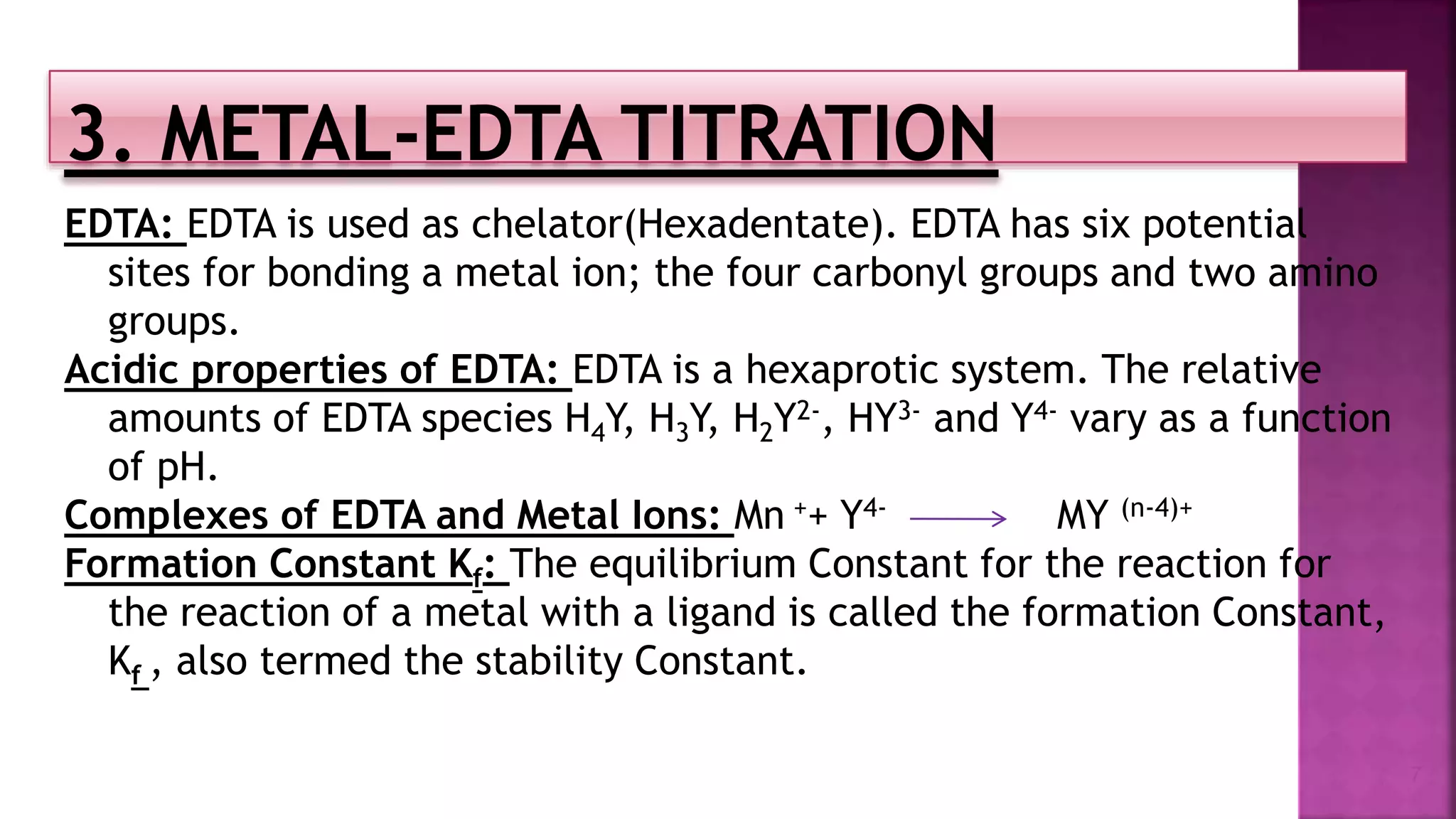
EDTA: EDTA is used as chelator(Hexadentate). EDTA has six potential
sites for bonding a metal ion; the four carbonyl groups and two amino
groups.
Acidic properties of EDTA: EDTA is a hexaprotic system. The relative
amounts of EDTA species H4Y, H3Y, H2Y2-, HY3- and Y4- vary as a function
of pH.
Complexes of EDTA and Metal Ions: Mn ++ Y4- MY (n-4)+
Formation Constant Kf: The equilibrium Constant for the reaction for
the reaction of a metal with a ligand is called the formation Constant,
Kf , also termed the stability Constant.
7
Conditional Formation Constant Kf’: is also called effective
formation Constant. It describes the formation of MY(n-4) at
any particular pH.
Control of pH: The minimum pH is needed for Titration of
many metal ions, provide a strategy for the selective
Titration of one ion in the presence of another.
 Auxiliary Complexing Agents / Buffer: is the buffer,
which not only fixes pH, but serves to complex the metal
ion and keep it in solution. Because it complexes the
metal ion until EDTA is introduced. 8
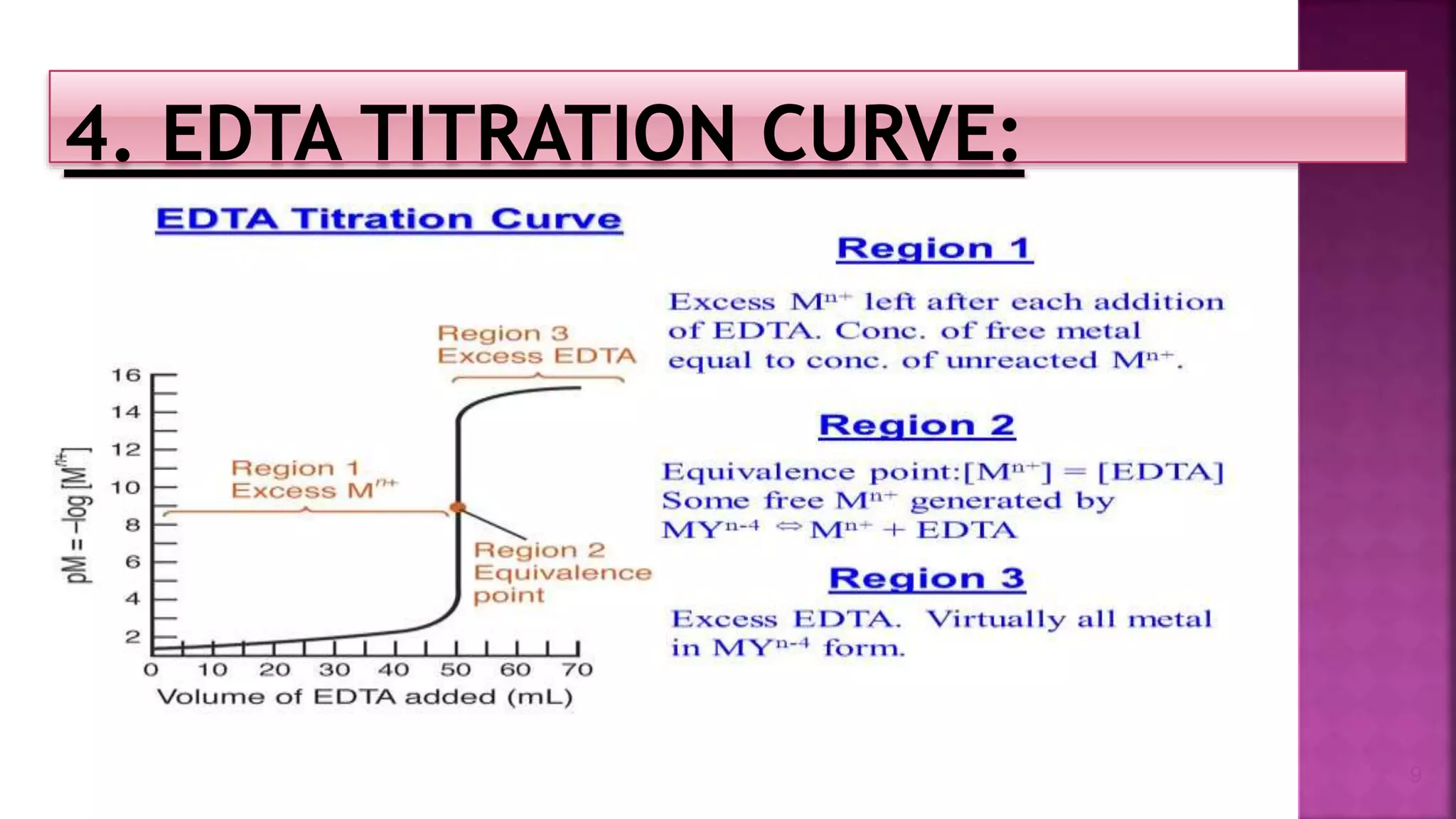
9
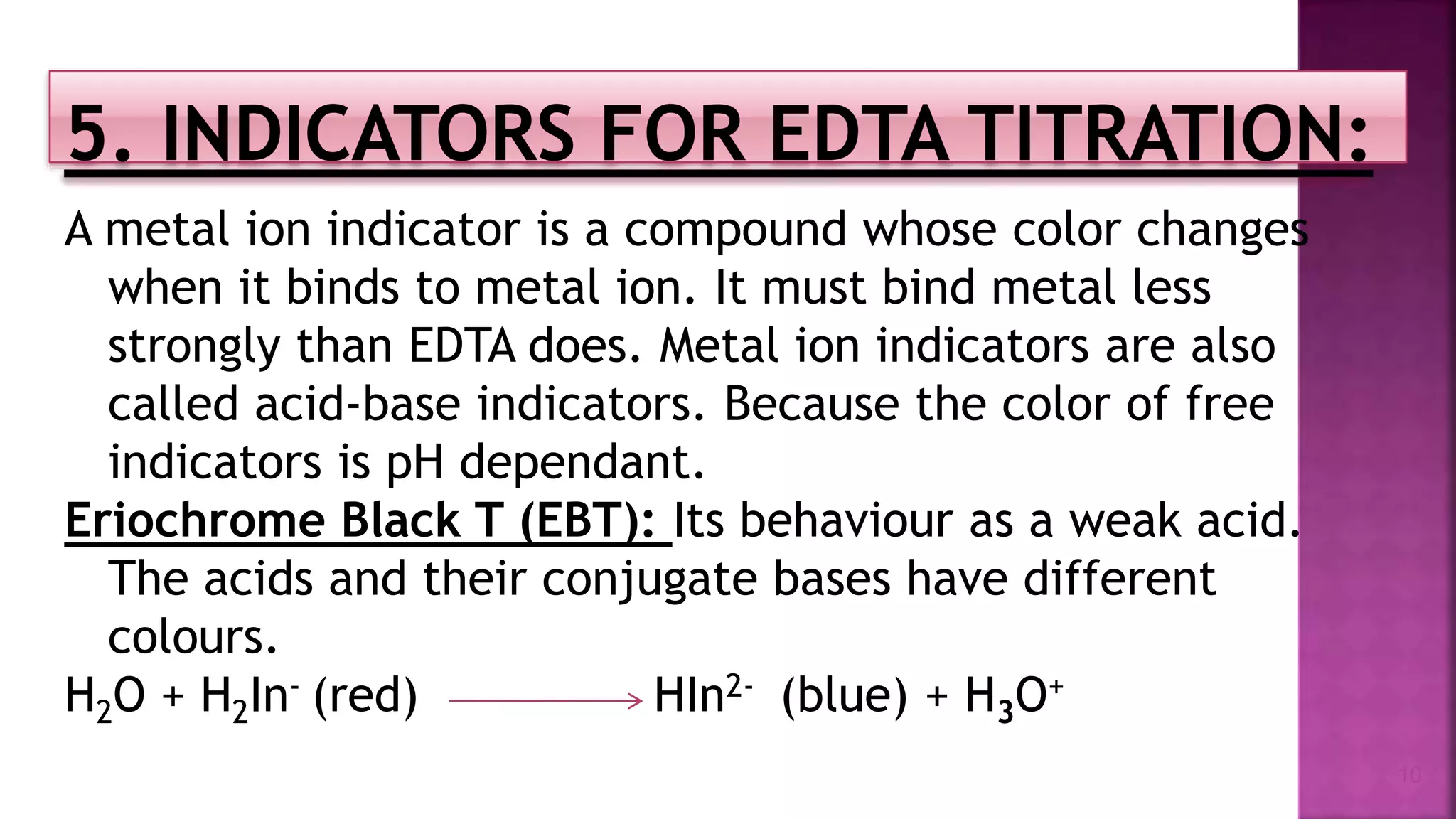
A metal ion indicator is a compound whose color changes
when it binds to metal ion. It must bind metal less
strongly than EDTA does. Metal ion indicators are also
called acid-base indicators. Because the color of free
indicators is pH dependant.
Eriochrome Black T (EBT): Its behaviour as a weak acid.
The acids and their conjugate bases have different
colours.
H2O + H2In- (red) HIn2- (blue) + H3O+
10
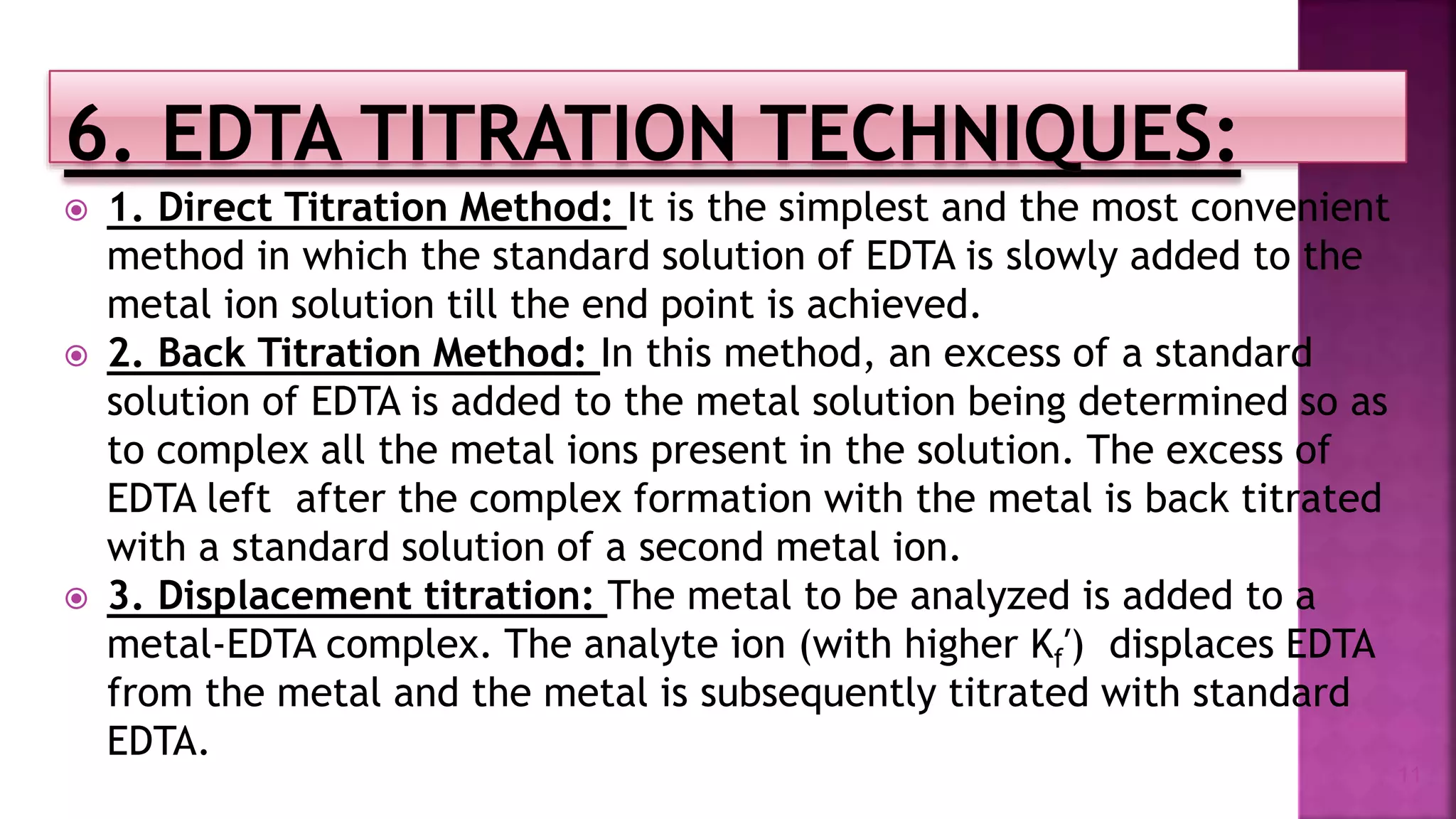
 1. Direct Titration Method: It is the simplest and the most convenient
method in which the standard solution of EDTA is slowly added to the
metal ion solution till the end point is achieved.
 2. Back Titration Method: In this method, an excess of a standard
solution of EDTA is added to the metal solution being determined so as
to complex all the metal ions present in the solution. The excess of
EDTA left after the complex formation with the metal is back titrated
with a standard solution of a second metal ion.
 3. Displacement titration: The metal to be analyzed is added to a
metal-EDTA complex. The analyte ion (with higher Kf′) displaces EDTA
from the metal and the metal is subsequently titrated with standard
EDTA.
11
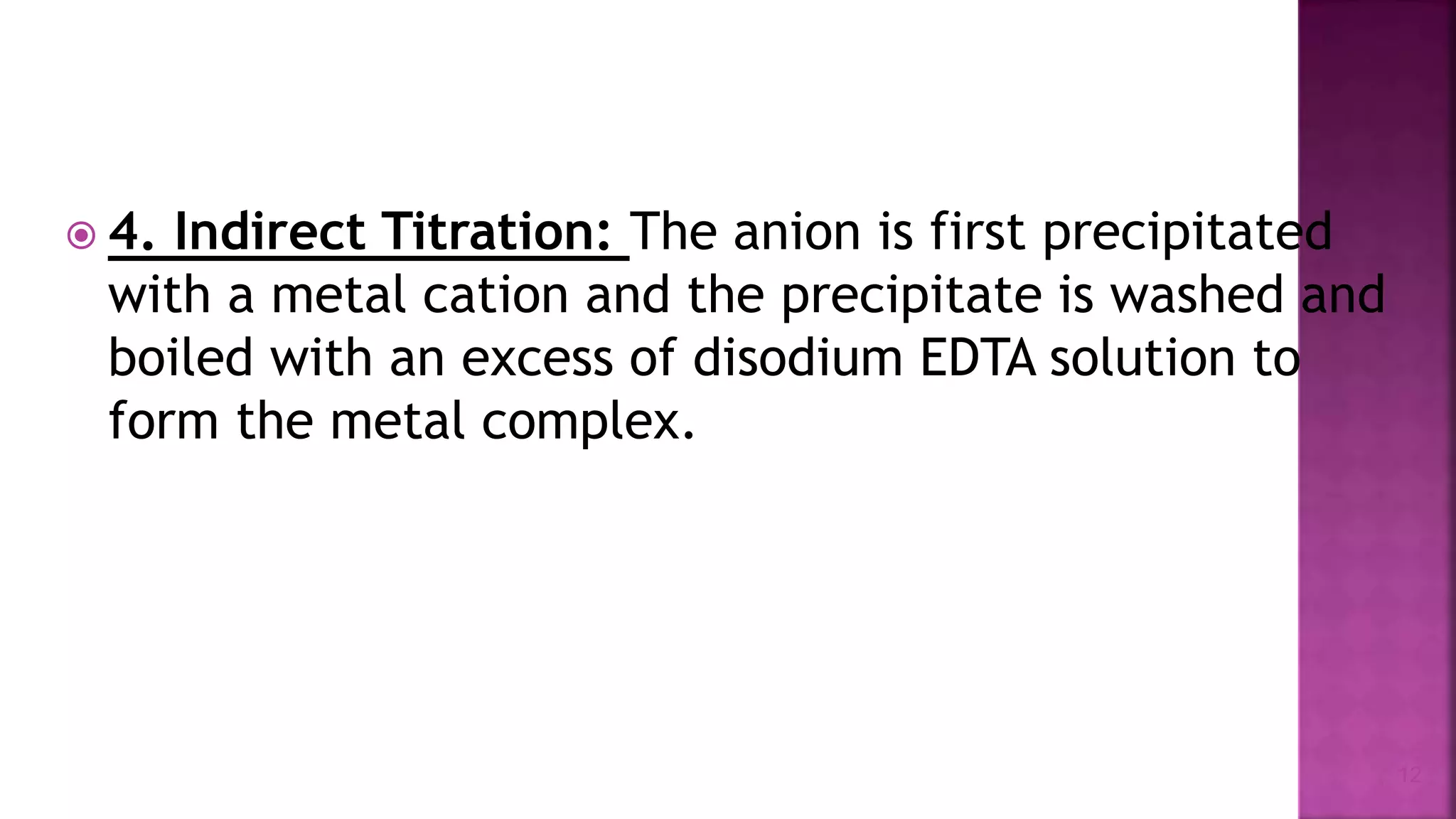
 4. Indirect Titration: The anion is first precipitated
with a metal cation and the precipitate is washed and
boiled with an excess of disodium EDTA solution to
form the metal complex.
12
 Hardness of Water: Actually, the hardness is due to
both Ca and Mg salts but the two are determined
together in the titration. The total Ca and Mg is
titrated with standard EDTA solution using eriochrome
black-T as indicator.
13
Masking Agent: is a reagent that protects some
component of the analyte from reaction with EDTA.
Masking used to prevent one element from interfering
in the analysis of another element.
 Demasking Agent: is a reagent that release of a
metal ion from a masking agent.
14
 Mg ion complex with EDTA:
 1. Mg2+ + In2- [MgIn]
 (red colour)
 2. [MgIn] + H4Y [MgY]2- + 2H+ + In2-
(blue)
15
 Complexometric titrations is the volumetric titration
through which end point can be detremined by
different stabilities of metal-indicator and metal-
titrant complex. Buffer solutions resist the change in
pH. The selectivity afforded by masking, demasking
and pH control allows individual components of
complex mixtures of metal ions to be analyzed by
EDTA titration.
16

Complexometric Titration

  • 1.
    EDTA Titration (BS-IIChemistry, Rabia Aziz) 1RABIA AZIZ
  • 2.
    1.Introduction 2.Complexometric Titration 8.Masking and Demasking agents 3.Metal-EDTA Titration 9. Example 4.EDTA Titration curve 10. Conclusion 5.Metal ion Indicator 6. EDTA Titration Techniques 7. Application of Complexometric Titration 2
  • 3.
    Titration: is atechnique in which a solution of known concentration to determine the concentration of unknown solution. Conditions for Titration: 1.Reaction Proceed rapidly 2.Well-defined stoichiometry 3.Large equilibrium Constant 3
  • 4.
    Complex formation Titration:A Titration based on formation of a complex ion is called a Complexometric Titration.  Complex: Metal ion + Ligand It may be electrically positive, negative or neutral. Metal ions are Lewis acids and ligands are Lewis bases. 4
  • 5.
    Ligands: ligands areelectron-pair donor and form coordinated covalent bond with Metal ion. Ligands Types: On the basis of number of donating group: Monodentate, Multidentate (bidentate, tridentate, tetradentate, pentadentate, hexadentate) Advantage of Multidentate: Tetradentate or Hexadentate ligands are more satisfactory as titrants than ligands with a lesser number of donor groups because their reactions with cations are more completely and because they tend to form 1:1 complexes. 5
  • 6.
    Chelate: A chelateis produced when a metal ion coordinates with two or more donor groups of a single ligand to form a five or six membered heterocyclic ring. Chelating Agent: Multidentate ligands are chelating Agent. Chelate Effect: The Multidentate ligands form strong 1:1 complexes with many metal Ions. The stability of Multidentate complex: is mainly an entropy effect. The reaction is favoured by negative enthalpy and positive entropy. 6
  • 7.
    EDTA: EDTA isused as chelator(Hexadentate). EDTA has six potential sites for bonding a metal ion; the four carbonyl groups and two amino groups. Acidic properties of EDTA: EDTA is a hexaprotic system. The relative amounts of EDTA species H4Y, H3Y, H2Y2-, HY3- and Y4- vary as a function of pH. Complexes of EDTA and Metal Ions: Mn ++ Y4- MY (n-4)+ Formation Constant Kf: The equilibrium Constant for the reaction for the reaction of a metal with a ligand is called the formation Constant, Kf , also termed the stability Constant. 7
  • 8.
    Conditional Formation ConstantKf’: is also called effective formation Constant. It describes the formation of MY(n-4) at any particular pH. Control of pH: The minimum pH is needed for Titration of many metal ions, provide a strategy for the selective Titration of one ion in the presence of another.  Auxiliary Complexing Agents / Buffer: is the buffer, which not only fixes pH, but serves to complex the metal ion and keep it in solution. Because it complexes the metal ion until EDTA is introduced. 8
  • 9.
  • 10.
    A metal ionindicator is a compound whose color changes when it binds to metal ion. It must bind metal less strongly than EDTA does. Metal ion indicators are also called acid-base indicators. Because the color of free indicators is pH dependant. Eriochrome Black T (EBT): Its behaviour as a weak acid. The acids and their conjugate bases have different colours. H2O + H2In- (red) HIn2- (blue) + H3O+ 10
  • 11.
     1. DirectTitration Method: It is the simplest and the most convenient method in which the standard solution of EDTA is slowly added to the metal ion solution till the end point is achieved.  2. Back Titration Method: In this method, an excess of a standard solution of EDTA is added to the metal solution being determined so as to complex all the metal ions present in the solution. The excess of EDTA left after the complex formation with the metal is back titrated with a standard solution of a second metal ion.  3. Displacement titration: The metal to be analyzed is added to a metal-EDTA complex. The analyte ion (with higher Kf′) displaces EDTA from the metal and the metal is subsequently titrated with standard EDTA. 11
  • 12.
     4. IndirectTitration: The anion is first precipitated with a metal cation and the precipitate is washed and boiled with an excess of disodium EDTA solution to form the metal complex. 12
  • 13.
     Hardness ofWater: Actually, the hardness is due to both Ca and Mg salts but the two are determined together in the titration. The total Ca and Mg is titrated with standard EDTA solution using eriochrome black-T as indicator. 13
  • 14.
    Masking Agent: isa reagent that protects some component of the analyte from reaction with EDTA. Masking used to prevent one element from interfering in the analysis of another element.  Demasking Agent: is a reagent that release of a metal ion from a masking agent. 14
  • 15.
     Mg ioncomplex with EDTA:  1. Mg2+ + In2- [MgIn]  (red colour)  2. [MgIn] + H4Y [MgY]2- + 2H+ + In2- (blue) 15
  • 16.
     Complexometric titrationsis the volumetric titration through which end point can be detremined by different stabilities of metal-indicator and metal- titrant complex. Buffer solutions resist the change in pH. The selectivity afforded by masking, demasking and pH control allows individual components of complex mixtures of metal ions to be analyzed by EDTA titration. 16