WHAT IS INVENTORY?
INVENTORY can be defined as
the goods and materials a
business holds for the
ultimate purpose of resale
WHAT IS INVENTORY
MANAGEMENT?
The overseeing and controlling of the
ordering, storage and use of components
that a company will use in the production
of goods it will sell, as well as the
supervision of quantities of finished goods
for sale
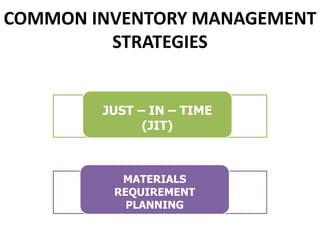
COMMON INVENTORY MANAGEMENT
STRATEGIES
JUST – IN – TIME
(JIT)
MATERIALS
REQUIREMENT
PLANNING
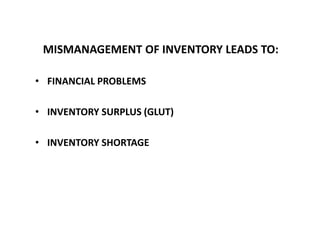
MISMANAGEMENT OF INVENTORY LEADS TO:
• FINANCIAL PROBLEMS
• INVENTORY SURPLUS (GLUT)
• INVENTORY SHORTAGE
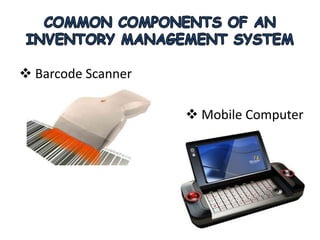
 Barcode Scanner
 Mobile Computer
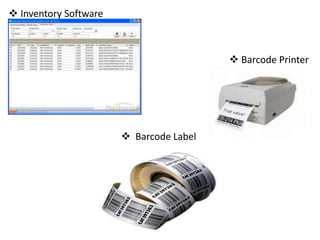
 Inventory Software
 Barcode Printer
 Barcode Label
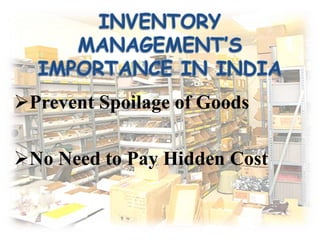
Prevent Spoilage of Goods
No Need to Pay Hidden Cost
Satisfying Customers
Saves Time
Future Planning
Just in time (JIT)
• A production strategy used to improve
business by reducing in-process inventory
• Based on the philosophy: Inventory is waste
• A shift away from the older “Just In Case”
strategy
Definition
“Just In Time is an inventory strategy which
companies employ to increase efficiency and
decrease waste by receiving goods only as
they are needed in the production process,
thereby reducing inventory costs.
This method requires that producers are able
to accurately forecast demand.”
KANBAN
 Literally means “signboard” or “billboard”
 Created by Taiichi Ohno
 It is not an inventory control system but a
scheduling system
 It uses the rate of demand to control the rate
of production
DEFINITION
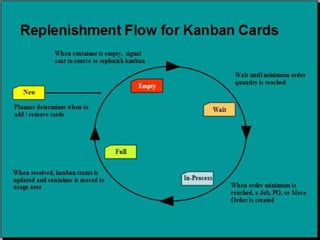
“A specific type of inventory control system. The
kanban system is based upon a series of colored
cards. These cards denote such factors as quantity,
the type of part and the manufacturer. A card is
placed in the bin or other container with each
group of manufactured items as an identifier for
those involved with the next phase of production
or distribution.”
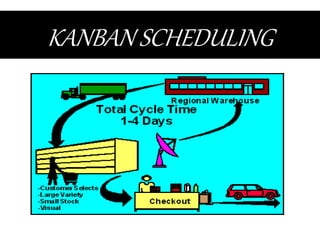
KANBAN SCHEDULING
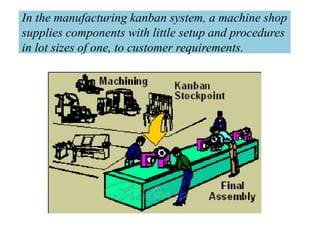
In the manufacturing kanban system, a machine shop
supplies components with little setup and procedures
in lot sizes of one, to customer requirements.
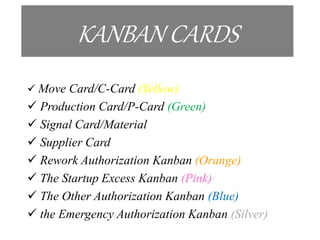
KANBAN CARDS
 Move Card/C-Card (Yellow)
 Production Card/P-Card (Green)
 Signal Card/Material
 Supplier Card
 Rework Authorization Kanban (Orange)
 The Startup Excess Kanban (Pink)
 The Other Authorization Kanban (Blue)
 the Emergency Authorization Kanban (Silver)
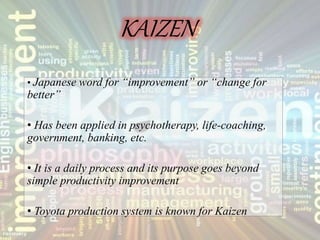
• Japanese word for “improvement” or “change for
better”
• Has been applied in psychotherapy, life-coaching,
government, banking, etc.
• It is a daily process and its purpose goes beyond
simple productivity improvement
• Toyota production system is known for Kaizen
KAIZEN
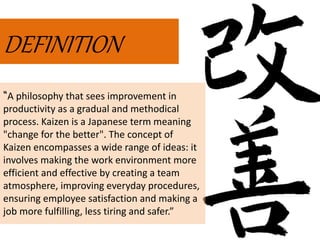
DEFINITION
“A philosophy that sees improvement in
productivity as a gradual and methodical
process. Kaizen is a Japanese term meaning
"change for the better". The concept of
Kaizen encompasses a wide range of ideas: it
involves making the work environment more
efficient and effective by creating a team
atmosphere, improving everyday procedures,
ensuring employee satisfaction and making a
job more fulfilling, less tiring and safer.”
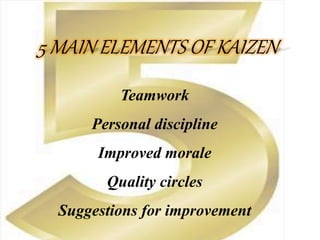
5 MAIN ELEMENTS OF KAIZEN
Teamwork
Personal discipline
Improved morale
Quality circles
Suggestions for improvement
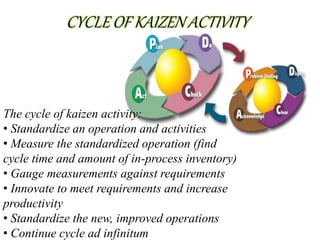
CYCLE OF KAIZEN ACTIVITY
The cycle of kaizen activity:
• Standardize an operation and activities
• Measure the standardized operation (find
cycle time and amount of in-process inventory)
• Gauge measurements against requirements
• Innovate to meet requirements and increase
productivity
• Standardize the new, improved operations
• Continue cycle ad infinitum
JIT IMPLEMENTATION DESIGN
1) Design Flow Process
• Redesign for flow
• Reduce lot sizes
• Link operations
• Balance workstation
capacity
• Preventive maintenance
• Reduce setup times
2) Total Quality Control
• Worker compliance
• Automatic inspection
• Quality measures
• Fail-safe methods
• Worker participation
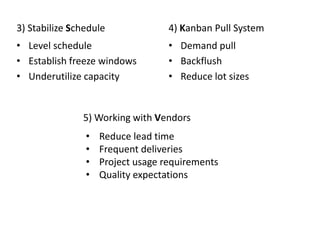
3) Stabilize Schedule
• Level schedule
• Establish freeze windows
• Underutilize capacity
4) Kanban Pull System
• Demand pull
• Backflush
• Reduce lot sizes
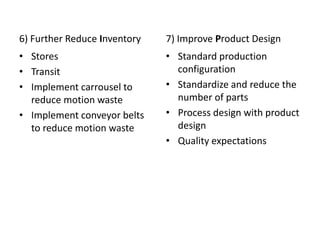
• Reduce lead time
• Frequent deliveries
• Project usage requirements
• Quality expectations
5) Working with Vendors
6) Further Reduce Inventory
• Stores
• Transit
• Implement carrousel to
reduce motion waste
• Implement conveyor belts
to reduce motion waste
7) Improve Product Design
• Standard production
configuration
• Standardize and reduce the
number of parts
• Process design with product
design
• Quality expectations
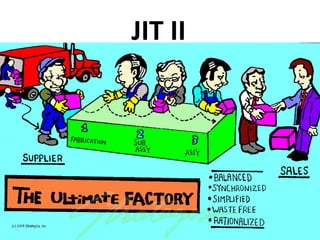
JIT II
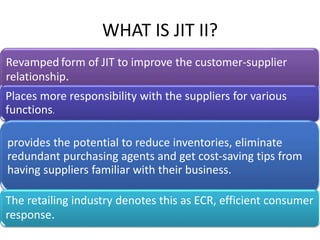
Revamped form of JIT to improve the customer-supplier
relationship.
Places more responsibility with the suppliers for various
functions.
provides the potential to reduce inventories, eliminate
redundant purchasing agents and get cost-saving tips from
having suppliers familiar with their business.
The retailing industry denotes this as ECR, efficient consumer
response.
WHAT IS JIT II?
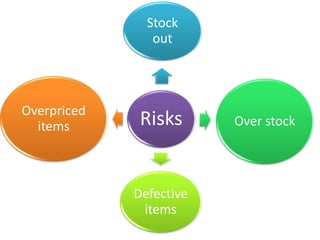
Risks
Stock
out
Over stock
Defective
items
Overpriced
items
INDUSTRIAL APPLICATION OF JIT
In context of – DELL and TOYOTA
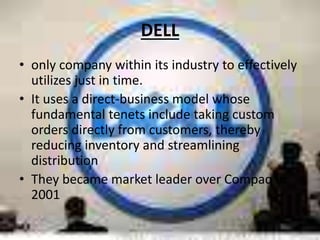
DELL
• only company within its industry to effectively
utilizes just in time.
• It uses a direct-business model whose
fundamental tenets include taking custom
orders directly from customers, thereby
reducing inventory and streamlining
distribution
• They became market leader over Compaq in
2001
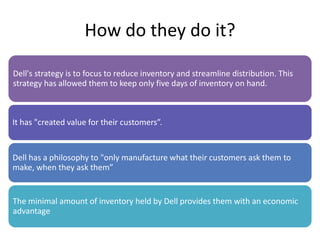
How do they do it?
Dell's strategy is to focus to reduce inventory and streamline distribution. This
strategy has allowed them to keep only five days of inventory on hand.
It has "created value for their customers”.
Dell has a philosophy to "only manufacture what their customers ask them to
make, when they ask them”
The minimal amount of inventory held by Dell provides them with an economic
advantage
• Dell's use of just in time results in cost savings,
superior customer satisfaction, limited waste,
and the ability to provide their suppliers with
more information. In the end these benefits
all result in a cost savings for Dell and higher
revenue.
• "master and pioneer" of just in time
• Their goal is to reduce the average time
between dealer order and delivery.
• TOYOTA connects dealers to factories and
factories to suppliers. The integration of the
value chain creates visibility for all members
of Toyota's supply chain
• Toyota has also adjusted their distribution
process effectively.
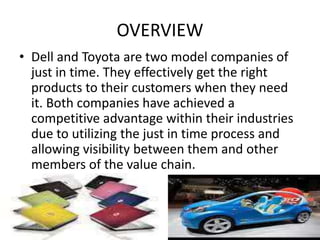
OVERVIEW
• Dell and Toyota are two model companies of
just in time. They effectively get the right
products to their customers when they need
it. Both companies have achieved a
competitive advantage within their industries
due to utilizing the just in time process and
allowing visibility between them and other
members of the value chain.
 Factory response fell to twice a day,
improving customer satisfaction.
 Factory began building many vehicles to
order, eliminating the risk that they would
not be sold. Thus, improving company’s
return on equity.
 Dramatic improvement in product quality.
 In some cases, company eliminated multiple
suppliers.
It has been widely emulated, but
not always with the expected results, as
many firms failed to adopt the full system.
The just-in-time philosophy was also
applied to other segments of the supply
chain in several types of industries.
 Reduced setup time
 The flow of goods from warehouse to shelves
improves
 Employees with multiple skills are used more
efficiently.
 Increased emphasis on supplier relationships.
 Production scheduling and work hour
consistency synchronized with demand.
 Supplies come in at regular intervals
throughout the production day.
 Minimizes storage space needed.
 Smaller chance of inventory
breaking/expiring
BUSINESS MODELS FOLLOWING
SIMILAR APPROACH
• VENDOR-MANAGED INVENTORY
 Same principles as those of JIT inventory
 Manager of inventory- vendor
 Industry experience and expertise
 Inventory cost on the vendor's books
• CUSTOMER-MANAGED INVENTORY
 Customer has responsibility
for all inventory decisions
• EARLY USE OF A JIT SYSTEM
 A type of JIT was used successfully
in the UK by Perkins to supply F3
engines to Ford from 1957 until 1964.
CONCLUSION
• In JIT workers are multifunctional.
• Multifunction machines, U-shaped cells.
• Environment is clean and free of waste
• The "PULL" element of JIT
JIT has truly changed the face of manufacturing and
transformed the global economy. JIT is both a
philosophy and collection of management methods
and techniques used to eliminate waste (particularly
inventory).
Inventory mgmt n jit

Inventory mgmt n jit

  • 2.
    WHAT IS INVENTORY? INVENTORYcan be defined as the goods and materials a business holds for the ultimate purpose of resale
  • 3.
    WHAT IS INVENTORY MANAGEMENT? Theoverseeing and controlling of the ordering, storage and use of components that a company will use in the production of goods it will sell, as well as the supervision of quantities of finished goods for sale
  • 5.
    COMMON INVENTORY MANAGEMENT STRATEGIES JUST– IN – TIME (JIT) MATERIALS REQUIREMENT PLANNING
  • 6.
    MISMANAGEMENT OF INVENTORYLEADS TO: • FINANCIAL PROBLEMS • INVENTORY SURPLUS (GLUT) • INVENTORY SHORTAGE
  • 7.
     Barcode Scanner Mobile Computer
  • 8.
     Inventory Software Barcode Printer  Barcode Label
  • 9.
    Prevent Spoilage ofGoods No Need to Pay Hidden Cost
  • 10.
  • 12.
    Just in time(JIT) • A production strategy used to improve business by reducing in-process inventory • Based on the philosophy: Inventory is waste • A shift away from the older “Just In Case” strategy
  • 13.
    Definition “Just In Timeis an inventory strategy which companies employ to increase efficiency and decrease waste by receiving goods only as they are needed in the production process, thereby reducing inventory costs. This method requires that producers are able to accurately forecast demand.”
  • 14.
    KANBAN  Literally means“signboard” or “billboard”  Created by Taiichi Ohno  It is not an inventory control system but a scheduling system  It uses the rate of demand to control the rate of production
  • 15.
    DEFINITION “A specific typeof inventory control system. The kanban system is based upon a series of colored cards. These cards denote such factors as quantity, the type of part and the manufacturer. A card is placed in the bin or other container with each group of manufactured items as an identifier for those involved with the next phase of production or distribution.”
  • 16.
  • 17.
    In the manufacturingkanban system, a machine shop supplies components with little setup and procedures in lot sizes of one, to customer requirements.
  • 18.
    KANBAN CARDS  MoveCard/C-Card (Yellow)  Production Card/P-Card (Green)  Signal Card/Material  Supplier Card  Rework Authorization Kanban (Orange)  The Startup Excess Kanban (Pink)  The Other Authorization Kanban (Blue)  the Emergency Authorization Kanban (Silver)
  • 20.
    • Japanese wordfor “improvement” or “change for better” • Has been applied in psychotherapy, life-coaching, government, banking, etc. • It is a daily process and its purpose goes beyond simple productivity improvement • Toyota production system is known for Kaizen KAIZEN
  • 21.
    DEFINITION “A philosophy thatsees improvement in productivity as a gradual and methodical process. Kaizen is a Japanese term meaning "change for the better". The concept of Kaizen encompasses a wide range of ideas: it involves making the work environment more efficient and effective by creating a team atmosphere, improving everyday procedures, ensuring employee satisfaction and making a job more fulfilling, less tiring and safer.”
  • 22.
    5 MAIN ELEMENTSOF KAIZEN Teamwork Personal discipline Improved morale Quality circles Suggestions for improvement
  • 23.
    CYCLE OF KAIZENACTIVITY The cycle of kaizen activity: • Standardize an operation and activities • Measure the standardized operation (find cycle time and amount of in-process inventory) • Gauge measurements against requirements • Innovate to meet requirements and increase productivity • Standardize the new, improved operations • Continue cycle ad infinitum
  • 24.
    JIT IMPLEMENTATION DESIGN 1)Design Flow Process • Redesign for flow • Reduce lot sizes • Link operations • Balance workstation capacity • Preventive maintenance • Reduce setup times 2) Total Quality Control • Worker compliance • Automatic inspection • Quality measures • Fail-safe methods • Worker participation
  • 25.
    3) Stabilize Schedule •Level schedule • Establish freeze windows • Underutilize capacity 4) Kanban Pull System • Demand pull • Backflush • Reduce lot sizes • Reduce lead time • Frequent deliveries • Project usage requirements • Quality expectations 5) Working with Vendors
  • 26.
    6) Further ReduceInventory • Stores • Transit • Implement carrousel to reduce motion waste • Implement conveyor belts to reduce motion waste 7) Improve Product Design • Standard production configuration • Standardize and reduce the number of parts • Process design with product design • Quality expectations
  • 27.
  • 28.
    Revamped form ofJIT to improve the customer-supplier relationship. Places more responsibility with the suppliers for various functions. provides the potential to reduce inventories, eliminate redundant purchasing agents and get cost-saving tips from having suppliers familiar with their business. The retailing industry denotes this as ECR, efficient consumer response. WHAT IS JIT II?
  • 29.
  • 30.
    INDUSTRIAL APPLICATION OFJIT In context of – DELL and TOYOTA
  • 31.
    DELL • only companywithin its industry to effectively utilizes just in time. • It uses a direct-business model whose fundamental tenets include taking custom orders directly from customers, thereby reducing inventory and streamlining distribution • They became market leader over Compaq in 2001
  • 32.
    How do theydo it? Dell's strategy is to focus to reduce inventory and streamline distribution. This strategy has allowed them to keep only five days of inventory on hand. It has "created value for their customers”. Dell has a philosophy to "only manufacture what their customers ask them to make, when they ask them” The minimal amount of inventory held by Dell provides them with an economic advantage
  • 33.
    • Dell's useof just in time results in cost savings, superior customer satisfaction, limited waste, and the ability to provide their suppliers with more information. In the end these benefits all result in a cost savings for Dell and higher revenue.
  • 34.
    • "master andpioneer" of just in time • Their goal is to reduce the average time between dealer order and delivery. • TOYOTA connects dealers to factories and factories to suppliers. The integration of the value chain creates visibility for all members of Toyota's supply chain • Toyota has also adjusted their distribution process effectively.
  • 35.
    OVERVIEW • Dell andToyota are two model companies of just in time. They effectively get the right products to their customers when they need it. Both companies have achieved a competitive advantage within their industries due to utilizing the just in time process and allowing visibility between them and other members of the value chain.
  • 36.
     Factory responsefell to twice a day, improving customer satisfaction.  Factory began building many vehicles to order, eliminating the risk that they would not be sold. Thus, improving company’s return on equity.  Dramatic improvement in product quality.
  • 37.
     In somecases, company eliminated multiple suppliers. It has been widely emulated, but not always with the expected results, as many firms failed to adopt the full system. The just-in-time philosophy was also applied to other segments of the supply chain in several types of industries.
  • 38.
     Reduced setuptime  The flow of goods from warehouse to shelves improves  Employees with multiple skills are used more efficiently.  Increased emphasis on supplier relationships.
  • 39.
     Production schedulingand work hour consistency synchronized with demand.  Supplies come in at regular intervals throughout the production day.  Minimizes storage space needed.  Smaller chance of inventory breaking/expiring
  • 40.
    BUSINESS MODELS FOLLOWING SIMILARAPPROACH • VENDOR-MANAGED INVENTORY  Same principles as those of JIT inventory  Manager of inventory- vendor  Industry experience and expertise  Inventory cost on the vendor's books
  • 42.
    • CUSTOMER-MANAGED INVENTORY Customer has responsibility for all inventory decisions • EARLY USE OF A JIT SYSTEM  A type of JIT was used successfully in the UK by Perkins to supply F3 engines to Ford from 1957 until 1964.
  • 43.
    CONCLUSION • In JITworkers are multifunctional. • Multifunction machines, U-shaped cells. • Environment is clean and free of waste • The "PULL" element of JIT JIT has truly changed the face of manufacturing and transformed the global economy. JIT is both a philosophy and collection of management methods and techniques used to eliminate waste (particularly inventory).

Editor's Notes

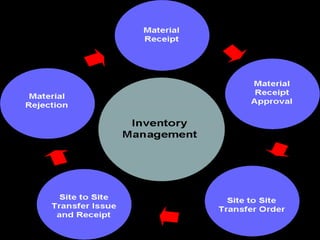
  • #5 Inventory Management handles with materials receipts, inter project transfer of materials and material issue. This module facilitates to identify or check the materials ordered in the PO have arrived or not. User can add the inventory to the storage location, once the material is been accepted. This module allows to issue the materials to the project store once request for consumption is been rose. User can enter the transfer details of the materials from one storage location to other storage location.