JIT and Lean Operations
Introduction to JIT
• Just-in-time (JIT) is an approach which aims to produce the
right part in the right place at the right time.
• It is a philosophy of manufacturing based on planned
elimination of all waste and on continuous improvement of
productivity
• It is a Japanese philosophy, firstly introduced by Toyota
• Good production systems require that managers address
three issues that are pervasive and fundamental to
operations management
• eliminate waste,
• remove variability,
• and improve throughput
1. Eliminate Waste
 Waste is anything that does not add value
from the customer point of view
 Storage, inspection, delay, waiting in queues,
and defective products do not add value and
are 100% waste
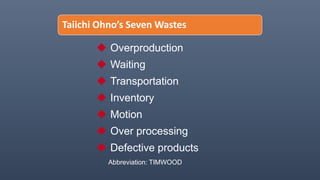
Taiichi Ohno’s Seven Wastes
 Overproduction
 Waiting
 Transportation
 Inventory
 Motion
 Over processing
 Defective products
Abbreviation: TIMWOOD
The 5 Ss
• 5s is checklist for better housekeeping
• Developed in Japan
• Helps lean operations
1. Structure/Organization(Seiri)
• separating items that are essential to the job from those that are not
• Placing the vital items in convenient locations
2. Systemize/Neatness (Seiso)
• Work area should be neat
• It reduces the time taken to locate the items
3. Sanitize/cleaning(Seiton)
• If the environment is clean, individuals will all start to maintain cleanliness
• Regular thorough cleaning is necessary and specific cleaning
responsibilities should be assigned
• Dirty environment generates negative thoughts and pessimism
4. Standardize(Seiketsu)
• emove variations from processes
• Following standard guidelines, employees better understand the working
environment and work within it quickly and safely
5. Self Discipline/Discipline(Shitsuke)
• Following the defined rules and regulations into the day-to-day working
culture of organization
2. Remove Variability
 JIT systems require managers to
reduce variability caused by both
internal and external factors
 Variability is any deviation from the
optimum process
 Inventory hides variability
 Less variability results in less waste
Sources of Variability
1. Incomplete or inaccurate drawings or
specifications
2. Poor production processes resulting
in incorrect quantities, late, or non-
conforming units
3. Unknown customer demands
3. Improve Throughput
 The time it takes to move an order from
receipt to delivery
 The time between the arrival of raw materials
and the shipping of the finished order is called
manufacturing cycle time
 A pull system increases throughput
Key Elements of JIT
• Stabilize and level the MPS with uniform plant loading
• Create a uniform load in all work centers through constant daily
production or mixed model assembly (producing same mix of
products each day)
• Reduce or eliminate setup times
• Operations should aim for single digit setup times
• Can be accomplished through better planning, process redesign
and product redesign
• Reduce lot sizes (manufacturing and purchases)
• Manufacture or purchase in small lots
• Requires close tie with the suppliers
• Reduce lead times (production and delivery)
• Reduce production lead times by placing work centers closer, using
cellular layout and reducing queue length
• Reduce delivery lead time by making better tie with the suppliers
• Preventive maintenance
• Use a machine and worker idle time to maintain equipment and
prevent breakdowns
• Flexible work force
• Workers should be made versatile
• Require supplier quality assurance and implement a zero
defects quality program
• Quality at source program must be implemented to give worker
personal responsibility for the quality of the work they do and
authority to stop when something goes wrong
• Small-lot (single unit) conveyance
• Use control system such as Kanban to convey parts
between work stations in small quantities (ideally one unit
at a time)
Kanban: a visual display board that provides information about the
stock of materials and supplies
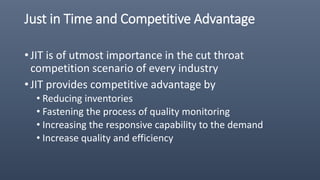
Just in Time and Competitive Advantage
• JIT is of utmost importance in the cut throat
competition scenario of every industry
• JIT provides competitive advantage by
• Reducing inventories
• Fastening the process of quality monitoring
• Increasing the responsive capability to the demand
• Increase quality and efficiency
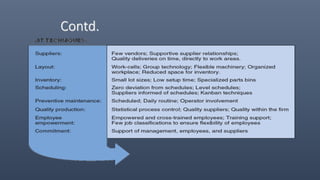
Contd.
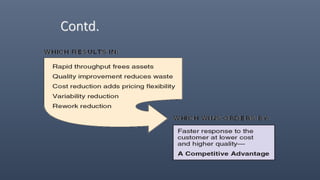
Contd.
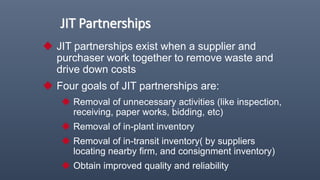
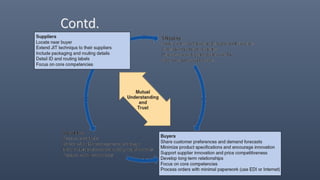
JIT Partnerships
 JIT partnerships exist when a supplier and
purchaser work together to remove waste and
drive down costs
 Four goals of JIT partnerships are:
 Removal of unnecessary activities (like inspection,
receiving, paper works, bidding, etc)
 Removal of in-plant inventory
 Removal of in-transit inventory( by suppliers
locating nearby firm, and consignment inventory)
 Obtain improved quality and reliability
Contd.
• Layout determines how the raw materials are travelled
before finished goods and services would be created
• JIT lay out reduce wastes in operations
Tactics for JIT layout
• Distance reduction
• High flexibility
• Impact on employees
• Reduce the space and inventory
JIT Layout
Distance Reduction
 JIT layout focus on reducing the total length of layout
as much as possible
 Often U-shaped layout for shorter paths and improved
communication
 Often using group technology concepts
group technology: a manufacturing technique in which
functionally-grouped machine(producing parts or products
with similar characteristics) are organized into cells to
achieve high repeatability levels.
High Flexibility
 Cells are made highly flexible and
interchangeable
 Applicable in office environments as well as
production settings
 Cells designed to be rearranged as volume or
designs of product change
 Facilitates both product and process
improvement
Impact of Employees
 Employees may be cross trained for flexibility and
efficiency
 Highly qualified, skilled, experienced and employees
only handle the operation layout or cell without
creating the waste
 Improved communications facilitate the passing on of
important information about the process
 Workers become their own inspectors, personally
responsible for the quality of their outputs
Reduced Space and Inventory
 With reduced space, inventory must be in
very small lots
 Units are always moving because there is no
storage
JIT Inventory
Inventory is at the minimum level
necessary to keep operations running
JIT Inventory Tactics
• Reduce or Eliminate Setup Times
• Reduce Lot Sizes (manufacturing and purchase)
• Reduce Lead Times (production and delivery)
• Reduce the Variability
• Reduce Setup Costs
1. Reduce Setup Times
• Aim for single digit setup times through better planning, process redesign,
and product redesign
2. Reduce Lot Sizes (manufacturing and purchases)
• Just in time has also come to mean elimination of waste by reducing
investment in inventory
• Ideal situation is to have lot sizes of one pulled from one process to the
next
3. Reduce Lead Times (production and delivery)
• Production lead times can be minimized by
• moving work stations closer together,
• applying group technology
• cellular manufacturing concepts
• Reducing queue length
• Improving the coordination between successive processes
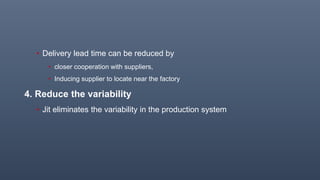
• Delivery lead time can be reduced by
• closer cooperation with suppliers,
• Inducing supplier to locate near the factory
4. Reduce the variability
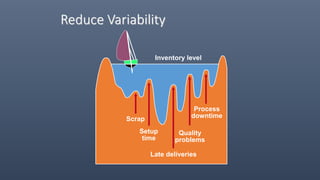
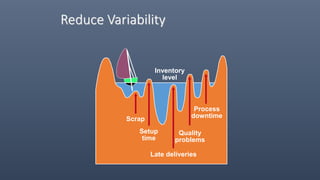
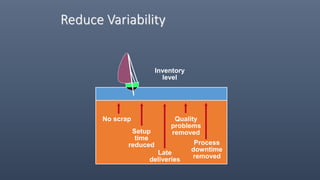
• Jit eliminates the variability in the production system
Reduce Variability
Inventory level
Process
downtimeScrap
Setup
time
Late deliveries
Quality
problems
Inventory
level
Reduce Variability
Process
downtimeScrap
Setup
time
Late deliveries
Quality
problems
Inventory
level
Reduce Variability
Process
downtime
removed
No scrap
Setup
time
reduced
Late
deliveries
Quality
problems
removed
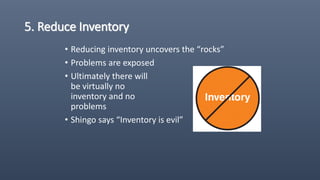
5. Reduce Inventory
• Reducing inventory uncovers the “rocks”
• Problems are exposed
• Ultimately there will
be virtually no
inventory and no
problems
• Shingo says “Inventory is evil”
6. Reduce Setup Costs
 High setup costs encourage large lot sizes
 Reducing setup costs reduces lot size and
reduces average inventory
 Setup time can be reduced through
preparation prior to shutdown and
changeover
Better scheduling improves performance
JIT Scheduling
JIT Scheduling Tactics
Communicate schedules to suppliers
Make level schedules
Perform to schedule
Seek one-piece-make and one-piece move
Eliminate waste
Produce in small lots
Use Kanbans
Make each operation produce a perfect part
Level Schedules
• Also called “Jelly bean” scheduling
• Process frequent small batches rather than
a few large batches
• Make and move small lots so the level
schedule is economical
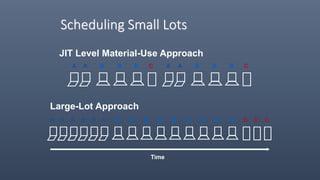
Scheduling Small Lots
A B CA AAB B B B B C
JIT Level Material-Use Approach
A CA AA B B B B B C CB B B BA A
Large-Lot Approach
Time
Kanban Production Control System
• Kanban is the Japanese word for card
• Many different sorts of signals are used, but
the system is still called a kanban
• I is a pull production control system
• It uses simple visual signals to control the movement of
materials between work centers as well as production of
new materials to replenish those sent downstream to
the next work center
Dual Card Kanban
• As used by Toyota there are two types of Kanban
• Production Kanban: signals the need to produce more
parts
• Withdrawal(move or conveyance) Kanban: signals the
need to withdraw parts from one work center and deliver
them to the next work center
Dual Card Kanban Rules
1. No parts are made unless there is production Kanban
to authorize production. In absence of production
Kanban, the process remains idle, workers perform
other activities
2. There is exactly one Kanban per container
3. Containers for each specific part are standardized and
they are always filled with the same quantity
Determining the number of Kanban cards or
container
• The number of JIT system sets the amount of
authorized inventory
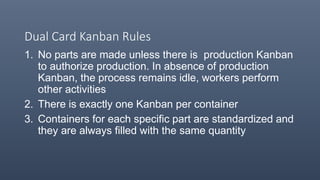
• Number of Kanbans (containers) =
𝐷𝑒𝑚𝑎𝑛𝑑 𝑑𝑢𝑟𝑖𝑛𝑔 𝑙𝑒𝑎𝑑 𝑡𝑖𝑚𝑒 + 𝑆𝑎𝑓𝑒𝑡𝑦 𝑆𝑡𝑜𝑐𝑘
𝑆𝑖𝑧𝑒 𝑜𝑓 𝐶𝑜𝑛𝑡𝑎𝑖𝑛𝑒𝑟
Advantages of Kanban
• Kanban helps in meeting schedules reducing the time and
costs required by setups and economical material handling
• Small batches allow only a very limited amount of faulty or
delayed material
• It keeps the operations away from all the pitfalls of keeping
inventory
JIT Quality
 There is Strong relationship between JIT and
Quality
JIT cuts the cost of obtaining good quality
because JIT exposes poor quality
Because lead times are shorter, quality
problems are exposed sooner
Better quality means fewer buffers and allows
simpler JIT systems to be used
JIT Quality Tactics
Use statistical process control
Empower employees
Build fail-safe methods (poka-yoke,
checklists, etc.)
Expose poor quality with small lot JIT
Provide immediate feedback
Difference Between Lean and JIT
• JIT is a tool of Lean where as Lean is a total business strategy
• Lean is externally focused on customer where as JIT is
internally focused
• JIT’s role is to explicitly highlight process problems while lean
aims at eliminating the problems
Lean Operations
Different from JIT in that it is externally focused on the
customer
Starts with understanding what the customer wants
Optimize the entire process from the customer’s perspective
Lean operation means identify what customer prefer and make
the necessary arrangement to the creation of value for them
Building a Lean Organization
 Transitioning to a lean system can be
difficult
 Lean systems tend to have the
following attributes
 Use JIT techniques
 Build systems that help employees
produce perfect parts
 Reduce space requirements
Building a Lean Organization
Develop partnerships with
suppliers
Educate suppliers
Eliminate all but value-added
activities
Develop employees
Make jobs challenging
Build worker flexibility
Lean and JIT Operations in Services
• When JIT is used in the context of services, the focus is often
on time needed to perform service
• Focus on inventory reduction
• Emphasis on
• Consistent high quality
• Standard work methods
• Flexible workers
• Close supplier relationship
Tactics for Deriving JIT Benefits in Services
• Eliminate disruption
• Workers should not be disturbed while working
• Make the System Flexible
• Though standardization works better but the employees should be
able to perform the varieties of works if needed
• Reduce setup times and processing times
• Eliminate waste
• Minimize work in process
• Simplify the process
• When customers are part of the system
• Use of machines like ATMs, vending machines, mobile phone
recharge machine, etc
Methods of Minimizing Non-sampling Errors
• Checking the sampling process
• Preparation of questionnaire
• Pilot survey
• Fix procedures
• Use of competent manpower
• Provide information
• Provide training
• Use of experts
• Checking data processing and analysis

JIT and lean operations

  • 1.
    JIT and LeanOperations
  • 2.
    Introduction to JIT •Just-in-time (JIT) is an approach which aims to produce the right part in the right place at the right time. • It is a philosophy of manufacturing based on planned elimination of all waste and on continuous improvement of productivity • It is a Japanese philosophy, firstly introduced by Toyota
  • 3.
    • Good productionsystems require that managers address three issues that are pervasive and fundamental to operations management • eliminate waste, • remove variability, • and improve throughput
  • 4.
    1. Eliminate Waste Waste is anything that does not add value from the customer point of view  Storage, inspection, delay, waiting in queues, and defective products do not add value and are 100% waste
  • 5.
    Taiichi Ohno’s SevenWastes  Overproduction  Waiting  Transportation  Inventory  Motion  Over processing  Defective products Abbreviation: TIMWOOD
  • 6.
    The 5 Ss •5s is checklist for better housekeeping • Developed in Japan • Helps lean operations 1. Structure/Organization(Seiri) • separating items that are essential to the job from those that are not • Placing the vital items in convenient locations 2. Systemize/Neatness (Seiso) • Work area should be neat • It reduces the time taken to locate the items
  • 7.
    3. Sanitize/cleaning(Seiton) • Ifthe environment is clean, individuals will all start to maintain cleanliness • Regular thorough cleaning is necessary and specific cleaning responsibilities should be assigned • Dirty environment generates negative thoughts and pessimism 4. Standardize(Seiketsu) • emove variations from processes • Following standard guidelines, employees better understand the working environment and work within it quickly and safely 5. Self Discipline/Discipline(Shitsuke) • Following the defined rules and regulations into the day-to-day working culture of organization
  • 8.
    2. Remove Variability JIT systems require managers to reduce variability caused by both internal and external factors  Variability is any deviation from the optimum process  Inventory hides variability  Less variability results in less waste
  • 9.
    Sources of Variability 1.Incomplete or inaccurate drawings or specifications 2. Poor production processes resulting in incorrect quantities, late, or non- conforming units 3. Unknown customer demands
  • 10.
    3. Improve Throughput The time it takes to move an order from receipt to delivery  The time between the arrival of raw materials and the shipping of the finished order is called manufacturing cycle time  A pull system increases throughput
  • 11.
    Key Elements ofJIT • Stabilize and level the MPS with uniform plant loading • Create a uniform load in all work centers through constant daily production or mixed model assembly (producing same mix of products each day) • Reduce or eliminate setup times • Operations should aim for single digit setup times • Can be accomplished through better planning, process redesign and product redesign • Reduce lot sizes (manufacturing and purchases) • Manufacture or purchase in small lots • Requires close tie with the suppliers
  • 12.
    • Reduce leadtimes (production and delivery) • Reduce production lead times by placing work centers closer, using cellular layout and reducing queue length • Reduce delivery lead time by making better tie with the suppliers • Preventive maintenance • Use a machine and worker idle time to maintain equipment and prevent breakdowns • Flexible work force • Workers should be made versatile • Require supplier quality assurance and implement a zero defects quality program • Quality at source program must be implemented to give worker personal responsibility for the quality of the work they do and authority to stop when something goes wrong
  • 13.
    • Small-lot (singleunit) conveyance • Use control system such as Kanban to convey parts between work stations in small quantities (ideally one unit at a time) Kanban: a visual display board that provides information about the stock of materials and supplies
  • 14.
    Just in Timeand Competitive Advantage • JIT is of utmost importance in the cut throat competition scenario of every industry • JIT provides competitive advantage by • Reducing inventories • Fastening the process of quality monitoring • Increasing the responsive capability to the demand • Increase quality and efficiency
  • 15.
  • 16.
  • 17.
    JIT Partnerships  JITpartnerships exist when a supplier and purchaser work together to remove waste and drive down costs  Four goals of JIT partnerships are:  Removal of unnecessary activities (like inspection, receiving, paper works, bidding, etc)  Removal of in-plant inventory  Removal of in-transit inventory( by suppliers locating nearby firm, and consignment inventory)  Obtain improved quality and reliability
  • 18.
  • 19.
    • Layout determineshow the raw materials are travelled before finished goods and services would be created • JIT lay out reduce wastes in operations Tactics for JIT layout • Distance reduction • High flexibility • Impact on employees • Reduce the space and inventory JIT Layout
  • 20.
    Distance Reduction  JITlayout focus on reducing the total length of layout as much as possible  Often U-shaped layout for shorter paths and improved communication  Often using group technology concepts group technology: a manufacturing technique in which functionally-grouped machine(producing parts or products with similar characteristics) are organized into cells to achieve high repeatability levels.
  • 21.
    High Flexibility  Cellsare made highly flexible and interchangeable  Applicable in office environments as well as production settings  Cells designed to be rearranged as volume or designs of product change  Facilitates both product and process improvement
  • 22.
    Impact of Employees Employees may be cross trained for flexibility and efficiency  Highly qualified, skilled, experienced and employees only handle the operation layout or cell without creating the waste  Improved communications facilitate the passing on of important information about the process  Workers become their own inspectors, personally responsible for the quality of their outputs
  • 23.
    Reduced Space andInventory  With reduced space, inventory must be in very small lots  Units are always moving because there is no storage
  • 24.
    JIT Inventory Inventory isat the minimum level necessary to keep operations running JIT Inventory Tactics • Reduce or Eliminate Setup Times • Reduce Lot Sizes (manufacturing and purchase) • Reduce Lead Times (production and delivery) • Reduce the Variability • Reduce Setup Costs
  • 25.
    1. Reduce SetupTimes • Aim for single digit setup times through better planning, process redesign, and product redesign 2. Reduce Lot Sizes (manufacturing and purchases) • Just in time has also come to mean elimination of waste by reducing investment in inventory • Ideal situation is to have lot sizes of one pulled from one process to the next 3. Reduce Lead Times (production and delivery) • Production lead times can be minimized by • moving work stations closer together, • applying group technology • cellular manufacturing concepts • Reducing queue length • Improving the coordination between successive processes
  • 26.
    • Delivery leadtime can be reduced by • closer cooperation with suppliers, • Inducing supplier to locate near the factory 4. Reduce the variability • Jit eliminates the variability in the production system
  • 27.
  • 28.
  • 29.
  • 30.
    5. Reduce Inventory •Reducing inventory uncovers the “rocks” • Problems are exposed • Ultimately there will be virtually no inventory and no problems • Shingo says “Inventory is evil”
  • 31.
    6. Reduce SetupCosts  High setup costs encourage large lot sizes  Reducing setup costs reduces lot size and reduces average inventory  Setup time can be reduced through preparation prior to shutdown and changeover
  • 32.
    Better scheduling improvesperformance JIT Scheduling JIT Scheduling Tactics Communicate schedules to suppliers Make level schedules Perform to schedule Seek one-piece-make and one-piece move Eliminate waste Produce in small lots Use Kanbans Make each operation produce a perfect part
  • 33.
    Level Schedules • Alsocalled “Jelly bean” scheduling • Process frequent small batches rather than a few large batches • Make and move small lots so the level schedule is economical
  • 34.
    Scheduling Small Lots AB CA AAB B B B B C JIT Level Material-Use Approach A CA AA B B B B B C CB B B BA A Large-Lot Approach Time
  • 35.
    Kanban Production ControlSystem • Kanban is the Japanese word for card • Many different sorts of signals are used, but the system is still called a kanban • I is a pull production control system • It uses simple visual signals to control the movement of materials between work centers as well as production of new materials to replenish those sent downstream to the next work center
  • 36.
    Dual Card Kanban •As used by Toyota there are two types of Kanban • Production Kanban: signals the need to produce more parts • Withdrawal(move or conveyance) Kanban: signals the need to withdraw parts from one work center and deliver them to the next work center
  • 37.
    Dual Card KanbanRules 1. No parts are made unless there is production Kanban to authorize production. In absence of production Kanban, the process remains idle, workers perform other activities 2. There is exactly one Kanban per container 3. Containers for each specific part are standardized and they are always filled with the same quantity
  • 38.
    Determining the numberof Kanban cards or container • The number of JIT system sets the amount of authorized inventory • Number of Kanbans (containers) = 𝐷𝑒𝑚𝑎𝑛𝑑 𝑑𝑢𝑟𝑖𝑛𝑔 𝑙𝑒𝑎𝑑 𝑡𝑖𝑚𝑒 + 𝑆𝑎𝑓𝑒𝑡𝑦 𝑆𝑡𝑜𝑐𝑘 𝑆𝑖𝑧𝑒 𝑜𝑓 𝐶𝑜𝑛𝑡𝑎𝑖𝑛𝑒𝑟
  • 39.
    Advantages of Kanban •Kanban helps in meeting schedules reducing the time and costs required by setups and economical material handling • Small batches allow only a very limited amount of faulty or delayed material • It keeps the operations away from all the pitfalls of keeping inventory
  • 40.
    JIT Quality  Thereis Strong relationship between JIT and Quality JIT cuts the cost of obtaining good quality because JIT exposes poor quality Because lead times are shorter, quality problems are exposed sooner Better quality means fewer buffers and allows simpler JIT systems to be used
  • 41.
    JIT Quality Tactics Usestatistical process control Empower employees Build fail-safe methods (poka-yoke, checklists, etc.) Expose poor quality with small lot JIT Provide immediate feedback
  • 42.
    Difference Between Leanand JIT • JIT is a tool of Lean where as Lean is a total business strategy • Lean is externally focused on customer where as JIT is internally focused • JIT’s role is to explicitly highlight process problems while lean aims at eliminating the problems
  • 43.
    Lean Operations Different fromJIT in that it is externally focused on the customer Starts with understanding what the customer wants Optimize the entire process from the customer’s perspective Lean operation means identify what customer prefer and make the necessary arrangement to the creation of value for them
  • 44.
    Building a LeanOrganization  Transitioning to a lean system can be difficult  Lean systems tend to have the following attributes  Use JIT techniques  Build systems that help employees produce perfect parts  Reduce space requirements
  • 45.
    Building a LeanOrganization Develop partnerships with suppliers Educate suppliers Eliminate all but value-added activities Develop employees Make jobs challenging Build worker flexibility
  • 46.
    Lean and JITOperations in Services • When JIT is used in the context of services, the focus is often on time needed to perform service • Focus on inventory reduction • Emphasis on • Consistent high quality • Standard work methods • Flexible workers • Close supplier relationship
  • 47.
    Tactics for DerivingJIT Benefits in Services • Eliminate disruption • Workers should not be disturbed while working • Make the System Flexible • Though standardization works better but the employees should be able to perform the varieties of works if needed • Reduce setup times and processing times • Eliminate waste • Minimize work in process
  • 48.
    • Simplify theprocess • When customers are part of the system • Use of machines like ATMs, vending machines, mobile phone recharge machine, etc
  • 49.
    Methods of MinimizingNon-sampling Errors • Checking the sampling process • Preparation of questionnaire • Pilot survey • Fix procedures • Use of competent manpower • Provide information • Provide training • Use of experts • Checking data processing and analysis