Operations Management
Lean and Just-in-Time
• Lean Operations is easy to understand
– The basic goal is removal of ALL Non-Value
Adding activity.
• This delivers an operation which is:
– Faster
– More dependable
– Produces higher quality products and services
– Is more responsive to customers
– Operates at lower cost..
Just-in-Time
• Means producing goods and services
exactly when they are needed:
– Not before they are needed so that they
wait as inventory
– (Definitely) not after they are needed so
that customers have to wait.
• A definition of JIT can then be taken as
follows:
– JIT aims to meet demand instantaneously,
with perfect quality and no waste.
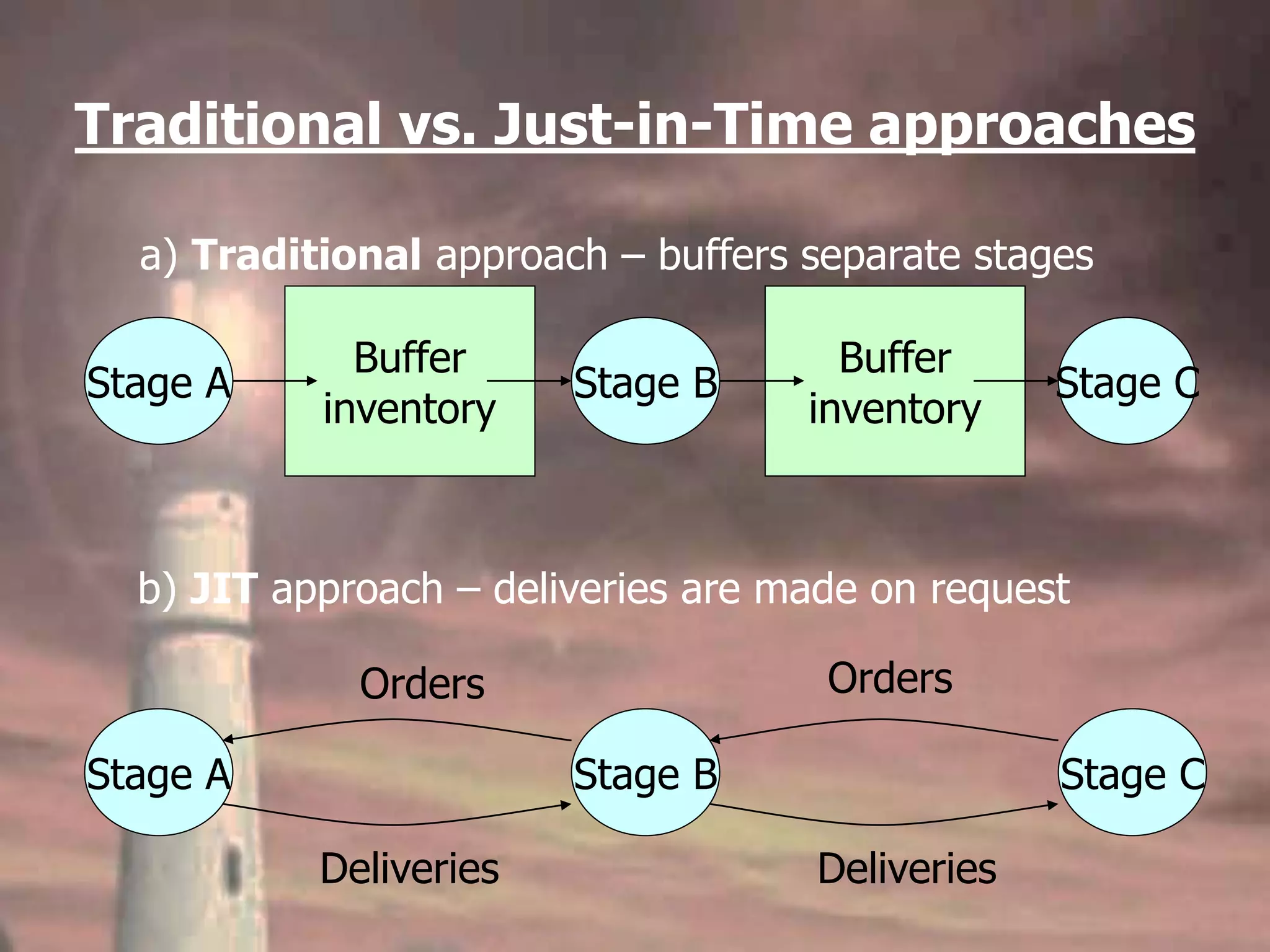
Traditional vs. Just-in-Time approaches
Stage A
Buffer
inventory
Stage B
Buffer
inventory
Stage C
Stage C
Stage B
Stage A
Orders Orders
Deliveries Deliveries
b) JIT approach – deliveries are made on request
a) Traditional approach – buffers separate stages
Lean and Just-in-Time
• Philosophy and a set of techniques
– Lean can be viewed as a philosophy for
Operations Management.
• Tools, Techniques
– TQM, SMED, BPR, J.I.T., Kanbans, 5S, 5 Whys, Poka-Yoke,
TAKT time, 7-Wastes, Flow…..
– The most important part is a mindset:
• C.I. & seeing waste (NVA) in everything you do
Further reading;
http://tutor2u.net/business/production/quality_tqm.htm
http://www.handsongroup.com/lean-manufacturing-tool-kit
Lean and Just-in-Time
Eliminate waste Involve everyone Continuous improvement
The Lean philosophy of operations
•Basic working practices
•Design for manufacture
•Operations focus
•Small simple machines
•Flow layout
•TPM
•Set-up reduction
•Total people involvement
•Visibility
•JIT supply
JIT as a method of
planning and control
•Pull scheduling
•Kanban control
•Levelled scheduling
•Mixed modelling
•Synchronisation
The lean philosophy of operations is the basis for JIT techniques that include
JIT methods of planning and control
The Lean Philosophy
• The lean philosophy of operations
– Eliminate waste
• The most significant part of the lean philosophy
– Identifying waste is the first step towards
eliminating it.
– There are generally seen as 7-wastes:
Waste can be defined as any activity which does not add value.
7-Wastes
• Over-production
– Producing more than is immediately needed by
the next process in the operations.
• Waiting (sometimes called queuing)
– Machine efficiency and labour efficiency are two
popular measures which are widely used to
measure machine and labour waiting time,
respectively. Less obvious is the amount of waiting
time of materials, disguised by operators who are
kept busy producing WIP which is not needed at
the time.
7-Wastes
• Transport
– Moving materials around the workspace
• Double/triple handing of WIP, does not add value.
– Layout changes which bring processes closer
together, improvements in transport methods and
workplace organisations will all reduce waste.
• Process
– The process itself may be a source of waste.
Some operations only exist because of poor
component design, poor maintenance, or for
historical reasons
• This is where CI & workplace reviews are vital.
7-Wastes
• Inventory
– All inventory should become a target of elimination.
It is only by tackling the causes of inventory that it
can be reduced.
• Motion
– An operator may look busy but sometimes no value
is being added. Simplification of work is a rich
source of reduction in the waste of motion.
• Defects (RFT)
– Waste is often very significant in operations, even if
actual measures of quality are limited.
– Total costs of quality are much greater than many
people consider, and it is therefore more important
to attack causes of defects costs.
7-Wastes
• Transport
• Inventory
• Motion
• Waiting
• Over-production
• Over-processing
• Defects People!
The Lean Philosophy
• The involvement of everyone
– Lean philosophy is often put forward as a
‘total’ system. Its aim is to provide
guidelines which embrace everyone and
every process in the organisation.
• Continuous improvement
– The Japanese word for continuous
improvement is Kaizen, and it is a key
part of the lean philosophy.
Lean Techniques
• Adopt basic working practices - is considered
as the method of operationalising the
‘involvement of everyone’ lean principle.
• Discipline – work standards which are critical for
the safety of company members, the environment,
and for the quality of the product.
• Flexibility – it should be possible to expand
responsibilities to the extent of people’s capabilities.
• Equality – unfair and divisive personnel policies
should be discarded.
Lean Techniques
– Autonomy
• Delegate increasing responsibility to people
involved in direct activities of the business, so
that management’s task becomes one of
supporting the shopfloor.
– Development of personnel
• Aim to create more company members who can
support the rigours of being competitive.
– Quality of working life (QWL)
• May include involvement in decision making,
security of employment, Fulfilment and working
area facilities.
Lean Techniques
– Creativity
• One of the indispensable elements of motivation!
– Total people involvement
• Staff take on increasing responsibility using their
abilities to the benefit of the company as a whole.
• In practice, it is difficult to achieve all the
‘basic working practices’ at the same
time.
Lean Techniques
• Design for ease of processing
– Design improvements can dramatically
reduce product(ion) costs;
• Simplifying number of components/sub-
assemblies
• Better use of materials and processing
techniques.
• Operations focus first
– Simplicity, repetition, repeatability, capability and
experience breed competence.
Lean Techniques
• Use small simple machines
– Small machines have several advantages over large
once.
• They can process different products and services simultaneously
and are also more robust.
– If a large machine breaks down, the whole system
ceases. Small machines can be easily moved, so layout
flexibility is enhanced.
• Layout for smooth flow
– Smooth flow of materials, data and people in the
operation is important in JIT.
• Long process routes give opportunities for delay and inventory
build-up, add no value to the products, and slow down the
throughput time of products.
Lean Techniques
• Adopt total productive maintenance (TPM)
– Total productive maintenance helps eliminate variability in
operations processes caused by unplanned breakdowns.
• Achieved by involving everyone in the search for maintenance
improvements.
• Reduce set-up times
– Set up time is defined as the time taken to change over the
process from one activity to the next. Set-up reduction
can be achieved by cutting out time taken to search for tools
and equipment, the pre-preparation of tasks which delay
changeovers, and the constant practice of set-up routines.
• Ensure visibility
– The more transparent an operation is, the easier it is for all
staff to share in its management and improvement. Visibility
measures include:
• Performance measures are displayed in the workplace
• Coloured lights indicate stoppages
• Workplace layouts are clear and open plan
(Visual Management)
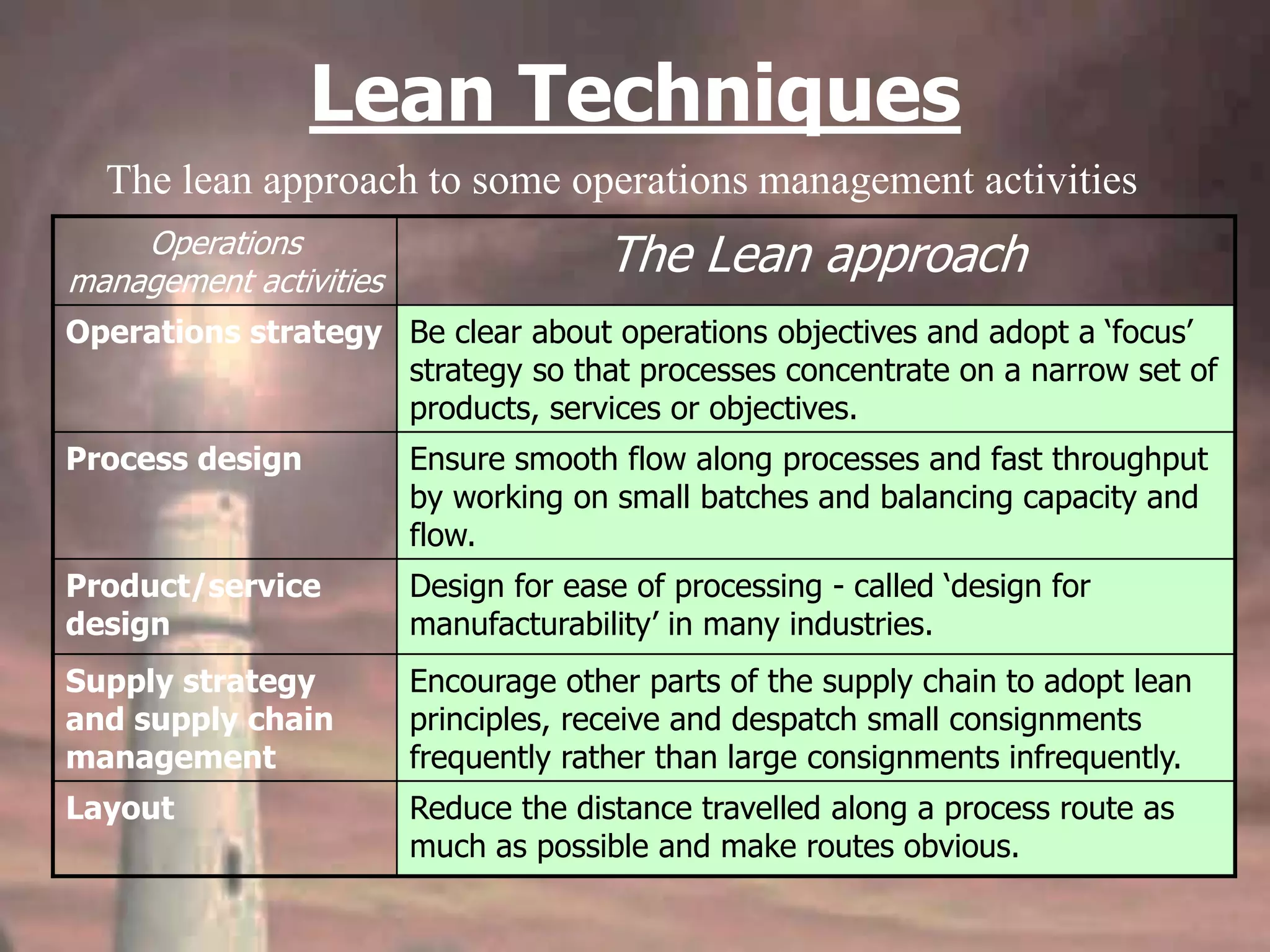
Lean Techniques
Operations
management activities
The Lean approach
Operations strategy Be clear about operations objectives and adopt a ‘focus’
strategy so that processes concentrate on a narrow set of
products, services or objectives.
Process design Ensure smooth flow along processes and fast throughput
by working on small batches and balancing capacity and
flow.
Product/service
design
Design for ease of processing - called ‘design for
manufacturability’ in many industries.
Supply strategy
and supply chain
management
Encourage other parts of the supply chain to adopt lean
principles, receive and despatch small consignments
frequently rather than large consignments infrequently.
Layout Reduce the distance travelled along a process route as
much as possible and make routes obvious.
The lean approach to some operations management activities
Lean Techniques
Operations
management activities The lean approach
Process technology Use small flexible process equipment, preferably that can
be re-configured.
Job design Concentrate on equipping staff with necessary skills, being
clear what is expected, encourage autonomy.
Process planning
and control
Use pull control principles, produce nothing until it’s
needed.
Inventory Minimise inventory, it obscures problems and slows
throughput.
Improvement Continuous! - the momentum of improvement is more
important than the rate of improvement
Maintenance Unexpected breakdown is waste, prevent disruption
through total productive maintenance (TPM).
Quality
management
All errors are further sources of waste, everyone in the
operation must be involved in reaching an error-free state.
Lean/JIT Planning and Control
• Poor inventory timing causes
unpredictability in an operation.
– Unpredictability causes waste because
people hold stock, capacity or time to
protect themselves against it.
Lean/JIT Planning and Control
• Kanban control
– Japanese for card or signal
• Sometimes called the ‘invisible conveyor’ which controls
the transfer of materials between the stages of an
operation.
– In its simplest form:
• A card used by a customer (internal or external) to
instruct supplier to send more materials.
– The receipt of a Kanban triggers movement,
production and supply of one unit or a standard
container of units
Lean in Service Operations
• Examples of service JIT - consider the
following examples:
– Supermarkets usually replenish their
shelves only when customers have taken
sufficient products off the shelf.
– The movement of goods from the ‘back
office’ store to the shelf is triggered only by
the ‘empty-shelf’ demand signal.
»Pull Control.
Lean in Service Operations
– A construction company makes a rule of only
calling for material deliveries to its sites the
day before materials are needed.
• This reduces clutter and the chances of theft.
• Pull Control reduces confusion.
– Many fast-food restaurants cook and
assemble food and place it in the warm area
only when the customer-facing server has
sold an item.
• Pull Control reduces throughput time.
Lean in Service Operations
• Other examples of Lean concepts and
methods apply even when most of the service
elements are intangible.
– Amazon allows customers to register significant
dates & events so that they (Amazon)
automatically e-mail reminders just-in-time to buy
a present.
• The value of delivered information can be
time dependent. Too early, customer
forgets. Too late is useless!
Lean in Service Operations
– New publishing technologies allow writers to print
hard copies of books “on demand” and distribute
them anywhere
– Flexibility allows customisation and small batch
sizes delivered ‘to order’.
Lean thinking and MRP
• The operating philosophies of MRP and Lean
seem to be fundamentally opposed.
– Lean encourages pull
– MRP is a ‘push’ system.
– Lean has aims which are wider than the
operations planning and control activity
– MRP is a planning and control ‘calculation
mechanism’.
– But, the two approaches can reinforce each other
in the same operation, provided the advantages of
each are understood and preserved.
Lean and MRP
• Key characteristics of MRP
– Uses orders derived from the master schedule as
the unit of control.
– MRP systems usually need a complex, centralised
computer-based organisation to support the
necessary hardware, software and systems.
– Is highly dependent on the accuracy of data
derived from bills of materials, stock records, etc…
– MRP systems assume a fixed operations
environment, with fixed lead times which are used
to calculate when materials should arrive at the
next operations.
– Records may take a long time to update.
Lean systems
• What defines a perfect (Lean)
process?
– Value is specified backwards from the customer;
• (VOC, customer perception of value)
– Every process step is:
• Valuable - Waste free, (Tim Wood – 7/8 Wastes)
• Capable - TQM, (Six Sigma)
• Available - Total Productive Maintenance
• Adequate - Levelled production, (Theory of constraints)
• Flexible - Mass Customisation
– CI – The process continually improves (or strives to)
Lean systems
• Total Quality (Management):
– Form, fit, and function are no longer sufficient for
“quality”.
• Quality “products” are just the beginning.
– It must be the right product, complete, and with all requested
options.
– It must have reliability, cosmetic appeal, attractive packaging, ship
with the correct paperwork, to the right location, to the appropriate
person, at the right time.
– The order should ship complete.
– The billing should go to the correct address, and have the correct
price and terms.
Today, the term quality must be expanded to
encompass all aspects of the procurement
process that effect overall customer satisfaction.
Lean systems
• Total Quality Lean:
– The philosophy and set of Lean techniques that
are fundamental to World Class quality
performance.
– Lean methodology minimizes inventory, and
thereby, lead times throughout the value
stream.
• Minimal inventory means minimal defects when a
process problem does occur.
• Minimum lead times also mean that a defect will
be quickly discovered, thereby helping to identify the
root cause.

Lean operations presentation

  • 1.
  • 2.
    Lean and Just-in-Time •Lean Operations is easy to understand – The basic goal is removal of ALL Non-Value Adding activity. • This delivers an operation which is: – Faster – More dependable – Produces higher quality products and services – Is more responsive to customers – Operates at lower cost..
  • 3.
    Just-in-Time • Means producinggoods and services exactly when they are needed: – Not before they are needed so that they wait as inventory – (Definitely) not after they are needed so that customers have to wait. • A definition of JIT can then be taken as follows: – JIT aims to meet demand instantaneously, with perfect quality and no waste.
  • 4.
    Traditional vs. Just-in-Timeapproaches Stage A Buffer inventory Stage B Buffer inventory Stage C Stage C Stage B Stage A Orders Orders Deliveries Deliveries b) JIT approach – deliveries are made on request a) Traditional approach – buffers separate stages
  • 5.
    Lean and Just-in-Time •Philosophy and a set of techniques – Lean can be viewed as a philosophy for Operations Management. • Tools, Techniques – TQM, SMED, BPR, J.I.T., Kanbans, 5S, 5 Whys, Poka-Yoke, TAKT time, 7-Wastes, Flow….. – The most important part is a mindset: • C.I. & seeing waste (NVA) in everything you do Further reading; http://tutor2u.net/business/production/quality_tqm.htm http://www.handsongroup.com/lean-manufacturing-tool-kit
  • 6.
    Lean and Just-in-Time Eliminatewaste Involve everyone Continuous improvement The Lean philosophy of operations •Basic working practices •Design for manufacture •Operations focus •Small simple machines •Flow layout •TPM •Set-up reduction •Total people involvement •Visibility •JIT supply JIT as a method of planning and control •Pull scheduling •Kanban control •Levelled scheduling •Mixed modelling •Synchronisation The lean philosophy of operations is the basis for JIT techniques that include JIT methods of planning and control
  • 7.
    The Lean Philosophy •The lean philosophy of operations – Eliminate waste • The most significant part of the lean philosophy – Identifying waste is the first step towards eliminating it. – There are generally seen as 7-wastes: Waste can be defined as any activity which does not add value.
  • 8.
    7-Wastes • Over-production – Producingmore than is immediately needed by the next process in the operations. • Waiting (sometimes called queuing) – Machine efficiency and labour efficiency are two popular measures which are widely used to measure machine and labour waiting time, respectively. Less obvious is the amount of waiting time of materials, disguised by operators who are kept busy producing WIP which is not needed at the time.
  • 9.
    7-Wastes • Transport – Movingmaterials around the workspace • Double/triple handing of WIP, does not add value. – Layout changes which bring processes closer together, improvements in transport methods and workplace organisations will all reduce waste. • Process – The process itself may be a source of waste. Some operations only exist because of poor component design, poor maintenance, or for historical reasons • This is where CI & workplace reviews are vital.
  • 10.
    7-Wastes • Inventory – Allinventory should become a target of elimination. It is only by tackling the causes of inventory that it can be reduced. • Motion – An operator may look busy but sometimes no value is being added. Simplification of work is a rich source of reduction in the waste of motion. • Defects (RFT) – Waste is often very significant in operations, even if actual measures of quality are limited. – Total costs of quality are much greater than many people consider, and it is therefore more important to attack causes of defects costs.
  • 11.
    7-Wastes • Transport • Inventory •Motion • Waiting • Over-production • Over-processing • Defects People!
  • 12.
    The Lean Philosophy •The involvement of everyone – Lean philosophy is often put forward as a ‘total’ system. Its aim is to provide guidelines which embrace everyone and every process in the organisation. • Continuous improvement – The Japanese word for continuous improvement is Kaizen, and it is a key part of the lean philosophy.
  • 13.
    Lean Techniques • Adoptbasic working practices - is considered as the method of operationalising the ‘involvement of everyone’ lean principle. • Discipline – work standards which are critical for the safety of company members, the environment, and for the quality of the product. • Flexibility – it should be possible to expand responsibilities to the extent of people’s capabilities. • Equality – unfair and divisive personnel policies should be discarded.
  • 14.
    Lean Techniques – Autonomy •Delegate increasing responsibility to people involved in direct activities of the business, so that management’s task becomes one of supporting the shopfloor. – Development of personnel • Aim to create more company members who can support the rigours of being competitive. – Quality of working life (QWL) • May include involvement in decision making, security of employment, Fulfilment and working area facilities.
  • 15.
    Lean Techniques – Creativity •One of the indispensable elements of motivation! – Total people involvement • Staff take on increasing responsibility using their abilities to the benefit of the company as a whole. • In practice, it is difficult to achieve all the ‘basic working practices’ at the same time.
  • 16.
    Lean Techniques • Designfor ease of processing – Design improvements can dramatically reduce product(ion) costs; • Simplifying number of components/sub- assemblies • Better use of materials and processing techniques. • Operations focus first – Simplicity, repetition, repeatability, capability and experience breed competence.
  • 17.
    Lean Techniques • Usesmall simple machines – Small machines have several advantages over large once. • They can process different products and services simultaneously and are also more robust. – If a large machine breaks down, the whole system ceases. Small machines can be easily moved, so layout flexibility is enhanced. • Layout for smooth flow – Smooth flow of materials, data and people in the operation is important in JIT. • Long process routes give opportunities for delay and inventory build-up, add no value to the products, and slow down the throughput time of products.
  • 18.
    Lean Techniques • Adopttotal productive maintenance (TPM) – Total productive maintenance helps eliminate variability in operations processes caused by unplanned breakdowns. • Achieved by involving everyone in the search for maintenance improvements. • Reduce set-up times – Set up time is defined as the time taken to change over the process from one activity to the next. Set-up reduction can be achieved by cutting out time taken to search for tools and equipment, the pre-preparation of tasks which delay changeovers, and the constant practice of set-up routines. • Ensure visibility – The more transparent an operation is, the easier it is for all staff to share in its management and improvement. Visibility measures include: • Performance measures are displayed in the workplace • Coloured lights indicate stoppages • Workplace layouts are clear and open plan (Visual Management)
  • 19.
    Lean Techniques Operations management activities TheLean approach Operations strategy Be clear about operations objectives and adopt a ‘focus’ strategy so that processes concentrate on a narrow set of products, services or objectives. Process design Ensure smooth flow along processes and fast throughput by working on small batches and balancing capacity and flow. Product/service design Design for ease of processing - called ‘design for manufacturability’ in many industries. Supply strategy and supply chain management Encourage other parts of the supply chain to adopt lean principles, receive and despatch small consignments frequently rather than large consignments infrequently. Layout Reduce the distance travelled along a process route as much as possible and make routes obvious. The lean approach to some operations management activities
  • 20.
    Lean Techniques Operations management activitiesThe lean approach Process technology Use small flexible process equipment, preferably that can be re-configured. Job design Concentrate on equipping staff with necessary skills, being clear what is expected, encourage autonomy. Process planning and control Use pull control principles, produce nothing until it’s needed. Inventory Minimise inventory, it obscures problems and slows throughput. Improvement Continuous! - the momentum of improvement is more important than the rate of improvement Maintenance Unexpected breakdown is waste, prevent disruption through total productive maintenance (TPM). Quality management All errors are further sources of waste, everyone in the operation must be involved in reaching an error-free state.
  • 21.
    Lean/JIT Planning andControl • Poor inventory timing causes unpredictability in an operation. – Unpredictability causes waste because people hold stock, capacity or time to protect themselves against it.
  • 22.
    Lean/JIT Planning andControl • Kanban control – Japanese for card or signal • Sometimes called the ‘invisible conveyor’ which controls the transfer of materials between the stages of an operation. – In its simplest form: • A card used by a customer (internal or external) to instruct supplier to send more materials. – The receipt of a Kanban triggers movement, production and supply of one unit or a standard container of units
  • 23.
    Lean in ServiceOperations • Examples of service JIT - consider the following examples: – Supermarkets usually replenish their shelves only when customers have taken sufficient products off the shelf. – The movement of goods from the ‘back office’ store to the shelf is triggered only by the ‘empty-shelf’ demand signal. »Pull Control.
  • 24.
    Lean in ServiceOperations – A construction company makes a rule of only calling for material deliveries to its sites the day before materials are needed. • This reduces clutter and the chances of theft. • Pull Control reduces confusion. – Many fast-food restaurants cook and assemble food and place it in the warm area only when the customer-facing server has sold an item. • Pull Control reduces throughput time.
  • 25.
    Lean in ServiceOperations • Other examples of Lean concepts and methods apply even when most of the service elements are intangible. – Amazon allows customers to register significant dates & events so that they (Amazon) automatically e-mail reminders just-in-time to buy a present. • The value of delivered information can be time dependent. Too early, customer forgets. Too late is useless!
  • 26.
    Lean in ServiceOperations – New publishing technologies allow writers to print hard copies of books “on demand” and distribute them anywhere – Flexibility allows customisation and small batch sizes delivered ‘to order’.
  • 27.
    Lean thinking andMRP • The operating philosophies of MRP and Lean seem to be fundamentally opposed. – Lean encourages pull – MRP is a ‘push’ system. – Lean has aims which are wider than the operations planning and control activity – MRP is a planning and control ‘calculation mechanism’. – But, the two approaches can reinforce each other in the same operation, provided the advantages of each are understood and preserved.
  • 28.
    Lean and MRP •Key characteristics of MRP – Uses orders derived from the master schedule as the unit of control. – MRP systems usually need a complex, centralised computer-based organisation to support the necessary hardware, software and systems. – Is highly dependent on the accuracy of data derived from bills of materials, stock records, etc… – MRP systems assume a fixed operations environment, with fixed lead times which are used to calculate when materials should arrive at the next operations. – Records may take a long time to update.
  • 29.
    Lean systems • Whatdefines a perfect (Lean) process? – Value is specified backwards from the customer; • (VOC, customer perception of value) – Every process step is: • Valuable - Waste free, (Tim Wood – 7/8 Wastes) • Capable - TQM, (Six Sigma) • Available - Total Productive Maintenance • Adequate - Levelled production, (Theory of constraints) • Flexible - Mass Customisation – CI – The process continually improves (or strives to)
  • 30.
    Lean systems • TotalQuality (Management): – Form, fit, and function are no longer sufficient for “quality”. • Quality “products” are just the beginning. – It must be the right product, complete, and with all requested options. – It must have reliability, cosmetic appeal, attractive packaging, ship with the correct paperwork, to the right location, to the appropriate person, at the right time. – The order should ship complete. – The billing should go to the correct address, and have the correct price and terms. Today, the term quality must be expanded to encompass all aspects of the procurement process that effect overall customer satisfaction.
  • 31.
    Lean systems • TotalQuality Lean: – The philosophy and set of Lean techniques that are fundamental to World Class quality performance. – Lean methodology minimizes inventory, and thereby, lead times throughout the value stream. • Minimal inventory means minimal defects when a process problem does occur. • Minimum lead times also mean that a defect will be quickly discovered, thereby helping to identify the root cause.

Editor's Notes