LEAN
OPERATiONS
Presented By:
Group 7
Pearson Education, Inc. publishing as Prentice
Hall © 2011
Based on the textbook by Heizer and Render
Most of the figures from the book:
What is JIT?
• A corporate system designed to produce
output within the minimum lead time and
at the lowest total cost by continuously
identifying and eliminating all forms of
corporate waste and variance.
Looking Back
• JIT originated in Japan, post WWII
• Driven by a need survive after the
devastation caused by the war
• JIT gained worldwide prominence in the
1970s
• Toyota Motor Co. developed JIT
Toyota Motor Corp.
• Largest vehicle manufacturer
• Techniques of JIT, TPS and Lean
Operation
• Introduced by Taiichi Ohno
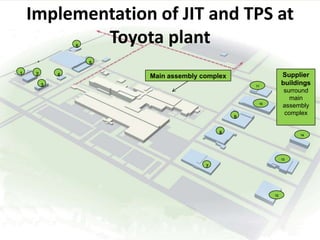
1 2
3
4
5
6
7
8
9
10
11
12
13
14
Main assembly complex Supplier
buildings
surround
main
assembly
complex
Implementation of JIT and TPS at
Toyota plant
Just-In-Time, TPS, and
Lean Operations
• JIT - continuous and forced problem solving
via a focus on throughput and reduced
inventory
• TPS -continuous improvement, respect for
people, and standard work practices
• Lean production - supplies the customer
with exact wants when the customer wants
it without waste
Just In Time
Good production systems require that
managers address three issues that are
pervasive and fundamental to operations
management: eliminate waste, remove
variability, and improve throughput
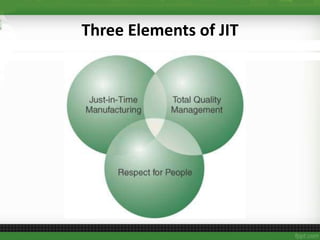
Three Elements of JIT
Eliminate Waste
• Waste is anything that does not add
value from the customer point of view
• Storage, inspection, delay, waiting in
queues, and defective products do
not add value and are 100% waste
The most dangerous
kind of waste is the
waste we do not
recognize
Ohno’s Seven Wastes
• Overproduction
• Queues
• Transportation
• Inventory
• Motion
• Over processing
• Defective products
Common Causes of Waste
• Layout (distance)
• Long setup time
• Incapable processes
• Poor maintenance
• Poor work methods
• Lack of training
• Inconsistent
performance measures
• Ineffective production
planning
• Lack of workplace
organization
• Poor supply
quality/reliability
Eliminate Waste
• Efficient, sustainable production
minimizes inputs, reduces waste
• Traditional “housekeeping” has been
expanded to the 5 Ss
The 5 Ss
• Sort/segregate – when in doubt, throw it
out
• Simplify/straighten – methods analysis
tools
• Shine/sweep – clean daily
• Standardize – remove variations from
processes
• Sustain/self-discipline – review work and
recognize progress
© 2011 Pearson Education,
Inc. publishing as Prentice
Hall
Two additional Ss
• Safety- build in good practices
• Support Maintenance- reduce variability
and unplanned downtime
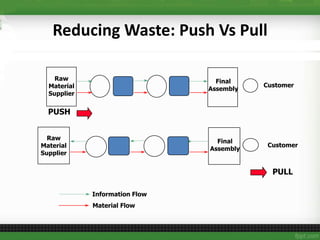
Reducing Waste: Push Vs Pull
Material Flow
Information Flow
Customer
Raw
Material
Supplier
Final
Assembly
PUSH
Customer
Raw
Material
Supplier
Final
Assembly
PULL
Remove Variability
• JIT systems require managers to
reduce variability caused by both
internal and external factors
• Variability is any deviation from the
optimum process
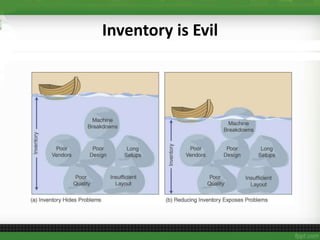
• Inventory hides variability
• Less variability results in less waste
Inventory is Evil
Sources of Variability
1. Incomplete or inaccurate drawings or
specifications
2. Poor production processes resulting in
incorrect quantities, late, or non-
conforming units
3. Unknown customer demands
Improve Throughput
• The time it takes to move an order
from receipt to delivery
• The time between the arrival of raw
materials and the shipping of the
finished order is called
manufacturing cycle time
• A pull system increases throughput
Improve Throughput
• By pulling material in small lots,
inventory cushions are removed,
exposing problems and emphasizing
continual improvement
• Manufacturing cycle time is reduced
• Push systems dump orders on the
downstream stations regardless of the
need
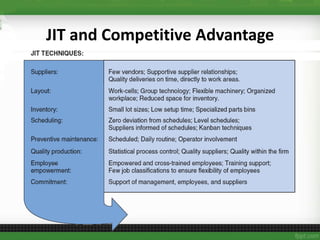
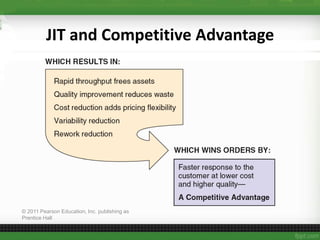
JIT and Competitive Advantage
© 2011 Pearson Education, Inc. publishing as
Prentice Hall
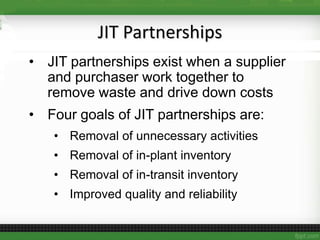
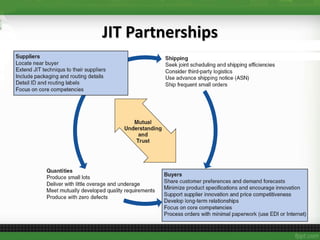
JIT Partnerships
• JIT partnerships exist when a supplier
and purchaser work together to
remove waste and drive down costs
• Four goals of JIT partnerships are:
• Removal of unnecessary activities
• Removal of in-plant inventory
• Removal of in-transit inventory
• Improved quality and reliability
JIT Partnerships
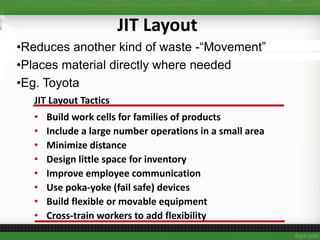
JIT Layout
•Reduces another kind of waste -“Movement”
•Places material directly where needed
•Eg. Toyota
JIT Layout Tactics
• Build work cells for families of products
• Include a large number operations in a small area
• Minimize distance
• Design little space for inventory
• Improve employee communication
• Use poka-yoke (fail safe) devices
• Build flexible or movable equipment
• Cross-train workers to add flexibility
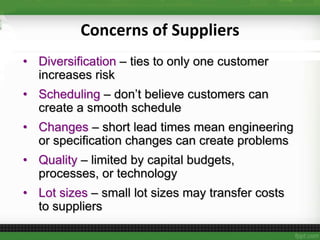
Concerns of Suppliers
• Diversification – ties to only one customer
increases risk
• Scheduling – don’t believe customers can
create a smooth schedule
• Changes – short lead times mean engineering
or specification changes can create problems
• Quality – limited by capital budgets,
processes, or technology
• Lot sizes – small lot sizes may transfer costs
to suppliers
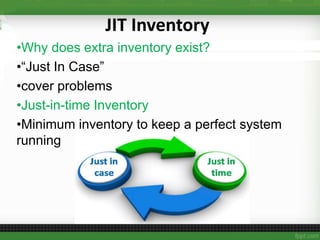
JIT Inventory
•Why does extra inventory exist?
•“Just In Case”
•cover problems
•Just-in-time Inventory
•Minimum inventory to keep a perfect system
running
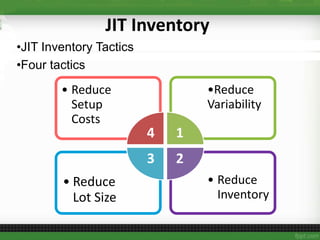
JIT Inventory
•JIT Inventory Tactics
•Four tactics
• Reduce
Inventory
• Reduce
Lot Size
•Reduce
Variability
• Reduce
Setup
Costs
4 1
23
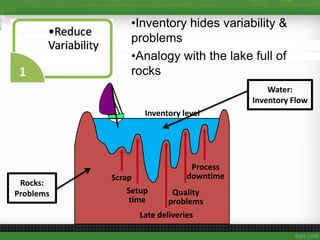
•Inventory hides variability &
problems
•Analogy with the lake full of
rocks
Inventory level
Process
downtimeScrap
Setup
time
Late deliveries
Quality
problems
Water:
Inventory Flow
Rocks:
Problems
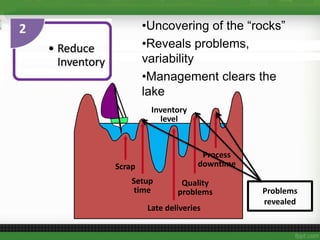
•Uncovering of the “rocks”
•Reveals problems,
variability
•Management clears the
lake
Inventory
level
Process
downtimeScrap
Setup
time
Late deliveries
Quality
problems Problems
revealed
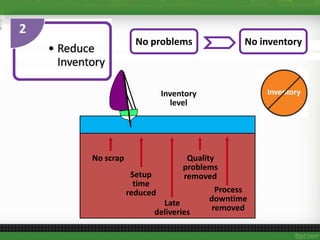
No problems No inventory
Inventory
level
Process
downtime
removed
No scrap
Setup
time
reduced
Late
deliveries
Quality
problems
removed
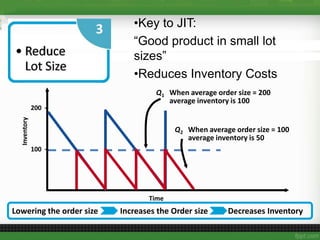
•Key to JIT:
“Good product in small lot
sizes”
•Reduces Inventory Costs
Q2 When average order size = 100
average inventory is 50
200 –
100 –
Inventory
Time
Q1 When average order size = 200
average inventory is 100
Lowering the order size Increases the Order size Decreases Inventory
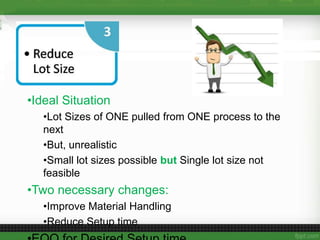
•Ideal Situation
•Lot Sizes of ONE pulled from ONE process to the
next
•But, unrealistic
•Small lot sizes possible but Single lot size not
feasible
•Two necessary changes:
•Improve Material Handling
•Reduce Setup time
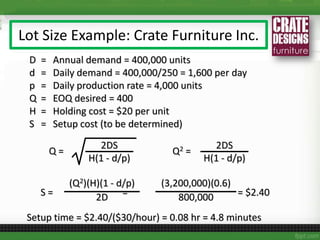
Lot Size Example: Crate Furniture Inc.
D = Annual demand = 400,000 units
d = Daily demand = 400,000/250 = 1,600 per day
p = Daily production rate = 4,000 units
Q = EOQ desired = 400
H = Holding cost = $20 per unit
S = Setup cost (to be determined)
Q =
2DS
H(1 - d/p)
Q2 =
2DS
H(1 - d/p)
S = = = $2.40
(Q2)(H)(1 - d/p)
2D
(3,200,000)(0.6)
800,000
Setup time = $2.40/($30/hour) = 0.08 hr = 4.8 minutes
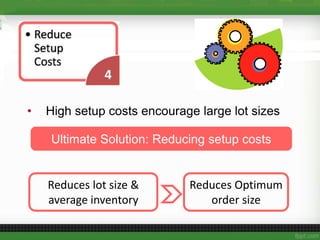
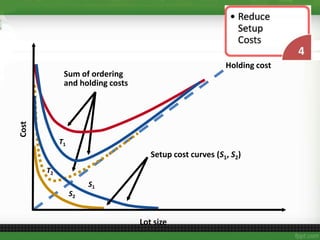
• High setup costs encourage large lot sizes
Ultimate Solution: Reducing setup costs
Reduces lot size &
average inventory
Reduces Optimum
order size
Holding cost
T2
S2
Setup cost curves (S1, S2)
T1
S1
Cost
Lot size
Sum of ordering
and holding costs
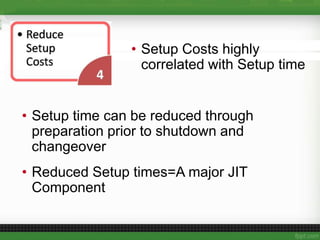
• Setup time can be reduced through
preparation prior to shutdown and
changeover
• Reduced Setup times=A major JIT
Component
• Setup Costs highly
correlated with Setup time
© 2011 Pearson Education, Inc. publishing as Prentice Hall
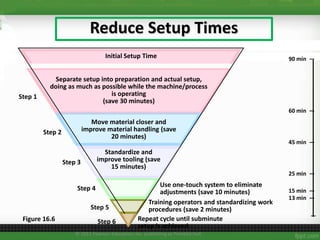
Reduce Setup Times
Figure 16.6
Use one-touch system to eliminate
adjustments (save 10 minutes)
Step 4
Step 5
Training operators and standardizing work
procedures (save 2 minutes)
Step 2
Move material closer and
improve material handling (save
20 minutes)
Step 1
Separate setup into preparation and actual setup,
doing as much as possible while the machine/process
is operating
(save 30 minutes)
Step 3
Standardize and
improve tooling (save
15 minutes)
Initial Setup Time 90 min —
60 min —
45 min —
25 min —
15 min —
13 min —
—
Repeat cycle until subminute
setup is achieved
Step 6
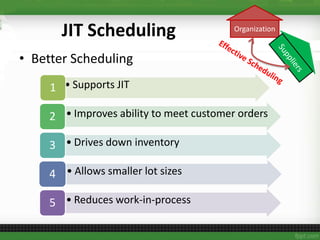
JIT Scheduling
• Better Scheduling
Organization
• Supports JIT1
• Improves ability to meet customer orders2
• Drives down inventory3
• Allows smaller lot sizes4
• Reduces work-in-process5
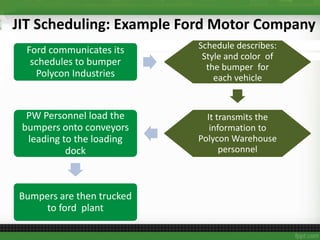
JIT Scheduling: Example Ford Motor Company
Ford communicates its
schedules to bumper
Polycon Industries
Schedule describes:
Style and color of
the bumper for
each vehicle
It transmits the
information to
Polycon Warehouse
personnel
PW Personnel load the
bumpers onto conveyors
leading to the loading
dock
Bumpers are then trucked
to ford plant
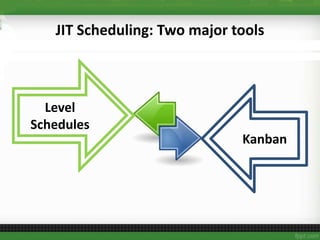
JIT Scheduling: Two major tools
Level
Schedules
Kanban
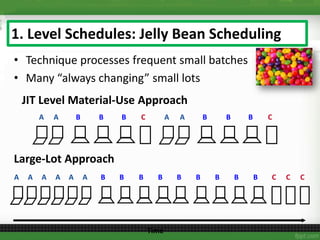
1. Level Schedules: Jelly Bean Scheduling
• Technique processes frequent small batches
• Many “always changing” small lots
A B CA AAB B B B B C
JIT Level Material-Use Approach
A CA AA B B B B B C CB B B BA A
Large-Lot Approach
Time
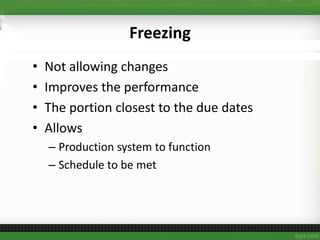
Freezing
• Not allowing changes
• Improves the performance
• The portion closest to the due dates
• Allows
– Production system to function
– Schedule to be met
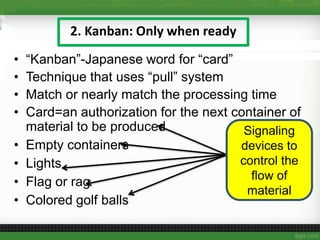
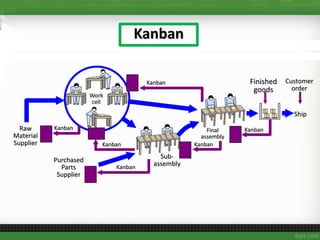
2. Kanban: Only when ready
• “Kanban”-Japanese word for “card”
• Technique that uses “pull” system
• Match or nearly match the processing time
• Card=an authorization for the next container of
material to be produced
• Empty containers
• Lights
• Flag or rag
• Colored golf balls
Signaling
devices to
control the
flow of
material
© 2011 Pearson Education, Inc. publishing as Prentice Hall
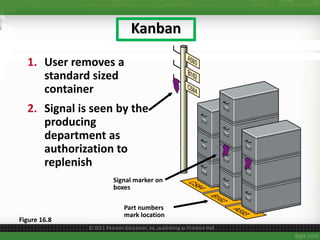
Kanban
1. User removes a
standard sized
container
2. Signal is seen by the
producing
department as
authorization to
replenish
Part numbers
mark location
Signal marker on
boxes
Figure 16.8
Work
cell
Raw
Material
Supplier
Kanban
Purchased
Parts
Supplier
Sub-
assembly
Ship
Kanban
Kanban
Kanban
Kanban
Finished
goods
Customer
order
Final
assembly
Kanban
Kanban
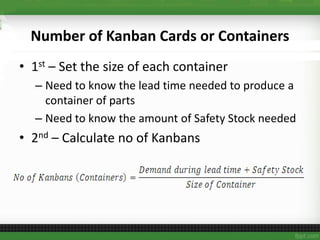
Number of Kanban Cards or Containers
• 1st – Set the size of each container
– Need to know the lead time needed to produce a
container of parts
– Need to know the amount of Safety Stock needed
• 2nd – Calculate no of Kanbans
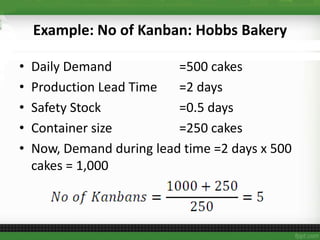
Example: No of Kanban: Hobbs Bakery
• Daily Demand =500 cakes
• Production Lead Time =2 days
• Safety Stock =0.5 days
• Container size =250 cakes
• Now, Demand during lead time =2 days x 500
cakes = 1,000
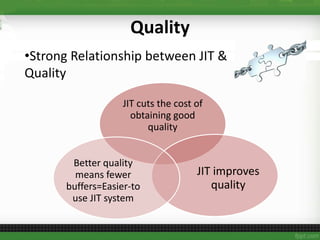
Quality
JIT cuts the cost of
obtaining good
quality
JIT improves
quality
Better quality
means fewer
buffers=Easier-to
use JIT system
•Strong Relationship between JIT &
Quality
© 2011 Pearson Education, Inc.
publishing as Prentice Hall
JIT Quality Tactics
Use statistical process control
Empower employees
Build fail-safe methods (poka-yoke,
checklists, etc.)
Expose poor quality with small lot
JIT
Provide immediate feedback
Table 16.4
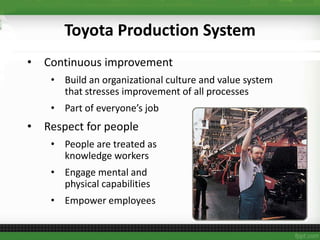
• Continuous improvement
• Build an organizational culture and value system
that stresses improvement of all processes
• Part of everyone’s job
• Respect for people
• People are treated as
knowledge workers
• Engage mental and
physical capabilities
• Empower employees
Toyota Production System
• Standard work practice
• Work shall be completely specified as to
content, sequence, timing, and outcome
• Internal and external customer-supplier
connection are direct
• Product and service flows must be simple and
direct
• Any improvement must be made in
accordance with the scientific method at the
lowest possible level of the organization
Toyota Production System
Lean Operations
• Different from JIT in that it is externally
focused on the customer
• Starts with understanding what the
customer wants
• Optimize the entire process from the
customer’s perspective
Building a Lean Organization
• Transitioning to a lean system can be
difficult
• Lean systems tend to have the
following attributes
• Use JIT techniques
• Build systems that help employees
produce perfect parts
• Reduce space requirements
Building a Lean Organization
• Develop partnerships with suppliers
• Educate suppliers
• Eliminate all but value-added
activities
• Develop employees
• Make jobs challenging
• Build worker flexibility
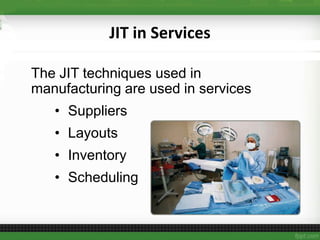
JIT in Services
The JIT techniques used in
manufacturing are used in services
• Suppliers
• Layouts
• Inventory
• Scheduling
Group 7
THANK YOU
ANY QUESTIONS?

Just In Time and Lean Operation Chapter Presentation

  • 1.
    LEAN OPERATiONS Presented By: Group 7 PearsonEducation, Inc. publishing as Prentice Hall © 2011 Based on the textbook by Heizer and Render Most of the figures from the book:
  • 2.
    What is JIT? •A corporate system designed to produce output within the minimum lead time and at the lowest total cost by continuously identifying and eliminating all forms of corporate waste and variance.
  • 3.
    Looking Back • JIToriginated in Japan, post WWII • Driven by a need survive after the devastation caused by the war • JIT gained worldwide prominence in the 1970s • Toyota Motor Co. developed JIT
  • 4.
    Toyota Motor Corp. •Largest vehicle manufacturer • Techniques of JIT, TPS and Lean Operation • Introduced by Taiichi Ohno
  • 5.
    1 2 3 4 5 6 7 8 9 10 11 12 13 14 Main assemblycomplex Supplier buildings surround main assembly complex Implementation of JIT and TPS at Toyota plant
  • 6.
    Just-In-Time, TPS, and LeanOperations • JIT - continuous and forced problem solving via a focus on throughput and reduced inventory • TPS -continuous improvement, respect for people, and standard work practices • Lean production - supplies the customer with exact wants when the customer wants it without waste
  • 7.
    Just In Time Goodproduction systems require that managers address three issues that are pervasive and fundamental to operations management: eliminate waste, remove variability, and improve throughput
  • 8.
  • 9.
    Eliminate Waste • Wasteis anything that does not add value from the customer point of view • Storage, inspection, delay, waiting in queues, and defective products do not add value and are 100% waste
  • 10.
    The most dangerous kindof waste is the waste we do not recognize
  • 11.
    Ohno’s Seven Wastes •Overproduction • Queues • Transportation • Inventory • Motion • Over processing • Defective products
  • 12.
    Common Causes ofWaste • Layout (distance) • Long setup time • Incapable processes • Poor maintenance • Poor work methods • Lack of training • Inconsistent performance measures • Ineffective production planning • Lack of workplace organization • Poor supply quality/reliability
  • 13.
    Eliminate Waste • Efficient,sustainable production minimizes inputs, reduces waste • Traditional “housekeeping” has been expanded to the 5 Ss
  • 14.
    The 5 Ss •Sort/segregate – when in doubt, throw it out • Simplify/straighten – methods analysis tools • Shine/sweep – clean daily • Standardize – remove variations from processes • Sustain/self-discipline – review work and recognize progress
  • 15.
    © 2011 PearsonEducation, Inc. publishing as Prentice Hall Two additional Ss • Safety- build in good practices • Support Maintenance- reduce variability and unplanned downtime
  • 16.
    Reducing Waste: PushVs Pull Material Flow Information Flow Customer Raw Material Supplier Final Assembly PUSH Customer Raw Material Supplier Final Assembly PULL
  • 17.
    Remove Variability • JITsystems require managers to reduce variability caused by both internal and external factors • Variability is any deviation from the optimum process • Inventory hides variability • Less variability results in less waste
  • 18.
  • 19.
    Sources of Variability 1.Incomplete or inaccurate drawings or specifications 2. Poor production processes resulting in incorrect quantities, late, or non- conforming units 3. Unknown customer demands
  • 20.
    Improve Throughput • Thetime it takes to move an order from receipt to delivery • The time between the arrival of raw materials and the shipping of the finished order is called manufacturing cycle time • A pull system increases throughput
  • 21.
    Improve Throughput • Bypulling material in small lots, inventory cushions are removed, exposing problems and emphasizing continual improvement • Manufacturing cycle time is reduced • Push systems dump orders on the downstream stations regardless of the need
  • 22.
  • 23.
    JIT and CompetitiveAdvantage © 2011 Pearson Education, Inc. publishing as Prentice Hall
  • 24.
    JIT Partnerships • JITpartnerships exist when a supplier and purchaser work together to remove waste and drive down costs • Four goals of JIT partnerships are: • Removal of unnecessary activities • Removal of in-plant inventory • Removal of in-transit inventory • Improved quality and reliability
  • 25.
  • 26.
    JIT Layout •Reduces anotherkind of waste -“Movement” •Places material directly where needed •Eg. Toyota JIT Layout Tactics • Build work cells for families of products • Include a large number operations in a small area • Minimize distance • Design little space for inventory • Improve employee communication • Use poka-yoke (fail safe) devices • Build flexible or movable equipment • Cross-train workers to add flexibility
  • 27.
    Concerns of Suppliers •Diversification – ties to only one customer increases risk • Scheduling – don’t believe customers can create a smooth schedule • Changes – short lead times mean engineering or specification changes can create problems • Quality – limited by capital budgets, processes, or technology • Lot sizes – small lot sizes may transfer costs to suppliers
  • 28.
    JIT Inventory •Why doesextra inventory exist? •“Just In Case” •cover problems •Just-in-time Inventory •Minimum inventory to keep a perfect system running
  • 29.
    JIT Inventory •JIT InventoryTactics •Four tactics • Reduce Inventory • Reduce Lot Size •Reduce Variability • Reduce Setup Costs 4 1 23
  • 30.
    •Inventory hides variability& problems •Analogy with the lake full of rocks Inventory level Process downtimeScrap Setup time Late deliveries Quality problems Water: Inventory Flow Rocks: Problems
  • 31.
    •Uncovering of the“rocks” •Reveals problems, variability •Management clears the lake Inventory level Process downtimeScrap Setup time Late deliveries Quality problems Problems revealed
  • 32.
    No problems Noinventory Inventory level Process downtime removed No scrap Setup time reduced Late deliveries Quality problems removed
  • 33.
    •Key to JIT: “Goodproduct in small lot sizes” •Reduces Inventory Costs Q2 When average order size = 100 average inventory is 50 200 – 100 – Inventory Time Q1 When average order size = 200 average inventory is 100 Lowering the order size Increases the Order size Decreases Inventory
  • 34.
    •Ideal Situation •Lot Sizesof ONE pulled from ONE process to the next •But, unrealistic •Small lot sizes possible but Single lot size not feasible •Two necessary changes: •Improve Material Handling •Reduce Setup time
  • 35.
    Lot Size Example:Crate Furniture Inc. D = Annual demand = 400,000 units d = Daily demand = 400,000/250 = 1,600 per day p = Daily production rate = 4,000 units Q = EOQ desired = 400 H = Holding cost = $20 per unit S = Setup cost (to be determined) Q = 2DS H(1 - d/p) Q2 = 2DS H(1 - d/p) S = = = $2.40 (Q2)(H)(1 - d/p) 2D (3,200,000)(0.6) 800,000 Setup time = $2.40/($30/hour) = 0.08 hr = 4.8 minutes
  • 36.
    • High setupcosts encourage large lot sizes Ultimate Solution: Reducing setup costs Reduces lot size & average inventory Reduces Optimum order size
  • 37.
    Holding cost T2 S2 Setup costcurves (S1, S2) T1 S1 Cost Lot size Sum of ordering and holding costs
  • 38.
    • Setup timecan be reduced through preparation prior to shutdown and changeover • Reduced Setup times=A major JIT Component • Setup Costs highly correlated with Setup time
  • 39.
    © 2011 PearsonEducation, Inc. publishing as Prentice Hall Reduce Setup Times Figure 16.6 Use one-touch system to eliminate adjustments (save 10 minutes) Step 4 Step 5 Training operators and standardizing work procedures (save 2 minutes) Step 2 Move material closer and improve material handling (save 20 minutes) Step 1 Separate setup into preparation and actual setup, doing as much as possible while the machine/process is operating (save 30 minutes) Step 3 Standardize and improve tooling (save 15 minutes) Initial Setup Time 90 min — 60 min — 45 min — 25 min — 15 min — 13 min — — Repeat cycle until subminute setup is achieved Step 6
  • 40.
    JIT Scheduling • BetterScheduling Organization • Supports JIT1 • Improves ability to meet customer orders2 • Drives down inventory3 • Allows smaller lot sizes4 • Reduces work-in-process5
  • 41.
    JIT Scheduling: ExampleFord Motor Company Ford communicates its schedules to bumper Polycon Industries Schedule describes: Style and color of the bumper for each vehicle It transmits the information to Polycon Warehouse personnel PW Personnel load the bumpers onto conveyors leading to the loading dock Bumpers are then trucked to ford plant
  • 42.
    JIT Scheduling: Twomajor tools Level Schedules Kanban
  • 43.
    1. Level Schedules:Jelly Bean Scheduling • Technique processes frequent small batches • Many “always changing” small lots A B CA AAB B B B B C JIT Level Material-Use Approach A CA AA B B B B B C CB B B BA A Large-Lot Approach Time
  • 44.
    Freezing • Not allowingchanges • Improves the performance • The portion closest to the due dates • Allows – Production system to function – Schedule to be met
  • 45.
    2. Kanban: Onlywhen ready • “Kanban”-Japanese word for “card” • Technique that uses “pull” system • Match or nearly match the processing time • Card=an authorization for the next container of material to be produced • Empty containers • Lights • Flag or rag • Colored golf balls Signaling devices to control the flow of material
  • 46.
    © 2011 PearsonEducation, Inc. publishing as Prentice Hall Kanban 1. User removes a standard sized container 2. Signal is seen by the producing department as authorization to replenish Part numbers mark location Signal marker on boxes Figure 16.8
  • 47.
  • 48.
    Number of KanbanCards or Containers • 1st – Set the size of each container – Need to know the lead time needed to produce a container of parts – Need to know the amount of Safety Stock needed • 2nd – Calculate no of Kanbans
  • 49.
    Example: No ofKanban: Hobbs Bakery • Daily Demand =500 cakes • Production Lead Time =2 days • Safety Stock =0.5 days • Container size =250 cakes • Now, Demand during lead time =2 days x 500 cakes = 1,000
  • 50.
    Quality JIT cuts thecost of obtaining good quality JIT improves quality Better quality means fewer buffers=Easier-to use JIT system •Strong Relationship between JIT & Quality
  • 51.
    © 2011 PearsonEducation, Inc. publishing as Prentice Hall JIT Quality Tactics Use statistical process control Empower employees Build fail-safe methods (poka-yoke, checklists, etc.) Expose poor quality with small lot JIT Provide immediate feedback Table 16.4
  • 52.
    • Continuous improvement •Build an organizational culture and value system that stresses improvement of all processes • Part of everyone’s job • Respect for people • People are treated as knowledge workers • Engage mental and physical capabilities • Empower employees Toyota Production System
  • 53.
    • Standard workpractice • Work shall be completely specified as to content, sequence, timing, and outcome • Internal and external customer-supplier connection are direct • Product and service flows must be simple and direct • Any improvement must be made in accordance with the scientific method at the lowest possible level of the organization Toyota Production System
  • 54.
    Lean Operations • Differentfrom JIT in that it is externally focused on the customer • Starts with understanding what the customer wants • Optimize the entire process from the customer’s perspective
  • 55.
    Building a LeanOrganization • Transitioning to a lean system can be difficult • Lean systems tend to have the following attributes • Use JIT techniques • Build systems that help employees produce perfect parts • Reduce space requirements
  • 56.
    Building a LeanOrganization • Develop partnerships with suppliers • Educate suppliers • Eliminate all but value-added activities • Develop employees • Make jobs challenging • Build worker flexibility
  • 57.
    JIT in Services TheJIT techniques used in manufacturing are used in services • Suppliers • Layouts • Inventory • Scheduling
  • 58.