
Presented by
A. R. Sivanesh M.E.,
Assistant Professor
Department of Mechanical Engineering
Sri Ranganathar Institute of Engineering
and Technology, Coimbatore
Lean Manufacturing Definition
• A systematic approach to identifying &
eliminating waste (non value added
Activities) through continuous
improvement by flowing the product at
the pull of the customer in pursuit of
perfection”
• The main principles of lean
manufacturing are zero waiting time,
zero inventory, internal customer pull
instead of push, reduced batch sizes,
and reduced process times.
Lean Manufacturing
• Lean manufacturing is the optimal way of producing goods through
the removal of waste and implementing flow, as opposed to batch
processing.
• Lean manufacturing is a generic process management philosophy
derived mostly from Toyota and focuses mainly on reduction of the
seven wastes originally identified by Toyota
• Lean manufacturing is focused on getting the right things, to the right
place, at the right time, in the right quantity to achieve perfect work
flow while minimizing waste and being flexible and able to change.
Lean Goals
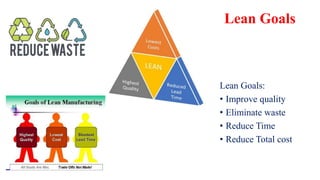
Lean Goals:
• Improve quality
• Eliminate waste
• Reduce Time
• Reduce Total cost
History
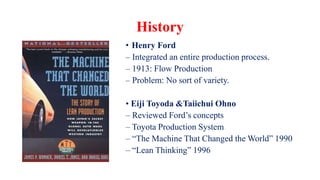
• Henry Ford
– Integrated an entire production process.
– 1913: Flow Production
– Problem: No sort of variety.
• Eiji Toyoda &Taiichui Ohno
– Reviewed Ford’s concepts
– Toyota Production System
– “The Machine That Changed the World” 1990
– “Lean Thinking” 1996
Lean Thinking
Lean Manufacturing (also known as
Lean Management, Lean Enterprise,
Lean Production or Lean Thinking) is a
system of management developed by
the Toyota Motor Corporation and
adapted successfully across the world
to almost every sector of
manufacturing as well as a huge range
of non-manufacturing sectors including
Healthcare, Banking, Government &
Services and even Agribusiness.
Muda (Waste)
Taiichi Ohno (1912-1990), the Toyota executive who was the most ferocious foe of waste human
history has produced, identified the first seven types of Muda in manufacturing system:
• INVENTORY
• WAITING TIME
• MOTION
• TRANSPORTATION
• DEFECTS
• OVER-PROCESSING
• OVER-PRODUCTION
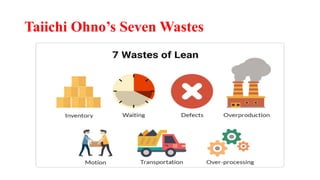
Taiichi Ohno’s Seven Wastes
The Seven Wastes
The Seven Wastes Are:
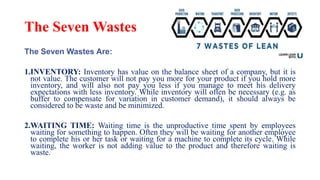
1.INVENTORY: Inventory has value on the balance sheet of a company, but it is
not value. The customer will not pay you more for your product if you hold more
inventory, and will also not pay you less if you manage to meet his delivery
expectations with less inventory. While inventory will often be necessary (e.g. as
buffer to compensate for variation in customer demand), it should always be
considered to be waste and be minimized.
2.WAITING TIME: Waiting time is the unproductive time spent by employees
waiting for something to happen. Often they will be waiting for another employee
to complete his or her task or waiting for a machine to complete its cycle. While
waiting, the worker is not adding value to the product and therefore waiting is
waste.
The Seven Wastes
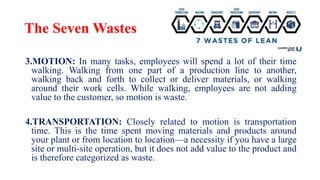
3.MOTION: In many tasks, employees will spend a lot of their time
walking. Walking from one part of a production line to another,
walking back and forth to collect or deliver materials, or walking
around their work cells. While walking, employees are not adding
value to the customer, so motion is waste.
4.TRANSPORTATION: Closely related to motion is transportation
time. This is the time spent moving materials and products around
your plant or from location to location—a necessity if you have a large
site or multi-site operation, but it does not add value to the product and
is therefore categorized as waste.
The Seven Wastes
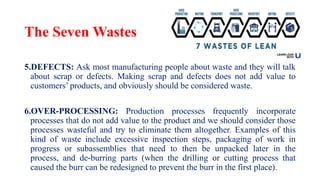
5.DEFECTS: Ask most manufacturing people about waste and they will talk
about scrap or defects. Making scrap and defects does not add value to
customers’ products, and obviously should be considered waste.
6.OVER-PROCESSING: Production processes frequently incorporate
processes that do not add value to the product and we should consider those
processes wasteful and try to eliminate them altogether. Examples of this
kind of waste include excessive inspection steps, packaging of work in
progress or subassemblies that need to then be unpacked later in the
process, and de-burring parts (when the drilling or cutting process that
caused the burr can be redesigned to prevent the burr in the first place).
The Seven Wastes
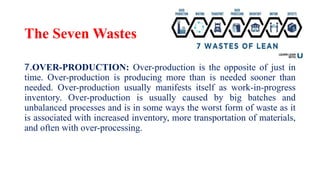
7.OVER-PRODUCTION: Over-production is the opposite of just in
time. Over-production is producing more than is needed sooner than
needed. Over-production usually manifests itself as work-in-progress
inventory. Over-production is usually caused by big batches and
unbalanced processes and is in some ways the worst form of waste as it
is associated with increased inventory, more transportation of materials,
and often with over-processing.
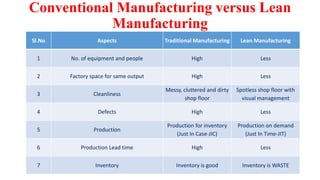
Conventional Manufacturing versus Lean
Manufacturing
Sl.No Aspects Traditional Manufacturing Lean Manufacturing
1 No. of equipment and people High Less
2 Factory space for same output High Less
3 Cleanliness
Messy, cluttered and dirty
shop floor
Spotless shop floor with
visual management
4 Defects High Less
5 Production
Production for inventory
(Just In Case-JIC)
Production on demand
(Just In Time-JIT)
6 Production Lead time High Less
7 Inventory Inventory is good Inventory is WASTE
Principles of Lean Manufacturing
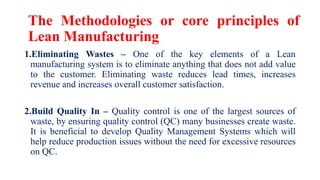
The Methodologies or core principles of
Lean Manufacturing
1.Eliminating Wastes – One of the key elements of a Lean
manufacturing system is to eliminate anything that does not add value
to the customer. Eliminating waste reduces lead times, increases
revenue and increases overall customer satisfaction.
2.Build Quality In – Quality control is one of the largest sources of
waste, by ensuring quality control (QC) many businesses create waste.
It is beneficial to develop Quality Management Systems which will
help reduce production issues without the need for excessive resources
on QC.
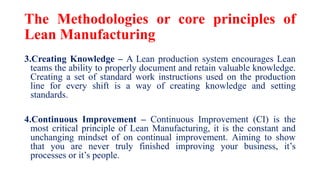
The Methodologies or core principles of
Lean Manufacturing
3.Creating Knowledge – A Lean production system encourages Lean
teams the ability to properly document and retain valuable knowledge.
Creating a set of standard work instructions used on the production
line for every shift is a way of creating knowledge and setting
standards.
4.Continuous Improvement – Continuous Improvement (CI) is the
most critical principle of Lean Manufacturing, it is the constant and
unchanging mindset of on continual improvement. Aiming to show
that you are never truly finished improving your business, it’s
processes or it’s people.
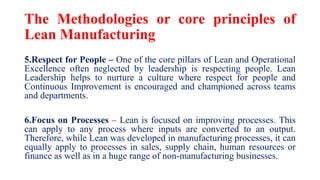
The Methodologies or core principles of
Lean Manufacturing
5.Respect for People – One of the core pillars of Lean and Operational
Excellence often neglected by leadership is respecting people. Lean
Leadership helps to nurture a culture where respect for people and
Continuous Improvement is encouraged and championed across teams
and departments.
6.Focus on Processes – Lean is focused on improving processes. This
can apply to any process where inputs are converted to an output.
Therefore, while Lean was developed in manufacturing processes, it can
equally apply to processes in sales, supply chain, human resources or
finance as well as in a huge range of non-manufacturing businesses.
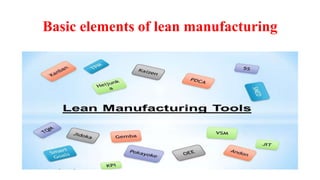
Basic elements of lean manufacturing
1. SMED/setup time Reduction
• Lean Manufacturing targets reduction of setup time and changeover
time because it consumes critical working time and reduces proper
utilization of machine and operator time.
• This can be achieved by sequenced and structured work instructions
to perform the job. The operator will follow the instruction and
should be able to finish the job within minimum possible time.
• The work instruction is based on time and motion study during
changeover, analysis of the waste and modification with the aim to
eliminate the waste.
Basic elements of lean manufacturing
2. Kanban
• Kanban is a shop floor tool which communicates customer requirement from
downstream to upstream worker.
• Once product is withdrawn from finished goods against customer demands to
replenish the moved quantity it is replaced with colored card (or electronically).
• This becomes a production order for the internal supplier in the upstream value
chain.
3. Total Productive Maintenance
• Total Productive Maintenance (TPM) promotes basic preventative maintenance
job to operator itself so that break down time of machines is reduced.
• It also enhances operational efficiency of machine as worker does cleaning,
lubricating, inspection, tightening activity of his machine.
Basic elements of lean manufacturing
4. Cellular Layout
• In cellular production layouts, equipment and workstations are arranged into
a large number of small tightly connected cells so that many stages or all
stages of a production process can occur within a single cell or a series of
cells.
• Cellular layout helps to achieve many of the objectives of Lean
Manufacturing due to its ability to help eliminate many non value-added
activities from the production process such as waiting times, bottlenecks,
transport and works-in-progress.
• Another benefit of cellular manufacturing is that responsibility for quality is
clearly assigned to the worker in a particular cell and he/she therefore
cannot blame workers at upstream stages for quality problems.
Basic elements of lean manufacturing
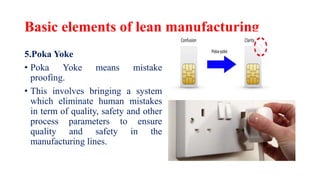
5.Poka Yoke
• Poka Yoke means mistake
proofing.
• This involves bringing a system
which eliminate human mistakes
in term of quality, safety and other
process parameters to ensure
quality and safety in the
manufacturing lines.
Basic elements of lean manufacturing
6.The Five S’s
• The 5S is a lean tool which consists of five steps Seiri, Seiton, Seiso, Seiketsu,
Shitsuke and taken from Japanese language which aims to improve work place
efficiency.
Seiri:
• It refers to the action of sorting out wanted and unwanted material in and around
workplace.
• Unwanted material should throw away and material which needs with lesser
frequency should be place near to workplace and material which is required more
frequently must be kept at a defined place very near to point of use.
• Seiri ensures in reduction of material searching time waste.
Basic elements of lean manufacturing
Seiton:
• Seiton or set in order means every object (material, tool or instrument) must
have a designated place to keep and every place have is the same object.
• The correct place, position, or holder for every tool, item, or material must
be chosen carefully in relation to how the work will be performed and who
will use them
Seiso:
• Seiso, is the third step in "5S", speaks about clean and shine.
• Everybody is caretaker of its workstation and should see to clean all the
commodities in and around workplace and make it shine.
Basic elements of lean manufacturing
Seiketsu:
• The forth S of "5S", is seiketsu, it means standardization. It consists of
defining the standards by which personnel must measure and maintain
'cleanliness'.
• Color coding can be used for standardization which can enable to visualize
between current level and desired level.
Shitsuke:
• The S of "5S" is Shitsuke, which means 'Self Discipline.' It stands for
promise to maintain the first 4 S as a way of life.
• The importance of shitsuke is taking away of bad habits of disorderliness
and regular practice of good ones.
Basic elements of lean manufacturing
Basic elements of lean
manufacturing
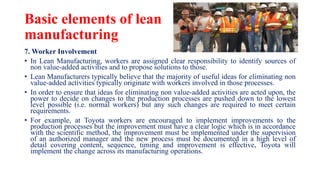
7. Worker Involvement
• In Lean Manufacturing, workers are assigned clear responsibility to identify sources of
non value-added activities and to propose solutions to those.
• Lean Manufacturers typically believe that the majority of useful ideas for eliminating non
value-added activities typically originate with workers involved in those processes.
• In order to ensure that ideas for eliminating non value-added activities are acted upon, the
power to decide on changes to the production processes are pushed down to the lowest
level possible (i.e. normal workers) but any such changes are required to meet certain
requirements.
• For example, at Toyota workers are encouraged to implement improvements to the
production processes but the improvement must have a clear logic which is in accordance
with the scientific method, the improvement must be implemented under the supervision
of an authorized manager and the new process must be documented in a high level of
detail covering content, sequence, timing and improvement is effective, Toyota will
implement the change across its manufacturing operations.
Basic elements of lean
manufacturing
8.Continual Improvement
• A company can never be perfectly efficient. Lean Manufacturing requires a commitment
to continual improvement, and preferably a systematic process for ensuring continuous
improvement, whereby the company constantly searches for non value-added activities
and ways to eliminate those.
• The focus of continual improvement should be on identifying the root causes of non
value-added activities and eliminating those by improving the production process.
9. Kaizen
• Kaizen means small improvement. To maintain continuous improvement activities
throughout the organization Kaizen culture should be created and maintained.
• Kaizen is done by the individuals mainly by operators for improvement in working
condition, safety, quality , productivity, set up time reduction or any other small change
for betterment.
Lean Manufacturing Certification
• Six Sigma Yellow Belt
• Six Sigma Green Belt
• Six Sigma Black Belt
• Introduction a Lean Six Sigma
• Introduction to Operations Management
• Advanced Manufacturing Process Analysis
• Six Sigma Advanced Improve and Control Phases
• Supply Chain Management
"Improvement usually means doing
something that we have never done before."
- Shigeo Shingo
BASICS OF LEAN MANUFACTURING

BASICS OF LEAN MANUFACTURING

  • 1.
    Presented by A. R.Sivanesh M.E., Assistant Professor Department of Mechanical Engineering Sri Ranganathar Institute of Engineering and Technology, Coimbatore
  • 2.
    Lean Manufacturing Definition •A systematic approach to identifying & eliminating waste (non value added Activities) through continuous improvement by flowing the product at the pull of the customer in pursuit of perfection” • The main principles of lean manufacturing are zero waiting time, zero inventory, internal customer pull instead of push, reduced batch sizes, and reduced process times.
  • 3.
    Lean Manufacturing • Leanmanufacturing is the optimal way of producing goods through the removal of waste and implementing flow, as opposed to batch processing. • Lean manufacturing is a generic process management philosophy derived mostly from Toyota and focuses mainly on reduction of the seven wastes originally identified by Toyota • Lean manufacturing is focused on getting the right things, to the right place, at the right time, in the right quantity to achieve perfect work flow while minimizing waste and being flexible and able to change.
  • 4.
    Lean Goals Lean Goals: •Improve quality • Eliminate waste • Reduce Time • Reduce Total cost
  • 5.
    History • Henry Ford –Integrated an entire production process. – 1913: Flow Production – Problem: No sort of variety. • Eiji Toyoda &Taiichui Ohno – Reviewed Ford’s concepts – Toyota Production System – “The Machine That Changed the World” 1990 – “Lean Thinking” 1996
  • 6.
    Lean Thinking Lean Manufacturing(also known as Lean Management, Lean Enterprise, Lean Production or Lean Thinking) is a system of management developed by the Toyota Motor Corporation and adapted successfully across the world to almost every sector of manufacturing as well as a huge range of non-manufacturing sectors including Healthcare, Banking, Government & Services and even Agribusiness.
  • 7.
    Muda (Waste) Taiichi Ohno(1912-1990), the Toyota executive who was the most ferocious foe of waste human history has produced, identified the first seven types of Muda in manufacturing system: • INVENTORY • WAITING TIME • MOTION • TRANSPORTATION • DEFECTS • OVER-PROCESSING • OVER-PRODUCTION
  • 8.
  • 9.
    The Seven Wastes TheSeven Wastes Are: 1.INVENTORY: Inventory has value on the balance sheet of a company, but it is not value. The customer will not pay you more for your product if you hold more inventory, and will also not pay you less if you manage to meet his delivery expectations with less inventory. While inventory will often be necessary (e.g. as buffer to compensate for variation in customer demand), it should always be considered to be waste and be minimized. 2.WAITING TIME: Waiting time is the unproductive time spent by employees waiting for something to happen. Often they will be waiting for another employee to complete his or her task or waiting for a machine to complete its cycle. While waiting, the worker is not adding value to the product and therefore waiting is waste.
  • 10.
    The Seven Wastes 3.MOTION:In many tasks, employees will spend a lot of their time walking. Walking from one part of a production line to another, walking back and forth to collect or deliver materials, or walking around their work cells. While walking, employees are not adding value to the customer, so motion is waste. 4.TRANSPORTATION: Closely related to motion is transportation time. This is the time spent moving materials and products around your plant or from location to location—a necessity if you have a large site or multi-site operation, but it does not add value to the product and is therefore categorized as waste.
  • 11.
    The Seven Wastes 5.DEFECTS:Ask most manufacturing people about waste and they will talk about scrap or defects. Making scrap and defects does not add value to customers’ products, and obviously should be considered waste. 6.OVER-PROCESSING: Production processes frequently incorporate processes that do not add value to the product and we should consider those processes wasteful and try to eliminate them altogether. Examples of this kind of waste include excessive inspection steps, packaging of work in progress or subassemblies that need to then be unpacked later in the process, and de-burring parts (when the drilling or cutting process that caused the burr can be redesigned to prevent the burr in the first place).
  • 12.
    The Seven Wastes 7.OVER-PRODUCTION:Over-production is the opposite of just in time. Over-production is producing more than is needed sooner than needed. Over-production usually manifests itself as work-in-progress inventory. Over-production is usually caused by big batches and unbalanced processes and is in some ways the worst form of waste as it is associated with increased inventory, more transportation of materials, and often with over-processing.
  • 13.
    Conventional Manufacturing versusLean Manufacturing Sl.No Aspects Traditional Manufacturing Lean Manufacturing 1 No. of equipment and people High Less 2 Factory space for same output High Less 3 Cleanliness Messy, cluttered and dirty shop floor Spotless shop floor with visual management 4 Defects High Less 5 Production Production for inventory (Just In Case-JIC) Production on demand (Just In Time-JIT) 6 Production Lead time High Less 7 Inventory Inventory is good Inventory is WASTE
  • 14.
    Principles of LeanManufacturing
  • 15.
    The Methodologies orcore principles of Lean Manufacturing 1.Eliminating Wastes – One of the key elements of a Lean manufacturing system is to eliminate anything that does not add value to the customer. Eliminating waste reduces lead times, increases revenue and increases overall customer satisfaction. 2.Build Quality In – Quality control is one of the largest sources of waste, by ensuring quality control (QC) many businesses create waste. It is beneficial to develop Quality Management Systems which will help reduce production issues without the need for excessive resources on QC.
  • 16.
    The Methodologies orcore principles of Lean Manufacturing 3.Creating Knowledge – A Lean production system encourages Lean teams the ability to properly document and retain valuable knowledge. Creating a set of standard work instructions used on the production line for every shift is a way of creating knowledge and setting standards. 4.Continuous Improvement – Continuous Improvement (CI) is the most critical principle of Lean Manufacturing, it is the constant and unchanging mindset of on continual improvement. Aiming to show that you are never truly finished improving your business, it’s processes or it’s people.
  • 17.
    The Methodologies orcore principles of Lean Manufacturing 5.Respect for People – One of the core pillars of Lean and Operational Excellence often neglected by leadership is respecting people. Lean Leadership helps to nurture a culture where respect for people and Continuous Improvement is encouraged and championed across teams and departments. 6.Focus on Processes – Lean is focused on improving processes. This can apply to any process where inputs are converted to an output. Therefore, while Lean was developed in manufacturing processes, it can equally apply to processes in sales, supply chain, human resources or finance as well as in a huge range of non-manufacturing businesses.
  • 18.
    Basic elements oflean manufacturing
  • 19.
    Basic elements oflean manufacturing 1. SMED/setup time Reduction • Lean Manufacturing targets reduction of setup time and changeover time because it consumes critical working time and reduces proper utilization of machine and operator time. • This can be achieved by sequenced and structured work instructions to perform the job. The operator will follow the instruction and should be able to finish the job within minimum possible time. • The work instruction is based on time and motion study during changeover, analysis of the waste and modification with the aim to eliminate the waste.
  • 20.
    Basic elements oflean manufacturing 2. Kanban • Kanban is a shop floor tool which communicates customer requirement from downstream to upstream worker. • Once product is withdrawn from finished goods against customer demands to replenish the moved quantity it is replaced with colored card (or electronically). • This becomes a production order for the internal supplier in the upstream value chain. 3. Total Productive Maintenance • Total Productive Maintenance (TPM) promotes basic preventative maintenance job to operator itself so that break down time of machines is reduced. • It also enhances operational efficiency of machine as worker does cleaning, lubricating, inspection, tightening activity of his machine.
  • 21.
    Basic elements oflean manufacturing 4. Cellular Layout • In cellular production layouts, equipment and workstations are arranged into a large number of small tightly connected cells so that many stages or all stages of a production process can occur within a single cell or a series of cells. • Cellular layout helps to achieve many of the objectives of Lean Manufacturing due to its ability to help eliminate many non value-added activities from the production process such as waiting times, bottlenecks, transport and works-in-progress. • Another benefit of cellular manufacturing is that responsibility for quality is clearly assigned to the worker in a particular cell and he/she therefore cannot blame workers at upstream stages for quality problems.
  • 22.
    Basic elements oflean manufacturing 5.Poka Yoke • Poka Yoke means mistake proofing. • This involves bringing a system which eliminate human mistakes in term of quality, safety and other process parameters to ensure quality and safety in the manufacturing lines.
  • 23.
    Basic elements oflean manufacturing 6.The Five S’s • The 5S is a lean tool which consists of five steps Seiri, Seiton, Seiso, Seiketsu, Shitsuke and taken from Japanese language which aims to improve work place efficiency. Seiri: • It refers to the action of sorting out wanted and unwanted material in and around workplace. • Unwanted material should throw away and material which needs with lesser frequency should be place near to workplace and material which is required more frequently must be kept at a defined place very near to point of use. • Seiri ensures in reduction of material searching time waste.
  • 24.
    Basic elements oflean manufacturing
  • 25.
    Basic elements oflean manufacturing Seiton: • Seiton or set in order means every object (material, tool or instrument) must have a designated place to keep and every place have is the same object. • The correct place, position, or holder for every tool, item, or material must be chosen carefully in relation to how the work will be performed and who will use them Seiso: • Seiso, is the third step in "5S", speaks about clean and shine. • Everybody is caretaker of its workstation and should see to clean all the commodities in and around workplace and make it shine.
  • 26.
    Basic elements oflean manufacturing
  • 27.
    Basic elements oflean manufacturing Seiketsu: • The forth S of "5S", is seiketsu, it means standardization. It consists of defining the standards by which personnel must measure and maintain 'cleanliness'. • Color coding can be used for standardization which can enable to visualize between current level and desired level. Shitsuke: • The S of "5S" is Shitsuke, which means 'Self Discipline.' It stands for promise to maintain the first 4 S as a way of life. • The importance of shitsuke is taking away of bad habits of disorderliness and regular practice of good ones.
  • 28.
    Basic elements oflean manufacturing
  • 29.
    Basic elements oflean manufacturing 7. Worker Involvement • In Lean Manufacturing, workers are assigned clear responsibility to identify sources of non value-added activities and to propose solutions to those. • Lean Manufacturers typically believe that the majority of useful ideas for eliminating non value-added activities typically originate with workers involved in those processes. • In order to ensure that ideas for eliminating non value-added activities are acted upon, the power to decide on changes to the production processes are pushed down to the lowest level possible (i.e. normal workers) but any such changes are required to meet certain requirements. • For example, at Toyota workers are encouraged to implement improvements to the production processes but the improvement must have a clear logic which is in accordance with the scientific method, the improvement must be implemented under the supervision of an authorized manager and the new process must be documented in a high level of detail covering content, sequence, timing and improvement is effective, Toyota will implement the change across its manufacturing operations.
  • 30.
    Basic elements oflean manufacturing 8.Continual Improvement • A company can never be perfectly efficient. Lean Manufacturing requires a commitment to continual improvement, and preferably a systematic process for ensuring continuous improvement, whereby the company constantly searches for non value-added activities and ways to eliminate those. • The focus of continual improvement should be on identifying the root causes of non value-added activities and eliminating those by improving the production process. 9. Kaizen • Kaizen means small improvement. To maintain continuous improvement activities throughout the organization Kaizen culture should be created and maintained. • Kaizen is done by the individuals mainly by operators for improvement in working condition, safety, quality , productivity, set up time reduction or any other small change for betterment.
  • 31.
    Lean Manufacturing Certification •Six Sigma Yellow Belt • Six Sigma Green Belt • Six Sigma Black Belt • Introduction a Lean Six Sigma • Introduction to Operations Management • Advanced Manufacturing Process Analysis • Six Sigma Advanced Improve and Control Phases • Supply Chain Management
  • 32.
    "Improvement usually meansdoing something that we have never done before." - Shigeo Shingo