Process
Selection
Shikha Sota
Contents
Types of production system
Project
Job
Mass
Production
Shikha Sota
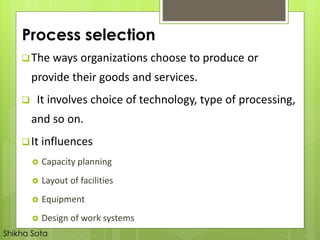
Process selection
The ways organizations choose to produce or
provide their goods and services.
 It involves choice of technology, type of processing,
and so on.
It influences
 Capacity planning
 Layout of facilities
 Equipment
 Design of work systems
Shikha Sota
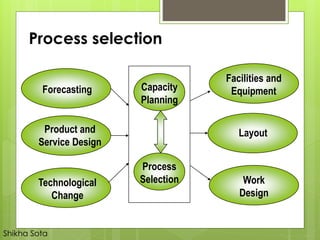
Forecasting
Product and
Service Design
Technological
Change
Capacity
Planning
Process
Selection
Facilities and
Equipment
Layout
Work
Design
Process selection
Shikha Sota
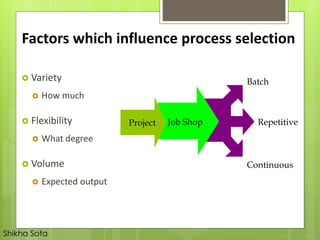
 Variety
 How much
 Flexibility
 What degree
 Volume
 Expected output
Factors which influence process selection
Batch
Repetitive
Continuous
Job ShopProject
Shikha Sota
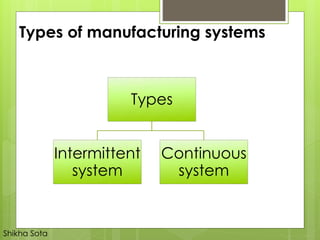
Types of manufacturing systems
Types
Intermittent
system
Continuous
system
Shikha Sota
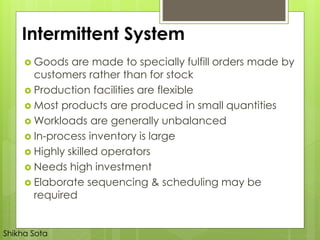
Intermittent System
 Goods are made to specially fulfill orders made by
customers rather than for stock
 Production facilities are flexible
 Most products are produced in small quantities
 Workloads are generally unbalanced
 In-process inventory is large
 Highly skilled operators
 Needs high investment
 Elaborate sequencing & scheduling may be
required
Shikha Sota
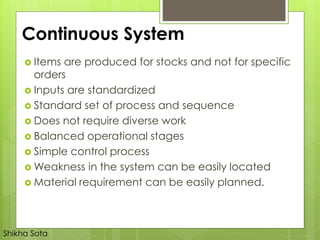
Continuous System
 Items are produced for stocks and not for specific
orders
 Inputs are standardized
 Standard set of process and sequence
 Does not require diverse work
 Balanced operational stages
 Simple control process
 Weakness in the system can be easily located
 Material requirement can be easily planned.
Shikha Sota
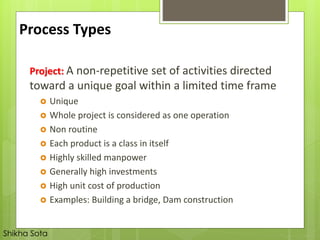
Project: A non-repetitive set of activities directed
toward a unique goal within a limited time frame
 Unique
 Whole project is considered as one operation
 Non routine
 Each product is a class in itself
 Highly skilled manpower
 Generally high investments
 High unit cost of production
 Examples: Building a bridge, Dam construction
Process Types
Shikha Sota
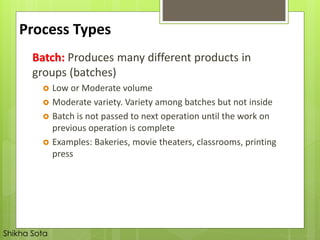
Batch: Produces many different products in
groups (batches)
 Low or Moderate volume
 Moderate variety. Variety among batches but not inside
 Batch is not passed to next operation until the work on
previous operation is complete
 Examples: Bakeries, movie theaters, classrooms, printing
press
Process Types
Shikha Sota
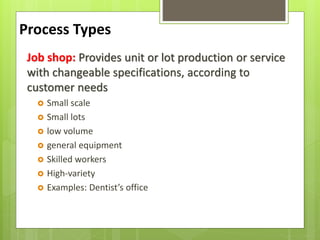
Job shop: Provides unit or lot production or service
with changeable specifications, according to
customer needs
 Small scale
 Small lots
 low volume
 general equipment
 Skilled workers
 High-variety
 Examples: Dentist’s office
Process Types
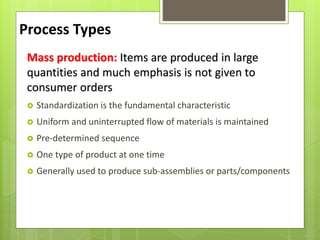
Mass production: Items are produced in large
quantities and much emphasis is not given to
consumer orders
 Standardization is the fundamental characteristic
 Uniform and uninterrupted flow of materials is maintained
 Pre-determined sequence
 One type of product at one time
 Generally used to produce sub-assemblies or parts/components
Process Types
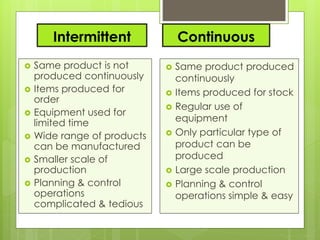
Intermittent
 Same product is not
produced continuously
 Items produced for
order
 Equipment used for
limited time
 Wide range of products
can be manufactured
 Smaller scale of
production
 Planning & control
operations
complicated & tedious
Continuous
 Same product produced
continuously
 Items produced for stock
 Regular use of
equipment
 Only particular type of
product can be
produced
 Large scale production
 Planning & control
operations simple & easy
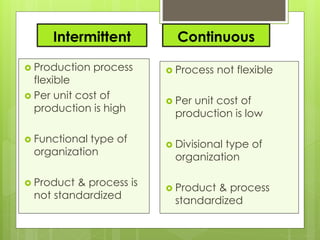
Intermittent
 Production process
flexible
 Per unit cost of
production is high
 Functional type of
organization
 Product & process is
not standardized
Continuous
 Process not flexible
 Per unit cost of
production is low
 Divisional type of
organization
 Product & process
standardized

Process selection

  • 1.
  • 2.
    Contents Types of productionsystem Project Job Mass Production Shikha Sota
  • 3.
    Process selection The waysorganizations choose to produce or provide their goods and services.  It involves choice of technology, type of processing, and so on. It influences  Capacity planning  Layout of facilities  Equipment  Design of work systems Shikha Sota
  • 4.
  • 5.
     Variety  Howmuch  Flexibility  What degree  Volume  Expected output Factors which influence process selection Batch Repetitive Continuous Job ShopProject Shikha Sota
  • 6.
    Types of manufacturingsystems Types Intermittent system Continuous system Shikha Sota
  • 7.
    Intermittent System  Goodsare made to specially fulfill orders made by customers rather than for stock  Production facilities are flexible  Most products are produced in small quantities  Workloads are generally unbalanced  In-process inventory is large  Highly skilled operators  Needs high investment  Elaborate sequencing & scheduling may be required Shikha Sota
  • 8.
    Continuous System  Itemsare produced for stocks and not for specific orders  Inputs are standardized  Standard set of process and sequence  Does not require diverse work  Balanced operational stages  Simple control process  Weakness in the system can be easily located  Material requirement can be easily planned. Shikha Sota
  • 9.
    Project: A non-repetitiveset of activities directed toward a unique goal within a limited time frame  Unique  Whole project is considered as one operation  Non routine  Each product is a class in itself  Highly skilled manpower  Generally high investments  High unit cost of production  Examples: Building a bridge, Dam construction Process Types Shikha Sota
  • 10.
    Batch: Produces manydifferent products in groups (batches)  Low or Moderate volume  Moderate variety. Variety among batches but not inside  Batch is not passed to next operation until the work on previous operation is complete  Examples: Bakeries, movie theaters, classrooms, printing press Process Types Shikha Sota
  • 11.
    Job shop: Providesunit or lot production or service with changeable specifications, according to customer needs  Small scale  Small lots  low volume  general equipment  Skilled workers  High-variety  Examples: Dentist’s office Process Types
  • 12.
    Mass production: Itemsare produced in large quantities and much emphasis is not given to consumer orders  Standardization is the fundamental characteristic  Uniform and uninterrupted flow of materials is maintained  Pre-determined sequence  One type of product at one time  Generally used to produce sub-assemblies or parts/components Process Types
  • 13.
    Intermittent  Same productis not produced continuously  Items produced for order  Equipment used for limited time  Wide range of products can be manufactured  Smaller scale of production  Planning & control operations complicated & tedious Continuous  Same product produced continuously  Items produced for stock  Regular use of equipment  Only particular type of product can be produced  Large scale production  Planning & control operations simple & easy
  • 14.
    Intermittent  Production process flexible Per unit cost of production is high  Functional type of organization  Product & process is not standardized Continuous  Process not flexible  Per unit cost of production is low  Divisional type of organization  Product & process standardized