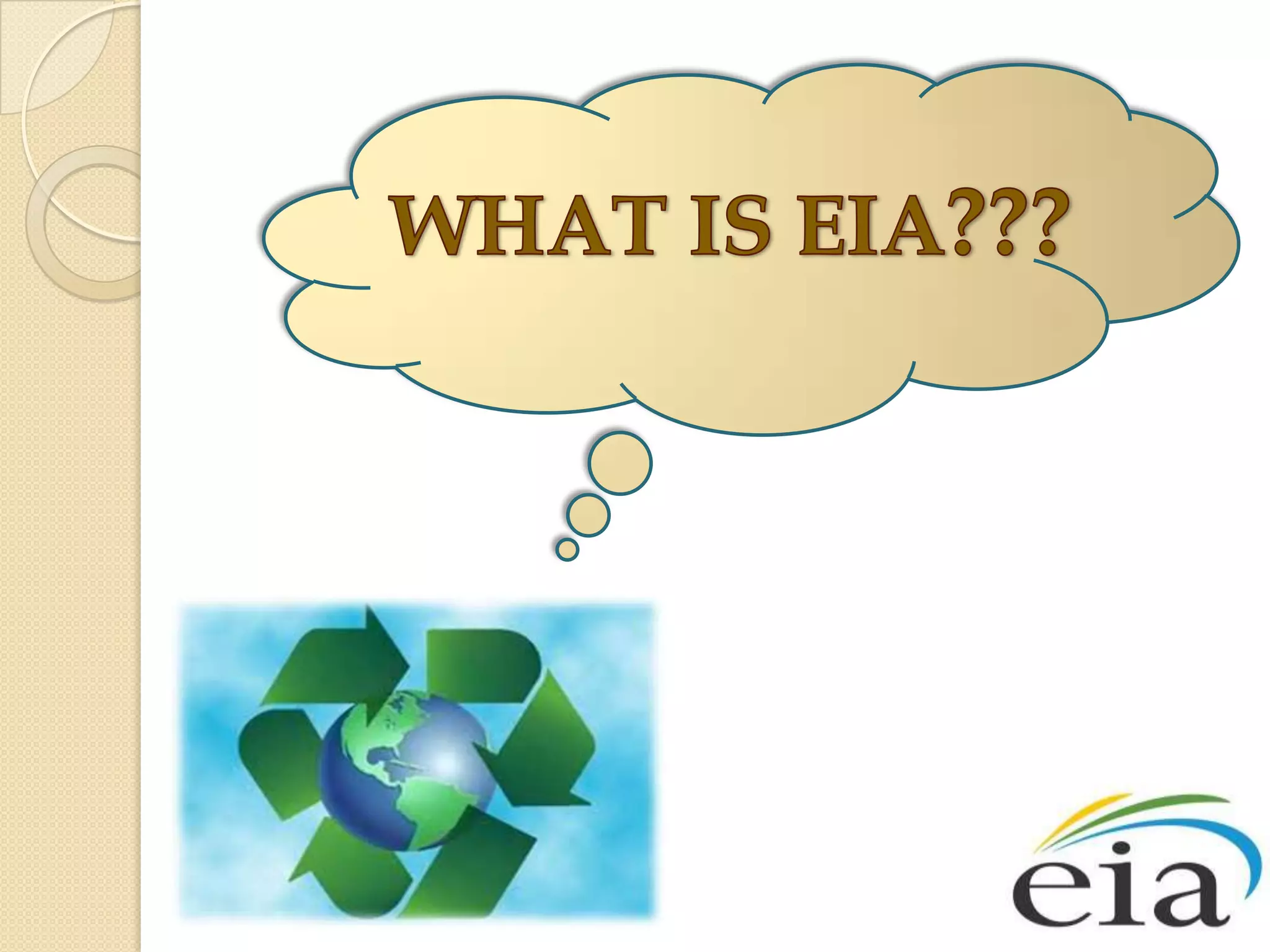
The document discusses Environmental Impact Assessments (EIAs). It notes that EIAs examine the impacts of developments on the environment and produce reports on these examinations. The purpose of EIAs is to provide information to help decision making and promote sustainable development. EIAs follow a structured process involving scoping, impact prediction and mitigation.
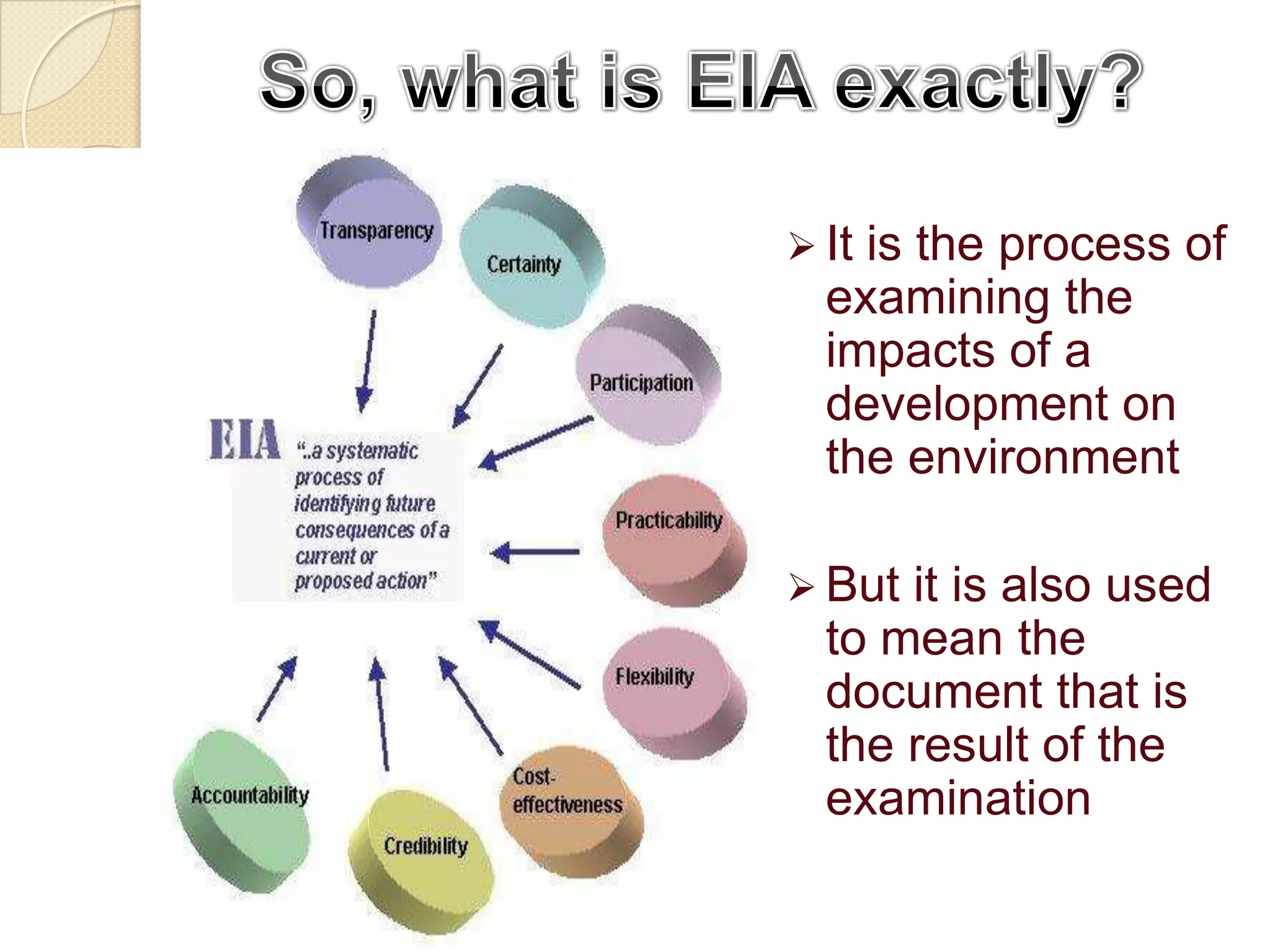
"Process for identifying the
likely consequences for the
biophysical environment &
for man's health & welfare of
implementing particular
activities & for conveying
information at every stage
where it can materially affect
the decision , to
those for sanctioning the
proposals".
[Wathern, 1992]
4.
Itis theprocess of
examining the
impacts of a
development on
the environment
But it is also used
to mean the
document that is
the result of the
examination
5.
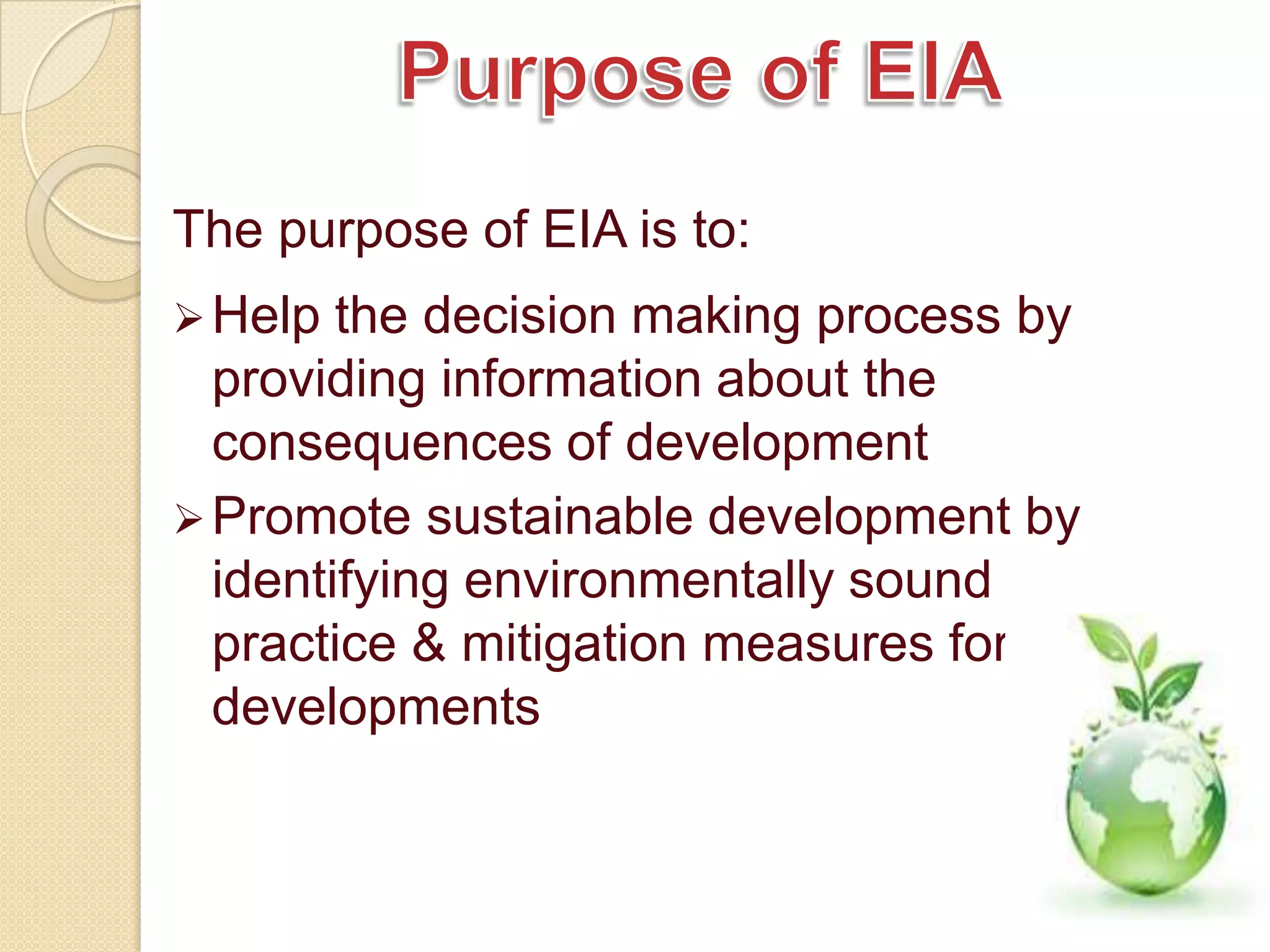
The purpose ofEIA is to:
Help the decision making process by
providing information about the
consequences of development
Promote sustainable development by
identifying environmentally sound
practice & mitigation measures for
developments
6.
In
1969 the US federal govt. passed the
National Environmental Policy
Act[NEPA]
Federal agencies had to consider the
natural environment in any land use
planning.
Thisgave the environment the same
status as economic priorities
7.
Within 20 years,other countries had also
included EIA's as part of their planning
policy;
like:
Canada (1973)
Columbia (1974)
Netherlands (1981)
UK (1988)
8.
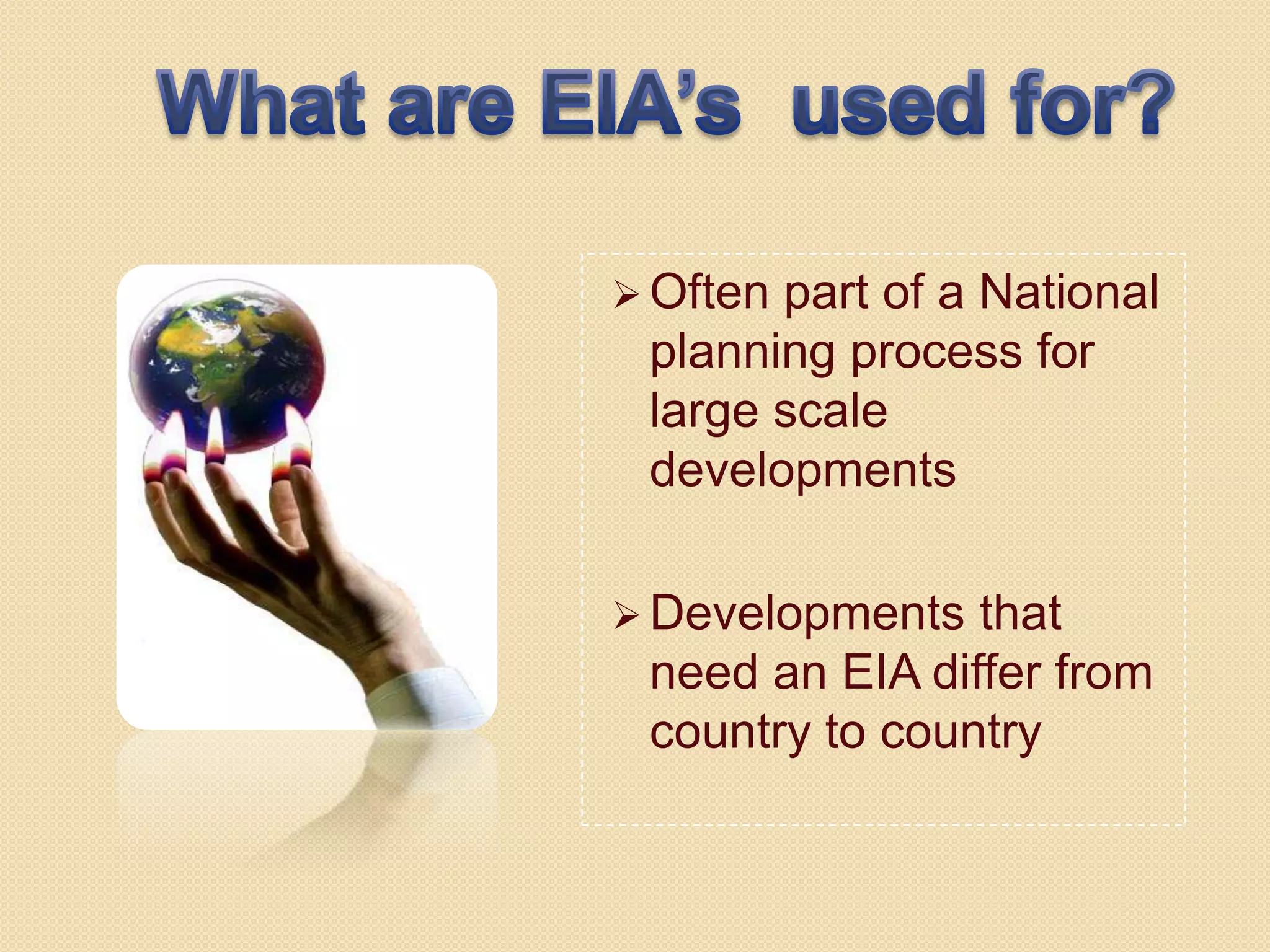
Oftenpart ofa National
planning process for
large scale
developments
Developments that
need an EIA differ from
country to country
9.
Which Developments???
Major new road
networks
Airport & port
developments
Building power
stations
Building dams &
reservoirs
Quarrying
Large scale housing
projects
10.
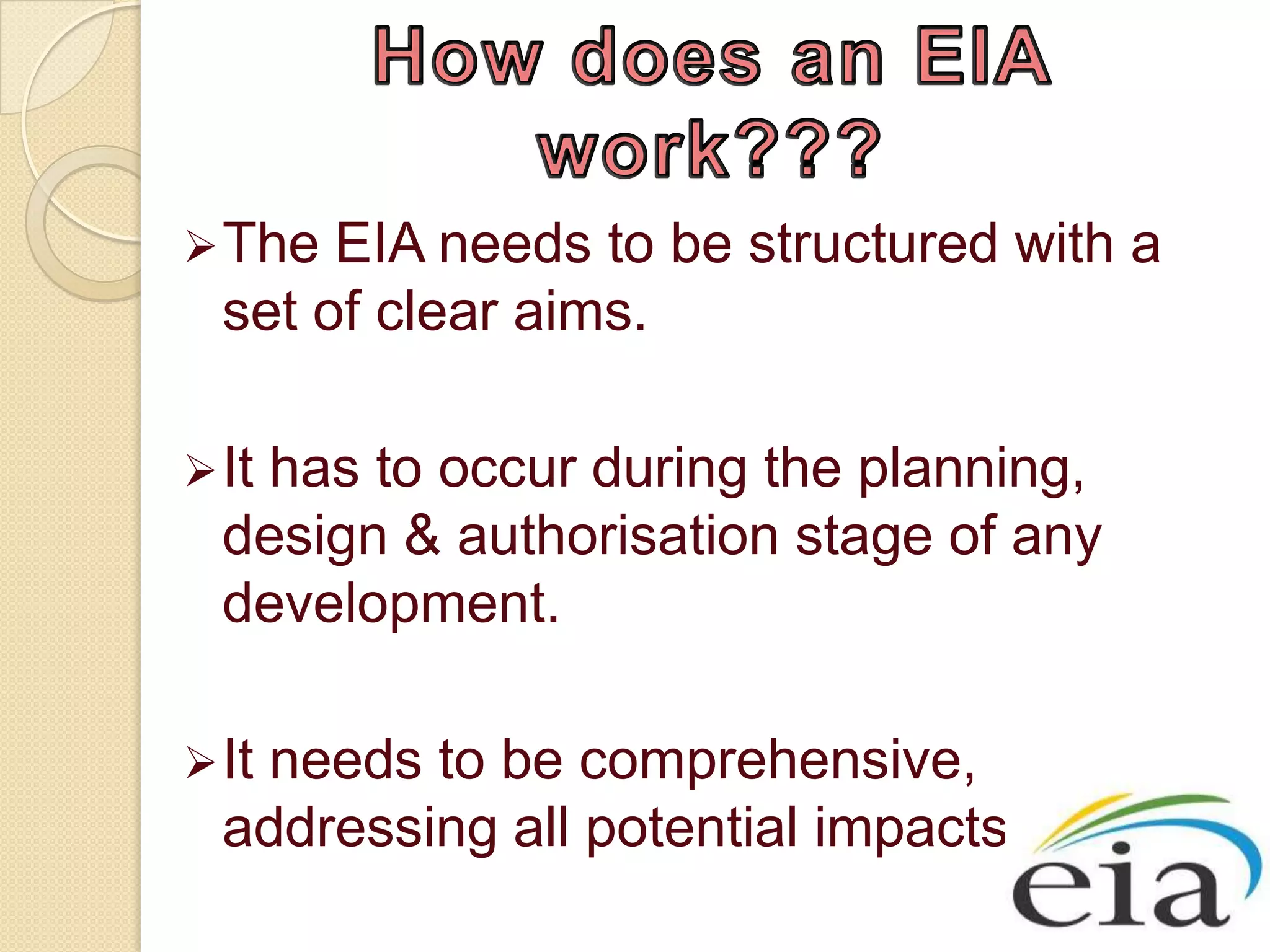
The EIA needs to be structured with a
set of clear aims.
It
has to occur during the planning,
design & authorisation stage of any
development.
It
needs to be comprehensive,
addressing all potential impacts.
11.
There needs to be focus on he potentially
significant issues.
There needs to be consultation & public
participation throughout the EIA process.
The findings of the EIA should be part of the
final decision process.
While it is often mainly concerned with the
natural environment the effect on man should be
considered
12.
Isan EIAneeded & which impacts
need to be considered[SCREENING]
Identifying impacts[SCOPING]
Predicts the scale of potential impacts
Limiting the effects of impacts to
acceptable limits[MITIGATION]
13.
What do youneed to
know???
What are the conditions like now
What effects do different phases of a
project cause
Who or what is likely to be affected
14.
Phases of anEIA
[this can be thought of as a project description]
What are the conditions now
What does the project plan to do
Description of project
Physical characteristics - land use
both during construction & operation
Production process
Waste products
Alternatives
What different approaches exist
15.
Phases of anEIA
Why to choose this one
Impact identification[scoping &
screening]
Consider all potential environmental
impacts whether good or bad
Detail those impacts that are
potentially significant
Comprehensive but focused
Impact on ecosystems, people,
resources & their interactions
16.
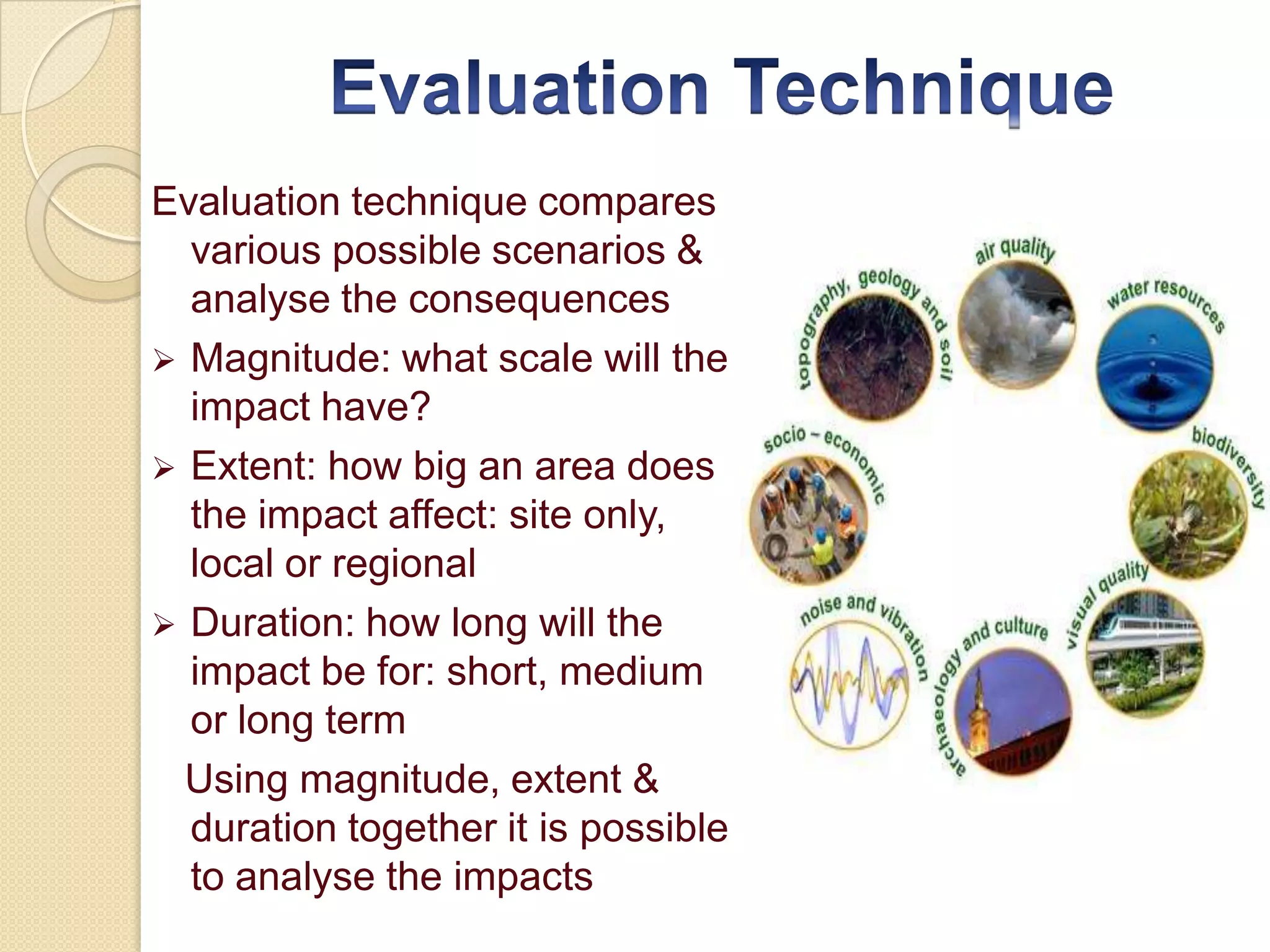
Evaluation technique compares
various possible scenarios &
analyse the consequences
Magnitude: what scale will the
impact have?
Extent: how big an area does
the impact affect: site only,
local or regional
Duration: how long will the
impact be for: short, medium
or long term
Using magnitude, extent &
duration together it is possible
to analyse the impacts
17.
Systematic & comprehensive but also
flexible enough to respond to
changing conditions
Be able to arrange large amounts of
data often from different sources in a
meaningful way
Based on quantitative evaluation that
is both accurate & objective
18.
Checklist ofimpacts:
General set of criteria
Often designed for certain types of
project
Can be very thorough if designed well
Cost benefit analysis:
This outline the value both positive &
negative of each impact
Can be very difficult to add a "cost" value
to ecosystems
19.
Impact matrices:
Combine achecklist of environmental
conditions & a list activities that may
have an effect
Cause & effect between the
environmental features & the activity can
be individually identified
20.
It isa systematic evaluation of all
significant environmental
consequences & action is likely to
happen upon the environment
It is a structural, systematic &
comprehensive approach
It is a process which forces
developers to reconsider proposals
21.
It isa systematic evaluation of all
significant environmental
consequences & action is likely to
happen upon the environment
It is a structural, systematic &
comprehensive approach
It is a process which forces
developers to reconsider proposals
![ "Process for identifying the
likely consequences for the
biophysical environment &
for man's health & welfare of
implementing particular
activities & for conveying
information at every stage
where it can materially affect
the decision , to
those for sanctioning the
proposals".
[Wathern, 1992]](https://image.slidesharecdn.com/evs-eia-120717060127-phpapp02/75/Evs-eia-3-2048.jpg)
![ In
1969 the US federal govt. passed the
National Environmental Policy
Act[NEPA]
Federal agencies had to consider the
natural environment in any land use
planning.
Thisgave the environment the same
status as economic priorities](https://image.slidesharecdn.com/evs-eia-120717060127-phpapp02/75/Evs-eia-6-2048.jpg)


![ Isan EIA needed & which impacts
need to be considered[SCREENING]
Identifying impacts[SCOPING]
Predicts the scale of potential impacts
Limiting the effects of impacts to
acceptable limits[MITIGATION]](https://image.slidesharecdn.com/evs-eia-120717060127-phpapp02/75/Evs-eia-12-2048.jpg)

![Phases of an EIA
[this can be thought of as a project description]
What are the conditions now
What does the project plan to do
Description of project
Physical characteristics - land use
both during construction & operation
Production process
Waste products
Alternatives
What different approaches exist](https://image.slidesharecdn.com/evs-eia-120717060127-phpapp02/75/Evs-eia-14-2048.jpg)
![Phases of an EIA
Why to choose this one
Impact identification[scoping &
screening]
Consider all potential environmental
impacts whether good or bad
Detail those impacts that are
potentially significant
Comprehensive but focused
Impact on ecosystems, people,
resources & their interactions](https://image.slidesharecdn.com/evs-eia-120717060127-phpapp02/75/Evs-eia-15-2048.jpg)