
Just-in-Time System
Dr S G
Deshmukh
Difficulty in Production !
 Demand is uncertain and variable.
 Same equipment and people are used to make a
variety of products.
 Switching products takes time.(imagaine changing
over from say dark shade to light shade in a paint
manufacturing !)
 Things may go wrong(Murphy’s law!)
 Materials are defective.
 Deliveries are variable (late).
 Equipment fails, people make mistakes, etc.

And so many other reasons..
Solution 1: Use Inventory
 Use inventory to:
 Match supply with varying demand.
 Act as a buffer
 Allow production of a variety of products on
the same equipment, tools etc.
 Overcome defective materials, late
deliveries, equipment failures, mistakes,
etc.
 Forecast demand based on classical methods
 Produce in large lots (to reduce expensive
setups) & economics of scale
 PUSH product to customer.(even if he/she
doesn't want !)
 Large lot sizes mean:
 Large work-in-process inventories.
 Large final product inventories.
 Slow response to changes and defects.
 Opaque view of the ground !
“Typical “ Production
 Use just-in-time to identify and solve
problems that create inventory.
 Reduce setup costs to switch products.
 Expose yourself to problems rather than
hiding under the cover of inventory !
 Eliminate defective materials, late
deliveries, equipment failures, mistakes,
etc.
Solution 2: Use Just-In-Time
“Just-in-Time” Production
 Produce in small lots to replenish stock
actually sold.
 Sales PULL product (and parts) through
plant.
 Get pulse of the market !
 Small lot sizes mean:
 Small work-in-process inventories.
 Small final product inventories.
 Quick response to changes and defects.
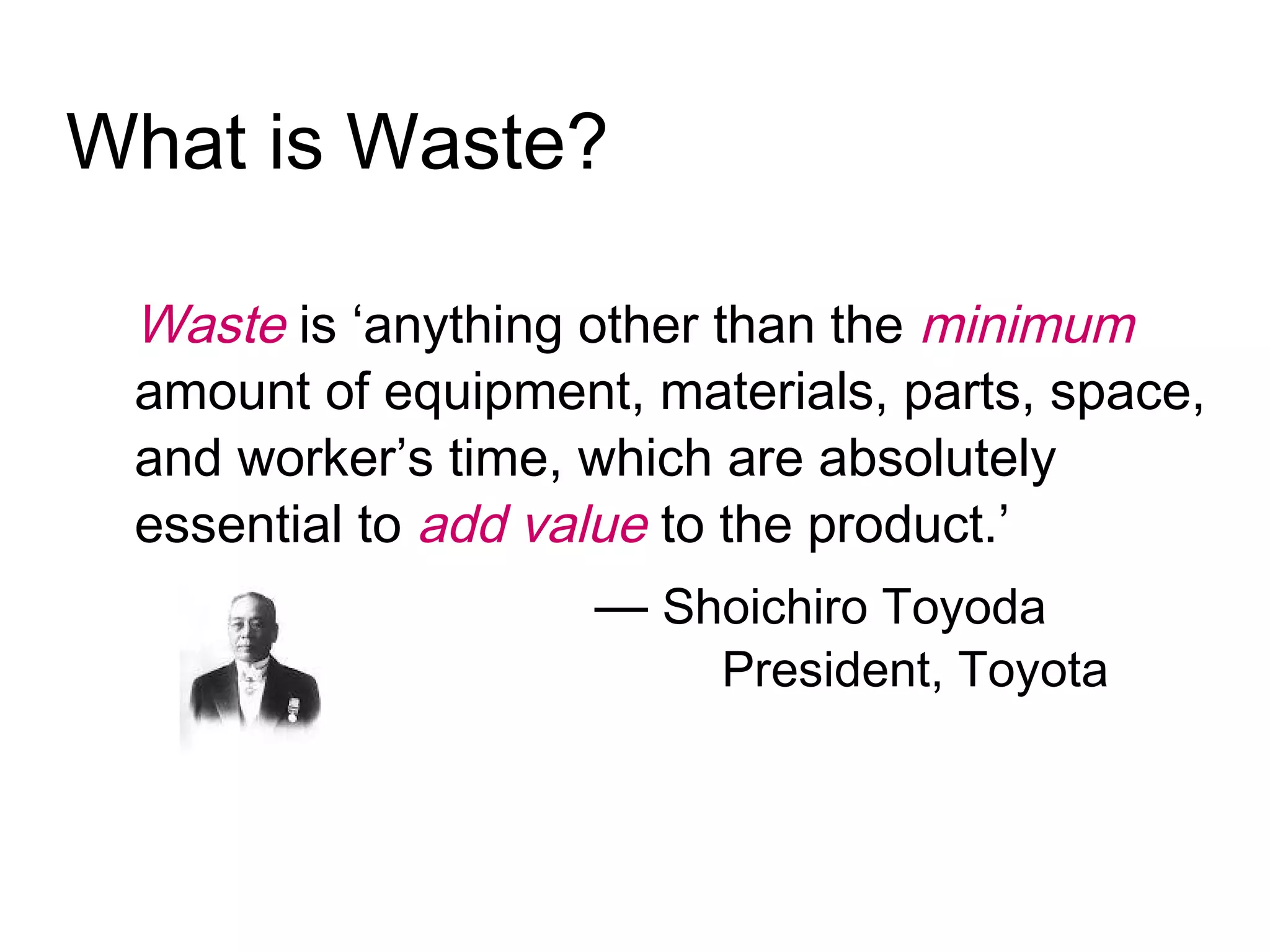
What is Waste?
Waste is ‘anything other than the minimum
amount of equipment, materials, parts, space,
and worker’s time, which are absolutely
essential to add value to the product.’
— Shoichiro Toyoda
President, Toyota
Different Kinds of Waste
 Waste from Over-production
 Waste of Motion
 Transportation waste
 Processing waste
 Defective Products
 Excess Inventory
 Information waste
 Energy waste
 Manpower waste
Elimination of Waste
• JIT attempts to eliminate all costs (waste) that DO
NOT ADD any value to a product.
• Machining, Packaging, Assembling etc. add value
to a product BUT Moving, Storing, Counting,
Sorting etc add COST but No Value to a product.
Hence try to eliminate them.
 Management philosophy of continuous
and forced problem solving.
 Supplies and components are ‘pulled’
through system to arrive where they are
needed when they are needed.
 Originated in Japan; Popularized by
Toyota; now used globally.
What is Just-in-Time?
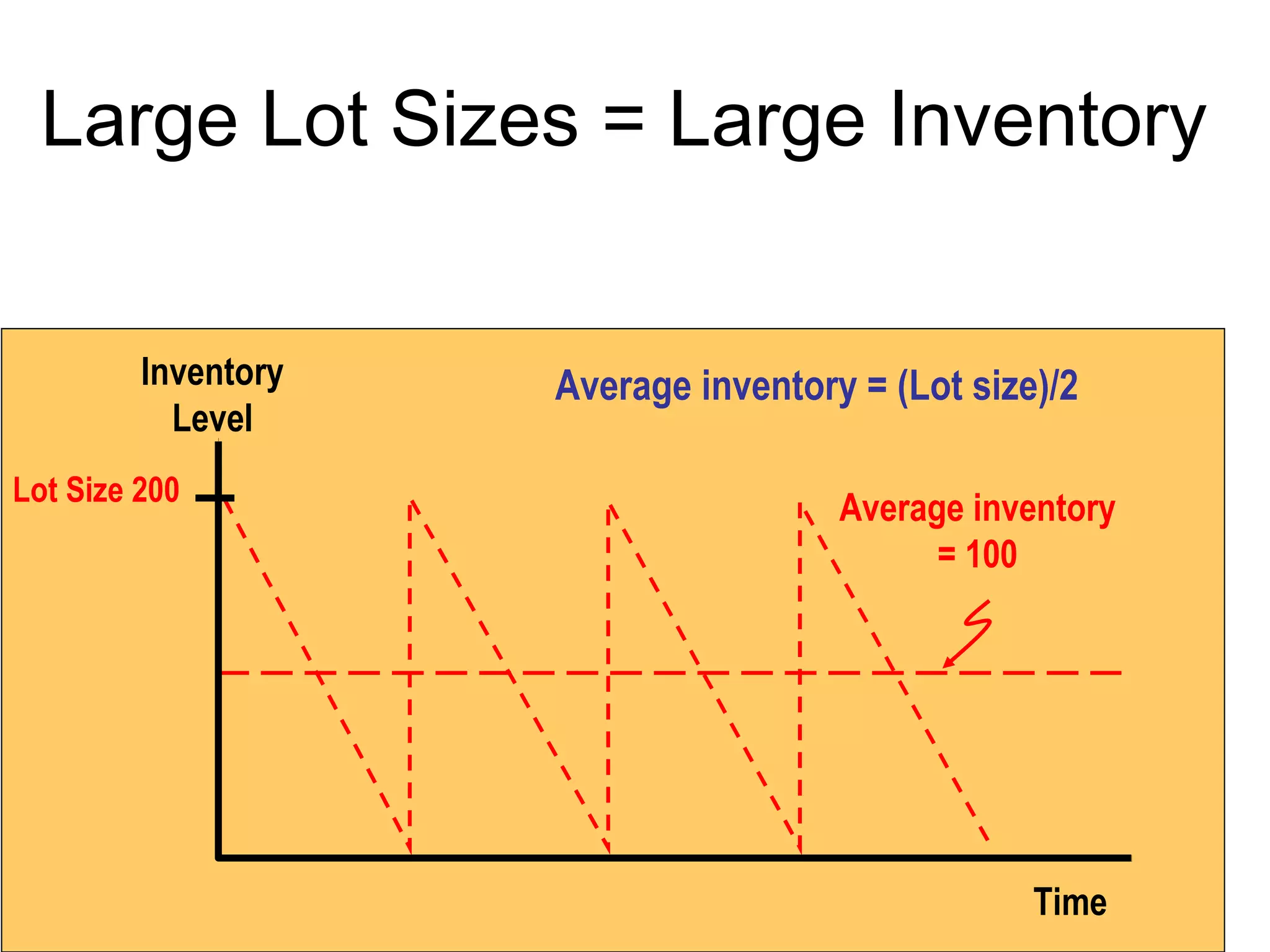
Large Lot Sizes = Large Inventory
Time
Inventory
Level
Lot Size 200
Average inventory
= 100
Average inventory = (Lot size)/2
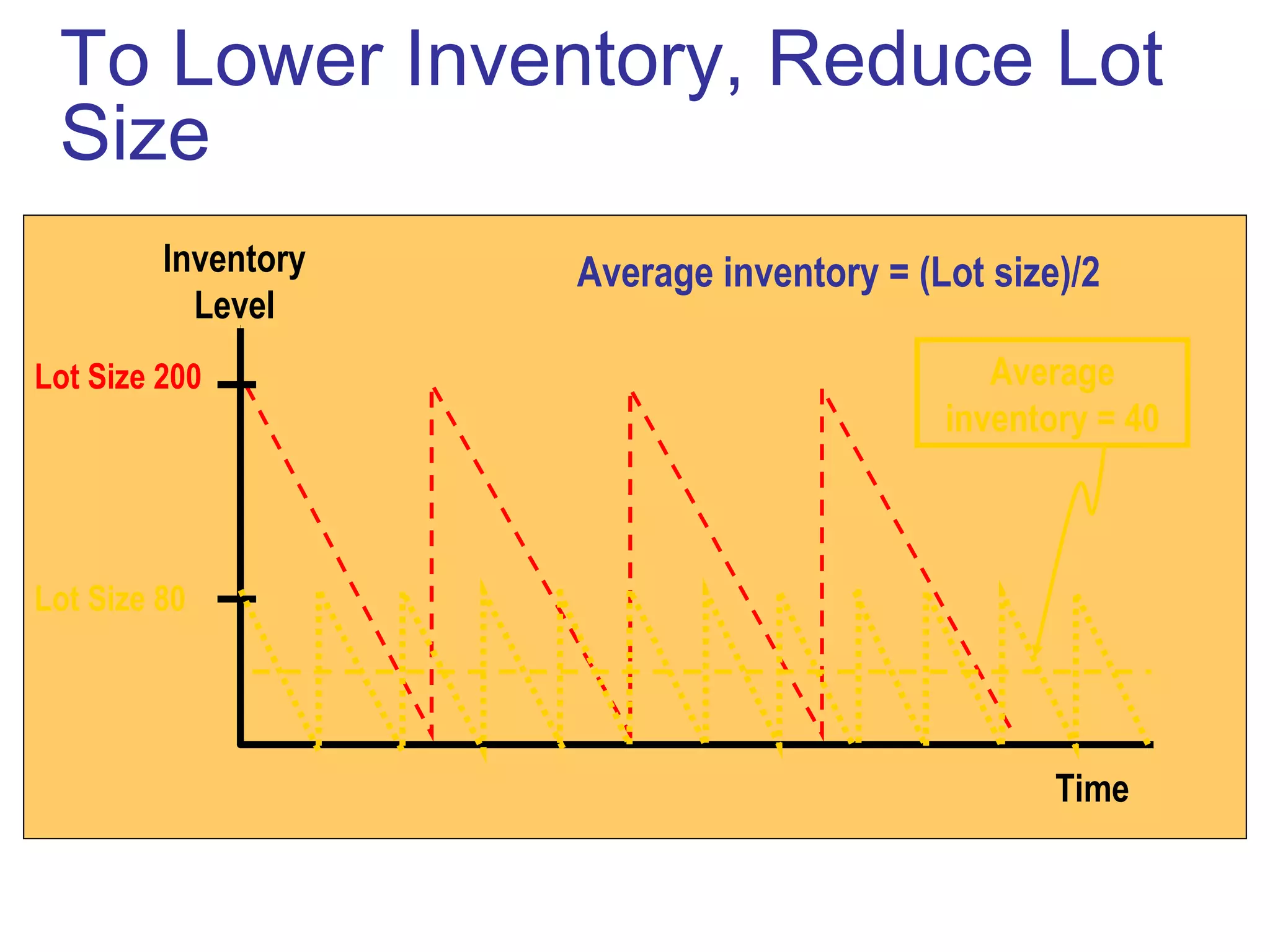
To Lower Inventory, Reduce Lot
Size
Time
Inventory
Level
Lot Size 200
Average inventory = (Lot size)/2
Lot Size 80
Average
inventory = 40
Steps to Reduce Setup Time
 Separate setup into preparation (while
machine is running) and actual setup
(while machine is stopped).
 Do as much as possible while the machine
is running.
 Move material closer and improve
material handling.
 Standardize and improve tooling.
Comment…
 INVENTORY is an Undesirable
cost.
 By LOWERING it, Hidden quality
and Production impediments are
revealed.
 Simplification and Elimination
through Problem Solving,
continuous improvement is the
key.
JIT
 Just-in-time (JIT): A highly coordinated
processing system in which goods move
through the system, and services are
performed, just as they are needed,
 JIT   lean production
 JIT  pull (demand) system
 JIT operates with very little “fat”
American Production and Inventory ControlAmerican Production and Inventory Control
Society (APICS) definition of JITSociety (APICS) definition of JIT
• "a philosophy” of manufacturing
• based on planned elimination of all waste
and continuous improvement of
productivity.
• encompasses successful execution of all
manufacturing activities required to
produce final product,
• from design engineering to delivery and
including all stages of conversion from raw
material onward.
Goals of JIT
A manufacturing process that is so
streamlined, cost efficient, quality
oriented and responsive to customer,
that it becomes a strategic weapon.
The goals in most cases consists of :
 Produce product only on demand.
 Produce a perfect quality product.
 Reduce the cost of manufacturing.
 Integrate and to optimize every step of
manufacturing process.
 Develop manufacturing Flexibility
 Keep commitments made to customers and
suppliers
Pull/Push Systems
 Pull system: System for moving work
where a workstation pulls output from
the preceding station as needed. (e.g.
Kanban)
 Push system: System for moving work
where output is pushed to the next
station as it is completed
JIT Through …
 Product design
 Process design
 Personnel/organizational
elements
 Manufacturing
planning and control
Enabler : Product Design
 Standard parts
 Modular design
 Highly capable production systems
 Concurrent
engineering
 Use of CAD/CAM
 Use of CFD
Enabler .. Process Design
 Small lot sizes
 Setup time reduction
 Manufacturing cells
 Limited work in process
 Quality improvement
 Production flexibility
 Little inventory storage
Production Flexibility
 Reduce downtime by reducing changeover
time
 Multi-tools, workstations
 Use preventive maintenance to reduce
breakdowns
 Cross-train workers to help clear bottlenecks
 Use many small units of capacity
 Use off-line buffers
 Reserve capacity for important customers
Enabler : Personnel/Organizational
Elements
 Workers as assets
 Cross-trained workers
 Belief in improvement by workers
 Continuous improvement
 Cost accounting
 Organic element of human being !!
 Leadership/project management
Enabler ..
Planning & Control
 Level loading
 Pull systems
 Visual systems (Andon ,
alarms etc.)
 Close vendor relationships
 Reduced transaction
processing
 Preventive maintenance
Models for supplier
Arms Length Model
 Closed, Competitive
 Evaluation on lowest bid
 Data/Information sharing very
limited
 Inspection based quality
regime
 No shared R&D
Partnership Model
 Collaboration based
 Multi-criteria evaluation of
sources
 Sharing of data/information
encouraged
 Participative attitude towards
quality
 Shared R&D
Buyer Supplier Relationship
 Buyer Action Attributes
 Supplier Action Attributes
 Joint Action Attributes
 Outcome Attributes
Buyer Action…
 Fewer suppliers
 Long term contract
 Increased volume to suppliers
 Supplier evaluation/certification
 Training and audit
 Freight consolidation
 Stable production schedule
 Performance evaluation
Supplier Action..
 SPC
 Close proximity
 Quality circle
 Flexible suppliers
 Reduced set ups
 Increased customer support
Joint Action
 Mutual trust & cooperation
 Information sharing
 Joint design & development
 Continuous improvement
Outcome …
 Frequent & reliable deliveries
 Small shipment
 Reduced paperwork
 Shared perceptions
 Flexibility in everything !
Benefits
 Cooperation,
 reduced inventory,
 quality at low cost,
 better planning and control,
 less paperwork
 improved communication
Kanban as a Control System
 Kanban: Card or other device that
communicates demand for work or materials
from the preceding station
 Kanban is the Japanese word meaning
“signal” or “visible record”
 Paperless production control system
 Authority to pull, or produce comes
from a downstream process.
Kanban..
• fixed quantity bins or containers or pallets used to signal
replenishment needs
• (reminiscent of traditional two-bin system of stock control).
• When first bin empty, new full bin moved in within usage time
from the second bin).
• With well-designed floor layouts, system adds considerably to
efficiency of operational environment.
• integration of computer systems internally & externally with
suppliers systems so Kanban data & instructions can flow
between linked systems.
Youtube on JIT (10.56
minutes)
 https://www.youtube.com/watch?
v=CBFKBf1rOyo
Frank Sinatra sings JIT…(2.18
minutes)
 https://www.youtube.com/watch?v=RIcQ2
NPTEL session By Prof G Srinivasan
(IIT Madras) on JIT (51 minutes)
 https://www.youtube.com/watch?
v=Zjx7zCjLjyw
 JIT objective: Frequent on-time deliveries
of small lots of high quality.
 Buyer and supplier form JIT partnerships
to eliminate:
 Unnecessary activities.
 In-plant inventory.
 In-transit inventory.
 Poor suppliers.
Suppliers
Transitioning to a JIT System
 Get top management commitment
 Decide which parts need most effort
 Obtain support of workers
 Start by trying to reduce setup times
 Gradually convert operations
 Convert suppliers to JIT
 Prepare for obstacles
Barriers to migration
 Management may not be committed
 Workers/management may not be
cooperative
 Suppliers may
resist
 Why?
Benefits of JIT Systems
 Reduced inventory levels
 High quality
 Flexibility
 Reduced lead times
 Increased productivity
Benefits of JIT Systems
..cont’d
 Increased equipment utilization
 Reduced scrap and rework
 Reduced space requirements
 Pressure for good vendor relationships
 Reduced need for indirect labor
Benefits of JIT.. Contd.
 Part Cost: Low scrap, Low Inventory
 Quality: Fast detection, Corrections
 Design: Fast Response to
Engineering changes
 Administration Efficiency: Fewer
suppliers, minimal expediting, less
paper work
 Productivity: Reduced
rework/Inspection delay, reduced parts
 JIT exposes quality problems by
reducing inventory.
 JIT limits number of defects produced
with small lots.
 JIT requires TQM.
 Statistical process control.
 Worker involvement & empowerment.
 Immediate feedback.
Quality
JIT is flow…
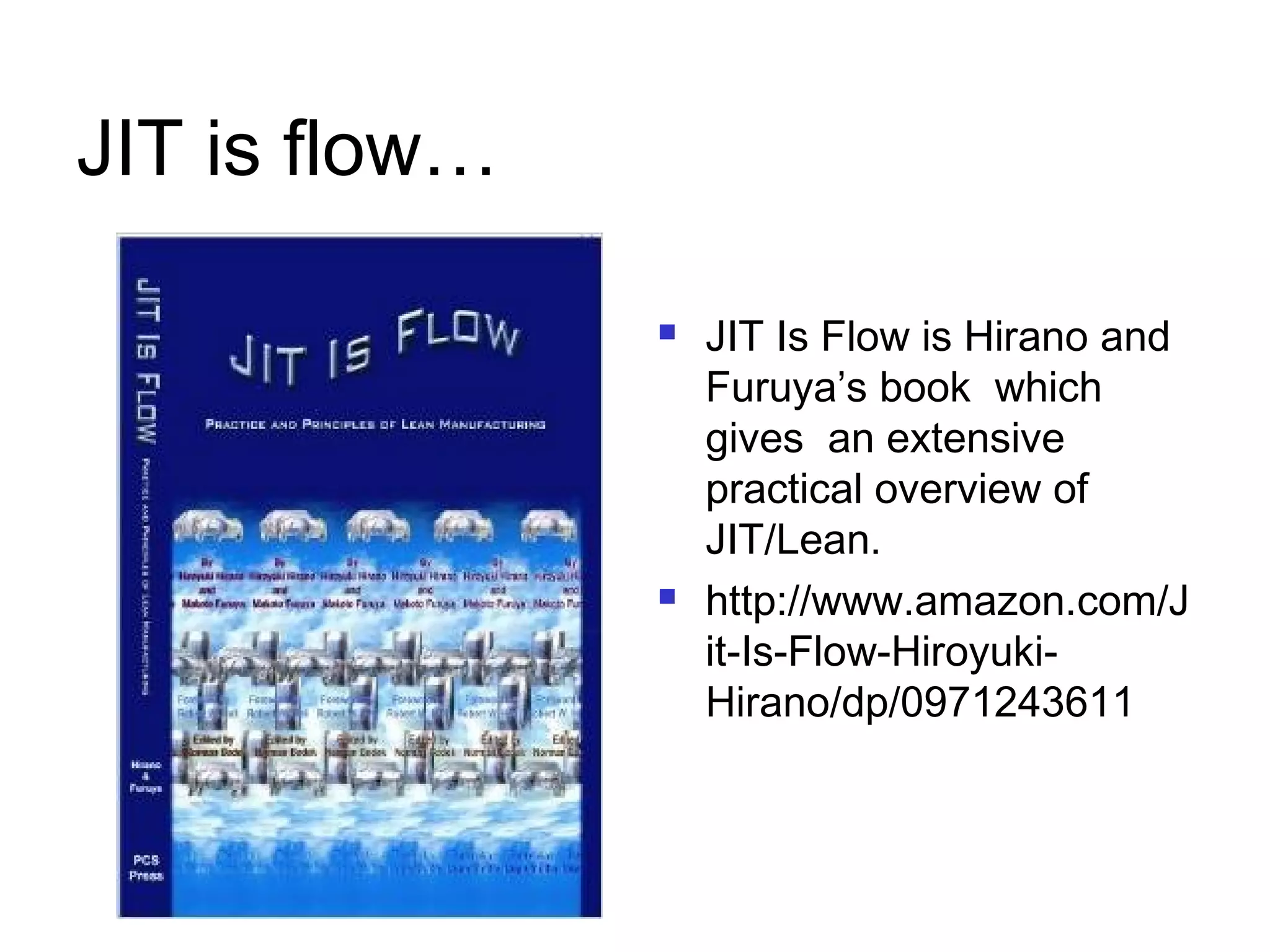
 JIT Is Flow is Hirano and
Furuya’s book which
gives an extensive
practical overview of
JIT/Lean.
 http://www.amazon.com/J
it-Is-Flow-Hiroyuki-
Hirano/dp/0971243611
Interesting book..
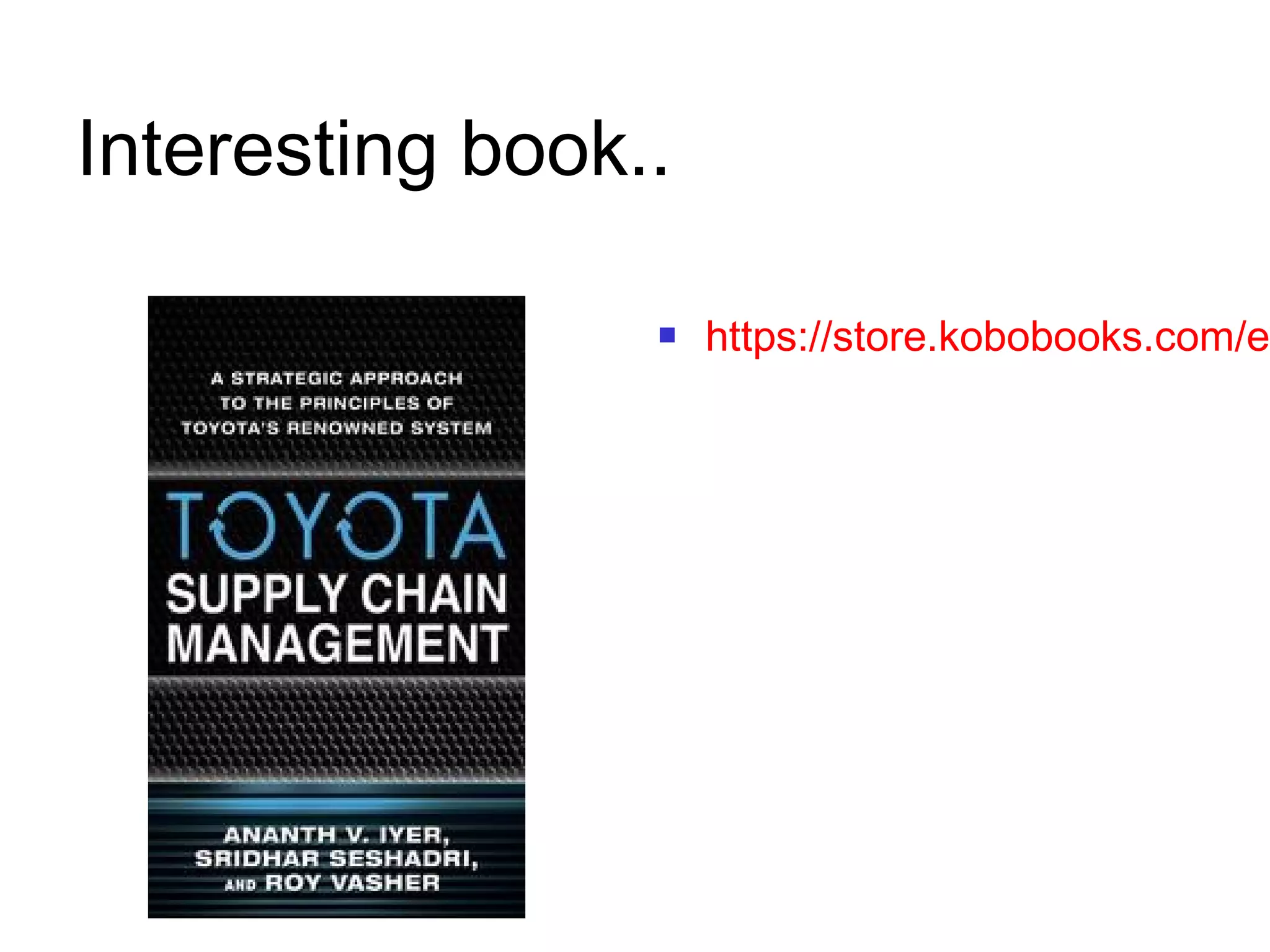
 https://store.kobobooks.com/en
Toyota Global..
 http://www.toyota-global.com/company/vis
Summary
 JIT as a philosophy
 Attack on elimination of waste
 Pull based system
 Critical Factors
 Involvement of top management
 Simplified processes
 Orientation towards inventory

Just In Time

  • 1.
  • 2.
    Difficulty in Production!  Demand is uncertain and variable.  Same equipment and people are used to make a variety of products.  Switching products takes time.(imagaine changing over from say dark shade to light shade in a paint manufacturing !)  Things may go wrong(Murphy’s law!)  Materials are defective.  Deliveries are variable (late).  Equipment fails, people make mistakes, etc.  And so many other reasons..
  • 3.
    Solution 1: UseInventory  Use inventory to:  Match supply with varying demand.  Act as a buffer  Allow production of a variety of products on the same equipment, tools etc.  Overcome defective materials, late deliveries, equipment failures, mistakes, etc.
  • 4.
     Forecast demandbased on classical methods  Produce in large lots (to reduce expensive setups) & economics of scale  PUSH product to customer.(even if he/she doesn't want !)  Large lot sizes mean:  Large work-in-process inventories.  Large final product inventories.  Slow response to changes and defects.  Opaque view of the ground ! “Typical “ Production
  • 5.
     Use just-in-timeto identify and solve problems that create inventory.  Reduce setup costs to switch products.  Expose yourself to problems rather than hiding under the cover of inventory !  Eliminate defective materials, late deliveries, equipment failures, mistakes, etc. Solution 2: Use Just-In-Time
  • 6.
    “Just-in-Time” Production  Producein small lots to replenish stock actually sold.  Sales PULL product (and parts) through plant.  Get pulse of the market !  Small lot sizes mean:  Small work-in-process inventories.  Small final product inventories.  Quick response to changes and defects.
  • 7.
    What is Waste? Wasteis ‘anything other than the minimum amount of equipment, materials, parts, space, and worker’s time, which are absolutely essential to add value to the product.’ — Shoichiro Toyoda President, Toyota
  • 8.
    Different Kinds ofWaste  Waste from Over-production  Waste of Motion  Transportation waste  Processing waste  Defective Products  Excess Inventory  Information waste  Energy waste  Manpower waste
  • 9.
    Elimination of Waste •JIT attempts to eliminate all costs (waste) that DO NOT ADD any value to a product. • Machining, Packaging, Assembling etc. add value to a product BUT Moving, Storing, Counting, Sorting etc add COST but No Value to a product. Hence try to eliminate them.
  • 10.
     Management philosophyof continuous and forced problem solving.  Supplies and components are ‘pulled’ through system to arrive where they are needed when they are needed.  Originated in Japan; Popularized by Toyota; now used globally. What is Just-in-Time?
  • 11.
    Large Lot Sizes= Large Inventory Time Inventory Level Lot Size 200 Average inventory = 100 Average inventory = (Lot size)/2
  • 12.
    To Lower Inventory,Reduce Lot Size Time Inventory Level Lot Size 200 Average inventory = (Lot size)/2 Lot Size 80 Average inventory = 40
  • 13.
    Steps to ReduceSetup Time  Separate setup into preparation (while machine is running) and actual setup (while machine is stopped).  Do as much as possible while the machine is running.  Move material closer and improve material handling.  Standardize and improve tooling.
  • 14.
    Comment…  INVENTORY isan Undesirable cost.  By LOWERING it, Hidden quality and Production impediments are revealed.  Simplification and Elimination through Problem Solving, continuous improvement is the key.
  • 15.
    JIT  Just-in-time (JIT):A highly coordinated processing system in which goods move through the system, and services are performed, just as they are needed,  JIT   lean production  JIT  pull (demand) system  JIT operates with very little “fat”
  • 16.
    American Production andInventory ControlAmerican Production and Inventory Control Society (APICS) definition of JITSociety (APICS) definition of JIT • "a philosophy” of manufacturing • based on planned elimination of all waste and continuous improvement of productivity. • encompasses successful execution of all manufacturing activities required to produce final product, • from design engineering to delivery and including all stages of conversion from raw material onward.
  • 17.
    Goals of JIT Amanufacturing process that is so streamlined, cost efficient, quality oriented and responsive to customer, that it becomes a strategic weapon. The goals in most cases consists of :  Produce product only on demand.  Produce a perfect quality product.  Reduce the cost of manufacturing.  Integrate and to optimize every step of manufacturing process.  Develop manufacturing Flexibility  Keep commitments made to customers and suppliers
  • 18.
    Pull/Push Systems  Pullsystem: System for moving work where a workstation pulls output from the preceding station as needed. (e.g. Kanban)  Push system: System for moving work where output is pushed to the next station as it is completed
  • 19.
    JIT Through … Product design  Process design  Personnel/organizational elements  Manufacturing planning and control
  • 20.
    Enabler : ProductDesign  Standard parts  Modular design  Highly capable production systems  Concurrent engineering  Use of CAD/CAM  Use of CFD
  • 21.
    Enabler .. ProcessDesign  Small lot sizes  Setup time reduction  Manufacturing cells  Limited work in process  Quality improvement  Production flexibility  Little inventory storage
  • 22.
    Production Flexibility  Reducedowntime by reducing changeover time  Multi-tools, workstations  Use preventive maintenance to reduce breakdowns  Cross-train workers to help clear bottlenecks  Use many small units of capacity  Use off-line buffers  Reserve capacity for important customers
  • 23.
    Enabler : Personnel/Organizational Elements Workers as assets  Cross-trained workers  Belief in improvement by workers  Continuous improvement  Cost accounting  Organic element of human being !!  Leadership/project management
  • 24.
    Enabler .. Planning &Control  Level loading  Pull systems  Visual systems (Andon , alarms etc.)  Close vendor relationships  Reduced transaction processing  Preventive maintenance
  • 25.
    Models for supplier ArmsLength Model  Closed, Competitive  Evaluation on lowest bid  Data/Information sharing very limited  Inspection based quality regime  No shared R&D Partnership Model  Collaboration based  Multi-criteria evaluation of sources  Sharing of data/information encouraged  Participative attitude towards quality  Shared R&D
  • 26.
    Buyer Supplier Relationship Buyer Action Attributes  Supplier Action Attributes  Joint Action Attributes  Outcome Attributes
  • 27.
    Buyer Action…  Fewersuppliers  Long term contract  Increased volume to suppliers  Supplier evaluation/certification  Training and audit  Freight consolidation  Stable production schedule  Performance evaluation
  • 28.
    Supplier Action..  SPC Close proximity  Quality circle  Flexible suppliers  Reduced set ups  Increased customer support
  • 29.
    Joint Action  Mutualtrust & cooperation  Information sharing  Joint design & development  Continuous improvement
  • 30.
    Outcome …  Frequent& reliable deliveries  Small shipment  Reduced paperwork  Shared perceptions  Flexibility in everything !
  • 31.
    Benefits  Cooperation,  reducedinventory,  quality at low cost,  better planning and control,  less paperwork  improved communication
  • 32.
    Kanban as aControl System  Kanban: Card or other device that communicates demand for work or materials from the preceding station  Kanban is the Japanese word meaning “signal” or “visible record”  Paperless production control system  Authority to pull, or produce comes from a downstream process.
  • 33.
    Kanban.. • fixed quantitybins or containers or pallets used to signal replenishment needs • (reminiscent of traditional two-bin system of stock control). • When first bin empty, new full bin moved in within usage time from the second bin). • With well-designed floor layouts, system adds considerably to efficiency of operational environment. • integration of computer systems internally & externally with suppliers systems so Kanban data & instructions can flow between linked systems.
  • 34.
    Youtube on JIT(10.56 minutes)  https://www.youtube.com/watch? v=CBFKBf1rOyo
  • 35.
    Frank Sinatra singsJIT…(2.18 minutes)  https://www.youtube.com/watch?v=RIcQ2
  • 36.
    NPTEL session ByProf G Srinivasan (IIT Madras) on JIT (51 minutes)  https://www.youtube.com/watch? v=Zjx7zCjLjyw
  • 37.
     JIT objective:Frequent on-time deliveries of small lots of high quality.  Buyer and supplier form JIT partnerships to eliminate:  Unnecessary activities.  In-plant inventory.  In-transit inventory.  Poor suppliers. Suppliers
  • 38.
    Transitioning to aJIT System  Get top management commitment  Decide which parts need most effort  Obtain support of workers  Start by trying to reduce setup times  Gradually convert operations  Convert suppliers to JIT  Prepare for obstacles
  • 39.
    Barriers to migration Management may not be committed  Workers/management may not be cooperative  Suppliers may resist  Why?
  • 40.
    Benefits of JITSystems  Reduced inventory levels  High quality  Flexibility  Reduced lead times  Increased productivity
  • 41.
    Benefits of JITSystems ..cont’d  Increased equipment utilization  Reduced scrap and rework  Reduced space requirements  Pressure for good vendor relationships  Reduced need for indirect labor
  • 42.
    Benefits of JIT..Contd.  Part Cost: Low scrap, Low Inventory  Quality: Fast detection, Corrections  Design: Fast Response to Engineering changes  Administration Efficiency: Fewer suppliers, minimal expediting, less paper work  Productivity: Reduced rework/Inspection delay, reduced parts
  • 43.
     JIT exposesquality problems by reducing inventory.  JIT limits number of defects produced with small lots.  JIT requires TQM.  Statistical process control.  Worker involvement & empowerment.  Immediate feedback. Quality
  • 44.
    JIT is flow… JIT Is Flow is Hirano and Furuya’s book which gives an extensive practical overview of JIT/Lean.  http://www.amazon.com/J it-Is-Flow-Hiroyuki- Hirano/dp/0971243611
  • 45.
  • 46.
  • 47.
    Summary  JIT asa philosophy  Attack on elimination of waste  Pull based system  Critical Factors  Involvement of top management  Simplified processes  Orientation towards inventory

Editor's Notes

  • #3 It is good at this point to emphasize the notion that JIT is a philosophy not simply delivery of small lots at specific times. It is also helpful to emphasize that JIT requires an ongoing effort.
  • #4 It is good at this point to emphasize the notion that JIT is a philosophy not simply delivery of small lots at specific times. It is also helpful to emphasize that JIT requires an ongoing effort.
  • #5 It is good at this point to emphasize the notion that JIT is a philosophy not simply delivery of small lots at specific times. It is also helpful to emphasize that JIT requires an ongoing effort.
  • #6 It is good at this point to emphasize the notion that JIT is a philosophy not simply delivery of small lots at specific times. It is also helpful to emphasize that JIT requires an ongoing effort.
  • #7 It is good at this point to emphasize the notion that JIT is a philosophy not simply delivery of small lots at specific times. It is also helpful to emphasize that JIT requires an ongoing effort.
  • #11 This might be a good time to differentiate between “push”and “pull” systems. Subsequent slides elaborate on the role of JIT and inventory levels in hiding problems.
  • #12 It is good at this point to emphasize the notion that JIT is a philosophy not simply delivery of small lots at specific times. It is also helpful to emphasize that JIT requires an ongoing effort.
  • #13 The next several slides look at the process and consequences of reducing inventory.
  • #14 The next several slides look at the process and consequences of reducing inventory.
  • #15 Students should be asked to draw their own connection between inventory and problems. Given that inventory exists in case of problems, if we wish to eliminate inventory, we also must eliminate problems. Again the notion that JIT is not simply an inventory methodology.
  • #39 You might point out here that both buyer and supplier gain from this relationship.