PSYCHOLOGICAL
  DISORDERS
What is Psychological
Disorder?
 A psychological disorder, also known as a
  mental disorder, is a pattern of behavioural or
  psychological symptoms that impact multiple
  life areas and/or create distress for the person
  experiencing these symptoms.
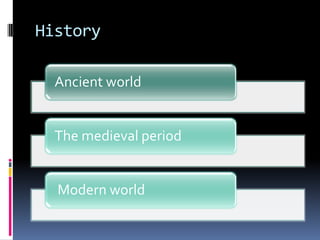
History

  Ancient world


  The medieval period


  Modern world
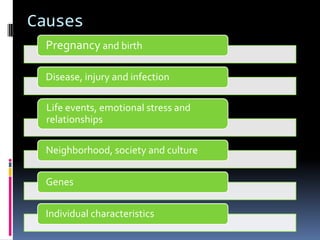
Causes
 Pregnancy and birth

 Disease, injury and infection

  Life events, emotional stress and
  relationships

 Neighborhood, society and culture

 Genes

 Individual characteristics
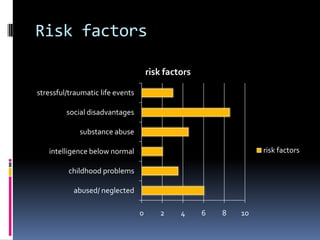
Risk factors

                                      risk factors

stressful/traumatic life events

         social disadvantages

             substance abuse

   intelligence below normal                                      risk factors

          childhood problems

           abused/ neglected

                                  0      2     4     6   8   10
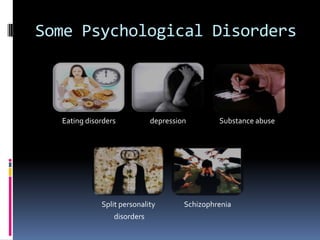
Some Psychological Disorders


  Eating disorders           depression        Substance abuse


             Split personality        Schizophrenia
                 disorders
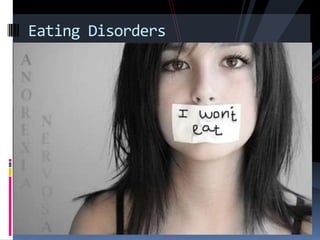
Eating Disorders
What is eating disorder?

 Eating habits that may involve either
  insufficient or excessive food intake to the
  detriment of an individual's physical and
  mental health.
 Severe distress or concern about body weight
  or shape may also characterize an eating
  disorder.
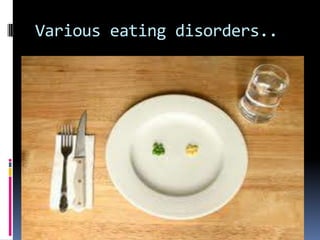
Various eating disorders..
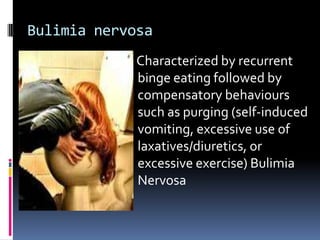
Bulimia nervosa
             Characterized by recurrent
             binge eating followed by
             compensatory behaviours
             such as purging (self-induced
             vomiting, excessive use of
             laxatives/diuretics, or
             excessive exercise) Bulimia
             Nervosa
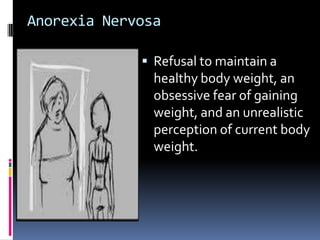
Anorexia Nervosa

              Refusal to maintain a
               healthy body weight, an
               obsessive fear of gaining
               weight, and an unrealistic
               perception of current body
               weight.
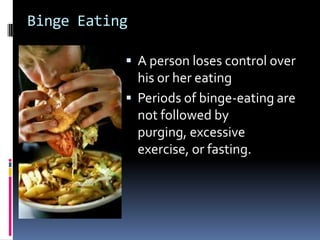
Binge Eating

            A person loses control over
             his or her eating
            Periods of binge-eating are
             not followed by
             purging, excessive
             exercise, or fasting.
Symptoms

 Constant adherence to increasingly strict
  diets, regardless of weight
 Secretly bingeing on large amounts of food
 Increase in consumption of
  laxatives, diuretics or diet pills
 Exercising compulsively, often several hours
  per day
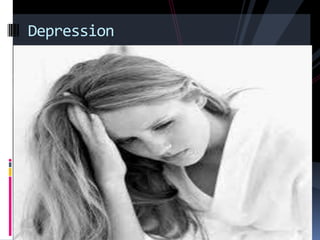
Depression
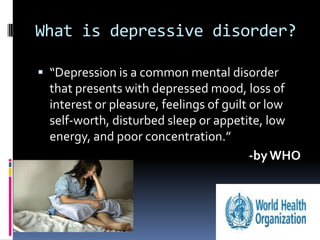
What is depressive disorder?

 “Depression is a common mental disorder
  that presents with depressed mood, loss of
  interest or pleasure, feelings of guilt or low
  self-worth, disturbed sleep or appetite, low
  energy, and poor concentration.”
                                          -by WHO
SIGNS AND SYMPTOMS..
 Persistent sad, anxious, or "empty" feeling
 Feelings of guilt, worthlessness, or helplessness
 Irritability, restlessness
 Loss of interest in activities or hobbies once
  pleasurable
 Fatigue and decreased energy
 Overeating, or appetite loss
 Thoughts of suicide, suicide attempts
 Aches or pains, headaches, cramps, or digestive
  problems that do not ease even with treatment.
A test to measure your level
of depression...
    I do everything slowly.
    I find it hard to concentrate when I read.
   There is no fun left in my life.
   I find it hard to make decisions.
   I have lost interest in things that used to mean a lot to me.
   I feel sad, depressed and unhappy.
   I feel restless and cannot relax.
   My sleep is disturbed: Too little, too much or disturbed sleep.
   I have lost or gained weight without being on a diet.
   I feel guilty and like a failure.
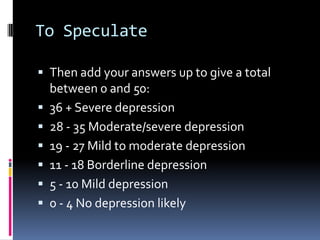
To Speculate

 Then add your answers up to give a total
    between 0 and 50:
   36 + Severe depression
   28 - 35 Moderate/severe depression
   19 - 27 Mild to moderate depression
   11 - 18 Borderline depression
   5 - 10 Mild depression
   0 - 4 No depression likely
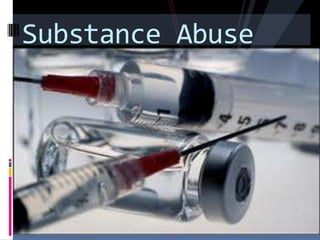
Substance Abuse
What is substance abuse?

 Substance abuse refers to the harmful or
  hazardous use of psychoactive
  substances, including alcohol and illicit drugs.
 The use of Psychoactive substance can lead to
   dependence syndrome
• strong desire to take the drug, persisting in its
   use despite harmful consequences,
• a higher priority given to drug use than to other
   activities
• increased tolerance
• sometimes a physical withdrawal state.
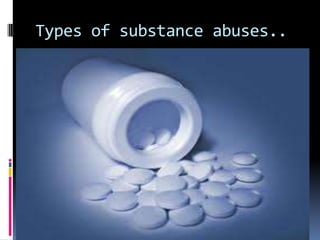
Types of substance abuses..
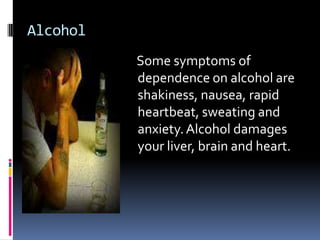
Alcohol
          Some symptoms of
          dependence on alcohol are
          shakiness, nausea, rapid
          heartbeat, sweating and
          anxiety. Alcohol damages
          your liver, brain and heart.
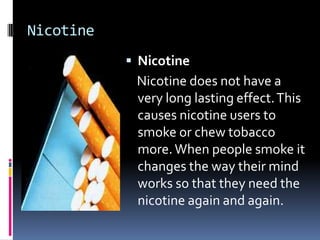
Nicotine
            Nicotine
            Nicotine does not have a
            very long lasting effect. This
            causes nicotine users to
            smoke or chew tobacco
            more. When people smoke it
            changes the way their mind
            works so that they need the
            nicotine again and again.
DRUGS...
HEROIN
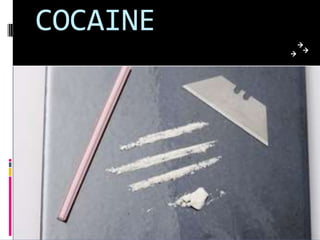
COCAINE
MARIJUANA
OPIUM
Inhalants...
Inhalants...

 A drug that enters the body through
  breathing is an inhalant. Inhalants cause brain
  damage, lung damage, coma or even death.
  Some examples are Adhesives, Aerosols:
  spray paint, hair spray, deodorant, air
  freshener) Cleaning Agents, Food Products(
  whipped cream aerosols) Solvents and Gases(
  nail polish remover, paint
  Remover, correction fluid, lighter fluid).
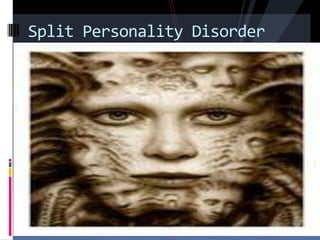
Split Personality Disorder
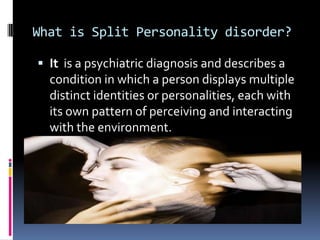
What is Split Personality disorder?

 It is a psychiatric diagnosis and describes a
  condition in which a person displays multiple
  distinct identities or personalities, each with
  its own pattern of perceiving and interacting
  with the environment.
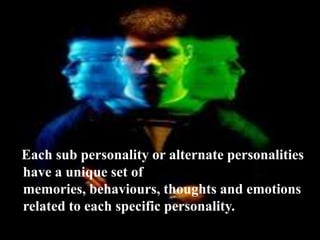
Each sub personality or alternate personalities
have a unique set of
memories, behaviours, thoughts and emotions
related to each specific personality.
CAUSES....

 An innate ability to dissociate easily
 Repeated episodes of severe physical or
  sexual abuse in childhood
 Lack of a supportive or comforting person to
  counteract abusive relative(s)
 Influence of other relatives with dissociative
  symptoms or disorders
Symptoms
 Lapses in memory,
 Experiencing blackouts,
 Being frequently accused of lying when they
  do not believe they are lying,
 Hearing voices inside their head that are not
  their own,
 Not recognizing themselves in the mirror,
 Feeling like more than one person.
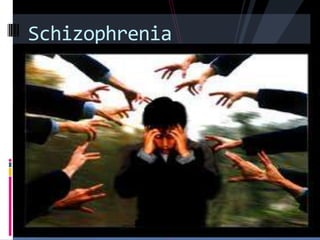
Schizophrenia
What is Schizophrenia?

           Schizophrenia is a complex mental
    disorder that makes it difficult to:
•   Tell the difference between real and unreal
    experiences
•   Think logically
•   Have normal emotional responses,
•   Behave normally in social situation.
Types of Schizophrenia

   Paranoid schizophrenia
   Disorganised schizophrenia
   Catatonic schizophrenia
   Undifferentiated schizophrenia
   Residual schizophrenia
Symptoms
Schizophrenia symptoms usually develop
slowly over months or years. Sometimes you
may have many symptoms, and at other times
you may only have a few.

At first, you may have the following symptoms:
 Irritable or tense feeling
 Difficulty in sleeping
 Difficulty in concentrating
As the illness continues, problems with
thinking, emotions and behavior
develop, including:
 Lack of emotion (flat affect)
 Strongly held beliefs that are not based in
  reality (delusions)
 Hearing or seeing things that are not there
  (hallucinations)
 Problems paying attention
 Thoughts "jump" between unrelated topics
  (“loose associations”)
 Bizarre behaviors
 Social isolation
Treatment of psychological disorder


 Psychotherapy
 Medication
 Creative therapies
 Lifestyle adjustments and supportive
  measures
Stigma about mental illness…
 People with mental illnesses suffer from a
  measurable amount of stigma. It is believed if
  you have a mental illness you may be
  violent, a killer, or even a sex offender.
 This very stigma discourages people from
  getting help which they desperately need
What can be done...

 start using a more respectful language
 Educate the public about mental
  illness, and how stigma misleads many
  of us into fear that is not rational and not
  accurate.
 Break down the barriers of
  ignorance, prejudice, or unfair
  discrimination

Psychological disorder

  • 1.
  • 2.
    What is Psychological Disorder? A psychological disorder, also known as a mental disorder, is a pattern of behavioural or psychological symptoms that impact multiple life areas and/or create distress for the person experiencing these symptoms.
  • 3.
    History Ancientworld The medieval period Modern world
  • 4.
    Causes Pregnancy andbirth Disease, injury and infection Life events, emotional stress and relationships Neighborhood, society and culture Genes Individual characteristics
  • 5.
    Risk factors risk factors stressful/traumatic life events social disadvantages substance abuse intelligence below normal risk factors childhood problems abused/ neglected 0 2 4 6 8 10
  • 6.
    Some Psychological Disorders Eating disorders depression Substance abuse Split personality Schizophrenia disorders
  • 7.
  • 8.
    What is eatingdisorder?  Eating habits that may involve either insufficient or excessive food intake to the detriment of an individual's physical and mental health.  Severe distress or concern about body weight or shape may also characterize an eating disorder.
  • 9.
  • 12.
    Bulimia nervosa Characterized by recurrent binge eating followed by compensatory behaviours such as purging (self-induced vomiting, excessive use of laxatives/diuretics, or excessive exercise) Bulimia Nervosa
  • 14.
    Anorexia Nervosa  Refusal to maintain a healthy body weight, an obsessive fear of gaining weight, and an unrealistic perception of current body weight.
  • 16.
    Binge Eating  A person loses control over his or her eating  Periods of binge-eating are not followed by purging, excessive exercise, or fasting.
  • 17.
    Symptoms  Constant adherenceto increasingly strict diets, regardless of weight  Secretly bingeing on large amounts of food  Increase in consumption of laxatives, diuretics or diet pills  Exercising compulsively, often several hours per day
  • 18.
  • 19.
    What is depressivedisorder?  “Depression is a common mental disorder that presents with depressed mood, loss of interest or pleasure, feelings of guilt or low self-worth, disturbed sleep or appetite, low energy, and poor concentration.” -by WHO
  • 21.
    SIGNS AND SYMPTOMS.. Persistent sad, anxious, or "empty" feeling  Feelings of guilt, worthlessness, or helplessness  Irritability, restlessness  Loss of interest in activities or hobbies once pleasurable  Fatigue and decreased energy  Overeating, or appetite loss  Thoughts of suicide, suicide attempts  Aches or pains, headaches, cramps, or digestive problems that do not ease even with treatment.
  • 23.
    A test tomeasure your level of depression...  I do everything slowly.  I find it hard to concentrate when I read.  There is no fun left in my life.  I find it hard to make decisions.  I have lost interest in things that used to mean a lot to me.  I feel sad, depressed and unhappy.  I feel restless and cannot relax.  My sleep is disturbed: Too little, too much or disturbed sleep.  I have lost or gained weight without being on a diet.  I feel guilty and like a failure.
  • 24.
    To Speculate  Thenadd your answers up to give a total between 0 and 50:  36 + Severe depression  28 - 35 Moderate/severe depression  19 - 27 Mild to moderate depression  11 - 18 Borderline depression  5 - 10 Mild depression  0 - 4 No depression likely
  • 25.
  • 26.
    What is substanceabuse?  Substance abuse refers to the harmful or hazardous use of psychoactive substances, including alcohol and illicit drugs.  The use of Psychoactive substance can lead to dependence syndrome • strong desire to take the drug, persisting in its use despite harmful consequences, • a higher priority given to drug use than to other activities • increased tolerance • sometimes a physical withdrawal state.
  • 27.
  • 28.
    Alcohol Some symptoms of dependence on alcohol are shakiness, nausea, rapid heartbeat, sweating and anxiety. Alcohol damages your liver, brain and heart.
  • 29.
    Nicotine  Nicotine Nicotine does not have a very long lasting effect. This causes nicotine users to smoke or chew tobacco more. When people smoke it changes the way their mind works so that they need the nicotine again and again.
  • 31.
  • 32.
  • 33.
  • 34.
  • 35.
  • 36.
  • 37.
    Inhalants...  A drugthat enters the body through breathing is an inhalant. Inhalants cause brain damage, lung damage, coma or even death. Some examples are Adhesives, Aerosols: spray paint, hair spray, deodorant, air freshener) Cleaning Agents, Food Products( whipped cream aerosols) Solvents and Gases( nail polish remover, paint Remover, correction fluid, lighter fluid).
  • 38.
  • 39.
    What is SplitPersonality disorder?  It is a psychiatric diagnosis and describes a condition in which a person displays multiple distinct identities or personalities, each with its own pattern of perceiving and interacting with the environment.
  • 40.
    Each sub personalityor alternate personalities have a unique set of memories, behaviours, thoughts and emotions related to each specific personality.
  • 41.
    CAUSES....  An innateability to dissociate easily  Repeated episodes of severe physical or sexual abuse in childhood  Lack of a supportive or comforting person to counteract abusive relative(s)  Influence of other relatives with dissociative symptoms or disorders
  • 42.
    Symptoms  Lapses inmemory,  Experiencing blackouts,  Being frequently accused of lying when they do not believe they are lying,  Hearing voices inside their head that are not their own,  Not recognizing themselves in the mirror,  Feeling like more than one person.
  • 43.
  • 44.
    What is Schizophrenia? Schizophrenia is a complex mental disorder that makes it difficult to: • Tell the difference between real and unreal experiences • Think logically • Have normal emotional responses, • Behave normally in social situation.
  • 46.
    Types of Schizophrenia  Paranoid schizophrenia  Disorganised schizophrenia  Catatonic schizophrenia  Undifferentiated schizophrenia  Residual schizophrenia
  • 49.
    Symptoms Schizophrenia symptoms usuallydevelop slowly over months or years. Sometimes you may have many symptoms, and at other times you may only have a few. At first, you may have the following symptoms:  Irritable or tense feeling  Difficulty in sleeping  Difficulty in concentrating
  • 50.
    As the illnesscontinues, problems with thinking, emotions and behavior develop, including:  Lack of emotion (flat affect)  Strongly held beliefs that are not based in reality (delusions)  Hearing or seeing things that are not there (hallucinations)  Problems paying attention  Thoughts "jump" between unrelated topics (“loose associations”)  Bizarre behaviors  Social isolation
  • 52.
    Treatment of psychologicaldisorder  Psychotherapy  Medication  Creative therapies  Lifestyle adjustments and supportive measures
  • 53.
    Stigma about mentalillness…  People with mental illnesses suffer from a measurable amount of stigma. It is believed if you have a mental illness you may be violent, a killer, or even a sex offender.  This very stigma discourages people from getting help which they desperately need
  • 55.
    What can bedone...  start using a more respectful language  Educate the public about mental illness, and how stigma misleads many of us into fear that is not rational and not accurate.  Break down the barriers of ignorance, prejudice, or unfair discrimination