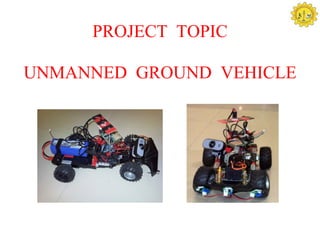
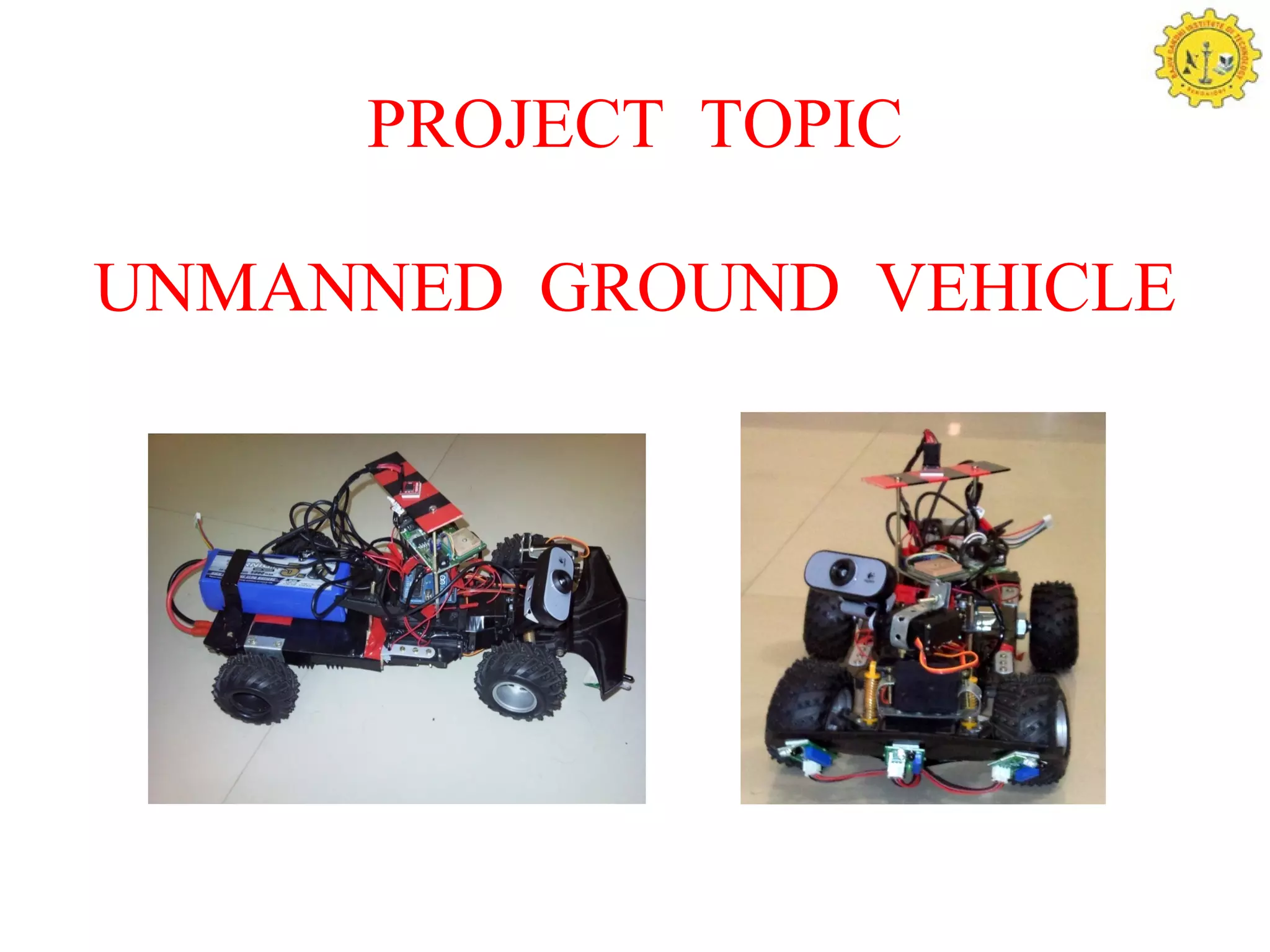
PROJECT TOPIC

UNMANNED GROUND VEHICLE
WHAT IS AN UNMANNED GROUND VEHICLE ?

•An Unmanned Ground vehicle (UGV) is a robot used to augment
human capability in both civic and military activities in open terrain.
•It is used as a human replacement in several dangerous military
operations such as handling explosives, diffusing bombs and front line
reconnaissance.

•There are two general classes of unmanned ground vehicles -
    Tele operated
    Autonomous
PROJECT ABSTRACT
Command Centre Control mode :
   • Maneuver the UGV wirelessly by transmitting navigation commands
     from the base station based on the video received from the on-board
     camera.
   • Control the turret wirelessly in order to locate and eliminate targets in
     the field of vision.
ARMCON mode :
   • Control the UGV using commands sent based on hand movements
     mapped by the IMU unit
Autonomous mode :
   • Capable of travelling from point A to point B without human
     navigation commands.
   • Adjust strategies based on surroundings using obstacle detection
     algorithms.
Raptor mode :
   • Locate and eliminate targets in the field vision using motion tracking.
   • Motion tracking implemented through advanced image processing
     algorithms.
Components Description
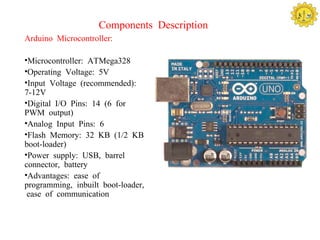
Arduino Microcontroller:

•Microcontroller: ATMega328
•Operating Voltage: 5V
•Input Voltage (recommended):
7-12V
•Digital I/O Pins: 14 (6 for
PWM output)
•Analog Input Pins: 6
•Flash Memory: 32 KB (1/2 KB
boot-loader)
•Power supply: USB, barrel
connector, battery
•Advantages: ease of
programming, inbuilt boot-loader,
 ease of communication
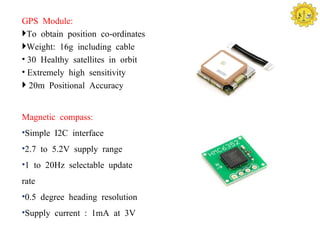
GPS Module:
To obtain position co-ordinates
Weight: 16g including cable
• 30 Healthy satellites in orbit
• Extremely high sensitivity
 20m Positional Accuracy


Magnetic compass:
•Simple I2C interface
•2.7 to 5.2V supply range
•1 to 20Hz selectable update
rate
•0.5 degree heading resolution
•Supply current : 1mA at 3V
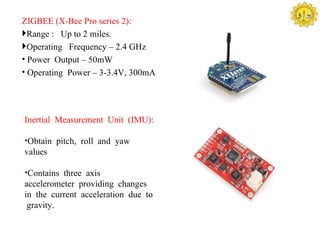
ZIGBEE (X-Bee Pro series 2):
Range : Up to 2 miles.
Operating Frequency – 2.4 GHz
• Power Output – 50mW
• Operating Power – 3-3.4V, 300mA


Inertial Measurement Unit (IMU):

•Obtain pitch, roll and yaw
values

•Contains three axis
accelerometer providing changes
in the current acceleration due to
 gravity.
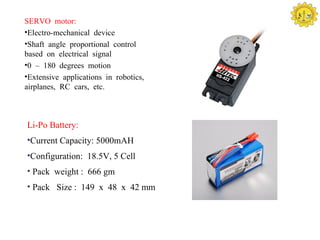
SERVO motor:
•Electro-mechanical device
•Shaft angle proportional control
based on electrical signal
•0 – 180 degrees motion
•Extensive applications in robotics,
airplanes, RC cars, etc.


Li-Po Battery:
•Current Capacity: 5000mAH
•Configuration: 18.5V, 5 Cell
• Pack weight : 666 gm
• Pack Size : 149 x 48 x 42 mm
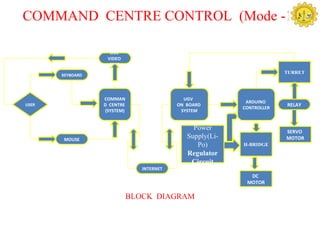
COMMAND CENTRE CONTROL (Mode -1)

                    LIVE
                   VIDEO
                    FEED
                                                                        TURRET
       KEYBOARD


                  COMMAN                     UGV
                                                            ARDUINO
USER              D CENTRE                 ON BOARD                     RELAY
                                                           CONTROLLER
                  (SYSTEM)                  SYSTEM


                                                Power                   SERVO
       MOUSE
                                              Supply(Li-                MOTOR
                                                 Po)       H-BRIDGE
                                              Regulator
                                               Circuit
                                INTERNET
                                                             DC
                                                            MOTOR

                             BLOCK DIAGRAM
Algorithm Design :
User side :-
   • Keys for rover movement
   • Their equivalent translation to the arduino controller.
   • The operation being executed are as shown.
                             Key     Character sent   Objective
                           Pressed
                             Up            U          Forward
                            Down           D          Reverse
                            Left           L          Turn left
                            Right          R            Turn
                                                        right
                             Ctrl          0            Stop
UGV side :-
  • UGV monitors serial input for the received characters and makes the subsequent decisions.
  • Execution of up(), down(), left(), right(), halt()
  • Clockwise and anticlockwise pin assignment for forward and reverse.
  • Separate PWM pin for 80 -120 degrees range of servo turn, H- Bridge Enable control for
    braking.
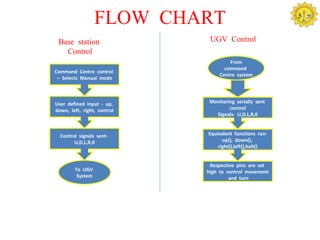
FLOW CHART
 Base station                 UGV Control
   Control
                                      From
                                    command
Command Centre control
                                  Centre system
 – Selects Manual mode


User defined input - up,      Monitoring serially sent
down, left, right, control            control
                                Signals- U,D,L,R,0


  Control signals sent-      Equivalent functions run-
        U,D,L,R,0                  up(), down(),
                                 right(),left(),halt()


                              Respective pins are set
        To UGV               high to control movement
         System                       and turn
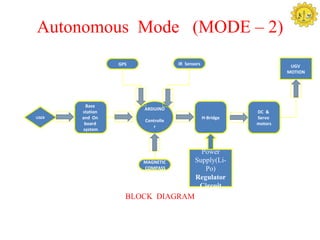
Autonomous Mode (MODE – 2)
                 GPS               IR Sensors                        UGV
                                                                    MOTION


         Base
                       ARDUINO
       station                                             DC &
USER   and On                                   H-Bridge   Servo
                       Controlle
        board                                              motors
                          r
        system


                                            Power
                       MAGNETIC           Supply(Li-
                       COMPASS               Po)
                                          Regulator
                                           Circuit
                   BLOCK DIAGRAM
Algorithm Design:
Obtain the Current GPS co-ordinates and the heading reading
from the Compass.
Obtain the Destination Co-ordinates from the user.
Calculate the angle by which the UGV orients with the
desired direction.
Calculated angle provides the rover movement control signals.
The UGV navigates itself to the desired location based on the
IR sensors values which are obtained with respect to the
obstacles.
                                          IR(L)   IR(M IR(R)     Operations
   IR(L)   IR(M IR(R)    Operations               )              performed
             )           performed        1       0    0       Right() and
   0       0    0       (No obstacles)                         Up()
   0       0    1       Left() and Up()   1       0    1       Up()
   0       1    0       Random[Right()    1       1    0       Right() and
                        or Left()] and                         Up()
                        Up()              1       1    1       Random[Right()
   0       1    1       Left() and Up()                        or Left()] and
                                                               down()
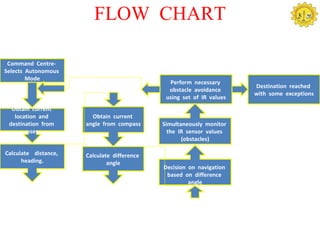
FLOW CHART

 Command Centre-
Selects Autonomous
        Mode
                                               Perform necessary
                                                                       Destination reached
                                               obstacle avoidance
                                                                       with some exceptions
                                              using set of IR values
  Obtain current
   location and         Obtain current
 destination from     angle from compass     Simultaneously monitor
        user                                   the IR sensor values
                                                    (obstacles)

Calculate distance,   Calculate difference
      heading.                angle
                                             Decision on navigation
                                              based on difference
                                                      angle
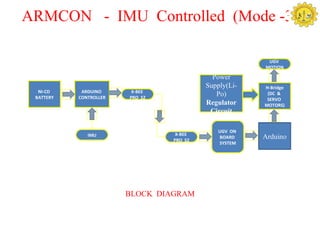
ARMCON - IMU Controlled (Mode -3)

                                                        UGV
                                                       MOTION

                                            Power
                                          Supply(Li-   H-Bridge
  NI-CD     ARDUINO      X-BEE
 BATTERY   CONTROLLER   PRO S2
                                             Po)        (DC &
                                                        SERVO
                                          Regulator    MOTORS)
                                           Circuit

                                              UGV ON
              IMU                 X-BEE
                                 PRO S2
                                              BOARD    Arduino
                                              SYSTEM


                        BLOCK DIAGRAM
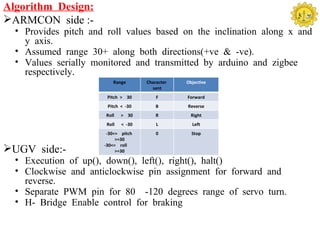
Algorithm Design:
ARMCON side :-
  • Provides pitch and roll values based on the inclination along x and
    y axis.
  • Assumed range 30+ along both directions(+ve & -ve).
  • Values serially monitored and transmitted by arduino and zigbee
    respectively.
                          Range       Character   Objective
                                        sent
                       Pitch > 30         F       Forward
                       Pitch < -30        B       Reverse
                       Roll   > 30        R         Right
                       Roll   < -30       L         Left
                       -30<= pitch        0         Stop
                           >=30

UGV side:-           -30<= roll
                           >=30

  • Execution of up(), down(), left(), right(), halt()
  • Clockwise and anticlockwise pin assignment for forward and
    reverse.
  • Separate PWM pin for 80 -120 degrees range of servo turn.
  • H- Bridge Enable control for braking
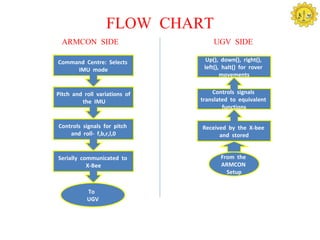
FLOW CHART
  ARMCON SIDE                      UGV SIDE

Command Centre: Selects          Up(), down(), right(),
     IMU mode                   left(), halt() for rover
                                       movements


Pitch and roll variations of       Controls signals
         the IMU               translated to equivalent
                                       functions


Controls signals for pitch     Received by the X-bee
    and roll- f,b,r,l,0              and stored


Serially communicated to              From the
           X-Bee                      ARMCON
                                        Setup


           To
           UGV
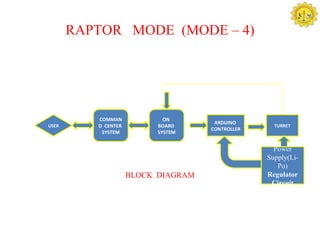
RAPTOR MODE (MODE – 4)


          COMMAN             ON
                                      ARDUINO
USER      D CENTER         BOARD                    TURRET
                                     CONTROLLER
           SYSTEM          SYSTEM


                                                    Power
                                                  Supply(Li-
                                                     Po)
                     BLOCK DIAGRAM                Regulator
                                                   Circuit
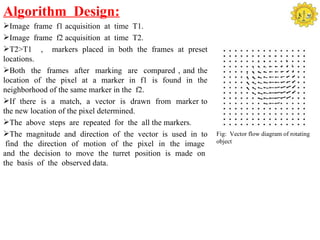
Algorithm Design:
Image frame f1 acquisition at time T1.
Image frame f2 acquisition at time T2.
T2>T1 , markers placed in both the frames at preset
locations.
Both the frames after marking are compared , and the
location of the pixel at a marker in f1 is found in the
neighborhood of the same marker in the f2.
If there is a match, a vector is drawn from marker to
the new location of the pixel determined.
The above steps are repeated for the all the markers.
The magnitude and direction of the vector is used in to   Fig: Vector flow diagram of rotating
 find the direction of motion of the pixel in the image    object

and the decision to move the turret position is made on
the basis of the observed data.
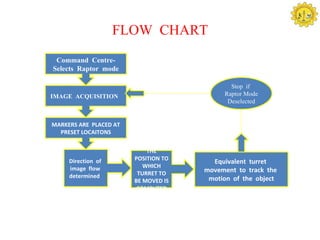
FLOW CHART
 Command Centre-
Selects Raptor mode

                                             Stop if
IMAGE ACQUISITION                          Raptor Mode
                                            Deselected


MARKERS ARE PLACED AT
  PRESET LOCAITONS


                            THE
                        POSITION TO
     Direction of                       Equivalent turret
     image flow            WHICH
                         TURRET TO    movement to track the
     determined                        motion of the object
                        BE MOVED IS
                         COMPUTED
Applications

   Reconnaissance .
   Bomb disposal.
   Search and rescue.
   Border patrol and surveillance.
   Active combat situations.
   Stealth combat operations.
   New explorations.
   To undertake dangerous missions which involves loss of human life.
RESULT:
Successfully built a stand-alone rover capable of both manual and
autonomous modes of control.
Added a rotating camera platform that can target the enemy with/without
human control.
Successfully implemented features including motion tracking, obstacle
detection, path planning , gesture control and GPS.


CONCLUSION:
     The incorporation of various technologies under one roof has given us the
path to
      achieve goals which have never been realized in such an efficient manner
in the past.
     These technologies bring about a self relying and able machine to
tackle
      situations on its own and ease a human’s job in the present day scenarios.
FUTURE ENHANCEMENTS
•   Additional sensors such as Passive infrared sensors, thermal imaging,
    Gas sensor, can be added to enhance the capabilities of the UGV.
•   Optical flow augmented with other image processing algorithms such
    as frame differencing, edge detection to accomplish more reliable
    motion tracking.
•   High end technology with higher resolving capabilities can be added
    to enhance the present functionality of the UGV.
•   Secure satellite links for communication increases the security of UGV
    operation.
References and Papers
Books:
 Rafael C. Gonzalez and Richard E. Woods, “Digital Image Processing,” 3rd ed., PHI
  Learning, 2008. 
Papers:
 K.K.Soundra Pandian Member, IAENG and Priyanka Mathur,”Traversability Assessment
  of Terrain for Autonomous Robot Navigation, “Proceedings of the International
  MultiConference of Engineers and Computer Scientists 2010 Vol II, IMECS 2010, March
  17-19, Hongkong, ISBN: 978-988-18210-4-1.
 Saurav Kumar and Pallavi Awasthi, “Navigation Architecture for Autonomous
  Surveillance Rover,” International Journal of Computer Theory and Engineering, Vol. 1,
  No. 3, August, 2009,1793-8201, Pg. 231-235.
 Mohd Azlan Shah Abd Rahim and Illani Mohd Nawi, “Path Planning Automated Guided
  Robot,” Proceedings of the World Congress on Engineering and Computer Science 2008,
  WCECS 2008, October 22 - 24, 2008, San Francisco, USA, ISBN: 978-988-98671-0-2.
 Boyoon Jung and Gaurav S. Sukhatme, “Real-time Motion Tracking from a Mobile
  Robot,” International Journal of Social Robotics, Volume 2, Number 1, 63-78, DOI:
  10.1007/s12369-009-0038-y
 Wenshuai Yua, Xuchu Yub, Pengqiang Zhang and Jun Zhou, “A New Framework of
  Moving Target Detection and Tracking for UAV Video Application,” The International
  Archives of the Photogrammetry, Remote Sensing and Spatial Information Sciences. Vol.
  XXXVII. Part B3b. Beijing 2008
THANK YOU

Unmanned Ground Vehicle

  • 1.
  • 3.
    WHAT IS ANUNMANNED GROUND VEHICLE ? •An Unmanned Ground vehicle (UGV) is a robot used to augment human capability in both civic and military activities in open terrain. •It is used as a human replacement in several dangerous military operations such as handling explosives, diffusing bombs and front line reconnaissance. •There are two general classes of unmanned ground vehicles -  Tele operated  Autonomous
  • 4.
    PROJECT ABSTRACT Command CentreControl mode : • Maneuver the UGV wirelessly by transmitting navigation commands from the base station based on the video received from the on-board camera. • Control the turret wirelessly in order to locate and eliminate targets in the field of vision. ARMCON mode : • Control the UGV using commands sent based on hand movements mapped by the IMU unit Autonomous mode : • Capable of travelling from point A to point B without human navigation commands. • Adjust strategies based on surroundings using obstacle detection algorithms. Raptor mode : • Locate and eliminate targets in the field vision using motion tracking. • Motion tracking implemented through advanced image processing algorithms.
  • 5.
    Components Description Arduino Microcontroller: •Microcontroller:ATMega328 •Operating Voltage: 5V •Input Voltage (recommended): 7-12V •Digital I/O Pins: 14 (6 for PWM output) •Analog Input Pins: 6 •Flash Memory: 32 KB (1/2 KB boot-loader) •Power supply: USB, barrel connector, battery •Advantages: ease of programming, inbuilt boot-loader, ease of communication
  • 6.
    GPS Module: To obtainposition co-ordinates Weight: 16g including cable • 30 Healthy satellites in orbit • Extremely high sensitivity  20m Positional Accuracy Magnetic compass: •Simple I2C interface •2.7 to 5.2V supply range •1 to 20Hz selectable update rate •0.5 degree heading resolution •Supply current : 1mA at 3V
  • 7.
    ZIGBEE (X-Bee Proseries 2): Range : Up to 2 miles. Operating Frequency – 2.4 GHz • Power Output – 50mW • Operating Power – 3-3.4V, 300mA Inertial Measurement Unit (IMU): •Obtain pitch, roll and yaw values •Contains three axis accelerometer providing changes in the current acceleration due to gravity.
  • 8.
    SERVO motor: •Electro-mechanical device •Shaftangle proportional control based on electrical signal •0 – 180 degrees motion •Extensive applications in robotics, airplanes, RC cars, etc. Li-Po Battery: •Current Capacity: 5000mAH •Configuration: 18.5V, 5 Cell • Pack weight : 666 gm • Pack Size : 149 x 48 x 42 mm
  • 9.
    COMMAND CENTRE CONTROL(Mode -1) LIVE VIDEO FEED TURRET KEYBOARD COMMAN UGV ARDUINO USER D CENTRE ON BOARD RELAY CONTROLLER (SYSTEM) SYSTEM Power SERVO MOUSE Supply(Li- MOTOR Po) H-BRIDGE Regulator Circuit INTERNET DC MOTOR BLOCK DIAGRAM
  • 10.
    Algorithm Design : Userside :- • Keys for rover movement • Their equivalent translation to the arduino controller. • The operation being executed are as shown. Key Character sent Objective Pressed Up U Forward Down D Reverse Left L Turn left Right R Turn right Ctrl 0 Stop UGV side :- • UGV monitors serial input for the received characters and makes the subsequent decisions. • Execution of up(), down(), left(), right(), halt() • Clockwise and anticlockwise pin assignment for forward and reverse. • Separate PWM pin for 80 -120 degrees range of servo turn, H- Bridge Enable control for braking.
  • 11.
    FLOW CHART Basestation UGV Control Control From command Command Centre control Centre system – Selects Manual mode User defined input - up, Monitoring serially sent down, left, right, control control Signals- U,D,L,R,0 Control signals sent- Equivalent functions run- U,D,L,R,0 up(), down(), right(),left(),halt() Respective pins are set To UGV high to control movement System and turn
  • 12.
    Autonomous Mode (MODE– 2) GPS IR Sensors UGV MOTION Base ARDUINO station DC & USER and On H-Bridge Servo Controlle board motors r system Power MAGNETIC Supply(Li- COMPASS Po) Regulator Circuit BLOCK DIAGRAM
  • 13.
    Algorithm Design: Obtain theCurrent GPS co-ordinates and the heading reading from the Compass. Obtain the Destination Co-ordinates from the user. Calculate the angle by which the UGV orients with the desired direction. Calculated angle provides the rover movement control signals. The UGV navigates itself to the desired location based on the IR sensors values which are obtained with respect to the obstacles. IR(L) IR(M IR(R) Operations IR(L) IR(M IR(R) Operations ) performed ) performed 1 0 0 Right() and 0 0 0 (No obstacles) Up() 0 0 1 Left() and Up() 1 0 1 Up() 0 1 0 Random[Right() 1 1 0 Right() and or Left()] and Up() Up() 1 1 1 Random[Right() 0 1 1 Left() and Up() or Left()] and down()
  • 14.
    FLOW CHART CommandCentre- Selects Autonomous Mode Perform necessary Destination reached obstacle avoidance with some exceptions using set of IR values Obtain current location and Obtain current destination from angle from compass Simultaneously monitor user the IR sensor values (obstacles) Calculate distance, Calculate difference heading. angle Decision on navigation based on difference angle
  • 15.
    ARMCON - IMUControlled (Mode -3) UGV MOTION Power Supply(Li- H-Bridge NI-CD ARDUINO X-BEE BATTERY CONTROLLER PRO S2 Po) (DC & SERVO Regulator MOTORS) Circuit UGV ON IMU X-BEE PRO S2 BOARD Arduino SYSTEM BLOCK DIAGRAM
  • 16.
    Algorithm Design: ARMCON side:- • Provides pitch and roll values based on the inclination along x and y axis. • Assumed range 30+ along both directions(+ve & -ve). • Values serially monitored and transmitted by arduino and zigbee respectively. Range Character Objective sent Pitch > 30 F Forward Pitch < -30 B Reverse Roll > 30 R Right Roll < -30 L Left -30<= pitch 0 Stop >=30 UGV side:- -30<= roll >=30 • Execution of up(), down(), left(), right(), halt() • Clockwise and anticlockwise pin assignment for forward and reverse. • Separate PWM pin for 80 -120 degrees range of servo turn. • H- Bridge Enable control for braking
  • 17.
    FLOW CHART ARMCON SIDE UGV SIDE Command Centre: Selects Up(), down(), right(), IMU mode left(), halt() for rover movements Pitch and roll variations of Controls signals the IMU translated to equivalent functions Controls signals for pitch Received by the X-bee and roll- f,b,r,l,0 and stored Serially communicated to From the X-Bee ARMCON Setup To UGV
  • 18.
    RAPTOR MODE (MODE– 4) COMMAN ON ARDUINO USER D CENTER BOARD TURRET CONTROLLER SYSTEM SYSTEM Power Supply(Li- Po) BLOCK DIAGRAM Regulator Circuit
  • 19.
    Algorithm Design: Image framef1 acquisition at time T1. Image frame f2 acquisition at time T2. T2>T1 , markers placed in both the frames at preset locations. Both the frames after marking are compared , and the location of the pixel at a marker in f1 is found in the neighborhood of the same marker in the f2. If there is a match, a vector is drawn from marker to the new location of the pixel determined. The above steps are repeated for the all the markers. The magnitude and direction of the vector is used in to Fig: Vector flow diagram of rotating find the direction of motion of the pixel in the image object and the decision to move the turret position is made on the basis of the observed data.
  • 20.
    FLOW CHART CommandCentre- Selects Raptor mode Stop if IMAGE ACQUISITION Raptor Mode Deselected MARKERS ARE PLACED AT PRESET LOCAITONS THE POSITION TO Direction of Equivalent turret image flow WHICH TURRET TO movement to track the determined motion of the object BE MOVED IS COMPUTED
  • 21.
    Applications  Reconnaissance .  Bomb disposal.  Search and rescue.  Border patrol and surveillance.  Active combat situations.  Stealth combat operations.  New explorations.  To undertake dangerous missions which involves loss of human life.
  • 22.
    RESULT: Successfully built astand-alone rover capable of both manual and autonomous modes of control. Added a rotating camera platform that can target the enemy with/without human control. Successfully implemented features including motion tracking, obstacle detection, path planning , gesture control and GPS. CONCLUSION:  The incorporation of various technologies under one roof has given us the path to achieve goals which have never been realized in such an efficient manner in the past.  These technologies bring about a self relying and able machine to tackle situations on its own and ease a human’s job in the present day scenarios.
  • 23.
    FUTURE ENHANCEMENTS • Additional sensors such as Passive infrared sensors, thermal imaging, Gas sensor, can be added to enhance the capabilities of the UGV. • Optical flow augmented with other image processing algorithms such as frame differencing, edge detection to accomplish more reliable motion tracking. • High end technology with higher resolving capabilities can be added to enhance the present functionality of the UGV. • Secure satellite links for communication increases the security of UGV operation.
  • 24.
    References and Papers Books: Rafael C. Gonzalez and Richard E. Woods, “Digital Image Processing,” 3rd ed., PHI Learning, 2008.  Papers:  K.K.Soundra Pandian Member, IAENG and Priyanka Mathur,”Traversability Assessment of Terrain for Autonomous Robot Navigation, “Proceedings of the International MultiConference of Engineers and Computer Scientists 2010 Vol II, IMECS 2010, March 17-19, Hongkong, ISBN: 978-988-18210-4-1.  Saurav Kumar and Pallavi Awasthi, “Navigation Architecture for Autonomous Surveillance Rover,” International Journal of Computer Theory and Engineering, Vol. 1, No. 3, August, 2009,1793-8201, Pg. 231-235.  Mohd Azlan Shah Abd Rahim and Illani Mohd Nawi, “Path Planning Automated Guided Robot,” Proceedings of the World Congress on Engineering and Computer Science 2008, WCECS 2008, October 22 - 24, 2008, San Francisco, USA, ISBN: 978-988-98671-0-2.  Boyoon Jung and Gaurav S. Sukhatme, “Real-time Motion Tracking from a Mobile Robot,” International Journal of Social Robotics, Volume 2, Number 1, 63-78, DOI: 10.1007/s12369-009-0038-y  Wenshuai Yua, Xuchu Yub, Pengqiang Zhang and Jun Zhou, “A New Framework of Moving Target Detection and Tracking for UAV Video Application,” The International Archives of the Photogrammetry, Remote Sensing and Spatial Information Sciences. Vol. XXXVII. Part B3b. Beijing 2008
  • 25.