BLUETOOTH
BASED WIRELESS
SENSOR NETWORKS
Contents
 Introduction
 Blutooth Specification
 Blutooth Basics
 Blutooth Topology
 Blutooth Software
 Blutooth Keyboard
 Blutooth Protocol Stack
 Blutooth Security
 Blutooth Based Sensor N/W
 Sensor N/W Implementation
 Blutooth Hardware
Architecture
 Algorithms For Operation Of
Networks
 Merits
 Demerits
Introduction
 Bluetooth Wireless Technology (BWT) was developed in
1994 at Ericsson in Sweden.
 It is named for Harald Blaatand.
 Bluetooth-Wireless and Automatic technology simplifying
art of communication.
 Frequency used is 2.45 GHz, same used in ISM devices.
 Purpose – Originally it was build to eliminate the need for
cable connections between PDAs and notebook PCs.
Later the goals were to enable different devices through
a commonly accepted standard for wireless connectivity
. Ericsson on advent of BWT conceptualized a Radio
Technology through a wireless personal area network
(WPAN).
Bluetooth Specification
 Bluetooth-Wireless technology providing
link between mobile and electronic
devices.
 It operates on 2.45 GHz radio signals
using frequency hopping spread spectrum.
 Technology of Bluetooth concentrates on
short range of communication.
Bluetooth Specification
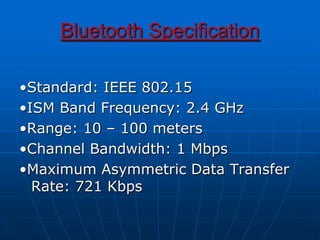
•Standard: IEEE 802.15
•ISM Band Frequency: 2.4 GHz
•Range: 10 – 100 meters
•Channel Bandwidth: 1 Mbps
•Maximum Asymmetric Data Transfer
Rate: 721 Kbps
Types of Bluetooth Wireless
Technology
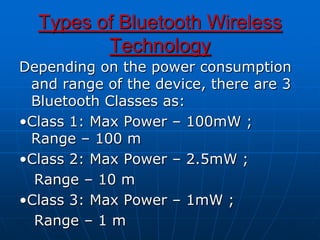
Depending on the power consumption
and range of the device, there are 3
Bluetooth Classes as:
•Class 1: Max Power – 100mW ;
Range – 100 m
•Class 2: Max Power – 2.5mW ;
Range – 10 m
•Class 3: Max Power – 1mW ;
Range – 1 m
Why the name Bluetooth?
The name was adopted as a tribute to
the tenth-century vikingking Harald
Blatand who peacefully united
Denmark and Norway.
Harald liked to eat blueberries,
which gave his teeth the coloration
that lead to the nickname
"Bluetooth."
How to reduce interference?
•BWT devices hop randomly between
frequencies up to 1600 times per
second.
•So,if another device using a 2.4 GHz
frequency (e.g.:cordless phone) ,
then the interference with the BWT
network lasts only for about 1/1600
of a second.
•By then, the devices hop to another
frequency.
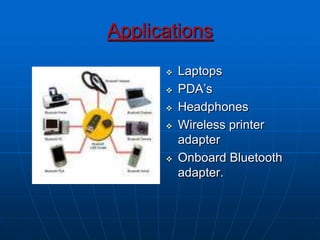
Applications
 Laptops
 PDA’s
 Headphones
 Wireless printer
adapter
 Onboard Bluetooth
adapter.
Bluetooth Basics
 Bluetooth is low powered and low cost.
 All the devices follow a uniform structure
 Devices Connect through network called
Pico nets.
 Strength lies in handling data and video
transmission simultaneously.
Bluetooth Basics
 Specification- Bluetooth specification gives
developers data link and application layer
definitions
 Spectrum-Bluetooth operates between 2.4
and 2.485 GHz using a frequency hopping
spread spectrum.
 Interference- is reduced using Adaptive
Frequency Hopping allowing a better
efficiency and greater performance.
Bluetooth Topology
2 main topologies are as:
i.PICONET TOPOLOGY,
&
ii.SCATTERNET TOPOLOGY
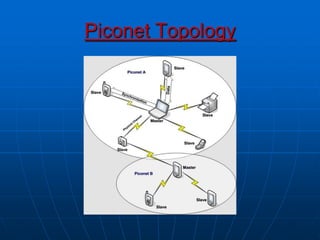
i.Piconet Topology
•A piconet consists of upto 8 BWT-
enabled devices.
•When piconet is established, one
device sets up frequency-hopping
pattern and other devices
synchronize their signals to the same
pattern.
•Each piconet has a different
frequency-hopping pattern.
Piconet Topology
ii.Scatternet Topology
•Scatternet consists of several piconets
connected by devices participating in
multiple piconet.
• There is a ‘BRIDGE’ connecting 2
piconets which is also a slave in
individual piconets.
Advantages of Scatternet :
•Higher throughput
•Multi-hop connections between devices
indifferent piconets
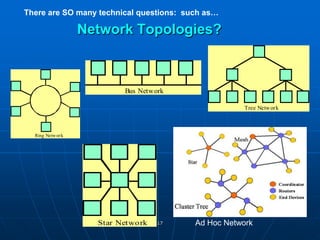
Network Topologies?
Bus Network
17
Tree Network
Star Network
Ring Network
Ad Hoc Network
There are SO many technical questions: such as…
Future Of Bluetooth
•BROADCAST CHANNELS:Adoption of
Bluetooth into mobile phones and
enable advertising models based on
users pulling information from the
information points.
•TOPOLOGY MANAGEMENT:Automatic
configuration of piconet topologies in
scatternet situations.
Bluetooth Software
 Bluetooth software can be installed and
used on Bluetooth capable devices.
 There exists different software for different
devices like PDA , personal computer.
 Enables the device to use technology at its
fullest.
 Best example is Bluesoleil.
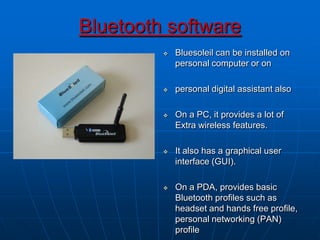
Bluetooth software
 Bluesoleil can be installed on
personal computer or on
 personal digital assistant also
 On a PC, it provides a lot of
Extra wireless features.
 It also has a graphical user
interface (GUI).
 On a PDA, provides basic
Bluetooth profiles such as
headset and hands free profile,
personal networking (PAN)
profile
How Bluetooth works?
 They normally operate at 2.45GHZ in license
free globally available ISM radio band.
 Advantage-worldwide availability and
compatibility.
 Disadvantage- devices must share the band
with other RF emitters including automobile
security systems, noise sources such as
Microwaves
 Solution- Frequency Hopping Spread
Spectrum.
Frequency Hopping Spread
Spectrum (FHSS)
 Frequency hopping is jumping from one
frequency to another within the ISM radio
band.
 Efficient use of entire bandwidth.
 Low Interference
 Provides basic level of security.
Working of FHSS
 There exists a master-slave relation between
devices.
 A device in master mode can communicate with
upto seven slave devices.
 Bluetooth devices work in a short range to
conserve the battery power.
Technical operations
 High speed, low powered wireless technology.
 Circuits are Contained on a 0.9 cm square.
 This offers 1MB link with security.
 Each device offers unique 48 bit address from
IEEE 802.15 standard.
 Authentification is via a 128 bit key.
 Supports up to 721KBps along with 3 voice
channels.
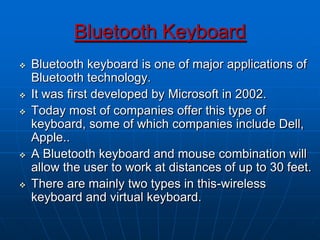
Bluetooth Keyboard
 Bluetooth keyboard is one of major applications of
Bluetooth technology.
 It was first developed by Microsoft in 2002.
 Today most of companies offer this type of
keyboard, some of which companies include Dell,
Apple..
 A Bluetooth keyboard and mouse combination will
allow the user to work at distances of up to 30 feet.
 There are mainly two types in this-wireless
keyboard and virtual keyboard.
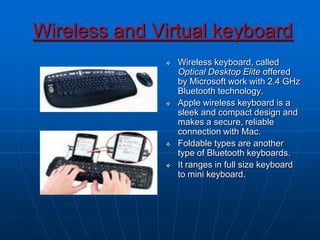
Wireless and Virtual keyboard
 Wireless keyboard, called
Optical Desktop Elite offered
by Microsoft work with 2.4 GHz
Bluetooth technology.
 Apple wireless keyboard is a
sleek and compact design and
makes a secure, reliable
connection with Mac.
 Foldable types are another
type of Bluetooth keyboards.
 It ranges in full size keyboard
to mini keyboard.
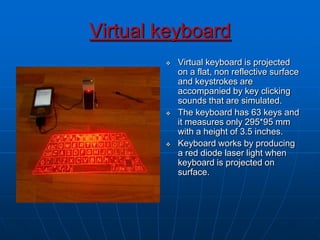
Virtual keyboard
 Virtual keyboard is projected
on a flat, non reflective surface
and keystrokes are
accompanied by key clicking
sounds that are simulated.
 The keyboard has 63 keys and
it measures only 295*95 mm
with a height of 3.5 inches.
 Keyboard works by producing
a red diode laser light when
keyboard is projected on
surface.
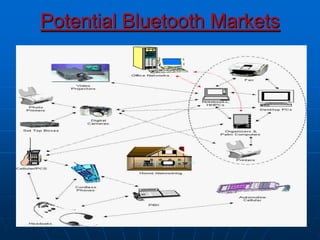
Potential Bluetooth Markets
28
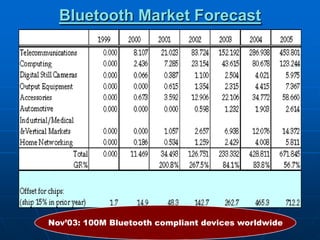
Bluetooth Market Forecast
29Nov’03: 100M Bluetooth compliant devices worldwide
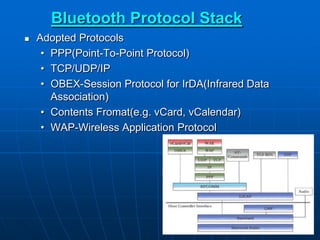
Bluetooth Protocol Stack
 Adopted Protocols
• PPP(Point-To-Point Protocol)
• TCP/UDP/IP
• OBEX-Session Protocol for IrDA(Infrared Data
Association)
• Contents Fromat(e.g. vCard, vCalendar)
• WAP-Wireless Application Protocol
Bluetooth Security
 Supports Unidirectional or Mutual Encryption based
on a Secret Link key Shared Between Two Devices
 Security Defined In 3 modes:
• Mode1- No Security
• Mode 2 - Service Level Security: Not Established
Before Channel is Established at L2CAP
• Mode 3 - Link Level Security: Device Initiates
Security Before LMP Link is Setup
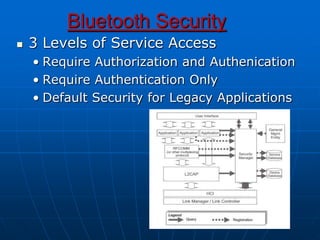
Bluetooth Security
 3 Levels of Service Access
• Require Authorization and Authenication
• Require Authentication Only
• Default Security for Legacy Applications
32
Bluetooth Based Sensor
Networks
•One such application is : WIRELESS
SENSOR NETWORKS (WSN)
•Important features of
WSN:Collaboration of network nodes
during execution and Data Centric
nature.
•Many smart sensor nodes scattered
in the field collect data and send it to
users via ‘gateway’ using multi-hop
routes.
Wireless Sensor Networks
(WSN)
WSN consists of number of small
devices equipped with asensing unit,
microprocessors, wireless
communication interfaceand power
source.
Sensor Network Implementation
•OBJECTIVE: To build a Hardware
platform and generic Software
Solutions to serve for research in
WSN protocols.
•Components of Sensor Network:
Smart Sensor Nodes and Gateway
Example: Pressure Sensor
For implementation of Pressure Sensor
as Bluetooth Node, following
components are important:
•Bluetooth Device
•Sensors
•Microcontroller
Blutooth Hardware Architecture
Bluetooth Hardware consists of 3 main
functional modules:
•2.4 GHz Bluetooth RF Transceiver
Unit
•Link Management Unit
•Host Controller Interface
Industrial CyberSecurity
 The Case of Vitek Boden
 On October 31, 2001 Vitek Boden was convicted of:
• 26 counts of will fully using a restricted computer to
cause damage
• 1 count of causing serious environment harm
 The facts of the case:
• Vitek worked for the contractor involved in the
installation of Maroochy Shire sewage treatment
plant.
• Vitek left the contractor in December 1999 and
approached the shire for employment. He was
refused.
• Between Jan 2000 and Apr 2000 the sewage
system experienced 47 unexplainable faults,
causing millions of liters of sewage to be spilled.
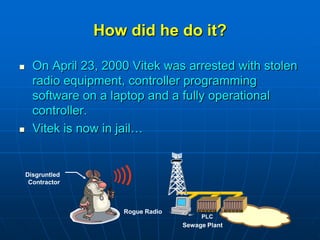
How did he do it?
 On April 23, 2000 Vitek was arrested with stolen
radio equipment, controller programming
software on a laptop and a fully operational
controller.
 Vitek is now in jail…
Disgruntled
Contractor
PLC PLC
Sewage Plant
Rogue Radio
Algorithms For Operation Of
Networks
•Initialization of gateway and
Bluetooth Inquiry Procedure.
•Discovery of Bluetooth device and
Checking of major and minor devices.
•Setting of parameters and assigning
type of devices and sensors.
•Description by Service-Class Field.
•Discarding of non-smart nodes.
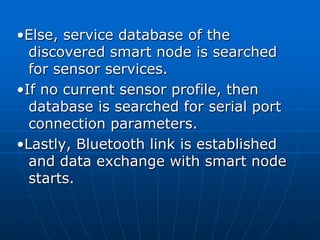
•Else, service database of the
discovered smart node is searched
for sensor services.
•If no current sensor profile, then
database is searched for serial port
connection parameters.
•Lastly, Bluetooth link is established
and data exchange with smart node
starts.
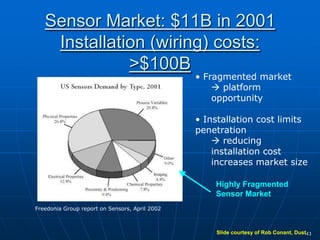
Sensor Market: $11B in 2001
Installation (wiring) costs:
>$100B
43
Freedonia Group report on Sensors, April 2002
• Fragmented market
 platform
opportunity
• Installation cost limits
penetration
 reducing
installation cost
increases market size
Slide courtesy of Rob Conant, Dust
Highly Fragmented
Sensor Market
Firewall Architectures
44
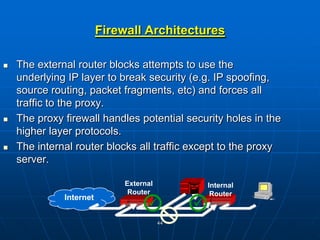
 The external router blocks attempts to use the
underlying IP layer to break security (e.g. IP spoofing,
source routing, packet fragments, etc) and forces all
traffic to the proxy.
 The proxy firewall handles potential security holes in the
higher layer protocols.
 The internal router blocks all traffic except to the proxy
server.
Internal
Router
Internet
External
Router

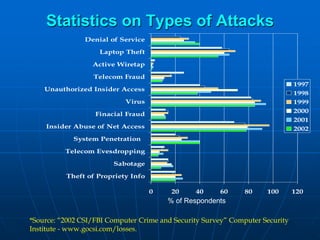
Statistics on Types of Attacks
0 20 40 60 80 100 120
Theft of Propriety Info
Sabotage
Telecom Evesdropping
System Penetration
Insider Abuse of Net Access
Finacial Fraud
Virus
Unauthorized Insider Access
Telecom Fraud
Active Wiretap
Laptop Theft
Denial of Service
1997
1998
1999
2000
2001
2002
*Source: “2002 CSI/FBI Computer Crime and Security Survey” Computer Security
Institute - www.gocsi.com/losses.
% of Respondents
There’s lot of “Wireless”
 From cellphones to PDAs to WiFi
to Satellite-based
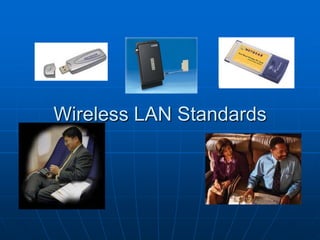
Wireless LAN Standards
Merits
 Wireless
 Inexpensive
 Automatic
 Interoperability
 Low interference and energy consumption.
 Share voice and data
 Instant PAN
 Upgradeable
 Long lasting technology.
 Easy link establishment
Demerits
 Data rate and security
 More susceptible to Interception and
attack
 Less range
 Average Speed
 Short Life
Thank You

PPT on Bluetooth Based Wireless Sensor Networks

  • 1.
  • 3.
    Contents  Introduction  BlutoothSpecification  Blutooth Basics  Blutooth Topology  Blutooth Software  Blutooth Keyboard  Blutooth Protocol Stack  Blutooth Security  Blutooth Based Sensor N/W  Sensor N/W Implementation  Blutooth Hardware Architecture  Algorithms For Operation Of Networks  Merits  Demerits
  • 4.
    Introduction  Bluetooth WirelessTechnology (BWT) was developed in 1994 at Ericsson in Sweden.  It is named for Harald Blaatand.  Bluetooth-Wireless and Automatic technology simplifying art of communication.  Frequency used is 2.45 GHz, same used in ISM devices.  Purpose – Originally it was build to eliminate the need for cable connections between PDAs and notebook PCs. Later the goals were to enable different devices through a commonly accepted standard for wireless connectivity . Ericsson on advent of BWT conceptualized a Radio Technology through a wireless personal area network (WPAN).
  • 5.
    Bluetooth Specification  Bluetooth-Wirelesstechnology providing link between mobile and electronic devices.  It operates on 2.45 GHz radio signals using frequency hopping spread spectrum.  Technology of Bluetooth concentrates on short range of communication.
  • 6.
    Bluetooth Specification •Standard: IEEE802.15 •ISM Band Frequency: 2.4 GHz •Range: 10 – 100 meters •Channel Bandwidth: 1 Mbps •Maximum Asymmetric Data Transfer Rate: 721 Kbps
  • 7.
    Types of BluetoothWireless Technology Depending on the power consumption and range of the device, there are 3 Bluetooth Classes as: •Class 1: Max Power – 100mW ; Range – 100 m •Class 2: Max Power – 2.5mW ; Range – 10 m •Class 3: Max Power – 1mW ; Range – 1 m
  • 8.
    Why the nameBluetooth? The name was adopted as a tribute to the tenth-century vikingking Harald Blatand who peacefully united Denmark and Norway. Harald liked to eat blueberries, which gave his teeth the coloration that lead to the nickname "Bluetooth."
  • 9.
    How to reduceinterference? •BWT devices hop randomly between frequencies up to 1600 times per second. •So,if another device using a 2.4 GHz frequency (e.g.:cordless phone) , then the interference with the BWT network lasts only for about 1/1600 of a second. •By then, the devices hop to another frequency.
  • 10.
    Applications  Laptops  PDA’s Headphones  Wireless printer adapter  Onboard Bluetooth adapter.

  • 11.
    Bluetooth Basics  Bluetoothis low powered and low cost.  All the devices follow a uniform structure  Devices Connect through network called Pico nets.  Strength lies in handling data and video transmission simultaneously.
  • 12.
    Bluetooth Basics  Specification-Bluetooth specification gives developers data link and application layer definitions  Spectrum-Bluetooth operates between 2.4 and 2.485 GHz using a frequency hopping spread spectrum.  Interference- is reduced using Adaptive Frequency Hopping allowing a better efficiency and greater performance.
  • 13.
    Bluetooth Topology 2 maintopologies are as: i.PICONET TOPOLOGY, & ii.SCATTERNET TOPOLOGY
  • 14.
    i.Piconet Topology •A piconetconsists of upto 8 BWT- enabled devices. •When piconet is established, one device sets up frequency-hopping pattern and other devices synchronize their signals to the same pattern. •Each piconet has a different frequency-hopping pattern.
  • 15.
  • 16.
    ii.Scatternet Topology •Scatternet consistsof several piconets connected by devices participating in multiple piconet. • There is a ‘BRIDGE’ connecting 2 piconets which is also a slave in individual piconets. Advantages of Scatternet : •Higher throughput •Multi-hop connections between devices indifferent piconets
  • 17.
    Network Topologies? Bus Network 17 TreeNetwork Star Network Ring Network Ad Hoc Network There are SO many technical questions: such as…
  • 18.
    Future Of Bluetooth •BROADCASTCHANNELS:Adoption of Bluetooth into mobile phones and enable advertising models based on users pulling information from the information points. •TOPOLOGY MANAGEMENT:Automatic configuration of piconet topologies in scatternet situations.
  • 19.
    Bluetooth Software  Bluetoothsoftware can be installed and used on Bluetooth capable devices.  There exists different software for different devices like PDA , personal computer.  Enables the device to use technology at its fullest.  Best example is Bluesoleil.
  • 20.
    Bluetooth software  Bluesoleilcan be installed on personal computer or on  personal digital assistant also  On a PC, it provides a lot of Extra wireless features.  It also has a graphical user interface (GUI).  On a PDA, provides basic Bluetooth profiles such as headset and hands free profile, personal networking (PAN) profile
  • 21.
    How Bluetooth works? They normally operate at 2.45GHZ in license free globally available ISM radio band.  Advantage-worldwide availability and compatibility.  Disadvantage- devices must share the band with other RF emitters including automobile security systems, noise sources such as Microwaves  Solution- Frequency Hopping Spread Spectrum.
  • 22.
    Frequency Hopping Spread Spectrum(FHSS)  Frequency hopping is jumping from one frequency to another within the ISM radio band.  Efficient use of entire bandwidth.  Low Interference  Provides basic level of security.
  • 23.
    Working of FHSS There exists a master-slave relation between devices.  A device in master mode can communicate with upto seven slave devices.  Bluetooth devices work in a short range to conserve the battery power.
  • 24.
    Technical operations  Highspeed, low powered wireless technology.  Circuits are Contained on a 0.9 cm square.  This offers 1MB link with security.  Each device offers unique 48 bit address from IEEE 802.15 standard.  Authentification is via a 128 bit key.  Supports up to 721KBps along with 3 voice channels.
  • 25.
    Bluetooth Keyboard  Bluetoothkeyboard is one of major applications of Bluetooth technology.  It was first developed by Microsoft in 2002.  Today most of companies offer this type of keyboard, some of which companies include Dell, Apple..  A Bluetooth keyboard and mouse combination will allow the user to work at distances of up to 30 feet.  There are mainly two types in this-wireless keyboard and virtual keyboard.
  • 26.
    Wireless and Virtualkeyboard  Wireless keyboard, called Optical Desktop Elite offered by Microsoft work with 2.4 GHz Bluetooth technology.  Apple wireless keyboard is a sleek and compact design and makes a secure, reliable connection with Mac.  Foldable types are another type of Bluetooth keyboards.  It ranges in full size keyboard to mini keyboard.
  • 27.
    Virtual keyboard  Virtualkeyboard is projected on a flat, non reflective surface and keystrokes are accompanied by key clicking sounds that are simulated.  The keyboard has 63 keys and it measures only 295*95 mm with a height of 3.5 inches.  Keyboard works by producing a red diode laser light when keyboard is projected on surface.
  • 28.
  • 29.
    Bluetooth Market Forecast 29Nov’03:100M Bluetooth compliant devices worldwide
  • 30.
    Bluetooth Protocol Stack Adopted Protocols • PPP(Point-To-Point Protocol) • TCP/UDP/IP • OBEX-Session Protocol for IrDA(Infrared Data Association) • Contents Fromat(e.g. vCard, vCalendar) • WAP-Wireless Application Protocol
  • 31.
    Bluetooth Security  SupportsUnidirectional or Mutual Encryption based on a Secret Link key Shared Between Two Devices  Security Defined In 3 modes: • Mode1- No Security • Mode 2 - Service Level Security: Not Established Before Channel is Established at L2CAP • Mode 3 - Link Level Security: Device Initiates Security Before LMP Link is Setup
  • 32.
    Bluetooth Security  3Levels of Service Access • Require Authorization and Authenication • Require Authentication Only • Default Security for Legacy Applications 32
  • 33.
    Bluetooth Based Sensor Networks •Onesuch application is : WIRELESS SENSOR NETWORKS (WSN) •Important features of WSN:Collaboration of network nodes during execution and Data Centric nature. •Many smart sensor nodes scattered in the field collect data and send it to users via ‘gateway’ using multi-hop routes.
  • 34.
    Wireless Sensor Networks (WSN) WSNconsists of number of small devices equipped with asensing unit, microprocessors, wireless communication interfaceand power source.
  • 35.
    Sensor Network Implementation •OBJECTIVE:To build a Hardware platform and generic Software Solutions to serve for research in WSN protocols. •Components of Sensor Network: Smart Sensor Nodes and Gateway
  • 36.
    Example: Pressure Sensor Forimplementation of Pressure Sensor as Bluetooth Node, following components are important: •Bluetooth Device •Sensors •Microcontroller
  • 37.
    Blutooth Hardware Architecture BluetoothHardware consists of 3 main functional modules: •2.4 GHz Bluetooth RF Transceiver Unit •Link Management Unit •Host Controller Interface
  • 38.
  • 39.
     On October31, 2001 Vitek Boden was convicted of: • 26 counts of will fully using a restricted computer to cause damage • 1 count of causing serious environment harm  The facts of the case: • Vitek worked for the contractor involved in the installation of Maroochy Shire sewage treatment plant. • Vitek left the contractor in December 1999 and approached the shire for employment. He was refused. • Between Jan 2000 and Apr 2000 the sewage system experienced 47 unexplainable faults, causing millions of liters of sewage to be spilled.
  • 40.
    How did hedo it?  On April 23, 2000 Vitek was arrested with stolen radio equipment, controller programming software on a laptop and a fully operational controller.  Vitek is now in jail… Disgruntled Contractor PLC PLC Sewage Plant Rogue Radio
  • 41.
    Algorithms For OperationOf Networks •Initialization of gateway and Bluetooth Inquiry Procedure. •Discovery of Bluetooth device and Checking of major and minor devices. •Setting of parameters and assigning type of devices and sensors. •Description by Service-Class Field. •Discarding of non-smart nodes.
  • 42.
    •Else, service databaseof the discovered smart node is searched for sensor services. •If no current sensor profile, then database is searched for serial port connection parameters. •Lastly, Bluetooth link is established and data exchange with smart node starts.
  • 43.
    Sensor Market: $11Bin 2001 Installation (wiring) costs: >$100B 43 Freedonia Group report on Sensors, April 2002 • Fragmented market  platform opportunity • Installation cost limits penetration  reducing installation cost increases market size Slide courtesy of Rob Conant, Dust Highly Fragmented Sensor Market
  • 44.
    Firewall Architectures 44  Theexternal router blocks attempts to use the underlying IP layer to break security (e.g. IP spoofing, source routing, packet fragments, etc) and forces all traffic to the proxy.  The proxy firewall handles potential security holes in the higher layer protocols.  The internal router blocks all traffic except to the proxy server. Internal Router Internet External Router 
  • 45.
    Statistics on Typesof Attacks 0 20 40 60 80 100 120 Theft of Propriety Info Sabotage Telecom Evesdropping System Penetration Insider Abuse of Net Access Finacial Fraud Virus Unauthorized Insider Access Telecom Fraud Active Wiretap Laptop Theft Denial of Service 1997 1998 1999 2000 2001 2002 *Source: “2002 CSI/FBI Computer Crime and Security Survey” Computer Security Institute - www.gocsi.com/losses. % of Respondents
  • 46.
    There’s lot of“Wireless”  From cellphones to PDAs to WiFi to Satellite-based
  • 47.
  • 48.
    Merits  Wireless  Inexpensive Automatic  Interoperability  Low interference and energy consumption.  Share voice and data  Instant PAN  Upgradeable  Long lasting technology.  Easy link establishment
  • 49.
    Demerits  Data rateand security  More susceptible to Interception and attack  Less range  Average Speed  Short Life
  • 50.