Unmanned Aerial
   Vehicle
     ((UAV))
UAV
Presented By:

  • Alexander Mohamed
    Osman
  • Riyad Ahmed El-laithy
  • Ruyyan Ahmed El-laithy
  • Peter Raouf Zaki
Introduction
• What are UVs ?
• What are UAVs ?
• Types of UAVs
  – Fixed wing UAV
  – Helicopter UAV
  – Quadroter UAV
Quadrotor Advantage Over Fixed-
          Wing Vehicle

• Less design complexity.
• Minimal space for take-off and landing. A
  VTOL vehicle.
Quadrotor Advantage Over
            Helicopter

• Quadrotors do not require mechanical
  linkages.

• The use of four rotors allows each
  individual rotor to have a smaller diameter
  than the equivalent helicopter rotor.
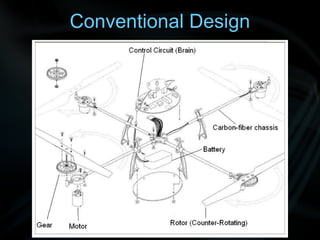
Conventional Design
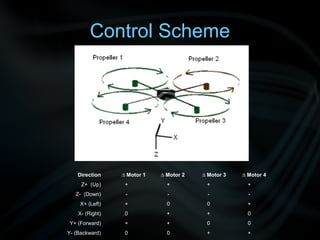
Control Scheme


    Direction    ∆ Motor 1   ∆ Motor 2   ∆ Motor 3   ∆ Motor 4
     Z+ (Up)      +            +          +            +
   Z- (Down)      -            -           -           -
     X+ (Left)    +            0          0            +
    X- (Right)    0            +          +            0
Y+ (Forward)      +            +          0            0
Y- (Backward)     0            0          +            +
Materials used in building the
           Prototypes


• Balsa wood planks

• Super glue
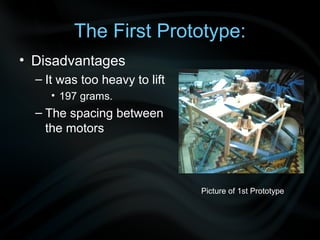
The First Prototype:
• Disadvantages
  – It was too heavy to lift
     • 197 grams.
  – The spacing between
    the motors


                               Picture of 1st Prototype
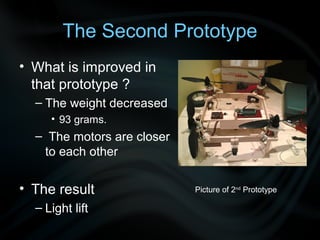
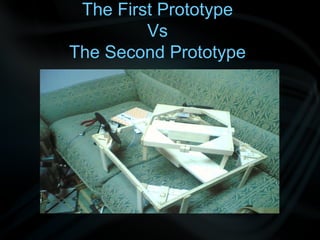
The Second Prototype
• What is improved in
  that prototype ?
  – The weight decreased
     • 93 grams.
  – The motors are closer
   to each other


• The result                Picture of 2nd Prototype

  – Light lift
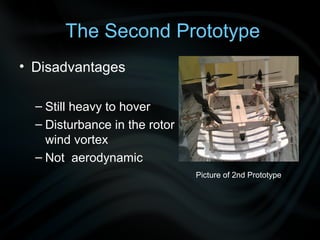
The Second Prototype
• Disadvantages

  – Still heavy to hover
  – Disturbance in the rotor
    wind vortex
  – Not aerodynamic
                               Picture of 2nd Prototype
The First Prototype
         Vs
The Second Prototype
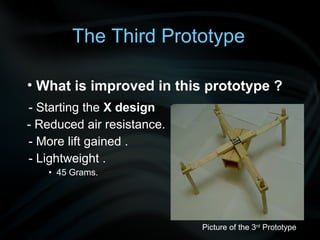
The Third Prototype

• What is improved in this prototype ?
- Starting the X design
- Reduced air resistance.
- More lift gained .
- Lightweight .
   • 45 Grams.


                            Picture of the 3rd Prototype
The Third Prototype


• Problems with the new design:
  – Too fragile.
  – The reduced air resistance was still not enough.


• What can be done ?
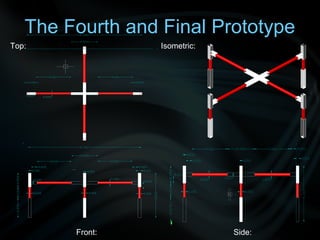
The Fourth and Final Prototype
Top:              Isometric:


        Front:                 Side:
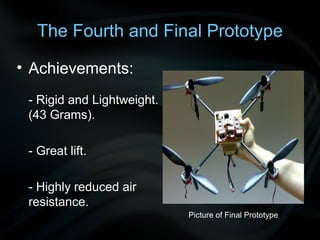
The Fourth and Final Prototype

• Achievements:
 - Rigid and Lightweight.
 (43 Grams).

 - Great lift.

 - Highly reduced air
 resistance.
                            Picture of Final Prototype
The Fourth and Final Prototype
• Specifications:

 -Total Weight (with all components)   = 990 Grams
                                         (0.99 Kg)
 - Acceleration at Full Power          = 4.061m/s2
 - Vertical Force at Full Power        = 4.021N
   (Assuming Differential Torque = 0)
 - Lateral thrust beyond Hover Thrust = 0.4141g
 - Power – to – Weight Ratio          = 1.5 : 1
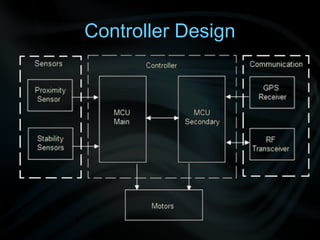
Controller Design
• Design Objectives

  – Stability
  – Obstacle Avoidance
  – Determining Position
  – Communication
Controller Design
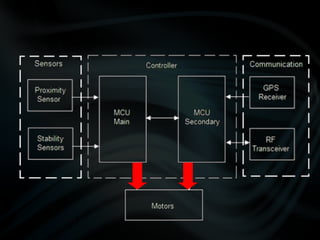
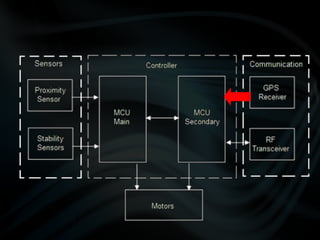
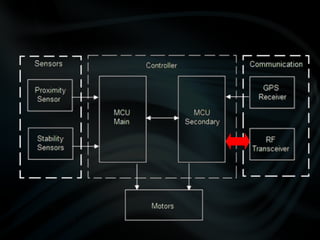
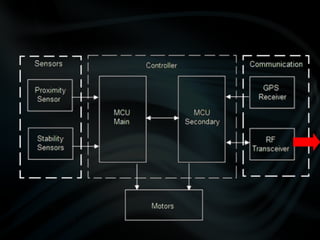
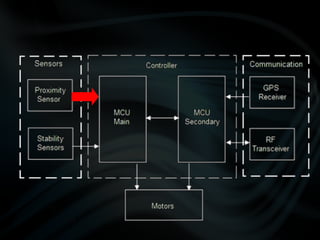
• To achieve these objectives we need

  – IMU (Inertial Measurement Unit)
  – 5 Ultrasonic Sensors
  – GPS Receiver
  – RF Transceiver
Controller Design
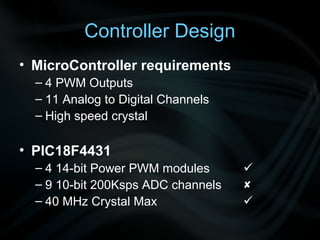
• MicroController requirements
  – 4 PWM Outputs
  – 11 Analog to Digital Channels
  – High speed crystal

• PIC18F4431
  – 4 14-bit Power PWM modules      
  – 9 10-bit 200Ksps ADC channels   
  – 40 MHz Crystal Max              
Controller Design
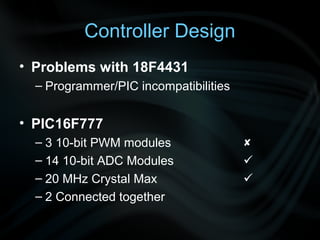
• Problems with 18F4431
  – Programmer/PIC incompatibilities


• PIC16F777
  – 3 10-bit PWM modules               
  – 14 10-bit ADC Modules              
  – 20 MHz Crystal Max                 
  – 2 Connected together
Controller Design
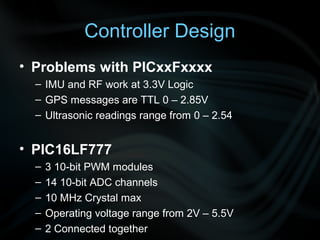
• Problems with PICxxFxxxx
  – IMU and RF work at 3.3V Logic
  – GPS messages are TTL 0 – 2.85V
  – Ultrasonic readings range from 0 – 2.54


• PIC16LF777
  –   3 10-bit PWM modules
  –   14 10-bit ADC channels
  –   10 MHz Crystal max
  –   Operating voltage range from 2V – 5.5V
  –   2 Connected together
Controller Design
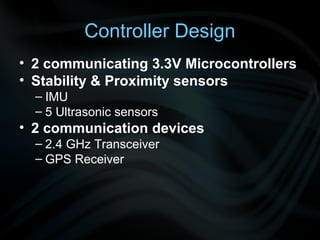
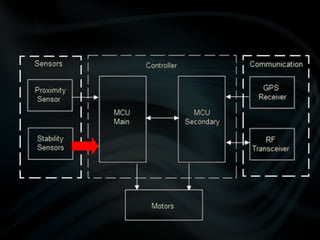
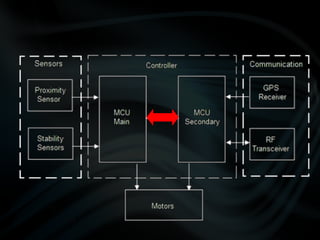
• 2 communicating 3.3V Microcontrollers
• Stability & Proximity sensors
  – IMU
  – 5 Ultrasonic sensors
• 2 communication devices
  – 2.4 GHz Transceiver
  – GPS Receiver
Controller Design
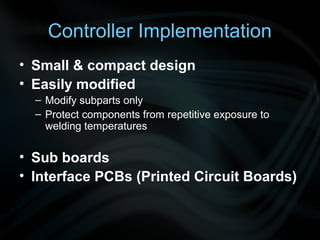
Controller Implementation
• Small & compact design
• Easily modified
  – Modify subparts only
  – Protect components from repetitive exposure to
    welding temperatures


• Sub boards
• Interface PCBs (Printed Circuit Boards)
Controller Design
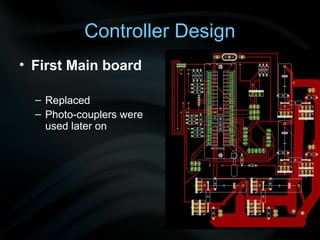
• First Main board

  – Replaced
  – Photo-couplers were
    used later on
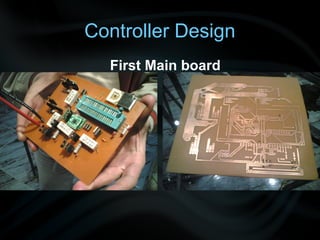
Controller Design
  First Main board
Controller Design
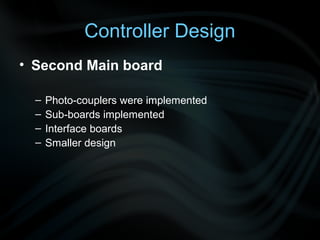
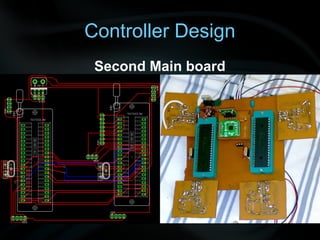
• Second Main board

  –   Photo-couplers were implemented
  –   Sub-boards implemented
  –   Interface boards
  –   Smaller design
Controller Design
 Second Main board
Controller Design
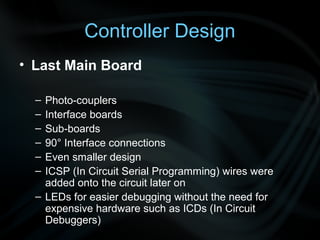
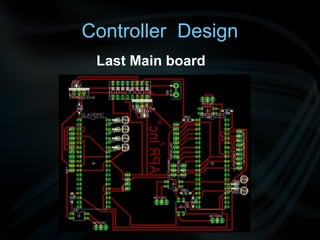
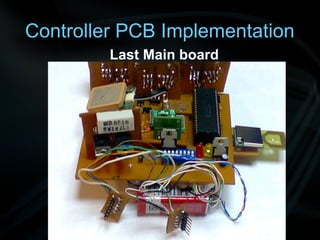
• Last Main Board

  – Photo-couplers
  – Interface boards
  – Sub-boards
  – 90° Interface connections
  – Even smaller design
  – ICSP (In Circuit Serial Programming) wires were
    added onto the circuit later on
  – LEDs for easier debugging without the need for
    expensive hardware such as ICDs (In Circuit
    Debuggers)
Controller Design
 Last Main board
Controller PCB Implementation
         Last Main board
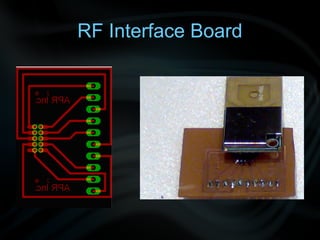
Interface Boards


• Easier error correction.

• Reduction of surface area.
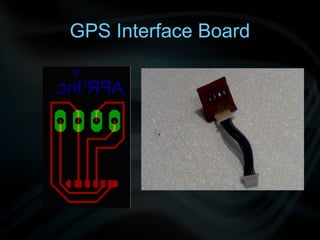
GPS Interface Board
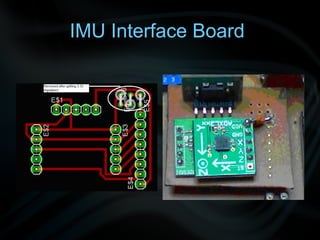
IMU Interface Board
RF Interface Board
PCB Production Procedures
• What do you need to make a PCB
  – Laser printer
  – Glossy paper
  – Acetone
  – Clothing iron
  – Acid
  – Steel sponge
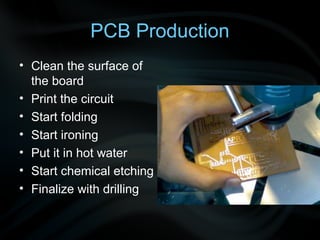
PCB Production
• Clean the surface of
  the board
• Print the circuit
• Start folding
• Start ironing
• Put it in hot water
• Start chemical etching
• Finalize with drilling
Analog-To-Digital Converter
• ADCs:

 - Importance of Data Acquisition in our UAV.
 - Vref set on 3 Volts.
 - Ultrasonic sensors.
 - Gyrometer.
 - Accelerometer.
ADCs
• ADC Reading = (Vin/Vref) X (2N); where


 Vin : is the Voltage input.
 Vref : is the reference voltage.
 N : is the resolution of the ADC Conversion.
Ultrasonic Sensors
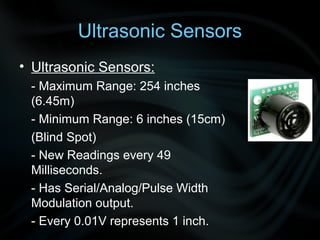
• Ultrasonic Sensors:
 - Maximum Range: 254 inches
 (6.45m)
 - Minimum Range: 6 inches (15cm)
 (Blind Spot)
 - New Readings every 49
 Milliseconds.
 - Has Serial/Analog/Pulse Width
 Modulation output.
 - Every 0.01V represents 1 inch.
Ultrasonic Sensors
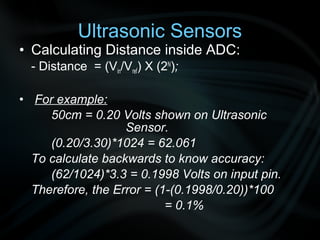
• Calculating Distance inside ADC:
  - Distance = (Vin/Vref) X (2N);

• For example:
     50cm = 0.20 Volts shown on Ultrasonic
                   Sensor.
     (0.20/3.30)*1024 = 62.061
  To calculate backwards to know accuracy:
     (62/1024)*3.3 = 0.1998 Volts on input pin.
  Therefore, the Error = (1-(0.1998/0.20))*100
                           = 0.1%
PWM
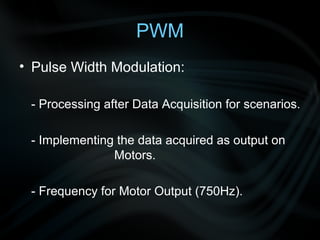
• Pulse Width Modulation:

 - Processing after Data Acquisition for scenarios.

 - Implementing the data acquired as output on
               Motors.

 - Frequency for Motor Output (750Hz).
PWM
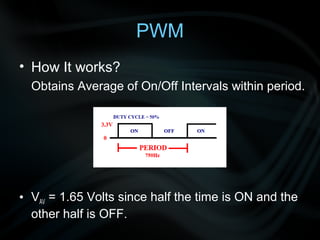
• How It works?
  Obtains Average of On/Off Intervals within period.


• VAV = 1.65 Volts since half the time is ON and the
  other half is OFF.
Testing Sensors
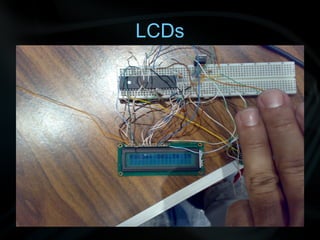
• A great way to test the sensors is using an
  LCD.
  – Tangible.
• Used to test all sensor outputs after
  processing:
 -   Ultrasonic.
 -   Accelerometer.
 -   Gyrometer.
 -   GPS Receiver.
 -   RF Transceiver units.
LCDs
GPS Applications
• GPS has become a widely used aid to
  navigation worldwide.
• A useful tool for
  – Map making.
  – Land surveying.
  – Scientific uses.
NAVSTAR Constellation


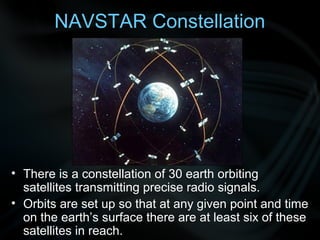
• There is a constellation of 30 earth orbiting
  satellites transmitting precise radio signals.
• Orbits are set up so that at any given point and time
  on the earth’s surface there are at least six of these
  satellites in reach.
GPS Messages
• Almanac contains orbital data
• Ephemeris contains the satellites precise
  orbit.
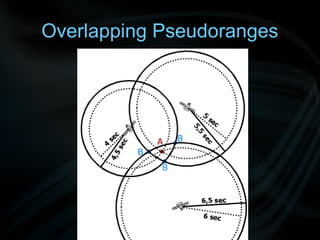
Pseudorange
• Estimated distance calculated by the
  receiver between the satellite and
  receiver.
Trilateration
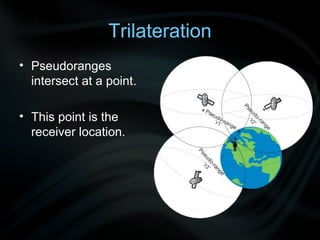
• Pseudoranges
  intersect at a point.

• This point is the
  receiver location.
Overlapping Pseudoranges
Latitude & Longitude
NMEA Protocol
• NMEA preferred to SiRF.

• Simply works with input and output
  messages.
Input Messages
Input Messages

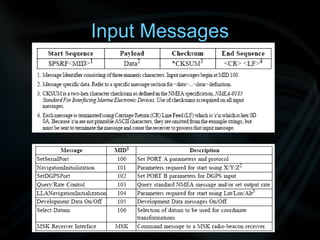
• Input messages are used for initialization.

• Selected input messages were:
  – Set Serial Port
  – Query/Rate Control
  – Development Data On/Off


• CRC required for input message.
Output Message
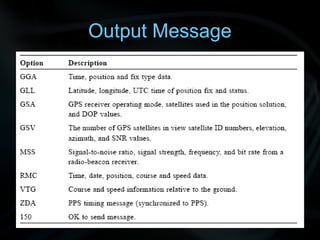
Output Message
• Message of choice was RMC, it contained
  all we needed which was:

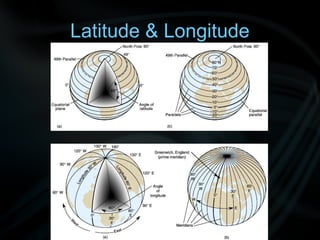
  – Latitude & Longitude
  – Course Heading
  – Velocity
USART
• The GPS communicates with the PIC
  through USART.
• Communicates at 4800 bps
• Asynchronous
Validating Message
• When the message is validated:

  – The latitude, longitude and heading are ready
    to be extracted to the Main PIC.
  – RF function is called to transmit data, to the
    simulator.
Inertial Measurement Unit
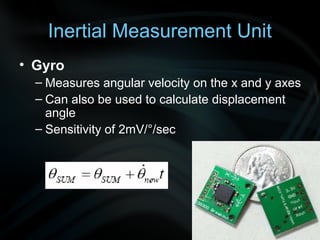
• Gyro
  – Measures angular velocity on the x and y axes
  – Can also be used to calculate displacement
    angle
  – Sensitivity of 2mV/°/sec
Inertial Measurement Unit
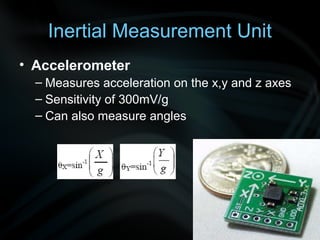
• Accelerometer
  – Measures acceleration on the x,y and z axes
  – Sensitivity of 300mV/g
  – Can also measure angles
Inertial Measurement Unit
• IMU

  – Gyrometer & Accelerometer
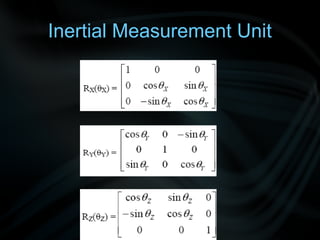
  – Transform acceleration readings onto the 3
    original axes.
  – Velocity & Displacement can be calculated
    from accelerometer readings on 3 main axes.
Inertial Measurement Unit
Microcontroller Communication
• SPI Communication

  – Master/Slave Configuration
  – 3 pin connection
  – Synchronous Serial Transmission
  – 8-bit at a time
  – Control Messages, & Sensor Values
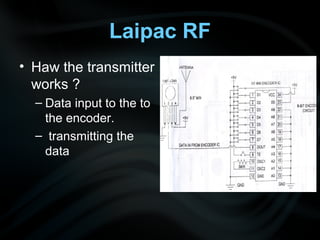
Laipac RF
• Haw the transmitter
  works ?
  – Data input to the to
    the encoder.
  – transmitting the
    data
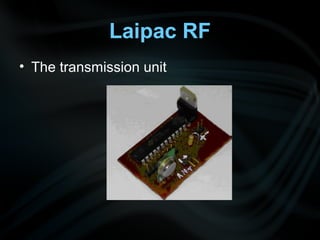
Laipac RF
• The transmission unit
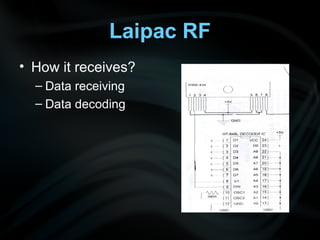
Laipac RF
• How it receives?
  – Data receiving
  – Data decoding
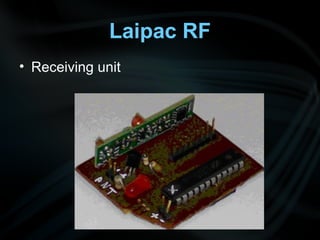
Laipac RF
• Receiving unit
Laipac RF
• Conclusion after testing
  – Too slow.
  – Big size .
  – Very small payload.
  – Very short range.
  – Need an external antenna.
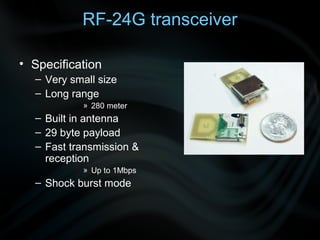
RF-24G transceiver

• Specification
  – Very small size
  – Long range
           » 280 meter
  – Built in antenna
  – 29 byte payload
  – Fast transmission &
    reception
           » Up to 1Mbps
  – Shock burst mode
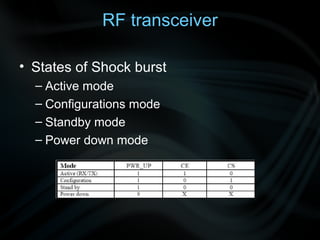
RF transceiver

• States of Shock burst
  – Active mode
  – Configurations mode
  – Standby mode
  – Power down mode
RF transceiver

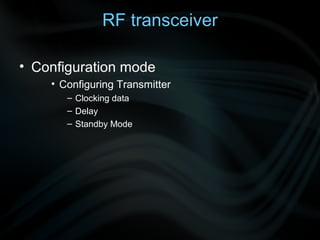
• Configuration mode
    • Configuring Transmitter
       – Clocking data
       – Delay
       – Standby Mode
RF transceiver

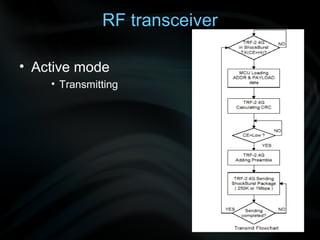
• Active mode
    • Transmitting
RF transceiver

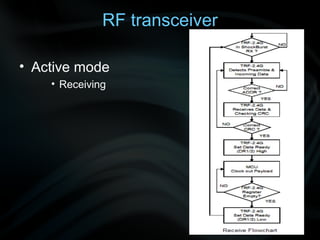
• Active mode
    • Receiving
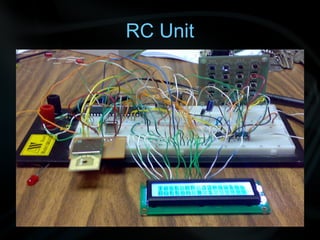
RC Unit
Data Acquisition
• What is Data Acquisition?
• Why?
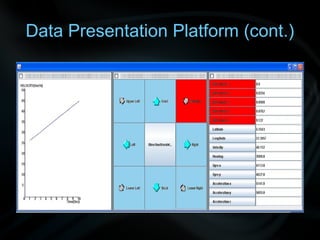
Data Presentation
• What is Data Presentation?
• Why?
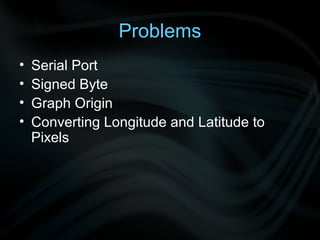
Problems
•   Serial Port
•   Signed Byte
•   Graph Origin
•   Converting Longitude and Latitude to
    Pixels
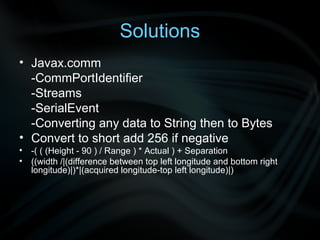
Solutions
• Javax.comm
  -CommPortIdentifier
  -Streams
  -SerialEvent
  -Converting any data to String then to Bytes
• Convert to short add 256 if negative
•   -( ( (Height - 90 ) / Range ) * Actual ) + Separation
•   ((width /|(difference between top left longitude and bottom right
    longitude)|)*|(acquired longitude-top left longitude)|)
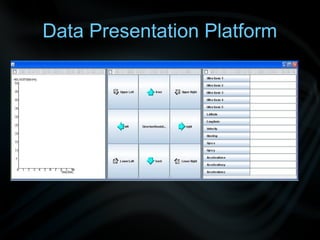
Data Presentation Platform
Data Presentation Platform (cont.)
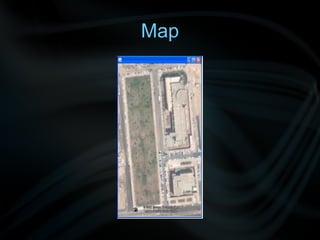
Map
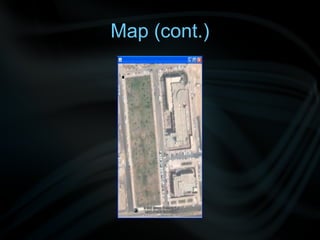
Map (cont.)
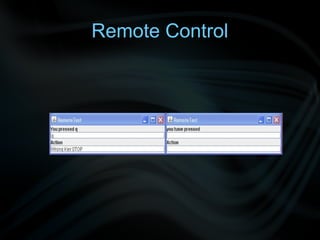
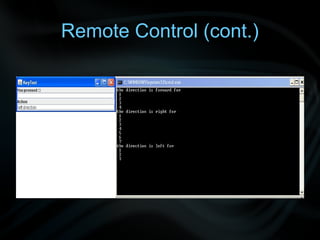
Remote Control
Remote Control (cont.)
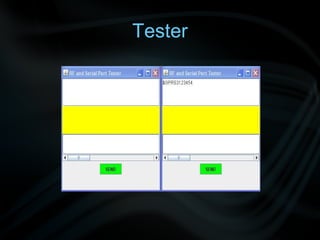
Tester
Object detection
Introduction
• What is an object ?

• What is object detection ?

• How to make it ?

• What is image processing ?
Challenges & solutions

• Acquisition problems

• Developing imaging application in a
 flexible environment
• Why not use c/c++ ?
  – Time consuming , handling

• Used language, Why ?
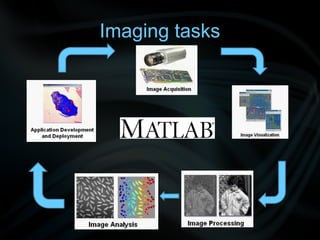
Imaging tasks
Imaging circumstances
• Type of the acquistion

• The properties of the target object?

• The environment

• The objective
Challenges

• Colored image

• Variance in lighting

• Uninformed background

• The target is colored

• The target’s shape is not defined
Our program

• Acquisition phase

• Visualization phase
  – Estimate the degree of the color

• Processing phase
  – Applying Median filter
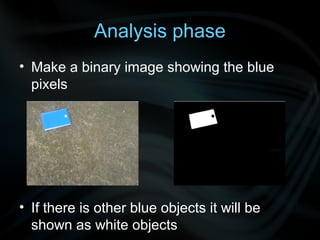
Analysis phase
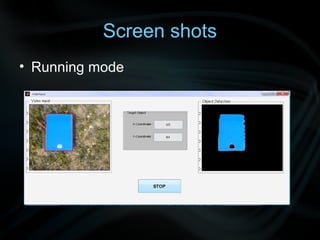
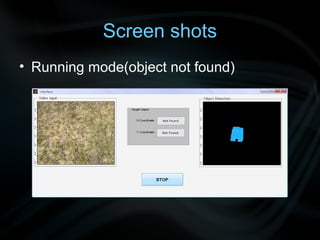
• Make a binary image showing the blue
  pixels


• If there is other blue objects it will be
  shown as white objects
• Pixel connectivity
• The use of the labeling function
  – [label,num]=bwlabel(y,4);
  – stats=regionprops(label,'Area','BoundingBox','
    PixelList');
• What are the importance of those
  functions
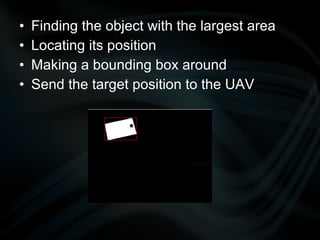
•   Finding the object with the largest area
•   Locating its position
•   Making a bounding box around
•   Send the target position to the UAV
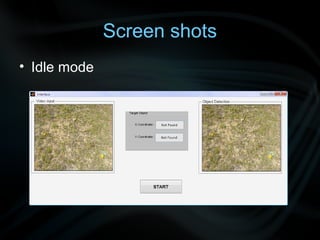
Screen shots
• Idle mode
Screen shots
• Running mode
Screen shots
• Running mode(object not found)
FUTURE IMPLEMENTATIONS
• Gyrometer & Accelerometer drift
  correction
• Ultrasonic sensors attached to servos.
• High powered brushless motors.
• A long range high resolution camera.
• Magnetometer
• Chassis redesign
CONCLUSION
• Local market restrictions inhibited time.
• Bottom down programming was the best
  approach.
• Data presentation helps in detecting errors
  faster and avoiding problems.
• Placing UAV on a map helps discovering
  its location.
• Tester helps in testing the response of the
  RF and the pic programs

UAV Presentation

  • 1.
    Unmanned Aerial Vehicle ((UAV))
  • 2.
    UAV Presented By: • Alexander Mohamed Osman • Riyad Ahmed El-laithy • Ruyyan Ahmed El-laithy • Peter Raouf Zaki
  • 3.
    Introduction • What areUVs ? • What are UAVs ? • Types of UAVs – Fixed wing UAV – Helicopter UAV – Quadroter UAV
  • 4.
    Quadrotor Advantage OverFixed- Wing Vehicle • Less design complexity. • Minimal space for take-off and landing. A VTOL vehicle.
  • 5.
    Quadrotor Advantage Over Helicopter • Quadrotors do not require mechanical linkages. • The use of four rotors allows each individual rotor to have a smaller diameter than the equivalent helicopter rotor.
  • 6.
  • 7.
    Control Scheme Direction ∆ Motor 1 ∆ Motor 2 ∆ Motor 3 ∆ Motor 4 Z+ (Up) + + + + Z- (Down) - - - - X+ (Left) + 0 0 + X- (Right) 0 + + 0 Y+ (Forward) + + 0 0 Y- (Backward) 0 0 + +
  • 8.
    Materials used inbuilding the Prototypes • Balsa wood planks • Super glue
  • 9.
    The First Prototype: •Disadvantages – It was too heavy to lift • 197 grams. – The spacing between the motors Picture of 1st Prototype
  • 10.
    The Second Prototype •What is improved in that prototype ? – The weight decreased • 93 grams. – The motors are closer to each other • The result Picture of 2nd Prototype – Light lift
  • 11.
    The Second Prototype •Disadvantages – Still heavy to hover – Disturbance in the rotor wind vortex – Not aerodynamic Picture of 2nd Prototype
  • 12.
    The First Prototype Vs The Second Prototype
  • 13.
    The Third Prototype •What is improved in this prototype ? - Starting the X design - Reduced air resistance. - More lift gained . - Lightweight . • 45 Grams. Picture of the 3rd Prototype
  • 14.
    The Third Prototype •Problems with the new design: – Too fragile. – The reduced air resistance was still not enough. • What can be done ?
  • 15.
    The Fourth andFinal Prototype Top: Isometric: Front: Side:
  • 16.
    The Fourth andFinal Prototype • Achievements: - Rigid and Lightweight. (43 Grams). - Great lift. - Highly reduced air resistance. Picture of Final Prototype
  • 17.
    The Fourth andFinal Prototype • Specifications: -Total Weight (with all components) = 990 Grams (0.99 Kg) - Acceleration at Full Power = 4.061m/s2 - Vertical Force at Full Power = 4.021N (Assuming Differential Torque = 0) - Lateral thrust beyond Hover Thrust = 0.4141g - Power – to – Weight Ratio = 1.5 : 1
  • 18.
    Controller Design • DesignObjectives – Stability – Obstacle Avoidance – Determining Position – Communication
  • 19.
    Controller Design • Toachieve these objectives we need – IMU (Inertial Measurement Unit) – 5 Ultrasonic Sensors – GPS Receiver – RF Transceiver
  • 20.
    Controller Design • MicroControllerrequirements – 4 PWM Outputs – 11 Analog to Digital Channels – High speed crystal • PIC18F4431 – 4 14-bit Power PWM modules  – 9 10-bit 200Ksps ADC channels  – 40 MHz Crystal Max 
  • 21.
    Controller Design • Problemswith 18F4431 – Programmer/PIC incompatibilities • PIC16F777 – 3 10-bit PWM modules  – 14 10-bit ADC Modules  – 20 MHz Crystal Max  – 2 Connected together
  • 22.
    Controller Design • Problemswith PICxxFxxxx – IMU and RF work at 3.3V Logic – GPS messages are TTL 0 – 2.85V – Ultrasonic readings range from 0 – 2.54 • PIC16LF777 – 3 10-bit PWM modules – 14 10-bit ADC channels – 10 MHz Crystal max – Operating voltage range from 2V – 5.5V – 2 Connected together
  • 23.
    Controller Design • 2communicating 3.3V Microcontrollers • Stability & Proximity sensors – IMU – 5 Ultrasonic sensors • 2 communication devices – 2.4 GHz Transceiver – GPS Receiver
  • 24.
  • 25.
    Controller Implementation • Small& compact design • Easily modified – Modify subparts only – Protect components from repetitive exposure to welding temperatures • Sub boards • Interface PCBs (Printed Circuit Boards)
  • 26.
    Controller Design • FirstMain board – Replaced – Photo-couplers were used later on
  • 27.
    Controller Design First Main board
  • 28.
    Controller Design • SecondMain board – Photo-couplers were implemented – Sub-boards implemented – Interface boards – Smaller design
  • 29.
  • 30.
    Controller Design • LastMain Board – Photo-couplers – Interface boards – Sub-boards – 90° Interface connections – Even smaller design – ICSP (In Circuit Serial Programming) wires were added onto the circuit later on – LEDs for easier debugging without the need for expensive hardware such as ICDs (In Circuit Debuggers)
  • 31.
  • 32.
  • 33.
    Interface Boards • Easiererror correction. • Reduction of surface area.
  • 34.
  • 35.
  • 36.
  • 37.
    PCB Production Procedures •What do you need to make a PCB – Laser printer – Glossy paper – Acetone – Clothing iron – Acid – Steel sponge
  • 38.
    PCB Production • Cleanthe surface of the board • Print the circuit • Start folding • Start ironing • Put it in hot water • Start chemical etching • Finalize with drilling
  • 40.
    Analog-To-Digital Converter • ADCs: - Importance of Data Acquisition in our UAV. - Vref set on 3 Volts. - Ultrasonic sensors. - Gyrometer. - Accelerometer.
  • 41.
    ADCs • ADC Reading= (Vin/Vref) X (2N); where Vin : is the Voltage input. Vref : is the reference voltage. N : is the resolution of the ADC Conversion.
  • 42.
    Ultrasonic Sensors • UltrasonicSensors: - Maximum Range: 254 inches (6.45m) - Minimum Range: 6 inches (15cm) (Blind Spot) - New Readings every 49 Milliseconds. - Has Serial/Analog/Pulse Width Modulation output. - Every 0.01V represents 1 inch.
  • 43.
    Ultrasonic Sensors • CalculatingDistance inside ADC: - Distance = (Vin/Vref) X (2N); • For example: 50cm = 0.20 Volts shown on Ultrasonic Sensor. (0.20/3.30)*1024 = 62.061 To calculate backwards to know accuracy: (62/1024)*3.3 = 0.1998 Volts on input pin. Therefore, the Error = (1-(0.1998/0.20))*100 = 0.1%
  • 45.
    PWM • Pulse WidthModulation: - Processing after Data Acquisition for scenarios. - Implementing the data acquired as output on Motors. - Frequency for Motor Output (750Hz).
  • 46.
    PWM • How Itworks? Obtains Average of On/Off Intervals within period. • VAV = 1.65 Volts since half the time is ON and the other half is OFF.
  • 47.
    Testing Sensors • Agreat way to test the sensors is using an LCD. – Tangible. • Used to test all sensor outputs after processing: - Ultrasonic. - Accelerometer. - Gyrometer. - GPS Receiver. - RF Transceiver units.
  • 48.
  • 50.
    GPS Applications • GPShas become a widely used aid to navigation worldwide. • A useful tool for – Map making. – Land surveying. – Scientific uses.
  • 51.
    NAVSTAR Constellation • Thereis a constellation of 30 earth orbiting satellites transmitting precise radio signals. • Orbits are set up so that at any given point and time on the earth’s surface there are at least six of these satellites in reach.
  • 52.
    GPS Messages • Almanaccontains orbital data • Ephemeris contains the satellites precise orbit.
  • 53.
    Pseudorange • Estimated distancecalculated by the receiver between the satellite and receiver.
  • 54.
    Trilateration • Pseudoranges intersect at a point. • This point is the receiver location.
  • 55.
  • 56.
  • 57.
    NMEA Protocol • NMEApreferred to SiRF. • Simply works with input and output messages.
  • 58.
  • 59.
    Input Messages • Inputmessages are used for initialization. • Selected input messages were: – Set Serial Port – Query/Rate Control – Development Data On/Off • CRC required for input message.
  • 60.
  • 61.
    Output Message • Messageof choice was RMC, it contained all we needed which was: – Latitude & Longitude – Course Heading – Velocity
  • 62.
    USART • The GPScommunicates with the PIC through USART. • Communicates at 4800 bps • Asynchronous
  • 63.
    Validating Message • Whenthe message is validated: – The latitude, longitude and heading are ready to be extracted to the Main PIC. – RF function is called to transmit data, to the simulator.
  • 65.
    Inertial Measurement Unit •Gyro – Measures angular velocity on the x and y axes – Can also be used to calculate displacement angle – Sensitivity of 2mV/°/sec
  • 66.
    Inertial Measurement Unit •Accelerometer – Measures acceleration on the x,y and z axes – Sensitivity of 300mV/g – Can also measure angles
  • 67.
    Inertial Measurement Unit •IMU – Gyrometer & Accelerometer – Transform acceleration readings onto the 3 original axes. – Velocity & Displacement can be calculated from accelerometer readings on 3 main axes.
  • 68.
  • 70.
    Microcontroller Communication • SPICommunication – Master/Slave Configuration – 3 pin connection – Synchronous Serial Transmission – 8-bit at a time – Control Messages, & Sensor Values
  • 72.
    Laipac RF • Hawthe transmitter works ? – Data input to the to the encoder. – transmitting the data
  • 73.
    Laipac RF • Thetransmission unit
  • 74.
    Laipac RF • Howit receives? – Data receiving – Data decoding
  • 75.
  • 76.
    Laipac RF • Conclusionafter testing – Too slow. – Big size . – Very small payload. – Very short range. – Need an external antenna.
  • 77.
    RF-24G transceiver • Specification – Very small size – Long range » 280 meter – Built in antenna – 29 byte payload – Fast transmission & reception » Up to 1Mbps – Shock burst mode
  • 78.
    RF transceiver • Statesof Shock burst – Active mode – Configurations mode – Standby mode – Power down mode
  • 79.
    RF transceiver • Configurationmode • Configuring Transmitter – Clocking data – Delay – Standby Mode
  • 80.
    RF transceiver • Activemode • Transmitting
  • 81.
    RF transceiver • Activemode • Receiving
  • 82.
  • 84.
    Data Acquisition • Whatis Data Acquisition? • Why?
  • 85.
    Data Presentation • Whatis Data Presentation? • Why?
  • 86.
    Problems • Serial Port • Signed Byte • Graph Origin • Converting Longitude and Latitude to Pixels
  • 87.
    Solutions • Javax.comm -CommPortIdentifier -Streams -SerialEvent -Converting any data to String then to Bytes • Convert to short add 256 if negative • -( ( (Height - 90 ) / Range ) * Actual ) + Separation • ((width /|(difference between top left longitude and bottom right longitude)|)*|(acquired longitude-top left longitude)|)
  • 88.
  • 89.
  • 90.
  • 91.
  • 92.
  • 93.
  • 94.
  • 95.
  • 96.
    Introduction • What isan object ? • What is object detection ? • How to make it ? • What is image processing ?
  • 97.
    Challenges & solutions •Acquisition problems • Developing imaging application in a flexible environment • Why not use c/c++ ? – Time consuming , handling • Used language, Why ?
  • 98.
  • 99.
    Imaging circumstances • Typeof the acquistion • The properties of the target object? • The environment • The objective
  • 100.
    Challenges • Colored image •Variance in lighting • Uninformed background • The target is colored • The target’s shape is not defined
  • 101.
    Our program • Acquisitionphase • Visualization phase – Estimate the degree of the color • Processing phase – Applying Median filter
  • 102.
    Analysis phase • Makea binary image showing the blue pixels • If there is other blue objects it will be shown as white objects
  • 103.
    • Pixel connectivity •The use of the labeling function – [label,num]=bwlabel(y,4); – stats=regionprops(label,'Area','BoundingBox',' PixelList'); • What are the importance of those functions
  • 104.
    Finding the object with the largest area • Locating its position • Making a bounding box around • Send the target position to the UAV
  • 105.
  • 106.
  • 107.
    Screen shots • Runningmode(object not found)
  • 108.
    FUTURE IMPLEMENTATIONS • Gyrometer& Accelerometer drift correction • Ultrasonic sensors attached to servos. • High powered brushless motors. • A long range high resolution camera. • Magnetometer • Chassis redesign
  • 109.
    CONCLUSION • Local marketrestrictions inhibited time. • Bottom down programming was the best approach. • Data presentation helps in detecting errors faster and avoiding problems. • Placing UAV on a map helps discovering its location. • Tester helps in testing the response of the RF and the pic programs